What Is an Infinitive in English? Definition and Examples

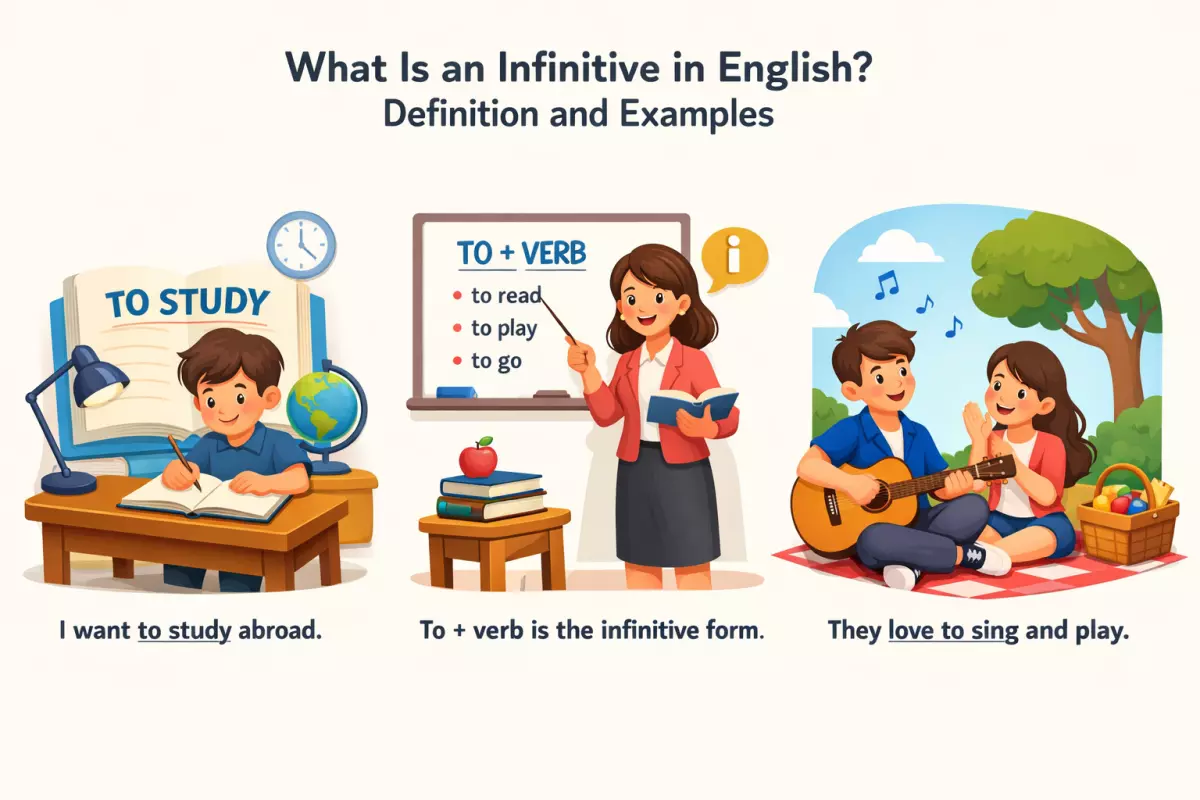 Learn what an infinitive is, how the to + verb form works, and how it differs from the bare infinitive. See how infinitives act as nouns, adjectives, or adverbs, which verbs commonly take them, and how they show purpose, intention, or result. Spot common mistakes and try practice sentences.
- What an infinitive is and how the 'to + verb' form works
- The difference between full infinitives and bare infinitives
- How infinitives function as nouns, adjectives, and adverbs
- Verbs that are commonly followed by infinitives
- Using infinitives to show purpose, intention, or result
- Typical mistakes learners make with infinitive forms
- Practice exercises: using infinitives correctly in sentences
If you have ever wondered why English uses forms like to eat or to go, you have met the infinitive. It often appears after verbs, adjectives, and nouns when we talk about plans, reasons, or goals, as in I want to leave, It is hard to explain, or a chance to win. Understanding how it works helps you speak more naturally and avoid common errors.
What an infinitive is and how the 'to + verb' form works
An infinitive is a verb form that names an action or state without showing tense. In English, the most common pattern is to + base verb (for example, to learn, to be, to decide). This form is flexible: it can describe purpose, complete the meaning of another verb, or act like a noun phrase in a sentence.
The basic form and what “base verb” means
In the “to” form, the verb stays in its dictionary shape (the base form). It does not change for person or time.
- to work (not “to works”)
- to go (not “to went”)
- to have (not “to has”)
- to be (not “to am/is/are”)
Common sentence patterns with the “to” form
This verb form often appears after certain verbs, after adjectives, and in structures that show purpose. The patterns below are some of the most frequent in everyday writing and speech.
- Verb + to + verb: I need to leave now.
- Verb + object + to + verb: She told me to wait.
- Adjective + to + verb: It’s easy to forget.
- Noun + to + verb: I have a plan to improve.
- Question word + to + verb: I don’t know what to say.
- Purpose (to + verb): I called to confirm the time.
- It + be + adjective + to + verb: It’s important to listen.
- Too + adjective + to + verb: The box is too heavy to lift.
- Adjective + enough + to + verb: She’s old enough to drive.
- First/next/last + to + verb: He was the first to arrive.
- Only + to + verb (unexpected result): I rushed there, only to find it closed.
- To + verb as a subject (more formal): To travel alone can be stressful.
Verbs that commonly take “to + verb”
Many verbs are naturally followed by an infinitive. Learning them as groups helps you choose the right structure without guessing.
- agree: They agreed to meet at noon.
- aim: We aim to reduce waste.
- arrange: She arranged to speak with the manager.
- choose: I chose to stay home.
- decide: He decided to quit.
- expect: They expect to finish soon.
- forget: Don’t forget to lock the door.
- hope: I hope to visit next year.
- learn: She learned to swim.
- manage: We managed to solve it.
- need: You need to sign here.
- offer: He offered to help.
- plan: They plan to expand.
- promise: I promise to call.
- refuse: She refused to answer.
- seem: It seems to work.
- tend: People tend to assume the worst.
- want: I want to understand the rules.
Common errors to avoid
- Using a changed verb form after “to”: ❌ to went → ✅ to go
- Adding an extra “to” after certain verbs: ❌ She made me to apologize → ✅ She made me apologize
- Confusing purpose with a full clause: ✅ I went to the store to buy milk. (purpose) vs. I went to the store and bought milk. (two actions)
The difference between full infinitives and bare infinitives

English infinitives come in two common shapes: one with to and one without it. The choice is not about meaning as much as it is about grammar patterns—certain verbs, structures, and expressions simply “select” one form over the other.
| Type | Form | Typical use | Examples |
|---|---|---|---|
| Full infinitive | to + base verb | Common after many verbs, adjectives, and nouns; also used to express purpose | to leave, to understand, to be, to have |
| Bare infinitive | base verb (no to) | Used after modal verbs and in a few fixed verb patterns (e.g., let/make/help) | leave, understand, be, have |
| Split infinitive (variant of full) | to + adverb + base verb | Used when an adverb naturally fits between to and the verb | to quickly decide, to fully explain |
| Negative infinitive (either type) | not + (to) + base verb | Negation placed before the infinitive | not to worry, not worry |
When to use the full infinitive (to + verb)
Use to when the infinitive follows structures that require it. These are the most frequent patterns learners meet in everyday writing and speech.
- After many common verbs: agree to, decide to, hope to, plan to, want to, need to, refuse to, promise to, learn to.
- After verb + object patterns: ask someone to, tell someone to, want someone to, need someone to, expect someone to, invite someone to, allow someone to.
- After adjectives: happy to, ready to, likely to, able to, eager to, careful to, surprised to.
- After nouns: a chance to, a plan to, a decision to, permission to, the ability to, the time to.
- To show purpose: “I came to help.” / “She studied to pass the exam.”
- After question words (except why): what to do, where to go, how to solve it, who to call.
- In “too/enough” structures: too tired to continue; strong enough to lift it.
When to use the bare infinitive (base verb only)
Use the base form without to after a smaller set of triggers. These patterns are very regular, so it helps to learn them as “signals” for the bare form.
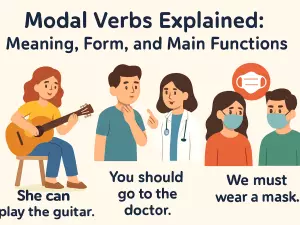
- After modal verbs: can, could, may, might, must, shall, should, will, would.
- ✅ “She can swim.” ❌ “She can to swim.”
- ✅ “You should wait.” ❌ “You should to wait.”
- After “do/does/did” in questions and negatives: “Do you know?” / “He didn’t call.”
- After “let” + object: “Let me explain.” / “They let us leave early.”
- After “make” + object (meaning force/require): “The noise made me jump.”
- After “help” + object: both forms are possible—“Help me carry this” and “Help me to carry this” are both used (bare is often more informal).
- After verbs of perception + object: see, hear, feel, watch, notice + object + base verb.
- ✅ “I saw her cross the street.”
- Compare: “I saw her crossing the street” (focuses more on the action in progress).
- After “had better” and “would rather”: “You’d better go now.” / “I’d rather stay.”
- After “why” in questions: “Why wait?” (not “Why to wait?”)
Common learner traps and quick fixes
- Don’t add “to” after modals: modals + base verb is the standard pattern.
- Don’t drop “to” after “want/need/plan/decide”: these typically take the full form.
- Remember object patterns: “want him to go” (not “want him go”).
- Perception verbs are special: “I heard them sing” is natural; “I heard them to sing” is not.
- Negatives go before the infinitive: “not to mention,” “not to worry,” “not go” (after a modal or “had better”).
How infinitives function as nouns, adjectives, and adverbs
An infinitive phrase can take on different jobs in a sentence depending on what it attaches to and what question it answers. A helpful way to identify its role is to ask: does it name an activity (noun-like), describe a noun (adjective-like), or explain why/how/when something happens (adverb-like)?
1) Infinitives used as nouns
When an infinitive acts like a noun, it can function as a subject, an object, or a subject complement. In these positions, it often answers “What?” or “What action/goal?”
- Subject: To learn a language takes time.
- Direct object (after a verb): She decided to leave early.
- Subject complement (after be): Their plan is to expand the team.
- After certain adjectives: He was glad to help.
- After question words (infinitive clause): I don’t know what to say.
- With “for + noun/pronoun” to show who does the action: It’s important for everyone to listen.
2) Infinitives used as adjectives
When an infinitive modifies a noun, it usually comes right after that noun and answers “Which one?” or “What kind?” This pattern is common with nouns like time, chance, way, place, person, and things to do.
- I need a book to read on the train. (Which book?)
- She’s the right person to ask. (What kind of person?)
- We don’t have much time to waste. (What kind of time?)
- That’s a good place to park. (Which place?)
- He found a way to solve the problem. (Which way?)
- There are plenty of reasons to stay. (Which reasons?)
- Do you have anything to declare? (Which thing?)
- She brought snacks to share. (What kind of snacks?)
- It’s not an easy rule to follow. (What kind of rule?)
- They made a decision to postpone the launch. (Which decision?)
3) Infinitives used as adverbs
When an infinitive modifies a verb, an adjective, or another adverb, it commonly expresses purpose, result, or a reaction. In many cases it answers “Why?” (purpose) or clarifies what leads to what.
- Purpose (why someone does something): We met to discuss the schedule.
- Purpose with emphasis: She called to make sure everything was ready.
- After an adjective (explains the situation): I’m happy to hear that.
- After an adjective (shows enough/too + result): The box is too heavy to lift.
- After an adjective (shows ability/possibility): The report is easy to understand.
- Result (what happened next): He arrived early, only to find the office closed.
- With “so as to” (more formal purpose): They spoke quietly so as to avoid waking the baby.
- With “in order to” (clear purpose): I took notes in order to remember the key points.
Quick checks for choosing the right label
- If the infinitive could be replaced by a noun phrase (the goal, the plan, the idea), it’s likely noun-like.
- If it directly follows a noun and specifies it, it’s acting as an adjective.
- If it explains purpose or the reason for an action (often removable without breaking the core meaning), it’s functioning as an adverb.
Verbs that are commonly followed by infinitives
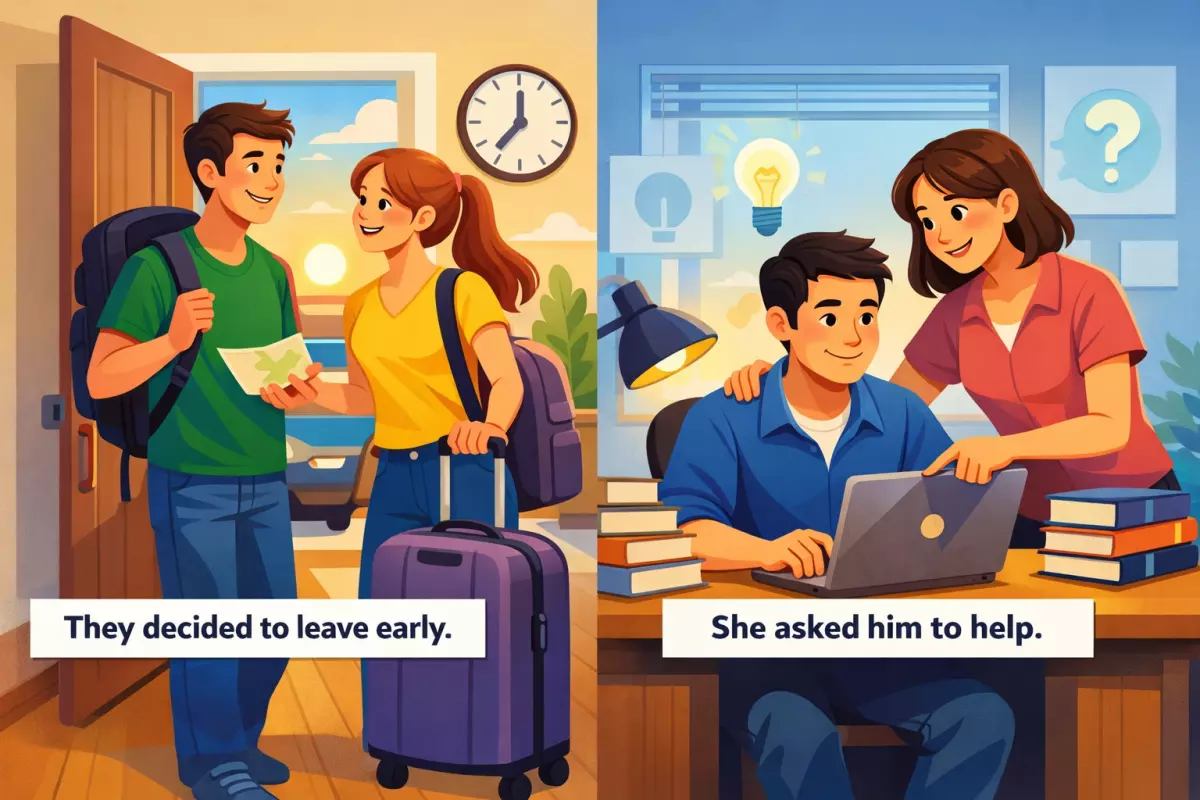
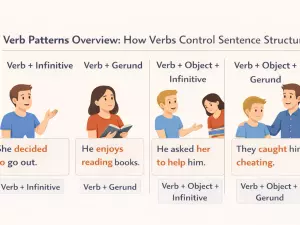
Many English verbs are regularly followed by to + base verb to show an intention, plan, decision, request, or effort. This pattern is especially common after verbs that express what someone wants, tries, decides, or agrees to do.
Common patterns
- Verb + to-infinitive: They decided to leave early.
- Verb + object + to-infinitive: She asked him to help.
- Verb + to-infinitive (often with a question word): I learned how to use the software.
Verbs often followed by a to-infinitive
- agree: We agreed to meet at noon.
- aim: The program aims to reduce waste.
- arrange: I arranged to speak with the manager.
- attempt: He attempted to fix the leak.
- choose: She chose to stay home.
- decide: They decided to postpone the trip.
- expect: I expect to finish by Friday.
- fail: He failed to notice the sign.
- forget: Don’t forget to lock the door.
- hope: We hope to see you soon.
- intend: I intend to apply for the role.
- learn: She learned to drive last year.
- manage: He managed to solve the problem.
- need: You need to update your password.
- offer: They offered to help with the move.
- plan: We plan to renovate the kitchen.
- promise: I promise to call tonight.
- refuse: She refused to answer the question.
- seem: He seems to understand the instructions.
- tend: Prices tend to rise in summer.
- try: Try to arrive on time.
- want: I want to improve my writing.
- would like: I’d like to order tea.
Verbs that commonly take an object + to-infinitive
- ask: She asked him to wait outside.
- advise: The doctor advised me to rest.
- allow: They allowed us to enter early.
- encourage: The coach encouraged the team to practice more.
- expect: I expected her to reply sooner.
- help: He helped me to carry the boxes. (Also common: helped me carry)
- invite: We invited them to join us.
- order: The officer ordered everyone to leave.
- persuade: She persuaded him to apologize.
- remind: Please remind me to email the client.
- teach: They taught the children to swim.
- tell: She told me to be careful.
- warn: He warned us not to touch the wires.
Usage notes and frequent errors
- After these verbs, use to + base verb, not an -ing form: ✅ I decided to go. ❌ I decided going.
- Some verbs can take either a to-infinitive or an -ing form with a change in meaning (for example, remember, forget, stop). In those cases, the choice depends on what you mean, not just grammar.
- With help, both forms are used: help + object + to + verb and help + object + verb.
Using infinitives to show purpose, intention, or result
An infinitive phrase often explains why someone does something, what they plan to do, or what happens as a consequence. In these uses, the infinitive acts like a compact “reason/goal/outcome” clause and is especially common after verbs of action, movement, and decision.
Common patterns
- Action + to + verb (purpose): “She stopped to talk to her teacher.”
- Go/come/leave/return + to + verb (purpose): “He went to the store to buy milk.”
- Decision/plan + to + verb (intention): “They decided to move closer to work.”
- Be + adjective + to + verb (purpose/goal): “This button is easy to find.”
- Too + adjective/adverb + to + verb (result: negative/limit): “The box was too heavy to lift.”
- Adjective/adverb + enough + to + verb (result: sufficient): “She was calm enough to explain the problem.”
- Only + to + verb (unexpected result): “He opened the email, only to realize it was spam.”
Purpose: answering “Why?”
When the infinitive gives a goal, it usually refers to the subject’s intention. This is common with purposeful actions (stop, go, come, sit down, open, call, write, study).
- “I’m calling to confirm your appointment.”
- “She saved money to travel during the summer.”
- “We met early to review the agenda.”
- “He turned on the light to see the keys.”
- “They whispered to avoid waking the baby.”
- ✅ “She went to the library to study.” ❌ “She went to the library for study.” (possible, but the meaning and structure change)
Intention: showing a plan or choice
Infinitives are also used after many verbs that express decisions, hopes, or willingness. The focus is on what someone intends or chooses to do.
- “We plan to launch the project in May.”
- “He promised to help with the report.”
- “She agreed to meet after class.”
- “They refused to answer the question.”
- “I hope to finish by Friday.”
- “Do you want to join us?”
Result: what happens because of a situation
Some infinitive structures describe outcomes rather than goals. These are common with too, enough, and only, where the phrase explains what the situation leads to.
- “The coffee is too hot to drink.”
- “The instructions were too unclear to follow.”
- “He was tired enough to fall asleep immediately.”
- “The room was quiet enough to hear the clock.”
- “She arrived late, only to find the office closed.”
- “He checked the file, only to discover it was empty.”
A common ambiguity: purpose vs. result
- “She grew up to become a doctor.” (often reads as a life outcome; it can sound more like result than a deliberate childhood purpose)
- “She studied hard to become a doctor.” (clear purpose: studying had a goal)
- “He woke up early to catch the train.” (purpose)
- “He woke up early, only to miss the train.” (result, unexpected)
Typical mistakes learners make with infinitive forms
Many errors with the infinitive come from mixing it up with the -ing form, adding or dropping to in the wrong place, or copying patterns from another language. The key is to learn verb patterns (which verbs take which form) and to notice when English requires a bare infinitive (without to).
- Using an -ing form when a verb needs the infinitive
❌ I decided going early. → ✅ I decided to go early.
Common verbs that typically take to + verb: decide, plan, hope, want, need, agree, refuse, promise, learn. - Using the infinitive when a verb needs -ing
❌ I enjoy to read. → ✅ I enjoy reading.
Common verbs that typically take -ing: enjoy, avoid, finish, consider, suggest, keep, mind, miss, practice. - Forgetting the bare infinitive after modal verbs
❌ She can to drive. → ✅ She can drive.
Modals (can, could, may, might, must, should, will, would) are followed by the base verb. - Adding “to” after “make” and “let”
❌ They made me to apologize. → ✅ They made me apologize.
❌ Let him to speak. → ✅ Let him speak.
Note: in the passive, to returns: ✅ I was made to apologize. - Confusing “help” patterns
Both are possible, but learners often mix them inconsistently in the same sentence.
✅ She helped me carry the boxes. / ✅ She helped me to carry the boxes. - Using “to” after prepositions
After a preposition, English normally uses -ing, not an infinitive.
❌ I’m interested in to learn French. → ✅ I’m interested in learning French.
Common prepositions that trigger this mistake: in, at, on, about, for, by, without, instead of. - Mixing up “to” as part of the infinitive vs. “to” as a preposition
✅ I want to go. (infinitive marker)
✅ I’m used to working late. (here to is a preposition; use -ing) - Using the wrong form after adjectives
Many adjective patterns require to + verb.
❌ It’s important doing this now. → ✅ It’s important to do this now.
Frequent adjectives: important, easy, hard, ready, glad, surprised, likely, happy. - Leaving out the infinitive after “too” and “enough”
❌ She’s too tired work. → ✅ She’s too tired to work.
❌ He’s old enough drive. → ✅ He’s old enough to drive. - Confusing “stop to do” vs. “stop doing”
✅ I stopped to smoke. (I paused another activity in order to smoke.)
✅ I stopped smoking. (I quit the habit.) - Confusing “remember/forget to do” vs. “remember/forget doing”
✅ Remember to lock the door. (don’t forget the action)
✅ I remember locking the door. (memory of a past action) - Misplacing “not” in negative infinitives
❌ I decided to not go. (possible, but often unnatural in careful writing)
✅ I decided not to go. - Splitting the infinitive in a way that changes meaning or sounds awkward
Split infinitives are sometimes fine, but learners may place adverbs where they confuse the message.
Less clear: ❌ She decided to immediately leave after the call.
Clearer: ✅ She decided to leave immediately after the call. / ✅ She immediately decided to leave after the call. - Using “for + object + infinitive” incorrectly
This structure is common, but it must be built carefully.
❌ For me go now is better. → ✅ It’s better for me to go now.
✅ It’s unusual for him to be late. - Overusing “to” where English prefers a finite clause
Learners sometimes create long chains of infinitives instead of a clearer clause.
Awkward: ❌ I explained him to do it. → ✅ I explained to him how to do it. / ✅ I explained that he should do it. - Choosing the wrong infinitive form for time (simple vs. perfect)
✅ I’m happy to meet you. (meeting now or in the future)
✅ I’m happy to have met you. (meeting happened earlier)
Quick check: what to learn first
- Memorize high-frequency verb patterns (want to do, enjoy doing, can do).
- Watch for triggers: modals + base verb; prepositions + -ing; adjectives + to + verb.
- When meaning changes (stop/remember/try), choose the form that matches the intended time and purpose.
Practice exercises: using infinitives correctly in sentences
These activities help you choose the right infinitive form (with to or without it), place it correctly after common verbs and adjectives, and avoid frequent errors such as double markers or missing objects.
1) Choose the correct form (to + base verb or bare infinitive)
- I decided ___ early to avoid traffic. (leave / to leave)
- She made me ___ my apology. (repeat / to repeat)
- We can’t afford ___ a mistake here. (make / to make)
- Did you see him ___ the door? (open / to open)
- They helped us ___ the boxes upstairs. (carry / to carry)
- He let the children ___ up late. (stay / to stay)
- I’d rather ___ at home tonight. (stay / to stay)
- You must ___ your ID at reception. (show / to show)
- She seems ___ the instructions clearly. (understand / to understand)
- We were ready ___ when the call came in. (start / to start)
Show answers
- to leave
- repeat
- to make
- open
- (to) carry
- stay
- stay
- show
- to understand
- to start
2) Fix the sentence (common infinitive mistakes)
- He promised to to call me after work.
- She suggested to meet at noon.
- I want that you to explain it again.
- They made us to wait outside.
- It’s important you to read the safety rules.
- We decided going by train.
- He asked me help him with the report.
- I look forward to see you soon.
- The manager let us to leave early.
- She is too tired for finish the assignment.
Show answers
- He promised to call me after work.
- She suggested meeting at noon. (or: She suggested that we meet at noon.)
- I want you to explain it again. (or: I want that explained again.)
- They made us wait outside.
- It’s important for you to read the safety rules. (or: It’s important that you read the safety rules.)
- We decided to go by train.
- He asked me to help him with the report.
- I look forward to seeing you soon.
- The manager let us leave early.
- She is too tired to finish the assignment.
3) Complete the pattern (verb + infinitive, verb + object + infinitive, adjective + infinitive)
Fill each blank with a suitable infinitive phrase. Keep the meaning natural.
- It was kind of you __________.
- I need you __________ before 5 p.m.
- They encouraged her __________.
- We’re planning __________ this weekend.
- He’s learning __________ more clearly.
- It’s difficult __________ without a map.
- She reminded me __________ the appointment.
- Are you ready __________?
- The teacher allowed us __________ our notes.
- I was surprised __________ so quickly.
Show answers
- to help (me)
- to send the file
- to apply for the job
- to visit my grandparents
- to speak
- to navigate
- to confirm
- to begin
- to use
- to hear back
4) Quick checklist (useful patterns to review)
- Verb + to-infinitive: agree to leave, decide to try, hope to win, refuse to pay, want to know.
- Verb + object + to-infinitive: ask someone to help, tell someone to wait, need someone to sign, expect someone to arrive.
- Verb + bare infinitive: let someone go, make someone apologize, help someone (to) understand.
- Perception verbs + bare infinitive: see/hear/feel someone do something (completed action) vs. see/hear/feel someone doing something (in progress).
- Adjective + to-infinitive: happy to help, easy to use, hard to explain, ready to start, likely to rain.
- Too/enough + to-infinitive: too busy to talk; old enough to vote.
- Preposition + -ing (not an infinitive): interested in learning; good at solving; look forward to meeting.