Causative Verbs Explained: Make, Let, Have, Get

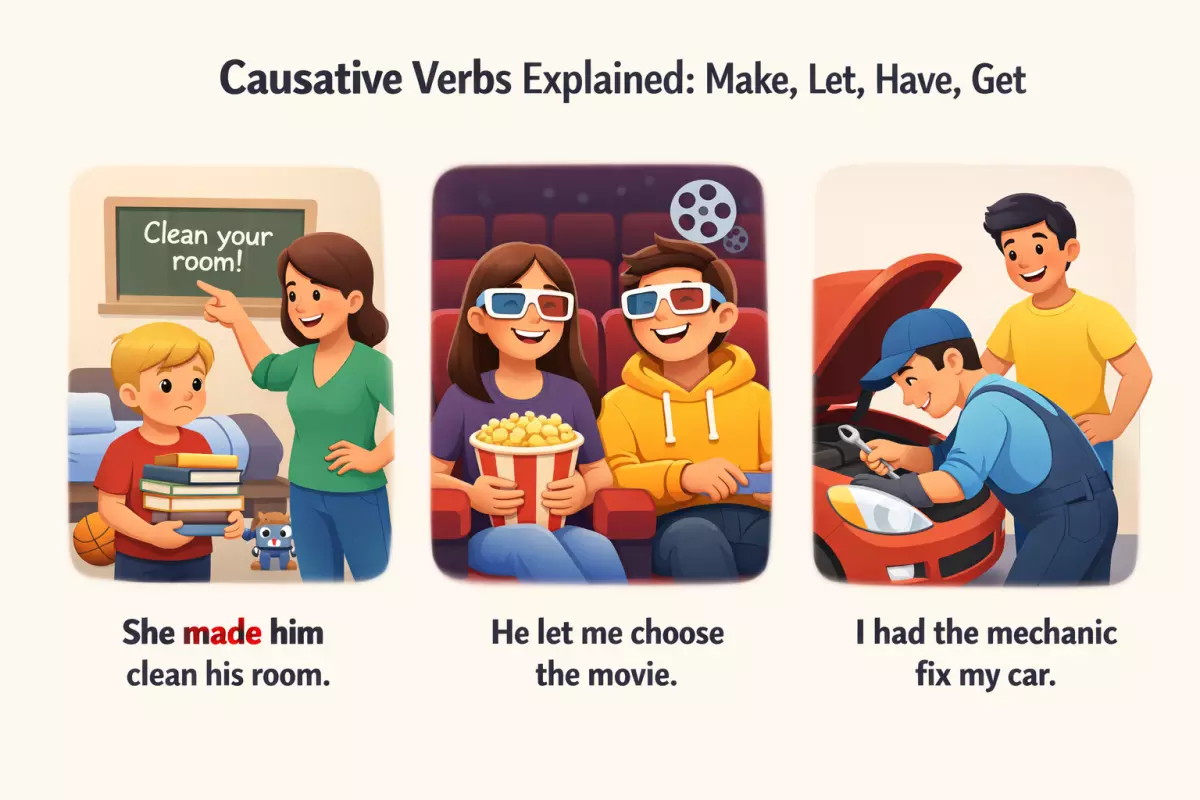 This article explains what causative verbs do in English, focusing on make for forcing, let for permission, have for arranging, and get for persuading or arranging. It covers object and verb-form patterns, common mistakes, real-life everyday examples, and homework practice tasks.
- What causative verbs do in English
- Make: forcing or causing an action
- Let: permission and allowing
- Have: arranging for someone to do something
- Get: persuading or arranging
- Causatives with objects and verb forms
- Common mistakes with causative structures
- Real-life examples in everyday English
- Homework: causative verb practice tasks
- FAQ about causative verbs
Causative structures with verbs like make, let, have, and get explain how we talk about causing someone else to do something. They are closely connected to core verb forms such as the to-infinitive in English and the gerund in English. They are common in daily life: a boss makes you stay late, a friend lets you borrow a jacket, you have your phone repaired, or you get a neighbor to help. This guide shows the main patterns and the subtle meaning differences, from force to permission to arranging.
Quick summary (causative verbs)
- Make + person + base verb → force someone to do something
- Let + person + base verb → allow someone to do something
- Have + person + base verb → arrange or instruct someone
- Have + object + past participle → service done for you
- Get + person + to + verb → persuade someone
- Get + object + past participle → manage to arrange a result
What causative verbs do in English
Causative structures show that one person or thing causes another action to happen. Like other dynamic and stative verbs, they help describe actions, control, and relationships between people. They shift the focus from “who did the action” to “who arranged it, allowed it, or persuaded someone to do it.” This is useful when you hire a service, delegate work, give permission, or push someone toward an outcome.
Core meanings these verbs express
- Make: force or require someone to do something (strong control).
- Let: allow someone to do something (permission, no force).
- Have: arrange for someone to do something (often a task or service; the speaker is in charge of the arrangement).
- Get: persuade or manage to make something happen (effort, negotiation, or success after trying).
| Verb | Main meaning | Structure | Example |
|---|---|---|---|
| make | force / strong control | make + person + base verb | She made him apologize. |
| let | permission / allow | let + person + base verb | They let me leave early. |
| have | arrange / instruct | have + person + base verb | I had my assistant call you. |
| have | service / result | have + object + past participle | I had my car repaired. |
| get | persuade / effort | get + person + to + verb | We got them to agree. |
| get | arrange a result | get + object + past participle | He got his phone fixed. |
Common patterns and what they signal
- make + object + base verb → “They made him apologize.” (pressure/obligation)
- let + object + base verb → “She let me leave early.” (permission)
- have + object + base verb → “I’ll have the assistant call you.” (delegation/arrangement)
- get + object + to + verb → “We got them to agree.” (persuasion/effort; uses the to-infinitive)
- have + object + past participle → “She had her hair cut.” (service done for you; focus on the result)
- get + object + past participle → “He got his phone repaired.” (managed to arrange a result, often after some effort)
What causatives help you say (with examples)
- Delegating a task: “Have the team review the draft.”
- Hiring a service: “We had the windows cleaned.”
- Persuading someone: “I got my neighbor to sign the form.”
- Giving permission: “They let us park in the driveway.”
- Imposing a rule: “The policy made employees wear badges.”
- Reporting a result without naming the worker: “She had her car serviced yesterday.”
- Showing difficulty or effort: “It took hours to get the printer working.”
- Describing control levels: “Make” sounds strongest; “let” is the most relaxed; “have” is managerial; “get” suggests influence.
- Keeping the agent vague or unimportant: “We had the issue fixed.” (the fixer is not the point)
- Explaining outcomes in workplaces: “The manager had IT reset my password.”
- Everyday requests: “Can you have him call me back?”
- Parenting/authority contexts: “I won’t let you skip school.” / “I made him finish his homework.”
Typical learner pitfalls to avoid
- ❌ “She made him to leave.” → ✅ “She made him leave.”
- ❌ “They let me to use it.” → ✅ “They let me use it.”
- ❌ “I got him agree.” → ✅ “I got him to agree.”
- Use have/get + past participle for services/results: “had my bike repaired,” “got my bike repaired,” not “had repaired my bike” when you mean a service.
Make: forcing or causing an action
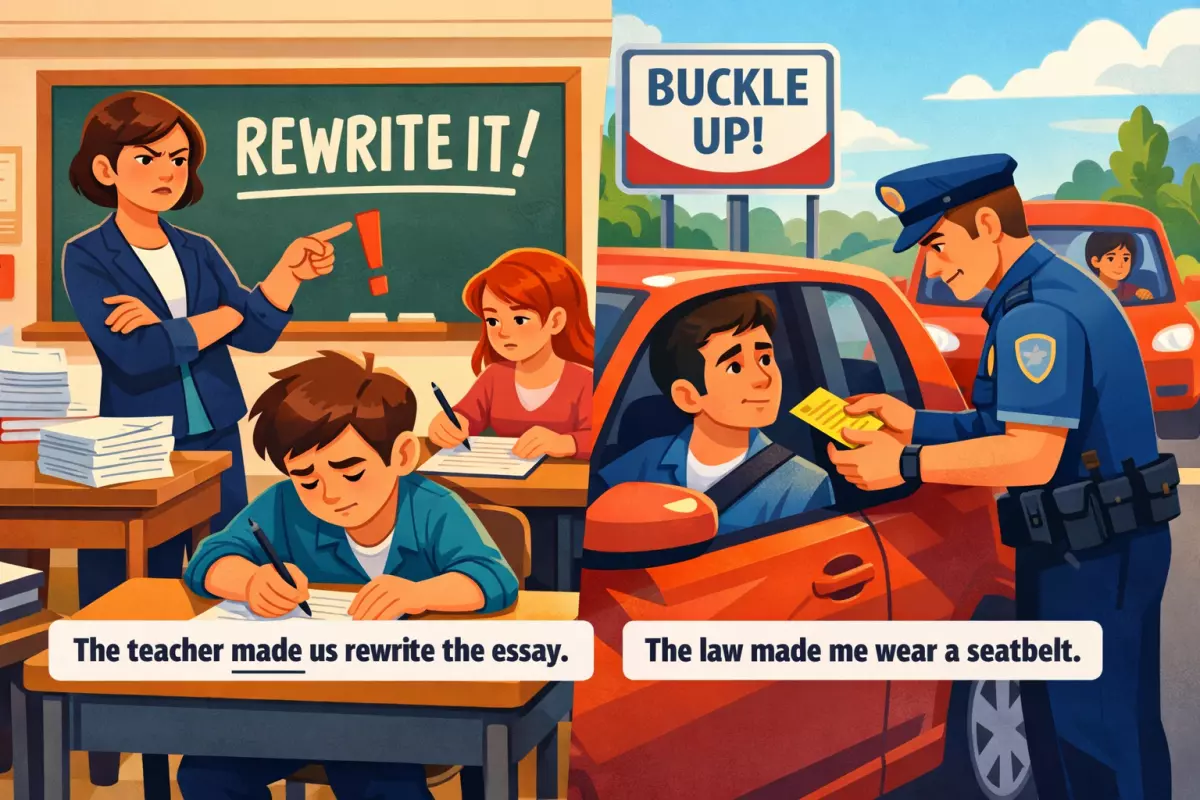
Make is used when one person or thing causes another person to do something, often with pressure, authority, or no real choice. It focuses on the result: the action happens because of the cause.
Core pattern
- make + object + base verb: “The teacher made the students rewrite the essay.”
- The verb after the object is the bare infinitive (base form), not “to + verb.”
- Common objects: me, you, him, her, us, them, people, employees, the team.
Common uses
- Rules/authority: “The law made drivers wear seat belts.”
- Pressure or insistence: “They made him apologize in public.”
- Unwanted obligation: “The delay made us wait for hours.”
- Cause-and-effect situations (things, not people): “The noise made the baby wake up.”
- Work/effort required: “This job makes me travel a lot.”
Active vs. passive forms
- Active: “They made her sign the form.”
- Passive: “She was made to sign the form.” (In the passive voice, “to” is typically used.)
- Passive is common when the agent is unknown or unimportant: “We were made to wait outside.”
Make vs. “make someone to…”
- ✅ “My boss made me stay late.”
- ❌ “My boss made me to stay late.”
- ✅ “I was made to stay late.” (passive)
Example sentences (varied contexts)
- “The coach made the players run extra laps.”
- “Their comments made her cry.”
- “The manager made everyone attend the meeting.”
- “The storm made the flight land early.”
- “His parents made him clean his room.”
- “The new policy made staff change their passwords.”
- “That song always makes me think of summer.”
- “The misunderstanding made them argue.”
- “The instructions made me redo the setup.”
- “The deadline made us work all weekend.”
- “The smell made him feel sick.”
- “The announcement made customers panic.”
- “The teacher made us turn off our phones.”
- “The technical issue made the app crash.”
- “They were made to leave the building.”
Notes on meaning and tone
- Make often sounds stronger than other causatives because it implies compulsion or lack of choice.
- For neutral arrangements or requests, English often prefers other verbs (covered in other sections), but this verb is appropriate when the situation involves force, necessity, or strong control.
Let: permission and allowing
Let is used when one person allows another person to do something. It often sounds neutral and everyday, especially for rules, decisions, and not stopping someone. In causative structures, it focuses on giving permission or removing an obstacle rather than forcing action.
Core pattern
- Structure: let + person + base verb (bare infinitive)
- Meaning: allow / permit / not prevent
- Form note: use the base verb, not “to” (✅ let him go ❌ let him to go)
Common uses and examples
- Permission from an authority: “My parents let me stay out late.”
- Agreeing to a request: “She let him borrow her laptop.”
- Not stopping an action: “Let them talk; they’ll figure it out.”
- Allowing access: “They let us into the building early.”
- Allowing a change: “The manager let me switch shifts.”
- Allowing someone to try: “Let her explain before you decide.”
- Allowing someone to choose: “I’ll let you pick the restaurant.”
- Allowing something to happen (not intervening): “Don’t let the situation get worse.”
- Allowing time/space: “Let the paint dry before you touch it.”
- Allowing communication: “They wouldn’t let him call anyone.”
- Allowing participation: “The coach let the new players join the drill.”
- Allowing a process: “Let the software update overnight.”
- Allowing entry/exit: “Security didn’t let anyone leave.”
- Allowing an exception: “They let us bring one guest.”
- Allowing a habit or behavior: “Don’t let him drive when he’s tired.”
Negatives, questions, and tense
- Negative: do/does/did + not + let + person + base verb: “They didn’t let us use our phones.”
- Question: do/does/did + subject + let + person + base verb? “Did they let you retake the test?”
- Past: let stays the same in the past (present: let / past: let): “Yesterday, she let me leave early.”
Passive: usually avoided
- In many contexts, let sounds awkward in the passive. Instead of “I was let go early,” speakers often choose a different verb: “I was allowed to go early.”
- One common fixed passive-like expression is “be let go” meaning “be dismissed from a job,” which is a special case: “He was let go last month.”
Let vs. allow (meaning is similar, form is different)
- Let + base verb: “They let us enter.”
- Allow + to-infinitive: “They allowed us to enter.” (this follows standard patterns of verbs followed by infinitives)
- Form warning: ✅ “They let us enter.” / ✅ “They allowed us to enter.” / ❌ “They let us to enter.”
Useful fixed phrases with “let”
- “Let me know.” (tell me when you have information)
- “Let’s + base verb.” (suggestion): “Let’s start.”
- “Let someone do their job.” (don’t interfere)
- “Let it go.” (stop focusing on it)
- “Let it be.” (accept it without changing it)
Have: arranging for someone to do something
Use have when you cause an action by giving instructions, making arrangements, or paying for a service. The focus is on getting the task done, not on forcing someone. This is common in workplaces, services (repairs, haircuts), and everyday errands.
Core patterns
- Have + person + base verb: you arrange for someone to do an action.
- Have + object + past participle: you arrange for a service to be done to something (often by a professional).
| Pattern | Meaning / use | Example |
|---|---|---|
| have + person + base verb | Ask/instruct someone to do something (often in a role or responsibility) | I’ll have my assistant call you tomorrow. |
| have + object + past participle | Arrange for a service; something is done to the object | We had the car serviced last week. |
| have + person + base verb + time/place | Set the details of the arrangement | Have the team meet in Room 4 at 9. |
| have + object + past participle + by + agent | Optionally name who did the work (often omitted) | I had my suit altered by a tailor near my office. |
Examples you can reuse
- Can you have someone look at the printer?
- I’ll have the receptionist send you the address.
- We had the technician replace the router.
- She had her brother pick up the groceries.
- Let’s have the kids clean up before dinner.
- They had the contractor finish the kitchen on time.
- I had my hair cut yesterday.
- He had his phone screen repaired.
- We had the documents translated into Spanish.
- She had the package delivered to her office.
- Have your lawyer review the contract.
- I had the meeting moved to Friday.
- They had the website updated last month.
- He had his eyes tested at the clinic.
- We had the carpets cleaned after the party.
- She had her photo taken for the ID card.
Common learner errors (and fixes)
- ✅ I had the mechanic check the brakes. → ❌ I had the mechanic to check the brakes. (Use the base verb, not “to + verb”.)
- ✅ We had the brakes checked. → ❌ We had the brakes check. (Use a past participle when the object receives the action.)
- ✅ I had my assistant email you. → ❌ I had my assistant emailed you. (Past participle doesn’t fit when the person is the doer.)
- ✅ I had my car washed. (Service done to the car.) → ❌ I had my car wash. (Missing the past participle.)
In many contexts, have sounds more neutral and practical than make. It often implies a routine request, a job duty, or a paid service rather than strong pressure.
Get: persuading or arranging
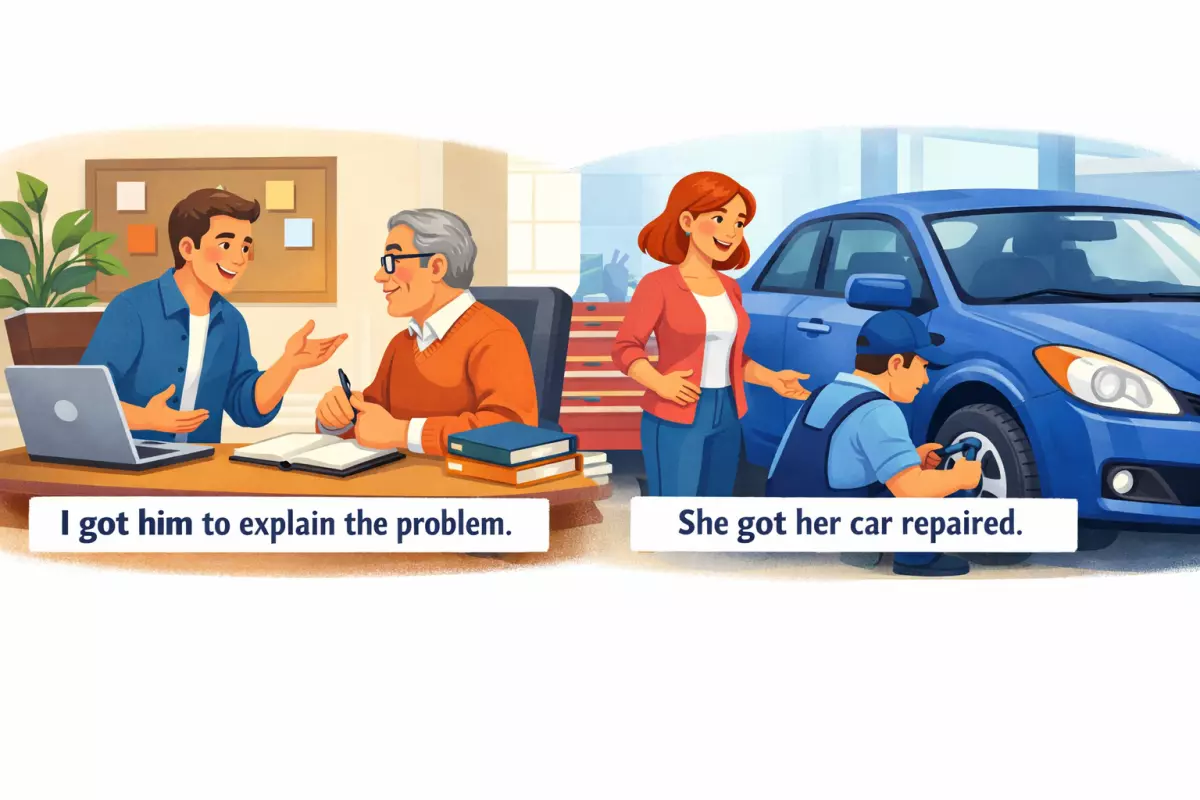
Use get as a causative verb when the subject causes an action to happen by convincing someone, requesting it, or making arrangements. It often suggests effort, negotiation, or a process (not instant control), which makes it different from stronger causatives like make.
Core patterns
- get + person + to + base verb (persuasion/convincing): “I got him to explain the problem.”
- get + object + past participle (arranging a service or causing a result): “She got her car repaired.”
- get + person + past participle (causing someone to be in a state, often in passive meaning): “They got the kids excited.”
Meaning and usage notes
- Effort is implied. “I got her to join the meeting” suggests she didn’t agree immediately.
- Common in spoken English. It sounds natural for everyday requests and practical arrangements.
- “To” is required in the persuasion pattern: ✅ “got him to call” ❌ “got him call.”
- Past participle focuses on the result (often a service done by someone else): “got the documents translated.”
- Who did the action may be unstated. “We got the locks changed” doesn’t say who changed them.
- Be careful with ambiguity. “I got John fired” can mean you caused it (intentionally or not), not that you hired him.
Examples: persuading someone (get + person + to + verb)
- We got the manager to approve the refund.
- Can you get him to lower the price?
- She got her team to focus on the deadline.
- They finally got me to try the new software.
- I couldn’t get the printer to work this morning.
- What got you to change your mind?
- He got his friend to cover his shift.
- We got the kids to clean up after dinner.
- I’m trying to get everyone to arrive on time.
- She got the client to sign the contract.
- He got his parents to let him travel alone.
- They got the audience to participate.
Examples: arranging a service or result (get + object + past participle)
- I got my laptop fixed yesterday.
- We need to get the report finished by Friday.
- She got her hair cut shorter.
- They got the tickets refunded.
- He got the package delivered to the office.
- Let’s get the room cleaned before guests arrive.
- I got the form signed by the supervisor.
- We got the meeting rescheduled.
- She got the photos printed for the presentation.
- He got the door unlocked by a locksmith.
- They got the website updated last night.
- I got the translation checked by a native speaker.
Common learner issues (quick fixes)
- Missing “to” after the person: ✅ “I got her to help” ❌ “I got her help.”
- Using an -ing form instead of the base verb: ✅ “got them to wait” ❌ “got them waiting” (different meaning).
- Confusing “did it myself” vs “arranged it”: “I got my car washed” usually means someone else washed it.
- Overusing “get” in formal writing: in formal contexts, alternatives like “persuade,” “arrange,” or “ensure” may fit better.
Causatives with objects and verb forms
Understanding these patterns is easier if you already know how infinitives and gerunds work, since causative verbs rely on specific verb forms after the object.
These causative patterns usually place an object (the person or thing affected) between the causative verb and the main action. The key choice is the verb form that follows: bare infinitive, to-infinitive, past participle, or -ing form. Each causative verb has its own common pattern and meaning.
| Causative verb | Common structure | Meaning focus | Example |
|---|---|---|---|
| make | make + object + bare infinitive | force/require | They made him apologize. |
| let | let + object + bare infinitive | allow/permit | She let me borrow her notes. |
| have | have + object + bare infinitive | arrange/instruct (often services or tasks) | I’ll have the assistant call you. |
| have | have + object + past participle | cause/arrange a service to be done | We had the car repaired. |
| get | get + object + to-infinitive | persuade/convince | He got her to agree. |
| get | get + object + past participle | manage/arrange a result (often with effort) | They got the door fixed. |
How the object changes the meaning
The object answers “who/what is affected?” and helps clarify whether the subject is controlling, permitting, arranging, or persuading. Compare these roles:
- Controller (strong pressure): The manager made the team stay late.
- Permission-giver: The teacher let the class leave early.
- Organizer (task assigned): I had my roommate pick up the package.
- Persuader (effort involved): We got our neighbors to sign the form.
Verb-form choices and what they signal
After the object, the verb form is not interchangeable. Use these patterns as fixed templates.
- Bare infinitive (no “to”): after make, let, and often have (active meaning).
- ✅ She made him wait. ❌ She made him to wait.
- ✅ They let us enter. ❌ They let us to enter.
- ✅ I’ll have the technician check it.
- To-infinitive: after get when someone is persuaded or convinced (see more about the to-infinitive in English).
- ✅ I got him to help. ❌ I got him help.
- ✅ She got the kids to clean their room.
- Past participle: after have and get to show a service/result done to the object (passive meaning).
- ✅ We had the windows cleaned. (someone cleaned them)
- ✅ He got his phone replaced. (managed to arrange a replacement)
- ✅ She had her hair cut.
Common usage notes and frequent errors
- Make + object + to-infinitive is a common mistake: use the bare infinitive (made me go, made her call).
- Let is followed by the bare infinitive, not “to”: let him speak, let them try.
- Get + object + bare infinitive is usually incorrect for causative meaning: use “to” (got them to listen).
- Have + object + past participle emphasizes a service or completed result: had the documents printed, had the leak fixed.
- Have + object + bare infinitive emphasizes giving instructions/arranging an action: had the intern email the client.
- With have/get + past participle, the “doer” can be added with by if needed: We had the roof repaired by a local company.
Choosing the right pattern is mainly about two decisions: (1) who is the affected object, and (2) whether the following verb should be active (bare infinitive / to-infinitive) or passive (past participle) to match the intended meaning.
When not to use each causative verb
- Make: do not use for services (❌ I made my car fixed → ✅ I had my car fixed)
- Let: never use "to" after it (❌ let him to go → ✅ let him go)
- Have: avoid when you mean persuasion (use "get" instead)
- Get: always use "to" before the verb in persuasion (❌ got him help → ✅ got him to help)
Common mistakes with causative structures
These verbs look simple, but small form choices change the meaning: who does the action, whether it is permission or obligation, and whether the subject is directly involved. The errors below focus on the patterns that cause the most confusion with make, let, have, and get.
-
Using to after make
Make is followed by an object + base verb (no to).
❌ She made me to apologize. → ✅ She made me apologize.
-
Adding to after let
Let uses object + base verb.
❌ They let us to leave early. → ✅ They let us leave early.
-
Mixing up have + base verb and have + past participle
These two patterns are different:
- have + person + base verb = the person does the action: ✅ I had the assistant call you.
- have + thing + past participle = a service is done to the thing: ✅ I had my phone repaired.
A common mistake is choosing the wrong structure for the meaning.
-
Using get + base verb instead of get + to-infinitive
Get normally takes object + to + verb when you persuade or manage to make someone do something.
❌ I got him sign the form. → ✅ I got him to sign the form.
-
Confusing permission (let) with forcing (make)
Choose the verb that matches the level of control.
- ✅ They let me take a day off. (permission)
- ✅ They made me work late. (no choice)
- ❌ They made me take a day off. (sounds like you were forced)
-
Using make when you mean “arrange a service”
Make is not used for paying/arranging services in the same way as have or get.
- ❌ I made my car fixed.
- ✅ I had my car fixed.
- ✅ I got my car fixed.
-
Wrong passive form with make
In the passive, make typically uses to (even though the active does not).
✅ Active: They made him leave. → ✅ Passive: He was made to leave.
❌ He was made leave.
-
Leaving out the object when it is required
With these causative patterns, you usually need to name who is caused to act.
- ❌ She made clean the kitchen.
- ✅ She made him clean the kitchen.
- ✅ She made the kids clean the kitchen.
-
Putting the wrong object after have/get for services
For “service” meaning, the object is the thing affected (not the person who performs the service).
- ❌ I had the mechanic repaired my car.
- ✅ I had my car repaired (by the mechanic).
- ✅ I got my car repaired (at the garage).
-
Using get + past participle when you mean “persuade”
Get + past participle usually means a service is done or a result happens to something, not that you convinced a person.
- ✅ I got the window fixed. (service/result)
- ✅ I got him to fix the window. (persuasion)
- ❌ I got him fixed the window. (wrong form)
-
Choosing have when you need a clearer “effort” meaning
Have can sound like giving instructions; get often suggests difficulty or effort. Using the wrong one can make the situation sound too easy or too authoritative.
- ✅ I had the technician check it. (instruction/arrangement)
- ✅ I got the technician to check it. (it took persuasion/effort)
-
Misplacing adverbs so the meaning becomes unclear
Place adverbs where they clearly modify the caused action, not the causative verb.
- ✅ She had him quickly rewrite the email. (quickly = rewrite)
- ✅ She quickly had him rewrite the email. (quickly = arranged it quickly)
-
Forgetting tense agreement in the causative verb
The causative verb carries the tense; the following verb stays in the required form (base verb, to-infinitive, or past participle).
- ✅ Yesterday, I had them clean the office.
- ✅ Last week, she got him to apologize.
- ✅ We will have the report printed tomorrow.
-
Overusing causatives when a simple verb is more natural
If the subject did the action directly, a normal verb is often clearer than a causative form.
- ❌ I had myself write the email.
- ✅ I wrote the email.
- ❌ She got herself to open the door.
- ✅ She opened the door.
When checking your sentence, confirm three things: the intended meaning (permission, obligation, arrangement, persuasion), the required verb form after the object (base verb, to-infinitive, or past participle), and whether the object is a person (doer) or a thing (receiver of a service).
Real-life examples in everyday English
These sentences show how people commonly use make, let, have, and get to talk about causing someone else to do something, or arranging for something to be done. Notice the pattern after each verb, because the grammar changes depending on which one you choose.
Everyday patterns and example sentences
- Make + person + base verb: “The noise made me wake up.”
- Make + person + base verb: “Don’t make him apologize if he’s not ready.”
- Make + thing + adjective: “That comment made the meeting awkward.”
- Let + person + base verb: “My boss lets us leave early on Fridays.”
- Let + person + base verb: “Please let me explain.”
- Let + object + base verb: “Let the soup cool before you eat it.”
- Have + person + base verb (request/arrangement): “I’ll have my assistant call you this afternoon.”
- Have + person + base verb (instruction): “The teacher had us write a short summary.”
- Have + object + past participle (service done for you): “We had the air conditioner fixed yesterday.”
- Have + object + past participle: “She had her hair cut really short.”
- Get + person + to + base verb (persuade/convince): “I finally got him to try sushi.”
- Get + person + to + base verb: “Can you get them to lower the music?”
- Get + object + past participle (cause something to be done): “I need to get my laptop repaired.”
- Get + object + past participle: “We should get the documents translated.”
- Negative forms: “They didn’t let us park there.” / “I couldn’t get her to answer my message.”
- Question forms: “Did he make you pay?” / “Can you have someone look at it?”
Quick usage notes (common choices)
- Use make when the idea is pressure or force: “They made us wait.” (not permission)
- Use let for permission or allowing something: “They let us wait inside.”
- Use have to give instructions or arrange a service: “I had the plumber check the leak.”
- Use get when it takes effort to persuade or to arrange: “I got the plumber to come earlier.”
- Form reminder: ✅ “She made me cry.” ❌ “She made me to cry.”
- Form reminder: ✅ “He got me to sign.” ❌ “He got me sign.”
Homework: causative verb practice tasks
Use these tasks to practice choosing the right causative verb and building the correct pattern. Focus on two decisions: (1) who does the action (you or someone else), and (2) which structure the verb requires (bare infinitive, to-infinitive, or past participle).
1) Pattern selection (form-focused)
- Complete the sentence with the correct form: “I made my brother ____ the dishes.” (do / to do / done)
- Complete the sentence with the correct form: “My parents let me ____ out late.” (stay / to stay / stayed)
- Complete the sentence with the correct form: “We had the mechanic ____ the brakes.” (check / to check / checked)
- Complete the sentence with the correct form: “She got her assistant ____ the meeting.” (to schedule / schedule / scheduled)
- Complete the sentence with the correct form: “He had his phone ____.” (repair / to repair / repaired)
- Complete the sentence with the correct form: “They got the window ____ yesterday.” (replace / to replace / replaced)
- Complete the sentence with the correct form: “The teacher made us ____ our phones away.” (put / to put / putting)
- Complete the sentence with the correct form: “I let my friend ____ my laptop.” (borrow / to borrow / borrowed)
- Complete the sentence with the correct form: “We had the report ____ by noon.” (finish / to finish / finished)
- Complete the sentence with the correct form: “Can you get him ____ on time?” (arrive / to arrive / arrived)
Show answers
- do
- stay
- check
- to schedule
- repaired
- replaced
- put
- borrow
- finished
- to arrive
2) Meaning choice (force, allow, arrange, persuade)
- Choose the best verb: “The manager ____ the staff work overtime.” (made / let / had / got)
- Choose the best verb: “My dad ____ me use his car this weekend.” (made / let / had / got)
- Choose the best verb: “We ____ a plumber fix the leak.” (made / let / had / got)
- Choose the best verb: “I ____ my neighbor to water my plants while I was away.” (made / let / had / got)
- Choose the best verb: “The rules ____ students bring phones into the exam room.” (made / let / had / got)
- Choose the best verb: “She finally ____ him to apologize.” (made / let / had / got)
- Choose the best verb: “They ____ the caterer deliver everything at 6.” (made / let / had / got)
- Choose the best verb: “I ____ my little sister watch the movie with us.” (made / let / had / got)
Show answers
- made
- let
- had
- got
- don’t let (or: did not let)
- got
- had
- let
3) Rewrite practice (same meaning, different causative structure)
- Rewrite using have + object + past participle: “Someone cut my hair yesterday.”
- Rewrite using get + object + past participle: “Someone repaired our washing machine.”
- Rewrite using have + person + base verb: “I asked the technician to install the software.”
- Rewrite using get + person + to-infinitive: “She persuaded her friend to help her move.”
- Rewrite using make + person + base verb: “The coach forced the team to run extra laps.”
- Rewrite using let + person + base verb: “My mom allowed me to choose the restaurant.”
- Rewrite using have + object + past participle: “A professional cleaned our carpets.”
- Rewrite using get + person + to-infinitive: “They convinced the landlord to lower the rent.”
Show answers
- I had my hair cut yesterday.
- We got our washing machine repaired.
- I had the technician install the software.
- She got her friend to help her move.
- The coach made the team run extra laps.
- My mom let me choose the restaurant.
- We had our carpets cleaned.
- They got the landlord to lower the rent.
4) Error correction (spot the pattern mistake)
- Correct the sentence: ❌ “She made him to leave early.”
- Correct the sentence: ❌ “I let my son to play outside.”
- Correct the sentence: ❌ “We had repaired the car.” (intended meaning: we paid someone to do it)
- Correct the sentence: ❌ “He got his brother help him.”
- Correct the sentence: ❌ “They had the documents to sign.” (intended meaning: someone signed them for them)
- Correct the sentence: ❌ “I got cut my hair last week.”
- Correct the sentence: ❌ “The teacher let us to use dictionaries.”
- Correct the sentence: ❌ “She had her assistant to call the clients.”
Show answers
- ✅ “She made him leave early.”
- ✅ “I let my son play outside.”
- ✅ “We had the car repaired.”
- ✅ “He got his brother to help him.”
- ✅ “They had the documents signed.”
- ✅ “I got my hair cut last week.”
- ✅ “The teacher let us use dictionaries.”
- ✅ “She had her assistant call the clients.”
5) Production task (write your own)
Write 8 original sentences: two with make, two with let, two with have, and two with get. Include at least one example of “service” meaning (object + past participle) and one example of “persuasion” meaning (get + person + to-infinitive). Check that the verb form after the object matches the required pattern.
FAQ about causative verbs
What is the difference between make and let
Make means forcing or causing someone to do something, while let means allowing someone to do something. Make shows stronger control, while let is about permission.
Do we use “to” after causative verbs
We do not use to after make, let, or have in active causative patterns: make someone do, let someone go, have someone call. We do use to after get: get someone to help. For a fuller explanation, see how the to-infinitive works in English. We also usually use to in the passive with make: He was made to apologize.
What is the difference between have and get in causative structures
Have usually sounds more neutral and is often used for arrangements, instructions, or services. Get often suggests effort, persuasion, or success after trying. Compare: I had the technician check it and I got the technician to check it.
What does “have something done” mean
Have something done means that another person does a service for you or that you arrange for something to be done. For example, I had my hair cut means someone else cut my hair.
What is the difference between have something done and get something done
Both patterns can describe arranging a service or result. Have something done often sounds more neutral or routine, while get something done can suggest extra effort, success, or problem-solving.
Is “let” used in the passive voice
Let is not commonly used in the passive in most everyday grammar explanations. English often prefers allow instead, as in We were allowed to leave early. One common exception is the fixed expression be let go, especially when talking about losing a job.