Gerund vs Infinitive: Key Differences and Rules

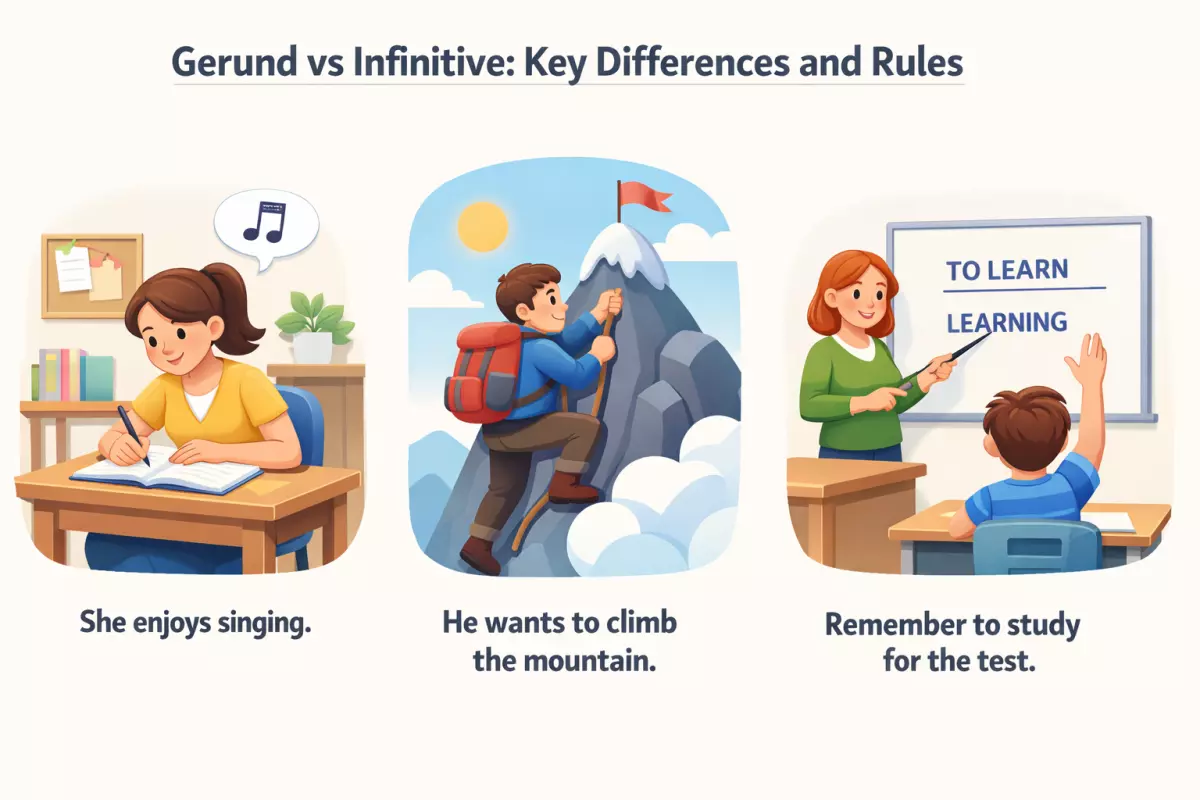 Learn why some English verbs take a gerund and others an infinitive, and how switching forms can change the meaning of a sentence. Get lists of common verbs for each pattern, plus verbs that allow both with different meanings. Finish with practical tips and exercises to choose correctly in context.
- Why some English verbs require a gerund and others an infinitive
- How sentence meaning changes with gerund vs infinitive
- Common verbs that must be followed by a gerund
- Common verbs that must be followed by an infinitive
- Verbs that allow both forms but change the meaning
- Practical tips for choosing the correct form in context
- Practice exercises: choosing between gerunds and infinitives
Choosing between an -ing form and to plus a verb may seem minor, but it can make a sentence sound natural or awkward. In everyday English, some verbs strongly prefer one pattern, others allow both with a shift in meaning, and a few depend on context. This guide explains the most useful rules and common native-speaker choices to help you speak and write with more confidence.
Why some English verbs require a gerund and others an infinitive
English verb patterns are largely conventional: certain verbs “select” a gerund (-ing form) or an infinitive (to + base verb) because that combination became standard over time. Still, there are useful usage patterns that explain many choices and help you predict the right form.
1) Gerund after verbs that describe enjoyment, avoidance, and completion
When the second action is treated like an activity or experience (a “thing you do”), English often uses a gerund.
- Enjoy: I enjoy reading before bed.
- Finish: She finished writing the report.
- Stop (quit an activity): He stopped smoking.
- Avoid: They avoided talking about politics.
- Consider: We considered moving closer to work.
- Suggest: He suggested taking a break.
- Recommend: I recommend trying the soup.
- Mind: Do you mind opening the window?
- Miss: I miss seeing my friends regularly.
- Keep (continue): She kept asking questions.
- Practice: They practiced pronouncing the new sounds.
- Delay / Postpone: We delayed leaving until noon.
- Risk: You risk losing your data.
- Give up: He gave up trying to fix it alone.
2) Infinitive after verbs that express intention, decisions, and plans
When the second verb points forward to a goal or intended action, English commonly uses an infinitive.
- Decide: We decided to leave early.
- Plan: She plans to study abroad.
- Hope: I hope to see you soon.
- Want: They want to buy a house.
- Need: You need to update the software.
- Choose: He chose to stay quiet.
- Agree: We agreed to meet at 6.
- Promise: She promised to call later.
- Offer: He offered to help with the boxes.
- Refuse: They refused to answer the question.
- Learn: I’m learning to drive.
- Manage: He managed to solve the problem.
- Fail: She failed to notice the sign.
- Attempt: They attempted to repair the roof.
3) Meaning changes: the same verb can take both forms with different results
Some verbs allow both structures, but the gerund and infinitive signal different meanings (often “activity” vs. “intended action,” or “before” vs. “after”).
- Stop: ✅ I stopped smoking (I quit). → ✅ I stopped to smoke (I paused another activity in order to smoke).
- Remember: ✅ I remember locking the door (memory of a past action). → ✅ Remember to lock the door (don’t forget to do it).
- Forget: ✅ I’ll never forget meeting her (past experience). → ✅ Don’t forget to email me (future task).
- Try: ✅ Try restarting your phone (experiment). → ✅ Try to restart it (make an effort; may be difficult).
- Regret: ✅ I regret saying that (I’m sorry about a past action). → ✅ We regret to inform you… (formal: announcing bad news).
- Go on: ✅ She went on talking (continued). → ✅ She went on to explain the next point (moved to the next step).
4) Object patterns: “verb + person + infinitive” is common
When the main verb is followed by an object (someone who receives the action), English often uses an infinitive to show what that person is expected, allowed, or persuaded to do.
- Want + object + to: I want you to listen.
- Need + object + to: We need them to arrive on time.
- Ask + object + to: She asked me to help.
- Tell + object + to: He told us to wait.
- Encourage + object + to: They encouraged her to apply.
- Allow/Permit + object + to: The teacher allowed students to use dictionaries.
- Remind + object + to: Please remind him to pay the bill.
- Expect + object + to: I expect you to be honest.
5) Prepositions strongly favor gerunds
If a verb comes after a preposition (in, on, at, about, of, for, without, etc.), the -ing form is the normal choice because it functions like a noun phrase.
- She’s interested in learning Korean.
- They apologized for being late.
- He left without saying goodbye.
- We talked about moving offices.
- She succeeded by working consistently.
In practice, the most reliable approach is to learn common verb patterns in groups (enjoy/avoid/finish + -ing; decide/plan/hope + to) and to watch for meaning shifts with verbs like stop, remember, and try. When a preposition appears, default to a gerund.
How sentence meaning changes with gerund vs infinitive

Some verbs can be followed by either a gerund (-ing) or an infinitive (to + base verb), but the choice can shift the meaning. In these cases, the grammar is not just a “rule”—it signals whether you mean a past experience, a future intention, a change of habit, or a different focus in the sentence.
Common verbs where the form changes the meaning
- Remember
- remember doing = recall a past action: “I remember meeting her at the conference.”
- remember to do = not forget a future task: “Remember to email her the file.”
- Forget
- forget doing = forget a past event happened: “He forgot locking the door and went back to check.”
- forget to do = fail to do something: “He forgot to lock the door.”
- Stop
- stop doing = quit an activity: “She stopped smoking.”
- stop to do = pause another action in order to do something: “She stopped to answer the phone.”
- Try
- try doing = experiment to see what happens: “Try restarting the router.”
- try to do = attempt, often with effort or difficulty: “I tried to restart it, but it wouldn’t turn on.”
- Regret
- regret doing = feel sorry about a past action: “I regret saying that.”
- regret to do = formal; regret giving news now: “We regret to inform you that your application was unsuccessful.”
- Go on
- go on doing = continue the same activity: “He went on talking despite the interruption.”
- go on to do = move to the next step or new activity: “She went on to study medicine.”
- Mean
- mean doing = involve as a result: “This change means working longer hours.”
- mean to do = intend: “I meant to call you yesterday.”
- Need (note the passive-like meaning with -ing)
- need doing = need to be done: “The kitchen needs cleaning.”
- need to do = it is necessary for someone to do it: “I need to clean the kitchen.”
How to choose: meaning cues that usually decide the form
- Memory vs. task: use -ing for recalling an experience; use to + verb for a duty you must not forget.
- Quitting vs. pausing: use -ing for ending an activity; use to + verb for stopping in order to do something else.
- Experiment vs. effort: use -ing for “test this method”; use to + verb for “attempt and maybe fail.”
- Past action vs. present announcement: use -ing to regret something you did; use to + verb in formal messages to regret saying something now.
- Continue vs. next stage: use -ing to keep doing the same thing; use to + verb to move forward to a new action.
- Result vs. intention: use -ing when the action is a consequence; use to + verb when it is your plan.
- “Needs cleaning” meaning: with some objects, -ing can mean “needs to be done,” which is different from “I need to do it.”
Quick correctness checks (common learner pitfalls)
- ✅ “I remembered to bring my passport.” → a task you did not forget.
- ❌ “I remembered bringing my passport.” (only correct if you mean you recall the past moment of bringing it, not that you didn’t forget it)
- ✅ “He stopped to smoke.” → he paused another activity so he could smoke.
- ✅ “He stopped smoking.” → he quit the habit.
- ✅ “Try adding more salt.” → experiment with a solution.
- ✅ “Try to add more salt without spilling.” → an effortful attempt.
Common verbs that must be followed by a gerund
Some verbs in English are typically followed by an -ing form (a gerund) rather than an infinitive. The pattern is straightforward: verb + gerund. If you use to + verb after these verbs, it will usually sound unnatural or be incorrect.
Use the following verbs with a gerund when the next word is an action:
- avoid + gerund: ✅ She avoided talking about the issue. ❌ She avoided to talk about the issue.
- consider + gerund: They considered moving abroad.
- deny + gerund: He denied taking the money.
- dislike + gerund: I dislike waiting in long lines.
- enjoy + gerund: We enjoy cooking together.
- finish + gerund: Please finish writing the report.
- give up + gerund: She gave up smoking.
- imagine + gerund: Can you imagine living without the internet?
- keep + gerund: He kept asking the same question.
- mind + gerund: Do you mind opening the window?
- miss + gerund: I miss seeing my friends every day.
- postpone + gerund: They postponed meeting the client.
- practice + gerund: She practices speaking English daily.
- quit + gerund: He quit drinking soda.
- recommend + gerund: I recommend taking notes during lectures.
- resist + gerund: She couldn’t resist laughing.
- risk + gerund: You risk losing your data if you don’t back it up.
- suggest + gerund: They suggested leaving early.
Two useful usage notes
- Object + gerund is common: Many of these verbs can take an object before the -ing form. Example: They recommended us booking in advance.
- Gerund can have its own object: The -ing form can be followed by what it acts on. Example: She avoided answering my question.
When you learn these verbs, focus on the pattern rather than translating word-for-word. If the main verb expresses stopping, delaying, enjoying, or avoiding an activity, the -ing form is often the natural choice.
Common verbs that must be followed by an infinitive

Some verbs are typically followed by to + base verb (the infinitive), not by a gerund. Learning these as patterns helps you avoid errors such as using -ing after a verb that normally takes an infinitive.
Core pattern
The most common structure is:
- Verb + to + verb: ✅ I decided to leave. ❌ I decided leaving.
- Verb + object + to + verb (when the verb allows an object): ✅ She asked him to wait.
High-frequency verbs that take the infinitive
- agree: They agreed to meet after work.
- aim: We aim to finish by Friday.
- arrange: She arranged to speak with the manager.
- attempt: He attempted to fix the leak.
- choose: I chose to stay home.
- claim: The company claims to follow the rules.
- decide: We decided to take the train.
- demand: They demanded to see the report.
- expect: I expect to hear back soon.
- fail: She failed to notice the sign.
- hope: I hope to visit next year.
- learn: He learned to drive at 18.
- manage: We managed to solve the problem.
- need: You need to show an ID.
- offer: They offered to help.
- plan: I plan to move in June.
- pretend: She pretended to understand.
- promise: He promised to call.
- refuse: They refused to pay.
- seem: It seems to be working.
- threaten: He threatened to quit.
- want: I want to improve my writing.
- wish: She wishes to remain anonymous.
Verbs that often use an object + infinitive
Many verbs sound most natural with an object before the infinitive. This is especially common when one person influences another person’s action.
- advise + object + to: The doctor advised me to rest.
- ask + object + to: She asked him to lower his voice.
- encourage + object + to: They encouraged us to apply.
- invite + object + to: I invited her to join us.
- order + object + to: The officer ordered them to stop.
- remind + object + to: Please remind me to email them.
- tell + object + to: He told me to be careful.
- teach + object + to: She taught him to swim.
- warn + object + to: They warned us to stay back.
Usage notes and common mistakes
- Don’t add -ing after these verbs: ✅ She refused to answer. ❌ She refused answering.
- Some verbs can take both patterns, but meaning may change (covered elsewhere in a full gerund vs. infinitive guide): for example, remember, stop, try.
- Watch for the object: ✅ I want to leave. / I want him to leave. (Not: I want him leaving.)
Verbs that allow both forms but change the meaning
Some verbs can be followed by either a gerund (-ing) or an infinitive (to + base verb), but the choice changes the message. These differences often follow a few common patterns: memory (before vs. after), intention vs. experience, and general preference vs. a specific action.
| Verb | Gerund (meaning + example) | Infinitive (meaning + example) |
|---|---|---|
| remember | Memory of a past action: I remember locking the door. | Don’t forget a future action: Remember to lock the door. |
| forget | Forget a past experience/event: I’ll never forget meeting her. | Fail to do something: I forgot to call you. |
| stop | Quit an activity: He stopped smoking. | Pause one action in order to do another: He stopped to smoke. |
| try | Experiment (see what happens): Try adding more salt. | Make an effort (may be difficult): I tried to lift the box. |
| regret | Feel sorry about a past action: I regret saying that. | Formal/polite announcement of bad news: We regret to inform you that your order was canceled. |
| mean | Involve/require: This job means working weekends. | Intend: I didn’t mean to offend you. |
| go on | Continue the same action: She went on talking. | Change to the next action: She went on to explain the next step. |
| need | Passive meaning (common in BrE): The car needs washing. | Someone must do it: The car needs to be washed. |
| propose | Suggest (often in meetings): She proposed delaying the launch. | Plan/intend (more formal): He proposes to resign next month. |
| hate / love / like / prefer | Often general enjoyment/dislike: I like swimming. | Often a specific situation or choice: I like to swim in the morning. |
Usage patterns to notice
- “Before vs. after” meaning (memory verbs): With remember and forget, the gerund usually points to an earlier action (something that happened), while the infinitive points to a later action (something to do).
- Stopping an activity vs. stopping to do something else: stop + -ing ends the activity; stop + to introduces a new purpose.
- Experiment vs. effort: try + -ing suggests testing a method; try + to emphasizes attempting a difficult action.
- Feelings about the past vs. formal statements: regret + -ing is personal and backward-looking; regret + to is common in formal notices.
- General preference vs. a particular choice: With verbs like like and prefer, the difference is often about whether you mean the activity in general or a specific habit/decision in context.
Common learner pitfalls
- ❌ I stopped to smoke (if you mean quitting the habit). → ✅ I stopped smoking.
- ❌ Remember locking the door! (if you mean “don’t forget”). → ✅ Remember to lock the door!
- ❌ Try to add more salt (if you mean “experiment”). → ✅ Try adding more salt.
Practical tips for choosing the correct form in context
Choose between a gerund (-ing) and an infinitive (to + base verb) by looking at the verb before it, the meaning you want (activity vs. goal), and the grammar pattern (preposition, object, or adjective). The cues below help you decide quickly without guessing.
1) Check the word right before the verb form
- After a preposition, use a gerund: “interested in learning,” “good at explaining,” “before leaving,” “without asking.”
- After “to” as a preposition (not the infinitive marker), use a gerund: “look forward to meeting,” “be used to working,” “object to waiting.”
- After many adjectives, use an infinitive to show purpose or reaction: “happy to help,” “ready to start,” “surprised to hear.”
- After certain nouns, an infinitive often expresses a plan or need: “a decision to move,” “time to go,” “a chance to practice.”
2) Use meaning as your tie-breaker (activity vs. aim)
- Gerund = the activity itself: “I enjoy cooking” (the process is enjoyable).
- Infinitive = purpose, intention, or result: “I went to the store to buy milk” (goal).
- Gerund as a general habit: “She likes reading before bed” (regular activity).
- Infinitive for a specific choice right now: “I’d like to speak to the manager” (specific request).
3) Memorize high-frequency verb patterns (the fastest win)
- Common verbs followed by a gerund: avoid, consider, enjoy, finish, keep, mind, miss, practice, recommend, risk, suggest.
- Common verbs followed by an infinitive: agree, decide, hope, learn, need, offer, plan, refuse, seem, want.
- Verbs that can take both with little change in meaning: begin, start, continue (often interchangeable: “started to rain” / “started raining”).
4) Watch for verbs where the choice changes the meaning
- remember + gerund = memory of a past action: ✅ “I remember locking the door.” ❌ “I remember to lock the door.” (different meaning)
- remember + infinitive = don’t forget to do it: ✅ “Remember to lock the door.”
- stop + gerund = quit an activity: ✅ “He stopped smoking.”
- stop + infinitive = pause another action in order to do this: ✅ “He stopped to smoke.”
- try + gerund = experiment to see what happens: ✅ “Try restarting the app.”
- try + infinitive = make an effort to do something difficult: ✅ “Try to restart the app.”
- regret + gerund = feel sorry about a past action: ✅ “I regret saying that.”
- regret + infinitive = formal announcement of bad news: ✅ “We regret to inform you…”
5) Use quick grammar checks for accuracy
- If the -ing form is the subject, it’s usually a gerund: “Learning takes time.”
- If you can replace the verb phrase with “this activity,” a gerund often fits: “I enjoy swimming” → “I enjoy this activity.”
- If you can replace it with “in order to,” an infinitive is likely: “I called to confirm” → “I called in order to confirm.”
- After object + verb patterns, infinitives are common: “She asked me to help,” “They told him to wait.”
- After “make/let/help”, the bare infinitive often appears: “They made me apologize,” “Let her go,” “Help me carry this.”
6) Common error fixes you can apply immediately
- ❌ “I’m good to cook.” → ✅ “I’m good at cooking.”
- ❌ “She suggested to go.” → ✅ “She suggested going.”
- ❌ “He decided going.” → ✅ “He decided to go.”
- ❌ “We look forward to meet you.” → ✅ “We look forward to meeting you.”
- ❌ “I want going home.” → ✅ “I want to go home.”
Practice exercises: choosing between gerunds and infinitives
Choose the correct form by focusing on common patterns: verbs that take only a gerund, verbs that take only an infinitive, verbs that change meaning depending on the form, and structures like prepositions, adjectives, and purpose.
Exercise 1: Complete the sentence (gerund or infinitive)
- I can’t stand (wait) in long lines.
- She promised (call) after the meeting.
- We discussed (move) to a smaller office.
- They decided (postpone) the launch.
- He avoided (answer) the question directly.
- Do you want (join) us for lunch?
- I’m looking forward to (see) you this weekend.
- It’s worth (check) the details before you pay.
- She offered (help) with the presentation.
- He admitted (break) the rule.
- We managed (finish) on time.
- They suggested (take) a different route.
Show answers
- waiting
- to call
- moving
- to postpone
- answering
- to join
- seeing
- checking
- to help
- breaking
- to finish
- taking
Exercise 2: Prepositions and fixed patterns
Rule reminder: after a preposition, use a gerund (including to when it is a preposition in phrases like “look forward to”). Choose the correct form.
- She apologized for (be) late.
- He’s interested in (learn) Japanese.
- They left without (say) goodbye.
- I’m used to (get) up early.
- We’re committed to (improve) customer support.
- He succeeded by (work) consistently.
- Thank you for (help) me.
- There’s no point in (argue) about it.
- She insisted on (pay) for dinner.
- After (read) the report, I changed my mind.
Show answers
- being
- learning
- saying
- getting
- improving
- working
- helping
- arguing
- paying
- reading
Exercise 3: Meaning changes (gerund vs. infinitive)
Some verbs can take both forms, but the meaning shifts. Choose the option that best fits the intended meaning in each sentence.
- I stopped (to smoke / smoking) because it was affecting my health.
- On the way home, we stopped (to get / getting) some groceries.
- I’ll never forget (to meet / meeting) her for the first time.
- Remember (to lock / locking) the door before you leave.
- He regrets (to say / saying) that he can’t attend.
- We regret (to inform / informing) you that your application was unsuccessful.
- Try (to restart / restarting) the app if it freezes.
- If that doesn’t work, try (to press / pressing) the reset button.
Show answers
- smoking
- to get
- meeting
- to lock
- saying
- to inform
- restarting
- pressing
Exercise 4: Error correction (fix the form)
Each sentence contains a gerund/infinitive mistake. Rewrite it correctly.
- ❌ She suggested to take a taxi.
- ❌ He insisted to pay for everything.
- ❌ I enjoy to cook on weekends.
- ❌ They agreed meeting at 6.
- ❌ We’re looking forward to see you.
- ❌ He avoided to answer my email.
- ❌ It’s important remembering her name.
- ❌ I decided going home early.
Show answers
- ✅ She suggested taking a taxi.
- ✅ He insisted on paying for everything.
- ✅ I enjoy cooking on weekends.
- ✅ They agreed to meet at 6.
- ✅ We’re looking forward to seeing you.
- ✅ He avoided answering my email.
- ✅ It’s important to remember her name.
- ✅ I decided to go home early.
Quick pattern checklist (use this while you practice)
- Use a gerund after prepositions: interested in learning, good at explaining, before leaving.
- Common gerund verbs: avoid, consider, discuss, enjoy, finish, suggest, admit, mind, miss, keep.
- Common infinitive verbs: decide, hope, plan, promise, agree, refuse, offer, manage, learn (to do), need.
- Purpose often uses an infinitive: I went to the store to buy milk.
- After adjectives, infinitives are common: It’s hard to explain, She’s ready to leave.
- Meaning-change verbs to watch: stop, remember, forget, regret, try.