Using Gerunds as the Subject of a Sentence

 This article explains why gerunds can be sentence subjects, shows common opening patterns, and compares gerund subjects with infinitive subjects. It covers when English prefers gerunds for activities, common learner mistakes, how to rewrite naturally, and practice exercises.
- Why gerunds can function as the subject of a sentence
- Typical sentence structures with gerunds at the beginning
- How gerund subjects differ from infinitive subjects
- When English prefers gerunds to talk about activities
- Common learner mistakes with gerund subjects
- How to rewrite sentences using gerunds naturally
- Practice exercises: building sentences with gerund subjects
Turning an -ing verb into the doer of a sentence is a practical grammar skill. It lets you treat activities like real things: Cooking relaxes me, Waiting feels endless, Learning English takes time. In everyday speech and writing, it helps you sound natural when describing habits, hobbies, and routines, without extra words, awkward phrasing, or complicated sentence structures.
Why gerunds can function as the subject of a sentence
A gerund is an -ing form that behaves like a noun. Because it names an activity, process, or idea (not an action happening right now), it can sit in the same “subject slot” that a noun or noun phrase would normally occupy.
What makes a gerund “noun-like”
- It can be replaced by a noun: “Running helps me focus” → “Exercise helps me focus.”
- It can take a determiner or possessive in some contexts: “His singing surprised everyone.”
- It can be modified (often by adverbs): “Practicing regularly improves accuracy.”
- It can take its own object like a verb: “Reading long articles builds stamina.”
- It can be expanded into a full gerund phrase: “Taking notes during lectures helps retention.”
Common subject patterns with gerunds
In real sentences, gerunds as subjects show up in a few predictable structures. These patterns help you recognize them quickly and build your own sentences accurately.
- Gerund + verb: “Traveling broadens perspective.”
- Gerund phrase + verb: “Learning a new keyboard shortcut saves time.”
- Gerund + be + complement: “Waiting is the hardest part.”
- Gerund + modal/auxiliary: “Overthinking can slow decisions.”
- Gerund + linking verb: “Working late feels normal in some jobs.”
- Gerund + passive meaning in context: “Parking here is prohibited.” (the activity is treated as a thing that is restricted)
How gerund subjects keep meaning clear
- They focus on the activity as a concept, not on who is doing it: “Arguing doesn’t solve the problem.”
- They sound natural for general truths and habits: “Drinking enough water improves concentration.”
- They work well for rules and signs: “Smoking is not allowed.”
- They help you avoid awkward “it” openings when the real topic is an activity: “Checking the schedule helps” (instead of “It helps to check the schedule”).
Examples you can model
- Writing daily builds confidence.
- Listening carefully prevents misunderstandings.
- Taking breaks improves productivity.
- Studying in short sessions works better for many people.
- Reading aloud helps with pronunciation.
- Asking follow-up questions shows attention.
- Keeping passwords secure protects your accounts.
- Using clear headings makes documents easier to scan.
- Practicing with real examples speeds up learning.
- Arriving early reduces stress.
- Saving a draft avoids losing work.
- Comparing two options clarifies the decision.
- Rewriting a sentence can improve tone.
- Planning meals saves money.
- Turning off notifications helps you focus.
- Reviewing feedback leads to stronger results.
Gerund subject vs. present participle: a quick distinction
- ✅ Gerund (subject = activity/idea): “Swimming is good exercise.”
- ❌ Not the same meaning: “The swimming child waved.” (here “swimming” describes “child,” so it functions like an adjective, not the subject)
Typical sentence structures with gerunds at the beginning

When a sentence opens with a gerund phrase, the -ing form functions as the subject and sets up the main idea before the verb. This front-loaded pattern is common in general statements, rules, and explanations because it highlights the activity or concept first.
Core patterns you can copy
- Gerund + singular verb + complement: “Reading improves concentration.”
- Gerund phrase + singular verb + complement: “Reading before bed helps me sleep.”
- Gerund + be + noun phrase: “Budgeting is a useful habit.”
- Gerund phrase + be + adjective: “Working late every night is exhausting.”
- Gerund phrase + modal + base verb: “Driving in heavy rain can be stressful.”
- Gerund phrase + present perfect (general result): “Skipping breakfast has caused problems for some people.”
- Gerund phrase + past tense (specific situation): “Taking that shortcut saved us ten minutes yesterday.”
- Gerund phrase + linking verb + clause-like complement: “Getting enough sleep means you recover faster.”
- Gerund phrase + negative verb: “Ignoring small errors doesn’t solve the problem.”
- Negative gerund phrase + verb: “Not checking the address leads to delays.”
Common expansions at the start of the sentence
Gerund subjects often include extra information (objects, adverbs, or prepositional phrases). These additions make the subject more specific while keeping the same grammar.
- Gerund + direct object: “Learning new words takes time.”
- Gerund + adverb: “Practicing regularly builds confidence.”
- Gerund + prepositional phrase: “Studying in a quiet place improves focus.”
- Gerund + object + prepositional phrase: “Preparing meals at home saves money.”
- Gerund + “by” phrase (method): “Saving energy by turning off lights reduces costs.”
- Gerund + time phrase: “Exercising in the morning boosts mood.”
- Gerund + reason phrase: “Leaving early because of traffic avoids stress.”
- Gerund + with phrase (accompaniment): “Working with a partner speeds up the task.”
Patterns with “it” and delayed subjects (contrast)
Sometimes writers choose a delayed-subject structure (“It is…”), but the gerund-at-the-front structure is often clearer when you want the activity to be the topic. Compare the placement and emphasis:
- ✅ “Meeting deadlines is important.” → Focus stays on the action.
- ✅ “It is important to meet deadlines.” → Focus shifts to the evaluation (“important”).
Extra example bank (quick models)
- “Cooking at home reduces food waste.”
- “Taking notes during lectures helps retention.”
- “Walking after meals can aid digestion.”
- “Comparing prices online saves time.”
- “Keeping backups prevents data loss.”
- “Asking clear questions leads to better answers.”
- “Watching tutorials is useful for beginners.”
- “Using simple language makes instructions easier to follow.”
- “Overthinking small mistakes can hurt performance.”
- “Not responding promptly creates confusion.”
How gerund subjects differ from infinitive subjects
English can use either a gerund phrase (an -ing form acting like a noun) or an infinitive phrase (to + base verb) in the subject position. Both can be grammatical, but they tend to signal different meanings, levels of formality, and patterns with certain verbs and structures.
| Feature | Gerund as subject (V-ing) | Infinitive as subject (to + V) |
|---|---|---|
| Typical meaning | Often presents an activity as a general idea or real experience | Often presents an action as a goal, plan, or potential choice |
| Common “feel” in context | Natural for everyday statements about habits and activities | More formal or abstract, especially in general statements |
| Best fit for general truths | Very common: “Swimming is good exercise.” | Possible but less common: “To swim is good exercise.” |
| Best fit for purpose/aim | Possible, but usually needs context: “Studying helps.” | Strong fit: “To study tonight is my priority.” |
| Use with “it” (extraposition) | Common: “It’s hard getting up early.” | Very common: “It’s hard to get up early.” |
| Use with “for + noun/pronoun” | Less typical in subject position: “For him, running is relaxing.” | Very typical: “For him to run daily is unusual.” |
| Sounding natural as a sentence opener | Usually natural: “Learning languages takes time.” | Can sound formal/stiff: “To learn languages takes time.” |
| Emphasis | Emphasizes the activity itself as a thing | Emphasizes the act as a step to take or a choice to make |
Choosing between them in real sentences
When you describe an activity in general, the -ing subject is usually the default. When you frame the subject as an intention, duty, or decision, the infinitive often fits better. In many cases, both forms are acceptable, but the nuance shifts.
- General activity/habit: “Reading before bed helps me sleep.” (natural, routine)
- Goal or plan: “To read before bed is my new habit.” (sounds like a deliberate decision)
- Experience-focused: “Traveling alone taught me confidence.”
- Choice-focused: “To travel alone takes courage.”
- Broad truth: “Eating vegetables is good for you.”
- Abstract statement: “To eat well is important.”
- Natural with long subjects: “Getting enough sleep during exams is difficult.”
- Often rewritten with ‘it’: “It’s difficult to get enough sleep during exams.”
Patterns that often sound more natural
Some structures strongly favor one option. If the subject is long or heavy, English frequently avoids placing it first and uses an “it” sentence instead, especially with infinitives.
- Preferred with “it + be + adjective + to…”: “It’s important to back up your files.”
- Also common with “it + be + adjective + V-ing”: “It’s exhausting working weekends.”
- Formal fronted infinitive (less common in conversation): “To ignore the warning signs is risky.”
- Fronted gerund for everyday topics: “Ignoring warning signs is risky.”
Quick accuracy notes
- Both forms take a singular verb when the subject is treated as one activity: “Running is fun.” / “To run is fun.”
- For most everyday writing, a gerund subject usually sounds smoother than a fronted infinitive, unless you want a more formal or deliberate tone.
- If a fronted infinitive feels stiff, rewrite with “it”: ✅ “It’s nice to meet you.” ❌ “To meet you is nice.”
When English prefers gerunds to talk about activities
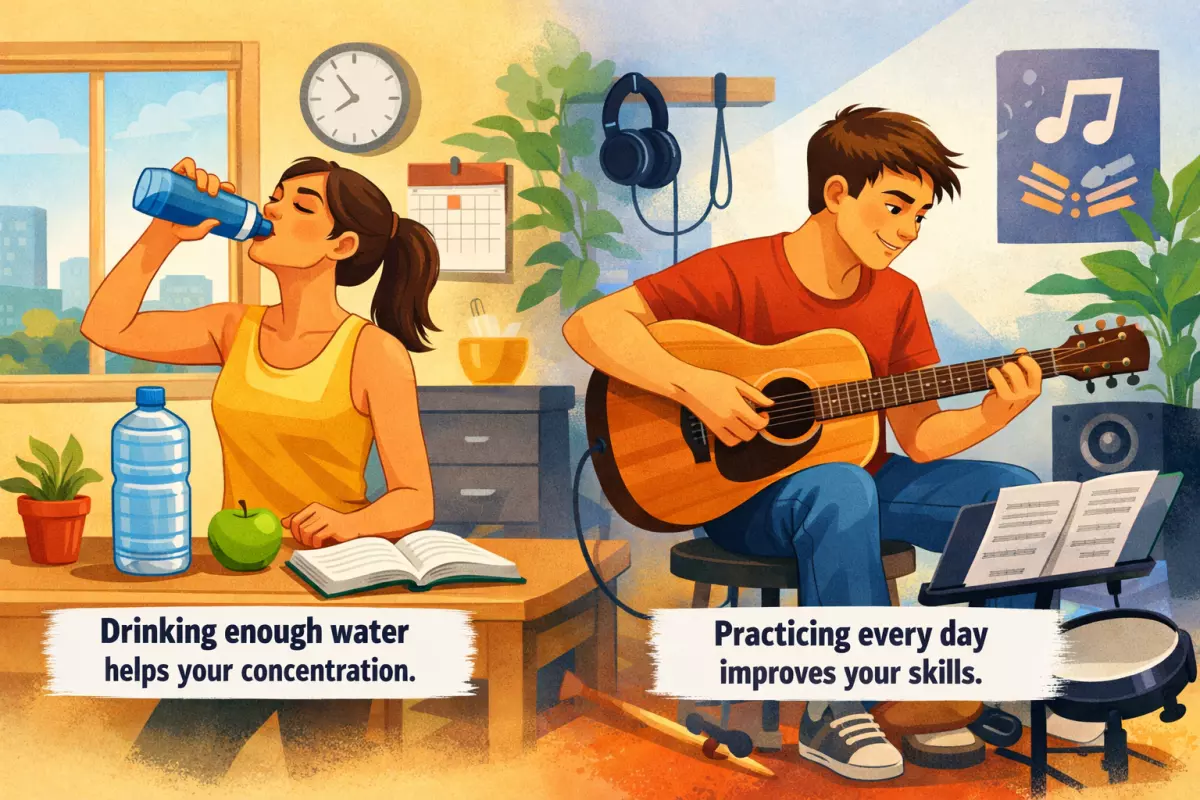
English often chooses a gerund (verb + -ing used as a noun) when the subject is an activity, habit, or general behavior rather than a one-time event. This is especially common when the speaker wants to name the action itself and treat it like a “thing” that can be discussed, evaluated, or compared.
Common situations where a gerund subject sounds natural
- General habits and routines: “Drinking enough water helps your concentration.”
- Skills and learning processes: “Practicing every day improves your pronunciation.”
- Rules and guidelines (general truths): “Following the instructions prevents mistakes.”
- Health and lifestyle choices: “Sleeping on a regular schedule supports recovery.”
- Work and productivity behaviors: “Checking email constantly interrupts deep work.”
- Social behavior and manners: “Interrupting people makes conversations harder.”
- Risk and safety topics: “Texting while driving increases the chance of accidents.”
- Environmental actions: “Recycling correctly reduces contamination.”
- Money and spending patterns: “Saving a little each week adds up.”
- Technology use: “Updating your software regularly improves security.”
- Emotions and coping strategies: “Talking to someone you trust can relieve stress.”
- Preferences stated as general activities: “Traveling alone isn’t for everyone.”
- Comparisons between activities: “Cooking at home is cheaper than eating out.”
- Cause-and-effect framing: “Skipping breakfast often leads to overeating later.”
- Policies and workplace norms: “Sharing confidential files violates company policy.”
Gerund subjects vs. “To + verb” subjects
Both forms can appear as the subject, but they often signal different emphasis. Gerund subjects usually sound more like a general activity or an established behavior; “to + verb” subjects often sound more abstract, goal-focused, or like a specific choice in a particular situation.
| Focus | Gerund as subject | To + verb as subject |
|---|---|---|
| General activity / habit | “Walking after dinner helps digestion.” | “To walk after dinner helps digestion.” (possible, more formal/abstract) |
| Experience-based statement | “Working from home saves commuting time.” | “To work from home saves commuting time.” (sounds less natural in everyday speech) |
| Goal or principle | “Being honest matters.” | “To be honest matters.” (more like a principle or guideline) |
| One-time choice in context | “Calling them now might be risky.” (can imply the act itself) | “To call them now might be risky.” (highlights the decision) |
Patterns that frequently follow a gerund subject
- Gerund + helps / improves / reduces: “Reading daily improves vocabulary.”
- Gerund + takes + time/money/effort: “Learning a new keyboard layout takes time.”
- Gerund + is/was + adjective: “Waiting in long lines is frustrating.”
- Gerund + can be + adjective: “Negotiating can be stressful.”
- Gerund + leads to / results in: “Overworking often leads to burnout.”
- Gerund + makes + noun/adjective: “Apologizing quickly makes repairs easier.”
- Gerund + means + noun/clause: “Moving abroad means adjusting to new routines.”
- Gerund + requires + noun: “Managing a team requires patience.”
- Gerund + prevents + noun: “Backing up your files prevents data loss.”
- Gerund + is + (not) worth + noun: “Arguing about it isn’t worth the time.”
Practice: choose the more natural subject
- _____ late often causes missed connections. (Running / To run)
- _____ enough protein supports muscle repair. (Eating / To eat)
- _____ your passwords regularly improves security. (Changing / To change)
- _____ kind to yourself during setbacks is important. (Being / To be)
- _____ every detail in advance can reduce anxiety. (Planning / To plan)
- _____ on time shows respect. (Arriving / To arrive)
Show answers
- Running
- Eating
- Changing
- Being
- Planning
- Arriving
Common learner mistakes with gerund subjects
When an -ing form functions as the subject, learners often mix it up with infinitives, confuse it with a present participle, or create agreement and punctuation problems. The points below focus on patterns that keep the sentence grammatical and natural.
-
Using the base verb instead of the -ing form
As a subject, the verb normally needs the gerund form.
❌ Learn languages takes time. → ✅ Learning languages takes time.
-
Choosing an infinitive when a gerund subject is the intended structure
Both patterns can be possible in English, but they are not always interchangeable. A gerund subject often sounds more general and “activity-focused.”
✅ Working late causes stress. (general activity)
✅ To work late is difficult for parents. (more specific/abstract; sometimes more formal)
Common mistake: switching forms mid-sentence or using the infinitive because it feels more “verb-like.”
-
Adding a subject pronoun where a possessive is expected (especially in formal writing)
When a person is “doing” the gerund action, formal English often prefers a possessive before the gerund.
❌ Him arriving late annoyed the team. → ✅ His arriving late annoyed the team.
In everyday speech, object forms are common, but learners should recognize the more standard written option.
-
Forgetting that a gerund subject is usually singular for verb agreement
A gerund phrase typically takes a singular verb, even if it contains a plural noun.
❌ Reading books are relaxing. → ✅ Reading books is relaxing.
Exception: when two gerund subjects are joined by and, the verb is usually plural.
✅ Cooking and cleaning take time.
-
Confusing a gerund subject with a present participle modifier
Gerunds act like nouns; present participles act like adjectives or create reduced clauses. Misplacing the -ing phrase can change the meaning.
❌ Walking to school, the rain was annoying. (suggests “the rain” was walking)
✅ Walking to school was annoying because of the rain.
-
Using an -ing clause without a clear subject (dangling -ing phrase)
If you add an introductory -ing clause, make sure the main clause subject is the “doer.” This is a frequent error when learners try to sound more advanced.
❌ Studying all night, the exam felt easier. → ✅ Studying all night, I found the exam easier.
-
Overloading the subject with a long gerund phrase
Very long -ing subjects are grammatical but hard to read. Learners often create them when translating directly from their first language.
✅ Keeping the subject shorter:
Improving customer satisfaction requires training.
Not: Improving customer satisfaction by redesigning the entire onboarding process for new hires in every region requires training.If the idea is complex, move details later in the sentence or use a dummy subject (It).
-
Missing articles or using the wrong determiner before a gerund
Gerunds can be general (no article) or specific (with the, this, that, etc.). Learners often choose randomly.
✅ Swimming is good exercise. (general)
✅ The swimming we did yesterday was exhausting. (specific)
-
Incorrect punctuation with a gerund subject and long introductory material
A gerund subject itself does not need a comma, but extra introductory phrases sometimes do. Learners often insert commas where they are not needed.
❌ In my opinion, learning English, is important. → ✅ In my opinion, learning English is important.
-
Using “of + gerund” when English needs a different structure
Some languages use a pattern like “the idea of doing,” and learners may overuse it. English sometimes needs a direct gerund subject instead.
❌ The idea of moving abroad is scares me. → ✅ Moving abroad scares me.
Use “the idea of + -ing” only when you truly mean “the idea,” not the action itself.
-
Mixing gerund subjects with “there is/are” in unnatural ways
English typically uses “There is/are” for existence, not for naming an activity as the subject.
❌ There is studying every day improves results. → ✅ Studying every day improves results.
If you need “there,” restructure: ✅ There is a benefit to studying every day.
-
Using a gerund subject when a noun is more idiomatic
Sometimes English prefers a concrete noun, especially in formal or technical writing.
✅ Data collection takes time. (often preferred)
✅ Collecting data takes time. (also correct, but slightly more “action-focused”)
-
Common correct patterns to model (quick reference)
These templates help avoid many of the errors above:
- ✅ Gerund + singular verb: “Driving at night is tiring.”
- ✅ Gerund phrase + singular verb: “Driving long distances is expensive.”
- ✅ Possessive + gerund: “Her singing surprised everyone.”
- ✅ Two gerunds with and + plural verb: “Planning and budgeting are essential.”
- ✅ Specific gerund with the/this/that: “The waiting was the worst part.”
How to rewrite sentences using gerunds naturally
When you want an action to function as the topic of a sentence, a gerund phrase (verb + -ing) often sounds smoother than an abstract noun or a full clause. The key is to keep the -ing form focused on the activity itself and to place it where a noun would normally appear: most often at the beginning as the subject.
Reliable rewrite patterns
- Pattern: Clause subject → gerund phrase subject
Use it when: the original subject is a long clause (especially with “that” or “to”). - Pattern: “It + be + adjective + to…” → gerund phrase + be + adjective
Use it when: you want a more direct, less “dummy it” structure. - Pattern: “To + verb” as subject → “-ing” as subject
Use it when: you’re describing a general activity, habit, or concept. - Pattern: Abstract noun (“practice,” “ability,” “process”) → gerund phrase
Use it when: the abstract noun feels vague and you want to name the action clearly. - Pattern: “The fact that…” → gerund phrase (when meaning allows)
Use it when: you can express the idea as an activity rather than a full proposition. - Pattern: Passive subject → gerund phrase (active meaning)
Use it when: you want a more active, general statement (without naming an agent).
Side-by-side rewrites (common sentence types)
| Original wording | Natural rewrite with a gerund as subject |
|---|---|
| It is important to get enough sleep. | Getting enough sleep is important. |
| It’s difficult to stay focused in a noisy room. | Staying focused in a noisy room is difficult. |
| To learn a language takes time. | Learning a language takes time. |
| It was surprising that she remembered everyone’s name. | Remembering everyone’s name was surprising. |
| It helps to review your notes after class. | Reviewing your notes after class helps. |
| The best way to improve is to practice daily. | Practicing daily is the best way to improve. |
Checklist for making the rewrite sound natural
- Keep the gerund phrase short when possible. If it gets long, add a clear object early: “Checking the oil level regularly…” is easier to process than “Checking regularly…”
- Use a specific object or complement. “Reading” is broad; “Reading research articles” tells the reader what kind of reading you mean.
- Avoid stacking multiple -ing forms. If you have two actions, consider coordination: “Planning ahead and budgeting carefully reduce stress.”
- Choose a logical subject. The gerund should represent the main idea, not a minor detail. Make the most important action the subject.
- Check meaning changes with “that” clauses. “That she left early was unexpected” is about a fact; “Leaving early was unexpected” frames it as an action. Use the version that matches your intent.
- Be careful with pronouns before gerunds. Formal: “His arriving late caused problems.” More common: “Him arriving late caused problems.” Pick one style and keep it consistent.
- Use the right verb after the subject. Gerund subjects often pair well with linking verbs and general verbs: “is,” “seems,” “helps,” “reduces,” “requires,” “takes.”
- Don’t force a gerund when an infinitive is more natural. Fixed expressions and purpose statements often prefer “to”: “To answer your question…” is usually better than “Answering your question…” in that context.
Quick transformation ideas (practice set)
- It is risky to share passwords. → Sharing passwords is risky.
- It’s rewarding to volunteer on weekends. → Volunteering on weekends is rewarding.
- To drive in heavy snow requires patience. → Driving in heavy snow requires patience.
- It was a mistake to ignore the warning signs. → Ignoring the warning signs was a mistake.
- It takes effort to build trust. → Building trust takes effort.
- It’s annoying to wait without updates. → Waiting without updates is annoying.
- It is healthy to drink more water. → Drinking more water is healthy.
- It’s challenging to speak in public. → Speaking in public is challenging.
- It is helpful to label your files clearly. → Labeling your files clearly is helpful.
- It was comforting to hear familiar voices. → Hearing familiar voices was comforting.
- It’s unfair to blame one person. → Blaming one person is unfair.
- It is satisfying to finish a long project. → Finishing a long project is satisfying.
Practice exercises: building sentences with gerund subjects
Use these tasks to get comfortable turning an action into the subject of a sentence. Focus on the pattern gerund (-ing) + singular verb, and add complements (objects, prepositional phrases, or infinitives) to make the meaning complete.
1) Convert the idea into a sentence
Rewrite each prompt so the action becomes the subject. Keep the meaning as close as possible.
- It is important to read every day.
- It surprised me that he arrived early.
- It is hard to say no to friends.
- It helps to plan meals in advance.
- It takes patience to learn pronunciation.
- It is risky to drive in heavy fog.
- It is fun to cook for other people.
- It annoys her when people interrupt.
Show answers
- Reading every day is important.
- Arriving early surprised me.
- Saying no to friends is hard.
- Planning meals in advance helps.
- Learning pronunciation takes patience.
- Driving in heavy fog is risky.
- Cooking for other people is fun.
- Being interrupted annoys her.
2) Choose the correct verb form and agreement
Complete each sentence with the best option. Pay attention to whether the -ing form is acting as a single activity (usually singular) or a coordinated pair (often plural).
- Working late (is / are) common in this industry.
- Answering emails quickly (makes / make) customers happier.
- Running and stretching (is / are) good before a workout.
- Listening to podcasts (helps / help) with comprehension.
- Skipping breakfast (causes / cause) low energy for some people.
- Saving money (requires / require) planning.
- Driving and texting (is / are) dangerous.
- Learning new words (takes / take) repetition.
- Being honest (builds / build) trust.
- Reading and writing (is / are) part of the test.
Show answers
- is
- makes
- are
- helps
- causes
- requires
- is
- takes
- builds
- are
3) Build complete subjects (add objects and modifiers)
Expand each starter into a natural sentence by adding an object and/or a modifier. Aim for a complete thought, not just a fragment.
- Learning … improves …
- Practicing … every day reduces …
- Keeping … in a notebook helps …
- Taking … too personally causes …
- Checking … before sending prevents …
- Asking … politely increases …
- Using … at night can affect …
- Spending … wisely makes …
- Explaining … clearly avoids …
- Replacing … regularly extends …
Show answers
- Learning new grammar patterns improves accuracy.
- Practicing pronunciation every day reduces hesitation.
- Keeping new vocabulary in a notebook helps retention.
- Taking feedback too personally causes stress.
- Checking the address before sending prevents delivery errors.
- Asking for clarification politely increases understanding.
- Using your phone at night can affect sleep.
- Spending money wisely makes budgeting easier.
- Explaining the steps clearly avoids confusion.
- Replacing air filters regularly extends the life of the system.
4) Fix the sentence (common errors)
Each item contains a typical mistake. Rewrite it so the -ing form works correctly as the subject.
- ❌ To exercise regularly are good for you.
- ❌ Study late makes me tired.
- ❌ Driving in the snow are stressful.
- ❌ Being on time show respect.
- ❌ Cook at home save money.
- ❌ Learning languages improve memory.
- ❌ To recycling reduces waste.
- ❌ Working and to resting is important.
Show answers
- ✅ Exercising regularly is good for you.
- ✅ Studying late makes me tired.
- ✅ Driving in the snow is stressful.
- ✅ Being on time shows respect.
- ✅ Cooking at home saves money.
- ✅ Learning languages improves memory.
- ✅ Recycling reduces waste.
- ✅ Working and resting are important.
5) Write your own (guided patterns)
Use these templates to produce original sentences. Keep the -ing phrase as the subject and choose a verb that matches it.
- Gerund + be + adjective: “_____ing is (not) + adjective.” (e.g., challenging, relaxing, necessary)
- Gerund + verb + object: “_____ing + verb + object.” (e.g., saves time, improves focus, reduces waste)
- Gerund + takes/requires: “_____ing takes/requires + noun.” (e.g., patience, practice, planning)
- Gerund + can/may: “_____ing can/may + verb.” (e.g., cause delays, lead to mistakes)
- Two gerunds as a compound subject: “_____ing and _____ing are + adjective.”
- Gerund + prepositional phrase: “_____ing + preposition + noun is + adjective.” (e.g., in public, under pressure, without notes)