Gerunds as the Object of a Verb: Rules and Examples

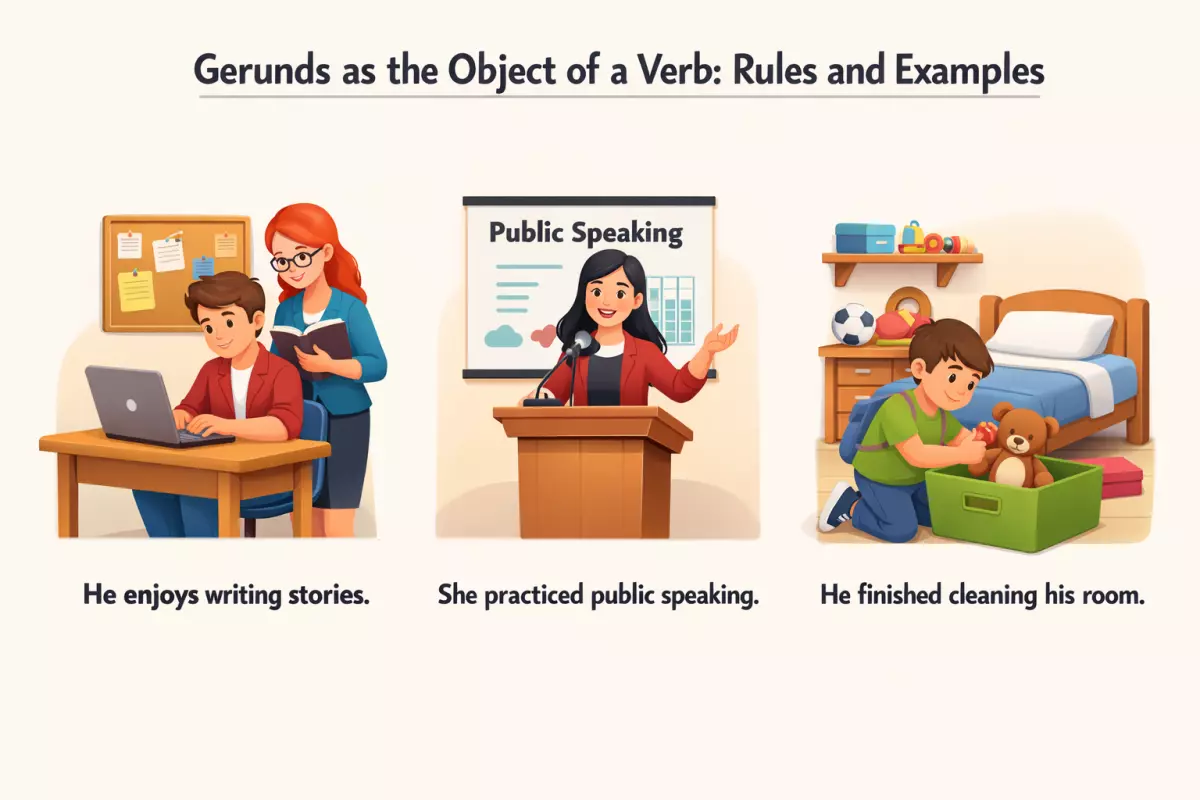 Explains why some verbs require a gerund, lists common gerund-taking verbs, and shows key sentence patterns. Compares gerund objects with infinitive objects, flags mistakes with enjoy, avoid, suggest, teaches spotting gerunds in longer sentences, and ends with fill-in practice.
- Why certain verbs must be followed by a gerund
- The most common verbs that take gerunds as objects
- Sentence patterns with gerunds after verbs
- How gerund objects differ from infinitive objects
- Mistakes learners make with verbs like enjoy, avoid, suggest
- How to recognize gerunds after verbs in longer sentences
- Practice exercises: completing sentences with gerund objects
Many English verbs are naturally followed by an -ing form, and learning this pattern can make you sound more fluent. In everyday speech we say enjoy cooking, avoid driving, or finish studying, because the activity becomes the object of the verb. This guide gives simple rules and practical examples so you can choose the right form with confidence.
Why certain verbs must be followed by a gerund
Some English verbs strongly prefer an -ing form when the next word is a verb acting as the object. This is mostly a pattern you learn as a chunk: the main verb “selects” a gerund because the meaning points to an activity, experience, habit, or mental process rather than a goal or intention.
Common patterns that trigger the -ing form
- Enjoyment and preference: when the verb expresses liking an activity, the object is typically a gerund (e.g., “enjoy reading”).
- Dislike and avoidance: verbs about not wanting an activity often take -ing (e.g., “avoid driving”).
- Finishing, delaying, or stopping: verbs that frame an action as completed or interrupted commonly use a gerund (e.g., “finish writing,” “stop smoking”).
- Mind and tolerate: verbs about whether something bothers you usually take -ing (e.g., “don’t mind waiting,” “can’t stand losing”).
- Suggesting and recommending: when proposing an action, English often uses -ing as the object (e.g., “suggest taking a break”).
- Admitting and denying: verbs that report responsibility or refusal typically take a gerund (e.g., “admit cheating,” “deny copying”).
- Considering and imagining: mental “preview” verbs often select -ing (e.g., “consider moving,” “imagine living abroad”).
- Keeping, practicing, and working on habits: verbs that focus on ongoing behavior tend to use -ing (e.g., “keep trying,” “practice speaking”).
Verbs commonly followed by a gerund (with examples)
- admit + gerund: “She admitted taking the file.”
- avoid + gerund: “They avoided talking about it.”
- can’t help + gerund: “I can’t help laughing.”
- can’t stand + gerund: “He can’t stand waiting.”
- consider + gerund: “We’re considering moving.”
- deny + gerund: “She denied breaking the rule.”
- dislike + gerund: “I dislike driving at night.”
- enjoy + gerund: “They enjoy cooking together.”
- finish + gerund: “Please finish writing the report.”
- give up + gerund: “He gave up smoking.”
- keep + gerund: “She kept asking questions.”
- mind + gerund: “Do you mind opening the window?”
- miss + gerund: “I miss seeing my friends.”
- practice + gerund: “They practice speaking every day.”
- recommend + gerund: “I recommend taking notes.”
- resist + gerund: “He couldn’t resist checking his phone.”
- risk + gerund: “You risk losing your progress.”
- suggest + gerund: “She suggested meeting earlier.”
Usage notes and common learner errors
- Don’t switch to an infinitive just because another language does. Many of these verbs do not normally take “to + verb” as the direct object in standard usage. ✅ “He avoided answering.” ❌ “He avoided to answer.”
- Watch for verb + preposition combinations. If a verb is followed by a preposition, the next verb is usually in -ing form because it functions like a noun after the preposition: “apologize for being late,” “insist on paying.”
- Some verbs allow both forms but change meaning. For example, “stop smoking” (quit the habit) vs. “stop to smoke” (pause an activity in order to smoke). When the meaning is “end an activity,” the gerund is the natural choice.
The most common verbs that take gerunds as objects

Many English verbs naturally take an -ing form after them when the next idea functions like a noun (the thing you do, enjoy, avoid, consider, and so on). In these patterns, the gerund is the direct object of the main verb.
Use the list below as a practical reference. Each item shows a common verb followed by a gerund object, with typical meanings and contexts.
High-frequency verbs followed by a gerund
- enjoy: I enjoy reading before bed.
- avoid: She avoids driving at night.
- finish: We finished cleaning the kitchen.
- stop: He stopped smoking last year.
- keep: They kept talking during the movie.
- consider: I’m considering moving closer to work.
- suggest: She suggested taking the train.
- recommend: The doctor recommended resting for a few days.
- admit: He admitted making a mistake.
- deny: She denied breaking the rules.
- mind: Do you mind opening the window?
- miss: I miss seeing my friends regularly.
- practice: They practice speaking English every day.
- postpone: We postponed meeting until Friday.
- delay: Don’t delay submitting the form.
- risk: You risk losing your data without backups.
- quit: She quit working there in June.
- discuss: They discussed changing the schedule.
Usage notes and common pitfalls
- “Suggest” and “recommend” typically take a gerund object: ✅ She suggested leaving early. ❌ She suggested to leave early.
- “Mind” is often used in questions and polite requests: Do you mind waiting a moment?
- “Stop” + gerund means ending an activity: He stopped talking. (He no longer talks.)
- “Keep” + gerund emphasizes continuation or repetition: She kept asking the same question.
- “Avoid,” “postpone,” and “delay” commonly appear when you talk about not doing something now: We avoided answering the question; They postponed signing the contract.
Sentence patterns with gerunds after verbs
When a verb is followed by another action, English often uses a gerund (verb + -ing) as the object. These patterns are common in everyday writing and speech, and they help you show what activity someone starts, stops, enjoys, avoids, suggests, or keeps doing.
Core structures you can reuse
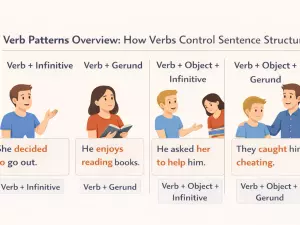
- Subject + verb + gerund: “She enjoys reading.”
- Subject + verb + object + gerund: “They caught him cheating.”
- Subject + verb + gerund + object: “He avoids driving at night.”
- Subject + verb + preposition + gerund: “I apologized for being late.”
- Subject + verb + possessive + gerund (more formal): “She appreciated his helping.”
- There + be + no + gerund (fixed expression): “There’s no knowing what will happen.”
Common verb groups that take a gerund object
- Likes/dislikes: enjoy, like, love, hate, dislike, prefer (often followed by a gerund when talking generally). Example: “We prefer walking.”
- Starting/continuing/stopping: start, begin, continue, keep, stop, quit, finish. Example: “He quit smoking.”
- Avoiding/denying: avoid, deny, resist, risk, postpone, delay. Example: “She denied taking the file.”
- Recommendations and plans: suggest, recommend, consider, propose. Example: “They suggested leaving early.”
- Mind and tolerate: mind, can’t stand, can’t help. Example: “I can’t help laughing.”
- Practice and skill-building: practice, work on. Example: “She practices speaking daily.”
High-value example patterns (correct vs. incorrect)
- ✅ “He avoids talking about money.” ❌ “He avoids to talk about money.”
- ✅ “We finished cleaning the kitchen.” ❌ “We finished to clean the kitchen.”
- ✅ “Do you mind opening the window?” ❌ “Do you mind to open the window?”
- ✅ “She suggested taking a break.” ❌ “She suggested to take a break.”
Expanded set of ready-to-copy sentences
- “I enjoy cooking for friends.”
- “They consider moving closer to work.”
- “He keeps asking the same question.”
- “She avoids driving in heavy traffic.”
- “We finished writing the report.”
- “I can’t stand waiting in long lines.”
- “Do you mind sharing your notes?”
- “They recommended booking in advance.”
- “She admitted making a mistake.”
- “He denied breaking the rules.”
- “We practiced pronouncing the new words.”
- “I miss seeing my classmates.”
- “She postponed meeting the client.”
- “He risked losing his job.”
- “They stopped complaining after the update.”
- “I appreciate you helping me today.”
In these structures, the gerund functions like a noun: it names the activity that completes the meaning of the main verb. If you can replace the -ing phrase with “this activity” and the sentence still makes sense, you are likely using a gerund object correctly.
How gerund objects differ from infinitive objects

Some verbs take an -ing form after them, some take a to-infinitive, and some allow both with either the same meaning or a meaning change. The choice is mostly a matter of verb pattern (what that verb “selects”), plus what you want to emphasize: an activity as a thing (gerund) or a goal/plan (infinitive).
| Pattern after the main verb | Typical use/meaning | Example with an object |
|---|---|---|
| Verb + gerund (-ing) | Focus on the activity as a fact, habit, or experience | She enjoys reading long novels. |
| Verb + to-infinitive | Focus on intention, decision, plan, or purpose | She decided to read a long novel. |
| Verb + gerund (common set) | Often follows verbs about liking/disliking, avoiding, finishing, and considering | They avoided talking about money. |
| Verb + to-infinitive (common set) | Often follows verbs about choosing, promising, hoping, and refusing | He refused to sign the form. |
| Verb + gerund or to-infinitive (little/no meaning change) | Both forms are possible; the difference is often style or emphasis | I like cooking / I like to cook on weekends. |
| Verb + gerund or to-infinitive (meaning changes) | The form signals a different idea (memory, sequence, or result) | She stopped smoking vs. She stopped to smoke. |
Verbs that strongly prefer a gerund object
With these verbs, the -ing form is the standard object pattern. Using a to-infinitive is usually unnatural or changes the structure.
- admit + -ing: He admitted taking the file.
- avoid + -ing: She avoided answering the question.
- consider + -ing: We considered moving closer.
- delay + -ing: They delayed sending the email.
- deny + -ing: He denied breaking the rule.
- discuss + -ing: Let’s discuss changing the schedule.
- enjoy + -ing: I enjoy learning new words.
- finish + -ing: She finished writing the report.
- imagine + -ing: I can’t imagine living there.
- keep + -ing: They kept asking for updates.
- mind + -ing: Do you mind waiting a minute?
- miss + -ing: He misses working with the team.
- practice + -ing: We practiced pronouncing the names.
- recommend + -ing: I recommend taking notes.
- risk + -ing: She risked losing her spot.
- suggest + -ing: They suggested meeting earlier.
Verbs that strongly prefer a to-infinitive object
These verbs typically point forward to an intended action, a choice, or a commitment, so the infinitive fits naturally.
- agree + to-infinitive: They agreed to help us.
- choose + to-infinitive: He chose to stay home.
- decide + to-infinitive: I decided to apply today.
- expect + to-infinitive: We expect to finish soon.
- hope + to-infinitive: She hopes to travel next year.
- learn + to-infinitive: He learned to drive at 18.
- manage + to-infinitive: They managed to solve it.
- offer + to-infinitive: She offered to pay the fee.
- plan + to-infinitive: We plan to meet at noon.
- promise + to-infinitive: He promised to call back.
- refuse + to-infinitive: She refused to answer.
- seem + to-infinitive: It seems to work fine.
- want + to-infinitive: I want to understand this rule.
- would like + to-infinitive: I’d like to speak with you.
Verbs that allow both forms (same meaning or a small shift)
Some verbs can take either form. Often the meaning stays close, but the feel changes: -ing can sound more general/experience-based, while the infinitive can sound more specific or purpose-driven.
- like: I like swimming / I like to swim in the morning.
- love: She loves cooking / She loves to cook for friends.
- hate: He hates waiting / He hates to wait in lines.
- prefer: They prefer walking / They prefer to walk when it’s sunny.
- start / begin (often interchangeable): It started raining / It started to rain.
- continue (often interchangeable): She continued speaking / She continued to speak.
Verbs where the choice changes the meaning
With certain verbs, switching between a gerund object and an infinitive object changes what the sentence means. These are worth learning as fixed contrasts.
- stop: ✅ He stopped smoking (quit the habit). → ✅ He stopped to smoke (paused another activity in order to smoke).
- remember: ✅ I remember locking the door (memory of a past action). → ✅ Remember to lock the door (don’t forget in the future).
- forget: ✅ I’ll never forget meeting her (memory). → ❌ I forgot meeting her (usually odd) / ✅ I forgot to meet her (failed to do it).
- try: ✅ Try restarting the app (experiment: see if it helps). → ✅ Try to restart the app (make an effort; may be difficult).
- regret: ✅ I regret saying that (feel sorry about a past action). → ✅ We regret to inform you (formal announcement of bad news).
- go on: ✅ He went on talking (continued). → ✅ He went on to explain the next step (moved to a new point).
When you are unsure, check the main verb first. If it’s a “preference” verb (enjoy, avoid, finish), an -ing object is usually the safe choice. If it’s a “decision/plan” verb (decide, hope, promise), the to-infinitive is usually the natural pattern.
Mistakes learners make with verbs like enjoy, avoid, suggest
Some verbs strongly prefer a gerund (-ing form) when they take another verb as their object. Errors usually happen when learners switch to an infinitive, forget the object, or use the wrong structure after reporting verbs like suggest.
Common pattern errors (with fixes)
- ❌ I enjoy to swim. → ✅ I enjoy swimming.
- ❌ She avoided to talk about it. → ✅ She avoided talking about it.
- ❌ They suggested to take a taxi. → ✅ They suggested taking a taxi.
- ❌ He admitted to cheat. → ✅ He admitted cheating.
- ❌ We considered to move. → ✅ We considered moving.
- ❌ I can’t stand to wait. → ✅ I can’t stand waiting.
- ❌ She finished to write the email. → ✅ She finished writing the email.
- ❌ Do you mind to open the window? → ✅ Do you mind opening the window?
- ❌ He kept to ask the same question. → ✅ He kept asking the same question.
- ❌ I miss to see my friends. → ✅ I miss seeing my friends.
- ❌ She quit to smoke. → ✅ She quit smoking.
- ❌ We postponed to meet until Friday. → ✅ We postponed meeting until Friday.
Mixing up “suggest” structures
Suggest is a frequent trouble spot because it allows several patterns, but not the “suggest + to + verb” pattern. Use one of these instead:
- ✅ suggest + gerund: They suggested taking a later train.
- ✅ suggest + (that) + clause: They suggested (that) we take a later train.
- ✅ suggest + noun: She suggested a break.
- ❌ suggest + to + verb: She suggested to take a break.
Forgetting the object after the verb
Some verbs can take a gerund directly, but in real use they often need an object to make the meaning complete. Leaving it out can sound unnatural or unclear.
- ❌ He avoided talking. → ✅ He avoided talking about the problem.
- ❌ I enjoy reading. → ✅ I enjoy reading mystery novels.
- ❌ They discussed moving. → ✅ They discussed moving to a new apartment.
- ❌ We considered changing. → ✅ We considered changing the schedule.
Using the wrong form after prepositions
Even when a verb is not on a “gerund-only” list, a preposition forces the -ing form. Learners often use an infinitive here by mistake.
- ❌ She insisted on to paying for lunch. → ✅ She insisted on paying for lunch.
- ❌ He apologized for to being late. → ✅ He apologized for being late.
- ❌ They talked about to moving. → ✅ They talked about moving.
- ❌ I’m interested in to learning more. → ✅ I’m interested in learning more.
Confusing gerunds with bare verbs after “help” and “make”
Not every verb pattern uses a gerund. A common overcorrection is adding -ing when the structure requires a bare infinitive (or “to” infinitive).
- ❌ This app helps me finding restaurants. → ✅ This app helps me find restaurants / helps me to find restaurants.
- ❌ The teacher made us studying. → ✅ The teacher made us study.
How to recognize gerunds after verbs in longer sentences
In longer sentences, a gerund object can be easy to miss because extra details (adverbs, prepositional phrases, interruptions, and even whole clauses) sit between the verb and the -ing form. The key is to locate the main verb first, then ask what action or activity completes its meaning. If the answer is an -ing word functioning as a noun, you are looking at a gerund used as the object of the verb.
Step-by-step checks for spotting the gerund object
- Find the main verb (the verb that carries the sentence’s core meaning), not a verb inside a relative clause or an aside.
- Look for an -ing form that behaves like a noun: it can be replaced by “it/this/that” without breaking the grammar (even if the meaning becomes vague).
- Ignore “noise” between the verb and the -ing form, such as time phrases, adverbs, or parenthetical comments.
- Check whether the -ing form has its own object (a strong sign it is a gerund phrase): “avoid making mistakes,” “consider joining the team.”
- Confirm it answers “what?” after the verb: “She suggested leaving early.” (Suggested what? Leaving early.)
- Watch for pronouns before the -ing form: “I appreciate your helping.” Here, “helping” is still the object; “your” marks who does the action.
- Don’t confuse it with a present participle: if the -ing word describes a noun (“the student working late”), it is not the verb’s object.
- Check for a preposition: if the -ing form follows a preposition (“insisted on leaving”), it is not the direct object of the verb; it is the object of the preposition.
- Test whether an infinitive would change the meaning: some verbs prefer a gerund and switching to “to + verb” is unnatural or changes the message (“avoid to do” ❌).
Common “long sentence” patterns that hide the gerund
- Verb + adverbial interruption + gerund: “She kept, despite the delays, trying to finish.”
- Verb + time/place phrase + gerund: “They discussed the issue all morning, considering several options.”
- Verb + indirect object + gerund: “He recommended us taking the earlier train.”
- Verb + (not) + gerund: “I regret not calling sooner.”
- Verb + gerund phrase with its own object: “She imagined moving to a new city.”
- Verb + gerund + modifiers: “We postponed meeting until next week.”
- Reporting verb + gerund in a longer complement: “He admitted, after a long pause, breaking the rule.”
- Verb + coordinated gerunds: “She enjoys reading novels and watching documentaries.”
Examples with the gerund object highlighted
- She avoided answering the question during the meeting.
- They considered, after reviewing the budget, cutting unnecessary costs.
- I appreciate your explaining the process so clearly.
- We discussed moving the deadline, but no one agreed.
- He admitted taking the file by mistake.
- The team postponed launching the update until the bugs were fixed.
- She suggested meeting near the station to save time.
- They finished packing just before the taxi arrived.
- He kept asking for feedback, even after the decision was made.
- We practiced pronouncing the new terms in full sentences.
- I regret not checking the address before leaving.
- She can’t stand waiting in long lines.
- They risked missing the flight by taking a later bus.
- He denied sharing the password with anyone.
- We enjoy working with clear deadlines and realistic goals.
- She quit smoking after the health scare.
Quick “gerund vs. participle” check in long sentences
- ✅ Gerund object (noun role): “She dislikes driving at night.” (Dislikes what? Driving.)
- ❌ Participle (adjective role): “She watched the car driving away.” (Driving describes “car,” not the object of “watched.”)
- ✅ Gerund phrase as object: “They avoided talking about money.”
- ❌ Participle clause adding extra info: “Talking about money, they looked uncomfortable.” (Intro clause; not an object of a verb.)
Practice exercises: completing sentences with gerund objects
Choose the correct gerund (verb + -ing) to complete each sentence. Focus on the pattern verb + gerund (for example, enjoy doing, avoid doing, consider doing). Some items also test gerunds after prepositions (for example, interested in doing).
Exercise 1: Fill in the blank with the correct gerund
- I enjoy ________ (cook) for friends on weekends.
- She avoided ________ (talk) about the mistake during the meeting.
- They considered ________ (move) closer to the office.
- We finished ________ (clean) the kitchen before the guests arrived.
- He suggested ________ (take) a short break.
- My parents don’t mind ________ (wait) if the line is long.
- Did you miss ________ (see) the final scene?
- I can’t imagine ________ (live) without internet access.
- The team practiced ________ (present) the proposal clearly.
- She kept ________ (ask) the same question.
- He admitted ________ (forget) to reply to the email.
- We postponed ________ (start) the project until next month.
Show answers
- cooking
- talking
- moving
- cleaning
- taking
- waiting
- seeing
- living
- presenting
- asking
- forgetting
- starting
Exercise 2: Choose the best completion (gerund vs. infinitive)
Complete each sentence with the correct form. Use a gerund when the main verb normally takes a gerund object; use an infinitive where that pattern is standard.
- He promised ________ (call / calling) after work.
- She recommended ________ (visit / to visit) the museum early.
- We decided ________ (leave / leaving) before the traffic got worse.
- They avoided ________ (drive / to drive) at night.
- I hope ________ (meet / meeting) your colleagues soon.
- He denied ________ (take / to take) the documents.
- She offered ________ (help / helping) with the report.
- We discussed ________ (change / to change) the schedule.
- They agreed ________ (share / sharing) the costs.
- He can’t stand ________ (wait / to wait) in long lines.
Show answers
- to call
- visiting
- to leave
- driving
- to meet
- taking
- to help
- changing
- to share
- waiting
Exercise 3: Complete sentences with a gerund after a preposition
Fill in each blank with the gerund form of the verb in parentheses. Watch for prepositions like in, of, about, for, and on, which are typically followed by a gerund.
- She’s interested in ________ (learn) Japanese.
- They apologized for ________ (arrive) late.
- I’m tired of ________ (hear) the same excuse.
- He insisted on ________ (pay) for dinner.
- We talked about ________ (expand) the team.
- Thank you for ________ (help) me with the forms.
- She’s good at ________ (solve) puzzles quickly.
- He left without ________ (say) goodbye.
Show answers
- learning
- arriving
- hearing
- paying
- expanding
- helping
- solving
- saying
Quick pattern reminder (for checking your choices)
- Common verbs that take a gerund object: enjoy, avoid, consider, finish, suggest, mind, miss, imagine, practice, keep, admit, deny, postpone, discuss, can’t stand.
- Common verbs that take an infinitive: promise, decide, hope, offer, agree, plan, want, need.
- After a preposition, use a gerund: interested in doing, good at doing, apologize for doing, insist on doing, talk about doing, without doing.