Infinitives of Purpose in English: How to Use “To”

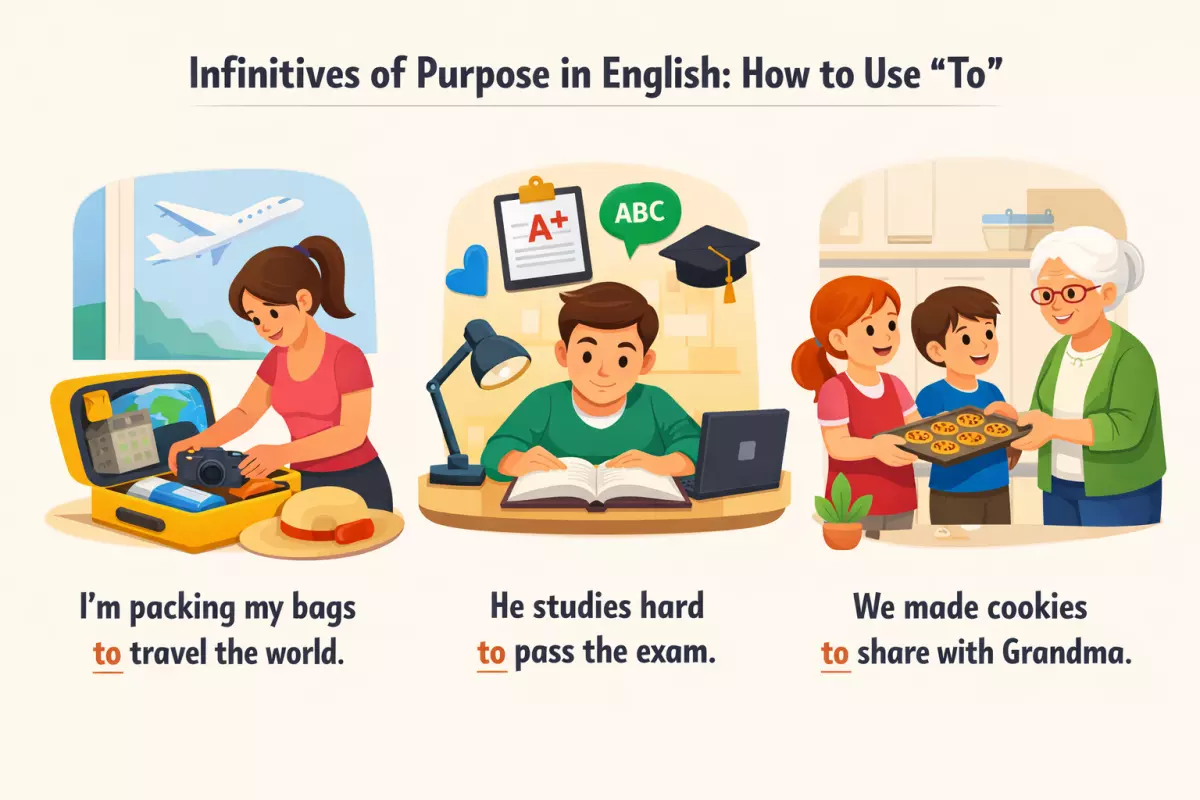 This article explains what an infinitive of purpose is, how to use to plus a verb to show why you do something, common sentence patterns, and where it goes in a sentence. It also compares it with for and so that, flags common mistakes, and gives practice exercises.
- What an infinitive of purpose means in English sentences
- How to use 'to + verb' to explain the purpose of an action
- Common sentence structures with infinitives of purpose
- How infinitives of purpose differ from 'for' and 'so that' constructions
- Where the infinitive of purpose is placed in a sentence
- Common learner mistakes when expressing purpose with infinitives
- Practice exercises: write sentences with infinitives of purpose
To explain why you do something in English, the simple phrase to plus a verb often works well. You hear it all the time: I stopped to buy milk, She called to check in, We met to talk. In this lesson, you will learn how to use this structure naturally so your reasons sound clear, polite, and realistic in everyday conversation.
What an infinitive of purpose means in English sentences
An infinitive phrase with to often answers the question “Why?” by stating the goal or intention behind an action. It links an activity to its purpose in a compact way: action + to + base verb. This structure is common in both speaking and writing because it clearly shows motivation without adding an extra clause.
Core meaning and basic pattern
Use to + verb when you want to express the intended result of an action. The main clause describes what someone does; the infinitive phrase explains the reason for doing it.
- Pattern: subject + verb + … + to + base verb
- Meaning: “in order to,” “so as to,” “with the aim of” (usually implied, not stated)
- Typical question it answers: “Why did they do that?”
Where it appears in a sentence
Purpose infinitives most often come after the main verb, but they can also appear earlier for emphasis. The meaning stays the same; the position mainly affects focus and rhythm.
- After the verb (most common): “She called to confirm the time.”
- After an object: “He brought a notebook to take notes.”
- At the beginning (more formal): “To avoid delays, arrive early.”
Common verbs and situations that use it
This structure often follows verbs of movement, communication, preparation, and problem-solving. The infinitive phrase adds a clear goal to the action.
- “I went to the pharmacy to pick up a prescription.”
- “They met to discuss the budget.”
- “She opened the window to get some fresh air.”
- “We saved money to buy a used car.”
- “He studied the manual to understand the settings.”
- “I’m writing to ask a quick question.”
- “She paused to think.”
- “They hired a tutor to improve their pronunciation.”
- “He checked the lock to make sure it was secure.”
- “We turned down the music to hear the announcement.”
- “I set an alarm to wake up on time.”
- “She used a spreadsheet to track expenses.”
- “They moved the meeting to accommodate everyone.”
- “He wore gloves to protect his hands.”
- “I left early to avoid traffic.”
How it differs from related purpose forms
English has several ways to express intention. The infinitive is usually the most direct and neutral choice. Use these alternatives when you need a different tone or structure.
- “to + verb” (neutral, very common): “She stayed late to finish the report.”
- “in order to + verb” (more explicit, often more formal): “She stayed late in order to finish the report.”
- “so as to + verb” (formal, often used to sound careful): “She stayed late so as to finish the report.”
- “for + noun” (purpose expressed as a noun, not an action): “She stayed late for the deadline.”
Meaning checks and common mistakes
A purpose infinitive should describe an intended goal, not a result that happened by accident. It also uses the base verb (not -ing) after to.
- ✅ “He went online to pay the bill.” → intention
- ❌ “He went online to paying the bill.” → incorrect verb form
- ✅ “I turned off notifications to focus.” → purpose
- ❌ “I turned off notifications to focused.” → incorrect verb form
- ✅ “She whispered to avoid waking the baby.” → goal
- ❌ “She whispered to avoided waking the baby.” → incorrect verb form
How to use 'to + verb' to explain the purpose of an action
Use to + base verb when you want to state the goal or intended result of an action. This structure is common in both speaking and writing because it is short, direct, and easy to place after the main clause.
Core pattern
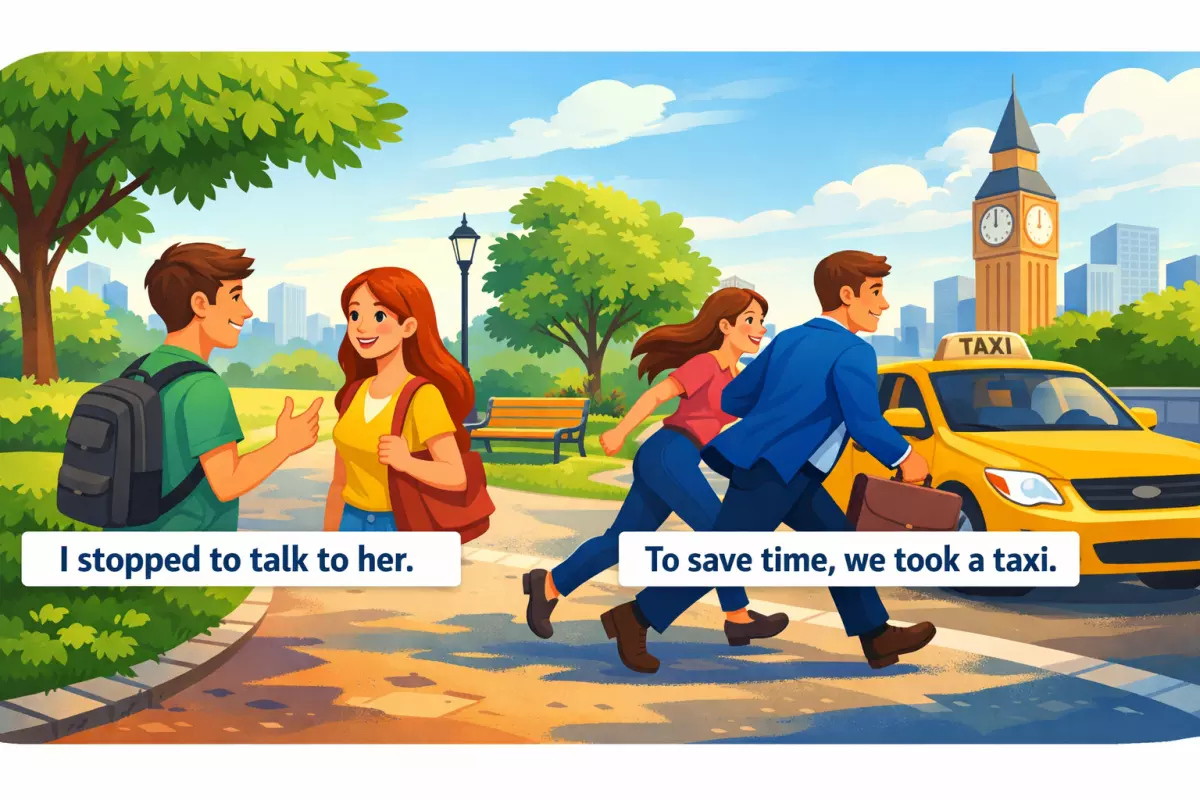
- Subject + verb + to + base verb: “I stopped to talk to her.”
- Subject + verb + object + to + base verb: “She called him to confirm the time.”
- To + base verb can also come first for emphasis (more formal): “To save time, we took a taxi.”
Where to place the purpose infinitive
- After the main action (most common): “We met to discuss the budget.”
- After the object when the purpose relates to that object: “He bought a notebook to write ideas in.”
- At the beginning to highlight intention: “To avoid confusion, label the files clearly.”
- Near the verb it explains to prevent ambiguity: “She went to the bank to open an account” (clearer than placing it far away).
Common verbs that often take a purpose infinitive
- go / come: “I went to the store to get milk.”
- stop: “He stopped to tie his shoe.”
- meet: “They met to plan the event.”
- call: “I’m calling to ask a question.”
- email / text: “She texted to check if you’re free.”
- visit: “We visited to see the new office.”
- open / close: “Open the window to let in fresh air.”
- use: “Use this key to unlock the door.”
- learn: “He’s studying to become a nurse.”
- practice: “I practice daily to improve my pronunciation.”
- save: “She’s saving money to buy a car.”
- wear: “He wore gloves to protect his hands.”
- turn off: “Turn off notifications to focus.”
- take: “Take an umbrella to stay dry.”
- hire: “They hired a guide to show them the city.”
Meaning check: purpose vs. result
- With this structure, the second verb expresses intention, not what actually happened: “I went there to talk to her” (the plan was to talk; it may or may not have happened).
- If you need to show an actual result, you often use a different structure (for example, “so” or “and”): “I went there and talked to her.”
Typical mistakes to avoid
- ❌ “I went to home to rest.” → ✅ “I went home to rest.” (no “to” before “home”)
- ❌ “He explained me to understand.” → ✅ “He explained it to help me understand.” (use an object; the purpose is “to help”)
- ❌ “She stopped to smoking.” → ✅ “She stopped to smoke.” / “She stopped smoking.” (different meanings)
- ❌ “I’m here for to talk.” → ✅ “I’m here to talk.” (avoid “for to” in modern standard English)
Quick contrast: “stop to do” vs. “stop doing”
- stop to + verb = pause one action in order to do another: “She stopped to answer the phone.”
- stop + -ing = end an activity: “She stopped answering the phone.”
Common sentence structures with infinitives of purpose
Purpose infinitives usually appear after a complete clause and explain the goal of an action. The patterns below show where the “to + base verb” phrase fits in a sentence and what kinds of verbs commonly introduce it.
Core patterns
- Subject + verb + to-infinitive: “I stopped to talk to my teacher.”
- Subject + verb + object + to-infinitive: “She called her friend to ask for advice.”
- Subject + verb + (object) + to-infinitive + rest of sentence: “They moved to a bigger apartment to have more space.”
- Subject + be + adjective + to-infinitive (purpose/goal from the adjective): “I’m ready to leave.”
- Subject + verb + in order to + infinitive (more explicit/formal): “He saved money in order to buy a car.”
- Subject + verb + so as to + infinitive (often formal; common in writing): “Please speak quietly so as to avoid waking the baby.”
Common verb groups that take a purpose infinitive
- Movement + purpose: “We went downtown to meet a client.”
- Stopping/pausing + purpose: “He pulled over to check the map.”
- Communication + purpose: “I emailed you to confirm the time.”
- Preparation + purpose: “She studied all weekend to pass the exam.”
- Using tools/technology + purpose: “I used a calculator to double-check the total.”
- Effort/attempt + purpose: “They tried again to solve the problem.”
Placement and punctuation: what sounds natural
- Most often at the end: “I’m taking notes to remember the key points.”
- At the beginning for emphasis (often with a comma): “To avoid delays, arrive early.”
- After the object when there is one: “He invited everyone to celebrate his promotion.”
- Don’t split the action and the goal too far apart: prefer “She turned on the lights to see better” over inserting long phrases between the verb and the purpose.
Purpose vs. other meanings (quick contrasts)
- ✅ Purpose: “I went to the store to buy milk.” → goal of going
- ✅ Result/next step (not purpose): “He grew up to become a doctor.” → what happened later
- ✅ Reason with adjective: “I’m happy to help.” → attitude + action
- ❌ Wrong form: “I went to the store for buy milk.” → use “to buy” or “to buy milk”
Expanded example bank (useful sentence frames)
- “I’m calling to ask a quick question.”
- “She opened the window to get some fresh air.”
- “We booked a table to celebrate your birthday.”
- “He wore a jacket to stay warm.”
- “They left early to avoid traffic.”
- “I wrote it down to make sure I wouldn’t forget.”
- “She turned down the music to focus.”
- “We met after class to review the assignment.”
- “He raised his hand to answer the question.”
- “I’m saving this article to read later.”
- “They practiced daily to improve their pronunciation.”
- “I moved my chair to see the screen better.”
- “She brought snacks to share with everyone.”
- “We installed the update to fix the bug.”
- “He joined the gym to get stronger.”
- “I checked the schedule to confirm the meeting room.”
How infinitives of purpose differ from 'for' and 'so that' constructions
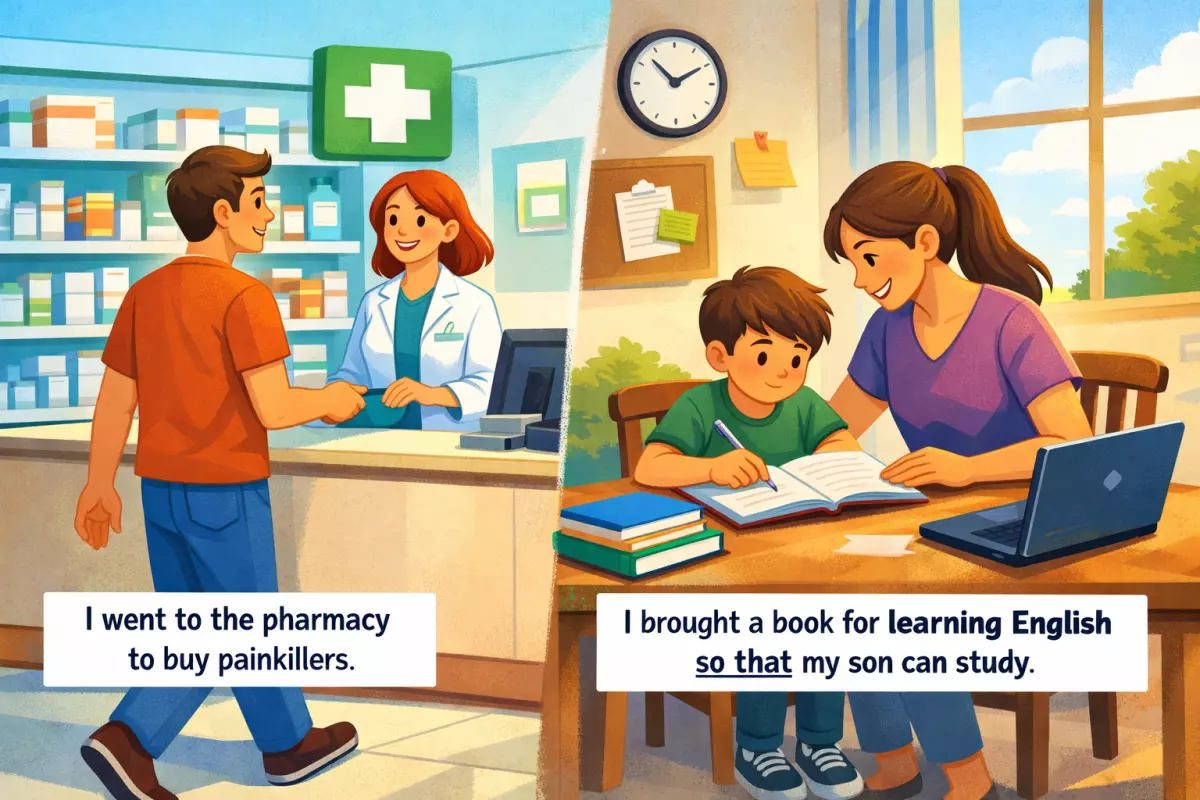
English offers several ways to express purpose. The to + base verb pattern is often the most direct, but for and so that are used when the grammar or meaning needs something different (for example, a noun instead of a verb, or a full clause with a subject).
| Structure | Typical use | Pattern | Example |
|---|---|---|---|
| Infinitive of purpose | Simple purpose with the same implied subject | to + base verb | I went to the pharmacy to buy painkillers. |
| For + noun / -ing | Purpose expressed as a thing/activity (not a full verb action) | for + noun / for + -ing | This tool is for cutting glass. |
| For + person + to + verb | Purpose where the doer is a different person | for + object + to + base verb | I left a note for Sam to read. |
| So that + clause | Purpose with a full clause; common for results, clarity, or ability | so that + subject + verb | Speak slowly so that everyone understands. |
| So that + modal | Purpose involving ability/permission/possibility | so that + can/could/will/would/may/might | I’ll email you the file so that you can review it. |
When “to + verb” is the best choice
Use an infinitive when the purpose is straightforward and the subject is understood to be the same as in the main clause.
- I’m calling to confirm the appointment.
- She opened the window to let in fresh air.
- They met to discuss the budget.
- We took a taxi to avoid being late.
- He studied hard to pass the exam.
- Please sit down to sign the form.
When “for” is more natural than an infinitive
For commonly introduces a noun or an -ing form that names the function of something. It often answers “What is it used for?” rather than “Why did someone do it?”
- This room is for meetings.
- Do you have a brush for cleaning bottles?
- The label is for identifying the cables.
- That money is for rent, not for shopping.
- A VPN is useful for protecting your connection on public Wi‑Fi.
“For + person + to + verb”: purpose with a different doer
If the person who will do the action is not the subject of the main clause, English often uses for + object + to.
- I arranged a meeting for the team to review the plan.
- We’re waiting for the technician to arrive.
- She saved a seat for her friend to join us.
- He wrote instructions for customers to follow.
When “so that” is the clearer option
So that introduces a full clause, which makes it useful when you need to state the subject explicitly, show a cause-and-effect relationship, or include a modal verb (can/could/might, etc.).
- Turn on the subtitles so that you can follow the dialogue.
- I’ll repeat it so that everyone hears the number.
- We left early so that we wouldn’t miss the train.
- Keep the receipt so that you can return it if needed.
- He wrote it down so that he might remember later.
Quick correctness checks
- ✅ I went to the store to buy milk. → Simple purpose (infinitive).
- ✅ This button is for resetting the device. → Function/use (for + -ing).
- ✅ I brought a form for you to sign. → Different doer (for + person + to).
- ✅ I whispered so that nobody would hear. → Full clause with subject/modal.
- ❌ This button is to reset the device. → Possible in some contexts, but “for resetting” is usually more natural for describing function.
Where the infinitive of purpose is placed in a sentence
An infinitive phrase that explains someone’s goal (to + base verb) most often comes after the action it explains. Placement is mainly about clarity: put the purpose close to the verb or clause it belongs to, and avoid positions that make it look like it modifies the wrong word.
Common positions and what they imply
- After the main verb (most common): This is the default pattern for stating a reason.
✅ I went to the pharmacy to buy cough medicine. - After the object: Use this when the purpose relates to what you did with the object.
✅ She opened the window to let some air in. - At the end of the sentence (especially in longer sentences): This keeps the main message clear before adding the goal.
✅ We reviewed the data carefully, to identify any unusual patterns. - After a clause (comma optional depending on length): Helpful when the purpose applies to the whole clause, not just one verb.
✅ He lowered his voice (,) to avoid waking the baby. - Near the beginning (less common; use for emphasis): This can work, but it may sound formal or create ambiguity if the subject isn’t clear.
✅ To save time, we took the train. - Immediately after the subject (usually avoid): This often sounds awkward or can confuse what the phrase modifies.
❌ She to save money bought a used car. → ✅ She bought a used car to save money.
Placement rules that prevent confusion
- Keep the purpose next to the action it explains: If another verb comes between them, readers may attach the goal to the wrong verb.
❌ I called my manager and emailed HR to ask for a day off. (Which action was “to ask”?)
✅ I called my manager to ask for a day off and emailed HR afterward. - Avoid “dangling” purpose phrases at the start: When the infinitive comes first, make sure the subject that follows is the one who has the goal.
❌ To get a refund, the receipt was required. → ✅ To get a refund, you need the receipt. - Use a comma when the opening phrase is long: Short openers may not need punctuation; longer ones read better with a comma.
✅ To reduce noise, we installed thicker curtains. - Don’t split the verb and its object with the purpose phrase: Keep “verb + object” together when possible.
❌ She explained to clarify the policy the new rules. → ✅ She explained the new rules to clarify the policy. - Be careful with pronouns like “it” and “this”: If the referent isn’t clear, move the infinitive closer to the noun it relates to.
✅ We changed the schedule to avoid a conflict.
More model sentences (natural patterns)
- I stopped by the store to pick up milk.
- They met early to prepare for the presentation.
- He turned off notifications to focus on writing.
- We booked a larger room to accommodate the team.
- She wore a jacket to stay warm.
- I’m calling to confirm your appointment.
- He paused to think before answering.
- They saved the file locally to avoid connection issues.
- She took notes to remember the details.
- We ran tests to check for errors.
- He moved the meeting to make room for the client call.
- I set an alarm to wake up on time.
- They spoke quietly to not disturb anyone.
- She updated the document to reflect the latest changes.
- We compared quotes to find the best price.
Common learner mistakes when expressing purpose with infinitives
Purpose with to + base verb is usually straightforward, but learners often overuse it, attach it to the wrong verb, or choose it when a different structure is needed. The points below highlight frequent pattern problems and show how to correct them.
Frequent errors and how to fix them
-
Using “for + verb” instead of “to + verb”
❌ I went to the shop for buy milk. → ✅ I went to the shop to buy milk.
Use to + infinitive for purpose. Use for + noun (not a verb) when the purpose is expressed as a thing: I went to the shop for milk.
-
Adding “to” after a preposition
❌ I’m interested to learn English. → ✅ I’m interested in learning English.
After prepositions (in, at, about, for, etc.), use a noun or -ing, not an infinitive.
-
Using an infinitive when the meaning is “so that” (result/purpose with a subject)
❌ I closed the window to the baby doesn’t wake up. → ✅ I closed the window so that the baby wouldn’t wake up.
Use so that + clause when you need a full clause with its own subject and verb.
-
Confusing purpose with reason (because)
❌ I stayed home to I was sick. → ✅ I stayed home because I was sick.
Infinitives answer “What is the goal?”; “because” explains the cause.
-
Misplacing the infinitive (unclear attachment)
❌ She told her friend to leave early about the meeting. → ✅ She told her friend about the meeting so that they could leave early.
Place the purpose phrase next to the action it explains. If it attaches to the wrong verb, rewrite.
-
Using “to” after certain verbs that take different patterns
❌ I suggested to go earlier. → ✅ I suggested going earlier / I suggested that we go earlier.
Some verbs don’t take an infinitive (suggest, recommend, avoid, consider). Learn their common complements.
-
Overusing “in order to” in simple sentences
✅ I called to confirm the time. (natural)
“In order to” is correct, but it can sound heavy. Use it mainly when you need emphasis or clarity: I left early in order to avoid traffic.
-
Forgetting the base form after “to”
❌ I went out to bought bread. → ✅ I went out to buy bread.
After “to,” use the base verb (buy, go, see), not past tense or -ing.
-
Using an infinitive where English prefers “for + -ing” (function/use)
❌ This tool is to cutting wood. → ✅ This tool is for cutting wood.
To describe what something is used for, for + -ing is often more natural than an infinitive.
-
Mixing “to” purpose with “to” as direction
❌ I went to the station to London. → ✅ I went to the station to go to London / I went to London.
“To London” can be direction/destination, not a purpose. If you mean the goal of the trip to the station, add the verb: to catch a train, to go to London.
-
Using “to” purpose after a noun when a relative clause is needed
❌ I need a person to can help me. → ✅ I need a person who can help me.
After a noun, an infinitive can describe function (a tool to open bottles), but if you need a modal or a full verb phrase, use a clause (who/that).
-
Creating double-purpose structures
❌ I went there for to see him. → ✅ I went there to see him.
Avoid stacking markers. Choose one purpose form.
-
Using an infinitive when the meaning is “too…to” or “enough…to”
❌ I’m very tired to work. → ✅ I’m too tired to work / I’m tired but I can work.
“Too/enough + adjective + to” expresses ability/limit, not goal. Don’t use it when you mean intention.
-
Using “to” purpose with a passive meaning when “to be + past participle” is required
❌ The form is required to fill. → ✅ The form is required to be filled.
If the subject receives the action, use the passive infinitive: to be + past participle.
When checking your own sentences, ask two questions: “Is this the goal of the action?” and “Does to introduce a base verb?” If either answer is no, a clause (so that), a preposition + -ing, or a different verb pattern may be the better choice.
Practice exercises: write sentences with infinitives of purpose
Use these activities to build sentences that explain a goal with to + base verb. Focus on the pattern “main action + to + purpose” and keep the purpose verb in the infinitive (to study, to save, to meet).
1) Combine two ideas into one sentence
Rewrite each pair as a single sentence using an infinitive to show purpose.
- I went to the pharmacy. I needed to buy painkillers.
- She turned on the subtitles. She wanted to understand the dialogue.
- They saved money. They planned to travel in July.
- He called the help desk. He needed to reset his password.
- We left early. We wanted to avoid traffic.
- Maria opened a new tab. She needed to check the schedule.
- The team met after lunch. They wanted to review the proposal.
- I’m taking a short course. I want to improve my writing.
- He wore gloves. He wanted to protect his hands.
- She set an alarm. She didn’t want to miss the train.
Show answers
- I went to the pharmacy to buy painkillers.
- She turned on the subtitles to understand the dialogue.
- They saved money to travel in July.
- He called the help desk to reset his password.
- We left early to avoid traffic.
- Maria opened a new tab to check the schedule.
- The team met after lunch to review the proposal.
- I’m taking a short course to improve my writing.
- He wore gloves to protect his hands.
- She set an alarm to avoid missing the train.
2) Fill in the purpose (write the infinitive)
Complete each sentence with a logical purpose using to + verb. More than one answer may be correct.
- I’m going to the library to __________.
- He bought a portable charger to __________.
- We’re meeting at 6 p.m. to __________.
- She muted her phone to __________.
- They installed a new lock to __________.
- I’m rewriting the introduction to __________.
- He started jogging to __________.
- We used a checklist to __________.
- She emailed the landlord to __________.
- I’m setting reminders to __________.
Show answers
- …to study / to return books / to print an article.
- …to charge his phone on the go / to keep his phone powered.
- …to discuss the plan / to have dinner / to practice.
- …to focus / to avoid interruptions / to stop notifications.
- …to improve security / to keep the door safe / to prevent break-ins.
- …to make it clearer / to improve the flow / to shorten it.
- …to get fitter / to lose weight / to reduce stress.
- …to avoid mistakes / to stay organized / to track tasks.
- …to report a problem / to ask a question / to request repairs.
- …to remember appointments / to stay on schedule / to build a habit.
3) Correct the purpose expression
Each sentence has a problem with how it shows purpose. Rewrite it using the infinitive pattern.
- I went to the store for buy milk.
- She called me to that we can talk.
- They opened the window for letting in fresh air.
- He studied hard for pass the exam.
- We brought snacks for to share.
- I’m saving this file for send it later.
- She took notes to remembering the details.
- He moved closer for hear better.
Show answers
- I went to the store to buy milk.
- She called me to talk.
- They opened the window to let in fresh air.
- He studied hard to pass the exam.
- We brought snacks to share.
- I’m saving this file to send later.
- She took notes to remember the details.
- He moved closer to hear better.
4) Expand prompts into full sentences (choose a subject and tense)
Turn each prompt into a natural sentence that includes a purpose infinitive. Add any details you need (time, place, object).
- (book / appointment) + to + (avoid / waiting)
- (wear / headset) + to + (join / meeting)
- (update / résumé) + to + (apply / job)
- (turn down / music) + to + (concentrate)
- (take / umbrella) + to + (stay / dry)
- (ask / question) + to + (clarify / instructions)
- (back up / photos) + to + (keep / safe)
- (practice / pronunciation) + to + (sound / clearer)
Show answers
- I booked an appointment to avoid waiting.
- She wore a headset to join the meeting.
- He updated his résumé to apply for a job.
- They turned down the music to concentrate.
- I took an umbrella to stay dry.
- We asked a question to clarify the instructions.
- She backed up her photos to keep them safe.
- He practices pronunciation to sound clearer.
Quick self-check (before you move on)
- Use the base verb after to: “to learn,” not “to learning.”
- Place the purpose close to the main action: “I called you to confirm,” not far away from the verb it explains.
- If the goal is negative, use to avoid + -ing or not to + verb: “to avoid missing the bus” / “not to miss the bus.”
- Keep it concise when possible: “She went to the bank to deposit a check.”