Infinitives After Modal Verbs: Rules and Examples

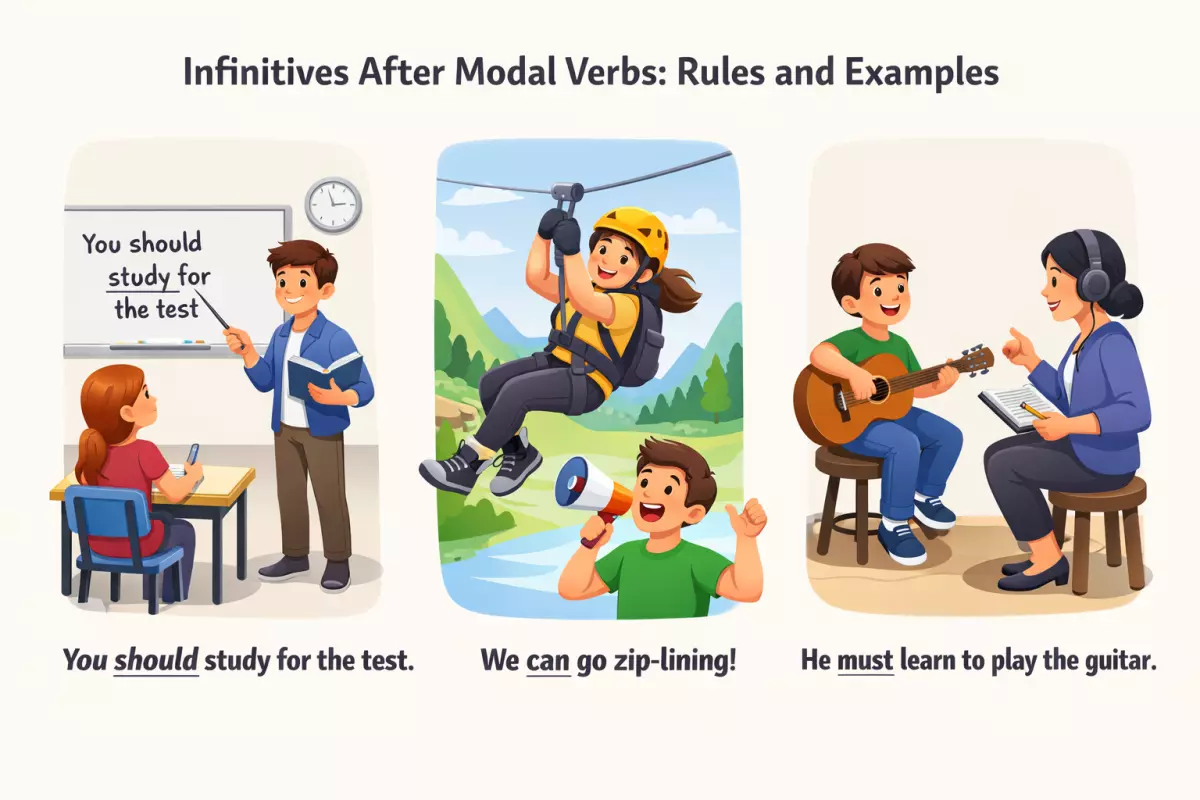 Learn why modal verbs take the bare infinitive, how sentences work with can, must, should, and may, and how each modal shifts meaning. It covers negatives, questions, common mistakes, perfect forms like may have done, and practice fill-ins.
- Why modal verbs are followed by the bare infinitive
- Sentence structure with modals like can, must, should, may
- How different modal verbs change the meaning of a sentence
- Using modal verbs in negative and question forms
- Common learner mistakes with modal + infinitive combinations
- Using modal verbs with perfect infinitives like may have done
- Practice exercises: complete sentences with modal verbs and infinitives
Modal verbs are followed by the base form of a verb, and using this pattern makes your English sound more natural. In daily speech we say can go, should call, and might help, not can to go or should to call. This guide explains the basic rule, shows how to form negatives and questions, and highlights common learner mistakes with clear examples you can use immediately.
Why modal verbs are followed by the bare infinitive
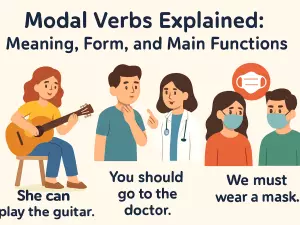
After a modal verb (like can, must, or should), English normally uses the base form of the verb (the “bare” infinitive) without to. This pattern is part of how modals work: they act as helper verbs that add meanings such as ability, obligation, permission, advice, or possibility, while the main verb stays in its simplest form.
Core pattern: modal + base verb
Modals don’t take typical verb endings (no -s, -ed, -ing), and they don’t use to before the next verb. Instead, they form a compact verb phrase:
- modal + bare infinitive: She can drive.
- modal + not + bare infinitive: You should not skip breakfast.
- modal + subject + bare infinitive (questions): Can you help?
- modal in short answers (main verb omitted): “Should I call?” “Yes, you should.”
Usage logic: what the modal contributes
The modal carries the “extra” meaning (certainty, necessity, permission, etc.), so the following verb does not need an infinitive marker. Compare the roles:
- Modal sets the attitude or force: must (necessity), might (possibility), should (recommendation).
- Main verb names the action/state in a neutral form: leave, wait, know, be.
Common correct vs. incorrect forms
- ✅ I can swim. ❌ I can to swim.
- ✅ You must wear a seatbelt. ❌ You must to wear a seatbelt.
- ✅ She should call him. ❌ She should to call him.
- ✅ We may leave early. ❌ We may to leave early.
- ✅ They might arrive late. ❌ They might to arrive late.
- ✅ He will help you. ❌ He will to help you.
Expanded examples: the bare infinitive after different modals
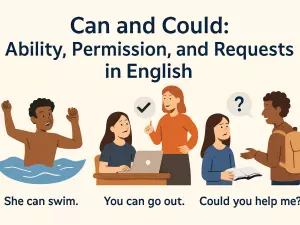
- Ability: She can read fast.
- Inability: I can’t hear you.
- Permission: You may sit here.
- Informal permission: You can use my phone.
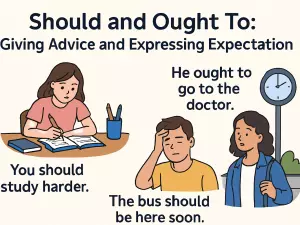
- Advice: You should save your work.
- Strong advice: You ought to check the date.
- Obligation: You must show ID.
- No obligation: You don’t have to come early.
- Prohibition: You mustn’t touch that.
- Possibility: It might rain later.
- Expectation: She should arrive soon.
- Prediction: They will win.
- Willingness: I will explain it again.
- Polite request: Could you open the window?
- Suggestion: We could try a different route.
- Deduction: He must be tired.
Important exceptions and near-exceptions
- Ought is the main modal-like verb that typically uses to: ✅ You ought to apologize. (Not bare infinitive.)
- Have to and be able to are semi-modals, not true modals, so they use to: ✅ I have to leave. ✅ She is able to swim.
- Modal + perfect still keeps the bare infinitive after the modal, but the next verb is have: ✅ She might have missed the train.
- Modal + passive uses bare be: ✅ The form must be signed.
- Modal + continuous uses bare be: ✅ He may be waiting outside.
Sentence structure with modals like can, must, should, may
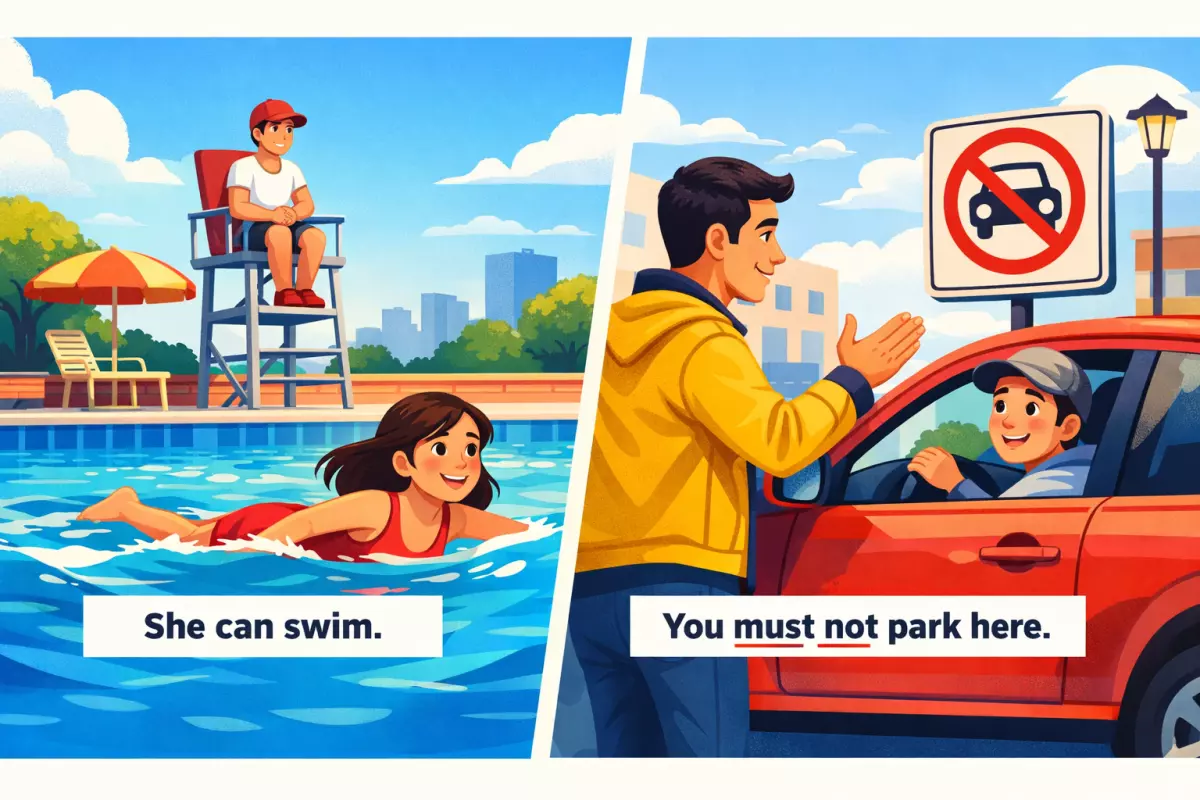
Modal verbs are followed by the base form of a verb (the bare infinitive), not to + verb. This creates a compact pattern for ability, obligation, advice, permission, and possibility.
Core word order patterns
- Affirmative: Subject + modal + base verb (+ object/complement).
✅ She can swim. / We should leave now. - Negative: Subject + modal + not + base verb.
✅ You must not park here. / He may not know the answer. - Yes/No question: Modal + subject + base verb?
✅ Can you help? / Should we call them? - Wh-question: Wh-word + modal + subject + base verb?
✅ Where can I sit? / Why must we wait? - Short answers: Modal (+ not).
✅ “Can you drive?” “Yes, I can.” / “No, I can’t.” - Tag questions: Statement + comma + modal (opposite polarity) + pronoun?
✅ You can finish today, can’t you? / She shouldn’t worry, should she?
Infinitive choice after modals
- Use the bare infinitive: can go, must leave, should try, may ask.
- ❌ Do not add “to” after a modal in standard structures.
❌ She can to swim. → ✅ She can swim. - Base verb stays unchanged: no -s in third person, no tense ending on the main verb.
❌ He can swims. → ✅ He can swim.
Common sentence frames with examples
- Ability: I can type fast.
- Inability: She can’t attend tonight.
- Obligation (strong): You must wear a helmet.
- Prohibition: You must not touch the exhibits.
- Advice: You should back up your files.
- Expectation: The package should arrive tomorrow.
- Permission (formal/neutral): You may enter now.
- Possibility: It may rain later.
- Polite request: Can you open the window?
- Suggestion (question form): Should we take a break?
- Checking rules: Must I sign this form?
- Asking permission: May I use your phone?
- Negative possibility: They may not agree with the plan.
- Advice not to do something: You shouldn’t skip meals.
- Logical necessity (speaker judgment): He must be tired after the flight.
Adding time and aspect after a modal
- Modal + be + -ing (activity in progress/around now): She may be waiting outside.
- Modal + have + past participle (past inference or missed action): They must have left early. / You should have called.
- Modal + be + past participle (passive voice): The form must be signed.
- Modal + have been + -ing (ongoing past activity, less common): He may have been working late.
How different modal verbs change the meaning of a sentence
Modal verbs are followed by the bare infinitive (the base verb without to), but each modal adds a different meaning such as ability, permission, obligation, or probability. Choosing the right modal changes how strong, polite, or certain the sentence sounds.
| Modal + bare infinitive | Main meaning | Typical use | Example |
|---|---|---|---|
| can + verb | ability / possibility | skills, general possibility | She can swim for an hour. |
| could + verb | past ability / polite possibility | past situations, softer requests | Could you open the window? |
| may + verb | permission / possibility | formal permission, uncertain outcomes | You may leave early today. |
| might + verb | weak possibility | low certainty guesses | It might rain later. |
| must + verb | strong obligation / strong logical conclusion | rules, certainty based on evidence | You must wear a helmet. |
| have to + verb | necessity (external obligation) | requirements from rules/situations | I have to submit the form by Friday. |
| should + verb | advice / expectation | recommendations, likely outcomes | You should back up your files. |
| ought to + verb | advice (more formal) | duty, moral expectation | You ought to apologize. |
| will + verb | future / willingness | predictions, decisions, offers | I will call you tonight. |
| would + verb | polite willingness / hypothetical | requests, imagined situations | I would help if I had time. |
| shall + verb | formal future / suggestion | formal documents, offers (BrE) | Shall we begin? |
| need (modal) + verb | lack of necessity (negative/questions) | formal negatives and questions | You needn’t wait for me. |
| be able to + verb | ability (flexible tense) | when tense/aspect is needed | She has been able to work remotely. |
| be allowed to + verb | permission (flexible tense) | rules across time | We were allowed to take photos. |
Patterns to notice in meaning and strength
- Certainty scale: might (weak) → may (possible) → could (possible) → must (very likely conclusion). Example: He might be at home vs. He must be at home.
- Advice vs. obligation: should/ought to suggest a good idea; must/have to express necessity. Example: You should see a doctor vs. You must see a doctor.
- Permission level: can is common and informal; may is more formal. Example: Can I sit here? vs. May I sit here?
- Politeness through distance: could and would often make requests softer than can and will. Example: Could you send the file? sounds less direct than Can you send the file?
- Ability wording: can is the basic choice, but be able to works when you need forms like perfect or infinitive. ✅ She has been able to focus ❌ She has can focus.
Quick example set: same base verb, different modal meaning
- I can stay late. (I’m able to.)
- I could stay late. (It’s possible / I’m willing, more tentative.)
- I may stay late. (It’s permitted / it’s possible.)
- I might stay late. (Uncertain plan.)
- I must stay late. (Strong obligation.)
- I have to stay late. (Necessary because of a requirement.)
- I should stay late. (Advice or expectation.)
- I will stay late. (Decision or firm intention.)
- I would stay late. (Hypothetical or polite willingness.)
- I needn’t stay late. (No obligation.)
- I am allowed to stay late. (Permission stated explicitly.)
- I am able to stay late. (Ability stated explicitly.)
In all of these, the verb after the modal stays in its base form (stay, not to stay and not stays). The modal is what carries tense, attitude, and the speaker’s level of certainty.
Using modal verbs in negative and question forms
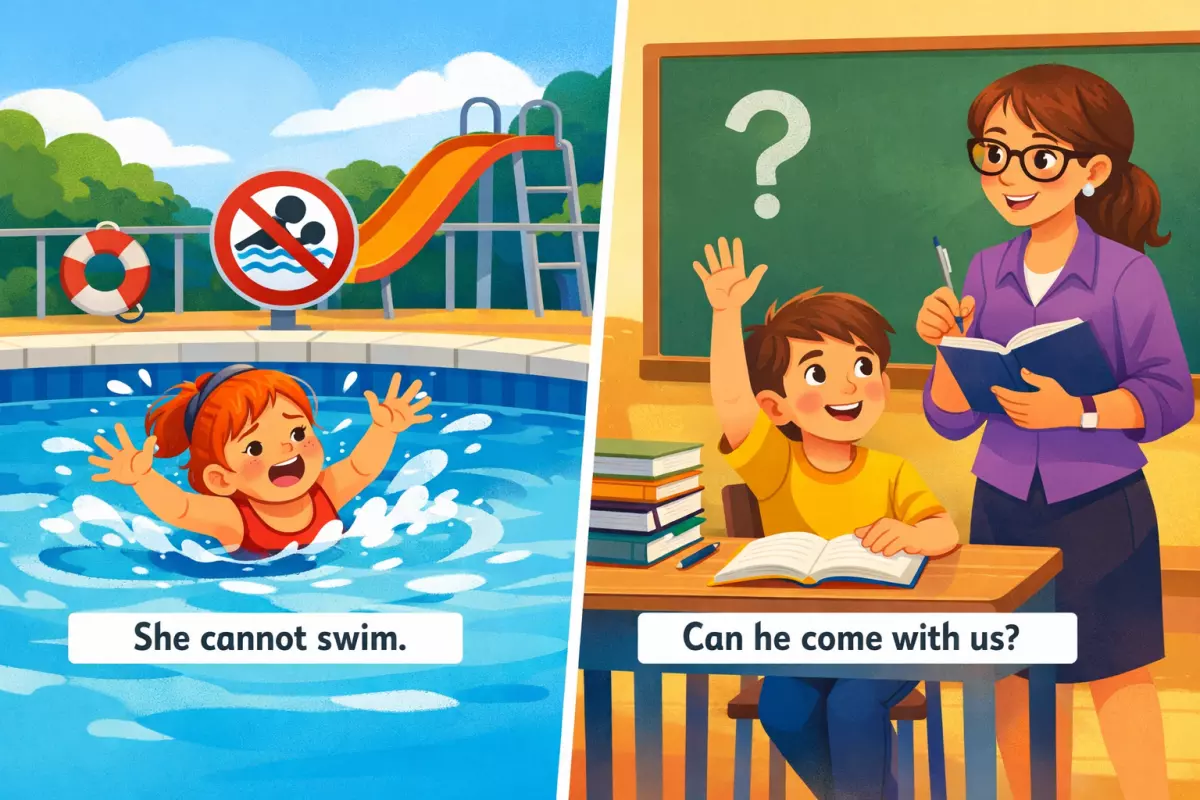
When you make a sentence negative or turn it into a question with a modal (can, could, may, might, must, shall, should, will, would), the main verb still stays in the base form (the bare infinitive). The modal changes position or takes not, but the infinitive pattern remains the same.
Negative forms: modal + not + base verb
To form negatives, place not directly after the modal. Do not add to before the main verb, and do not change the main verb for tense or agreement.
- ✅ She cannot swim. → (not: cannot to swim)
- ✅ They may not enter. → (not: may not to enter)
- ✅ You should not worry. → (not: should not worries)
- ✅ He must not park here. → (not: must not to park)
- ✅ We won’t wait. → (not: won’t waiting)
- ✅ I wouldn’t say that. → (not: wouldn’t to say)
- ✅ She couldn’t hear you. → (not: couldn’t heard)
- ✅ You might not need help. → (not: might not needs)
- ✅ He shouldn’t drive tonight. → (not: shouldn’t to drive)
- ✅ They can’t be serious. → (not: can’t to be)
- ✅ We mustn’t forget our passports. → (not: mustn’t forgetting)
- ✅ I may not finish on time. → (not: may not finished)
Question forms: modal + subject + base verb
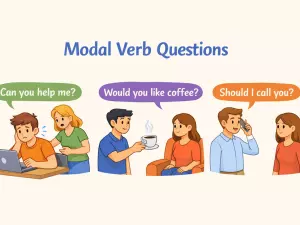
To ask a question, invert the modal and the subject. The main verb remains the bare infinitive, without to. This applies to yes/no questions and to wh- questions (what, where, why, how, etc.).
- ✅ Can you help me?
- ✅ Could she join us later?
- ✅ May I leave early?
- ✅ Should we call a taxi?
- ✅ Must he wear a uniform?
- ✅ Will they arrive by noon?
- ✅ Would you open the window?
- ✅ Where can I park?
- ✅ Why should we trust this source?
- ✅ When will you start?
- ✅ How could they know?
- ✅ What might happen next?
Negative questions and short answers
Negative questions often check expectations or express surprise. Short answers repeat the modal (not the main verb), and negatives use not or a contraction.
- ✅ Can’t you stay a bit longer?
- ✅ Shouldn’t we confirm the booking?
- ✅ Won’t he tell you the truth?
- ✅ A: Can you drive? B: Yes, I can. / No, I can’t.
- ✅ A: Should we wait? B: Yes, we should. / No, we shouldn’t.
- ✅ A: Will they come? B: Yes, they will. / No, they won’t.
Common learner mistakes with modal + infinitive combinations
Most errors with modals happen because learners apply normal verb rules (like adding -s, using to, or choosing the wrong auxiliary) where modal patterns are different. The fixes are usually simple: use the base verb after a modal, choose the right infinitive form (simple, perfect, continuous), and build negatives/questions consistently.
Frequent errors and how to correct them
- ❌ Adding -s/-ed after a modal
❌ She can speaks English. → ✅ She can speak English.
❌ They must arrived early. → ✅ They must arrive early. - ❌ Using “to” after a modal (except “ought to”)
❌ I can to go now. → ✅ I can go now.
✅ Exception: You ought to apologize. - ❌ Doubling auxiliaries (modal + do/does/did)
❌ Do you can swim? → ✅ Can you swim?
❌ He doesn’t must leave. → ✅ He mustn’t leave. / He doesn’t have to leave. - ❌ Making negatives with the wrong helper
Use not directly after the modal: can’t, won’t, shouldn’t, mustn’t, etc.
❌ She don’t can drive. → ✅ She can’t drive. - ❌ Confusing “mustn’t” and “don’t have to”
✅ You mustn’t park here. (prohibited)
✅ You don’t have to park here. (not necessary) - ❌ Using “must” for past obligation
❌ Yesterday I must go to work. → ✅ Yesterday I had to go to work.
(Use had to for past necessity; must is mainly present/future.) - ❌ Mixing up “could” (past ability) and “could have” (past possibility/regret)
✅ When I was five, I could swim. (ability in the past)
✅ I could have helped you. (but I didn’t) - ❌ Wrong infinitive choice for time meaning
If the action is earlier than the modal meaning, use the perfect infinitive.
❌ He must be tired; he worked all night. (possible but often less precise)
✅ He must have worked all night. (deduction about a past action) - ❌ Using a continuous infinitive when you mean a finished action
✅ She may be sleeping. (in progress now)
✅ She may have slept already. (completed earlier) - ❌ Overusing “will” for willingness vs. prediction
✅ He will help you. (willingness/offer)
✅ It will rain tomorrow. (prediction)
Problems appear when context requires one meaning but the sentence suggests the other. - ❌ Using “may” in questions when “can/could” is more natural
✅ Can I sit here? (common, informal)
✅ Could I sit here? (polite)
✅ May I sit here? (very formal) - ❌ Forgetting that modals don’t take an infinitive marker in passive patterns
❌ The report must to be finished today. → ✅ The report must be finished today. - ❌ Incorrect word order with adverbs
Place frequency adverbs after the modal (or after the first auxiliary).
❌ She can always to help. → ✅ She can always help.
✅ She may have already left. - ❌ Using “to” after “had better”
❌ You had better to call her. → ✅ You had better call her. - ❌ Confusing “used to” (past habit) with “be used to” (familiar with)
✅ I used to live there. (past habit/state)
✅ I am used to getting up early. (noun/gerund after “to” here)
A quick accuracy check
- After a modal, use the base verb: can go, should see, might help.
- Use not right after the modal for negatives: cannot/can’t, should not/shouldn’t.
- For past deduction/possibility, prefer modal + have + past participle: must have left, might have forgotten.
- For actions in progress, use modal + be + -ing: may be waiting, could be working.
- Remember key exceptions: ought to, have to, had better (no “to”).
Using modal verbs with perfect infinitives like may have done
To talk about the past with a modal verb, English often uses the pattern modal + have + past participle. This structure helps you express possibility, probability, certainty, obligation, criticism, or missed opportunity about an earlier time (not about the present).
Core form and when to use it
The perfect infinitive after a modal points back to a completed (or earlier) situation. Compare the time reference:
- may do = a possibility now or in the future
- may have done = a possibility about the past
Common meanings by modal (with examples)
- may have + past participle (possible past): She may have missed the train.
- might have + past participle (possible past; often more tentative): They might have taken the wrong exit.
- could have + past participle (past possibility/ability; sometimes a missed chance): I could have helped, but I didn’t know.
- must have + past participle (strong logical conclusion about the past): He must have forgotten our meeting.
- can’t have + past participle (strong negative conclusion): She can’t have said that; it’s not like her.
- should have + past participle (expected action; often criticism/regret): You should have called earlier.
- ought to have + past participle (similar to should; more formal): We ought to have checked the address.
- needn’t have + past participle (unnecessary action that was done): You needn’t have brought food; we had plenty.
- didn’t need to + base verb (no necessity; action may not have happened): We didn’t need to book in advance.
- would have + past participle (hypothetical past result; often with if): I would have gone if I’d had time.
- shall have + past participle (rare; formal/legal or very formal prediction): The tenant shall have paid all fees by Friday.
Negatives and questions
- Negative form: modal + not + have + past participle (They may not have received the email.)
- Question form: modal + subject + have + past participle? (Could he have left already?)
- Short answers: Yes, he may have. / No, he can’t have.
Useful patterns and frequent mistakes
- ✅ may have seen / ❌ may have saw (use the past participle, not the past simple)
- ✅ must have been / ❌ must have be (use a past participle form after have)
- ✅ could have gone / ❌ could have went (irregular verbs still need the participle)
- should have often implies judgment: You should have apologized. (The speaker thinks it was the right action.)
- needn’t have focuses on “unnecessary but done”: I needn’t have worried. (I worried, but it wasn’t necessary.)
- didn’t need to focuses on “no necessity” and doesn’t confirm the action: I didn’t need to worry. (Maybe I worried, maybe not.)
- might have commonly appears in explanations: The delay might have been caused by traffic.
- must have is about inference, not permission: She must have left early. (That’s the logical conclusion.)
Expanded example set (quick practice)
- They may have misunderstood the instructions.
- He might have been asleep when you called.
- We could have saved time by taking the highway.
- You should have backed up the files.
- She ought to have told you the truth.
- It must have rained last night; the streets are wet.
- They can’t have finished already; they started late.
- I needn’t have bought tickets; entry was free.
- Could she have forgotten her password again?
- He may not have heard the announcement.
- We wouldn’t have missed the bus if we’d left earlier.
- The package might not have arrived yet.
- Someone must have taken my keys by mistake.
- You shouldn’t have spoken to her like that.
- Could you have left your phone at the office?
Practice exercises: complete sentences with modal verbs and infinitives
Complete each sentence by choosing the correct infinitive form after the modal verb. Focus on the pattern: modal + base verb (no to), and watch for negatives and questions. Some items also test perfect and passive infinitives.
Exercise 1: Modal + base infinitive (no “to”)
- You should ________ (call) your grandmother tonight.
- We can’t ________ (park) here after 6 p.m.
- He may ________ (join) us later if he finishes work early.
- They must ________ (wear) safety glasses in the lab.
- Could you ________ (open) the window, please?
- I might ________ (take) a later train if this one is delayed.
- She shouldn’t ________ (drive) when she’s that tired.
- What time do we have to ________ (leave)?
- You don’t need to ________ (bring) anything; we have enough food.
- He can ________ (speak) three languages fluently.
- We ought to ________ (check) the details before we agree.
- May I ________ (use) your phone for a moment?
Show answers
- call
- park
- join
- wear
- open
- take
- drive
- leave
- bring
- speak
- check
- use
Exercise 2: Common mistakes (choose the correct option)
- You must ✅ (a) finish / ❌ (b) to finish your report today.
- She can ✅ (a) come / ❌ (b) to come with us tomorrow.
- We should ✅ (a) not worry / ❌ (b) to not worry about it yet.
- He might ✅ (a) be / ❌ (b) to be late because of traffic.
- Could you ✅ (a) help / ❌ (b) to help me with this box?
- They may ✅ (a) not understand / ❌ (b) don’t understand the instructions.
- I can ✅ (a) hardly hear / ❌ (b) to hardly hear you.
- You mustn’t ✅ (a) touch / ❌ (b) to touch that switch.
Show answers
- (a) finish
- (a) come
- (a) not worry
- (a) be
- (a) help
- (a) not understand
- (a) hardly hear
- (a) touch
Exercise 3: Perfect and passive infinitives after modals
Complete the sentences using the correct form: modal + have + past participle (perfect) or modal + be + past participle (passive).
- She looks upset. She might ________ ________ (hear) the news already.
- The lights are off; they must ________ ________ (turn off) earlier.
- You should ________ ________ (tell) me you were running late.
- The package can ________ ________ (deliver) tomorrow morning.
- He can’t ________ ________ (finish) the project in one day; it’s too big.
- The meeting may ________ ________ (cancel) because the manager is sick.
- They must ________ ________ (forget) the address; they’re completely lost.
- This form should ________ ________ (sign) by a parent or guardian.
- I might ________ ________ (leave) my keys at the office.
- The results could ________ ________ (announce) this afternoon.
Show answers
- might have heard
- must have been turned off
- should have told
- can be delivered
- can’t have finished
- may be cancelled
- must have forgotten
- should be signed
- might have left
- could be announced