Bare Infinitive in English: When to Use Verb Without “To”

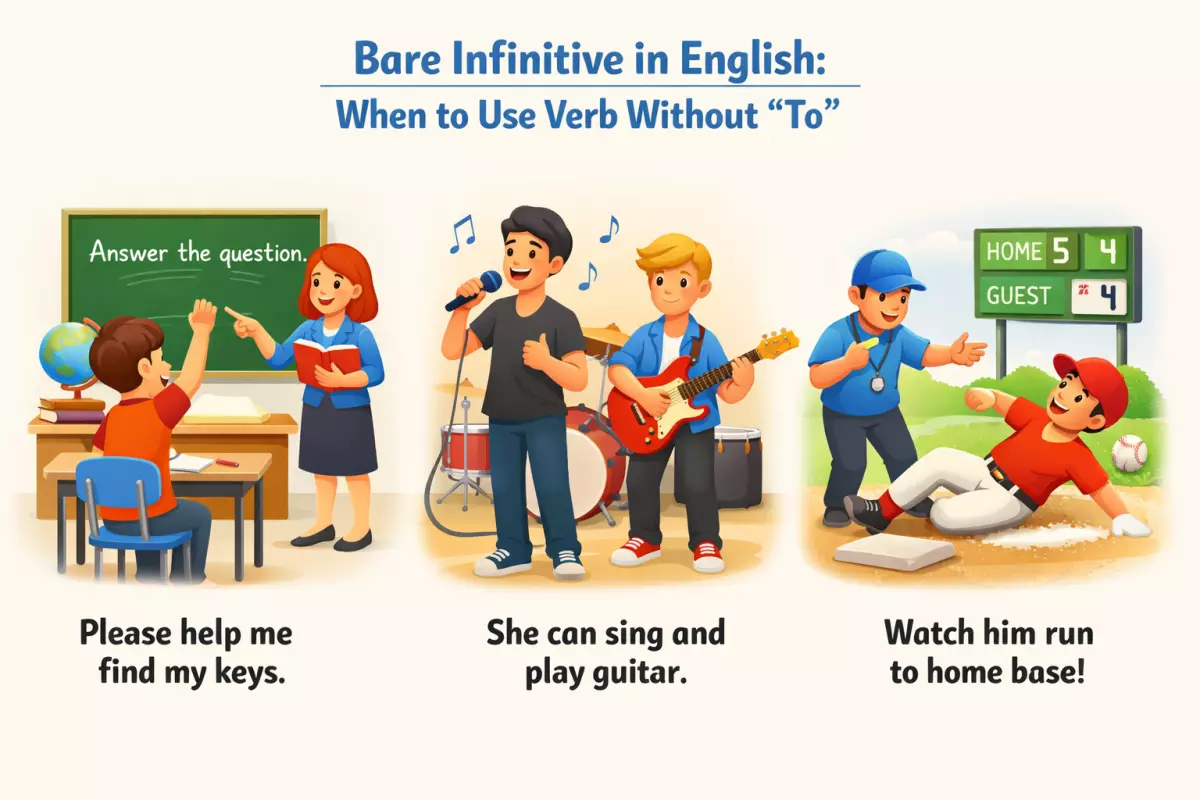 Explains what the bare infinitive is versus to + verb, when to use it after modals, perception verbs like see/hear/feel, and after let, make, and help. Covers had better and would rather, common to mistakes, and practice exercises to spot and use it right.
- What the bare infinitive is and how it differs from 'to + verb'
- Using bare infinitives after modal verbs
- Bare infinitives after verbs of perception like see, hear, feel
- Using bare infinitives after let, make, and help
- Bare infinitives in structures like had better and would rather
- Common learner mistakes with missing or unnecessary 'to'
- Practice exercises: identify and use bare infinitives correctly
In everyday English, you often use the base form of a verb without to, which helps your speech sound natural and confident. You hear it after modal verbs like can, should, or must, after make and let, and in short instructions like come here or sit down. When you notice these patterns in real conversations, you can stop guessing and start using them automatically.
What the bare infinitive is and how it differs from 'to + verb'
The bare infinitive is the base form of a verb used without to. It looks the same as the dictionary form (for example, go, see, help, be), but it appears only in specific grammatical patterns. The to-infinitive uses the same base verb, but it includes the marker to (for example, to go, to see), and it follows different verbs and structures.
Form: same verb, different marker
- Bare infinitive: base verb only → leave, take, call.
- To-infinitive: to + base verb → to leave, to take, to call.
- Neither form changes for person or number: I can go, she can go (not goes).
- Negatives place not before the verb phrase: He can’t swim; He decided not to swim.
Core usage difference: where each form is expected
- After modal verbs, English uses the verb without to: can go, must leave, should wait.
- After many main verbs, English prefers the to-infinitive: want to go, plan to leave, decide to wait.
- After certain perception and causative verbs, the base verb is common (especially in active voice): see him run, make them stop, let her speak.
- After prepositions, you normally do not use either infinitive form; you use a gerund: interested in learning (not in learn or in to learn).
Quick pattern guide with examples (correct vs. incorrect)
- Modal + base verb: ✅ She can drive. ❌ She can to drive.
- Want/hope/plan + to-infinitive: ✅ They hope to win. ❌ They hope win.
- Make/let + base verb: ✅ Don’t make me wait. ❌ Don’t make me to wait.
- Help (both possible in many contexts): ✅ Help me carry this. / ✅ Help me to carry this.
- Perception verbs (active): ✅ I heard her sing. ❌ I heard her to sing.
- Perception verbs (passive often uses to): ✅ She was heard to sing.
Common signals that the bare infinitive is coming
- Modal verbs: can, could, may, might, must, shall, should, will, would.
- Fixed patterns: had better + verb (You’d better go), would rather + verb (I’d rather stay).
- Causatives and permission: make + object + verb, let + object + verb.
- Perception verbs in active voice: see, hear, feel, watch, notice + object + verb.
In short, both structures use the same base verb, but the grammar around them is different: some verbs and constructions require the plain base form, while others require to. Learning the patterns is more reliable than translating from another language.
Using bare infinitives after modal verbs
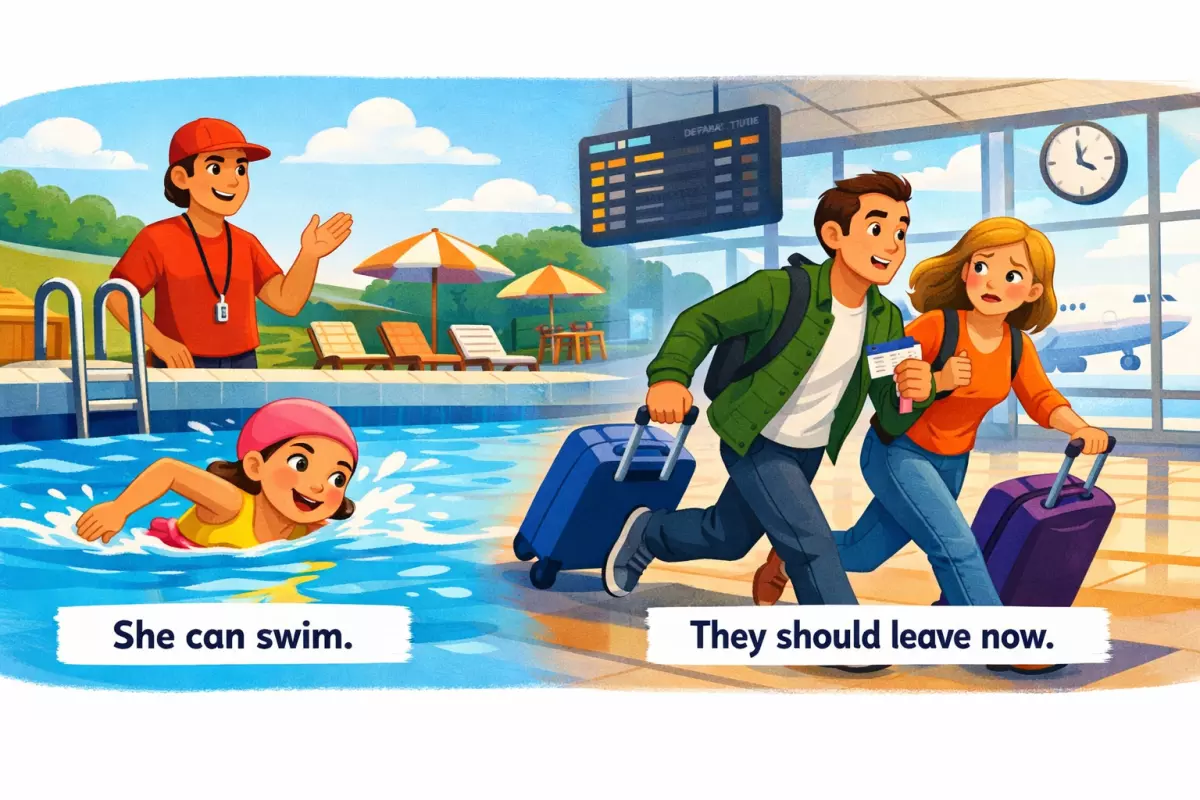
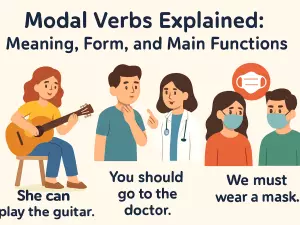
After a modal verb, English normally uses the base form of the main verb (the verb without “to”). This pattern is very stable: the modal stays the same for all subjects, and the next verb stays in its bare form.
Core pattern
- Structure: modal + bare infinitive
→ She can swim. / They should leave now. - No “to” after the modal: ✅ You must go. ❌ You must to go.
- No -s in the third person: ✅ He can drive. ❌ He can drives.
Common modals that take the bare infinitive
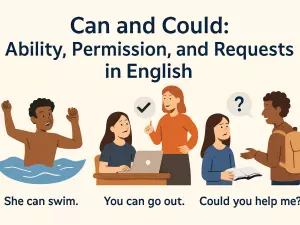
- can + verb: I can help.
- could + verb: We could wait.
- may + verb: You may enter.
- might + verb: It might rain.
- must + verb: She must leave early.
- shall + verb (more formal/BrE): Shall we begin?
- should + verb: You should check the address.
- will + verb: They will call later.
- would + verb: I would choose the blue one.
- ought to + verb: You ought to apologize. (exception: it uses “to”)
Negatives and questions
- Negative: modal + not + bare infinitive
→ You should not worry. / He can’t come. - Question: modal + subject + bare infinitive
→ Can you stay? / Should we start now? - Negative question: modal + subject + not + bare infinitive
→ Can’t you see it? / Shouldn’t we tell her?
Modal + bare infinitive with different verb types
- Action verbs: He can run fast.
- State verbs: You should know the rules.
- Be: It may be true.
- Have: You must have a ticket.
- Do: We can do it tomorrow.
Two-verb sequences: where “to” appears and where it doesn’t
- Modal + bare infinitive + object + to-infinitive: She can ask him to help. (bare infinitive after the modal; “to” belongs to the second infinitive)
- Modal + bare infinitive + -ing clause: You should avoid driving at night. (the verb after the modal is bare; the next part depends on the main verb)
- Modal + be + past participle (passive): The form must be signed.
- Modal + have + past participle (perfect meaning): They might have missed the train.
Common trouble spots
- “Ought to” is different: it requires “to” (You ought to call.), unlike most modals.
- “Have to” is not a modal: it uses “to” and changes form (She has to leave., We had to wait.).
- Don’t add endings to the main verb: keep it in the base form after the modal (She might arrive, not might arrives).
Bare infinitives after verbs of perception like see, hear, feel
After verbs that describe direct perception, English often uses an object + verb without to. This pattern is common when you notice the whole action from beginning to end (or as a complete event), especially in everyday narration.
Core pattern
- Verb of perception + object + bare infinitive
- Common perception verbs: see, hear, feel, watch, notice, observe, overhear, listen to
- Example structure: “I saw him leave.” / “We heard the door slam.”
Meaning: complete action vs. action in progress
Using the bare infinitive typically suggests you perceived the action as a whole. If you want to highlight that the action was in progress, English often prefers an -ing form instead (object + verb-ing).
- Whole event: “I saw her cross the street.”
- In progress: “I saw her crossing the street.”
- Whole event: “We heard the baby cry.” (you heard the crying happen)
- In progress: “We heard the baby crying.” (you heard it while it was happening)
Examples (object + bare infinitive)
- I saw the cat jump onto the table.
- She heard someone knock at the door.
- We watched the plane land.
- They felt the ground shake.
- He noticed her eyes widen.
- I overheard them mention my name.
- Did you see him take the keys?
- I heard the glass break.
- She watched the children run into the garden.
- We felt the wind pick up.
- He observed the technician reset the system.
- I listened to her explain the rules.
- They noticed the lights flicker.
- She heard her phone vibrate.
- I saw the waiter drop a tray.
- We watched the sun disappear behind the hills.
Passive forms: “to” usually returns
In active sentences, the verb after the object is often bare. In passive sentences, English typically uses to before the infinitive.
- ✅ Active: “They saw him enter the building.” → Passive: “He was seen to enter the building.”
- ✅ Active: “We heard her sing.” → Passive: “She was heard to sing.”
- ✅ Active: “I watched them leave.” → Passive: “They were watched to leave.”
Common learner errors
- ❌ “I saw him to leave.” → ✅ “I saw him leave.”
- ❌ “We heard her to sing.” → ✅ “We heard her sing.”
- ❌ “They watched the dog to run away.” → ✅ “They watched the dog run away.”
Using bare infinitives after let, make, and help
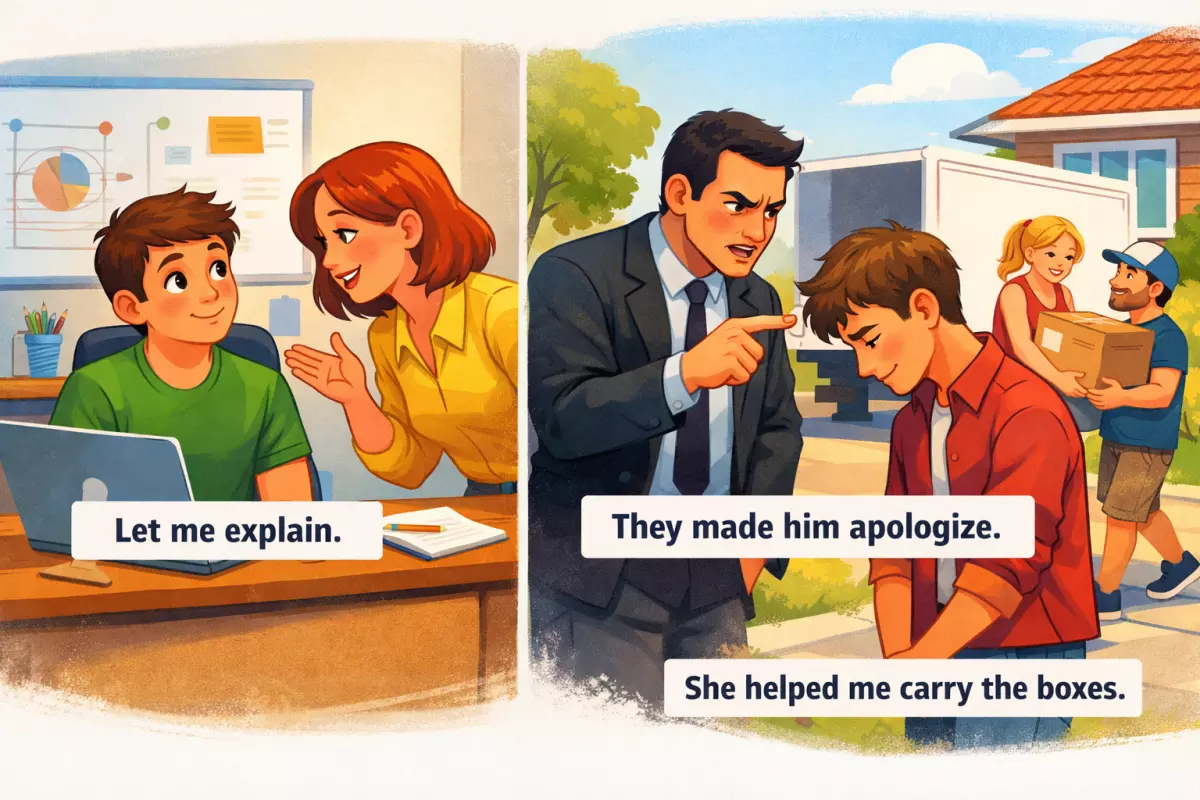
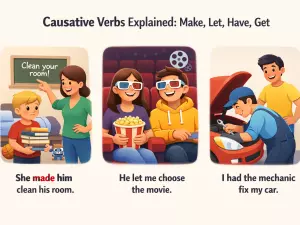
After certain verbs, English commonly uses a verb without to to show that one person causes, allows, or assists another person to do an action. The most typical pattern is verb + object + base verb.
Core patterns
- let + object + bare infinitive (permission/allowing): Let me explain.
- make + object + bare infinitive (forcing/causing): They made him apologize.
- help + object + bare infinitive (assistance): She helped me carry the boxes.
Let: allow someone to do something
Let is followed by an object (a person/thing) and then the base form of the verb. It does not take to in this structure.
- ✅ Let her speak. → not: ❌ Let her to speak.
- Let him decide.
- Let us begin.
- Let the kids play outside.
- Let your phone charge.
- Let me know tomorrow.
- Let them try again.
In passive voice, let is uncommon; English usually rephrases (for example, with allow).
Make: cause or force someone to do something
Make also takes the bare infinitive after the object in active sentences. It often implies pressure, obligation, or a strong cause-and-effect result.
- ✅ The teacher made us rewrite the essay.
- That movie made me cry.
- The noise made her jump.
- His comment made them laugh.
- The rules made everyone wear badges.
- Don’t make me wait.
- The delay made the team miss the meeting.
In passive voice, make typically changes to be made + to-infinitive: He was made to apologize. (Passive often adds to.)
Help: bare infinitive or to-infinitive
Help is flexible. Both forms are common: help + object + bare infinitive and help + object + to-infinitive. The meaning is usually the same, and the choice often depends on style and rhythm.
- ✅ Can you help me find my keys?
- ✅ Can you help me to find my keys?
- She helped him prepare for the interview.
- She helped him to prepare for the interview.
- This guide will help you understand the rules.
- This guide will help you to understand the rules.
- They helped us move house.
- They helped us to move house.
When help is followed directly by a verb (without an object), both patterns can appear as well: It helps (to) reduce stress.
Common mistakes to avoid
- Adding “to” after let: ❌ Let me to check. → ✅ Let me check.
- Adding “to” after make (active): ❌ They made him to leave. → ✅ They made him leave.
- Forgetting the object when it is required for the meaning: She made him wait (clear) vs. She made wait (incorrect in standard use).
- Mixing active and passive patterns: ✅ They made him leave. but ✅ He was made to leave.
Bare infinitives in structures like had better and would rather
Some fixed expressions take a verb in its base form (the verb without “to”) right after them. Two of the most common are had better (strong advice or warning) and would rather (preference). In both patterns, the next verb stays in the bare infinitive.
Core patterns to remember
- had better + base verb: “You had better leave now.”
- had better not + base verb: “You’d better not touch that.”
- would rather + base verb: “I’d rather stay home.”
- would rather not + base verb: “She’d rather not discuss it.”
- would rather + subject + past simple (preference about someone else’s action, often present/future meaning): “I’d rather you came earlier.”
- would rather + subject + past perfect (preference about the past): “He’d rather they had told him.”
Had better: meaning, form, and common mistakes
Had better is used for strong advice, often implying a negative consequence if the advice is ignored. It is common in speech as the contraction ’d better. Even though it contains “had,” it usually refers to the present or near future.
- ✅ “You’d better call her tonight.” → strong advice
- ✅ “We’d better leave before traffic gets worse.”
- ✅ “They’d better not be late again.”
- ❌ “You’d better to call her tonight.”
- ❌ “You’d better called her tonight.”
- ✅ “Hadn’t we better check the address?” (more formal; less common than “Shouldn’t we…?”)
Would rather: preferences and two different structures
Would rather expresses what someone prefers. When the subject is the same person who will do the action, use would rather + base verb. When the preference is about another person’s action, use would rather + subject + past simple (or past perfect for past time).
- ✅ “I’d rather walk than take a taxi.”
- ✅ “She’d rather wait outside.”
- ✅ “We’d rather not rush the decision.”
- ❌ “I’d rather to walk.”
- ✅ “I’d rather you didn’t mention this at work.”
- ✅ “They’d rather he was more careful.” (informal; “were” is also possible in more formal style)
- ✅ “I’d rather you had told me earlier.” (preference about a past situation)
More example sentences (quick pattern practice)
- “You’d better save your work before closing the laptop.”
- “We’d better not forget the tickets.”
- “He’d better apologize if he wants to fix things.”
- “I’d rather eat at home tonight.”
- “She’d rather not drive in heavy rain.”
- “I’d rather you turned the music down.”
- “They’d rather we did it tomorrow.”
- “Would you rather sit here or by the window?”
- “You’d better not say anything until you know the facts.”
- “I’d rather you hadn’t shared that message.”
Common learner mistakes with missing or unnecessary 'to'
Errors with infinitives often come from mixing two patterns: verbs that take the bare infinitive (verb without “to”) and verbs that require the full infinitive (to + verb). The safest way to fix these problems is to learn the verb pattern, then check whether there is an “exception trigger” such as a modal, make/let/help, or a perception verb.
1) Adding “to” after modals (unnecessary “to”)
After modal verbs, English uses the base form directly. This includes negatives and questions.
- ❌ She can to swim. → ✅ She can swim.
- ❌ You must to leave now. → ✅ You must leave now.
- ❌ He should to apologize. → ✅ He should apologize.
- ❌ We might to be late. → ✅ We might be late.
- ❌ Do I have to to go? → ✅ Do I have to go?
- ❌ She didn’t need to pay. (when “need” is a modal) → ✅ She needn’t pay.
2) Using “to” after “make” and “let” (unnecessary “to” in active voice)
In the active voice, make and let are followed by object + bare infinitive. Learners often insert “to” because many other verbs use “to + verb.”
- ❌ They made me to sign the form. → ✅ They made me sign the form.
- ❌ Don’t let him to drive. → ✅ Don’t let him drive.
- ❌ The teacher made us to rewrite it. → ✅ The teacher made us rewrite it.
- ❌ Her parents didn’t let her to go out. → ✅ Her parents didn’t let her go out.
Note the common switch in the passive: “to” usually returns.
- ✅ I was made to sign the form.
- ✅ He was not allowed to drive. (more common than “was let”)
3) Confusion with “help” (both patterns exist)
Help can be followed by either form: help + object + bare infinitive or help + object + to-infinitive. Learners sometimes “correct” one into the other and become inconsistent.
- ✅ She helped me carry the boxes.
- ✅ She helped me to carry the boxes.
- ✅ Can you help fix this?
- ✅ Can you help to fix this?
Tip: choose one style and keep it consistent within the same text.
4) Adding “to” after perception verbs (unnecessary “to” in active voice)
With verbs like see, hear, watch, notice, feel, the active pattern often uses object + bare infinitive for a complete action. Learners frequently add “to” by analogy with other verb structures.
- ❌ I saw him to cross the street. → ✅ I saw him cross the street.
- ❌ We heard her to sing. → ✅ We heard her sing.
- ❌ She watched them to leave. → ✅ She watched them leave.
- ❌ I noticed him to take my keys. → ✅ I noticed him take my keys.
In the passive, “to” is common again:
- ✅ He was seen to cross the street.
- ✅ She was heard to sing.
5) Missing “to” after verbs that require the full infinitive
Some verbs are followed by to + verb. Learners sometimes drop “to” because they overgeneralize the bare infinitive pattern.
- ❌ I want buy a new phone. → ✅ I want to buy a new phone.
- ❌ She decided go early. → ✅ She decided to go early.
- ❌ We agreed meet at six. → ✅ We agreed to meet at six.
- ❌ He hopes get the job. → ✅ He hopes to get the job.
- ❌ They managed finish on time. → ✅ They managed to finish on time.
- ❌ I promised call you. → ✅ I promised to call you.
- ❌ She refused answer. → ✅ She refused to answer.
- ❌ He offered help. (meaning “offer to help”) → ✅ He offered to help.
6) Mixing “stop/remember/forget/try” patterns (not just a “to” issue)
With certain verbs, the choice between a gerund (-ing) and an infinitive changes the meaning. Learners sometimes “fix” the sentence by adding or removing “to,” but the real problem is choosing the wrong structure.
- ❌ I stopped to smoke. (if you mean you quit the habit) → ✅ I stopped smoking.
- ❌ Remember locking the door. (if you mean “don’t forget to do it”) → ✅ Remember to lock the door.
- ❌ I forgot to meet him yesterday. (if you mean you didn’t remember a past event) → ✅ I forgot meeting him yesterday.
- ❌ I tried to calling her. → ✅ I tried to call her / I tried calling her. (different meanings)
7) Overusing “to” after “why”
After “Why (not)…?” questions, English typically uses the base form, not “to + verb.”
- ❌ Why to wait? → ✅ Why wait?
- ❌ Why not to come with us? → ✅ Why not come with us?
- ❌ Why to worry about it? → ✅ Why worry about it?
When checking your own writing, look first for “trigger words” that strongly prefer the bare infinitive (modals; make/let; perception verbs in active voice). Then check common “to-verbs” (want, decide, agree, hope, manage, promise, refuse, offer). This simple pattern check catches most missing or extra “to” mistakes.
Practice exercises: identify and use bare infinitives correctly
Use these tasks to spot when English needs the verb in its base form (without “to”) and when it does not. Focus on the trigger pattern: a modal, a perception verb, make/let/help, or the fixed structure had better often signals the base verb.
Exercise 1: Choose the correct form (bare verb vs. “to”)
- You should (call / to call) your manager before 5.
- I heard her (sing / to sing) in the hallway.
- They made us (wait / to wait) outside.
- We decided (leave / to leave) early.
- Can you (help / to help) me carry this box?
- He let me (borrow / to borrow) his laptop.
- She wants (go / to go) home now.
- You had better (take / to take) an umbrella.
- I watched them (play / to play) basketball.
- We hope (see / to see) you soon.
- Do you dare (ask / to ask) him directly?
- I felt the building (shake / to shake) during the storm.
Show answers
- call
- sing
- wait
- to leave
- help
- borrow
- to go
- take
- play
- to see
- ask (common in “dare” as a modal-like verb in questions/negatives)
- shake
Exercise 2: Correct the sentence (remove or add “to”)
- ❌ She can to drive very well.
- ❌ I made him to apologize.
- ❌ They want go now.
- ❌ We watched her to open the package.
- ❌ You had better to check the address.
- ❌ He helped me to fix my bike. (Make the most natural version.)
- ❌ Let’s to start the meeting.
- ❌ I heard him to say my name.
- ❌ She decided take a break.
- ❌ You must to wear a seatbelt.
Show answers
- ✅ She can drive very well.
- ✅ I made him apologize.
- ✅ They want to go now.
- ✅ We watched her open the package.
- ✅ You had better check the address.
- ✅ He helped me fix my bike. (Also possible: “helped me to fix”)
- ✅ Let’s start the meeting.
- ✅ I heard him say my name.
- ✅ She decided to take a break.
- ✅ You must wear a seatbelt.
Exercise 3: Identify the trigger (what forces the base verb?)
For each sentence, name the pattern that calls for the verb without “to” (for example: modal, perception verb, make/let/help, had better, let’s).
- You should see a doctor.
- I saw them cross the street.
- She made me rewrite the email.
- Let’s order dessert.
- You had better tell the truth.
- He can speak three languages.
- We heard the door slam.
- They let us choose our seats.
- Could you help me find my keys?
- I felt my phone vibrate.
Show answers
- Modal (should)
- Perception verb (saw)
- Make + object
- Let’s
- Had better
- Modal (can)
- Perception verb (heard)
- Let + object
- Help + object (bare form is common)
- Perception verb (felt)
Quick checklist for self-correction
- If there’s a modal (can, could, will, would, shall, should, may, might, must) → use the base verb: “must leave,” not “must to leave.”
- After perception verbs (see, hear, watch, feel, notice) + object → base verb is common for the complete action: “heard him say…”
- After make/let + object → use the base verb: “made me wait,” “let us enter.”
- After “had better” and “would rather” → use the base verb: “had better go,” “would rather stay.”
- After most other verbs (want, decide, plan, hope, agree) → “to” is usually required: “decided to leave.”