Gerunds After Prepositions: Rules and Examples

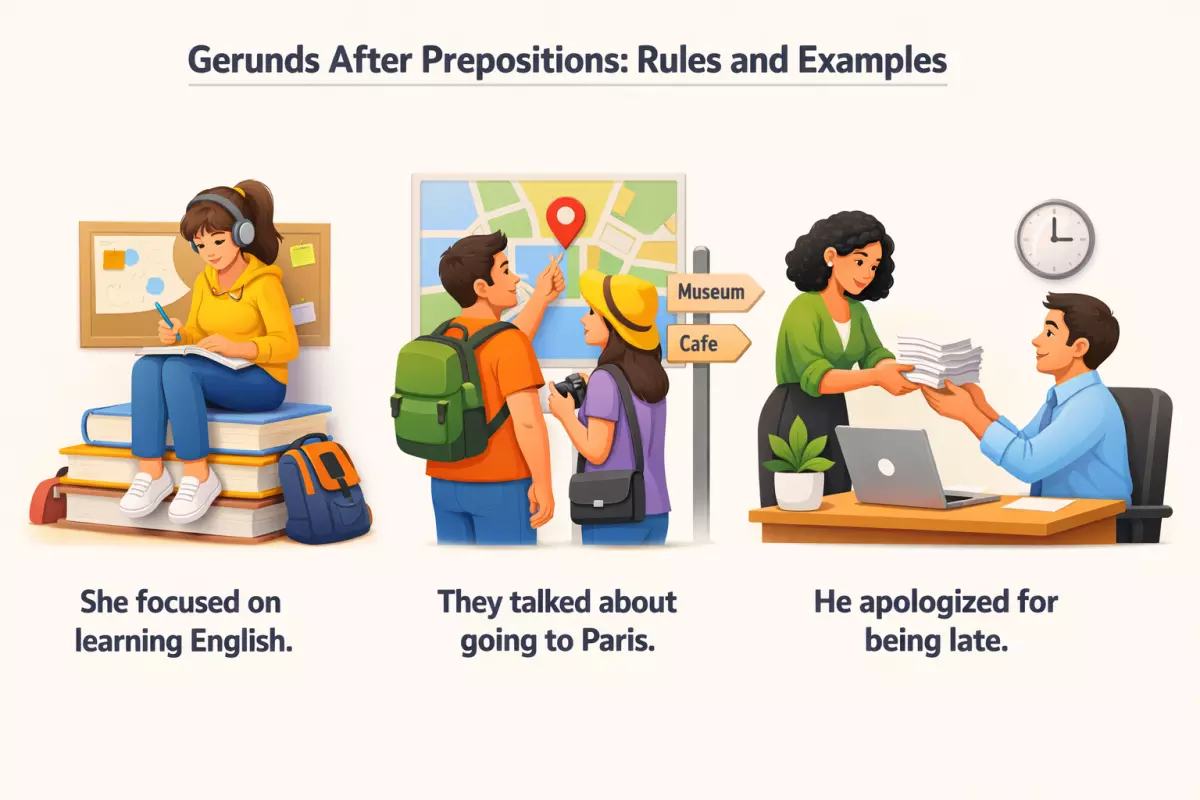 This article explains why verbs after prepositions take the gerund, lists common prepositions that need -ing, and covers gerunds in phrasal and fixed phrases like interested in and good at. It also explains multi-word preps like because of/instead of, common learner errors, and quick practice.
- Why verbs after prepositions must use the gerund form
- Common prepositions followed by gerunds in everyday English
- Gerunds in phrasal expressions and fixed phrases
- Using gerunds after expressions like interested in or good at
- How gerunds work after multi-word prepositions like because of or instead of
- Frequent mistakes learners make after prepositions
- Practice exercises: choose the correct gerund after a preposition
After words like in, on, at, and without, English often uses an -ing form instead of an infinitive, and that’s what we’ll practice here. You’ll hear it in everyday phrases like thanks for helping, interested in learning, and tired of waiting. Once you notice this habit, your sentences sound smoother and more natural because you’re using the form native speakers expect in real conversations.
Why verbs after prepositions must use the gerund form
After a preposition (in, on, at, for, of, about, by, with, without, before, after, etc.), English typically requires a noun-like element. When the next idea is an action, the -ing form works because it functions as a noun (a gerund). This is why you see patterns like interested in learning or good at explaining, not an infinitive.
Core pattern: preposition + noun (or noun equivalent)
Prepositions introduce objects. That object can be a regular noun, a pronoun, or a gerund phrase:
- Preposition + noun: She apologized for the delay.
- Preposition + pronoun: This depends on you.
- Preposition + gerund: She apologized for being late.
Because an infinitive (to + base verb) is not treated as a noun object in this position, it usually sounds ungrammatical after a preposition.
What to use instead of an infinitive after a preposition
When you want to express an action after a preposition, choose the gerund. Compare the correct and incorrect forms:
- ✅ She’s interested in learning French. ❌ interested in to learn
- ✅ They left without saying goodbye. ❌ without to say
- ✅ He succeeded by practicing daily. ❌ by to practice
- ✅ We talked about moving. ❌ about to move
Common structures that trigger the gerund
Many everyday expressions end in a preposition, so the next verb naturally appears in the -ing form. These are usage patterns to memorize:
- be good at + -ing: She’s good at organizing events.
- be bad at + -ing: I’m bad at remembering names.
- be interested in + -ing: They’re interested in investing early.
- be afraid of + -ing: He’s afraid of flying.
- be tired of + -ing: She’s tired of waiting.
- be responsible for + -ing: I’m responsible for training new staff.
- look forward to + -ing: We look forward to meeting you.
- insist on + -ing: She insisted on paying.
- apologize for + -ing: He apologized for interrupting.
- complain about + -ing: They complained about being ignored.
- think about + -ing: I’m thinking about changing jobs.
- worry about + -ing: Stop worrying about making mistakes.
- depend on + -ing: It depends on finding a solution.
- prevent (someone) from + -ing: This prevents us from finishing early.
- stop (someone) from + -ing: Don’t stop her from trying.
- be used to + -ing: I’m used to working nights.
- object to + -ing: They objected to raising taxes.
- instead of + -ing: He walked instead of driving.
Important note: “to” can be a preposition, not part of an infinitive
Some phrases contain to as a preposition (not the infinitive marker). In these cases, the next verb still takes -ing:
- ✅ I’m used to getting up early. → “to” = preposition
- ✅ We look forward to hearing from you.
- ✅ She objected to waiting outside.
This is a frequent source of errors because learners see “to” and expect an infinitive. Checking whether “to” belongs to a fixed expression (used to, look forward to, object to) helps you choose the correct form.
Common prepositions followed by gerunds in everyday English
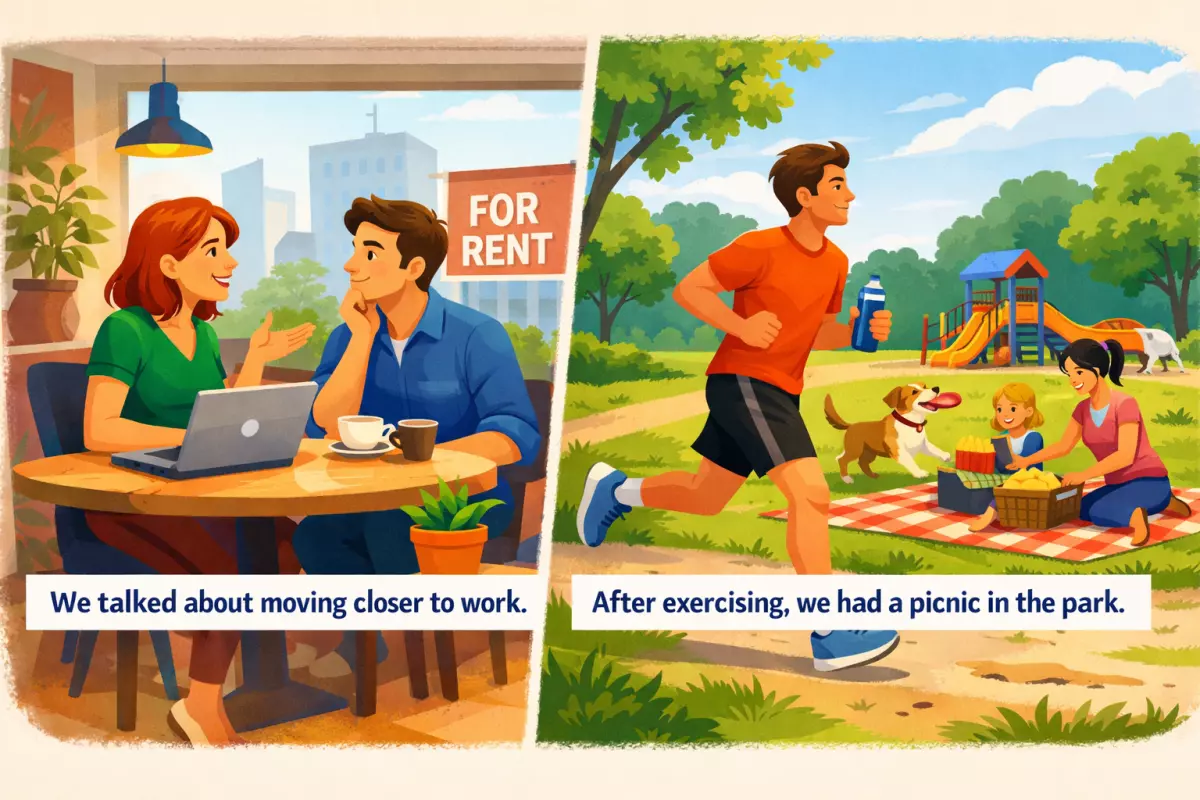
After a preposition, English typically uses an -ing form (a gerund), not an infinitive. This pattern shows up constantly in everyday speech because prepositions often introduce activities, habits, and reasons. If you can put a noun after the preposition, you can usually put a gerund there too.
High-frequency prepositions + gerund patterns
- about + gerund: talk/think/worry about doing something. Example: “We talked about moving closer to work.”
- after + gerund: what happens next in time. Example: “After finishing the report, she went home.”
- before + gerund: what happens earlier. Example: “Wash your hands before eating.”
- by + gerund: method or how something is done. Example: “You can improve by practicing every day.”
- for + gerund: purpose or intended use (common with “tools/places are for…”). Example: “This button is for restarting the device.”
- from + gerund: prevention or stopping. Example: “That didn’t stop him from trying again.”
- in + gerund: focus on the process or area. Example: “She’s interested in learning Korean.”
- of + gerund: common after adjectives/nouns like “tired of,” “idea of.” Example: “I’m tired of waiting.”
- on + gerund: continuing or immediately after. Example: “On arriving, please check in at reception.”
- without + gerund: something does not happen. Example: “He left without saying goodbye.”
- at + gerund: skill level or reaction (often “good/bad at”). Example: “She’s good at explaining complex ideas.”
- against + gerund: opposition or resistance. Example: “They advised against taking that route at night.”
- instead of + gerund: replacement choice. Example: “Try calling instead of texting.”
- because of + gerund: reason (often more natural with a noun, but gerunds are common). Example: “Because of working late, he missed dinner.”
- due to + gerund: cause (more formal). Example: “The delay was due to snow falling overnight.”
Quick accuracy check: preposition → gerund (not infinitive)
- ✅ “She apologized for being late.” ❌ “She apologized for to be late.”
- ✅ “They’re excited about traveling.” ❌ “They’re excited about to travel.”
- ✅ “He left without paying.” ❌ “He left without to pay.”
When you’re unsure, locate the preposition (about, in, by, without, etc.) and treat what follows as a noun slot. Filling that slot with an -ing form is the default choice in modern English.
Gerunds in phrasal expressions and fixed phrases
Many common expressions include a preposition (or preposition-like word) that is normally followed by a gerund. In these set patterns, using an infinitive often sounds unnatural or is simply incorrect, so it helps to learn the chunk as a whole.
Common fixed patterns that take a gerund
- be used to + gerund: “I’m used to working nights.” (meaning: accustomed to)
- get used to + gerund: “You’ll get used to driving on the left.”
- look forward to + gerund: “We’re looking forward to seeing you.”
- be opposed to + gerund: “They’re opposed to raising taxes.”
- object to + gerund: “Do you object to sharing the room?”
- be committed to + gerund: “She’s committed to improving safety.”
- be devoted to + gerund: “He’s devoted to helping new staff.”
- be dedicated to + gerund: “The group is dedicated to protecting wildlife.”
- be accustomed to + gerund: “I’m accustomed to speaking in public.”
- be responsible for + gerund: “She’s responsible for organizing the event.”
- be capable of + gerund: “He’s capable of solving it quickly.”
- be interested in + gerund: “They’re interested in learning more.”
- succeed in + gerund: “She succeeded in finding a solution.”
- insist on + gerund: “He insisted on paying for dinner.”
- focus on + gerund: “Let’s focus on fixing the main problem.”
- depend on + gerund: “It depends on getting approval.”
- apologize for + gerund: “I apologize for interrupting.”
- thank someone for + gerund: “Thanks for coming.”
- prevent someone from + gerund: “This prevents us from making mistakes.”
- keep someone from + gerund: “Noise kept me from sleeping.”
Two high-frequency traps to watch
- to is a preposition in some expressions, not part of an infinitive: ✅ “I’m looking forward to meeting you.” ❌ “looking forward to meet you.”
- be used to (accustomed to) vs. used to (past habit): ✅ “I’m used to getting up early.” but “I used to get up early.”
When you learn these as fixed units, the choice becomes automatic: preposition → gerund. If you’re unsure, check whether the word before the verb is functioning as a preposition (to, in, on, for, of, from); if it is, a gerund is usually the natural follow-up.
Using gerunds after expressions like interested in or good at

Many common adjective-based expressions are followed by a preposition, and that preposition is typically followed by a gerund (verb + -ing). This pattern is especially common when you describe feelings, skills, habits, or reactions: adjective + preposition + -ing.
Core pattern
When an adjective requires a preposition (often in, at, of, about, for, to, or with), the next verb usually takes the gerund form.
- ✅ She’s interested in learning Japanese.
- ❌ She’s interested in to learn Japanese.
- ✅ He’s good at explaining complex ideas.
- ❌ He’s good at explain complex ideas.
Common adjective + preposition combinations that take a gerund
- interested in + -ing: They’re interested in starting a small business.
- good at + -ing: She’s good at noticing small details.
- bad at + -ing: I’m bad at remembering names.
- keen on + -ing: He’s keen on trying new recipes.
- fond of + -ing: She’s fond of collecting postcards.
- tired of + -ing: We’re tired of waiting for updates.
- afraid of + -ing: He’s afraid of making a mistake.
- capable of + -ing: The team is capable of solving the problem quickly.
- proud of + -ing: I’m proud of finishing the project on time.
- ashamed of + -ing: She was ashamed of lying to her friend.
- excited about + -ing: They’re excited about moving to a new city.
- worried about + -ing: I’m worried about losing the data.
- responsible for + -ing: He’s responsible for training new staff.
- used to + -ing: I’m used to working late during busy seasons.
- opposed to + -ing: She’s opposed to cutting the budget.
- successful in + -ing: They were successful in reducing costs.
Meaning differences: gerund vs. noun after the preposition
After the preposition, you can often use either a gerund or a noun. The gerund emphasizes the activity, while a noun names the thing more generally.
- She’s interested in learning French. (the activity)
- She’s interested in French. (the subject)
- He’s good at negotiating. (the skill in action)
- He’s good at negotiation. (the general area)
Common learner pitfalls
- Don’t switch to an infinitive after the preposition: ❌ interested in to study → ✅ interested in studying
- Keep the preposition when it’s required: ❌ good explaining → ✅ good at explaining
- Watch “used to”: used to + -ing (accustomed to) vs. used to + base verb (past habit). Example: I’m used to getting up early. / I used to get up early.
How gerunds work after multi-word prepositions like because of or instead of
Multi-word prepositions (also called complex prepositions) behave like single prepositions in grammar. That means they are followed by a noun phrase, and a gerund (-ing form) can fill that noun role: because of + being, instead of + going, in spite of + trying.
Core pattern
- Multi-word preposition + gerund: because of missing the train; instead of calling; in spite of feeling tired.
- Multi-word preposition + noun/pronoun: because of the delay; instead of him; in front of the building.
- Multi-word preposition + gerund phrase (with its own object): because of not checking the schedule; due to losing your ID.
- Negative form: because of not answering; instead of not telling anyone.
Common multi-word prepositions that often take gerunds
- because of + gerund: We stayed home because of feeling sick.
- instead of + gerund: She walked instead of taking a taxi.
- due to + gerund: The flight was delayed due to having technical issues.
- owing to + gerund: The event was canceled owing to rain / owing to raining heavily.
- in spite of + gerund: He went out in spite of working late.
- despite + gerund: Despite being tired, they kept studying.
- as a result of + gerund: As a result of missing the deadline, the project was paused.
- on account of + gerund: On account of having no receipt, the return was refused.
- in addition to + gerund: In addition to answering emails, he manages reports.
- by means of + gerund: They solved it by means of testing different methods.
- with a view to + gerund: She saved money with a view to moving abroad.
- in favor of + gerund: The committee voted in favor of expanding the program.
- in the event of + gerund: In the event of losing your card, contact support.
- for the purpose of + gerund: The form is required for the purpose of verifying identity.
- in the process of + gerund: They are in the process of hiring new staff.
Gerund vs. full clause: what changes
These expressions can be followed by a gerund phrase (noun-like) or by a full clause with a finite verb. The choice affects structure, not meaning.
- ✅ because of missing the bus (preposition + gerund phrase)
- ✅ because I missed the bus (conjunction + clause)
- ✅ instead of arguing, listen (preposition + gerund)
- ✅ rather than argue, listen (often uses base verb; gerund is also possible in many contexts)
Common mistakes to avoid
- ❌ because of he was late → ✅ because of being late / ✅ because he was late
- ❌ instead of to call → ✅ instead of calling
- ❌ due to they forgot → ✅ due to forgetting / ✅ because they forgot
- ❌ in spite of to try → ✅ in spite of trying
Frequent mistakes learners make after prepositions
After a preposition, English normally requires a noun phrase. When the “thing” is an action, that action is expressed with a gerund (verb + -ing), not an infinitive. The errors below are common because many languages use a different structure, or because learners confuse prepositions with particles and conjunctions.
Common error patterns (with fixes)
- Using an infinitive after a preposition: ❌ She insisted on to pay. → ✅ She insisted on paying.
- Using the base verb after a preposition: ❌ They left without say goodbye. → ✅ They left without saying goodbye.
- Forgetting that “to” can be a preposition (not always part of an infinitive): ❌ I’m looking forward to see you. → ✅ I’m looking forward to seeing you.
- Mixing “in” and “to” patterns: ❌ She is interested to learn more. → ✅ She is interested in learning more.
- Omitting the preposition and changing the structure: ❌ He apologized being late. → ✅ He apologized for being late.
- Confusing “because of” (preposition) with “because” (conjunction): ❌ Because of he was tired, he stayed home. → ✅ Because he was tired, he stayed home. / ✅ Because of being tired, he stayed home.
- Using a full clause after a preposition (without changing the structure): ❌ After he arrived, we started. is fine, but ❌ After of he arrived, we started. is not. → ✅ After arriving, we started. / ✅ After he arrived, we started.
- Using “despite/in spite of” incorrectly: ❌ Despite she was sick, she went to work. → ✅ Despite being sick, she went to work. / ✅ Although she was sick, she went to work.
- Adding “of” after “discuss”: ❌ We discussed about moving. → ✅ We discussed moving.
- Using “married with” instead of “married to”: ❌ She is married with working late. (wrong meaning) / ❌ She is married with him. → ✅ She is married to him.
- Confusing adjective + preposition collocations: ❌ He’s good in playing chess. → ✅ He’s good at playing chess.
- Using the wrong preposition after a verb: ❌ They accused him for stealing. → ✅ They accused him of stealing.
- Forgetting the gerund after “without”: ❌ She left without to tell me. → ✅ She left without telling me.
- Misusing “instead of”: ❌ Instead of to study, he played games. → ✅ Instead of studying, he played games.
- Using “by” with an infinitive: ❌ You can improve by to practice. → ✅ You can improve by practicing.
- Confusing “used to” (past habit) with “be used to” (preposition to): ❌ I am used to work at night. → ✅ I am used to working at night.
Quick checks that prevent most errors
- Check for a preposition first: if the word introduces a noun phrase (on, in, at, for, of, about, without, before, after, by, despite), the next “action word” is usually a gerund.
- Watch “to” carefully: after verbs like want or plan, to starts an infinitive (to go); after phrases like look forward to or be used to, to behaves like a preposition (to going).
- Don’t force a gerund when you need a clause: some ideas require a subject + verb. Compare: After arriving, … (gerund phrase) vs. After he arrived, … (clause).
- Learn common verb/adjective + preposition pairs: many mistakes come from choosing the wrong preposition, not from the -ing form itself (e.g., interested in, good at, accuse of).
Practice exercises: choose the correct gerund after a preposition
Choose the option that correctly completes each sentence. Focus on the pattern: preposition + gerund (-ing form). Watch for common prepositions such as in, on, at, for, of, about, with, without, from, to and for fixed phrases like instead of, by, and before/after.
Exercise 1: Pick the correct form
- She apologized for (be / being) late.
- They’re interested in (learn / learning) Spanish.
- He succeeded by (work / working) consistently.
- I’m tired of (wait / waiting) in long lines.
- We left without (say / saying) goodbye.
- She insisted on (pay / paying) for dinner.
- He’s good at (solve / solving) puzzles.
- They talked about (move / moving) abroad.
- Thanks for (help / helping) me with the report.
- Before (start / starting) the meeting, please silence your phone.
- After (finish / finishing) the exam, hand in your paper.
- She’s worried about (lose / losing) her keys again.
Show answers
- being
- learning
- working
- waiting
- saying
- paying
- solving
- moving
- helping
- starting
- finishing
- losing
Exercise 2: Common preposition phrases
Complete each sentence by choosing the correct option. Many of these are set patterns where the preposition is part of a larger phrase.
- Instead of (complain / complaining), try offering a solution.
- She’s responsible for (organize / organizing) the schedule.
- He’s capable of (handle / handling) the workload.
- They prevented him from (enter / entering) the building.
- We’re looking forward to (meet / meeting) your team.
- She’s known for (give / giving) clear explanations.
- He left the room without (close / closing) the door.
- They’re excited about (launch / launching) the new product.
- He’s afraid of (fly / flying) at night.
- She’s not used to (work / working) remotely.
- He apologized for (interrupt / interrupting) the call.
- We’re committed to (reduce / reducing) waste.
Show answers
- complaining
- organizing
- handling
- entering
- meeting
- giving
- closing
- launching
- flying
- working
- interrupting
- reducing
Exercise 3: Error correction (fix the form after the preposition)
Each sentence contains a mistake. Rewrite it by using the correct -ing form after the preposition.
- She’s interested in learn more about design.
- He left without to say anything.
- They’re good at to manage deadlines.
- We talked about move to a new office.
- Thanks for help me yesterday.
- He succeeded by to work harder.
- Before to start, read the instructions.
- She insisted on pay in cash.
Show answers
- She’s interested in learning more about design.
- He left without saying anything.
- They’re good at managing deadlines.
- We talked about moving to a new office.
- Thanks for helping me yesterday.
- He succeeded by working harder.
- Before starting, read the instructions.
- She insisted on paying in cash.
Quick reminders to notice while you practice
- After a preposition, use the -ing form: ✅ interested in learning ❌ interested in learn.
- To can be a preposition in phrases like look forward to, be used to, be committed to → it takes a gerund.
- With before and after, a gerund is common when the subject stays the same: After finishing, Before starting.
- Fixed combinations are frequent: apologize for, insist on, prevent someone from, thank you for, tired of.