Gerund or Infinitive? Simple Rules and Usage Guide

 This article explains why some English verbs take a gerund or an infinitive, lists common verbs that require each form, and shows verbs that allow both. It also covers cases where meaning changes, plus real-speech tips and practice exercises.
- Why English verbs can be followed by a gerund or an infinitive
- Common verbs that require a gerund form
- Common verbs that require an infinitive form
- Verbs that allow both forms with little change in meaning
- Verbs where gerund and infinitive change the meaning of a sentence
- Practical tips for choosing the correct structure in real speech
- Practice exercises: choose gerund or infinitive in context
Choosing between a verb ending in -ing and to plus a verb may seem minor, but it affects what sounds natural in everyday English. This guide explains simple patterns based on real usage, helping you choose quickly after common verbs such as enjoy, want, and decide. With practical examples, you will gain confidence, write more smoothly, and stop second-guessing your sentences in conversation and at work.
Why English verbs can be followed by a gerund or an infinitive
After many verbs, English uses a second verb to complete the meaning. That second verb can appear as a gerund (-ing) or an infinitive (to + base verb) because English marks different relationships between the two actions: whether the second action is viewed as an activity, a plan, a goal, a result, or an instruction.
1) Two common “shapes” for verb + verb
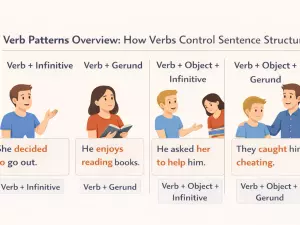
When one verb is followed by another, English typically chooses one of these patterns:
- Verb + gerund: the second action is treated like an activity or experience (a thing you do). Example: She enjoys cooking.
- Verb + infinitive: the second action is treated like a purpose, intention, or future step. Example: She decided to cook.
2) How meaning influences the choice
The form often matches the speaker’s focus. These are useful meaning-based tendencies (not absolute rules):
- Activity/experience focus → gerund: used when the action itself is the “thing” being discussed. Example: I miss living near the sea.
- Decision/plan focus → infinitive: used when the action is a chosen next step. Example: We plan to move next year.
- Avoidance/resistance → gerund: common with verbs about avoiding or delaying actions. Example: He avoided answering.
- Promise/offer/hope → infinitive: common with verbs that point forward to an intended action. Example: They promised to help.
- Feelings about an action → often gerund: common when reacting to an action as an event. Example: She admitted making a mistake.
3) Verb “families” that prefer one form
Many verbs develop stable patterns over time. Learning them in groups helps because the same grammar choice repeats across similar meanings.
- Common verbs followed by a gerund: admit, avoid, consider, delay, deny, enjoy, finish, imagine, keep, mind, miss, practice, quit, recommend, risk, suggest.
- Common verbs followed by an infinitive: agree, decide, expect, hope, learn, manage, need, offer, plan, pretend, promise, refuse, seem, want.
4) Verbs that allow both forms (sometimes with a meaning change)
Some verbs accept either a gerund or an infinitive. In these cases, the choice can change the meaning or the time reference.
- remember + -ing = recall a past action: ✅ I remember locking the door.
- remember + to + verb = not forget a necessary action: ✅ Remember to lock the door.
- stop + -ing = end an activity: ✅ He stopped smoking.
- stop + to + verb = pause one action in order to do another: ✅ He stopped to smoke.
- try + -ing = experiment with a method: ✅ Try restarting the app.
- try + to + verb = attempt something difficult: ✅ Try to restart the server.
5) Structure can force the form
Sometimes the grammar around the verb determines what can follow.
- Verb + object + infinitive is common when one person influences another: She told him to leave. / They encouraged us to apply.
- Preposition + gerund is a strong rule: after a preposition, use -ing. ✅ He apologized for being late. ❌ He apologized for to be late.
- “Go” + activity often uses a gerund to name an activity: go shopping, go swimming, go hiking.
In practice, choosing between -ing and to + verb is less about “one universal rule” and more about recognizing patterns: what the first verb means, whether an object is present, and whether the second action is treated as an activity, a plan, or an instruction.
Common verbs that require a gerund form
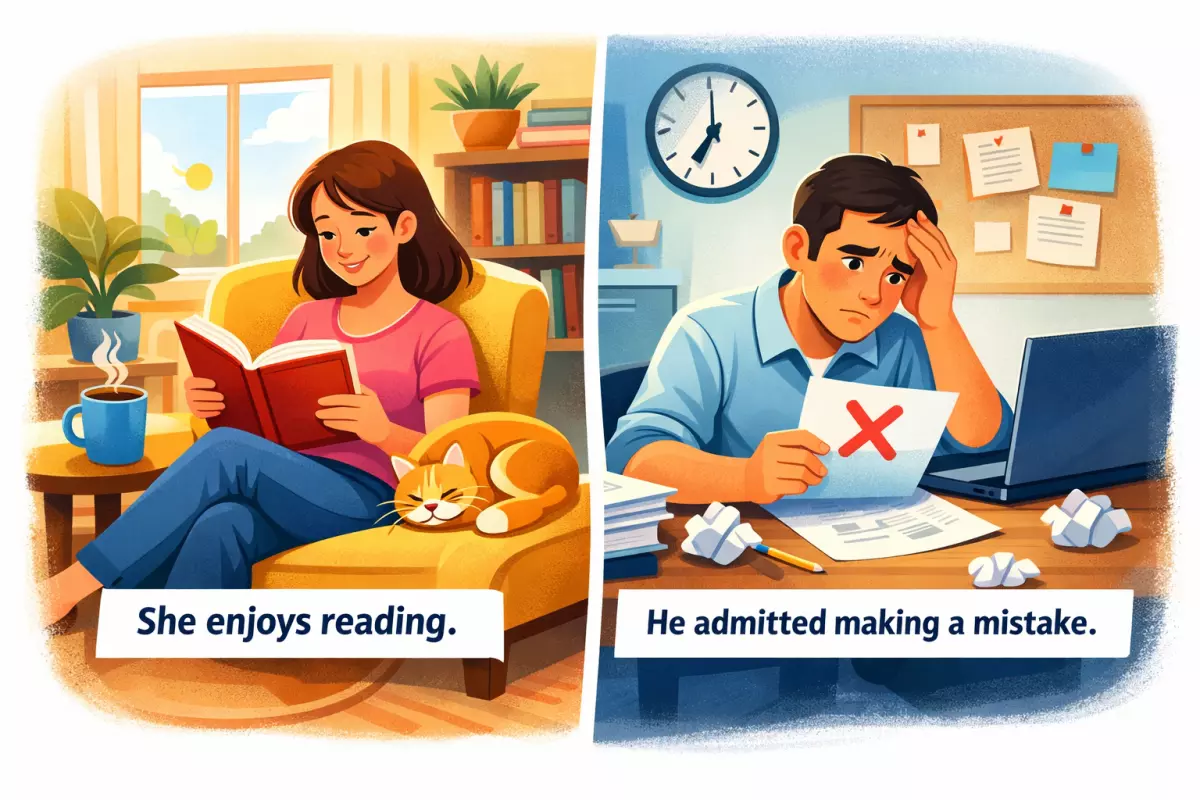
Some verbs are typically followed by an -ing form (a gerund) when the next word is another action. This pattern is especially common after verbs that express enjoyment, avoidance, completion, or mental processes. In these cases, use verb + gerund rather than an infinitive.
Core pattern and quick reminders
- Structure: verb + verb-ing (gerund) → She enjoys reading.
- Common mistake to avoid: ❌ She enjoys to read. → ✅ She enjoys reading.
- Gerund can take an object: He admitted making a mistake.
- Gerund can be negative: They avoided not answering the question. (more natural: They avoided answering the question.)
Verbs that are usually followed by a gerund
- admit → He admitted lying about the time.
- avoid → She avoids driving at night.
- consider → We considered moving closer to work.
- delay → They delayed signing the contract.
- deny → He denied taking the money.
- dislike → I dislike waiting in long lines.
- enjoy → She enjoys cooking for friends.
- finish → He finished writing the report.
- give up → She gave up trying to fix it alone.
- imagine → Can you imagine living without internet?
- keep (continue) → They kept asking the same question.
- mind → Do you mind opening the window?
- miss → I miss seeing my classmates.
- practice → He practices speaking every day.
- recommend → They recommend taking the early train.
- regret (about a past action) → I regret saying that.
- risk → You risk losing your progress.
- suggest → She suggested meeting after lunch.
Usage notes: patterns learners often mix up
- Stop + gerund means “quit the activity”: He stopped smoking. (Compare with stopped to smoke = stopped in order to smoke.)
- Regret + gerund looks back on something already done: She regrets telling him. (Compare with regret to inform you = formal announcement.)
- Mind + gerund is common in polite questions: Would you mind waiting a moment?
- Recommend/Suggest usually take a gerund when the next word is an action: He suggested taking a break. (Also possible: suggested that we take a break.)
Common verbs that require an infinitive form
Many English verbs are typically followed by to + base verb (the infinitive). This pattern is especially common after verbs that express plans, decisions, promises, requests, or willingness. Learning these verbs as “verb + to-infinitive” chunks helps you choose the correct form quickly.
Core pattern
Use verb + to + verb:
- ✅ I decided to leave early.
- ✅ She promised to call tonight.
- ❌ I decided leaving early. → ✅ I decided to leave early.
High-frequency verbs followed by the infinitive
The verbs below commonly take an infinitive complement. In most cases, a gerund is not used right after these verbs.
- agree (to do): They agreed to meet at noon.
- aim (to do): We aim to finish by Friday.
- arrange (to do): He arranged to pick her up.
- ask (to do): I asked to speak to the manager.
- choose (to do): She chose to stay home.
- claim (to do): He claimed to know the answer.
- decide (to do): They decided to postpone the trip.
- demand (to do): The client demanded to see the report.
- expect (to do): I expect to hear back soon.
- fail (to do): He failed to notice the sign.
- forget (to do): Don’t forget to lock the door.
- hope (to do): We hope to visit next year.
- learn (to do): She learned to drive at 18.
- manage (to do): He managed to solve the problem.
- offer (to do): They offered to help us move.
- plan (to do): I plan to apply tomorrow.
- prepare (to do): She prepared to give a short talk.
- pretend (to do): He pretended to be asleep.
- promise (to do): I promise to be on time.
- refuse (to do): She refused to answer.
- seem (to do): You seem to understand.
- tend (to do): Prices tend to rise in summer.
- threaten (to do): He threatened to quit.
- want (to do): I want to improve my writing.
- wish (to do): They wish to speak privately.
Common “verb + object + infinitive” patterns
Some verbs are often followed by an object (a person) and then the infinitive. This is a very regular structure in everyday English.
- advise + person + to do: She advised me to wait.
- allow + person + to do: They allowed him to enter.
- ask + person + to do: I asked her to send the file.
- encourage + person + to do: We encouraged them to try again.
- expect + person + to do: I expect you to be ready at 8.
- invite + person + to do: He invited us to join.
- need + person + to do: I need you to sign here.
- order + person + to do: The officer ordered them to stop.
- persuade + person + to do: She persuaded him to apologize.
- remind + person + to do: Please remind me to call.
- teach + person + to do: He taught her to swim.
- tell + person + to do: She told me to sit down.
- warn + person + to do: They warned us to be careful.
When you learn a new verb, note whether it normally takes “to + verb” and whether it also allows an object before the infinitive. That small detail prevents many common gerund vs. infinitive mistakes.
Verbs that allow both forms with little change in meaning
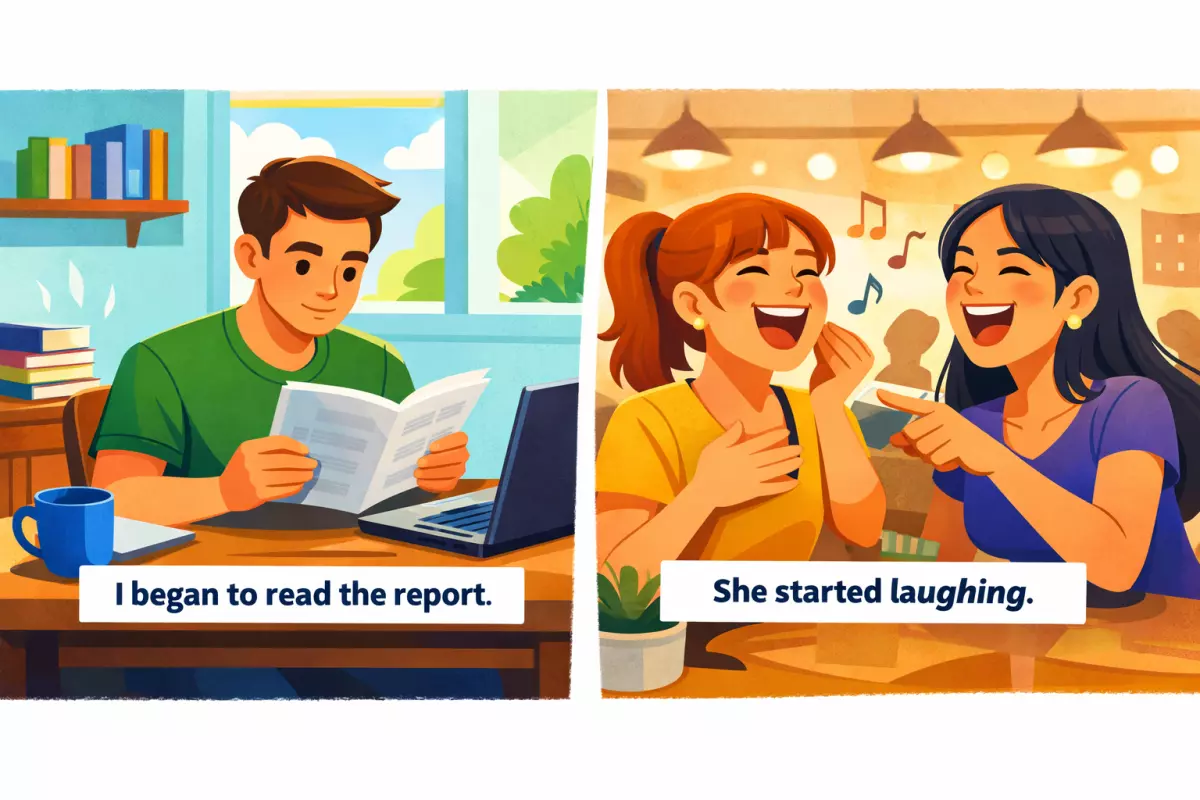
Some verbs can be followed by either a gerund (verb + -ing) or an infinitive (to + base verb) without a real shift in meaning. The choice often depends on style, rhythm, or what sounds more natural in context. In these cases, both structures are typically correct, and any difference is usually minor (for example, slightly more formal with an infinitive).
Common verbs that work with either gerund or infinitive
- begin: I began to read / I began reading the report.
- start: She started to laugh / She started laughing at the joke.
- continue: They continued to talk / They continued talking after the meeting.
- intend (often infinitive, but -ing is possible in some contexts): I intend to apply / I intend applying next week.
- love: He loves to cook / He loves cooking for friends.
- like: I like to walk / I like walking in the evening.
- prefer: She prefers to study / She prefers studying alone.
- hate: They hate to wait / They hate waiting in long lines.
- can’t stand: I can’t stand to be / I can’t stand being interrupted.
- can’t bear: He can’t bear to watch / He can’t bear watching scary films.
- attempt: She attempted to fix / She attempted fixing the printer.
- propose (meaning “suggest”): They proposed to meet / They proposed meeting on Friday.
- cease (more formal): The noise ceased to bother / The noise ceased bothering me.
Usage notes that help you choose
- Infinitive often sounds a bit more formal or deliberate: I like to review my notes before class.
- Gerund often sounds more general or habitual: I like reviewing my notes before class.
- With begin/start/continue, both are usually interchangeable, especially in everyday English: She started to explain / started explaining.
- Avoid awkward stacking of sounds: Many speakers prefer the gerund when the next word is also “to” (to avoid “to… to…”). Example: I started reading to relax (often preferred over “started to read to relax”).
- Keep the structure consistent in coordinated phrases: He likes swimming and running (matching forms is usually smoother than mixing).
Quick correctness check
- ✅ She began to work early. / She began working early.
- ✅ I hate to complain, but this is important. / I hate complaining, but this is important.
- ❌ He suggested to go now. → ✅ He suggested going now. (This verb does change the rule; it does not belong in the “either form” group.)
Verbs where gerund and infinitive change the meaning of a sentence
Some verbs can be followed by either a gerund (-ing) or an infinitive (to + base verb), but the choice changes the meaning. These are not “free” alternatives: each pattern signals a different time reference, intention, or result.
| Verb | Verb + gerund (meaning + example) | Verb + infinitive (meaning + example) |
|---|---|---|
| remember | Memory of a past action: “I remember locking the door.” | Don’t forget a future action: “Remember to lock the door.” |
| forget | Forget a past experience/action: “I’ll never forget meeting her.” | Fail to do something: “I forgot to email you.” |
| stop | Quit an activity: “He stopped smoking.” | Pause one action in order to do another: “He stopped to smoke.” |
| try | Experiment to see what happens: “Try restarting the app.” | Make an effort (often difficult): “I tried to restart it, but it crashed.” |
| regret | Feel sorry about a past action: “I regret telling him.” | Formal: announce bad news: “We regret to inform you that…” |
| go on | Continue the same activity: “She went on talking.” | Move to the next step/topic: “She went on to explain the plan.” |
| mean | Involve/require: “This job means working weekends.” | Intend: “I meant to call you.” |
| need | Passive meaning (common in speech): “The car needs washing.” | Active meaning: “I need to wash the car.” |
| allow / permit | General permission (often about a category): “They don’t allow smoking here.” | Permission for a person: “They allowed him to smoke outside.” |
| advise | General recommendation: “I advise taking the early train.” | Advice to a person: “I advised her to take the early train.” |
Quick usage notes
- Past vs. future focus: With verbs like remember and forget, the gerund usually points back to an earlier action, while the infinitive points forward to something you must do.
- Changing the main action: With stop and go on, the gerund keeps the same activity, but the infinitive often introduces a new purpose or next step.
- Effort vs. experiment: With try, the infinitive highlights effort; the gerund suggests testing a possible solution.
- Common passive meaning: Need + gerund (“needs washing”) is equivalent to “needs to be washed” in meaning, even though the form looks active.
Practical tips for choosing the correct structure in real speech
Choose faster and more accurately by listening for the verb’s “pattern” rather than translating word by word. In everyday speaking, most mistakes come from using the right idea with the wrong verb form (for example, using to + verb where the verb normally takes -ing, or the other way around).
1) Identify the verb pattern first (not the topic)
- Verb + -ing: common after verbs that describe enjoyment, avoidance, and finishing. Examples: enjoy, avoid, finish, keep, consider.
- Verb + to-infinitive: common after verbs about plans, decisions, and willingness. Examples: decide, plan, choose, hope, refuse.
- Verb + object + to-infinitive: common when someone causes, wants, or asks another person to do something. Examples: want, ask, tell, allow, encourage.
- Verb + -ing / to-infinitive (meaning changes): a small group where the form changes the meaning. Examples: remember, stop, try, regret.
2) Use quick meaning checks for the “meaning-change” verbs
- stop: stop smoking = quit the habit; stop to smoke = pause another activity in order to smoke.
- remember: remember locking the door = memory of a past action; remember to lock the door = don’t forget a future action.
- try: try calling her = experiment/suggestion; try to call her = attempt (maybe difficult).
- regret: regret saying it = feel sorry about a past action; regret to say = formal way to introduce bad news.
3) Rely on high-frequency “safe” chunks in conversation
- I’m looking forward to + -ing (I’m looking forward to meeting you.)
- It’s worth + -ing (It’s worth checking.)
- I can’t stand + -ing (I can’t stand waiting.)
- I don’t mind + -ing (I don’t mind helping.)
- I’m used to + -ing (I’m used to getting up early.)
- I’d like to + base verb (I’d like to ask a question.)
- I need to + base verb (I need to leave soon.)
- I want you to + base verb (I want you to be honest.)
- It’s hard/easy to + base verb (It’s hard to explain.)
- It’s important to + base verb (It’s important to listen.)
4) Watch for “to” that is a preposition (it usually leads to -ing)
In real speech, “to” is not always the infinitive marker. After many expressions, to is a preposition, so it is followed by a noun or an -ing form.
- be committed to + -ing (She’s committed to improving.)
- be opposed to + -ing (They’re opposed to raising taxes.)
- get used to + -ing (You’ll get used to driving on the left.)
- look forward to + -ing (We look forward to seeing you.)
- object to + -ing (He objected to paying extra.)
5) Use simple correction checks while speaking
- If you can insert a person after the verb, you may need object + to-infinitive: “I want him to call.”
- If the verb expresses an activity you experience (enjoy/avoid/finish), default to -ing: “I avoid driving at night.”
- If the verb expresses a decision or plan, default to to-infinitive: “We decided to leave.”
- If you hear a modal (can, could, should, must), use the base verb, not a gerund/infinitive: ✅ “I can go.” ❌ “I can to go.”
- If you are naming an action as a general idea, an -ing form often works naturally: “Swimming is good exercise.”
6) Keep a short “personal list” of verbs you use often
Fluency improves when you memorize patterns for the verbs you actually say every day. Start with 10–15 and add more as you notice them.
- -ing group: enjoy, avoid, finish, keep, suggest, consider, imagine, miss, practice, recommend.
- to-infinitive group: decide, plan, hope, promise, refuse, agree, learn, manage, offer, seem.
- object + to-infinitive group: want, ask, tell, allow, remind, encourage, expect, invite, need, help.
Practice exercises: choose gerund or infinitive in context
Choose the correct form (gerund or infinitive) based on the verb pattern and the meaning in each sentence. Pay attention to common triggers: verbs followed by to + base verb, verbs followed by -ing, and verbs that change meaning depending on the form.
Exercise 1: Complete the sentences
- I can’t afford ___ (buy) a new laptop this month.
- She suggested ___ (take) the earlier train to avoid traffic.
- We decided ___ (stay) home because the weather got worse.
- Do you mind ___ (open) the window?
- He promised ___ (call) me as soon as he arrived.
- They admitted ___ (break) the rule, but it was an accident.
- I’m not used to ___ (drive) on the left.
- My manager expects me ___ (finish) the report by Friday.
- She kept ___ (ask) the same question.
- He refused ___ (sign) the document without reading it.
- Thanks for ___ (help) me with the boxes.
- We hope ___ (see) you again soon.
Show answers
- to buy
- taking
- to stay
- opening
- to call
- breaking
- driving
- to finish
- asking
- to sign
- helping
- to see
Exercise 2: Verb + object patterns (watch the structure)
Some verbs are typically followed by an object + infinitive (for example: want someone to do, expect someone to do). Complete each sentence with the correct form.
- My parents want me ___ (study) medicine.
- The teacher encouraged us ___ (participate) more in class.
- They warned him not ___ (touch) the wires.
- I’d like you ___ (be) honest with me.
- She reminded him ___ (lock) the door.
- We invited them ___ (join) us for dinner.
- The coach taught the team ___ (work) together.
- He asked me ___ (wait) outside.
- The company hired her ___ (manage) the project.
- Can you help me ___ (carry) this upstairs?
Show answers
- to study
- to participate
- to touch
- to be
- to lock
- to join
- to work
- to wait
- to manage
- to carry
Exercise 3: Same verb, different meaning (choose carefully)
For these items, the choice affects meaning. Use context clues to decide between -ing and to + verb.
- I stopped ___ (smoke) last year, and I feel much better now.
- I stopped ___ (buy) coffee because I realized I’d forgotten my wallet.
- Remember ___ (turn off) the lights before you leave.
- I remember ___ (meet) her at a conference years ago.
- He tried ___ (restart) the computer, but it still wouldn’t work.
- He tried ___ (drink) less coffee, but he got headaches.
- Don’t forget ___ (send) the attachment this time.
- I’ll never forget ___ (see) the northern lights for the first time.
- She went on ___ (explain) the plan in more detail.
- After university, he went on ___ (work) in finance for a decade.
Show answers
- smoking
- to buy
- to turn off
- meeting
- to restart
- drinking
- to send
- seeing
- to explain
- working
Exercise 4: Error correction (rewrite the underlined part)
Each sentence contains a form that doesn’t fit the verb pattern or meaning. Rewrite only the part in brackets.
- She enjoys [to cook] for friends on weekends.
- He offered [helping] us move house.
- I can’t stand [to wait] in long lines.
- They agreed [going] earlier to miss the rush hour.
- We’re considering [to rent] a smaller apartment.
- He managed [finishing] the marathon despite the heat.
- Do you expect [seeing] him today?
- She avoided [to talk] about the problem.
- I learned [speaking] English by practicing every day.
- He pretended [knowing] the answer.
Show answers
- cooking
- to help
- waiting
- to go
- renting
- to finish
- to see
- talking
- to speak
- to know