Perfect Infinitives (To Have Done): Rules and Usage

 Learn what a perfect infinitive is and how to have plus a past participle points to an earlier action. See it after modals like should, could, and might for regret, criticism, or speculation, plus adjective and reporting-verb patterns. Includes common mistakes and practice exercises.
- What a perfect infinitive is and how 'to have + past participle' works
- How perfect infinitives refer to actions that happened earlier in time
- Using perfect infinitives after modal verbs like should, could, and might
- How perfect infinitives express regret, criticism, or speculation
- Sentence patterns with adjectives and reporting verbs
- Common learner mistakes with perfect infinitive forms
- Practice exercises: complete sentences using perfect infinitives
Want to describe an action that happened before another time and make the timing clear? The structure to have plus a past participle does this by looking back from a later point to a completed action, a missed opportunity, or a reason. You can say I’m glad to have finished or She seems to have forgotten. This article shows when it sounds natural and when it feels awkward.
What a perfect infinitive is and how 'to have + past participle' works
A perfect infinitive is an infinitive form that places the action before the time of another verb. It is built with to have + past participle and is used when you want to show that something was already completed earlier (often earlier than a present comment, a past report, or a future plan).
Core meaning: “earlier than the main verb”
This structure is mainly about time sequencing. The main verb sets the reference point (now, then, or later), and the perfect infinitive points to an action completed before that point.
- Present reference: “I’m happy to have finished the report.” (finishing happened before the current feeling)
- Past reference: “She said she was glad to have met you.” (meeting happened before the moment she spoke)
- Future reference: “He hopes to have completed the course by June.” (completion happens before June)
How the form is built
The pattern is straightforward: to have + a past participle (V3). The past participle can be regular (-ed) or irregular (done, gone, seen, written, etc.).
- to have worked
- to have lived
- to have done
- to have gone
- to have seen
- to have taken
- to have written
- to have made
- to have forgotten
- to have chosen
- to have built
- to have kept
Where it commonly appears (usage patterns)
You will often see this form after verbs and expressions that look back on an earlier action, especially when the speaker is evaluating, reporting, or expressing emotion about it.
- After adjectives about feelings or judgments: “I’m relieved to have found my keys.”
- After reporting verbs: “They claimed to have solved the problem.”
- After “seem/appear”: “He seems to have misunderstood the instructions.”
- After “be said/believed/known/thought”: “She is believed to have left early.”
- After “hope/expect/plan” with a deadline: “We expect to have shipped everything by Friday.”
- After “too/enough” structures: “He was lucky enough to have avoided the traffic.”
- In passive-style reporting with an agent omitted: “The painting is thought to have been stolen.”
Perfect infinitive vs. simple infinitive
Choose the perfect form when the action is earlier; choose the simple infinitive (to do) when the action is simultaneous with or later than the main verb.
- ✅ “I’m glad to have met you.” (meeting happened before the current feeling)
- ✅ “I’m glad to meet you.” (meeting is happening now, as you speak)
- ✅ “She seems to have left.” (leaving happened earlier)
- ✅ “She seems to leave early.” (general habit) / “She seems to be leaving.” (happening now)
Common learner pitfalls
- Using the wrong time meaning: “He is happy to win” (present/future) vs. “He is happy to have won” (already won).
- Mixing forms: ❌ “to have went” → ✅ “to have gone”
- Forgetting the reference point: if the main verb is in the past (“said,” “thought,” “was”), the completed action usually needs the perfect infinitive to show it happened before that past moment.
How perfect infinitives refer to actions that happened earlier in time

Use to have + past participle when you want the infinitive to point to a completed action that comes before the time of the main verb. This is common after reporting verbs, adjectives about feelings or judgments, and modal-like expressions where the speaker looks back and evaluates what occurred.
Core time relationship
The perfect infinitive sets up a simple sequence: the action in the perfect infinitive happens first, and the action or viewpoint in the main clause happens later. Compare the meaning difference:
- to do → action is simultaneous with, or after, the main verb’s time
- to have done → action is earlier than the main verb’s time
Where this “earlier action” meaning shows up most
- After reporting verbs (say, claim, believe, report, seem): the report happens now; the action is already completed.
- After adjectives about feelings (glad, happy, relieved, sorry, disappointed): the emotion is current; the cause is in the past.
- After judgments and evaluations (wise, foolish, right, wrong): the judgment is made later; the evaluated act happened earlier.
- After “seem/appear”: the appearance is present; the inferred event is earlier.
- After “be said/known/expected”: the statement/expectation exists now; the event is earlier.
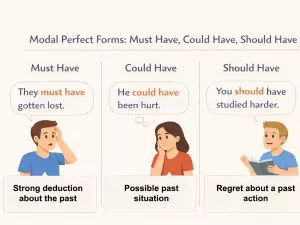
- With modals (must, might, could, should): the modal meaning is about a past event (deduction, possibility, criticism, regret).
High-value patterns with examples
- Reporting: “She claims to have finished the report.” (claim now; finishing earlier)
- Reporting (passive): “The company is said to have lost a major client.”
- Belief: “They believe him to have acted alone.”
- Seeming: “He seems to have forgotten the meeting.”
- Discovery: “I was surprised to have missed your call.”
- Relief: “She was relieved to have passed the exam.”
- Regret: “I’m sorry to have caused confusion.”
- Criticism (modal): “You should have told me earlier.”
- Deduction (modal): “He must have left already.”
- Possibility (modal): “They might have taken the wrong train.”
- Unrealized ability/opportunity (modal): “I could have helped, but I didn’t know.”
- Expectation not met (modal): “The parcel should have arrived by now.”
- Formal apology: “We regret to have informed you so late.”
- Formal notice: “The minister is expected to have resigned before the vote.”
- Inference from evidence: “The streets are wet; it seems to have rained.”
Common contrasts and frequent mistakes
- ✅ “I’m happy to have met you.” (meeting happened earlier) ❌ “I’m happy to meet you.” (usually used at the moment of meeting)
- ✅ “She is believed to have taken the documents.” ❌ “She is believed to take the documents.” (changes meaning to a general habit)
- ✅ “He seems to have changed his mind.” ❌ “He seems to change his mind.” (suggests a repeated tendency)
- ✅ “You should have called.” (past criticism) ❌ “You should call.” (present advice)
In practice, choose the perfect infinitive when the main clause expresses a later viewpoint (a claim, feeling, deduction, or evaluation) and you need the infinitive to clearly signal that the relevant action was already completed.
Using perfect infinitives after modal verbs like should, could, and might
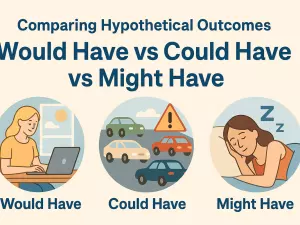
After a modal verb, have + past participle shifts the meaning to an earlier time (usually the past). This structure is common when you want to judge a past action, describe an unreal past possibility, or make a careful guess about what happened.
Core pattern
- Modal + have + past participle: should have done, could have done, might have done
- Negative: modal + not + have + past participle: shouldn’t have said, couldn’t have finished, might not have noticed
- Questions: modal + subject + have + past participle: Should I have called? Could they have left?
Should have + past participle (past advice, criticism, regret)
Should have is used to evaluate a past decision. It often implies “the better choice was different,” so it can sound like criticism or regret depending on context.
- ✅ You should have told me earlier. → It would have been better if you had told me.
- ✅ We should have booked the tickets in advance.
- ✅ She shouldn’t have shared that password.
- ✅ I shouldn’t have interrupted you.
- ✅ Should we have taken a different route?
- ❌ You should have to called me. → You should have called me.
Could have + past participle (past possibility, unrealized ability, alternative outcomes)
Could have points to something that was possible in the past, often an option that did not happen. It can also express that someone had the ability/opportunity but didn’t use it.
- ✅ I could have helped you yesterday, but I didn’t see your message.
- ✅ They could have won if they had defended better.
- ✅ We could have taken the train instead of driving.
- ✅ She couldn’t have known about the change. → It wasn’t possible for her to know.
- ✅ Could he have misunderstood the instructions?
- ❌ We could have went earlier. → We could have gone earlier.
Might have + past participle (uncertain past, cautious guesses, missed chances)
Might have is used when you are not sure about a past situation, or when you want to mention a possible outcome that didn’t happen (often more tentative than could have).
- ✅ She might have missed the bus. → It’s possible, but not certain.
- ✅ They might not have received the email yet.
- ✅ I might have left my keys at the office.
- ✅ We might have avoided the delay if we’d left earlier.
- ✅ Might he have taken the wrong folder by mistake?
Common meaning contrasts to keep clear
- should do (present/future advice) vs should have done (past evaluation): You should call her / You should have called her.
- could do (general ability/option now) vs could have done (past possibility): I could help / I could have helped.
- might do (possible future) vs might have done (uncertain past): She might come / She might have come.
Frequent learner issues
- Using to after a modal: ❌ should to have done → ✅ should have done
- Using the past simple instead of the past participle: ❌ could have went → ✅ could have gone
- Confusing certainty: might have = uncertain; must have (not covered here) = strong deduction.
How perfect infinitives express regret, criticism, or speculation

The perfect infinitive (to have + past participle) is a useful way to refer back to an earlier action and comment on it from the present point of view. It often appears after reporting verbs, modal expressions, and adjectives that evaluate a past choice or guess at what happened.
1) Regret about a past action or missed opportunity
Use the form to show that the action is already in the past, and the speaker now wishes it had happened differently. Common triggers include verbs like regret, wish, be sorry, and phrases like would like (in hindsight).
- I regret to have said that. (formal; more common: I regret saying that.)
- I’m sorry to have missed your call.
- She wishes to have taken the earlier train. (formal; more common: She wishes she had taken…)
- They would have liked to have seen the final match. (hindsight; note the double perfect is common in speech)
- He seems to have forgotten to apologize. (implied regret/complaint about a past omission)
- ✅ I’m glad to have met you. → positive “regret-like” reflection on a past event
2) Criticism, blame, or “you should have…” meanings
Perfect infinitives are frequent after modals and semi-modals that judge a past decision. The structure lets you criticize without narrating the whole past event again.
- You should have told me earlier. (modal + perfect infinitive meaning)
- He ought to have checked the figures before sending the report.
- They could have warned us about the delay. (criticism: they had the ability/opportunity)
- She might have mentioned the change of plan. (mild reproach)
- You needn’t have bought so much food. (unnecessary past action)
- He was supposed to have finished by Friday. (expectation not met)
- She was meant to have called yesterday. (planned/expected past action)
- ❌ You should to have told me. → ✅ You should have told me.
3) Speculation and deduction about what happened
When paired with modals like must, may, might, could, and can’t, the perfect infinitive supports guesses about a past situation. The speaker is not describing a known fact, but reasoning from evidence.
- She must have left already; the lights are off. (strong deduction)
- They may have taken a different route. (possible)
- He might have misunderstood the instructions. (uncertain)
- It could have been a technical glitch. (one plausible explanation)
- He can’t have seen the message; he replied immediately. (strong negative deduction)
- She may not have realized the deadline was today. (speculation about lack of awareness)
- They must have been waiting for hours. (perfect infinitive with a state/continuous idea in context)
Common patterns to notice
- Modal + have + past participle is the core pattern for past evaluation: should have done, might have done, must have done.
- With reporting or perception verbs, the form often signals “earlier than the reporting moment”: seem to have done, appear to have done, be said to have done.
- In formal writing, perfect infinitives can follow adjectives of reaction: pleased to have helped, sorry to have caused, surprised to have heard.
- In everyday English, some regret structures prefer other grammar (especially wish + past perfect), but the perfect infinitive remains common after modals and in more formal phrasing.
Sentence patterns with adjectives and reporting verbs
Perfect infinitives (to have + past participle) often appear after evaluative adjectives and after reporting verbs when the speaker looks back at an earlier action. These patterns are especially common when you want to show that the action was completed before the feeling, judgment, report, or discovery.
Adjective + perfect infinitive (evaluation after the fact)
Use this structure to comment on a past action from a later point in time. It is frequent with adjectives about emotions, judgments, and reactions.
- Subject + be + adjective + to have + past participle: “She was relieved to have finished the exam.”
- Subject + be + adjective + to have + past participle: “They were surprised to have received the refund so quickly.”
- It + be + adjective + (of/for + someone) + to have + past participle: “It was careless of him to have left the door unlocked.”
- It + be + adjective + to have + past participle: “It was fortunate to have booked early.”
- Common adjectives in this pattern: pleased, glad, relieved, happy, sorry, shocked, surprised, disappointed, proud, ashamed, lucky, fortunate, foolish, careless, sensible, wise.
- ✅ “I’m glad to have met your team.” → meeting happened before the feeling of gladness.
- ❌ “I’m glad to meet your team yesterday.” → use the perfect infinitive (or past simple) for a completed past meeting.
- Negative form: “She was embarrassed not to have remembered his name.”
- Passive form: “He was shocked to have been treated that way.”
- With degree words: “We were very lucky to have found a seat.”
Reporting verbs + perfect infinitive (reported belief, claim, or discovery)
After reporting verbs, the perfect infinitive helps show that the reported action happened earlier than the reporting. This is common in formal writing, news style, and careful summaries.
- Subject + reporting verb + to have + past participle: “The witness claimed to have seen the driver.”
- Subject + reporting verb + to have + past participle: “She admitted to have made a mistake.” → more natural: “She admitted having made a mistake” or “She admitted she had made a mistake.”
- Subject + reporting verb + to have + past participle: “He denied having taken the files.” (Often uses gerund; perfect infinitive is less typical with deny.)
- Common reporting verbs that work well with the perfect infinitive: claim, report, state, say, believe, think, consider, understand, appear, seem, prove, turn out.
- With “seem/appear”: “She seems to have forgotten the appointment.”
- With “be said/thought/believed” (reporting passive): “The company is believed to have lost the contract.”
- Negative form: “He is reported not to have paid the fine.”
- Passive perfect infinitive: “The documents are said to have been stolen.”
- Time clarity: “They said to have arrived at noon” ❌ → “They are said to have arrived at noon” or “They said they had arrived at noon.”
- Meaning check: “He claimed to have been promoted” (promotion happened before the claim).
Choosing between perfect infinitive and simple infinitive
- Use the perfect infinitive when the action is earlier than the adjective/reported viewpoint: “I’m happy to have completed the course.”
- Use the simple infinitive when the action is simultaneous or future relative to the viewpoint: “I’m happy to complete the course next month.”
- With reporting verbs, the perfect form often replaces a that-clause with past perfect: “She is said to have left” → “People say that she had left.”
Common learner mistakes with perfect infinitive forms
Errors with to have + past participle usually come from mixing time references: learners use it when they mean a simple past event, or they avoid it when they need to show an earlier action. The key is to check whether the infinitive action happened before the main verb (or before a point in the past).
Frequent problems and how to fix them
- Using a simple infinitive when the earlier action matters
❌ I’m happy to finish the project yesterday. → ✅ I’m happy to have finished the project. - Using the perfect infinitive when no “earlier than” meaning is needed
❌ I want to have see you tomorrow. → ✅ I want to see you tomorrow. - Confusing “to have done” with the present perfect tense
❌ I have done it means the same as I’m glad to have done it. → ✅ “I have done it” is a main verb tense; “to have done” is an infinitive phrase used after another verb/adjective. - Wrong structure: adding “have” but keeping the base verb
❌ to have do / to have finish → ✅ to have done / to have finished - Regular/irregular past participle mistakes
❌ to have went / to have buyed → ✅ to have gone / to have bought - Mixing up perfect infinitive and perfect continuous infinitive
❌ I’m tired to have worked all day (focus is on duration). → ✅ I’m tired to have been working all day. - Choosing the wrong form after modals when talking about past possibility/criticism
❌ He must be forget the meeting. → ✅ He must have forgotten the meeting.
❌ You should lock the door (but it’s already too late). → ✅ You should have locked the door. - Using “would have” incorrectly inside an infinitive phrase
❌ I’m glad to would have helped. → ✅ I’m glad to have helped.
(Use “would have + past participle” as part of a conditional clause, not after “to”.) - Forgetting that some verbs prefer a different meaning with perfect forms
❌ I remembered to have met him (often sounds wrong). → ✅ I remember meeting him / I remember that I met him. - Overusing the form after “seem/appear” when simple time is intended
❌ She seems to have be happy right now. → ✅ She seems to be happy right now.
(Use to have been only if you mean “earlier than now/then.”) - Not matching the time of reporting verbs
❌ Yesterday, he claimed to finish the work. → ✅ Yesterday, he claimed to have finished the work. - Confusion after adjectives expressing feelings or judgments
❌ I’m sorry to break your phone (but it happened earlier). → ✅ I’m sorry to have broken your phone. - Placing “not” in the wrong spot
❌ to have not told you → ✅ not to have told you (more formal) / ✅ to not have told you (common in modern usage).
(Both are used; keep it consistent and clear.) - Using the perfect infinitive where a past clause is clearer
❌ I was surprised to have seen him at the party (can sound heavy). → ✅ I was surprised that I saw him at the party.
(The infinitive version is possible, but a clause often sounds more natural.) - Missing the “earlier action” meaning in passive forms
❌ The suspect is believed to arrest last night. → ✅ The suspect is believed to have been arrested last night.
When checking your own sentences, ask two questions: (1) Is the infinitive action earlier than the main verb’s time? (2) Do you need an active form (to have done) or a passive form (to have been done)? Answering those usually prevents most tense and form mix-ups.
Practice exercises: complete sentences using perfect infinitives
Use to have + past participle to show that one action happened earlier than the verb in the main clause (often to express regret, criticism, relief, or a past possibility). Complete each sentence with the correct perfect infinitive form of the verb in brackets. Pay attention to whether the meaning is active or passive.
Exercise 1: Complete the sentence (active)
- She seems ________ (forget) the meeting was moved to Friday.
- I’m glad ________ (meet) you before the interview; it helped me relax.
- He claims ________ (see) the file yesterday, but he can’t describe it.
- They were lucky ________ (find) a taxi so quickly in the rain.
- We’re sorry ________ (miss) your call; our phones were on silent.
- The team appears ________ (solve) the problem overnight.
- You were foolish ________ (leave) your passport at home.
- She pretended ________ (finish) the report, but the last page was blank.
Show answers
- to have forgotten
- to have met
- to have seen
- to have found
- to have missed
- to have solved
- to have left
- to have finished
Exercise 2: Complete the sentence (passive where needed)
- She was relieved ________ (choose) for the final round.
- He was shocked ________ (tell) the news so late.
- The documents appear ________ (lose) during the move.
- I’m disappointed ________ (exclude) from the discussion.
- They were happy ________ (invite) to the ceremony.
- The painting is believed ________ (steal) from a private collection.
Show answers
- to have been chosen
- to have been told
- to have been lost
- to have been excluded
- to have been invited
- to have been stolen
Exercise 3: Choose the better completion (to do vs. to have done)
- He seems (to forget / to have forgotten) my name again.
- I’m happy (to work / to have worked) with her last year.
- They hope (to finish / to have finished) by 6 p.m.
- She was lucky (to meet / to have met) the manager before he left.
- We expect (to receive / to have received) the results tomorrow.
- He claims (to break / to have broken) the record in 2019.
- I’m sorry (to interrupt / to have interrupted) you earlier.
- She seems (to be / to have been) tired all week.
Show answers
- to have forgotten
- to have worked
- to finish
- to have met
- to receive
- to have broken
- to have interrupted
- to have been
Exercise 4: Rewrite using a perfect infinitive (keep the meaning)
- It seems that she forgot to attach the file. → She seems ________ the file.
- I’m glad that I spoke to him earlier. → I’m glad ________ to him earlier.
- They are believed to have stolen the bike. → They are believed ________ the bike.
- He was sorry that he arrived late. → He was sorry ________ late.
- It appears that the keys were left in the car. → The keys appear ________ in the car.
- She claims that she met the author in Paris. → She claims ________ the author in Paris.
Show answers
- to have forgotten to attach
- to have spoken
- to have stolen
- to have arrived
- to have been left
- to have met
Quick usage reminders (patterns to copy)
- seem/appear + to have + past participle: “He seems to have misunderstood the question.”
- claim/pretend + to have + past participle: “She pretended to have sent the email.”
- be (un)happy / glad / sorry / relieved + to have + past participle: “I’m sorry to have caused confusion.”
- be lucky / foolish / wrong + to have + past participle: “You were lucky to have caught the last train.”
- Passive form when the subject receives the action: to have been + past participle (“to have been invited”).