How to Form Questions in the Present Perfect Tense

 Here we how to form present perfect questions, when to use have or has, creating yes/no and WH-questions, using words like ever, never, already, and yet, understanding time references, avoiding common mistakes, and includes practice exercises.
If you want to ask about past experiences or recent events in English, it's important to know how to use have or has followed by the past participle. This structure, known as the present perfect tense, helps you ask questions like Have you ever visited London? or Has she finished her homework? By practicing these types of questions, you can make your conversations sound more natural and fluent, and you'll find it easier to connect with others in English about things that have happened in the past or have just occurred.
Present Perfect Question Structure
To ask questions in the present perfect tense, English uses a specific word order. The question typically starts with "have" or "has," followed by the subject, and then the past participle form of the main verb. This structure allows us to inquire about experiences, recent actions, or changes over time.
Basic Word Order
The fundamental pattern is:
- Have/Has + subject + past participle + (optional rest of sentence)?
For example:
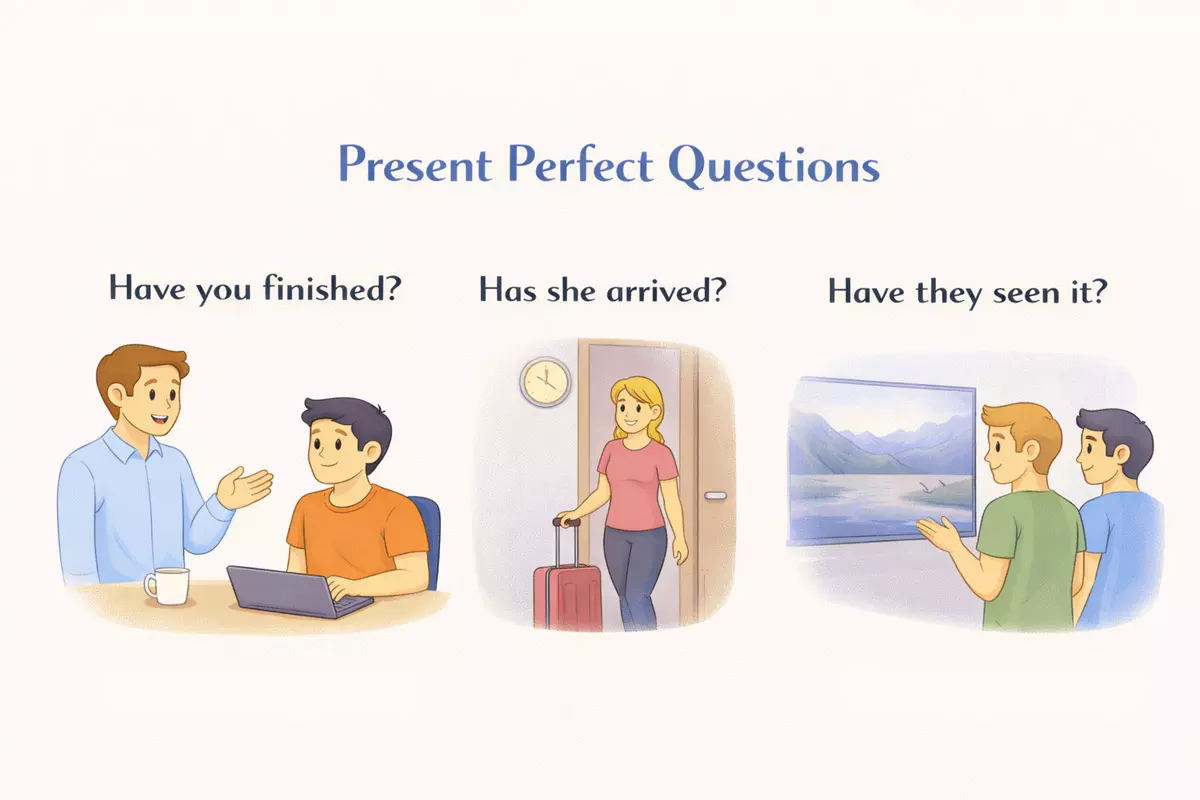
- Have you finished your homework?
- Has she ever visited Italy?
- Have they seen this movie before?
Yes/No Questions
These questions begin with "Have" or "Has," followed by the subject:
- Have I met you before?
- Has it stopped raining?
- Have we received any mail?
Wh- Questions
When asking for specific information, use a question word (like "what," "where," "who," "why," or "how") before "have/has":
- What have you done today?
- Where has he gone?
- Who has called me?
- Why have they left?
- How have you solved the problem?
Negative Questions
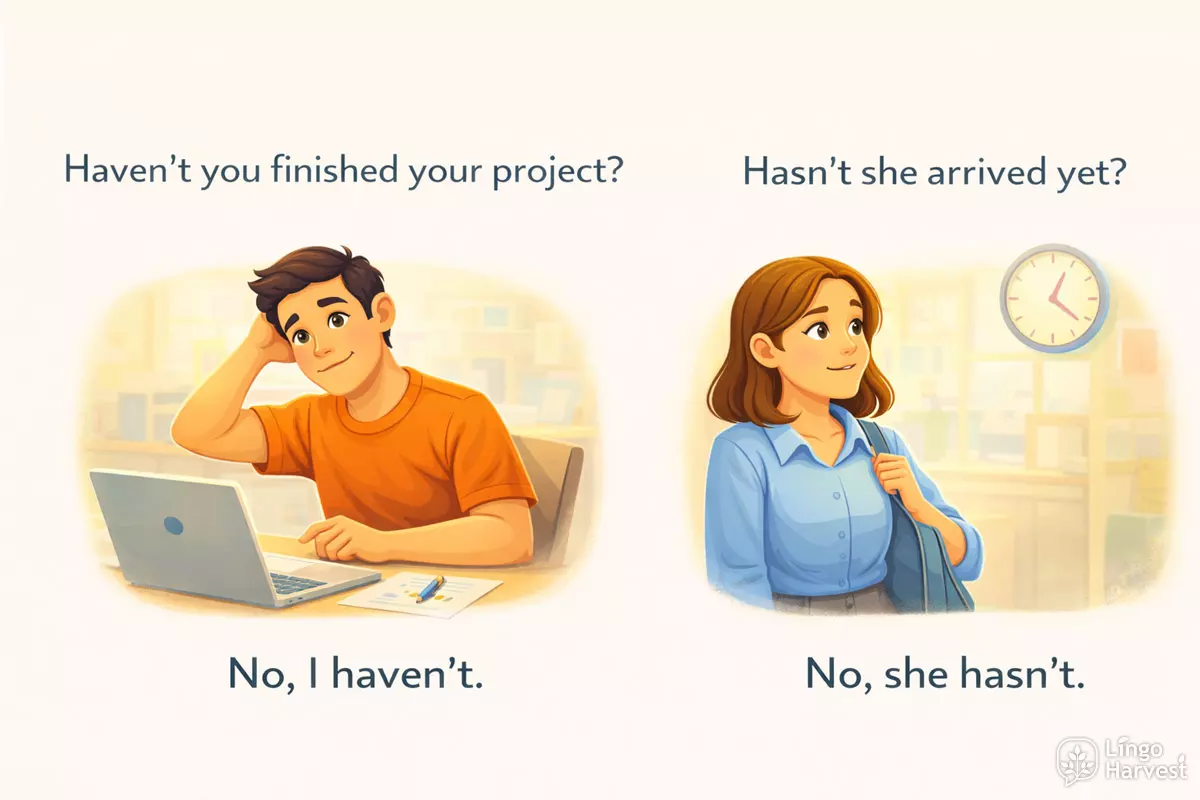
To express surprise or expectation, negative questions use "haven't" or "hasn't":
- Haven't you finished your project?
- Hasn't she arrived yet?
Common Patterns Compared
The following table shows typical forms for present perfect questions, using "to eat" as the example verb:
| Type | Example |
|---|---|
| Yes/No | Have you eaten? |
| Wh- Question | What have you eaten? |
| Negative | Haven't you eaten? |
| Third Person | Has she eaten? |
| With since/for | How long have you eaten here? |
Tips for Forming Questions
- Always use the past participle form of the main verb (e.g., "eaten," "gone," "seen").
- Use "has" for third-person singular subjects (he, she, it); use "have" for all others.
- For questions about time, use "how long" with "since" or "for" phrases: "How long have they lived here?"
- To ask about experiences, use "ever": "Have you ever tried sushi?"
- To ask about repeated actions, use "how many times": "How many times have you watched this show?"
Mastering this question format helps you communicate more naturally when discussing experiences or recent events in English.
Have vs Has in Questions
Choosing between “have” and “has” in present perfect questions depends on the subject of the sentence. Both are auxiliary verbs, but the correct form is determined by whether the subject is singular or plural, and whether it’s first, second, or third person. Understanding this distinction is essential for making grammatically correct questions in English.
When to Use "Have" and "Has"
Use “have” with the pronouns I, you, we, and they. For third-person singular subjects like he, she, or it, use “has.” This rule applies even when forming questions in the present perfect tense. The auxiliary verb always comes before the subject in these questions.
| Subject | Auxiliary Verb | Example Question |
|---|---|---|
| I / you / we / they | have | Have they finished their homework? |
| he / she / it | has | Has she visited London? |
| Plural nouns | have | Have the students arrived? |
| Singular nouns | has | Has Tom called you? |
Common Examples
- Have you seen this movie? → Yes, I have seen it.
- Has it stopped raining? → Yes, it has stopped.
- Have we met before? → Yes, we have met before.
- Has the train left? → Yes, it has already left.
- Have your friends arrived? → No, they haven’t arrived yet.
- Has my order shipped? → Yes, it has been shipped.
- Have I missed anything? → No, you haven’t missed anything.
- Has your sister called? → Yes, she has called.
- Have they read the book? → No, they haven’t read it yet.
- Has the cat eaten? → Yes, it has eaten.
- Have the teachers prepared the lesson? → Yes, they have prepared it.
- Has the company announced the results? → No, it hasn’t announced them yet.
- Have you ever traveled abroad? → Yes, I have traveled abroad.
- Has he finished his work? → Yes, he has finished it.
- Have the children gone to bed? → Yes, they have gone to bed.
Notice that the subject immediately follows the auxiliary verb, and the main verb is always in the past participle form. This structure is a key part of forming present perfect questions naturally and accurately.
Yes/No Questions in Present Perfect
To ask a question that can be answered with “yes” or “no” using the present perfect tense, start with the correct form of the auxiliary verb have or has, followed by the subject, then the past participle of the main verb. This structure helps you find out if something has happened at an unspecified time before now.
Structure and Word Order
The basic pattern is: Have/Has + subject + past participle + (rest of sentence)? Use have for I, you, we, they and has for he, she, it.
| Subject | Question Form |
|---|---|
| I / you / we / they | Have + subject + past participle ...? |
| He / she / it | Has + subject + past participle ...? |
Common Examples
- Have you finished your homework? → Yes, I have finished it.
- Has she ever visited London? → Yes, she has visited London.
- Have they seen this movie before? → No, they haven’t seen it before.
- Has he called you today? → Yes, he has called me.
- Have we met somewhere before? → Yes, we have met before.
- Has it stopped raining? → Yes, it has stopped raining.
- Have I made a mistake? → No, you haven’t made a mistake.
- Has the train left? → Yes, it has already left.
- Have the children eaten yet? → No, they haven’t eaten yet.
- Has your friend arrived? → Yes, my friend has arrived.
- Have you tried sushi? → Yes, I have tried sushi.
- Has anyone found my keys? → No, no one has found them.
- Have you been to Paris? → Yes, I have been there.
- Has this ever happened to you? → Yes, this has happened to me.
- Have you read the instructions? → Yes, I have read them.
- Has the meeting started? → No, it hasn’t started yet.
- Have we received the package? → Yes, we have received it.
- Has your dog learned any tricks? → Yes, it has learned a few.
Short Answers
Respond to these questions with Yes, subject + have/has or No, subject + haven’t/hasn’t. For example:
- ✅ Yes, I have.
- ❌ No, she hasn’t.
- ✅ Yes, they have.
- ❌ No, it hasn’t.
Tips for Use
- Use this pattern when you want to know about experiences, changes, or completed actions with a connection to the present.
- The exact time is not important or is unknown. If you need to specify when, use the simple past instead.
- Words like ever, yet, already, just are common in these questions.
Mastering this question form helps you sound more natural and fluent when checking if something has happened up to now.
WH-Questions in Present Perfect
Forming questions that begin with WH-words (such as who, what, where, when, why, and how) in the present perfect tense allows you to ask about experiences, actions, or events that have a connection to the present moment. The typical structure is: WH-word + have/has + subject + past participle + (rest of question)? This pattern helps you gather specific information rather than just yes/no answers.
Word Order and Structure
The word order in these questions is important. Start with the appropriate WH-word, followed by "have" or "has," then the subject, and finally the past participle of the main verb. For example: Where have you been? or What has she done?
Common WH-Words Used
You can use a variety of WH-words to form these types of questions. Here are some of the most common:
- Who
- What
- Where
- When
- Why
- How
- Which
- Whose
- How many
- How much
Example Patterns
Below is a table showing several WH-question forms in the present perfect tense, illustrating different WH-words and subjects:
| WH-Word | Example Question |
|---|---|
| What | What have you eaten today? |
| Where | Where has she gone? |
| Who | Who has finished the project? |
| Why | Why have they left early? |
| How | How have you solved the problem? |
| When | When have we met before? |
| Which | Which books have you read? |
| Whose | Whose keys have you found? |
| How many | How many times have you visited London? |
| How much | How much money has he saved? |
Tips for Forming Effective Questions
- Choose the WH-word that matches the information you want (e.g., "where" for places, "why" for reasons).
- Remember to use "have" with I/you/we/they and "has" with he/she/it.
- The main verb should always be in its past participle form (e.g., eaten, gone, done).
Using these patterns, you can ask about completed actions with relevance to the present. Practicing different WH-words and subjects will help you become more comfortable with this type of question.
Use with Ever, Never, Already, Yet
Certain adverbs frequently appear in present perfect questions, each adding a different nuance. “Ever” and “never” are often used to ask about life experiences, while “already” and “yet” help clarify if something has happened before now or up to the present moment. Understanding how these words function in present perfect questions will make your English sound more natural and precise.
How “Ever” and “Never” Work in Questions

“Ever” is typically used in questions to ask if something has happened at any time up to now. It emphasizes the idea of ‘at any point in your life.’ On the other hand, “never” is used in negative statements, but can also appear in questions for emphasis or surprise.
- Have you ever visited Japan? → Yes, I have visited Japan.
- Has she ever tried sushi? → Yes, she has tried sushi.
- Have they ever seen snow? → No, they haven’t seen snow before.
- Have you never ridden a bicycle? → No, I have ridden a bicycle.
- Has he never been late before? → No, he has been late before.
Using “Already” and “Yet” in Present Perfect Questions
“Already” is used when asking if something has happened sooner than expected. “Yet” appears in questions (and negatives) to check if something expected has happened up to now. “Already” is usually placed between “have/has” and the past participle, while “yet” comes at the end of the question.
- Have you already finished your homework? → Yes, I have already finished it.
- Has she already eaten lunch? → Yes, she has already eaten.
- Have they already left? → No, they haven’t left yet.
- Have you finished your homework yet? → No, I haven’t finished it yet.
- Has he called you yet? → Yes, he has called me.
- Have the tickets sold out yet? → No, they haven’t sold out yet.
Patterns and Word Order
The placement of these adverbs can change the meaning or emphasis of the question. Here’s a quick guide to where each word usually fits:
| Adverb | Typical Position in Question | Example Question |
|---|---|---|
| Ever | After subject | Have you ever been to Italy? |
| Never | After subject (for emphasis; more common in statements) | Have you never tried sushi? |
| Already | After “have/has” and before main verb | Have you already eaten? |
| Yet | Usually at the end of the question | Have you finished yet? |
More Sample Questions
- Have you ever flown in a helicopter? → No, I haven’t flown in one yet.
- Has your friend ever lost their keys? → Yes, they have lost them before.
- Have we already met? → Yes, we have already met.
- Has the movie started yet? → No, it hasn’t started yet.
- Have your parents ever visited Paris? → Yes, they have visited Paris.
- Have you already read this book? → Yes, I have already read it.
- Have you never tasted mango? → No, I have tasted mango.
- Has he already called the doctor? → Yes, he has already called.
- Have you submitted your assignment yet? → No, I haven’t submitted it yet.
- Has she ever forgotten her password? → Yes, she has forgotten it before.
Getting comfortable with these patterns will help you ask clear and correct present perfect questions, whether you’re talking about experiences, achievements, or events that may or may not have happened up to now.
Time References and Meaning
Questions in the present perfect tense are closely linked with how we talk about time and experience. Unlike simple past questions, present perfect questions focus on actions or events that connect to the present moment in some way, rather than specifying when exactly something happened. This means we’re often interested in whether something has happened at any point up to now, not the specific date or time.
When to Use Present Perfect in Questions
We use this tense to ask about life experiences, recent changes, or completed actions that have relevance now. The exact time is not important—or sometimes even unknown. Instead, the focus is on the result, experience, or effect in the present. For example, “Have you ever visited Paris?” is about whether the experience has happened at any time before now, not about a specific trip.
Common Time Expressions
Certain words and phrases often appear in present perfect questions. These help signal that the time frame is open or connects to the present. Here are some of the most frequent ones:
- ever → Have you ever visited Canada?
- never → Have you never tried sushi?
- already → Have they already finished the project?
- yet → Has she called you yet?
- just → Have you just arrived?
- recently → Have you changed jobs recently?
- so far → How many chapters have you read so far?
- lately → Have you felt tired lately?
- before → Have we met before?
- up to now → What have you learned up to now?
- in the last year/week/month → Have you traveled much in the last year?
- since (with a specific point in time) → Have you lived here since 2020?
- for (with a period of time) → Have they worked here for five years?
- how many times → How many times have you seen this movie?
- today → Have you spoken to her today?
- this week/month/year → Have you exercised this week?
Comparing Present Perfect and Simple Past in Questions
It’s easy to confuse present perfect with the simple past when forming questions, but the meaning changes depending on which you use. Present perfect relates to an indefinite time before now, while simple past refers to a definite, completed time in the past.
| Present Perfect Question | Simple Past Question |
|---|---|
| Have you finished your homework? | Did you finish your homework? |
| Has she ever seen snow? | Did she see snow last winter? |
| Have they visited London? | Did they visit London in 2022? |
| Have you eaten breakfast? | Did you eat breakfast this morning? |
Meaning and Implications
When you use the present perfect in a question, you’re usually interested in the result or relevance now. For example, asking “Have you read the instructions?” checks if the person is prepared at this moment. The tense is especially useful for situations where the timing is vague or not important—what matters is the connection to the present.
Remember, if you want to ask about a specific time in the past, use the simple past tense instead. The present perfect is for open-ended, ongoing, or unspecified time frames that still affect the present.
Common Learner Mistakes
Many students face challenges when constructing questions in the present perfect tense, often due to confusion between word order, auxiliary verbs, and the correct use of past participles. Recognizing these frequent pitfalls can help you avoid them in your own speaking and writing.
Mixing Up Word Order
A typical slip is using the statement word order instead of the correct question format. In present perfect questions, the auxiliary verb ("have" or "has") must come before the subject. For example:
- ❌ You have finished your homework?
- ✅ Have you finished your homework?
Swapping the order leads to confusion and may sound unnatural to native speakers.
Incorrect Use of "Have" and "Has"
Another source of mistakes is not matching "have" or "has" with the subject. Remember: use "have" with "I," "you," "we," and "they," and "has" with "he," "she," and "it." Errors in this area can be subtle but important for clarity.
| Subject | Correct Auxiliary | Example Question |
|---|---|---|
| I / you / we / they | have | Have they eaten? |
| he / she / it | has | Has she left? |
| John / the cat / your friend | has | Has John called? |
| My parents / the students | have | Have the students arrived? |
Using the Base Verb Instead of the Past Participle
Learners sometimes forget to use the past participle form of the main verb. This can lead to sentences like "Have you see the movie?" instead of "Have you seen the movie?" Always check that the past participle—not the base or simple past form—follows "have" or "has."
Forgetting to Use "Have/Has" in Short Answers
Short answers to present perfect questions should include the auxiliary verb:
- ❌ Yes, I.
- ✅ Yes, I have.
- ❌ No, she not.
- ✅ No, she hasn't.
Misplacing Question Words
When using "what," "where," "why," etc., these should come before "have/has":
- ❌ Where you have been?
- ✅ Where have you been?
Summary List: Typical Errors
- Using statement order instead of question order
- Incorrect choice between "have" and "has"
- Forgetting the past participle form
- Omitting "have/has" in short answers
- Placing question words incorrectly
- Adding unnecessary "do/does/did" as in present simple questions
- Confusing present perfect with simple past in questions
- Using double negatives (e.g., "Haven't you not finished?")
- Overusing contractions in formal writing ("Hasn't he done it?" in a formal essay)
- Mispronouncing "have" or "has" in connected speech
By being aware of these patterns, you can sharpen your skills and form questions in the present perfect more accurately and confidently.
Practice Exercises and Self-Check
Test your understanding of forming questions in the present perfect by working through these activities. Practicing with a variety of examples will help you recognize question structures and use them confidently in conversation and writing.
1. Change Statements to Present Perfect Questions
Rewrite each of the following sentences as a question using the present perfect. Pay attention to word order and auxiliary verbs.
- She has visited Paris.
- They have finished their homework.
- John has eaten breakfast.
- The students have read the book.
- You have met her before.
- He has completed the report.
- We have booked the tickets.
- My sister has learned to drive.
- The company has released a new update.
- I have cleaned my room.
Show answers
- Has she visited Paris?
- Have they finished their homework?
- Has John eaten breakfast?
- Have the students read the book?
- Have you met her before?
- Has he completed the report?
- Have we booked the tickets?
- Has your sister learned to drive?
- Has the company released a new update?
- Have you cleaned your room?
2. Fill in the Blanks: Question Formation Practice
Complete the present perfect questions by filling in the correct form of "have" or "has" and the past participle.
- _______ you _______ (see) that movie?
- _______ she _______ (try) sushi before?
- _______ they _______ (finish) the project?
- _______ your brother _______ (visit) London?
- _______ we _______ (miss) the bus?
- _______ he _______ (call) you today?
- _______ the children _______ (eat) yet?
- _______ I _______ (make) a mistake?
- _______ she _______ (read) this book?
- _______ they _______ (arrive) already?
Show answers
- Have you seen that movie?
- Has she tried sushi before?
- Have they finished the project?
- Has your brother visited London?
- Have we missed the bus?
- Has he called you today?
- Have the children eaten yet?
- Have I made a mistake?
- Has she read this book?
- Have they arrived already?
3. Wh- Questions in the Present Perfect
Form a question for each answer using the present perfect tense and a suitable question word (who, what, where, when, why, how, how long, how many).
- Answer: I have called the doctor. (Who?)
- Answer: She has traveled to Italy. (Where?)
- Answer: They have finished because they worked quickly. (Why?)
- Answer: He has lost his keys. (What?)
- Answer: We have lived here since 2010. (How long?)
- Answer: I have read three books this month. (How many?)
- Answer: She has learned a lot recently. (What?)
- Answer: They have met before. (Who?)
- Answer: He has changed jobs this year. (When?)
- Answer: We have solved the problem together. (How?)
Show answers
- Who have you called?
- Where has she traveled?
- Why have they finished?
- What has he lost?
- How long have you lived here?
- How many books have you read this month?
- What has she learned recently?
- Who have they met before?
- When has he changed jobs?
- How have you solved the problem?
4. Quick Reference: Present Perfect Question Patterns
Use this table as a reference for common structures when asking present perfect questions. Compare Yes/No questions and Wh- questions.
| Yes/No Question | Wh- Question |
|---|---|
| Have you finished? | What have you finished? |
| Has she called? | Who has she called? |
| Have they arrived? | When have they arrived? |
| Has it rained? | Why has it rained? |
| Have we met? | Where have we met? |
5. Self-Check: Spot the Mistake
Identify and correct the mistakes in these present perfect questions.
- Did you have seen this film?
- Has they finished the game?
- Where you have traveled?
- Have she eats breakfast?
- What have he done?
- Did she has called you?
- Have they went to Paris?
- What you have learned today?
- Has we completed the task?
- Where has you put the keys?
Show answers
- Have you seen this film?
- Have they finished the game?
- Where have you traveled?
- Has she eaten breakfast?
- What has he done?
- Has she called you?
- Have they gone to Paris?
- What have you learned today?
- Have we completed the task?
- Where have you put the keys?
Review your answers and revisit any points that were challenging. Practicing these patterns will help you form questions naturally and accurately in real-life situations.