Gerunds in English Idioms and Fixed Expressions

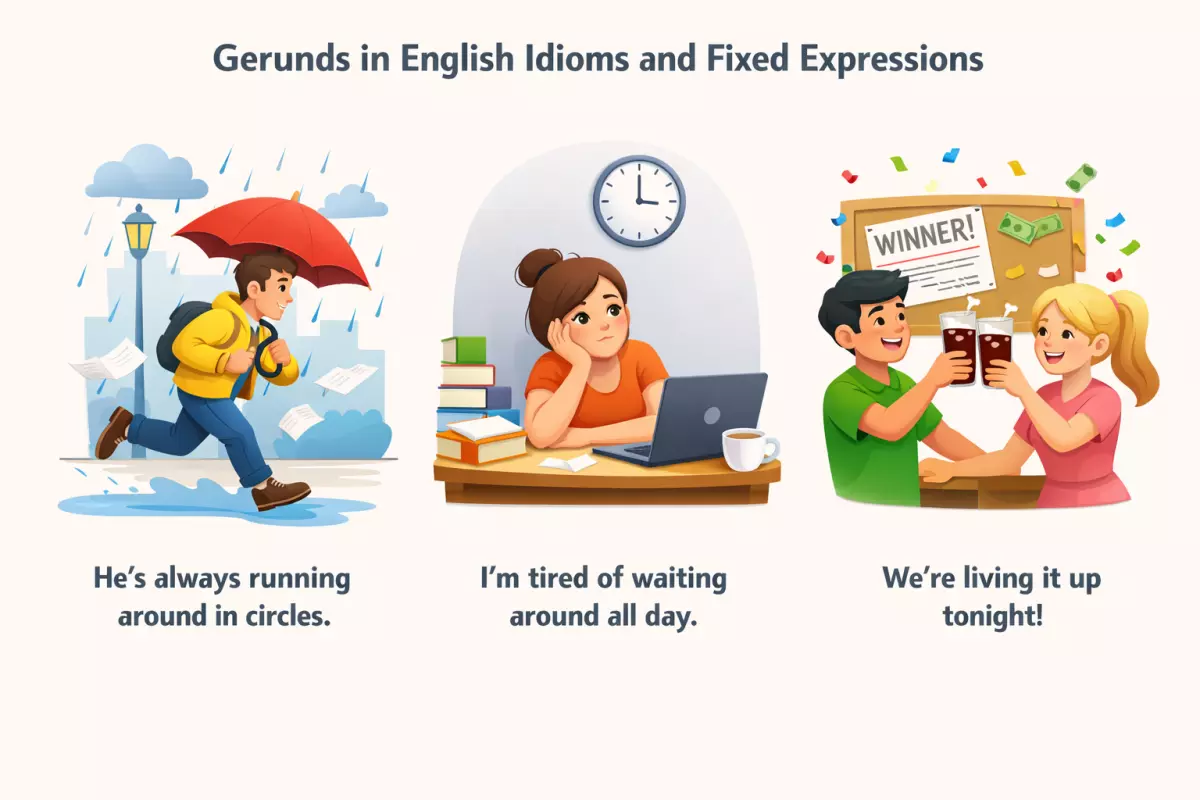 The article explains why many English idioms use gerunds, which fixed expressions require -ing, and how they show up in everyday speech. It covers cases where swapping the gerund breaks meaning, gives common spoken examples, shows how to spot fixed phrases, and includes fill-in practice.
- Why many English idioms include gerund forms
- Common fixed expressions that always use a gerund
- How gerunds appear in everyday conversational phrases
- Idiomatic structures where changing the gerund breaks the meaning
- Examples from spoken English that learners frequently hear
- How to recognize fixed expressions instead of literal grammar patterns
- Practice exercises: complete idiomatic phrases with the correct gerund
Many everyday sayings use verb forms ending in -ing, especially in fixed phrases people repeat without thinking. This lesson explains how these forms work in common idioms, why they sound natural to native speakers, and what they mean in real situations. With practical examples, you will learn to spot them quickly and use them with confidence in conversation.
Why many English idioms include gerund forms
Gerund (-ing) forms fit naturally into fixed phrases because they behave like nouns while still keeping a sense of action. That combination helps idioms name a typical activity (not just a one-time event), sound rhythmic, and stay flexible in real sentences.
Key usage patterns that make -ing forms common in idioms
- They label an activity as a “thing.” A gerund can act as the subject or object, so the expression can refer to an action as a concept: “Seeing is believing,” “There’s no accounting for taste.”
- They create a general, timeless meaning. Many idioms describe habits, rules of life, or typical behavior, and -ing supports that broad reading: “Practice makes perfect” is often phrased with gerunds in similar sayings like “Living and learning.”
- They work well after prepositions. Fixed expressions frequently use prepositional frames (in, on, by, without, for), and English normally takes a gerund after a preposition: “by doing,” “without knowing,” “for crying out loud.”
- They support compact “no + -ing” constructions. Idioms often use the pattern no + gerund to mean “it’s impossible” or “it won’t happen”: “No use crying over spilt milk,” “No getting around it,” “No telling.”
- They keep the focus on the process, not the result. Idioms commonly highlight ongoing effort, repeated attempts, or gradual change, which -ing expresses efficiently: “Getting there,” “Building bridges,” “Keeping up appearances.”
- They make memorable sound patterns. Many expressions rely on rhythm, alliteration, or repetition, and -ing endings help create that “catchy” feel: “cutting corners,” “spilling the beans,” “beating around the bush.”
- They allow easy slotting into common verb frames. A lot of idioms appear after verbs like go, keep, start, stop, avoid, can’t help, where gerunds are expected or frequent in everyday usage.
- They stay stable even when tense changes elsewhere. The idiom’s core can remain unchanged while the main verb carries tense: “He kept pushing his luck,” “She’s been pulling strings.”
- They help idioms function as noun phrases. Many fixed expressions are used as labels for situations or behavior types, and gerunds make that noun-like packaging easy: “playing with fire,” “walking on eggshells.”
- They reduce the need for extra words. Instead of longer clauses (“the act of…,” “the fact that someone…”), a gerund phrase can carry the meaning in a tight unit: “Worth doing,” “Seeing red.”
Common idiom frames that regularly use gerunds
- There’s no + -ing: “There’s no knowing,” “There’s no pleasing some people.”
- It’s no use / no good + -ing: “It’s no use arguing,” “It’s no good pretending.”
- Can’t help + -ing: “I can’t help laughing.”
- Spend time + -ing: “spend time beating around the bush” (often used to criticize indirectness).
- Keep + -ing: “keep moving the goalposts,” “keep pushing your luck.”
- Go + -ing (activity frame): “go fishing,” “go shopping,” which can become semi-fixed in set contexts.
- Be + -ing inside a fixed phrase: “be pulling someone’s leg,” “be getting cold feet.”
Examples: idioms where -ing is part of the fixed wording
- “Seeing is believing.”
- “Spilling the beans” (revealing a secret).
- “Beating around the bush” (avoiding the main point).
- “Cutting corners” (doing something cheaply or carelessly).
- “Walking on eggshells” (being very cautious).
- “Playing with fire” (taking a risky action).
- “Keeping up appearances” (maintaining an image).
- “Pulling strings” (using influence).
- “Jumping to conclusions” (deciding too quickly).
- “Running on fumes” (having very little energy/resources left).
- “Getting your wires crossed” (misunderstanding each other).
- “Living on borrowed time” (having extra time beyond what was expected).
- “Putting all your eggs in one basket” (depending on a single plan).
- “Burning the midnight oil” (working late into the night).
- “Looking on the bright side” (staying optimistic).
When you learn these expressions, notice whether the -ing word is acting as a noun (subject/object), following a preposition, or forming part of a set verb phrase. That small grammar check helps you keep the idiom’s wording stable while still using it naturally in different tenses and sentence types.
Common fixed expressions that always use a gerund

Some English set phrases are built around an -ing form and sound unnatural (or change meaning) if you swap in an infinitive. These patterns often appear after prepositions, in short “formula” chunks, or in idioms where the -ing form behaves like a noun.
How to recognize these patterns
- Preposition + -ing: when a fixed phrase contains a preposition (of, for, to, in, on, without), the verb that follows is typically a gerund.
- “It’s no use / It’s worth …” frames: these established frames strongly prefer an -ing form.
- “There’s no …” and “Can’t help …” frames: common conversational structures that take a gerund.
- Idiomatic pairings: certain verbs and adjectives regularly “lock in” with -ing in everyday usage.
High-frequency fixed expressions with gerunds
- It’s no use + gerund: “It’s no use arguing about it now.”
- It’s no good + gerund: “It’s no good pretending everything is fine.”
- There’s no point (in) + gerund: “There’s no point in waiting any longer.”
- There’s no + gerund: “There’s no telling what will happen.”
- It’s worth + gerund: “It’s worth checking the details.”
- It’s not worth + gerund: “It’s not worth getting upset over.”
- Have trouble / difficulty + gerund: “She had trouble finding the address.”
- Spend time + gerund: “He spends time reading after work.”
- Waste time + gerund: “Don’t waste time worrying.”
- Can’t help + gerund: “I can’t help laughing at that.”
- Can’t stand + gerund: “He can’t stand waiting in lines.”
- Look forward to + gerund: “I’m looking forward to meeting your team.”
- Be used to + gerund: “They’re used to working late.”
- Get used to + gerund: “You’ll get used to speaking in public.”
- Be busy + gerund: “She’s busy preparing the report.”
- How about + gerund?: “How about going for a walk?”
- What about + gerund?: “What about trying a different approach?”
- Without + gerund: “He left without saying goodbye.”
Common learner pitfalls (and quick fixes)
- After to in look forward to, be used to, and get used to, to is a preposition, not an infinitive marker: ✅ “look forward to meeting” ❌ “look forward to meet”.
- In There’s no + gerund, the -ing form often expresses “it’s impossible to know/avoid”: “There’s no knowing the answer for sure.”
- With It’s worth + gerund, the gerund acts like the activity being evaluated: “worth doing,” not “worth to do.”
How gerunds appear in everyday conversational phrases
In casual speech, gerunds (verb + -ing used like a noun) often show up inside fixed phrases that speakers use as ready-made chunks. These expressions can function as advice, small talk, complaints, or polite refusals, and the -ing form typically names an activity rather than describing an action in progress.
Common patterns you can notice
- Preposition + gerund: Many conversational set phrases rely on a preposition (like for, about, of, in, on) followed by an -ing form.
- Verb + gerund as an object: Some everyday verbs naturally take an -ing clause, especially when the meaning is “enjoy,” “avoid,” “finish,” or “suggest.”
- Gerund as the subject: The -ing form can act as the topic of the sentence, especially in general statements and life advice.
- Possessive + gerund (more formal): In careful speech you may hear my/your/his + -ing to highlight who is responsible for the action, though everyday conversation often drops the possessive.
- Fixed frames: Certain expressions keep the -ing form even when other words change (pronoun, tense, or time phrase), which is a sign they behave like idioms.
Everyday conversational phrases that use gerunds
- Thanks for coming. (preposition + gerund)
- Sorry for being late. (apology + reason)
- How about getting coffee? (suggestion)
- What about trying again? (alternative option)
- I’m thinking of moving. (plan/idea)
- I’m looking forward to seeing you. (fixed “to” + gerund)
- It’s not worth arguing. (evaluation)
- There’s no point (in) waiting. (practical judgment)
- No kidding. / No joking. (set response; informal)
- Fancy meeting you here. (surprise; fixed-style phrase)
- Just kidding. / Just saying. (softening, clarifying intent)
- Speaking of work, how’s it going? (topic shift)
- Strictly speaking, that’s not true. (qualification)
- Generally speaking, it’s a good idea. (generalization)
- Considering everything, we did well. (framing a conclusion)
- All things considered, it’s fine. (set phrase with an implied “being”)
- Do you mind opening the window? (polite request)
- I can’t help laughing. (involuntary reaction)
- It’s like talking to a wall. (idiomatic comparison)
- He’s good at explaining things. (adjective + preposition + gerund)
Usage notes and common pitfalls
- “To” is not always an infinitive marker. In fixed expressions like look forward to and be used to, to is a preposition, so it is followed by an -ing form: ✅ used to working ❌ used to work (when to is a preposition).
- Keep the phrase intact. Many chunks resist changes in form. For example, speakers say There’s no point (in) + -ing far more often than reworded alternatives.
- Gerunds often sound more natural for general activities. Compare: It’s worth trying (general activity) → smoother than forcing a full clause in quick conversation.
- Possessive + gerund is optional in casual speech. You may hear both I appreciate you helping and the more formal I appreciate your helping; the meaning is similar, but the second highlights the action as a “thing.”
Idiomatic structures where changing the gerund breaks the meaning

Many fixed expressions rely on a specific -ing form as part of the “stored” phrase. If you swap the gerund for an infinitive, a different verb form, or a near-synonym, the result often sounds unnatural or shifts the meaning away from the idiom. The safest approach is to learn these as complete chunks and keep the gerund exactly as it appears.
Common fixed frames that require the gerund
- There’s no + gerund: ✅ There’s no knowing what will happen. ❌ There’s no to know what will happen.
- It’s no use / It’s no good + gerund: ✅ It’s no use arguing. ❌ It’s no use to argue.
- Can’t help + gerund (meaning “can’t avoid”): ✅ I can’t help laughing. ❌ I can’t help to laugh (different meaning or unnatural in many contexts).
- Have trouble / difficulty / a hard time + gerund: ✅ She had trouble sleeping. ❌ She had trouble to sleep.
- Spend time / waste time + gerund: ✅ Don’t waste time complaining. ❌ Don’t waste time to complain.
- Be busy + gerund: ✅ He’s busy preparing for the meeting. ❌ He’s busy to prepare for the meeting.
- Go + gerund for activities: ✅ Let’s go shopping. ❌ Let’s go to shop (changes the pattern and often the feel).
- It’s worth + gerund: ✅ It’s worth trying. ❌ It’s worth to try.
- Look forward to + gerund (because to is a preposition here): ✅ I’m looking forward to seeing you. ❌ …to see you (common learner error).
- Be used to + gerund (meaning “accustomed to”): ✅ I’m used to getting up early. ❌ I’m used to get up early (different structure/meaning).
- Object to + gerund: ✅ They object to paying extra. ❌ They object to pay extra.
- Admit / deny / avoid / risk + gerund: ✅ He denied taking it. ❌ He denied to take it.
- Keep / stop / quit + gerund: ✅ She stopped smoking. ❌ She stopped to smoke (means she stopped in order to smoke).
- Feel like + gerund: ✅ I feel like staying in. ❌ I feel like to stay in.
- Be (not) keen on + gerund: ✅ He’s not keen on sharing details. ❌ …keen on to share details.
Idioms where the -ing word is part of the “name” of the expression
Some phrases are idioms in the strict sense: the -ing form is not just a grammar choice, but a fixed component of the expression. Replacing it with another form usually makes the phrase sound “made up,” even if the literal meaning is still guessable.
- ✅ Seeing is believing. ❌ To see is to believe (different proverb; not the same set phrase).
- ✅ There’s no accounting for taste. ❌ There’s no account for taste.
- ✅ It goes without saying. ❌ It goes without to say.
- ✅ Never mind (historically linked to “mind” as a verb; not interchangeable with “don’t mind” in all uses). ❌ Never minding (not an idiom).
- ✅ Talking of (meaning “on the subject of”): Talking of deadlines, we need a plan. ❌ To talk of deadlines, we need a plan.
- ✅ Speaking of: Speaking of travel, have you booked tickets? ❌ To speak of travel, have you booked tickets?
- ✅ Judging by/from: Judging by his tone, he’s upset. ❌ To judge by his tone… (changes the function and sounds less idiomatic).
- ✅ Considering (as a sentence adverb): Considering the cost, it’s a good deal. ❌ To consider the cost… (different structure).
- ✅ Generally speaking. ❌ General speaking / To speak generally (different feel and not the set phrase).
- ✅ Strictly speaking. ❌ Strict speaking / To speak strictly (not the standard idiom).
- ✅ Putting it mildly. ❌ To put it mildly (possible, but less like the fixed comment phrase in many contexts).
- ✅ Taking everything into account. ❌ To take everything into account (grammatical, but the idiomatic “comment” use is commonly -ing).
Usage tips: how to avoid “almost right” rewrites
- When to is a preposition (look forward to, be used to, object to), treat the next verb like a noun and use the gerund.
- With “no use/no good,” “can’t help,” and “have trouble,” the -ing form is the normal pattern; switching to an infinitive usually signals a learner error.
- Watch meaning contrasts with stop: stop doing = end an activity; stop to do = pause in order to do something else.
- For proverb-like expressions (Seeing is believing; It goes without saying), learn the full wording; small grammar changes tend to break the set phrase.
Examples from spoken English that learners frequently hear
In everyday conversation, gerunds often appear inside set phrases where the -ing form behaves like a noun. These expressions are common in casual speech, workplace talk, and friendly advice, so it helps to learn them as chunks rather than building them word-by-word.
Common fixed expressions with -ing
- It’s no use + -ing: “It’s no use arguing about it now.” (Meaning: it won’t help.)
- It’s (not) worth + -ing: “It’s not worth stressing over.” / “It’s worth trying.”
- There’s no point (in) + -ing: “There’s no point in waiting any longer.”
- Can’t help + -ing: “I can’t help laughing when he says that.” (Meaning: it happens automatically.)
- Can’t stand + -ing: “I can’t stand listening to loud chewing.”
- Don’t mind + -ing: “I don’t mind helping.” (Often used to sound polite.)
- Feel like + -ing: “Do you feel like going out?” (Meaning: do you want to?)
- Be used to + -ing: “I’m used to getting up early.” (Habit; not the same as “used to + verb.”)
- Get used to + -ing: “You’ll get used to working with him.” (Process of adapting.)
- Look forward to + -ing: “I’m looking forward to seeing you.” (Here, to is a preposition, so -ing follows.)
- How about / What about + -ing?: “How about grabbing lunch?” (Suggestion.)
- It’s a waste of time + -ing: “It’s a waste of time trying to convince him.”
- Have trouble / difficulty + -ing: “She’s having trouble sleeping.”
- Be busy + -ing: “Sorry, I’m busy answering emails.”
- Spend time + -ing: “I spent all weekend cleaning.”
- Go + -ing (activity): “We went shopping.” / “They’re going hiking.”
Quick usage notes learners often need
- Prepositions usually trigger a gerund: after words like in, on, at, for, you typically use -ing: ✅ “good at explaining” ❌ “good at explain.”
- “Look forward to” is a frequent trap: ✅ “looking forward to meeting you” ❌ “looking forward to meet you.”
- “Used to” has two different patterns: “I’m used to driving” (I’m accustomed) vs. “I used to drive” (past habit).
- Many of these are polite softeners: “I don’t mind waiting” and “How about waiting a bit?” can sound less direct than “Wait.”
How to recognize fixed expressions instead of literal grammar patterns
Some -ing forms look like ordinary gerunds you can freely swap or expand, but in idioms they behave more like “pre-made chunks.” The key is to notice when the wording is conventional and resistant to change, even though it resembles a normal verb pattern.
Signals that an -ing phrase is a fixed expression
- Limited variation: you can’t easily replace the verb, change the preposition, or switch word order without sounding unnatural. Example: ✅ “There’s no knowing what will happen.” ❌ “There’s no understanding what will happen.” (possible meaning, but it’s no longer the idiom)
- Frozen function: the phrase acts as one unit (often an adverbial comment, a stance marker, or a set response) rather than a literal action. Example: “Generally speaking, it’s fine.”
- Predictable collocation: certain words strongly “pull” the -ing form. If you keep seeing the same pairing, treat it as a chunk. Example: “Worth + -ing” as in “It’s worth seeing.”
- Fixed pragmatic meaning: the meaning is more about attitude or situation than the base verb. Example: “Speaking of which…” introduces a topic shift, not literal speaking.
- Unusual literal reading: a word-for-word interpretation sounds odd or too narrow compared with how people actually use it. Example: “Judging by the results…” is about inference, not courtroom judging.
- Set punctuation/position: the phrase commonly appears at the start of a sentence, between commas, or as a tag. Example: “Strictly speaking, that’s not correct.”
- Resists tense and aspect changes: you usually can’t shift it to past or progressive without breaking the established form. Example: ✅ “All things considered, we should go.” ❌ “All things considering…” (rare and sounds off in most contexts)
- Article/determiner patterns are fixed: some expressions allow no article, or require a specific one. Example: “It’s no use arguing.” (not typically “a use” here)
- Common in advice, evaluation, or transitions: many idiomatic -ing chunks help speakers comment, generalize, or move the conversation along rather than describe an action.
Common fixed -ing chunks to learn as whole units
- “Generally speaking, …”
- “Strictly speaking, …”
- “Roughly speaking, …”
- “Frankly speaking, …”
- “Speaking of …”
- “That depends on what you mean by …” (often followed by an -ing topic in practice)
- “There’s no knowing …”
- “There’s no telling …”
- “It’s no use -ing.”
- “It’s no good -ing.”
- “It’s worth -ing.”
- “It’s not worth -ing.”
- “How about -ing?” (suggestion formula)
- “What about -ing?” (suggestion/objection formula)
- “On hearing/seeing + noun, …” (formal narrative opener)
- “Judging by/from …”
- “Considering …” (meaning “taking into account”)
- “Given …” (similar function; often competes with -ing comment phrases)
Quick tests to decide: idiom chunk or literal gerund?
- Substitution test: try swapping the verb or preposition. If the sentence stays grammatical but loses its “native” feel, you’re likely dealing with a set phrase.
- Expansion test: try adding a direct object, adverbs, or modifiers. Literal gerunds accept expansion more freely; fixed expressions often become clumsy. Example: ✅ “It’s no use arguing.” ❌ “It’s no use arguing loudly for hours.” (possible, but the idiomatic punch weakens)
- Position test: move the phrase. If it normally sits sentence-initial or parenthetical and moving it sounds wrong, treat it as a conventional discourse marker.
- Meaning test: ask whether the phrase mainly signals evaluation/transition (“to be precise,” “in general,” “by inference”) rather than describing an action. If yes, it’s functioning idiomatically.
- Frequency test (in your input): if you repeatedly encounter the exact wording in books, news, or conversations, store it as a single unit and practice it that way.
When an -ing form is part of a fixed expression, accuracy comes from using the established wording and placement. Treat it like a vocabulary item with a grammar shape, not a grammar pattern you can freely remodel.
Practice exercises: complete idiomatic phrases with the correct gerund
Complete each fixed expression by adding the missing -ing form. Many of these are set phrases, so the gerund is not freely interchangeable with an infinitive. Pay attention to common patterns such as preposition + -ing (e.g., on/by/without + gerund) and idioms where the gerund is part of the “dictionary form” of the expression.
Exercise 1: Fill in the missing gerund
- It’s no use ________ about it now. (complain)
- There’s no point ________ the same argument. (repeat)
- He left without ________ goodbye. (say)
- She succeeded by ________ consistent. (be)
- They solved the issue by ________ a compromise. (reach)
- I can’t help ________ when I hear that song. (smile)
- Would you mind ________ the window? (close)
- He insisted on ________ the bill. (pay)
- She apologized for ________ late. (be)
- They’re looking forward to ________ you again. (see)
- He’s responsible for ________ the final decision. (make)
- She’s good at ________ under pressure. (work)
- We’re used to ________ up early. (get)
- He’s not interested in ________ sides. (take)
- They prevented the accident by ________ quickly. (react)
- It’s worth ________ a second opinion. (get)
Show answers
- complaining
- repeating
- saying
- being
- reaching
- smiling
- closing
- paying
- being
- seeing
- making
- working
- getting
- taking
- reacting
- getting
Exercise 2: Choose the correct completion (one gerund fits the idiom)
- She’s always talking about ________ a difference. (make / to make)
- He’s keen on ________ things properly the first time. (doing / to do)
- We had trouble ________ a taxi in the rain. (finding / to find)
- They admitted ________ a mistake. (making / to make)
- He gave up ________ after a few months. (smoking / to smoke)
- I’m thinking of ________ a short break. (taking / to take)
- She’s capable of ________ the project alone. (handling / to handle)
- He ended up ________ the wrong email. (sending / to send)
- They kept on ________ even when it got difficult. (trying / to try)
- He can’t stand ________ in long lines. (waiting / to wait)
- She suggested ________ earlier. (leaving / to leave)
- We avoided ________ about politics at dinner. (talking / to talk)
Show answers
- make
- doing
- finding
- making
- smoking
- taking
- handling
- sending
- trying
- waiting
- leaving
- talking
Exercise 3: Repair the phrase (replace the incorrect form with a gerund)
Each sentence contains a non-idiomatic choice (usually an infinitive) where English normally uses an -ing form. Rewrite only the underlined part.
- It’s no use to argue with him.
- She left without to lock the door.
- He insisted on to speak to the manager.
- They’re looking forward to to meet you.
- I can’t help to laugh at that scene.
- She succeeded by to work steadily.
- Would you mind to move your bag?
- It’s worth to try again.
Show answers
- arguing
- locking
- speaking
- meeting
- laughing
- working
- moving
- trying
Quick usage reminders (patterns to notice)
- Preposition + gerund: insist on, apologize for, succeed by, interested in, good at, used to, capable of.
- Set frames: it’s no use + -ing, there’s no point + -ing, it’s worth + -ing.
- Verb + gerund in common fixed usage: avoid, admit, suggest, can’t stand, give up, keep on, end up.
- If a phrase feels “locked in,” treat the gerund as part of the expression rather than a freely chosen verb form.