Gerund or Infinitive After Common English Verbs

 This article explains why some verbs take a gerund while others take an infinitive. It breaks down verb groups that require only gerunds or only infinitives, shows verbs that allow both, and highlights cases where meaning changes. Includes examples and practice exercises.
- Why different verbs require either a gerund or an infinitive
- Key verb groups that are followed only by gerunds
- Key verb groups that are followed only by infinitives
- Verbs that allow both forms without changing the meaning
- Verbs where gerund and infinitive change the meaning of a sentence
- How to remember verb patterns through common usage examples
- Practice exercises: choose the correct form after common verbs
Do you ever pause after a verb and wonder whether to use the -ing form or to plus the base verb? In everyday English, the choice usually depends on the verb you use and the meaning you want, not on complicated grammar rules. This article explains common patterns after frequent verbs, helping you speak and write more smoothly, avoid typical errors, and sound natural in real conversations.
Why different verbs require either a gerund or an infinitive
In English, the verb that comes first often controls the form of the next verb. Some verbs naturally take an -ing form because they describe an activity as a thing (an experience, a habit, a process). Other verbs prefer to + base verb because they point forward to a goal, plan, decision, or intended action. These preferences are not random, but they are largely fixed by usage, so learning the common patterns is the most reliable approach.
Common patterns that explain the choice
- Activity as an object (gerund): When the second verb functions like a noun (the activity itself is the “thing” being discussed), English often uses verb + -ing.
- ✅ I enjoy reading.
- ✅ They discussed moving abroad.
- ✅ She finished writing the report.
- Future intention or purpose (infinitive): When the meaning is about an aim, plan, or next step, English often uses verb + to + verb.
- ✅ We decided to leave early.
- ✅ He promised to call.
- ✅ I hope to visit next year.
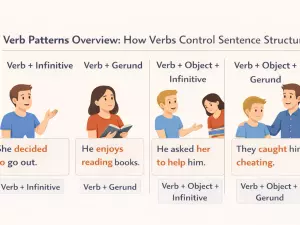
- “Verb + object + infinitive” (infinitive with a doer): If the main verb is followed by a person/thing that will do the action, the infinitive is common.
- ✅ She asked him to help.
- ✅ They told us to wait.
- ✅ I want you to be honest.
- Prepositions trigger -ing: After a preposition (in, on, at, about, of, for, to, etc.), the next verb is typically a gerund.
- ✅ She’s good at explaining.
- ✅ I’m interested in learning more.
- ✅ They apologized for arriving late.
- Note: This is why look forward to is followed by -ing: ✅ I look forward to meeting you.
- Some verbs allow both forms, but the meaning changes: A small group can take either a gerund or an infinitive, and the choice affects meaning (often “general” vs. “specific,” or “memory” vs. “action”).
- ✅ I remember locking the door. (memory of a past action)
- ✅ I remember to lock the door. (don’t forget to do it)
- ✅ She stopped smoking. (quit)
- ✅ She stopped to smoke. (paused in order to smoke)
- ✅ He tried restarting the computer. (experimented with a method)
- ✅ He tried to restart the computer. (made an effort)
Usage cues that help you choose quickly
- If the first verb expresses liking/disliking, the -ing form is common: enjoy, dislike, avoid, mind, can’t stand.
- If the first verb expresses a decision, promise, or plan, the infinitive is common: decide, promise, plan, agree, refuse.
- If there is an object between the verbs, check whether the verb typically takes object + infinitive: want someone to…, need someone to…, expect someone to…, persuade someone to…
- If the second verb follows a preposition, use -ing: interested in…, worried about…, committed to…
Common learner errors to watch for
- ❌ She suggested to go. → ✅ She suggested going.
- ❌ I want going home. → ✅ I want to go home.
- ❌ He insisted to pay. → ✅ He insisted on paying.
- ❌ I look forward to meet you. → ✅ I look forward to meeting you.
The most efficient way to master these forms is to learn verbs in “chunks” (for example, avoid + -ing, decide + to, ask + object + to) and to notice whether the meaning points to an activity being discussed or an action that is intended next.
Key verb groups that are followed only by gerunds
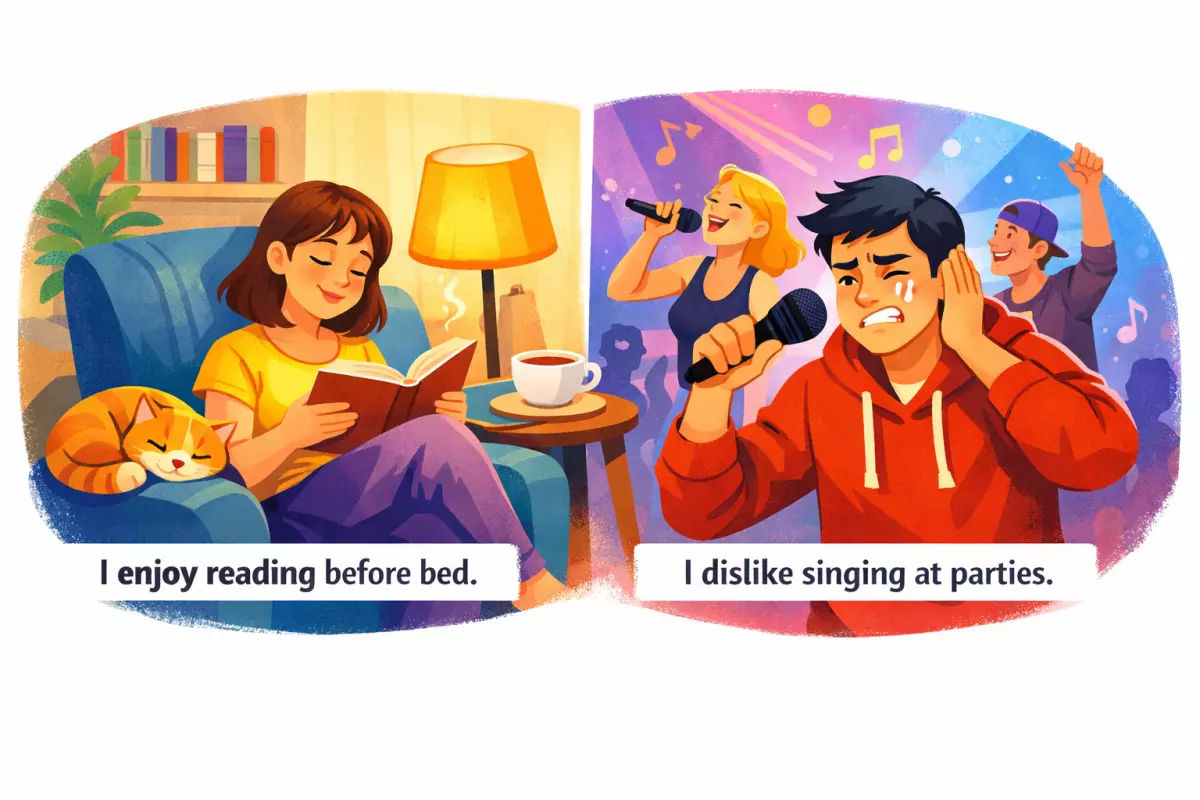
Some English verbs strongly prefer the -ing form when they take another verb as an object. In these patterns, the verb after the main verb acts like a noun (an activity or experience), so the gerund is the natural choice. Using an infinitive in these cases is usually ungrammatical or changes the structure entirely.
1) Enjoyment, dislike, and preference
These verbs express how someone feels about an activity. They are typically followed by a gerund.
- enjoy: ✅ I enjoy reading before bed. ❌ I enjoy to read.
- like / love / hate (common with gerunds, especially for general habits): I hate waiting in long lines.
- can’t stand / can’t bear: She can’t stand being interrupted.
- prefer (often gerund for general preference): He prefers working early in the morning.
- don’t mind: I don’t mind helping you.
- fancy (BrE): Do you fancy going out tonight?
2) Avoidance, delay, and “not doing” actions
When the meaning is about escaping an action, postponing it, or preventing it, the -ing form is the standard follow-up.
- avoid: Try to avoid making the same mistake.
- delay: They delayed signing the contract.
- postpone: We postponed meeting until Friday.
- put off: He keeps putting off studying.
- risk: You risk losing your data.
- miss (fail to do/experience): I miss talking to my old friends.
3) “Admit/deny” and responsibility verbs
These verbs often introduce an action as a fact or claim, so a gerund works as the object of the verb.
- admit: He admitted taking the file.
- deny: She denied breaking the rules.
- confess: He confessed to cheating. (Also common: confess + that-clause.)
- regret (about a past action): I regret telling him the secret.
- appreciate: I appreciate having extra time.
4) “Consider/keep/practice” and process verbs
When the main verb focuses on the process of thinking about, continuing, or training an activity, a gerund typically follows.
- consider: Consider taking a different route.
- keep: Keep trying; you’re improving.
- practice: She practices speaking every day.
- suggest: He suggested meeting earlier.
- recommend: I recommend checking the settings.
- discuss: We discussed moving the deadline.
- mention: She mentioned seeing him downtown.
5) “Finish/quit” and completion or stopping verbs
For actions that end, stop, or get completed, English usually treats the following verb as an activity noun, so the -ing form is expected.
- finish: I finished writing the report.
- complete: They completed building the bridge.
- quit: He quit smoking.
- give up: She gave up drinking soda.
- stop (stop an activity): We stopped talking when the teacher arrived.
Quick usage notes (common learner traps)
- Object vs. no object: Some verbs can take a gerund directly (I avoided answering) or a noun + gerund (I avoided answering the question).
- “Stop” meaning matters: stop doing = end an activity; stop to do = pause another activity in order to do something else.
- “Regret” meaning matters: regret doing = feel sorry about a past action; regret to do = formal way to introduce bad news (different pattern).
Key verb groups that are followed only by infinitives
Some common verb patterns in English take to + base verb (the infinitive) and do not normally allow a gerund (-ing) after them. Learning these as groups helps you predict the correct form and avoid mixing patterns.
1) Verbs of planning, intention, and decision
These verbs typically look forward to a future action, so they are followed by an infinitive.
- plan to + verb: We plan to move next year. ❌ plan moving
- decide to + verb: She decided to leave early.
- choose to + verb: He chose to stay home.
- intend to + verb: I intend to call you tomorrow.
- hope to + verb: They hope to win the match.
- expect to + verb: We expect to finish on time.
- promise to + verb: I promised to help.
- agree to + verb: She agreed to meet us at 6.
- refuse to + verb: He refused to answer.
- offer to + verb: They offered to drive us.
2) Verbs of willingness, effort, and ability
These verbs describe whether someone is ready or able to do something, so the infinitive is the natural complement.
- want to + verb: I want to learn Spanish. ❌ want learning
- would like to + verb: I’d like to speak with you.
- would love to + verb: We’d love to join you.
- need to + verb: You need to show your ID.
- manage to + verb: She managed to solve it.
- fail to + verb: He failed to notice the sign.
- attempt to + verb: They attempted to fix the leak.
- struggle to + verb: I struggle to concentrate here.
- learn to + verb: He learned to swim at five.
3) Verbs of arrangement and preparation
Use the infinitive when the verb focuses on organizing an action or making sure it happens.
- arrange to + verb: We arranged to meet at the station.
- prepare to + verb: She prepared to give a short talk.
- aim to + verb: The company aims to reduce costs.
- plan to + verb: They plan to expand the office.
- wait to + verb: Wait to open the package until tomorrow.
4) Verbs that commonly take an object + infinitive
Many verbs are followed by a person/object and then an infinitive. The meaning is usually “cause/ask/allow someone to do something.”
- ask + object + to + verb: She asked me to help.
- tell + object + to + verb: He told us to be quiet.
- advise + object + to + verb: The doctor advised her to rest.
- encourage + object + to + verb: They encouraged him to apply.
- invite + object + to + verb: We invited them to come for dinner.
- persuade + object + to + verb: She persuaded me to try it.
- remind + object + to + verb: Please remind me to email them.
- allow + object + to + verb: They allowed us to enter.
- enable + object + to + verb: This tool enables you to edit faster.
- force + object + to + verb: They forced him to apologize.
5) Useful notes and common pitfalls
- Help can be followed by to + verb or the bare infinitive: She helped me (to) carry the bags.
- Some verbs change meaning depending on the pattern (for example, remember, stop, try), but the verbs listed above generally keep the infinitive pattern in everyday use.
- When you see an infinitive after these verbs, it usually answers “What is the plan/decision/effort?”: decide to leave, manage to finish, ask her to call.
Verbs that allow both forms without changing the meaning

Some English verbs can be followed by either a gerund (-ing) or an infinitive (to + base verb) with little or no difference in meaning. In these cases, the choice is usually about style, rhythm, or what sounds more natural in context, rather than a change in time or intention.
These verbs are especially common in everyday speech and writing. When you learn them as patterns, you can focus on accuracy and fluency instead of memorizing separate meanings.
Common verbs that take either gerund or infinitive (same meaning)
- begin: She began to cry / She began crying.
- start: They started to laugh / They started laughing.
- continue: He continued to talk / He continued talking.
- love: I love to read / I love reading.
- like: She likes to swim / She likes swimming.
- hate: He hates to wait / He hates waiting.
- prefer: We prefer to walk / We prefer walking.
- attempt: She attempted to fix it / She attempted fixing it.
- intend (often infinitive, but gerund is possible in some contexts): I intend to stay / I intend staying for a while.
- cease (more formal): The noise ceased to bother us / The noise ceased bothering us.
- can’t bear: She can’t bear to watch / She can’t bear watching.
- can’t stand: I can’t stand to lose / I can’t stand losing.
Usage notes and patterns to watch
- Begin / start are the most flexible. Both forms are standard, and the meaning is typically the same.
- With love, like, hate, prefer, the gerund often sounds more general (a habit), while the infinitive can sound more specific or “in this situation.” However, in many sentences there is no practical difference, and both options are acceptable.
- After these verbs, keep the structure consistent when you list activities: “She started reading and taking notes” (not mixing forms unless there is a reason).
- In longer sentences, writers sometimes choose the infinitive to avoid two -ing forms close together: “He started to feel tired” can sound cleaner than “started feeling tired,” though both are correct.
- In informal conversation, the gerund is very common after like/love/hate: “I like working from home.” In more careful or formal writing, either form may appear.
When a verb allows both options with the same meaning, aim for consistency and natural flow. If you are unsure, choose the form that matches the surrounding sentence patterns and sounds less repetitive.
Verbs where gerund and infinitive change the meaning of a sentence
Some verbs can be followed by either a gerund (-ing) or an infinitive (to + base verb), but the choice changes the meaning. These are not “free” alternatives: each pattern signals a different time reference (past vs. future), intention, or whether something is real or only imagined.
Common verbs with a meaning change
-
remember + gerund: you recall a past action.
Example: “I remember locking the door.” (I locked it, and I recall it.)
remember + infinitive: you don’t forget to do a future/necessary action.
Example: “Remember to lock the door.” (Don’t forget to do it.)
-
forget + gerund: you forget that something happened (often surprising).
Example: “I’ll never forget meeting her.” (The meeting happened.)
forget + infinitive: you fail to do something you should do.
Example: “I forgot to send the email.” (I didn’t send it.)
-
stop + gerund: you end an activity.
Example: “He stopped smoking.” (He quit the activity.)
stop + infinitive: you pause one action in order to do another.
Example: “He stopped to smoke.” (He stopped walking/working so he could smoke.)
-
try + gerund: you experiment with a method to see if it helps.
Example: “Try restarting the computer.” (A suggestion to test a solution.)
try + infinitive: you make an effort to do something difficult.
Example: “I tried to restart it, but it wouldn’t turn on.” (I attempted, possibly unsuccessfully.)
-
regret + gerund: you feel sorry about something in the past.
Example: “She regrets leaving early.” (She left early and now feels bad.)
regret + infinitive: you give bad news politely (often formal).
Example: “We regret to inform you that your application was unsuccessful.”
-
mean + gerund: it involves or requires something.
Example: “This job means working weekends.” (Working weekends is part of it.)
mean + infinitive: it is your intention.
Example: “I meant to call you.” (I intended to call.)
-
go on + gerund: you continue the same action.
Example: “He went on talking for hours.” (Same activity continues.)
go on + infinitive: you move to the next action (a new step).
Example: “He went on to explain the main problem.” (Next point/action.)
-
need + gerund: something needs to be done to it (passive meaning).
Example: “The car needs washing.” (= needs to be washed.)
need + infinitive: someone has an obligation/necessity to do something.
Example: “I need to wash the car.”
-
require + gerund: something requires being done (passive meaning, similar to “need”).
Example: “The report requires checking.” (= requires to be checked.)
require + infinitive: someone/something demands that another action happen.
Example: “They require you to check the report.”
-
allow / permit + gerund: common when there is no object (more natural in signs/rules).
Example: “Smoking is not permitted.” / “They don’t allow smoking here.”
allow / permit + object + infinitive: common when you say who can do it.
Example: “They don’t allow visitors to smoke here.”
-
advise / recommend + gerund: typical when giving general advice.
Example: “I recommend taking a taxi.”
advise / recommend + object + infinitive: used when you specify the person.
Example: “I recommend you to take a taxi” ❌ (avoid this form in standard modern English)
Better: “I recommend that you take a taxi.” / “I advise you to take a taxi.”
-
be afraid + gerund: fear of something happening (often a general fear).
Example: “She’s afraid of flying.”
be afraid + infinitive: hesitation about doing something or a polite way to introduce bad news.
Example: “I’m afraid to ask.” / “I’m afraid to say we’re closed.”
Quick usage checks
-
If the meaning is about memory of a real past event, gerund is common: “remember/forget/regret + -ing.”
-
If the meaning is about duty, intention, or the next step, infinitive is common: “remember/forget/mean/go on + to…”
-
If the verb describes ending one activity, use “stop + -ing”; if it describes pausing in order to do something, use “stop + to…”
-
With “need/require + -ing,” the subject is usually the thing that must be fixed/cleaned/checked (passive sense): “The floor needs mopping.”
How to remember verb patterns through common usage examples
Remembering whether a verb takes a gerund or an infinitive gets easier when you learn the verb in a “mini-phrase” you can reuse. Instead of memorizing a rule in isolation, store a common collocation (verb + object + -ing/to) and repeat it in different contexts.
1) Learn verbs in chunks (not as single words)
Many mistakes happen because learners memorize the base verb but not the pattern that follows. The quickest fix is to attach a frequent, natural continuation.
- enjoy + -ing: “enjoy working from home,” “enjoy reading before bed.”
- avoid + -ing: “avoid driving at night,” “avoid talking about it.”
- decide + to + verb: “decide to leave early,” “decide to wait.”
- hope + to + verb: “hope to see you soon,” “hope to finish today.”
- suggest + -ing: “suggest meeting later,” “suggest taking a break.”
- agree + to + verb: “agree to help,” “agree to sign.”
2) Use “meaning hooks” for verbs that change meaning
Some verbs can take both forms, but the meaning shifts. Treat these as two separate entries in your memory, each with a clear example sentence.
- remember + -ing = recall a past action: ✅ “I remember locking the door.” ❌ “I remember to lock the door.”
- remember + to + verb = don’t forget a duty: ✅ “Remember to lock the door.”
- stop + -ing = quit an activity: ✅ “He stopped smoking.”
- stop + to + verb = pause one action to do another: ✅ “He stopped to smoke.”
- try + -ing = experiment with a method: ✅ “Try restarting your phone.”
- try + to + verb = make an effort (may fail): ✅ “I tried to call you, but you didn’t answer.”
- regret + -ing = feel sorry about a past action: ✅ “I regret saying that.”
- regret + to + verb = formal bad news: ✅ “We regret to inform you that…”
3) Group verbs by the pattern you hear most often
Pattern grouping helps because your brain recognizes “families” of usage. Practice each family with a small set of high-frequency verbs.
- Common verbs followed by -ing: admit making, consider moving, deny taking, finish cleaning, keep trying, miss seeing, practice speaking, risk losing.
- Common verbs followed by to + verb: afford to buy, choose to stay, fail to notice, learn to drive, manage to solve, offer to pay, plan to travel, refuse to answer, seem to work.
- Verb + object + to + verb (someone does the action): advise her to rest, allow them to enter, ask him to call, encourage us to apply, expect you to understand, need you to sign, remind me to send, tell her to wait, want them to come.
- Verb + object + -ing (less common, but useful): catch him cheating, hear them arguing, see her running, find people sleeping on the train.
4) Build quick “swap drills” to lock the pattern in
Take one model sentence and swap only the final verb. This keeps the structure stable while you practice the correct form.
- Model for -ing: “I can’t stand waiting.” → “I can’t stand queuing.” / “I can’t stand arguing.”
- Model for to + verb: “We decided to leave.” → “We decided to postpone.” / “We decided to stay.”
- Model for object + to: “They asked me to help.” → “They asked me to explain.” / “They asked me to wait.”
- Model for meaning change: “I stopped smoking.” vs “I stopped to smoke.” (memorize as a pair, not separately).
When you meet a new verb, record it with one natural continuation (“avoid + -ing,” “offer + to + verb,” “remind + object + to + verb”). Repeating these ready-made examples in speaking and writing is what turns the pattern into a habit.
Practice exercises: choose the correct form after common verbs
Choose the correct verb pattern (gerund or infinitive) to complete each sentence. Focus on what the main verb typically “allows” after it: some take -ing, some take to + verb, and a few can take both with a change in meaning.
Exercise 1: One correct form (gerund or infinitive)
- We decided (to leave / leaving) early because of the weather.
- She avoided (to answer / answering) the question directly.
- They promised (to call / calling) as soon as they arrived.
- I can’t stand (to wait / waiting) in long lines.
- He offered (to help / helping) with the move.
- Do you mind (to open / opening) the window?
- She managed (to finish / finishing) the report before lunch.
- We considered (to take / taking) the train instead of driving.
- He refused (to sign / signing) the contract.
- I miss (to see / seeing) my friends from university.
- They agreed (to meet / meeting) at 6 p.m.
- She suggested (to try / trying) a different approach.
Show answers
- to leave
- answering
- to call
- waiting
- to help
- opening
- to finish
- taking
- to sign
- seeing
- to meet
- trying
Exercise 2: Both forms possible (meaning changes)
In each item, choose the option that matches the meaning in brackets.
- I remembered (to lock / locking) the door. (I have a memory of doing it earlier.)
- Remember (to lock / locking) the door. (Don’t forget to do it.)
- She stopped (to smoke / smoking) last year. (She quit the habit.)
- She stopped (to smoke / smoking) because she got a phone call. (She paused another action in order to do this.)
- I’ll never forget (to meet / meeting) him for the first time. (The meeting is a past memory.)
- Don’t forget (to meet / meeting) him at reception. (This is a future task.)
- He tried (to restart / restarting) the computer, but it didn’t work. (He made an effort.)
- He tried (to restart / restarting) the computer, and that solved the problem. (He tested a method to see what happens.)
Show answers
- locking
- to lock
- smoking
- to smoke
- meeting
- to meet
- to restart
- restarting
Exercise 3: Error correction (fix the verb form)
Each sentence contains one mistake with a gerund/infinitive pattern. Rewrite it correctly.
- He suggested to take a short break.
- They enjoyed to watch the match together.
- I hope seeing you again soon.
- She refused signing the form.
- We decided going by bus.
- Do you mind to wait here for a moment?
- He offered helping me with my CV.
- I can’t afford buying a new laptop right now.
- She apologized to be late.
- They promised helping, but they never did.
Show answers
- He suggested taking a short break.
- They enjoyed watching the match together.
- I hope to see you again soon.
- She refused to sign the form.
- We decided to go by bus.
- Do you mind waiting here for a moment?
- He offered to help me with my CV.
- I can’t afford to buy a new laptop right now.
- She apologized for being late.
- They promised to help, but they never did.
Quick pattern reminders to check your choices
- Common verbs followed by to + verb: agree, decide, hope, manage, offer, promise, refuse.
- Common verbs followed by -ing: avoid, consider, enjoy, finish, mind, miss, suggest.
- Verbs that can take both with a meaning shift: remember, forget, stop, try.
- If you are unsure, test the sentence as a “plan” (often infinitive) vs. an “activity/experience” (often gerund).