Gerunds and Infinitives in Spoken English Usage

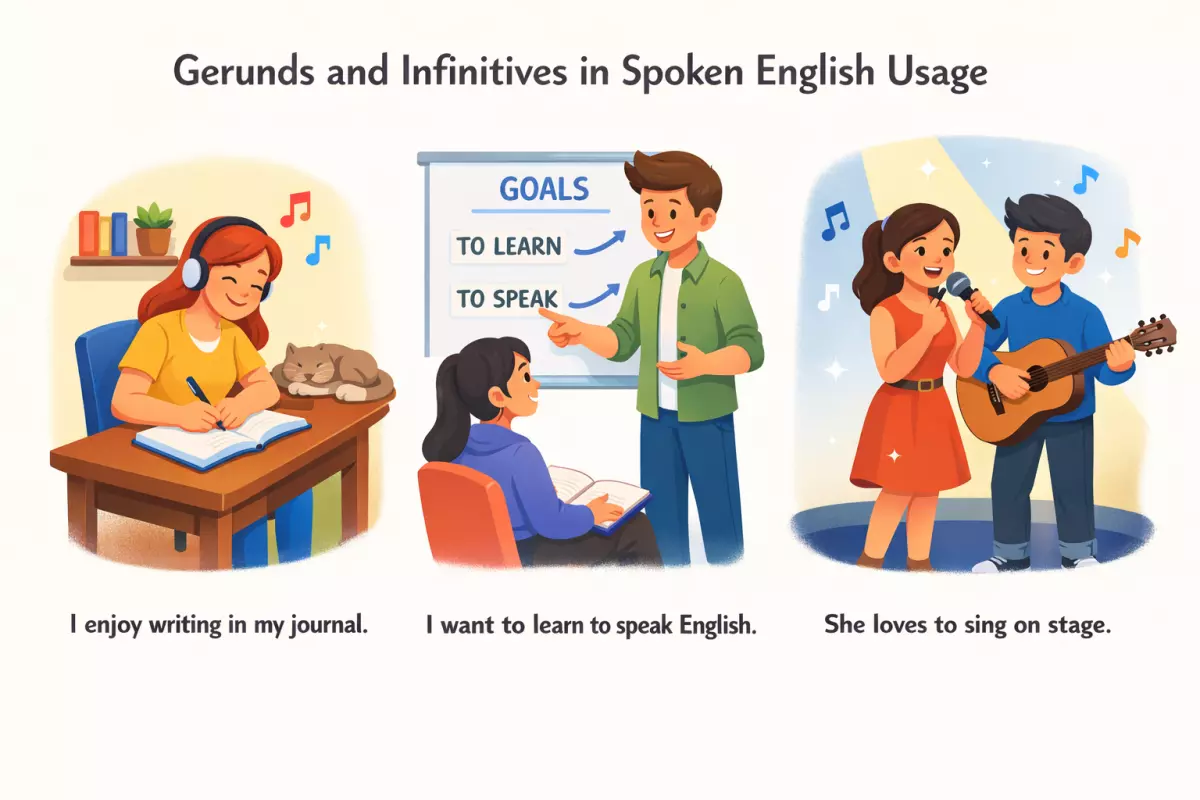 This article shows how gerunds and infinitives show up in everyday talk, using common patterns like like doing and want to do. It explains why some verb choices sound more natural than textbook rules, gives real conversation examples, flags learner mistakes, and includes rewrite exercises.
- How gerunds and infinitives appear in everyday conversations
- Common spoken patterns like 'like doing' and 'want to do'
- Why certain verb patterns sound more natural in informal speech
- Differences between textbook grammar and real spoken English
- Examples from typical daily conversations and situations
- Common learner mistakes when speaking with gerunds and infinitives
- Practice exercises: rewrite sentences to sound natural in spoken English
Choosing between forms like talking and to talk can make your English sound more natural and confident. These patterns, known as gerunds and infinitives, are less about memorizing long rules and more about noticing what people actually say and why. This article will help you hear common choices in speech, understand how meaning can change, and respond smoothly in real conversations.
How gerunds and infinitives appear in everyday conversations
In casual speech, speakers choose between the -ing form and the to-form mainly based on the verb that comes before it and the meaning they want (habit, plan, purpose, or result). Certain patterns show up repeatedly in requests, small talk, opinions, and quick explanations.
Common conversation patterns (with examples)
- Like/love/hate + -ing for general preferences: “I like cooking at home.” / “She hates waiting.”
- Like/love/hate + to + verb for specific situations or choices: “I hate to ask, but can you help?”
- Enjoy + -ing for activities: “We enjoyed talking with you.”
- Mind + -ing in polite requests: “Do you mind opening the window?”
- Would you mind + -ing for extra politeness: “Would you mind sending that again?”
- Finish/stop/quit + -ing to end an activity: “I need to stop snacking.”
- Keep + -ing for repetition/continuation: “He kept calling me.”
- Start/begin + -ing or start/begin + to + verb (both common; choice often depends on rhythm): “It started raining.” / “I started to worry.”
- Try + to + verb for effort toward a goal: “Try to get some rest.”
- Try + -ing for experimenting with a method: “Try restarting your phone.”
- Remember/forget + to + verb for duties (do it now/later): “Remember to lock the door.”
- Remember/forget + -ing for past memories: “I remember meeting her once.”
- Need + to + verb for necessity: “I need to leave soon.”
- Need + -ing (common in some varieties) meaning “needs to be done”: “The kitchen needs cleaning.”
- Want/plan/hope/decide + to + verb for intentions and decisions: “We decided to stay in.”
- Ask/tell + someone + to + verb for requests and instructions: “He told me to text you.”
- Help + (to) + verb (both used): “Can you help (to) carry this?”
- It’s worth + -ing for recommendations: “It’s worth checking.”
- Good at + -ing after adjectives + prepositions: “She’s good at explaining things.”
Meaning shifts that matter in real talk
Some verb pairs are frequent because the form changes the meaning, not just the grammar. In fast conversations, these differences help listeners understand whether you mean an intention, a memory, or a suggestion.
- Stop + -ing (end an activity) vs. stop + to + verb (pause another activity in order to do something): ✅ “I stopped smoking.” vs. ✅ “I stopped to buy coffee.”
- Go on + -ing (continue) vs. go on + to + verb (move to the next topic/action): “He went on talking.” vs. “He went on to explain the plan.”
- Need + -ing (requires attention) vs. need + to + verb (speaker’s obligation): “The report needs editing.” vs. “I need to edit the report.”
Quick cues for choosing the form
- After many prepositions, use the -ing form: “Thanks for coming,” “I’m interested in learning.”
- After intention/decision verbs, the to-form is the default: “I’m planning to call,” “I decided to wait.”
- For general likes and dislikes, -ing is common; for a specific occasion, the to-form often sounds more natural.
- When you mean “as a method,” -ing often fits (try, suggest, recommend); when you mean “as a goal,” the to-form often fits (try, hope, want).
Common spoken patterns like 'like doing' and 'want to do'

In everyday conversation, speakers rely on a small set of verb patterns that signal preference, intention, and plans. Some verbs are typically followed by a gerund (-ing form), others by an infinitive (to + base verb), and a few allow both with a change in meaning or emphasis.
1) Preference and enjoyment: gerund patterns
When the verb expresses enjoyment, general preference, or an activity you see as a habit, the -ing form is common in spoken English.
- like + -ing: “I like walking home.”
- love + -ing: “She loves cooking for friends.”
- hate + -ing: “I hate waiting in lines.”
- enjoy + -ing: “They enjoy watching old movies.”
- prefer + -ing: “I prefer texting at night.”
- don’t mind + -ing: “I don’t mind helping.”
- can’t stand + -ing: “He can’t stand being late.”
- be into + -ing: “I’m into running these days.”
- be good at + -ing: “She’s good at explaining things.”
- be used to + -ing (familiar with): “I’m used to getting up early.”
2) Intention and decisions: infinitive patterns
When the verb points to a decision, a plan, or a goal, the infinitive is the default choice in natural speech.
- want to + verb: “I want to leave soon.”
- need to + verb: “We need to talk.”
- plan to + verb: “They plan to move next year.”
- decide to + verb: “I decided to stay.”
- hope to + verb: “I hope to see you later.”
- try to + verb (make an effort): “Try to listen.”
- learn to + verb: “He’s learning to drive.”
- offer to + verb: “She offered to help.”
- promise to + verb: “I promise to call.”
- refuse to + verb: “He refused to pay.”
3) Verbs that allow both: small shifts in meaning
Some verbs can be followed by either form. In casual speaking, the choice often reflects whether you mean a general activity (-ing) or a specific situation/decision (to + verb), or it can signal a real meaning change.
- like + -ing (enjoyment/habit) vs like to + verb (choice/idea): “I like reading” vs “I like to read before bed.”
- love/hate/prefer + -ing vs love/hate/prefer + to: both occur; -ing often sounds more “activity-focused” in spontaneous speech.
- start/begin + -ing / start/begin + to: “It started raining” / “It started to rain.” (Both common; -ing is especially frequent with weather and ongoing actions.)
- remember + -ing (memory of a past action) vs remember + to (don’t forget): ✅ “I remember meeting her” vs ✅ “Remember to lock the door.”
- forget + -ing (memory disappears) vs forget + to (fail to do): ✅ “I’ll never forget seeing that” vs ❌ “I forgot to bring my keys.”
- stop + -ing (quit an activity) vs stop + to (pause in order to do something): “Stop talking” vs “We stopped to get coffee.”
- try + -ing (experiment) vs try + to (effort): “Try restarting it” vs “Try to be on time.”
- go on + -ing (continue) vs go on + to (next step): “He went on complaining” vs “She went on to explain the plan.”
4) Fast spoken forms and common reductions
In real speech, these patterns often appear in reduced or blended forms. Recognizing them helps with listening and makes your own speaking sound more natural.
- wanna = want to: “I wanna go.”
- gonna = going to (future plan): “I’m gonna call you.”
- hafta = have to: “I hafta leave.”
- needta = need to: “You needta see this.”
- tryna = trying to: “I’m tryna focus.”
- like + -ing often becomes very short: “I like sleeping in” (the /k/ may be soft and quick).
5) Quick usage checks
- Use -ing after verbs that describe enjoyment and general preferences: “I enjoy working from home.”
- Use to + verb after verbs that describe plans, choices, and intentions: “We decided to meet at six.”
- When both forms are possible, choose based on meaning: continuing an activity (-ing) vs doing something as a purpose or next step (to + verb).
Why certain verb patterns sound more natural in informal speech
In casual conversation, speakers usually choose verb patterns that are quick to say, easy to process in real time, and flexible for adding details. This often favors gerunds after common verbs, short infinitive phrases for purpose, and “chunked” expressions that people learn as ready-made combinations.
1) Frequency and “chunking” in everyday verbs
Many high-frequency verbs in spoken English strongly prefer one pattern, so the “natural” choice is often the one listeners expect to hear. These combinations become fixed in memory, which makes them feel smoother than alternatives.
- Gerund-heavy everyday verbs: enjoy, finish, avoid, consider, suggest, recommend, miss, keep, imagine, practice.
- Infinitive-heavy everyday verbs: want, need, hope, plan, decide, try, learn, offer, refuse, promise.
- Common chunked frames: “I’m thinking of + -ing,” “I’m trying to + verb,” “Do you want to + verb?”
2) Gerunds fit informal talk because they behave like “things”
Gerund clauses (-ing) work like noun phrases, which makes them convenient for talking about activities in a general, relaxed way. They also combine naturally with prepositions, which are common in speech.
- They label an activity as a topic: “Cooking is relaxing,” “Driving there is a pain.”
- They follow prepositions smoothly: “I’m good at explaining,” “Thanks for coming,” “I’m tired of waiting.”
- They sound natural after “keep,” “stop,” “avoid,” “finish,” “mind”: “Keep going,” “Stop complaining,” “I don’t mind helping.”
- They work well for quick, general statements: “I love getting up early” (general habit), not a single planned event.
3) Infinitives often signal purpose, intention, or a next step
In spoken usage, infinitives frequently point forward to a goal or plan. This makes them a good match for on-the-spot decisions and quick explanations.
- Purpose: “I called to check,” “I’m here to help,” “I went out to get milk.”
- Intentions and decisions: “I decided to leave,” “I’m planning to move,” “I need to talk to you.”
- Willingness and offers: “I’ll try to come,” “Do you want to sit?”, “I can’t afford to miss it.”
- After adjectives for reactions/judgments: “It’s hard to say,” “It’s nice to meet you,” “I’m ready to go.”
4) Meaning differences push speakers toward one pattern
Some verbs allow both forms but change meaning. In informal speech, people choose the pattern that matches the intended meaning with the least extra explanation.
- Remember/forget: “Remember to lock the door” (future task) vs. “I remember locking the door” (memory of past action).
- Stop: “Stop talking” (end the activity) vs. “Stopped to talk” (pause another activity in order to talk).
- Try: “Try restarting it” (experiment) vs. “Try to restart it” (attempt, may fail).
- Like/love/hate: “I like swimming” (general) vs. “I’d like to swim” (specific preference now/soon).
5) Informal speech favors shorter, lighter structures
Conversation often prioritizes speed and clarity over formal balance. That can make certain infinitive or gerund choices feel less “heavy,” especially when the sentence is already long.
- Short infinitives after common verbs keep the line moving: “I want to go,” “We need to talk,” “I have to leave.”
- Gerunds reduce repetition when the activity is the main idea: “Working late is rough” (compact subject).
- When a clause would be long, speakers often pick the pattern that avoids extra words: “I’m thinking of going after work” (compact) rather than a more formal alternative.
6) Quick “sounds natural” checks with common patterns
- ✅ “Thanks for helping.” → preposition + -ing
- ✅ “I’m looking forward to seeing you.” → “to” as a preposition + -ing
- ✅ “I need to call her.” → need + to-infinitive
- ✅ “We decided to stay.” → decide + to-infinitive
- ✅ “Do you mind waiting?” → mind + -ing
- ❌ “Do you mind to wait?” → uncommon in modern spoken English
- ✅ “I can’t stand being late.” → can’t stand + -ing
- ✅ “I’m trying to fix it.” → try + to-infinitive (attempt)
- ✅ “Try turning it off and on.” → try + -ing (experiment)
- ✅ “I stopped to get coffee.” → stop + to-infinitive (purpose)
- ✅ “I stopped talking.” → stop + -ing (end activity)
- ✅ “I’d like to ask something.” → would like + to-infinitive (polite, specific)
Differences between textbook grammar and real spoken English
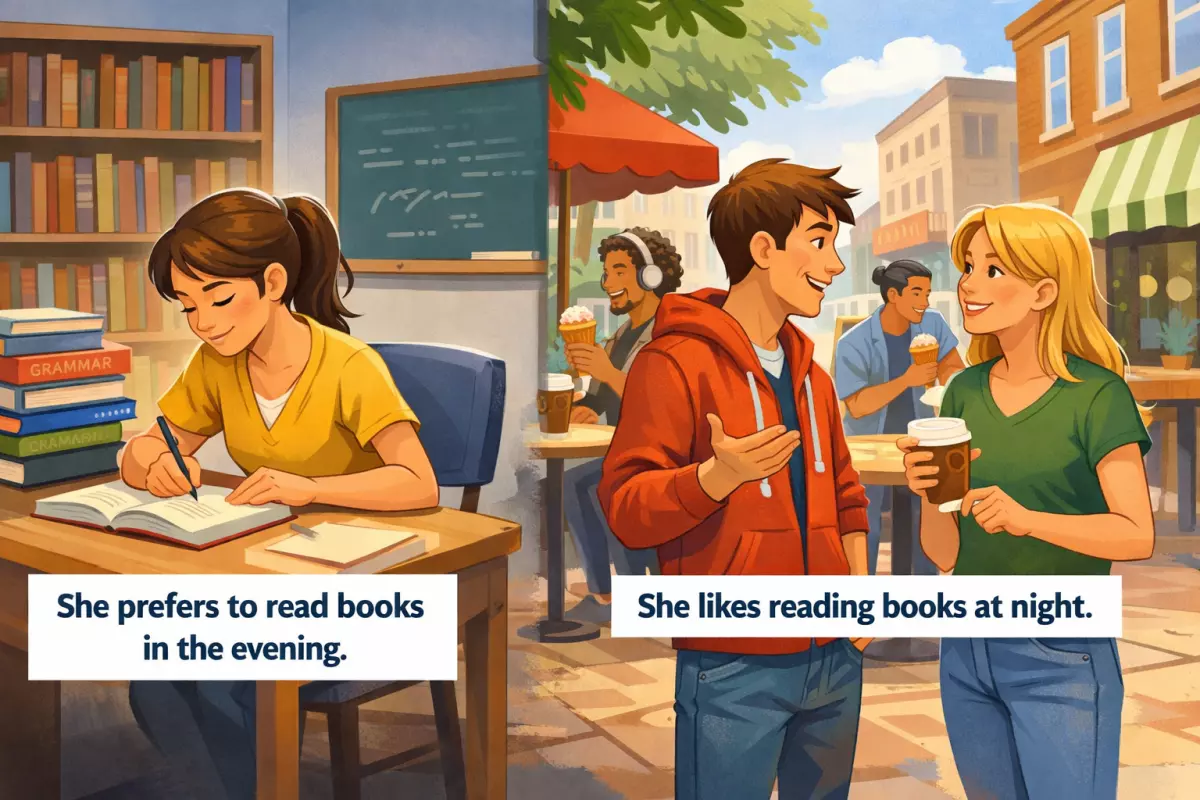
In everyday conversation, choices between gerunds (-ing) and infinitives (to + base verb) are often guided by speed, clarity, and what sounds natural in the moment—not by the neat rule lists found in coursebooks. As a result, spoken English shows more shortcuts, softer meanings, and more flexible patterns than many “one-verb-one-form” explanations suggest.
1) Spoken English favors shorter, high-frequency patterns
Textbooks often highlight full, carefully built sentences. In real speech, people rely on compact, reusable chunks that keep the conversation moving, especially with common verbs like want, need, like, try, and start.
- want/need + to-infinitive: “I need to go.” “Do you want to sit?”
- like/love/hate + -ing for general preference: “I hate waiting.” “She loves cooking.”
- go + -ing for activities: “We went shopping.” “Let’s go swimming.”
- spend time + -ing: “I spent all day answering emails.”
- It’s worth + -ing: “It’s worth checking.”
2) Meaning differences get blurred or ignored in casual talk
Some verb pairs are taught as having clear meaning contrasts (for example, “remember doing” vs “remember to do”). In conversation, speakers sometimes choose whichever form comes fastest, and listeners rely on context to interpret the meaning.
- remember: “Remember to call me” (future task) vs “I remember meeting him” (past memory).
- forget: “Don’t forget to lock the door” vs “I’ll never forget seeing that” (experience).
- stop: “Stop talking” (end the action) vs “I stopped to talk” (pause in order to talk).
- try: “Try restarting it” (experiment) vs “Try to be quiet” (make an effort).
- regret: “I regret saying that” (feel sorry about a past action) vs “We regret to inform you…” (formal announcement; much less common in speech).
3) Conversation uses more “softening” and indirectness
Spoken English often adds extra words to sound polite, less direct, or less final. This affects gerunds and infinitives because speakers choose forms that fit common polite frames.
- would like + to-infinitive: “I’d like to ask a question.”
- Do you mind + -ing: “Do you mind waiting a second?”
- Would you mind + -ing: “Would you mind closing the window?”
- It’s nice + to-infinitive: “It’s nice to see you.”
- Thanks for + -ing: “Thanks for coming.”
4) Reduced grammar: ellipsis, fragments, and “missing” words
Real speech regularly drops parts that are obvious from context. Gerunds and infinitives often appear in short fragments, especially when answering questions or reacting.
- Answer fragments: “What do you want to do?” → “Just to relax.” / “Watching a movie.”
- After about: “How about going now?” (often shortened from longer suggestions)
- After instead of: “Instead of arguing, let’s decide.”
- After without: “He left without saying goodbye.”
- Headline-style speech: “Me? Move to London? No way.” (infinitive idea without a full clause)
5) “Verb + -ing / to” rules are less rigid than lists imply
Many learning materials present fixed categories (“these verbs take -ing,” “those take to”). In spoken usage, some verbs allow both forms with little difference, and speakers switch based on rhythm, emphasis, or what they’ve just said.
- start/begin: “It started raining” / “It started to rain” (both common; -ing often feels more immediate).
- continue: “She continued talking” / “She continued to talk.”
- like: “I like swimming” (general) / “I like to swim in the mornings” (habit/choice; both occur).
- love/hate: “I hate to say it, but…” (set phrase) vs “I hate saying it…” (also possible; context decides).
6) Real speech relies on common “-ing” noun-like uses
Gerunds behave like nouns, and spoken English uses them constantly for quick labeling of activities, problems, and plans. This can be more frequent than textbook exercises suggest.
- As subject: “Driving in the city is stressful.”
- As object: “I miss sleeping in.”
- After prepositions: “I’m good at explaining things.”
- As a general category: “Meeting new people is hard for him.”
- As a complaint/issue: “All this waiting is annoying.”
7) Spoken corrections and restarts change the form mid-sentence
People often begin with one structure and then adjust while speaking. This leads to self-corrections where a gerund or infinitive gets swapped midstream.
- Restarting: “I was thinking of—actually, I want to ask you something.”
- Reframing: “I tried fixing it—well, I tried to fix it, but it didn’t work.”
- Softening after a strong start: “I hate—no, I just don’t like dealing with that.”
- Changing to a clearer plan: “We were planning on going—maybe we should just stay.”
8) What sounds “natural” often comes from collocations, not rules
In conversation, the most reliable guide is often the phrase that commonly occurs with that verb or adjective. Learning these chunks helps more than memorizing long verb lists.
- be used to + -ing: “I’m used to getting up early.”
- look forward to + -ing: “I’m looking forward to seeing you.”
- can’t stand + -ing: “I can’t stand waiting in line.”
- have trouble + -ing: “I’m having trouble logging in.”
- make a decision + to-infinitive: “He decided to quit.”
- be ready + to-infinitive: “We’re ready to leave.”
For spoken fluency, it helps to focus on the most common conversational frames (polite requests, suggestions, preferences, and quick reactions) and to notice which verbs regularly pair with -ing or with to in the phrases people actually use.
Examples from typical daily conversations and situations
Spoken English tends to favor short, familiar patterns: certain verbs are naturally followed by a gerund (-ing), others by an infinitive (to + base verb), and a few allow both with a change in meaning. The examples below show how these choices sound in everyday situations like making plans, giving advice, and reacting to news.
Common situations and the form that usually follows
- Making plans (suggest + -ing): “Do you feel like getting coffee?” / “I suggest leaving early.”
- Agreeing to a plan (decide + to-infinitive): “We decided to meet at 7.”
- Offering help (offer + to-infinitive): “I can offer to drive you home.”
- Talking about preferences (prefer + -ing or to-infinitive): “I prefer walking.” / “I prefer to walk if it’s not too far.”
- Enjoyment (enjoy + -ing): “I really enjoy cooking on weekends.”
- Stopping an activity (stop + -ing): “Can you stop talking for a second?”
- Stopping to do something (stop + to-infinitive): “Let’s stop to get gas.”
- Starting/continuing (start/keep + -ing): “It started raining.” / “Keep trying.”
- Promises and decisions (promise/plan + to-infinitive): “I promise to call you later.” / “We’re planning to visit next month.”
- Advice (recommend + -ing): “I recommend taking the earlier train.”
- Apologies (apologize for + -ing): “Sorry—I apologize for being late.”
- Thanking (thank you for + -ing): “Thanks for helping me with that.”
- Being honest about difficulty (struggle + to-infinitive): “I’m struggling to focus today.”
- Ability/effort (manage + to-infinitive): “I managed to finish it on time.”
- Preventing problems (avoid + -ing): “Try to avoid checking your phone while driving.”
- Considering options (consider + -ing): “Have you considered moving closer to work?”
- Being used to a routine (be used to + -ing): “I’m used to waking up early.”
- Getting used to a new routine (get used to + -ing): “You’ll get used to working nights.”
Pairs that learners often mix up (meaning changes)
- Remember + -ing (memory of a past event) vs remember + to-infinitive (not forget a task): ✅ “I remember meeting her.” → past memory. ✅ “Remember to lock the door.” → future task.
- Forget + -ing (memory missing) vs forget + to-infinitive (fail to do a task): ✅ “I’ll never forget seeing that view.” ✅ “I forgot to reply to your message.”
- Try + -ing (experiment) vs try + to-infinitive (make an effort): ✅ “Try restarting your phone.” → see if it helps. ✅ “I’m trying to stop eating late.” → effort over time.
- Stop + -ing (end an activity) vs stop + to-infinitive (pause in order to do something): ✅ “He stopped complaining.” ✅ “She stopped to answer the call.”
Quick correction-style examples you hear in conversation
- ✅ “I can’t stand waiting in long lines.” ❌ “I can’t stand to wait in long lines.”
- ✅ “They agreed to split the bill.” ❌ “They agreed splitting the bill.”
- ✅ “Do you mind opening the window?” ❌ “Do you mind to open the window?”
- ✅ “She refused to talk about it.” ❌ “She refused talking about it.”
- ✅ “He admitted making a mistake.” ❌ “He admitted to make a mistake.”
Common learner mistakes when speaking with gerunds and infinitives
In spontaneous conversation, learners often choose the wrong verb form because they rely on direct translation, overgeneralize a “rule,” or switch forms mid-sentence while thinking. The result is usually understandable, but it can sound unnatural or even change the meaning.
Frequent mistakes and how to fix them
- Using an infinitive after a preposition
❌ I’m interested in to learn more. → ✅ I’m interested in learning more.
After prepositions (in, at, about, of, for, without), use the -ing form. - Forgetting that “to” can be a preposition (not always an infinitive marker)
❌ I’m used to work early. → ✅ I’m used to working early.
In “be used to,” “look forward to,” and “get used to,” to is a preposition, so it takes -ing. - Mixing up verb patterns: “enjoy/avoid/finish” + -ing
❌ I enjoy to cook. → ✅ I enjoy cooking.
Common -ing verbs include: enjoy, avoid, finish, consider, suggest, recommend, mind, practice, miss. - Mixing up verb patterns: “decide/plan/hope” + to-infinitive
❌ We decided going home. → ✅ We decided to go home.
Many “future/choice” verbs prefer the to-infinitive: decide, plan, hope, agree, choose, promise, refuse, offer. - Using “make/let/help” with the wrong infinitive form
❌ She made me to apologize. → ✅ She made me apologize.
Make/let use the bare infinitive. Help can be bare or with to (help me (to) carry). - Confusing “stop” meanings
❌ I stopped to smoke (when you mean you quit). → ✅ I stopped smoking.
Stop + -ing = quit an activity. Stop + to-infinitive = pause another activity in order to do something. - Confusing “remember/forget” meanings
❌ I forgot locking the door (when you mean you didn’t do it). → ✅ I forgot to lock the door.
Remember/forget + to-infinitive = duty/action not yet done (or not done). + -ing = memory of something already done. - Confusing “try” meanings
❌ Try to restarting it. → ✅ Try restarting it.
Try + to-infinitive = attempt something difficult. Try + -ing = experiment with a possible solution. - Confusing “regret” in formal speech
❌ I regret to say I was late (when describing a past action). → ✅ I regret saying I was late.
Regret + -ing refers to regretting a past action; regret + to-infinitive is common in formal announcements (regret to inform you...). - Overusing -ing after “want/need/would like”
❌ I want going now. → ✅ I want to go now.
Want/need/would like usually take the to-infinitive. - Wrong subject with infinitives (missing “for”)
❌ It’s important you to be on time. → ✅ It’s important for you to be on time.
Use “for + person + to-infinitive” when the doer is not the subject of the main clause. - Misplacing the object: “ask/tell/want” + person + to-infinitive
❌ She told to me to call. → ✅ She told me to call.
The typical order is verb + person + to-infinitive: tell me to call, ask him to wait, want you to listen. - Using a full clause after a preposition instead of -ing
❌ Thanks for you helped. → ✅ Thanks for helping.
After “for,” use a noun or -ing form; if you need a subject, use “your/my/her” + -ing (Thanks for your helping). - Stacking two verbs without the correct connector
❌ I suggested to go. → ✅ I suggested going.
❌ I explained him to do it. → ✅ I explained how to do it / I explained it to him.
When speaking quickly, learners often attach an infinitive where the verb requires -ing or a different structure. - Switching forms mid-sentence
❌ I like to cook and watching movies. → ✅ I like cooking and watching movies.
Keep parallel structure in lists: -ing with -ing, or to-infinitive with to-infinitive. - Using “to” twice or adding extra words in fast speech
❌ I want to to go. → ✅ I want to go.
This is a fluency slip: slow down slightly before the second verb, or chunk the phrase (“want to go”).
Quick speaking checks
- If there’s a preposition right before the verb, choose -ing.
- If the first verb expresses a plan/decision/hope, choose to + base verb.
- If the verb is one that changes meaning (stop, remember, forget, try), decide whether you mean “before” (to-infinitive) or “already happened/ongoing” (-ing).
- When listing activities, keep the grammar parallel to sound natural.
Practice exercises: rewrite sentences to sound natural in spoken English
Rewrite each sentence so it sounds like something a person would naturally say in conversation. Focus on common spoken patterns with gerunds and infinitives: verb + -ing after prepositions, want/need/plan/hope + to, and everyday alternatives like “feel like,” “be worth,” “can’t stand,” and “it’s easier to.” Keep the meaning the same unless the task asks you to change emphasis.
Task 1: Choose the more natural structure (-ing vs. to + verb)
- I enjoy to cook on weekends.
- She suggested to take a taxi.
- Do you mind to open the window?
- He decided going home early.
- We’re interested to join the class.
- They avoided to talk about money.
- I can’t afford buying a new phone right now.
- Thanks to help me yesterday.
Show answers
- I enjoy cooking on weekends.
- She suggested taking a taxi.
- Do you mind opening the window?
- He decided to go home early.
- We’re interested in joining the class.
- They avoided talking about money.
- I can’t afford to buy a new phone right now.
- Thanks for helping me yesterday.
Task 2: Make the sentence sound more conversational (same meaning)
- I would like to ask you to help me to move this table.
- I prefer to not go out tonight.
- He began to speak about his childhood, and then he continued to speak about it for an hour.
- She is considering to change her job.
- I am thinking to buy a used car.
- They insisted to pay for dinner.
- I am used to wake up early.
- It is difficult for me remembering names.
- We are excited to meeting your team.
- He apologized to be late.
Show answers
- Could you help me move this table?
- I’d rather not go out tonight.
- He started talking about his childhood and went on for an hour.
- She’s thinking about changing jobs.
- I’m thinking of buying a used car.
- They insisted on paying for dinner.
- I’m used to waking up early.
- It’s hard for me to remember names.
- We’re excited to meet your team.
- He apologized for being late.
Task 3: Rewrite using common spoken “shortcut” patterns
- I do not want to cook tonight. (Use: “feel like”)
- It is not necessary for you to bring anything. (Use: “don’t need to”)
- It is a good idea to book in advance. (Use: “worth”)
- I dislike waiting in long lines. (Use: “can’t stand”)
- It is easy for me to get distracted. (Use: “I’m easily …”)
- I regret to tell you that the order is delayed. (Make it sound like customer support speech)
- My plan is to start to exercise more. (Reduce repetition)
- She attempted to explain it, but it didn’t help. (Use a more natural verb)
Show answers
- I don’t feel like cooking tonight.
- You don’t need to bring anything.
- It’s worth booking in advance.
- I can’t stand waiting in long lines.
- I’m easily distracted.
- I’m sorry to tell you your order’s delayed.
- I’m planning to exercise more.
- She tried to explain it, but it didn’t help.
Quick check: patterns you should be using in your rewrites
- Preposition + -ing: interested in joining, good at explaining, thanks for helping, tired of waiting.
- Mind / suggest / avoid / consider + -ing: mind opening, suggested taking, avoided talking, considered moving.
- Decide / hope / plan / afford + to: decided to leave, hope to see you, plan to call, can’t afford to buy.
- Spoken alternatives: don’t feel like + -ing, it’s worth + -ing, I’d rather (not) + base verb, can’t stand + -ing.
- Reduce repetition: start talking (not start to talk about… continue to talk about…), plan to exercise (not plan to start to…).