Gerunds and Infinitives in Formal English Writing

 Covers how gerunds and infinitives work in formal written English, when academic writing prefers infinitives, and when gerunds make sentences clearer. Includes examples from essays, reports, and professional communication, common informal-sounding mistakes, tips, and practice exercises.
- How gerunds and infinitives function in formal written English
- When academic writing prefers infinitive structures
- When gerunds create clearer and more concise sentences
- Examples from essays, reports, and professional communication
- Common grammar mistakes that make writing sound informal
- Tips for choosing the correct structure in formal contexts
- Practice exercises: improve sentences for formal writing
Choosing between verb forms such as the -ing form and to + verb can make formal writing sound smooth or awkward. In essays, reports, and emails, the best option often depends on the main verb, the meaning you intend, and the rhythm of the sentence. By learning common patterns and checking how each choice changes tone, you can write with confidence and avoid errors that distract readers.
How gerunds and infinitives function in formal written English
In academic and professional prose, gerunds (-ing forms used as nouns) and infinitives (to + base verb, or the bare infinitive after certain verbs) help writers express actions as concepts, goals, or procedures. Choosing between them is often a matter of grammar pattern, but it also affects emphasis: gerunds tend to present an activity as a general process, while infinitives often highlight purpose, intention, or a specific outcome.
Core roles in sentence structure
- Subject position: Gerunds commonly act as subjects in formal statements (e.g., “Reducing waste remains a priority.”). Infinitives can also serve as subjects, especially when the sentence frames an aim (e.g., “To reduce waste is a priority,” though this is less common than an extraposed structure).
- Object position: Many reporting and stance verbs take a gerund or an infinitive as the direct object, depending on the verb (e.g., “The committee recommended revising the policy” vs. “The committee decided to revise the policy”).
- Complement after “be”: Both forms can complete definitions and classifications (e.g., “The main challenge is securing funding” / “The main challenge is to secure funding”).
- Object of a preposition: After prepositions, formal English strongly prefers a gerund (e.g., “in conducting the analysis,” “by applying the method,” “without addressing the limitation”).
- Reduced clauses and compact phrasing: Gerund phrases can condense information (e.g., “After reviewing the data, the team revised the model.”), supporting a concise, report-like style.
Verb patterns that shape choice
- Verbs typically followed by a gerund: avoid, consider, recommend, suggest, propose, risk, justify, acknowledge, anticipate, postpone, discontinue.
- Verbs typically followed by an infinitive: aim, plan, decide, intend, attempt, agree, refuse, fail, seek, expect, promise, tend.
- Verbs that allow both with a meaning shift: remember, forget, stop, try, regret.
- ✅ “Remember to submit the appendix” (do it in the future) → vs. “Remember submitting the appendix” (recall a past action).
- ✅ “Stop to review the figures” (pause in order to review) → vs. “Stop reviewing the figures” (cease the activity).
- Verbs that allow both with little change in meaning: begin, start, continue. In formal writing, consistency within a paragraph is usually more important than the choice itself.
Common formal constructions and reliable patterns
- Purpose and intended result: Use an infinitive to express purpose clearly (e.g., “To improve reliability, the procedure was repeated.”).
- Extraposition with “it”: “It is + adjective + to-infinitive” is frequent in evaluations and recommendations (e.g., “It is essential to document assumptions.”).
- “It is + adjective + that-clause” vs. infinitive: When the subject is an agent (“that the team document…”), a that-clause often reads more precise; when the focus is the action itself, the infinitive is compact (e.g., “It is essential to document assumptions.”).
- Fixed expressions with gerunds: “in addition to,” “in terms of,” “by means of,” “with a view to” are followed by a gerund (e.g., “with a view to improving throughput”).
- Parallelism in lists: Keep forms aligned in coordinated structures (e.g., “The study aims to identify, to measure, and to explain…” or “The study involves identifying, measuring, and explaining…”).
- Avoiding ambiguity with “to”: When “to” is a preposition (e.g., “devoted to,” “committed to,” “opposed to”), it is followed by a gerund: “committed to improving,” not “committed to improve.”
- Agency with “for” + noun/pronoun: “It is important for researchers to report limitations” helps specify who should act.
- Nominal style and abstraction: Gerunds can support a measured, analytical tone by treating actions as entities (e.g., “monitoring,” “sampling,” “benchmarking”), but overuse may make sentences dense.
Accuracy checks that prevent common errors
- ✅ Use a gerund after prepositions: “by analyzing,” ❌ not “by analyze.”
- ✅ Match the verb’s pattern: “recommend revising,” ❌ not “recommend to revise” (in standard formal usage).
- ✅ Keep parallel forms: “to collect and to interpret” or “collecting and interpreting,” ❌ not “to collect and interpreting.”
- ✅ Distinguish purpose from result: “to reduce errors” (purpose) vs. “reducing errors” (activity/process).
- ✅ Avoid dangling -ing clauses: ensure the implied subject fits (e.g., “After reviewing the data, the team…” rather than “After reviewing the data, the conclusion…”).
When academic writing prefers infinitive structures
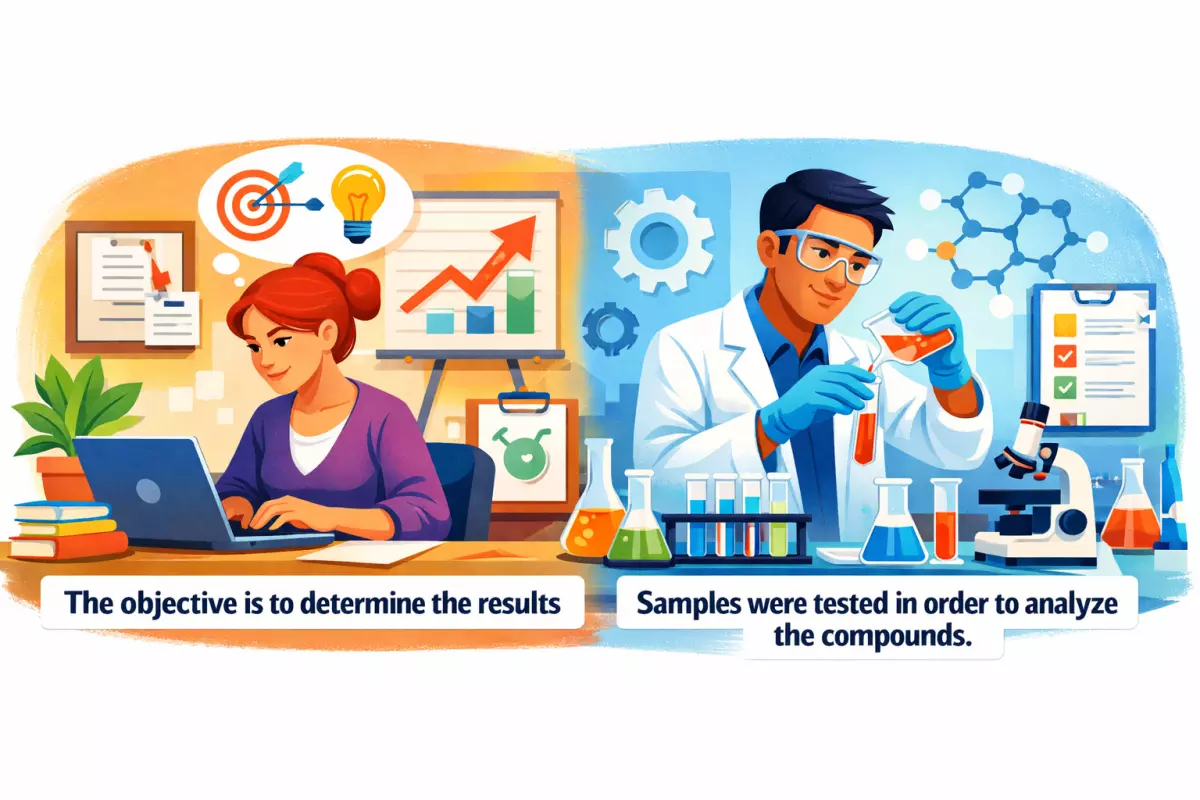
In research prose, the infinitive often signals purpose, intended outcomes, and controlled scope. It can also sound more precise than a gerund when the writer is describing an aim, a planned procedure, or a decision point in an argument.
Common contexts where the infinitive is the default choice
- Stating aims and research objectives: “This study aims to evaluate…”, “The objective is to determine…”, “We seek to identify…”
- Expressing purpose (especially with in order to / so as to): “Samples were diluted to reduce viscosity.”; “The protocol was modified in order to improve sensitivity.”
- Describing designed functions of methods or instruments: “The filter is used to remove impurities.”; “A control condition was included to isolate the effect.”
- Reporting decisions and commitments: “The authors decided to exclude outliers.”; “We chose to focus on…”
- Framing recommendations and implications: “Future work should aim to validate…”; “Clinicians may need to monitor…”
- Using extraposition with “it” for stance and evaluation: “It is important to note…”; “It is difficult to quantify…”; “It is necessary to control for…”
- After adjectives that evaluate feasibility or difficulty: “The dataset is hard to interpret.”; “The procedure is easy to replicate.”
- After nouns that encode goals, plans, or opportunities: “an attempt to replicate”, “a strategy to minimize bias”, “an opportunity to compare groups”
- After reporting verbs that introduce an intended action: “We propose to extend the model…”; “The team intends to collect…”
- With “too … to” and “enough … to” for threshold claims: “The signal was too weak to detect.”; “The sample size was large enough to permit subgroup analysis.”
- To express a result framed as an achieved capability: “The model was able to predict…”; “The assay failed to detect…”
- To narrow interpretation with a specific next step: “These findings suggest to interpret with caution” ❌ → “These findings suggest interpreting with caution” ✅ (note: some verbs prefer gerunds; see verb-specific patterns)
- To avoid heavy nominalization in long noun phrases: “A method to estimate exposure” can read cleaner than “a method for exposure estimation” in dense technical passages.
High-frequency academic patterns to model
- “The aim of this paper is to…”
- “The purpose of the present study is to…”
- “To test this hypothesis, we…” (fronted infinitive clause for purpose)
- “In order to control for X, we…”
- “This section seeks to clarify…”
- “These results help to explain…”
- “The analysis was conducted to assess…”
- “It remains unclear how to…” (wh-word + infinitive)
- “The question is whether to…” (whether + infinitive in decision framing)
- “We were unable to…”
- “The findings are likely to…”
- “This approach is intended to…”
- “The goal is to reduce…”
- “The procedure allows researchers to…”
Usage notes that affect formality and clarity
- Prefer the infinitive to mark purpose clearly: “We collected follow-up data to evaluate durability” is typically tighter than “We collected follow-up data for evaluating durability.”
- Use “to + verb” after many stance adjectives with extraposition: “It is essential to consider confounders” is a standard academic frame.
- Keep the subject consistent where possible: “We used bootstrapping to estimate uncertainty” is clearer than switching to an impersonal subject mid-sentence.
- Watch verb-specific complementation: some verbs strongly prefer gerunds (e.g., “avoid doing”), while others prefer infinitives (e.g., “decide to do”). Choosing the wrong complement can sound non-native or change meaning.
- Avoid dangling purpose clauses: “To improve accuracy, the model was trained…” can be ambiguous if the implied agent is unclear; revise to name the actor when needed.
When gerunds create clearer and more concise sentences
In formal writing, a gerund (the -ing form used as a noun) often helps you state an action as a concept without adding extra clauses. This can reduce wordiness, keep the subject consistent, and make the sentence flow more smoothly—especially when you are describing processes, policies, or repeated actions.
Common patterns where gerunds improve clarity
- As the subject when the action itself is the topic: “Reducing emissions requires coordinated policy.”
- As the object of a verb after verbs that typically take gerunds: “The committee recommended revising the protocol.”
- After prepositions (a frequent source of errors): “The report focuses on improving data integrity.”
- After fixed expressions that naturally take -ing: “The team avoided disclosing confidential details.”
- To name activities in headings and lists for parallel structure: “Collecting samples,” “Calibrating instruments,” “Recording results.”
Concise rewrites: choosing a gerund over a longer structure
- ✅ “We discussed expanding the dataset.” → more direct than “We discussed whether we should expand the dataset.”
- ✅ “The policy prohibits sharing passwords.” → tighter than “The policy prohibits employees from sharing passwords.” (when the actor is obvious or irrelevant)
- ✅ “The study addresses measuring long-term outcomes.” → cleaner than “The study addresses how to measure long-term outcomes.”
- ✅ “They acknowledged missing the deadline.” → simpler than “They acknowledged that they missed the deadline.”
- ✅ “The procedure involves heating the solution.” → less bulky than “The procedure involves the solution being heated.”
- ✅ “This approach reduces errors by standardizing inputs.” → more streamlined than “This approach reduces errors because it standardizes inputs.”
- ✅ “The audit revealed weaknesses in tracking inventory.” → more compact than “The audit revealed that the company was weak at tracking inventory.”
- ✅ “The guideline emphasizes documenting decisions.” → more economical than “The guideline emphasizes that decisions should be documented.”
- ✅ “The method improves reliability through controlling for confounders.” → clearer than “The method improves reliability through the control of confounders.”
- ✅ “The organization is committed to supporting staff development.” → smoother than “The organization is committed to the support of staff development.”
- ✅ “The team succeeded in identifying the root cause.” → more natural than “The team succeeded to identify the root cause.”
- ✅ “The findings justify revising the model.” → more direct than “The findings justify that the model should be revised.”
High-value usage rules (especially in formal English)
- Use a gerund after a preposition: “in developing,” “by analyzing,” “for improving,” “without disclosing,” “after reviewing.” ❌ “in develop,” “by analyze.”
- Prefer gerunds to abstract noun stacks when an action is central: “improving compliance” is often clearer than “compliance improvement initiatives.”
- Use a gerund to keep parallel structure in coordinated items: “reviewing, editing, and approving” (not “reviewing, to edit, and approval”).
- Keep the implied subject clear when the -ing phrase follows a noun: “The manager approved the team’s working remotely” can be ambiguous; revise to “approved the team’s remote work” or “approved the team working remotely,” depending on meaning.
- Avoid dangling -ing phrases that attach to the wrong subject: ❌ “After reviewing the data, the conclusion was revised.” ✅ “After reviewing the data, the authors revised the conclusion.”
Examples from essays, reports, and professional communication

Formal writing often relies on predictable verb patterns: some verbs are typically followed by a gerund (-ing form), others by an infinitive (to + base verb), and some allow both with a change in meaning. The examples below model common sentence frames used in academic essays, analytical reports, and workplace messages.
Academic essays: argument, evaluation, and stance
- Gerund after prepositions: “This study contributes to understanding how policy changes affect employment.”
- Gerund as subject: “Reducing administrative delays remains a priority for public agencies.”
- Infinitive of purpose: “The author cites longitudinal data to support the claim.”
- Verb + infinitive (stance/decision): “The paper aims to demonstrate the limits of the model.”
- Verb + gerund (avoid/consider): “The analysis avoids assuming a linear relationship.”
- It + adjective + infinitive: “It is essential to distinguish correlation from causation.”
- Gerund after “by” (method): “The argument is strengthened by comparing results across regions.”
- Verb + infinitive (attempt/seek): “The researcher seeks to clarify the mechanism behind the effect.”
- Verb + gerund (recommend): “The review recommends expanding the sample size in future work.”
- Infinitive after “too/enough”: “The evidence is insufficient to justify a definitive conclusion.”
Reports: process, findings, and recommendations
- Gerund after “in” (focus area): “Key risks were identified in maintaining legacy systems.”
- Infinitive for planned action: “The team will implement controls to reduce error rates.”
- Verb + gerund (continue): “The department will continue monitoring performance indicators.”
- Verb + infinitive (plan): “Management plans to allocate additional resources next quarter.”
- Gerund after “without”: “The system can be updated without interrupting service.”
- Infinitive after “able/unable”: “The vendor was unable to provide complete documentation.”
- Gerund after “risk”: “Delaying the upgrade risks exposing customer data.”
- Infinitive after “need”: “Several procedures need to be revised to meet compliance standards.”
- Gerund after “in order to” is incorrect (use infinitive): ❌ “in order to improving” → ✅ “in order to improve reporting accuracy.”
- Gerund as object of “recommend”: “We recommend conducting a follow-up audit within six months.”
Professional communication: requests, updates, and diplomacy
- Infinitive after “would like”: “I would like to confirm the meeting time.”
- Gerund after “appreciate”: “We appreciate your responding by Friday.”
- Infinitive after “happy/glad”: “I’m happy to provide additional details if needed.”
- Gerund after “look forward to”: “I look forward to discussing the proposal.”
- Infinitive after “need” (request): “We need to finalize the scope before procurement begins.”
- Gerund after prepositions in set phrases: “Thank you for taking the time to review the draft.”
- Infinitive to soften direction: “Please ensure to submit the form by 3 p.m.”
- More natural alternative (common in formal email): “Please ensure that you submit the form by 3 p.m.”
- Verb + gerund (avoid in tone management): “We suggest reframing the summary to highlight outcomes.”
- Verb + infinitive (offer/agree): “We agree to extend the deadline by two business days.”
Meaning changes when both forms are possible
- Remember + gerund (past action): “The committee remembers approving the budget in May.”
- Remember + infinitive (future obligation): “Please remember to attach the updated schedule.”
- Stop + gerund (end an activity): “The organization stopped using the legacy platform.”
- Stop + infinitive (pause to do something): “The analyst stopped to verify the figures before submission.”
- Try + gerund (experiment): “Try running the query with a narrower date range.”
- Try + infinitive (attempt): “Try to resolve the discrepancy before escalation.”
Common grammar mistakes that make writing sound informal
Formality often breaks down when gerunds and infinitives are used in “spoken” patterns that are acceptable in conversation but look loose on the page. The issues below are less about grammar being “wrong” and more about choosing structures that sound precise, consistent, and appropriately academic or professional.
1) Overusing conversational verb patterns
Some verbs invite informal, chatty phrasing (especially with infinitives). In formal writing, prefer more direct reporting verbs, clearer complements, or nominal structures.
- ❌ “I want to discuss…” → ✅ “This paper aims to discuss…”
- ❌ “We need to look at…” → ✅ “This section examines…”
- ❌ “I hope to show…” → ✅ “The results show…”
- ❌ “We try to explain…” → ✅ “We explain…” / “We provide an explanation of…”
2) Using “like” + gerund for preferences in formal contexts
“Like doing” is natural in speech, but it can sound casual in academic or business prose. More formal options include “prefer to,” “prefer -ing,” “tend to,” or “is recommended.”
- ❌ “Many users like using…” → ✅ “Many users prefer to use…”
- ❌ “Researchers like working with…” → ✅ “Researchers tend to work with…”
- ❌ “We like to avoid…” → ✅ “It is advisable to avoid…”
3) Unclear reference with gerund subjects
Gerund phrases as subjects can be effective, but they become informal-sounding when the “doer” is vague or when the sentence reads like a slogan. Add a clear agent or reframe with a noun phrase.
- ❌ “Using the new system improves outcomes.” (Who is using it?) → ✅ “Clinicians’ use of the new system improves outcomes.”
- ❌ “Working together reduces risk.” → ✅ “Interdepartmental collaboration reduces risk.”
- ❌ “Being transparent builds trust.” → ✅ “Transparency builds trust.”
4) Dangling or “free-floating” infinitives
Infinitive phrases that are not clearly attached to the right subject can feel sloppy. Make sure the infinitive’s purpose or result clearly belongs to the grammatical subject.
- ❌ “To improve accuracy, the data were cleaned.” (Who improved it?) → ✅ “To improve accuracy, we cleaned the data.”
- ❌ “To address the issue, a new policy was introduced.” → ✅ “To address the issue, the committee introduced a new policy.”
5) Informal “try and” instead of an infinitive
In careful writing, “try and + verb” is usually replaced by “try to + verb,” which is more standard and unambiguous.
- ❌ “We will try and reduce errors.” → ✅ “We will try to reduce errors.”
- ❌ “The team will try and identify…” → ✅ “The team will try to identify…”
6) Casual “go + gerund” and similar idioms
Idioms like “go shopping” or “go looking for” can sound too conversational unless the context is intentionally informal. Replace them with more precise verbs.
- ❌ “We went looking for evidence…” → ✅ “We sought evidence…”
- ❌ “The team went digging into the logs…” → ✅ “The team analyzed the logs…”
- ❌ “We went asking stakeholders…” → ✅ “We consulted stakeholders…”
7) Mixing gerunds and infinitives in parallel structures
Parallelism affects formality because inconsistent patterns look unedited. When listing actions, keep the same grammatical form throughout.
- ❌ “The goals are to reduce costs and improving quality.” → ✅ “The goals are to reduce costs and to improve quality.”
- ❌ “The policy focuses on monitoring outcomes and to report incidents.” → ✅ “The policy focuses on monitoring outcomes and reporting incidents.”
- ❌ “They recommended to revise the protocol and updating the checklist.” → ✅ “They recommended revising the protocol and updating the checklist.”
8) Overusing “start/begin + -ing” for formal description
“Start/begin doing” is fine, but repeated use can sound narrative and informal. In analytical writing, replace it with more specific verbs (initiate, implement, commence, introduce) or describe the change directly.
- ❌ “The company started using a new tool in 2023.” → ✅ “The company implemented a new tool in 2023.”
- ❌ “The system began failing under load.” → ✅ “The system failed under load.” / “Failure occurred under load.”
9) Casual “help + (to) infinitive” with vague claims
“Help to” is grammatical, but claims like “helps to improve” can sound promotional or imprecise. In formal writing, specify the mechanism or use a tighter verb (facilitates, enables, supports) with a concrete object.
- ❌ “This feature helps to improve performance.” → ✅ “This feature reduces latency by caching results.”
- ❌ “The training helped employees to understand the policy.” → ✅ “The training enabled employees to interpret the policy requirements.”
10) Informal preposition choices before gerunds
Gerunds commonly follow prepositions, but some combinations are wordy or casual. Prefer established formal collocations (e.g., “in order to” can often be reduced to “to” when the meaning stays clear).
- ❌ “In order to reduce risk, …” → ✅ “To reduce risk, …”
- ❌ “They discussed about changing the plan.” → ✅ “They discussed changing the plan.”
- ❌ “They emphasized on improving quality.” → ✅ “They emphasized improving quality.”
Tips for choosing the correct structure in formal contexts
In formal writing, gerunds and infinitives should be chosen for consistency, clarity, and control of meaning. Many verbs allow only one structure, while others change meaning depending on whether they take a gerund or an infinitive. The safest approach is to rely on common patterns, keep the sentence’s focus on the intended action or result, and avoid conversational shortcuts.
Choose the structure that matches the verb pattern
- Use a gerund after verbs that typically take -ing: avoid, consider, discuss, emphasize, finish, justify, mention, recommend, risk, suggest.
- Use an infinitive after verbs that typically take to + base verb: aim, decide, expect, intend, plan, refuse, seek, tend, want.
- When a verb allows both forms, check whether the meaning changes (see the “meaning-shift” items below) rather than treating them as interchangeable.
Use infinitives to express purpose, intention, or a planned outcome
- Purpose statements are usually clearer with an infinitive: “The committee met to review the proposal.”
- Policy or procedural language often prefers infinitives for goals: “The program aims to reduce delays.”
- When the action is not yet realized, an infinitive often fits: “The team expects to complete the audit in May.”
Use gerunds to describe general activities, ongoing processes, and established practices
- General behaviors are commonly expressed with -ing: “The report addresses managing stakeholder expectations.”
- Ongoing or repeated activities often read naturally with gerunds: “The protocol involves monitoring temperature changes.”
- When the activity itself is the topic, a gerund keeps the focus on the process: “Collecting baseline data is essential.”
Prefer the more explicit option when the sentence could be misread
- When a gerund could attach to the wrong noun, switch to an infinitive or rephrase: “a decision to postpone the launch” (often clearer than “a decision postponing the launch”).
- When the subject is long, an infinitive can reduce heaviness: “The primary objective is to standardize reporting.”
- If the reader might confuse time reference, choose the form that signals it: “remember to submit” (future action) vs. “remember submitting” (past action).
Watch for verbs where the choice changes meaning
- remember: ✅ “Remember to attach the file.” → future task; ✅ “Remember attaching the file.” → memory of a past action.
- forget: ✅ “Do not forget to include the appendix.” → omission risk; ✅ “He will never forget meeting the donor.” → past experience.
- stop: ✅ “The agency stopped issuing paper permits.” → activity ended; ✅ “The agency stopped to review the data.” → paused in order to do something.
- try: ✅ “Try to verify the figures.” → attempt; ✅ “Try verifying the figures first.” → experiment with a method.
- regret: ✅ “We regret to inform you…” → formal announcement; ✅ “We regret delaying the response.” → remorse about an action.
Handle formal reporting verbs and recommendations carefully
- After recommend and suggest, a gerund is common in polished prose: “The panel recommends expanding access.”
- When you need to name the responsible party, use an infinitive with an explicit subject: “The panel recommends that the agency expand access” (often more formal than “recommends the agency to expand”).
- Avoid nonstandard patterns: ❌ “recommend the agency to expand” (often incorrect in standard formal English) → use “recommend that…” or “recommend expanding…”.
Use object + infinitive patterns for directives and expectations
- Many formal verbs take object + to-infinitive: “The policy requires employees to complete training.”
- Common verbs in this pattern include: allow, enable, expect, instruct, require, encourage, permit.
- Be precise about agency: “The guidelines encourage applicants to provide references” (clear who should act).
Keep parallel structure in coordinated lists and headings
- Use the same form across bullet points and series: “The procedure involves collecting samples, labeling containers, and documenting results.”
- Avoid mixing forms without a reason: ❌ “involves collecting samples, to label containers, and documenting results.”
- In section titles, choose one style and maintain it: “Methods for analyzing data” or “Methods to analyze data” (do not alternate within the same document).
Reduce ambiguity with clear subjects and time reference
- If the doer is not obvious, add a clause: “The review found that staff need to update records” (clearer than “a need for updating records” in some contexts).
- Use gerunds with possessives sparingly and only when the style guide supports it: “the client’s requesting a revision” can sound legalistic; “the client’s request to revise the document” is often smoother.
- When describing completed actions in findings, gerunds often fit: “The audit confirmed misreporting of expenses.”
Practice exercises: improve sentences for formal writing
Revise the sentences below by choosing a more appropriate gerund or infinitive structure for a formal register. Focus on these common goals: (1) use the standard verb pattern (verb + gerund / verb + infinitive), (2) reduce conversational phrasing, and (3) keep meaning and tense consistent.
Task 1: Choose the correct complement (gerund or infinitive)
- The committee agreed (postponing / to postpone) the vote until further notice.
- The report recommends (to implement / implementing) additional controls.
- We aim (reducing / to reduce) processing time by 15%.
- The manager avoided (to comment / commenting) on ongoing negotiations.
- The policy requires employees (submitting / to submit) the form by Friday.
- The data appear (supporting / to support) the initial hypothesis.
- The team considered (to expand / expanding) the scope of the study.
- The auditor declined (to approve / approving) the expense without documentation.
- The procedure enables users (to access / accessing) archived records.
- The department anticipates (to receive / receiving) the final figures next week.
Show answers
- to postpone
- implementing
- to reduce
- commenting
- to submit
- to support
- expanding
- to approve
- to access
- receiving
Task 2: Rewrite to sound more formal (keep the meaning)
- We’re looking to cut costs by renegotiating supplier contracts.
- They admitted they messed up by not following the protocol.
- The purpose of this memo is to give an overview about how to use the system.
- She said she would try and finish the analysis by Monday.
- There is a need to quickly improve how we handle complaints.
- He insisted on us to attend the meeting in person.
- The company is committed to make sure that data is stored securely.
- We discussed about expanding into new markets.
- The supervisor reminded me that I should submit the form.
- It’s important that we keep to document all changes.
Show answers
- We seek to reduce costs by renegotiating supplier contracts.
- They acknowledged failing to follow the protocol.
- The purpose of this memo is to provide an overview of using the system.
- She stated that she would try to finish the analysis by Monday.
- There is a need to improve complaint handling promptly.
- He insisted on our attending the meeting in person.
- The company is committed to ensuring that data is stored securely.
- We discussed expanding into new markets.
- The supervisor reminded me to submit the form.
- It is important to continue documenting all changes.
Task 3: Correct common pattern errors (one change per sentence)
- The board suggested to revise the timeline.
- We look forward to meet with the stakeholders.
- They made us to sign the updated agreement.
- The analyst recommended to allocate additional resources.
- The new tool helps to identify anomalies in real time.
- She prevented the team to disclose confidential details.
- He is responsible of maintaining the archive.
- The client requested us providing a revised draft.
- The findings indicate to improve data validation.
- The organization is considering to relocate the office.
Show answers
- The board suggested revising the timeline.
- We look forward to meeting with the stakeholders.
- They made us sign the updated agreement.
- The analyst recommended allocating additional resources.
- The new tool helps identify anomalies in real time.
- She prevented the team from disclosing confidential details.
- He is responsible for maintaining the archive.
- The client requested that we provide a revised draft.
- The findings indicate a need to improve data validation.
- The organization is considering relocating the office.
Quick checklist for your revisions
- After recommend, suggest, consider, avoid, anticipate, prefer a gerund: “recommend implementing,” not “recommend to implement.”
- After agree, aim, decide, plan, refuse, appear, prefer an infinitive: “decide to proceed,” not “decide proceeding.”
- After a preposition, use a gerund: “look forward to meeting,” “committed to ensuring,” “by renegotiating.”
- With causatives, use the bare infinitive: “make/let/help someone do” (not “to do” in most formal modern usage).
- When a verb needs an object, keep it: “require employees to submit,” “enable users to access.”
- Replace “try and + verb” with “try to + verb” in formal prose.