Using Gerunds and Infinitives in Questions

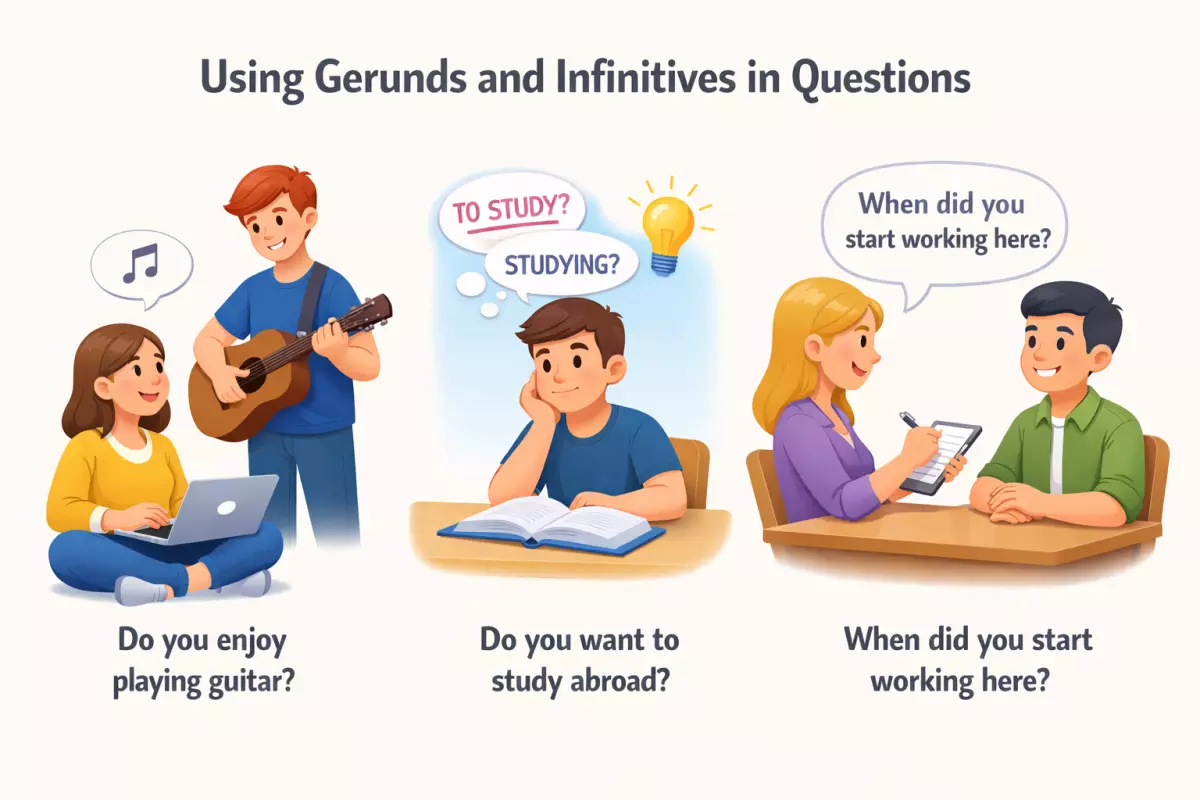 This article explains how gerunds work in question structures, how indirect questions use patterns like what to do, and how question word + infinitive sentences are built. It compares direct vs embedded questions, gives everyday examples, flags common mistakes, and includes practice exercises.
- How gerunds appear inside question structures
- Using infinitives in indirect questions like 'what to do'
- Sentence patterns with question word + infinitive
- Differences between direct questions and embedded questions
- Examples of question structures used in everyday English
- Typical learner mistakes when forming questions with verb patterns
- Practice exercises: create questions using gerunds and infinitives
Choosing between -ing forms and to-forms in questions can be tricky because it affects the meaning. In everyday English, -ing often follows certain verbs and prepositions, while the to-form fits other patterns, especially for plans, decisions, or purpose. Learn the common frames and your questions will sound smoother, clearer, and more natural in conversation.
How gerunds appear inside question structures
In questions, a gerund (the -ing form used as a noun) most often shows up as the thing being asked аbout: an activity, an idea, or a choice. You’ll see it after certain verbs and prepositions, and it can also function as the subject or object inside an embedded question.
Common patterns you’ll see
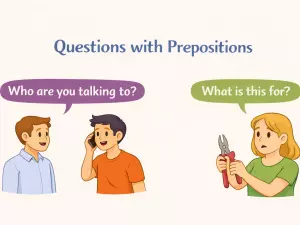
- After prepositions in questions: When a question ends with (or includes) a preposition, the next verb is typically a gerund. Examples: “What are you interested in learning?” / “Who are you responsible for training?”
- After verbs that take a gerund: Some verbs naturally lead into -ing even when you form a question. Examples: “Do you enjoy working from home?” / “Did you avoid talking to them?”
- As the subject of a question: The activity itself can be the subject. Examples: “Is driving at night difficult for you?” / “Was waiting worth it?”
- After “How about / What about”: These are very common for suggestions and reactions. Examples: “How about taking a break?” / “What about meeting earlier?”
- Inside embedded questions: The question word introduces a clause, and the gerund appears where a noun would. Examples: “Can you explain why changing the plan matters?” / “Do you remember when moving felt hardest?”
- As the object of “stop,” “finish,” “keep,” and similar verbs: These verbs often signal an activity in progress. Examples: “Did you stop checking your email?” / “Will you keep practicing?”
Question templates with examples
- “What do you think about moving to a new team?”
- “How do you feel about working weekends?”
- “What are the risks of sharing that file?”
- “Who benefits from changing the rules?”
- “What’s the point of arguing about it?”
- “What are you good at doing?”
- “What are you worried about losing?”
- “What are you responsible for handling?”
- “Who are you interested in meeting?”
- “What did you end up choosing?”
- “Did you consider taking the earlier flight?”
- “Do you mind waiting a few minutes?”
- “Did you finish writing the report?”
- “Are you done packing?”
- “Is learning a new system stressful at first?”
- “Was asking for help the right move?”
Quick accuracy checks (common trouble spots)
- Preposition + verb → use a gerund: ✅ “What are you interested in studying?” ❌ “interested in study”
- “How about / What about” → follow with -ing: ✅ “What about trying again?” ❌ “What about try again?”
- Gerund as subject → treat it like a singular idea: “Is traveling alone safe?” (often takes singular verb agreement)
- Verb choice matters: If the main verb requires -ing, keep -ing even in questions: “Do you enjoy reading?” not “Do you enjoy to read?”
Using infinitives in indirect questions like 'what to do'

English often uses an infinitive clause after a question word to talk about a decision, plan, or problem in a compact way. This structure is common after verbs like know, decide, remember, and figure out, especially when the subject is the same person who will do the action.
Core pattern
The basic form is:
- question word + to + base verb: what to do, where to go, how to respond
- often placed after a reporting verb: I don’t know what to do.
When this structure works best
Use a question word + infinitive when it expresses an “open choice” or “next step” rather than a request for a full statement. It typically implies “what I should do / what we should do” without saying should.
- Use it when the main clause already shows who is responsible for the action: “I can’t decide where to park.”
- Use it to summarize a longer clause: “She explained how to apply.” (≈ how we should apply / how to apply properly)
- Use it in instructions and problem-solving contexts: “This guide shows you how to reset your password.”
- Avoid it when you need a complete indirect question with a subject and tense: “I don’t know what he did” (not “what to do” because the subject is different).
Common question words used with infinitives
- what to + verb: what to say, what to buy, what to do next
- where to + verb: where to meet, where to start, where to look
- when to + verb: when to leave, when to call, when to stop
- how to + verb: how to fix it, how to answer, how to pronounce it
- which + noun + to + verb: which route to take, which form to fill out, which key to press
- who to + verb: who to ask, who to invite, who to contact
Typical verbs and expressions that introduce it
- I don’t know what to do.
- We need to decide where to go.
- She couldn’t remember which file to open.
- He learned how to swim.
- Can you show me how to use this?
- They’re discussing when to announce the results.
- I’m trying to figure out who to call.
- Tell me what to write in the subject line.
- Please advise me when to submit the form.
- It’s hard to choose which one to buy.
- He explained where to plug it in.
- She hesitated, unsure what to say.
Key grammar notes and frequent errors
- No subject inside the infinitive clause: ✅ “I don’t know what to do.” ❌ “I don’t know what I to do.”
- Use the base verb after “to”: ✅ “where to go” ❌ “where to going”
- Use a full clause when the subject changes: ✅ “I don’t know what she wants.” (not “what to want”)
- Don’t confuse direct vs. indirect word order: “I don’t know where he is” (indirect clause) vs. “Where is he?” (direct question). The infinitive version avoids this issue: “I don’t know where to look.”
- “Whether” does not take an infinitive in standard usage: ✅ “I’m not sure whether I should go.” ❌ “whether to go” is possible in some contexts, but it is more limited and sounds more formal; many learners overuse it.
Meaning: advice, possibility, and “should”
These infinitive clauses often imply advice or the best option. Compare the meanings:
- “I don’t know what to do.” → I don’t know the right action / next step.
- “I don’t know what I should do.” → more explicit about advice or obligation.
- “I don’t know what I will do.” → focuses on future plans, not necessarily the “right” choice.
Sentence patterns with question word + infinitive
Use a question word + infinitive to talk about an unknown action, choice, or next step. This structure often replaces a longer clause (for example, “I don’t know what I should do”) and is common after verbs that express uncertainty, decisions, learning, and explaining.
Core patterns
- Statement: Subject + verb + question word + to + base verb
→ “I don’t know what to say.” - Question: Auxiliary + subject + verb + question word + to + base verb?
→ “Do you know where to park?” - With an object: Subject + verb + object + question word + to + base verb
→ “She showed me how to use the scanner.” - Negative infinitive: question word + not + to + base verb
→ “He explained what not to do in an emergency.”
Which question words work best
- what to + verb (choice/action): “Tell me what to bring.”
- where to + verb (place/direction): “They discussed where to meet.”
- when to + verb (timing): “I’m not sure when to leave.”
- how to + verb (method/steps): “Can you explain how to reset it?”
- who to + verb (person to contact/choose): “Ask HR who to email.”
- which to + verb (selection from options): “I can’t decide which to buy.”
- whether to + verb (yes/no decision): “We’re debating whether to postpone the launch.”
Common verbs before the structure
- know: “Do you know how to get there?”
- learn: “She’s learning how to drive.”
- decide: “He couldn’t decide what to order.”
- remember: “Remember where to put the key.”
- forget: “I forgot when to submit the form.”
- figure out: “We’re trying to figure out why to change the plan ❌ (use a clause instead: “why we should change…”)”
- ask: “She asked where to sit.”
- show: “He showed us how to connect the cables.”
- tell: “Tell me what to do next.”
- explain: “Please explain how to apply.”
- discuss: “They discussed when to start.”
- consider: “I’m considering whether to accept the offer.”
When this pattern is not appropriate
- Use a full clause after “why”: “I don’t know why to leave ❌” → “I don’t know why I should leave ✅”
- Use a clause when the subject must be stated clearly: “She explained what to do” (general instructions) vs. “She explained what I should do” (advice for one person).
- Avoid it when you need tense or aspect: “I’m not sure when to have finished ❌” → “I’m not sure when it has to be finished ✅”
Expanded example set (quick practice)
- “I don’t know what to write in the subject line.”
- “Can you tell me where to upload the file?”
- “She taught him how to pronounce the name.”
- “We’re deciding which to choose for the final.”
- “Do you remember when to renew the license?”
- “He asked who to call if the alarm goes off.”
- “They weren’t sure whether to sign the contract.”
- “Please show me how to change the settings.”
- “I can’t figure out what to do with these cables.”
- “She explained what not to share online.”
- “We discussed where to stay during the conference.”
- “He didn’t know which to pick, so he asked for advice.”
- “Tell me when to stop.”
- “I’m learning how to budget.”
- “Do you know what to expect at the interview?”
Differences between direct questions and embedded questions
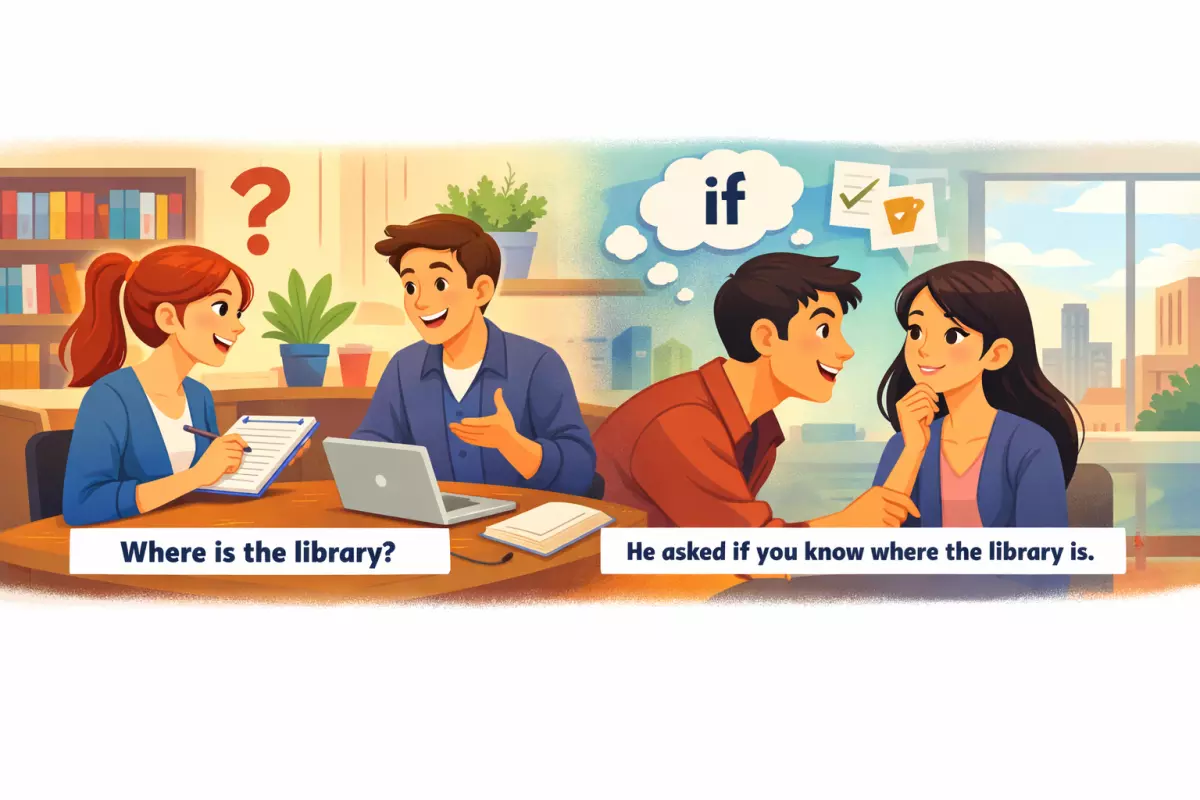
When a question stands alone, it follows normal question word order. When it sits inside a larger sentence (after verbs like ask, know, wonder, tell, or in statements like I’m not sure…), the grammar shifts toward statement word order. This matters for gerunds and infinitives because the embedded structure often adds an extra verb layer (for example, ask + infinitive or ask + if/whether + clause).
| Feature | Direct question | Embedded question |
|---|---|---|
| Typical position | Stands alone as a question | Appears inside a statement or another question |
| Word order | Uses question order (auxiliary before subject) | Uses statement order (subject before verb) |
| Do/does/did support | Common in simple present/past questions | Not used inside the embedded clause |
| Question mark | Ends with “?” | Usually no “?” (unless the whole sentence is a question) |
| Yes/no form | Auxiliary inversion: “Are you…?” | Uses if / whether: “I wonder if…” |
| Wh- form | Wh-word + inversion: “Where are you…?” | Wh-word + statement order: “Do you know where you are…?” |
| Common infinitive pattern | “What should I do?” | “I don’t know what to do.” |
| Common gerund pattern | “Is it worth trying?” | “I’m not sure if it’s worth trying.” |
Word order shifts you need to control
- ✅ Direct: “Where does she live?” → Embedded: “Do you know where she lives?”
- ✅ Direct: “What did they decide?” → Embedded: “I remember what they decided.”
- ❌ “Do you know where does she live?” (keep statement order in the embedded clause)
- ❌ “I wonder what did they decide.” (no inversion after the wh-word inside the sentence)
How gerunds and infinitives show up in each type
Both types can contain gerunds and infinitives, but embedded forms often use them to shorten the clause or to match the verb pattern of the reporting verb.
- Direct question + infinitive meaning (with modal): “What should I do?” / “Where can we park?”
- Embedded question + wh- + to-infinitive: “I don’t know what to do.” / “Can you tell me where to park?”
- Direct question with gerund as a noun: “Is taking the train cheaper?” / “Is waiting necessary?”
- Embedded question with gerund phrase: “Do you know if taking the train is cheaper?”
- Verb pattern difference (ask): “What did you ask?” vs. “I asked how to start.” / “I asked if we should start.”
High-utility transformations (direct → embedded)
- “What should I say?” → “I’m not sure what to say.”
- “When do we leave?” → “Do you know when we leave?”
- “Where is he staying?” → “Can you tell me where he’s staying?”
- “Did they finish?” → “I wonder if they finished.”
- “Is it worth buying?” → “I can’t tell if it’s worth buying.”
- “How do I get there?” → “Could you explain how to get there?”
- “Which one should we choose?” → “Let’s decide which one to choose.”
- “Do I need to pay?” → “Please confirm whether I need to pay.”
- “Why did she leave?” → “Nobody knows why she left.”
- “Should we keep trying?” → “We’re discussing whether to keep trying.”
- “Can I open the window?” → “Do you mind if I open the window?”
- “Is he okay with waiting?” → “I’m not sure if he’s okay with waiting.”
Examples of question structures used in everyday English
In real conversations, questions with gerunds and infinitives often follow a few repeatable frames. Learning the frames helps you choose between -ing forms (gerunds) and to + verb forms (infinitives) quickly, especially after common verbs, adjectives, and prepositions.
Common question frames with gerunds (-ing)
- How about + -ing? → How about meeting after work?
- What about + -ing? → What about taking the train instead?
- Do you mind + -ing? → Do you mind closing the window?
- Would you mind + -ing? → Would you mind waiting a minute?
- Is it worth + -ing? → Is it worth buying the extended warranty?
- What’s the point of + -ing? → What’s the point of arguing about it?
- Are you interested in + -ing? → Are you interested in joining our group?
- Are you good at + -ing? → Are you good at remembering names?
- Are you used to + -ing? → Are you used to working nights?
- Do you feel like + -ing? → Do you feel like going out tonight?
- What do you think about + -ing? → What do you think about moving the meeting?
- What are the chances of + -ing? → What are the chances of getting a refund?
Common question frames with infinitives (to + verb)
- Do you want + to + verb? → Do you want to grab lunch?
- Would you like + to + verb? → Would you like to sit here?
- Are you planning + to + verb? → Are you planning to travel this summer?
- Do you need + to + verb? → Do you need to leave early?
- Did you decide + to + verb? → Did you decide to apply?
- Are you hoping + to + verb? → Are you hoping to get a promotion?
- Would you prefer + to + verb? → Would you prefer to meet online?
- Is it easy/hard + to + verb? → Is it hard to find parking here?
- Is it possible + to + verb? → Is it possible to reschedule?
- What do you want/need + to + verb? → What do you need to finish today?
- How long does it take + to + verb? → How long does it take to get there?
- Which option is best + to + verb? → Which app is best to track expenses?
Quick contrasts learners often mix up
- Prepositions take gerunds: ✅ Are you interested in learning Spanish? ❌ Are you interested in to learn Spanish?
- Adjective + to-infinitive is common: ✅ Is it safe to drink this water? (Not: safe drinking in this meaning.)
- “Used to” vs “use”: ✅ Are you used to getting up early? → routine; ✅ Did you use to get up early? → past habit
- “Mind” takes -ing: ✅ Do you mind helping me? ❌ Do you mind to help me?
These patterns cover a large share of everyday questions. When you build your own, focus on what comes right before the verb form: prepositions (in, of, about, to) usually lead to a gerund, while many “want/plan/need/decide” structures naturally lead to an infinitive.
Typical learner mistakes when forming questions with verb patterns
Errors often happen when learners try to combine question word order (auxiliaries like do/does/did, inversion, and tense) with verb patterns (gerund vs. infinitive). The safest approach is to build the question structure first, then check which verb form the main verb requires.
Common pattern problems (with fixes)
- Using an infinitive after a verb that requires a gerund
❌ Do you enjoy to study at night?
✅ Do you enjoy studying at night? - Using a gerund after a verb that requires an infinitive
❌ Did she decide going abroad?
✅ Did she decide to go abroad? - Mixing up “want/hope/plan” with “like/love/hate” patterns
❌ Do you want going now?
✅ Do you want to go now?
❌ Do you like to cooking?
✅ Do you like cooking? - Forgetting that some verbs allow both forms but change meaning
❌ Did you remember locking the door tomorrow? (time meaning is wrong)
✅ Did you remember to lock the door? (remember first, then do it)
✅ Do you remember locking the door? (memory of a past action) - Using the wrong form after prepositions
After a preposition, use a gerund.
❌ What are you interested in to learn?
✅ What are you interested in learning? - Confusing “to” as a preposition vs. “to” in an infinitive
❌ Are you looking forward to meet them?
✅ Are you looking forward to meeting them?
✅ Do you want to meet them? (infinitive) - Adding extra “to” after certain verbs
❌ Did he suggest to take a taxi?
✅ Did he suggest taking a taxi? - Dropping the “to” in infinitives where it is required
❌ Do you want go with us?
✅ Do you want to go with us? - Misbuilding questions with “What/How about …?”
These are followed by a gerund (or a noun phrase).
❌ What about to take a break?
✅ What about taking a break? - Using a base verb after “be” instead of a gerund in progressive forms
❌ What are you do this weekend?
✅ What are you doing this weekend? - Using “do-support” when the main verb is “be”
❌ Do you afraid of flying?
✅ Are you afraid of flying? - Forgetting the auxiliary in simple present/past questions
❌ Why you avoid talking to him?
✅ Why do you avoid talking to him?
❌ When you decided to leave?
✅ When did you decide to leave? - Wrong negative placement with gerunds/infinitives
Put not after the auxiliary, or before the infinitive when it belongs to the second verb.
❌ Why you don’t mind to wait?
✅ Why don’t you mind waiting?
✅ Why did you decide not to call? - Using an object incorrectly with patterns like “ask/tell/want”
Many verbs take object + to-infinitive.
❌ Did you ask to him to help?
✅ Did you ask him to help?
❌ Do you want that I go? (possible but not the usual pattern)
✅ Do you want me to go? - Confusing “stop” + gerund vs. “stop” + infinitive
❌ Did you stop to smoke? (means you stopped another activity in order to smoke)
✅ Did you stop smoking? (quit the habit)
✅ Did you stop to smoke? (only if the meaning is “pause to smoke”) - Overusing “to” after modal verbs
Modals take the base verb (no to).
❌ Can you to help me?
✅ Can you help me?
Quick self-check before you finalize a question
- Build the question frame first: auxiliary + subject + main verb (or inversion with be).
- Identify the verb pattern you need: verb + gerund, verb + to-infinitive, or preposition + gerund.
- If two forms are possible, confirm the meaning (for example, remember/forget/stop/try).
- Check whether an object is required before the infinitive (for example, want/ask/tell/expect).
Practice exercises: create questions using gerunds and infinitives
Build accurate question forms by choosing the right verb pattern first (gerund, infinitive, or either), then adding the question structure (auxiliary + subject + verb, or a question word like what/why/how). Focus on meaning: gerunds often sound like activities or general experiences, while infinitives often point to goals, plans, or decisions.
1) Rewrite prompts into natural questions
Turn each prompt into a complete question. Keep the meaning the same, and use the verb pattern shown in parentheses.
- You / enjoy / cook (gerund) → make a question.
- She / decide / move (infinitive) → make a question.
- They / avoid / drive at night (gerund) → make a question.
- He / hope / meet the team (infinitive) → make a question.
- We / consider / change the schedule (gerund) → make a question.
- Maria / promise / call later (infinitive) → make a question.
- You / suggest / take a break (gerund) → make a question.
- The manager / agree / review the report (infinitive) → make a question.
- People / risk / lose data (gerund) → make a question.
- He / plan / start a course (infinitive) → make a question.
Show answers
- Do you enjoy cooking?
- Did she decide to move?
- Do they avoid driving at night?
- Does he hope to meet the team?
- Do we consider changing the schedule?
- Did Maria promise to call later?
- Do you suggest taking a break?
- Did the manager agree to review the report?
- Do people risk losing data?
- Does he plan to start a course?
2) Choose gerund or infinitive to complete the question
Complete each question with the correct form of the verb in parentheses. Use -ing or to + base verb.
- Do you mind ________ (wait) a few minutes?
- What do you want ________ (do) after class?
- Have you finished ________ (write) the email?
- Do they expect ________ (arrive) on time?
- Why did he refuse ________ (answer) the question?
- Do you enjoy ________ (work) remotely?
- Did she offer ________ (help) you?
- How did you learn ________ (use) this tool?
- Do we need ________ (bring) anything?
- Who suggested ________ (meet) earlier?
- Do you avoid ________ (eat) late at night?
- Did they decide ________ (take) the train?
Show answers
- waiting
- to do
- writing
- to arrive
- to answer
- working
- to help
- to use
- to bring
- meeting
- eating
- to take
3) Create wh- questions that sound natural
Write a question for each cue. Use the given question word and the target pattern. Aim for everyday phrasing.
- What / you / enjoy (gerund) / on weekends?
- Why / she / decide (infinitive) / early?
- How / you / learn (infinitive) / so fast?
- What / they / avoid (gerund) / when traveling?
- Who / offer (infinitive) / you / a ride?
- When / he / plan (infinitive) / the project?
- What / you / consider (gerund) / right now?
- Where / you / hope (infinitive) / next year?
Show answers
- What do you enjoy doing on weekends?
- Why did she decide to leave early?
- How did you learn to do it so fast?
- What do they avoid doing when traveling?
- Who offered to give you a ride?
- When does he plan to start the project?
- What are you considering doing right now?
- Where do you hope to be next year?
4) Fix the error (gerund vs. infinitive)
Each item has one problem with the verb form. Rewrite the question correctly.
- ❌ Do you enjoy to swim?
- ❌ Did she suggest to take a taxi?
- ❌ Have you finished to read the article?
- ❌ Do they want going now?
- ❌ Did he decide moving abroad?
- ❌ Do you mind to help me?
- ❌ Who agreed helping with the event?
- ❌ Are you interested to join us?
Show answers
- ✅ Do you enjoy swimming?
- ✅ Did she suggest taking a taxi?
- ✅ Have you finished reading the article?
- ✅ Do they want to go now?
- ✅ Did he decide to move abroad?
- ✅ Do you mind helping me?
- ✅ Who agreed to help with the event?
- ✅ Are you interested in joining us?
5) Challenge: write your own questions from patterns
Write one original question for each pattern below. Keep the verb pattern exactly as shown.
- Do/Does + subject + enjoy + gerund + ... ?
- Did + subject + decide + infinitive + ... ?
- Wh-word + do/does + subject + avoid + gerund + ... ?
- Wh-word + did + subject + refuse + infinitive + ... ?
- Do/Does + subject + mind + gerund + ... ?
- Did + subject + offer + infinitive + ... ?
- Wh-word + do/does + subject + consider + gerund + ... ?
- Do/Does + subject + need + infinitive + ... ?
- Did + subject + promise + infinitive + ... ?
- Wh-word + did + subject + learn + infinitive + ... ?