Common Gerund and Infinitive Mistakes in English

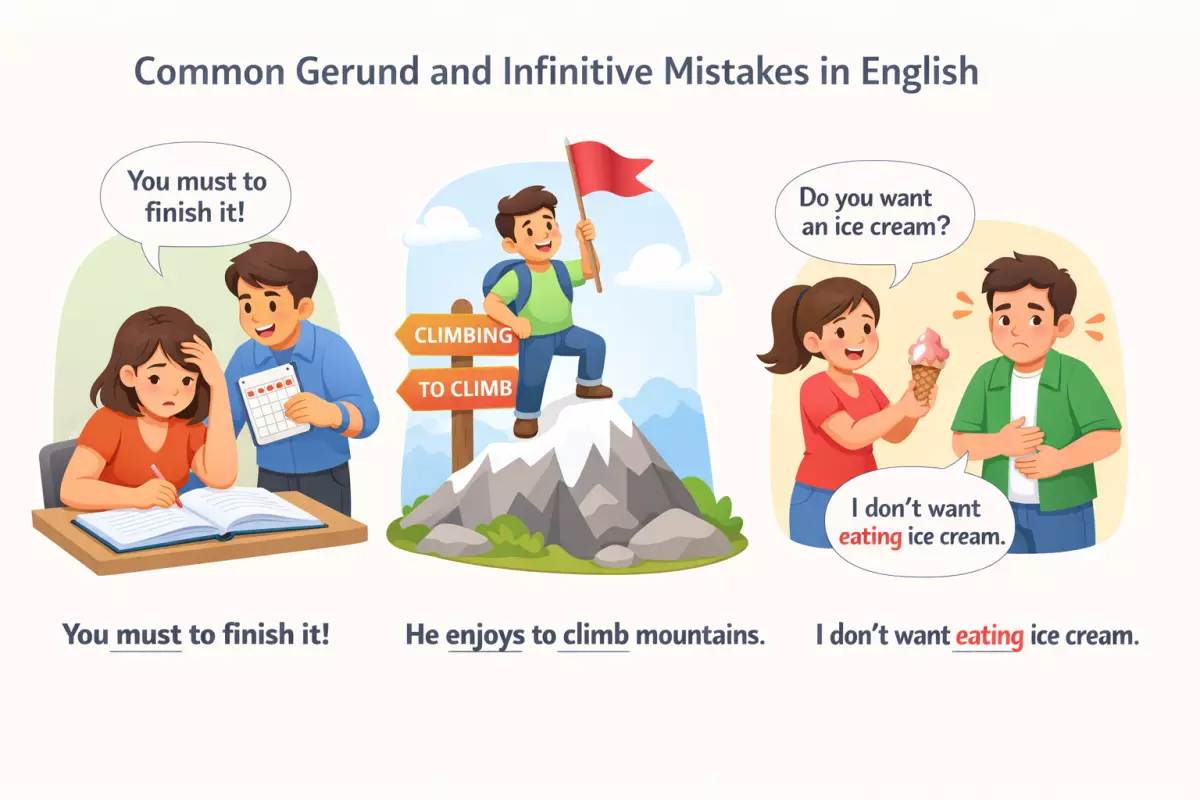 Learn why gerunds and infinitives get confused, especially with stop, remember, and try, and which wrong verb patterns show up in speech and writing. See how meaning changes with the wrong form, plus quick choosing tips, correct vs incorrect examples, and practice exercises to fix typical errors.
- Why learners often confuse gerunds and infinitives
- Frequent mistakes with verbs like stop, remember, and try
- Incorrect verb patterns commonly used in speech and writing
- How meaning changes when the wrong form is used
- Simple strategies for choosing the correct verb structure
- Examples comparing incorrect and correct sentences
- Practice exercises: correct typical gerund and infinitive errors
Many English learners struggle to choose between -ing forms and to plus a verb, and these small choices can make a sentence sound natural or awkward. In everyday speech, the right option depends on the main verb, the meaning you intend, and the context. This guide highlights common mistakes I hear in class and offers clear, practical tips to correct them quickly.
Why learners often confuse gerunds and infinitives
Choosing between -ing forms and to + base verb is difficult because both can act like nouns, both can follow many common verbs, and small changes in form can change meaning. Learners often expect one simple rule, but English relies on verb-specific patterns, fixed expressions, and subtle differences in emphasis.
Common sources of confusion
- Both forms can function as a subject or object. “Swimming is fun” and “To swim is fun” are both possible, but they sound different in everyday use.
- Many verbs allow only one pattern. Some verbs typically take a gerund (enjoy doing), while others take an infinitive (decide to do). Memorizing “one-size-fits-all” rules leads to errors.
- Some verbs allow both forms but with a meaning change. The form is not just grammar; it can signal a different time reference or intention.
- L1 transfer (first-language influence). In many languages, the equivalent structure uses one form consistently, so learners overuse either the infinitive or the -ing form in English.
- “To” is confusing because it has two jobs. It can be part of an infinitive (“to eat”) or a preposition (“look forward to”), and prepositions are usually followed by -ing.
- Prepositions trigger -ing, even when it doesn’t look like a preposition. Phrases like “be used to,” “object to,” and “be committed to” often mislead learners into using an infinitive.
- Adjective + infinitive patterns feel similar to verb patterns. “It’s easy to forget” is natural, but learners may incorrectly copy that after verbs (“I enjoy to forget” ❌).
- Spoken English favors certain choices. Infinitive subjects (“To understand this is important”) are grammatical but less common than “It’s important to understand this,” which affects what sounds “right.”
- Confusion between purpose and activity. Infinitives often express purpose (“I went to buy milk”), while -ing often names an activity (“Buying milk takes time”).
- Negative forms add another layer. “Not to do” vs “not doing” depends on the same pattern rules, so uncertainty doubles when negation is added.
- Passive and perfect forms exist in both systems. “To be done / to have done” and “being done / having done” can appear in advanced writing and increase the decision load.
- Textbook lists rarely match real frequency. Learners may study uncommon verbs while missing high-frequency patterns like “spend time doing,” “want to,” and “good at doing.”
High-impact pattern traps to watch
- Verb + preposition + -ing: “insist on doing,” “apologize for doing,” “think about doing,” “succeed in doing.”
- Adjective + preposition + -ing: “good at doing,” “interested in doing,” “afraid of doing,” “tired of doing.”
- Fixed phrase “look forward to” + -ing: “I look forward to meeting you” (not “to meet”).
- “Used to” vs “be used to”: “I used to walk” (past habit) vs “I’m used to walking” (accustomed).
- Purpose infinitive: “I’m calling to confirm” → the action is the goal of calling.
- After modal verbs, use base verb (not gerund/infinitive): “can go,” “should study,” not “can to go” or “should studying.”
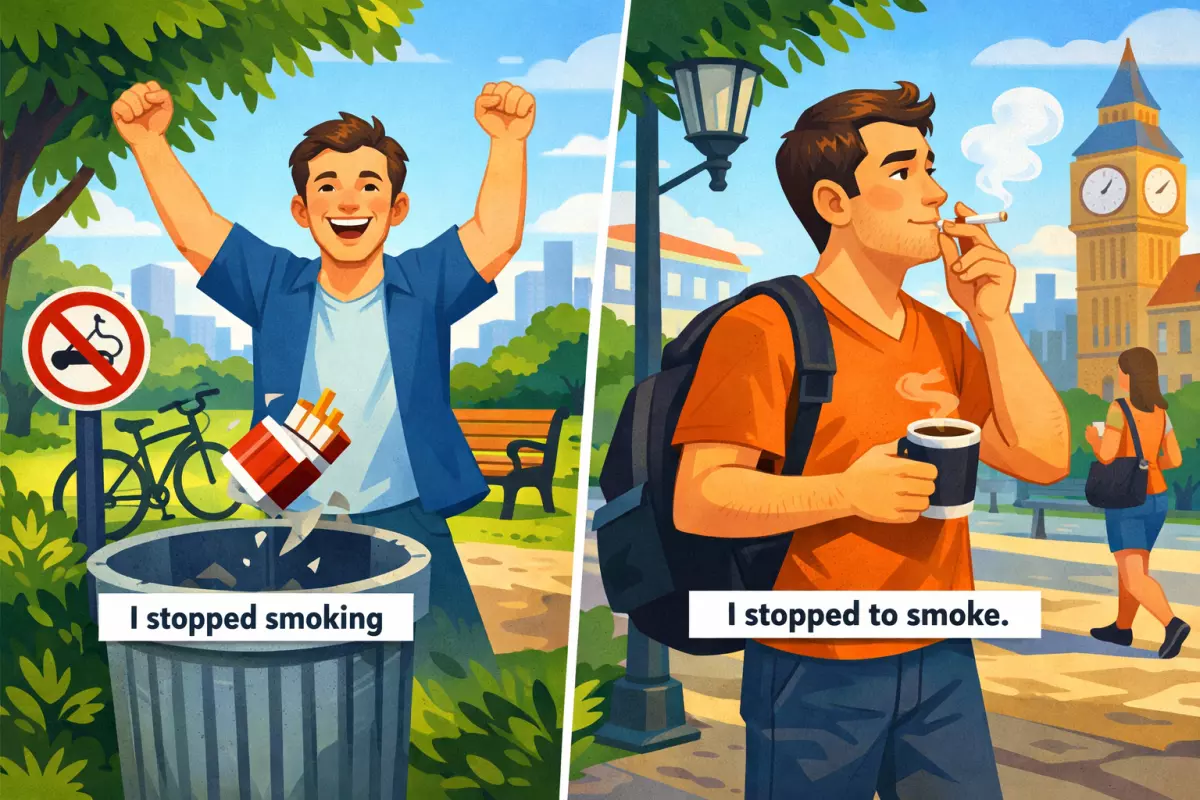
- “Stop” meaning changes: “stop smoking” (quit) vs “stop to smoke” (pause another activity in order to smoke).
- “Remember/forget” time reference shifts: “remember to lock” (future duty) vs “remember locking” (memory of past action).
- “Try” meaning changes: “try to solve” (attempt) vs “try solving” (experiment with a method).
- “Need” can switch structure: “need to clean” vs “needs cleaning” (same idea, different grammar).
- “Help” allows both in many cases: “help do” / “help to do,” which makes learners assume all verbs behave this way.
- Reporting preferences: “prefer doing” and “prefer to do” are both possible, but the sentence structure around them differs (“prefer doing X to doing Y” vs “prefer to do X rather than do Y”).
These patterns explain why mistakes persist: the choice is often determined by the specific word before it (a verb, adjective, or preposition), and a small form change can signal purpose, time, or intention. Building accuracy usually comes from learning verbs and expressions in chunks (for example, “admit doing,” “decide to do,” “look forward to doing”) rather than trying to apply one universal rule.
Frequent mistakes with verbs like stop, remember, and try
Some common English verbs change meaning depending on whether they are followed by a gerund (-ing) or an infinitive (to + base verb). The most frequent errors happen when learners choose the form that matches their first language, rather than the meaning they intend.
Stop: “end an activity” vs “pause in order to do something”
- stop + -ing = end the activity: ✅ I stopped smoking. → (I quit.) ❌ I stopped to smoke. (This means you paused another activity so you could smoke.)
- stop + to + verb = pause another action in order to do something: ✅ We stopped to get coffee. → (We were traveling; we paused.) ❌ We stopped getting coffee. (This means you no longer get coffee.)
- Typical mix-up with work/study: ✅ She stopped working at 6. ❌ She stopped to work at 6. (This suggests she paused something else so she could work.)
- With “talk”: ✅ He stopped talking. (He became quiet.) ✅ He stopped to talk to a friend. (He paused walking/running.)
Remember: “memory before” vs “memory after”
- remember + -ing = recall a past experience: ✅ I remember meeting her at a conference. ❌ I remember to meet her at a conference. (This sounds like a planned task, not a memory.)
- remember + to + verb = not forget to do a task (often future or scheduled): ✅ Remember to lock the door. ❌ Remember locking the door. (This asks someone to recall it, not to do it.)
- Common email/office mistake: ✅ Please remember to attach the file. ❌ Please remember attaching the file. (This implies the attaching already happened.)
- With “pay”: ✅ I remembered to pay the bill. (I didn’t forget.) ✅ I remember paying the bill. (I recall doing it.)
- Test-yourself question: if you can add “don’t forget,” you usually need to + verb; if you can add “I have a memory of,” you usually need -ing.
Try: “experiment” vs “attempt and maybe fail”
- try + -ing = experiment with a method (a suggestion): ✅ Try restarting your computer. ❌ Try to restart your computer. (This can sound like an effort that may be difficult or unsuccessful.)
- try + to + verb = attempt to do something (effort-focused): ✅ I tried to lift the box, but it was too heavy. ❌ I tried lifting the box, but it was too heavy. (This sounds more like “I experimented with lifting” rather than “I attempted and failed.”)
- Advice vs effort: ✅ Try taking the earlier train. (See if it helps.) ✅ I tried to take the earlier train, but it was cancelled. (I attempted; circumstances prevented it.)
- With “learn”: ✅ Try learning a few phrases first. (Experiment with this approach.) ✅ I tried to learn Japanese, but I gave up. (Attempt over time.)
- With “call”: ✅ Try calling him after lunch. (Suggestion.) ✅ I tried to call him, but he didn’t answer. (Attempt.)
Quick meaning checks that prevent most errors
- If the verb after stop is the activity that ends, use -ing; if it is the purpose of stopping, use to + verb.
- If remember refers to a duty or reminder, use to + verb; if it refers to a past event you can “replay” in your mind, use -ing.
- If try means “test a method,” use -ing; if it means “make an effort to achieve something,” use to + verb.
- When a sentence feels ambiguous, add a short clarifier: “so I could…” (purpose), “I didn’t forget…” (duty), or “as an experiment…” (method). The correct form usually becomes obvious.
Incorrect verb patterns commonly used in speech and writing
Many errors with gerunds and infinitives come from using the wrong verb pattern after a common verb, adjective, or fixed expression. Some verbs typically take to + infinitive, others take an -ing form, and a smaller group can take both with a change (or no change) in meaning. The patterns below highlight frequent mix-ups and show a natural correction.
Frequent pattern mix-ups (wrong form → natural form)
- ❌ I suggest to go. → ✅ I suggest going.
- ❌ She recommend to try it. → ✅ She recommends trying it.
- ❌ They avoid to talk about it. → ✅ They avoid talking about it.
- ❌ He admitted to steal the money. → ✅ He admitted stealing the money.
- ❌ We consider to move. → ✅ We consider moving.
- ❌ I miss to see you. → ✅ I miss seeing you.
- ❌ She finished to write the report. → ✅ She finished writing the report.
- ❌ He kept to ask the same question. → ✅ He kept asking the same question.
- ❌ I can’t stand to wait in lines. → ✅ I can’t stand waiting in lines.
- ❌ She postponed to meet us. → ✅ She postponed meeting us.
- ❌ He risked to lose his job. → ✅ He risked losing his job.
- ❌ They denied to break the rules. → ✅ They denied breaking the rules.
- ❌ I expect seeing him tomorrow. → ✅ I expect to see him tomorrow.
- ❌ She decided going alone. → ✅ She decided to go alone.
- ❌ We hope finding a solution soon. → ✅ We hope to find a solution soon.
- ❌ He agreed helping us. → ✅ He agreed to help us.
- ❌ I refused paying. → ✅ I refused to pay.
- ❌ They managed finishing on time. → ✅ They managed to finish on time.
Patterns that cause “double mistakes”
Some structures trigger two problems at once: the wrong verb form and the wrong grammar around it. Watch for these especially in fast speech.
- Preposition + verb: After a preposition, use an -ing form (not an infinitive).
❌ I’m interested to learn more. → ✅ I’m interested in learning more. - Object + infinitive: Some verbs need an object before the infinitive.
❌ She told to wait. → ✅ She told me to wait. - Make/let + bare infinitive: Use the base verb without “to.”
❌ He made me to apologize. → ✅ He made me apologize. - Help + (to) infinitive: Both forms are common, but keep the verb as an infinitive, not -ing.
❌ Can you help me doing this? → ✅ Can you help me (to) do this?
Verbs that allow both forms but change meaning
Another source of errors is assuming that -ing and to + infinitive mean the same thing. With the verbs below, the choice changes the message.
- Stop: ✅ stop smoking (quit the activity) vs. stop to smoke (pause another activity in order to smoke).
- Remember: ✅ remember locking the door (memory of a past action) vs. remember to lock the door (don’t forget a future duty).
- Forget: ✅ forget meeting him (memory disappears) vs. forget to meet him (fail to do it).
- Try: ✅ try calling her (experiment) vs. try to call her (attempt, may not succeed).
- Regret: ✅ regret saying it (feel sorry about a past action) vs. regret to say (formal: announce bad news).
When you are unsure, check what comes immediately after the verb: a preposition usually signals an -ing form, while many “plan/decision” verbs prefer to + infinitive. Building a small personal list of the verbs you use most often helps prevent these recurring gerund and infinitive mistakes.
How meaning changes when the wrong form is used

Choosing a gerund (-ing) or an infinitive (to + verb) is not only a grammar choice; it can change the time reference, the speaker’s intention, or even the basic meaning. Some verbs allow both forms but with different patterns, so using the “wrong” one can make your sentence sound confusing or give an unintended message.
Verbs where the form changes the meaning
| Verb | Gerund (-ing): typical meaning | Infinitive (to + verb): typical meaning | Examples (contrast) |
|---|---|---|---|
| remember | Memory of a past action | Not forget to do a future action | ✅ I remember locking the door. / ✅ Remember to lock the door. |
| forget | Forget a past experience/action | Fail to do a required action | ✅ I’ll never forget meeting her. / ✅ I forgot to call you. |
| stop | Quit an activity | Pause one action in order to do another | ✅ He stopped smoking. / ✅ He stopped to smoke. |
| try | Experiment: see what happens | Make an effort: attempt to achieve a goal | ✅ Try restarting the router. / ✅ Try to restart the router. |
| regret | Feel sorry about a past action | Formal: be sorry to give bad news | ✅ I regret saying that. / ✅ We regret to inform you… |
| mean | Involve or require | Intend to do something | ✅ This job means working weekends. / ✅ I mean to call you. |
| go on | Continue the same action | Move on to the next action/topic | ✅ She went on talking. / ✅ She went on to explain the plan. |
| need | Passive meaning (common in informal BrE) | Active meaning: someone must do it | ✅ The car needs washing. / ✅ The car needs to be washed. |
Common meaning shifts to watch for
- Past vs. future focus: With verbs like remember and forget, the gerund often looks back, while the infinitive points to something you must do later.
- Stopping an activity vs. stopping in order to do something: stop + -ing usually means “quit,” but stop + to usually means “pause one action to do another.”
- Experimenting vs. attempting: try + -ing suggests testing a possible solution; try + to emphasizes effort and difficulty.
- Formal announcements: regret + to is common in official messages; regret + -ing is the everyday way to express remorse.
- Requirement vs. intention: mean + -ing often explains what something involves; mean + to expresses what someone planned to do.
- Continuing vs. moving to the next step: go on + -ing continues; go on + to introduces the next action or point.
- Hidden passive meaning: In “needs washing,” the subject receives the action (it needs to be washed), which can surprise learners who expect an active meaning.
Quick checks before you choose -ing or to
- Ask: “Am I talking about a real past event?” If yes, a gerund may be the natural choice (for verbs like remember/forget).
- Ask: “Is this an obligation or a reminder?” If yes, an infinitive is often the intended form (for remember to, forget to).
- Ask: “Did the action end, or did it pause for another purpose?” Ended → stop + -ing; paused for a purpose → stop + to.
- Ask: “Am I suggesting a method?” Method → try + -ing; effort/attempt → try + to.
- When a sentence sounds illogical (for example, “I stopped to smoke” when you mean quitting), re-check whether the form is signaling a different intention.
Simple strategies for choosing the correct verb structure
Choose between a gerund (-ing) and an infinitive (to + base verb) by focusing on the verb that comes before it and the meaning you want. Many errors happen when learners pick a form based on “what sounds right” instead of a reliable pattern.
Practical checks you can apply quickly
- Check the main verb’s pattern first. Some verbs are followed by only a gerund, some by only an infinitive, and some allow both (sometimes with a meaning change).
- Use the “plan vs. experience” test. If the second verb refers to an intention, goal, or future action, an infinitive is common (e.g., “decide to leave”). If it refers to an activity or experience, a gerund is common (e.g., “enjoy swimming”).
- Look for prepositions. After a preposition, use a gerund: “interested in learning,” “good at explaining,” “before leaving.” (The word to can be tricky because it is sometimes a preposition, not an infinitive marker.)
- Spot “to” as a preposition. In phrases like “look forward to,” “be used to,” and “object to,” the word “to” is a preposition, so it must be followed by -ing:
- ❌ “I look forward to meet you.” → ✅ “I look forward to meeting you.”
- ❌ “She is used to work late.” → ✅ “She is used to working late.”
- Use the “it + adjective” frame for infinitives. When a sentence starts with “It is …,” the next verb is often an infinitive: “It’s important to read carefully,” “It was nice to meet you.”
- After modal verbs, use the base form (not to + verb, not -ing). “can go,” “should study,” “might be.” This prevents mix-ups like “can to go” or “should going.”
- After “make/let/help,” use the base form (common pattern). “make me laugh,” “let her leave,” “help him carry” (also possible: “help him to carry” in some varieties).
- Use gerunds as nouns. If the verb form is acting as the subject or object like a noun, -ing is often the natural choice: “Swimming is relaxing,” “I like reading.”
- Watch for meaning changes with “try,” “remember,” “stop.” If the choice changes the meaning, pick the form that matches your message (see the examples below).
High-frequency verb groups to memorize (with examples)
- Gerund after these common verbs: avoid, consider, enjoy, finish, keep, mind, miss, practice, recommend, suggest
- ✅ “They recommended taking the earlier train.”
- ❌ “They recommended to take the earlier train.”
- Infinitive after these common verbs: agree, decide, hope, learn, need, offer, plan, promise, refuse, want
- ✅ “We decided to postpone the meeting.”
- ❌ “We decided postponing the meeting.”
- Verb + object + infinitive: advise, allow, ask, encourage, expect, invite, order, remind, teach, tell, want
- ✅ “She reminded him to call.”
- ❌ “She reminded him calling.”
- Verb + gerund or infinitive (often with a meaning change): remember, forget, stop, try, regret
- ✅ “Remember to lock the door.” (don’t forget the action)
- ✅ “I remember locking the door.” (memory of a past action)
- ✅ “He stopped smoking.” (quit the habit)
- ✅ “He stopped to smoke.” (paused another activity in order to smoke)
- ✅ “Try to restart the computer.” (attempt)
- ✅ “Try restarting the computer.” (experiment with a method)
Preposition patterns that prevent common mistakes
- Adjective + preposition + -ing: afraid of flying, interested in learning, good at explaining, tired of waiting
- Noun + preposition + -ing: a reason for leaving, a method of solving, an advantage of working remotely
- Verb + preposition + -ing: insist on paying, apologize for being late, think about moving, succeed in finding
- Fixed expressions with “to” + -ing: look forward to meeting, be committed to improving, be opposed to changing, get used to waking up early
A quick self-edit routine
- Underline the first verb (the one that controls the structure) and check whether it normally takes -ing, to + verb, or an object + to + verb.
- Circle any prepositions (in, on, at, for, of, about, to). If a verb follows a preposition, change it to -ing.
- Confirm the meaning when both forms are possible (especially with remember/forget/stop/try/regret).
- Fix common “double markers.” Remove extra “to” or extra -ing:
- ❌ “I want to going.” → ✅ “I want to go.”
- ❌ “I enjoy to read.” → ✅ “I enjoy reading.”
Examples comparing incorrect and correct sentences
These pairs show where learners often choose the wrong verb form and how to fix it. Watch for patterns: some verbs are followed by a gerund (-ing), others by an infinitive (to + base verb), and a few change meaning depending on which form you use.
| Incorrect | Correct | What to notice |
|---|---|---|
| ❌ I enjoy to swim. | ✅ I enjoy swimming. | Enjoy is followed by a gerund. |
| ❌ She decided going home early. | ✅ She decided to go home early. | Decide is followed by an infinitive. |
| ❌ They suggested to take a taxi. | ✅ They suggested taking a taxi. | Suggest takes a gerund (or a that-clause). |
| ❌ He promised finishing the report. | ✅ He promised to finish the report. | Promise is followed by an infinitive. |
| ❌ I can’t afford buying a new phone. | ✅ I can’t afford to buy a new phone. | Afford is typically followed by an infinitive. |
| ❌ We avoided to talk about it. | ✅ We avoided talking about it. | Avoid is followed by a gerund. |
| ❌ Do you mind to open the window? | ✅ Do you mind opening the window? | Mind is followed by a gerund. |
| ❌ She agreed helping us. | ✅ She agreed to help us. | Agree is followed by an infinitive. |
| ❌ He refused giving me the key. | ✅ He refused to give me the key. | Refuse is followed by an infinitive. |
| ❌ I’m looking forward to meet you. | ✅ I’m looking forward to meeting you. | Look forward to: the “to” is a preposition, so use -ing. |
| ❌ She insisted to pay for dinner. | ✅ She insisted on paying for dinner. | Insist on takes a gerund. |
| ❌ He’s good to play chess. | ✅ He’s good at playing chess. | Good at + gerund is the usual pattern. |
| ❌ I spent two hours to study. | ✅ I spent two hours studying. | Spend time + gerund is standard. |
| ❌ It’s worth to try. | ✅ It’s worth trying. | Worth is followed by a gerund. |
| ❌ I want that you to come. | ✅ I want you to come. | Want can take an object + infinitive (want someone to do). |
| ❌ She made me to apologize. | ✅ She made me apologize. | Make + object uses the bare infinitive (no “to”). |
| ❌ I let him to borrow my car. | ✅ I let him borrow my car. | Let + object uses the bare infinitive. |
| ❌ I stopped to smoke last year. (meaning: I quit) | ✅ I stopped smoking last year. | Stop + -ing means quit an activity; stop + to means pause in order to do something else. |
| ❌ I remembered to lock the door. (meaning: I have a memory of it) | ✅ I remember locking the door. | Remember + -ing = recall a past action; remember + to = not forget to do it. |
Quick pattern reminders
- If the verb expresses a preference or enjoyment, it often takes -ing (enjoy, avoid, mind).
- If the verb expresses a decision, plan, or promise, it commonly takes to + base verb (decide, agree, promise, refuse).
- After a preposition, use -ing: interested in learning, good at speaking, look forward to meeting.
- Some verbs change meaning depending on the form (stop, remember, forget, try). Check whether the sentence refers to a past memory or a purpose.
Practice exercises: correct typical gerund and infinitive errors
Correct each sentence by choosing the natural form (gerund, infinitive, or a different structure). Focus on the verb pattern after the main verb, adjective, or preposition, and watch for small changes in meaning with verbs like stop, remember, and try.
Exercise 1: Fix the verb form
Rewrite each sentence so it is grammatically correct and natural.
- I suggested to go earlier to avoid traffic.
- She insisted to pay for dinner.
- They enjoyed to swim in the lake.
- He admitted to break the window.
- We decided going by train instead of driving.
- Do you mind to open the window?
- He avoided to answer my question.
- She promised calling me after work.
- I’m looking forward to meet your team.
- He’s good in fixing bikes.
- Thank you to help me yesterday.
- It’s no use to complain about it now.
Show answers
- I suggested going earlier to avoid traffic.
- She insisted on paying for dinner.
- They enjoyed swimming in the lake.
- He admitted breaking the window.
- We decided to go by train instead of driving.
- Do you mind opening the window?
- He avoided answering my question.
- She promised to call me after work.
- I’m looking forward to meeting your team.
- He’s good at fixing bikes.
- Thank you for helping me yesterday.
- It’s no use complaining about it now.
Exercise 2: Choose the meaning (stop / remember / try)
Each item is incorrect or unclear. Correct it so the meaning in brackets is expressed.
- He stopped to smoke. (He quit the habit.)
- He stopped smoking to answer the phone. (He paused an activity.)
- Remember to lock the door last night. (Memory of a past action.)
- I remember meeting her tomorrow. (A planned action.)
- Try to restart the router if the internet is down. (Experiment: see if it helps.)
- Try turning down the music to be polite. (Make an effort; difficult but necessary.)
- Don’t forget calling me. (A future task.)
- I’ll never forget to see that view for the first time. (A past experience.)
Show answers
- He stopped smoking.
- He stopped smoking to answer the phone.
- Remember locking the door last night.
- I remember to meet her tomorrow. (More natural: I have to meet her tomorrow.)
- Try restarting the router if the internet is down.
- Try to turn down the music to be polite.
- Don’t forget to call me.
- I’ll never forget seeing that view for the first time.
Exercise 3: Prepositions and fixed patterns
Many mistakes happen after prepositions (which take a gerund) and in set phrases. Correct each sentence.
- She apologized to be late.
- They’re interested to invest in the project.
- I’m used to work at night.
- He insisted to speaking to the manager.
- We talked about to move abroad.
- He left without to say goodbye.
- There’s no point to argue.
- She succeeded to get the job after three interviews.
- I’m thinking to buy a new laptop.
- They prevented us to enter the building.
Show answers
- She apologized for being late.
- They’re interested in investing in the project.
- I’m used to working at night.
- He insisted on speaking to the manager.
- We talked about moving abroad.
- He left without saying goodbye.
- There’s no point arguing.
- She succeeded in getting the job after three interviews.
- I’m thinking of buying a new laptop.
- They prevented us from entering the building.
Quick pattern reminders (use while checking your corrections)
- After a preposition, use a gerund: ✅ interested in learning, ❌ interested in learn.
- Suggest, recommend, avoid, enjoy, finish, consider typically take a gerund.
- Decide, promise, hope, plan, agree, refuse typically take an infinitive.
- Insist is usually followed by on + gerund: ✅ insisted on paying.
- Mind is followed by a gerund: ✅ mind waiting.
- Stop + gerund → quit an activity; stop + to-infinitive → pause in order to do something else.
- Remember/forget + gerund → memory of the past; remember/forget + to-infinitive → a duty or task.
- Try + gerund → experiment; try + to-infinitive → effort (often difficult).