How Modal Verbs Work in English Sentence Structure

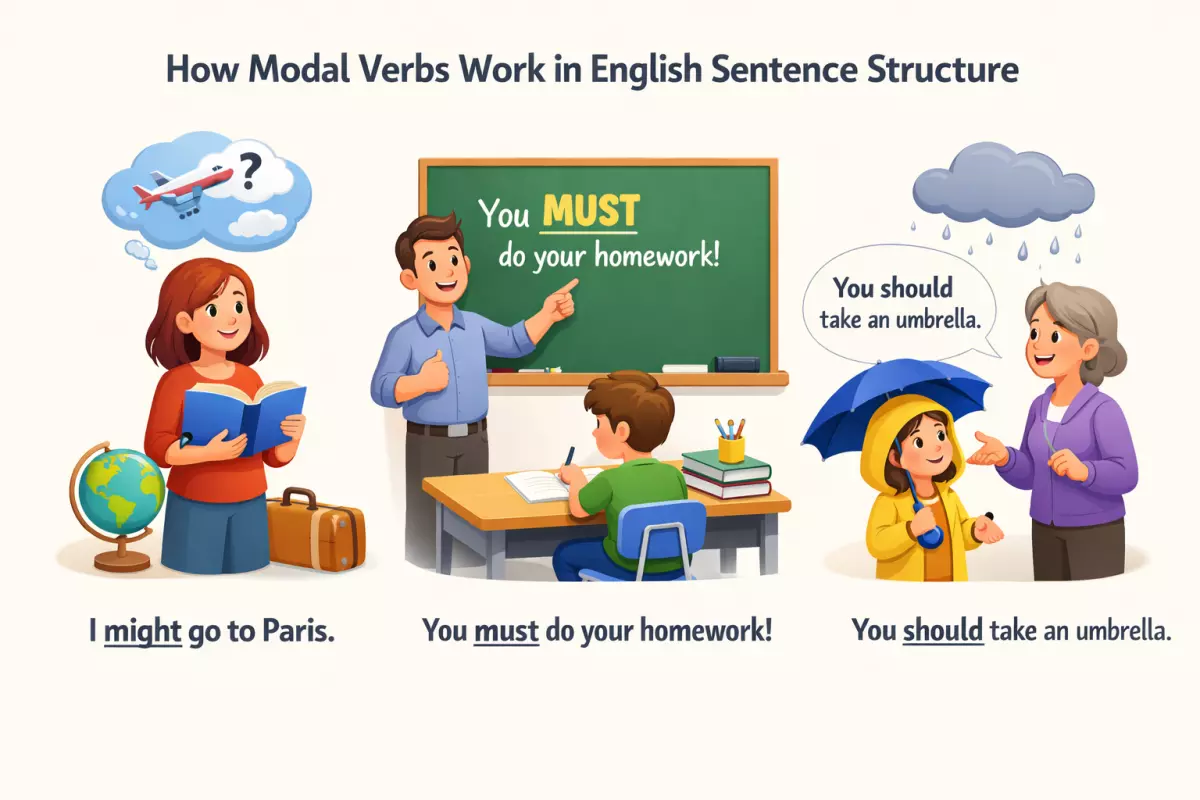 This article explains where modal verbs go in English and why they come before the main verb. It covers the subject plus modal plus base verb pattern, forming questions without do, making negatives with not, placing adverbs and time phrases, how modals change tone, and practice exercises.
- Where modal verbs appear in an English sentence and why they come before the main verb
- The core modal structure: subject plus modal plus base verb
- How modal verbs form questions without the auxiliary do
- How negative sentences are created using modal verbs and not
- How modal verbs interact with adverbs and time expressions
- How different modal verbs change the tone and meaning of a sentence
- Practice exercises on building sentences with modal verbs
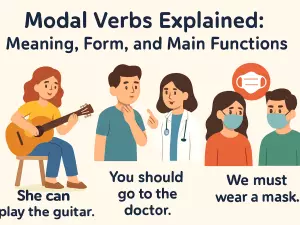
Helping verbs like can, must, and might often determine whether a sentence sounds polite, confident, or uncertain. Placed before the main verb, they shift meaning to show ability, permission, advice, obligation, or possibility. In everyday speaking and writing, picking the right one helps you communicate clearly and naturally without adding extra words.
Where modal verbs appear in an English sentence and why they come before the main verb
In standard English word order, a modal verb sits in the verb phrase before the main verb. This position signals that the speaker is adding meaning such as possibility, ability, permission, advice, or necessity, while the main verb keeps the core action.
The basic placement pattern
Modals are part of the auxiliary (helping) verb system. They appear after the subject and before the base form of the main verb.
- Core pattern: Subject + modal + base verb (+ rest of sentence)
- She can swim.
- They might arrive late.
- You should call your manager.
- We must leave now.
Why the modal comes before the main verb
The modal’s job is to “modify” the main verb by adding stance (certainty, obligation, willingness, etc.). English expresses that stance in a fixed slot: the auxiliary position. Putting the modal first makes it easy to form negatives, questions, and short answers consistently.
- It marks meaning early: The listener learns the speaker’s attitude (can/must/might) before the action.
- It follows auxiliary rules: Modals behave like auxiliaries, so they take the auxiliary position in the verb phrase.
- It keeps the main verb simple: After a modal, the main verb stays in the base form (no -s, no -ed, no -ing).
- It supports quick grammar operations: Negation and inversion attach to the modal rather than changing the main verb.
What form the main verb takes after a modal
After a true modal (can, could, may, might, must, shall, should, will, would), the next verb is the base form. This is one of the strongest clues that a word is functioning as a modal.
- ✅ She can drive. → not “can drives”
- ✅ He should study tonight.
- ✅ I might go later.
- ❌ She can drives.
- ❌ He should studies tonight.
How modals behave in negatives
In negative statements, not comes after the modal (or is contracted with it). The main verb still stays in the base form.
- I cannot wait. / I can’t wait.
- She should not sign that document.
- We might not finish on time.
- They won’t agree.
- You mustn’t touch that.
How modals behave in questions
In questions, the modal usually moves in front of the subject (auxiliary inversion). This is another reason modals are placed before the main verb: the modal is the element that flips position to form a question.
- Can you help me?
- Should we start now?
- Will they be here soon?
- Would you like some tea?
- May I come in?
Modals with other auxiliaries (perfect, continuous, passive)
A modal can come before other auxiliary verbs to build more complex meanings. The modal still comes first, then the auxiliary chain follows in a set order.
- Modal + be + -ing (continuous): She may be working right now.
- Modal + have + past participle (perfect): They must have forgotten.
- Modal + be + past participle (passive): The form should be submitted today.
- Modal + have been + -ing: He might have been waiting for hours.
- Modal + have been + past participle: It could have been stolen.
Common placement errors to avoid
- Don’t put a modal after the main verb: ❌ “She goes can” → ✅ “She can go.”
- Don’t add verb endings after a modal: ❌ “He can runs” → ✅ “He can run.”
- Don’t stack two true modals together: ❌ “You must can leave” → ✅ “You must leave” or “You can leave.”
- Don’t use do-support with a modal: ❌ “Do you can swim?” → ✅ “Can you swim?”
The core modal structure: subject plus modal plus base verb
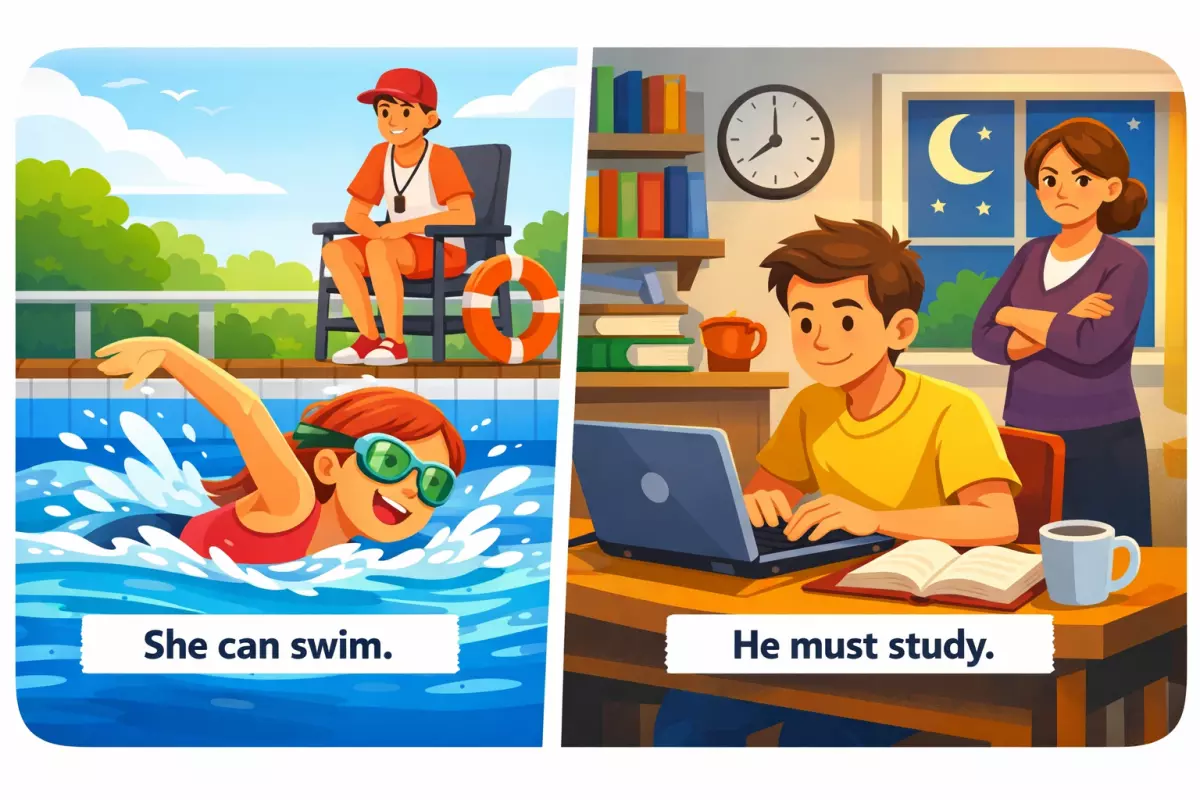
In English, a modal verb sits between the subject and the main verb to add meanings like ability, permission, advice, obligation, or possibility. The main verb that follows stays in its base form (the dictionary form), not a tense form.
Basic pattern and what “base verb” means
The most common frame is:
- Subject + modal + base verb → She can swim.
- The base verb is the plain form: go, see, work, be, have, do (not goes, went, working).
- Modals do not take -s in the third person singular: ✅ He must leave. ❌ He musts leave.
- After a modal, do not use to: ✅ They can help. ❌ They can to help.
Common modals used in this structure
- can (ability/permission): I can drive.
- could (past ability/polite possibility): We could try again.
- may (permission/possibility): You may enter.
- might (weaker possibility): It might rain.
- must (strong obligation/strong conclusion): You must wear a helmet.
- should (advice/expectation): You should rest.
- shall (formal offers/future in some varieties): Shall we begin?
- will (future/volition): She will call later.
- would (polite requests/hypotheticals): Would you wait?
Negatives and questions keep the base verb
Negation is formed by adding not after the modal (often contracted). Questions are formed by moving the modal before the subject. The main verb still stays in base form.
- Negative: ✅ He cannot swim. / He can’t swim.
- Negative: ✅ You should not worry. / You shouldn’t worry.
- Question: ✅ Can she swim?
- Question: ✅ Should we leave now?
- Question + negative: ✅ Can’t they come?
Frequent learner errors to avoid
- Using a tense form after a modal: ❌ She can swims. → ✅ She can swim.
- Adding to after a modal: ❌ We must to go. → ✅ We must go.
- Doubling modals: ❌ He will can help. → ✅ He will be able to help.
- Using do/does to form questions with modals: ❌ Do you can drive? → ✅ Can you drive?
- Forgetting that the modal carries tense/attitude, not the main verb: ✅ She might arrive late. (not arrives)
Example set (same structure, different meanings)
- I can stay. (ability/permission)
- She could win. (possibility)
- They may leave early. (permission)
- It might snow tonight. (uncertainty)
- You must stop here. (obligation)
- He should apologize. (advice)
- We will meet tomorrow. (future plan)
- She would help if asked. (hypothetical)
- Shall I open the window? (offer)
- Can you explain this? (request)
- Should I call now? (seeking advice)
- Must we sign today? (checking necessity)
How modal verbs form questions without the auxiliary do
When a modal verb is present, it usually acts as the auxiliary for question formation. Instead of adding do/does/did, you invert the modal and the subject. The main verb stays in its base form (bare infinitive) after the modal.
Core pattern: modal–subject inversion
The basic structure is:
- Modal + subject + base verb → Can you help?
- Modal + subject + not + base verb (or contracted) → Should we not wait? / Shouldn’t we wait?
- Wh-word + modal + subject + base verb → Where can they park?
Examples across common modals (yes/no and wh- questions)
- Can you open the window?
- Could she join us later?
- May I leave early?
- Might they be delayed?
- Should we call a taxi?
- Must I show my ID?
- Will he be there on time?
- Would you explain that again?
- Shall we start now? (more formal / BrE)
- What can I do to help?
- Why should we change the plan?
- When will they arrive?
- Where could I find the receipt?
- How might this affect the results?
- Who would you invite?
Negatives: placement of not
With modals, not follows the modal, and the modal still inverts with the subject in questions.
- ✅ Can you not make noise? / Can’t you make noise? (meaning differs by context)
- ✅ Shouldn’t we check the address first?
- ✅ Why can’t they come?
- ❌ Do you can help?
- ❌ Does she should call?
Key usage notes (what to watch for)
- No do-support: If a true modal (can, could, may, might, must, shall, should, will, would) is in the clause, it carries the question structure by inversion.
- Base verb after the modal: Use the bare infinitive, not a tense-marked verb. ✅ Can he go? ❌ Can he goes?
- Modal + be / have: The modal still inverts, and be or have follows the subject. Example: Will you be ready? / Should we have left earlier?
- Short answers: Reply with the modal, not do. ✅ “Can you swim?” “Yes, I can.” ❌ “Yes, I do.”
- Tag questions: The tag repeats the modal. “You can drive, can’t you?” “She should call, shouldn’t she?”
How negative sentences are created using modal verbs and not
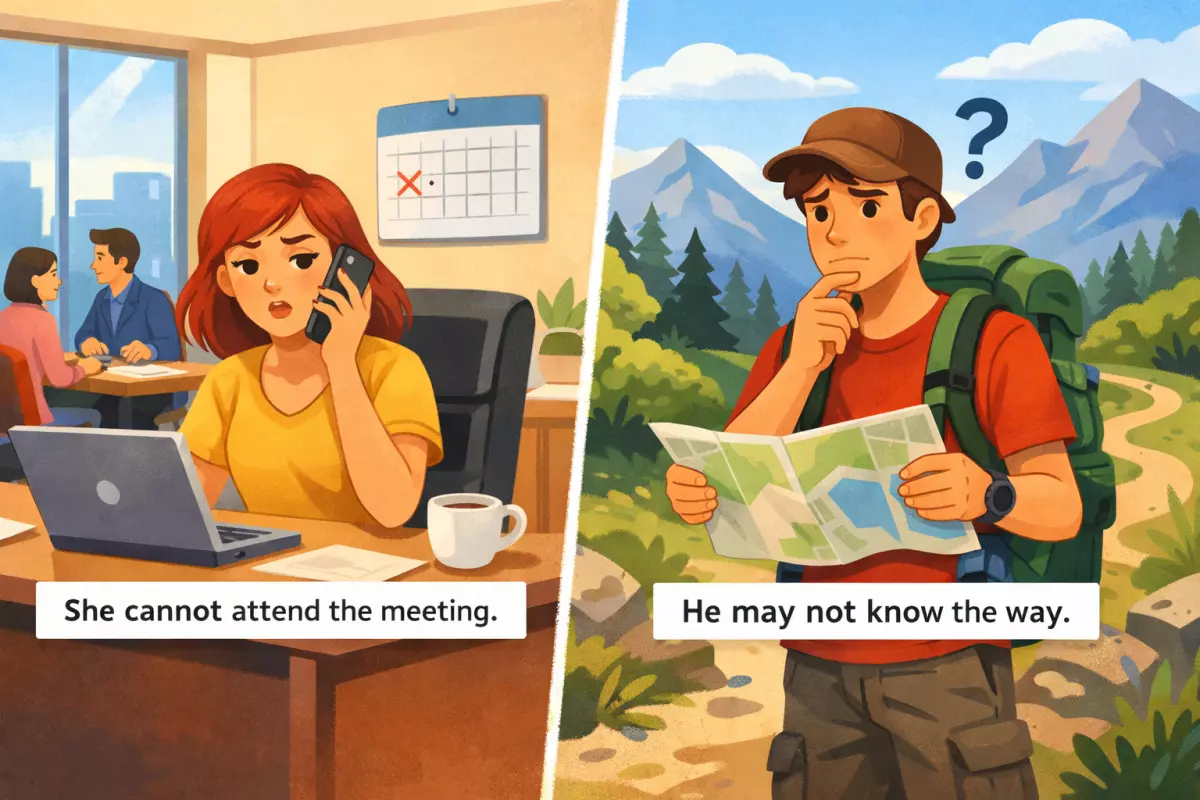
To make a negative statement with a modal verb, place not directly after the modal and before the base form of the main verb. Modals do not use do/does/did for negation, and the main verb stays in its plain form (no -s, no -ed, no infinitive to).
Core pattern
- Structure: Subject + modal + not + base verb (+ rest of sentence)
- Example: She cannot attend the meeting.
- Key rule: After a modal, use the base verb: “He may not know” (not “may not knows”).
Common negative forms (with examples)
- can + not → I cannot hear you clearly. (Also written as can’t.)
- could + not → We couldn’t find the address.
- may + not → You may not enter without a badge. (Often permission/prohibition.)
- might + not → They might not arrive on time.
- must + not → You must not touch the equipment. (Strong prohibition.)
- shall + not → The tenant shall not sublet the apartment. (Formal/legal.)
- should + not → You shouldn’t skip breakfast.
- will + not → I won’t be late.
- would + not → He wouldn’t answer my calls.
- ought + not + to → You ought not to speak like that. (More formal; less common.)
- need + not (modal-like) → You needn’t worry about it. (BrE; “don’t need to” is also common.)
- dare + not (modal-like) → She daren’t ask him. (BrE; “doesn’t dare” is also common.)
Contractions and spelling notes
- can’t, won’t, and shan’t are irregular contractions (especially won’t for “will not”).
- cannot is commonly written as one word in standard English; “can not” is usually reserved for emphasis on the choice (e.g., “I can not agree” meaning “I am able not to agree”).
- In formal writing, the full form (e.g., “will not”) is often preferred over contractions.
Meaning differences: “must not” vs. “don’t have to”
- ✅ You must not park here. → It is prohibited.
- ✅ You don’t have to park here. → It is not necessary (you are free to choose).
- ❌ You mustn’t come tomorrow. (This means “don’t come,” not “it’s optional.”)
Placement with adverbs and emphasis
- Keep not immediately after the modal: ✅ She may not fully understand.
- For emphasis, add stress words after the negative: He cannot possibly finish today.
- Avoid separating the modal and not with other words in standard word order.
How modal verbs interact with adverbs and time expressions
Adverbs and time expressions help place a modal meaning on a timeline and adjust how strong, frequent, or certain the speaker sounds. The most common pattern is that many adverbs sit between the modal and the main verb, while time phrases often appear at the beginning or end of the clause.
Common placement patterns
- Modal + adverb + base verb: “She can probably finish today.”
- Modal + not + adverb + base verb (often): “He can’t really help.”
- Modal + adverb + have + past participle: “They might already have left.”
- Fronted time expression + modal clause: “Tomorrow, we will meet at noon.”
- Modal clause + end-position time expression: “We should call later.”
- Adverb before the modal (less common; used for emphasis or style): “She probably will agree.”
- Frequency adverbs usually go between modal and main verb: “You should always check the address.”
Adverbs that commonly modify modal meaning
- Certainty/likelihood (often with may/might/could/should/must): “It might possibly rain.”
- Strength/softening: “You could just ask.” / “You must really stop.”
- Focus/limitation: “We can only stay an hour.”
- Expectation: “She should normally be here by nine.”
- Politeness/indirectness: “Could you possibly open the window?”
Time expressions and which modal forms they tend to trigger
- Future time (“tomorrow,” “next week,” “in an hour”) commonly pairs with will or be going to: “We will start next week.”
- Deadlines (“by Friday,” “before 6”) often pair with must/need to/should: “You must submit it by Friday.”
- Duration up to now (“for two hours,” “since Monday”) often pushes speakers toward modal + have + past participle for inference: “They might have been waiting since noon.”
- Already/yet frequently appear in perfect structures: “She may already have left.” / “They might not have arrived yet.”
- Just can signal recent time and fits well with perfect forms: “He could have just missed the bus.”
Expanded examples (correct vs. awkward/incorrect placement)
- ✅ “You should always back up your files.” → ❌ “You always should back up your files.” (possible, but unusual without emphasis)
- ✅ “She might still be sleeping.” → ❌ “She still might be sleeping.” (possible, but changes emphasis)
- ✅ “They could probably fix it today.” → ❌ “They could fix probably it today.”
- ✅ “He may already have seen the email.” → ❌ “He may have already seen the email.” (also correct; both placements are common)
- ✅ “We must leave now.” → ❌ “We must now leave.” (grammatical, but more formal and less natural in speech)
- ✅ “You can’t really park here.” → ❌ “You really can’t park here.” (correct, but stronger emphasis on “really”)
- ✅ “I should probably call later.” → ❌ “I probably should call later.” (correct; different emphasis)
- ✅ “By 5 p.m., we will have finished.” → ❌ “By 5 p.m., we will finished.”
- ✅ “She might have arrived yesterday.” → ❌ “She might arrived yesterday.”
- ✅ “They should be here soon.” → ❌ “They should here be soon.”
- ✅ “You must never share that password.” → ❌ “You never must share that password.”
- ✅ “He may not even know.” → ❌ “He may even not know.” (possible, but less natural)
When choosing placement, keep the core verb phrase together: the modal comes first, then optional negation, then short adverbs, then the main verb (or have + past participle for past-time meanings). Time expressions are flexible, but end position is the default unless you need to set the schedule or deadline upfront.
How different modal verbs change the tone and meaning of a sentence
Modal verbs don’t just add grammar; they shape how a message sounds—firm or tentative, polite or blunt, confident or cautious. Choosing one modal over another changes the relationship between speaker and listener (permission vs. obligation), and it can also change how likely something seems (certainty vs. possibility).
Common tone shifts by modal choice
- Can (ability, informal permission, practical possibility): often sounds direct and everyday.
Examples: “I can lift this.” / “Can I leave early?” / “It can get noisy here.” - Could (polite permission, weaker possibility, past ability): softens requests and reduces certainty.
Examples: “Could I ask a question?” / “It could rain later.” / “When I was younger, I could run fast.” - May (formal permission, possibility): more formal than can/could; can sound careful or official.
Examples: “May I come in?” / “We may need more time.” - Might (weaker possibility, cautious suggestion): signals low confidence or a gentle option.
Examples: “I might be late.” / “You might want to back up your files.” - Must (strong obligation, logical conclusion): sounds firm; can feel strict in rules, confident in deductions.
Examples: “You must wear a helmet.” / “She must be at work (her car is gone).” - Have to (external obligation): similar force to must, but often implies rules or circumstances rather than personal insistence.
Examples: “I have to submit this by Friday.” / “Do we have to sign in?” - Should (advice, expectation): less forceful than must; suggests the “best” choice or a norm.
Examples: “You should see a doctor.” / “The train should arrive at 6.” - Ought to (advice with moral/social pressure): close to should, but can sound slightly more formal or duty-based.
Examples: “You ought to apologize.” - Will (future, willingness, firm intention): can sound decisive; in offers it can sound helpful.
Examples: “I will call you tonight.” / “I’ll carry that for you.” - Would (polite requests, hypothetical meaning, habitual past): reduces pressure and adds distance from certainty.
Examples: “Would you open the window?” / “I would help if I could.” / “When we were kids, we would play outside.” - Shall (formal future, offers/suggestions in some varieties): can sound official or old-fashioned; in questions it frames suggestions.
Examples: “Shall we begin?” / “We shall return.” - Need (to) (necessity): can be strong but often sounds practical rather than authoritarian.
Examples: “You need to reset your password.” / “Do I need to bring ID?” - Be able to (ability with emphasis on circumstances): often chosen when timing or conditions matter.
Examples: “I’ll be able to join after 3.”
Patterns that commonly change politeness and force
- Permission: “Can I…?” (neutral) → “Could I…?” (more polite) → “May I…?” (more formal).
- Requests: “Can you…?” (direct) → “Could you…?” (softer) → “Would you…?” (polite, less pushy).
- Advice: “You should…” (recommendation) → “You might…” (gentle suggestion, optional).
- Rules/obligation: “You must…” (strict) vs. “You have to…” (rule/circumstance) vs. “You should…” (guidance).
- Certainty: “It must be…” (strong inference) vs. “It may/might be…” (uncertain).
- Negotiation and diplomacy: “We could…” often invites discussion; “We must…” signals a fixed requirement.
Example sets showing meaning changes with the same base sentence
- “You must submit the form today.” (requirement; little room to refuse)
- “You have to submit the form today.” (deadline/rule-driven necessity)
- “You should submit the form today.” (recommended; consequences implied but not absolute)
- “You could submit the form today.” (option; low pressure)
- “You might submit the form today.” (very tentative; can sound unclear unless context supports it)
- “Can you submit the form today?” (request; can sound brisk)
- “Could you submit the form today?” (polite request)
- “Would you submit the form today?” (polite, often used when asking a favor)
In practice, the best choice depends on two variables: (1) how much authority or certainty you want to express, and (2) how much you want to soften the impact for politeness. Modals let you adjust those two settings without changing the core message.
Practice exercises on building sentences with modal verbs
Build accurate sentences by focusing on three things: the modal + base verb pattern, the correct negative and question forms, and the meaning you intend (ability, permission, advice, obligation, probability). Complete the tasks below using natural English word order and punctuation.
1) Choose the best modal for the meaning
- You __________ park here after 6 p.m.; it’s free then. (permission)
- She __________ swim when she was five. (past ability)
- You __________ see a doctor if the pain continues. (advice)
- He __________ be at work already; it’s only 7 a.m. (low probability)
- We __________ submit the form by Friday, or the application won’t be processed. (strong obligation)
- They __________ be stuck in traffic; the highway is closed. (logical possibility)
- __________ I borrow your charger for a minute? (polite request)
- You __________ touch that wire; it’s dangerous. (prohibition)
- She __________ have left her phone at home; it’s not in her bag. (deduction about the past)
- I __________ help you tomorrow if I finish early. (future possibility)
- We __________ to speak quietly during the exam. (rule/obligation)
- He __________ not remember the password; try resetting it. (possibility)
Show answers
- can
- could
- should
- can’t
- must
- might
- Could
- mustn’t
- must have
- may / might
- have
- may / might
2) Fix the structure (word order and verb form)
Rewrite each sentence so it follows standard patterns. Keep the meaning the same.
- ❌ She can to drive at night.
- ❌ Do you can help me?
- ❌ He musts leave now.
- ❌ We don’t must be late.
- ❌ Might you to open the window?
- ❌ I should to call her.
- ❌ They can’t to enter without a badge.
- ❌ You must not to smoke here.
- ❌ She could sings well when she was younger.
- ❌ He may goes later.
Show answers
- ✅ She can drive at night.
- ✅ Can you help me?
- ✅ He must leave now.
- ✅ We mustn’t be late. / We don’t have to be late (changes meaning), so prefer: We mustn’t be late.
- ✅ Might you open the window?
- ✅ I should call her.
- ✅ They can’t enter without a badge.
- ✅ You must not smoke here. / You mustn’t smoke here.
- ✅ She could sing well when she was younger.
- ✅ He may go later.
3) Make negatives and questions correctly
Transform each prompt as directed. Use contractions where they sound natural.
- (Negative) You can park here.
- (Question) She should tell him the truth.
- (Negative) They might arrive today.
- (Question) We must finish by noon.
- (Negative) I have to attend the meeting.
- (Question) He may use my laptop.
- (Negative) You ought to apologize.
- (Question) You could speak to the manager.
Show answers
- You can’t park here.
- Should she tell him the truth?
- They might not arrive today.
- Must we finish by noon?
- I don’t have to attend the meeting.
- May he use my laptop?
- You ought not to apologize. / You shouldn’t apologize (similar meaning).
- Could you speak to the manager?
4) Build complete sentences from prompts (modal + base verb)
Turn each set of notes into one natural sentence. Add articles, prepositions, and time expressions as needed.
- (you / should / back up / your files / regularly)
- (we / can / meet / after lunch / if you’re free)
- (she / might / be / in a meeting / right now)
- (I / must / leave / early / tomorrow)
- (they / could / take / the train / instead)
- (he / may not / know / the answer)
- (students / mustn’t / use / phones / during the test)
- (you / don’t have to / pay / today)
- (I / would / rather / wait / a bit)
- (can / you / send / the invoice / again?)
- (we / should / not / ignore / the warning signs)
- (she / can’t / be / serious)
Show answers
- You should back up your files regularly.
- We can meet after lunch if you’re free.
- She might be in a meeting right now.
- I must leave early tomorrow.
- They could take the train instead.
- He may not know the answer.
- Students mustn’t use phones during the test.
- You don’t have to pay today.
- I would rather wait a bit.
- Can you send the invoice again?
- We should not ignore the warning signs.
- She can’t be serious.
5) Add perfect modals for past meaning (must have / might have / could have / should have)
Complete each sentence to express a past deduction, possibility, missed opportunity, or regret.
- He isn’t answering. He __________ __________ fallen asleep.
- The lights are off; they __________ __________ left already.
- I __________ __________ told you earlier, but I forgot.
- She __________ __________ taken a taxi; the bus was delayed.
- You __________ __________ checked the address before you left.
- They got the highest score. They __________ __________ practiced a lot.
- We missed the exit. We __________ __________ turned back there.
- He looks surprised. He __________ not __________ heard the news.
Show answers
- might have
- may have / might have
- should have
- could have
- should have
- must have
- could have
- may not have / might not have