Modal Verbs vs Regular Verbs: Key Grammar Differences

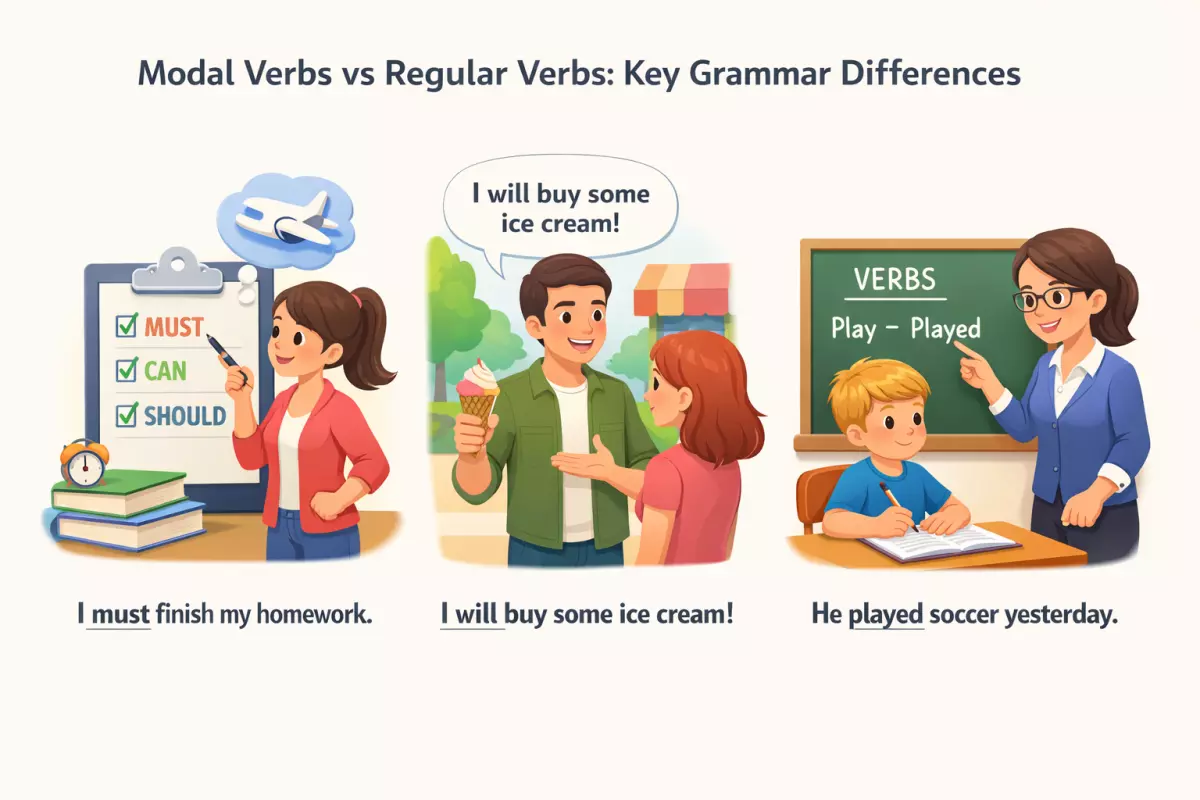 This article explains how regular verbs work in English grammar and how modal verbs are different. It shows why modals don’t take s, ed, or ing, how regular verbs use auxiliaries, and compares sentences. It also covers common learner mistakes and gives exercises to tell them apart.
- What regular verbs are and how they behave in English grammar
- The grammatical properties that make modal verbs unique
- Why modal verbs do not take endings like s, ed, or ing
- How regular verbs rely on auxiliary verbs while modal verbs do not
- Sentence comparisons showing modal verbs and regular verbs in context
- Typical learner confusion between modal verb patterns and regular verb forms
- Exercises for distinguishing modal verbs from regular verbs
Knowing the difference between helping verbs like can, must, and should and everyday action verbs can make your English sound more natural. In real conversations, modal helpers add meaning by showing ability, permission, advice, or obligation, while main verbs carry the action and change with tense. When you recognize each role, you can avoid common errors and choose clearer, more accurate sentences.
What regular verbs are and how they behave in English grammar
Regular (or “main”) verbs carry the core meaning of an action, state, or event, and they behave like full verbs: they can show tense, take objects, and work with auxiliaries to form questions, negatives, and complex tenses. Unlike modal verbs, they typically change form for third-person singular in the present and for past time.
How regular verbs form their main tenses
Most regular verbs follow predictable patterns. The base form is used after to (to work) and after auxiliaries (do/does/did, will, have). The present simple adds -s/-es for he/she/it, and the past simple/past participle commonly add -ed (with spelling adjustments).
- Base form: work, play, live, study, watch
- Present simple (I/you/we/they): work, play, live, study, watch
- Present simple (he/she/it): works, plays, lives, studies, watches
- Past simple: worked, played, lived, studied, watched
- Past participle (used with have/has/had): worked, played, lived, studied, watched
- -ing form (used with am/is/are/was/were): working, playing, living, studying, watching
Spelling rules you see again and again
- Add -s for most third-person singular forms: run → runs, read → reads
- Add -es after -s, -sh, -ch, -x, -z, -o: watch → watches, fix → fixes, go → goes
- Consonant + y changes to -ies: study → studies, carry → carries
- Vowel + y just adds -s: play → plays, enjoy → enjoys
- Add -ed for many past forms: clean → cleaned, open → opened
- Final -e + -d (not -ed): live → lived, like → liked
- Consonant + y changes to -ied in the past: study → studied, copy → copied
- Double the final consonant in many short stressed patterns: stop → stopped, plan → planned
- -ing form often drops final -e: make → making, write → writing
- -ing form may double the final consonant: run → running, sit → sitting
Negatives and questions: regular verbs use “do” support
In the present simple and past simple, main verbs do not usually form negatives or questions by themselves. They rely on do/does/did, and the main verb stays in the base form.
- Negative (present): I do not work on Sundays. / She does not work on Sundays.
- Negative (past): They did not work yesterday.
- Question (present): Do you work here? / Does he work here?
- Question (past): Did you work late?
- Correct vs incorrect: ✅ Does she play tennis? ❌ Does she plays tennis?
How they combine with auxiliaries in other tenses
Regular verbs also appear in multi-part verb phrases where an auxiliary carries tense or aspect and the main verb provides the meaning.
- Continuous: am/is/are + -ing (She is working.)
- Perfect: have/has/had + past participle (They have worked here for years.)
- Passive: be + past participle (The emails were answered.)
- Future: will + base form (I will call you later.)
Common patterns with objects and complements
- Verb + direct object: read a book, buy a ticket, watch a film
- Verb + indirect object: give her a message, send them an email
- Verb + preposition: listen to music, look at the map, talk about work
- Linking-style uses (state verbs): seem tired, become quiet, remain calm
The grammatical properties that make modal verbs unique
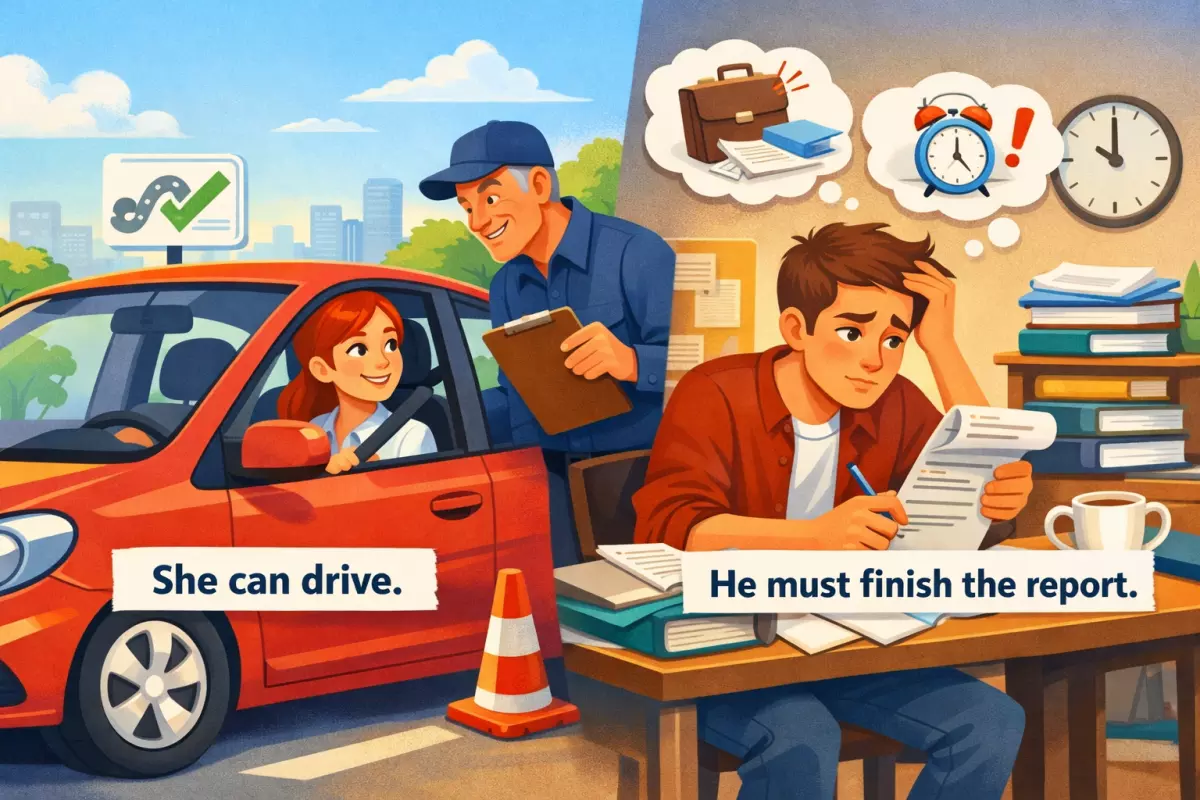
Modal verbs follow a small set of special grammar rules that affect how they form negatives, questions, and verb phrases. They typically act as “helpers” that add meanings like ability, permission, obligation, or probability, while the main verb stays in a base form.
Core form: no -s, no infinitive, no participles
- No third-person -s: ✅ She can drive. ❌ She cans drive.
- No “to” infinitive form: ❌ to can / to must (standard English avoids these; other structures replace them).
- No -ing or -ed participles: ❌ canning (as a modal), musted, maying. (These forms exist only as different words/meanings, not as modal forms.)
- Limited tense marking: many modals don’t have full tense pairs; where a “past” form exists, it often signals politeness or distance rather than past time (e.g., could, would, might).
Verb phrase pattern: modal + bare infinitive
A modal is followed by the base form of the main verb (sometimes called the bare infinitive). This is one of the clearest usage patterns separating modals from regular verbs.
- ✅ can + base: can go, can see, can help
- ✅ should + base: should call, should wait, should explain
- ✅ must + base: must leave, must be, must finish
- ✅ may/might + base: may arrive, might change, might work
- ✅ will/would + base: will try, would prefer, would agree
- ✅ shall (formal) + base: shall begin, shall provide
- ✅ modal + be + -ing (progressive meaning): might be waiting, could be working, should be studying
- ✅ modal + have + past participle (perfect meaning): must have forgotten, might have left, should have told
- ✅ modal + be + past participle (passive meaning): can be repaired, should be checked, must be done
- ✅ stacked auxiliaries after the modal: may have been delayed, could have been seen, should have been completed
Negatives and questions: no do-support
Unlike most regular verbs, modals form negatives and questions directly, without using do/does/did. This creates short, predictable patterns in conversation and writing.
- Negative: modal + not
- ✅ She cannot/can’t swim. ❌ She doesn’t can swim.
- ✅ You should not/shouldn’t worry. ❌ You don’t should worry.
- ✅ He may not agree. (meaning depends on context: possibility vs. permission)
- Question: modal + subject + base verb
- ✅ Can you help? ❌ Do you can help?
- ✅ Should we leave now?
- ✅ Might they be late?
Short answers and tags: modal repeats, main verb drops
In short answers, the modal often carries the meaning by itself, so the main verb is omitted. The same idea appears in question tags.
- ✅ “Can you drive?” “Yes, I can.” (not “Yes, I can drive.” in most contexts)
- ✅ “Should we call her?” “No, we shouldn’t.”
- ✅ “He might come.” “He might.” (context-dependent but common in speech)
- ✅ You can swim, can’t you?
- ✅ They should be here, shouldn’t they?
Restrictions: modals don’t normally combine with each other
Standard modern English usually allows only one true modal per clause. When a second “modal-like” meaning is needed, English uses periphrastic alternatives (multi-word forms) rather than stacking modals.
- ❌ She will can come tomorrow. → ✅ She will be able to come tomorrow.
- ❌ You must may leave early. → ✅ You may leave early. / You must be allowed to leave early. (meaning changes with choice)
- ❌ He should must apologize. → ✅ He really must apologize. / He should apologize. (choose one force)
- ✅ Exceptions exist in some dialects (e.g., “might could”), but they are not standard in formal writing.
Related “semi-modals” behave differently
Some expressions act like modals in meaning but follow regular verb grammar in form. Recognizing them helps avoid mixing patterns.
- have to: takes do-support and tense like a regular verb (✅ Do you have to go? / He has to go.)
- be able to: inflects with be (✅ She is able to help. / They were able to help.)
- need to: often regular (✅ He needs to leave. / Did you need to leave?)
- ought to: modal-like but keeps “to” (✅ You ought to call.)
- used to: fixed past habit form (✅ I used to live there. / Did you use to live there?)
Why modal verbs do not take endings like s, ed, or ing
Modal verbs behave differently from regular verbs because they function as “helper” verbs that express ability, permission, obligation, possibility, or advice. In modern English, they stay in a fixed form and rely on other words (especially the main verb and time expressions) to show meaning, instead of changing their own endings.
1) Modals are “defective” verbs: they have limited forms
Most verbs can build a full set of forms (work/works/worked/working). Modals do not. They typically have only one present-form shape (and sometimes a past-form partner like can/could), so adding -s, -ed, or -ing is not part of the pattern.
- ✅ She can swim. ❌ She cans swim.
- ✅ They must leave now. ❌ They musts leave now.
- ✅ He should call. ❌ He shoulded call.
- ✅ We may go. ❌ We maying go.
2) The main verb carries the “real” verb form
After a modal, the next verb is usually the base form (sometimes called the bare infinitive). This is why you do not see -s, -ed, or -ing attached to the modal itself; the structure is modal + base verb.
- can + base verb: can go, can help, can wait
- must + base verb: must stop, must pay, must remember
- should + base verb: should try, should listen, should apologize
- may/might + base verb: may arrive, might rain, might change
- will/would + base verb: will call, would prefer, would agree
3) No third-person singular -s with modals
Regular present-tense verbs change in the third person singular (he/she/it works). Modals do not change for person or number, so the same form is used with I/you/he/she/it/we/they.
- I can / she can / they can
- I will / he will / we will
- I should / it should / they should
- I might / she might / they might
4) No -ed past tense on modals; time is shown in other ways
Many modals do not form a past tense with -ed. When English needs to express past time, it often uses (a) a past-form modal where available (can → could, will → would), (b) a perfect structure (modal + have + past participle), or (c) a different expression such as “had to.”
- can → could: She could swim when she was five.
- will → would: He said he would call later.
- modal + have + past participle: They might have missed the train.
- must (no *musted*): Use “had to” for past obligation: I had to leave early.
- should (no *shoulded*): Use “should have” for past advice/regret: You should have told me.
5) No -ing form on modals; use alternatives
Because modals do not create present participles, you cannot use them in progressive forms like “am ___ing.” When you need an -ing idea, English typically switches to a semi-modal or another verb phrase.
- ❌ I am musting go. → ✅ I have to go.
- ❌ She is canning drive today. → ✅ She is able to drive today.
- ❌ They were shoulding study. → ✅ They were supposed to study.
- ❌ We are maying leave soon. → ✅ We might be leaving soon.
In short, modals stay unchanged and let the surrounding grammar do the work: the following verb stays in the base form, and tense/aspect is expressed with combinations like have, participles, or alternative phrases (have to, be able to, be allowed to, be supposed to).
How regular verbs rely on auxiliary verbs while modal verbs do not
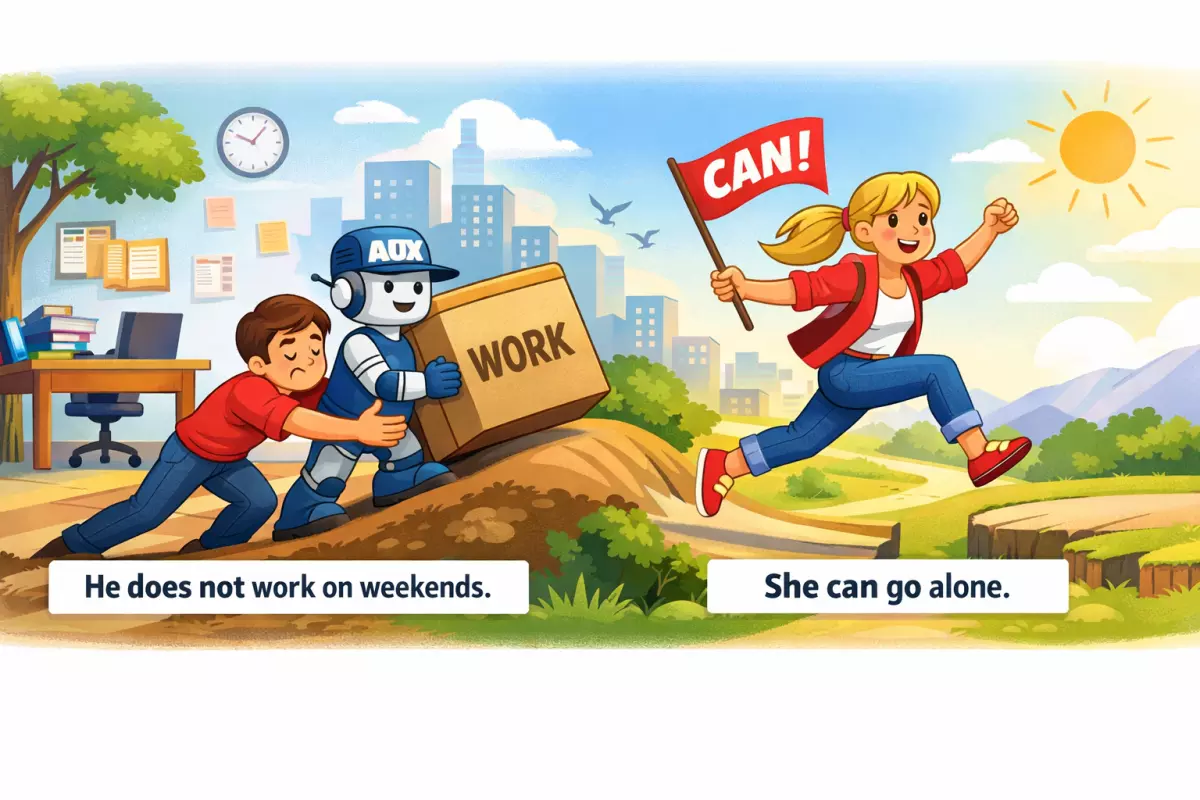
In English, many verb meanings are built by combining a main verb with an extra “helper” verb. Regular (lexical) verbs often need an auxiliary to form questions, negatives, and certain tenses. Modal verbs, by contrast, already behave like auxiliaries, so they can do that grammatical work themselves.
Regular verbs: the auxiliary carries the grammar
With regular verbs, the auxiliary typically shows tense and supports structures like negation and inversion (question word order). The main verb usually stays in a base form after the auxiliary.
- Questions (do-support): ✅ Do you work on Fridays? → main verb stays base (work).
- Negatives (do-support): ✅ I do not work on Fridays. (not I work not).
- Past questions/negatives: ✅ Did she call? / She did not call. (not did not called).
- Progressive aspect (be + -ing): ✅ They are studying. / Are they studying?
- Perfect aspect (have + past participle): ✅ He has finished. / Has he finished?
- Passive voice (be + past participle): ✅ The window was broken. / Was the window broken?
- Emphasis with do: ✅ I do understand. (used for contrast or insistence).
- Key pattern: auxiliary + base verb → does go, did go, will go (not did went).
Modal verbs: no extra “do” is needed
Modals (like can, should, must) already function as auxiliaries. They form questions by inversion and form negatives by adding not directly to the modal, while the following verb remains in the base form.
- Questions (inversion without do): ✅ Can you swim? ❌ Do you can swim?
- Negatives (not after the modal): ✅ She cannot drive. ❌ She doesn’t can drive.
- Modal + base verb: ✅ They should leave now. (not should leaves).
- Past-time meaning without past tense on the main verb: ✅ He could come tomorrow. / He could not come yesterday. (the main verb stays come).
- Short answers: ✅ Yes, I can. / No, she shouldn’t.
Quick pattern checklist (common learner traps)
- ✅ Did you see it? ❌ Did you saw it?
- ✅ She doesn’t like coffee. ❌ She doesn’t likes coffee.
- ✅ Must we leave now? ❌ Do we must leave now?
- ✅ You must not touch that. ❌ You don’t must touch that.
- ✅ Are they working? ❌ Do they working?
- ✅ Has he arrived? ❌ Did he arrived? (when the intended meaning is present perfect).
As a usage rule, ask: “Is there already an auxiliary in the verb phrase?” If a modal is present, it handles the question/negative structure. If not, regular verbs typically use do/does/did for questions and negatives, while be and have serve as auxiliaries for progressive and perfect forms.
Sentence comparisons showing modal verbs and regular verbs in context
These paired examples highlight a practical pattern: modal verbs (can, must, should, might, etc.) stay in a simple form and are followed by a base verb, while regular verbs change form for tense, subject, and aspect (work/works/worked/working; have/has/had; etc.). Notice how meaning shifts too—modals often add ability, permission, advice, obligation, or possibility.
| Meaning focus | Modal verb example | Regular verb example |
|---|---|---|
| Ability | She can swim. | She swims well. |
| Permission | You may leave early. | The teacher allows you to leave early. |
| Obligation (strong) | You must wear a helmet. | You wear a helmet every time you ride. |
| Advice | You should back up your files. | I recommend backing up your files. |
| Possibility (uncertain) | It might rain later. | Rain seems likely later. |
| Expectation / logical prediction | They should arrive by noon. | They usually arrive by noon. |
| Request (polite) | Could you open the window? | Please open the window. |
| Offer | I can help you with that. | I will help you with that. |
| Future intention (formal) | I will call you tonight. | I plan to call you tonight. |
| Habit vs. willingness | He won’t answer emails on weekends. | He doesn’t answer emails on weekends. |
| Necessity (external rule) | We have to show ID at the entrance. | We show ID at the entrance. |
| Prohibition | You mustn’t park here. | Parking is prohibited here. |
| Past possibility | She might have missed the train. | She missed the train, perhaps. |
| Past obligation (not done) | You should have told me earlier. | You didn’t tell me earlier. |
| Past ability (general vs. specific) | When I was five, I could read. | When I was five, I read simple books. |
| Confidence / deduction | That must be the right address. | I’m sure that is the right address. |
Usage patterns to notice in the examples
- Form after a modal: modal + base verb (can swim, should back up, might rain). No -s, no -ed, no -ing directly on the main verb after the modal.
- Regular verb agreement: present simple often adds -s in third person singular (she swims; he doesn’t answer).
- Negatives: modals commonly take not directly (cannot/can’t, mustn’t, won’t), while regular verbs typically use do/does/did (don’t answer).
- Past meaning with modals: many “past” interpretations use modal + have + past participle (might have missed; should have told).
- Meaning difference: modals frequently express stance (permission, obligation, probability), while regular verbs more often describe facts, habits, or actions.
Typical learner confusion between modal verb patterns and regular verb forms
Many errors happen when learners apply regular verb rules (like adding -s, using to, or building tense forms) to modal verbs, or when they forget that some “modal-like” verbs actually behave like normal verbs. The key is to notice the pattern: core modals use a bare infinitive and don’t take typical verb endings.
Frequent mix-ups and how to fix them
- Adding -s to a modal in the third person singular
❌ She cans swim. → ✅ She can swim. - Using “to” after a modal
❌ You must to leave now. → ✅ You must leave now. - Using -ing after a modal instead of the base form
❌ He can swimming. → ✅ He can swim. - Making a past tense by adding -ed to a modal
❌ They mighted be late. → ✅ They might be late. - Using “do/does/did” with a modal in questions
❌ Do you can drive? → ✅ Can you drive? - Using “don’t/doesn’t/didn’t” to negate a modal
❌ She doesn’t must go. → ✅ She mustn’t go / She doesn’t have to go (different meaning). - Doubling modals
❌ I will can help. → ✅ I can help / I will be able to help. - Confusing “mustn’t” with “don’t have to”
✅ You mustn’t park here. (prohibition)
✅ You don’t have to come early. (no necessity) - Using “to” after “should” because it feels like a normal verb
❌ You should to see a doctor. → ✅ You should see a doctor. - Forgetting that modals don’t use “infinitive” or “participle” forms
❌ to can / canning / canned (as a modal) → ✅ use a different verb: to be able to, being able to, been able to - Overusing “could” as the past of “can” in all meanings
✅ When I was 5, I could swim. (general ability)
✅ I was able to open the door. (single successful action is often clearer than “could”) - Mixing modal patterns with regular verbs that look similar
❌ He mayed arrive late. → ✅ He may arrive late.
“Modal-like” verbs that behave like regular verbs
Some verbs express necessity, advice, or ability but follow regular verb grammar. Learners often treat them like core modals and drop to or skip tense endings.
- have to: ❌ She have to go. → ✅ She has to go. / She had to go.
- need to: ❌ You need go now. → ✅ You need to go now.
- be able to: ❌ I can to finish tomorrow. → ✅ I will be able to finish tomorrow.
- be allowed to: ❌ We may to enter? → ✅ Are we allowed to enter?
- be supposed to: ❌ She shoulds be here. → ✅ She is supposed to be here.
Quick pattern check for editing your own sentences
- If you see a modal, the next verb is usually the base form: can go, should try, might happen.
- If you see to + verb after “must/can/should/may/might,” it’s probably wrong (unless it’s part of a different structure like “be able to”).
- Questions and negatives with modals usually don’t use do/does/did: Can you…? She can’t…
- If you need a tense that core modals don’t provide, switch to a regular-verb alternative: will be able to, had to, has been able to.
Exercises for distinguishing modal verbs from regular verbs
Use these practice tasks to spot whether a verb is functioning as a modal (showing ability, permission, obligation, possibility, advice) or as a main verb that carries tense and can take typical verb endings. Focus on patterns: modals are followed by a base verb (no to), don’t take -s in the third person, and form negatives/questions without do.
1) Identify the verb type (modal or regular)
- She can swim.
- He swims every morning.
- They must leave now.
- I want to leave now.
- You should call your teacher.
- She calls her teacher every Friday.
- We might be late.
- We are late again.
- He will help you.
- He helps you when you ask.
- You have to wear a helmet.
- You may wear a helmet if you prefer.
Show answers
- Modal: can
- Regular: swims
- Modal: must
- Regular: want
- Modal: should
- Regular: calls
- Modal: might
- Regular (main verb): are
- Modal: will
- Regular: helps
- Regular (semi-modal phrase): have (to)
- Modal: may
2) Choose the correct form (watch for base verb vs. -s/-ed/to)
- She can (drive / drives / to drive) at night.
- He must (finish / finishes / finished) the report today.
- My sister might (comes / come / to come) later.
- Our manager will (approve / approves / approved) the budget.
- She should (to see / see / sees) a doctor.
- He wants (go / to go / goes) home.
- They need (to leave / leave / leaving) early.
- She may (takes / take / to take) a break.
- He has to (wear / wears / to wear) a badge.
- She likes (read / to read / reads) before bed.
Show answers
- drive
- finish
- come
- approve
- see
- to go
- to leave
- take
- wear
- to read
3) Fix the sentence (common modal-verb errors)
- ❌ He can drives. → Rewrite correctly.
- ❌ She must to leave now. → Rewrite correctly.
- ❌ Do you can help me? → Rewrite correctly.
- ❌ He doesn’t should talk like that. → Rewrite correctly.
- ❌ She may goes with us. → Rewrite correctly.
- ❌ Must we to pay today? → Rewrite correctly.
- ❌ He will to call you later. → Rewrite correctly.
- ❌ She cans speak French. → Rewrite correctly.
- ❌ Might you to open the window? → Rewrite correctly.
- ❌ He mustn’t to park here. → Rewrite correctly.
Show answers
- ✅ He can drive.
- ✅ She must leave now.
- ✅ Can you help me?
- ✅ He shouldn’t talk like that.
- ✅ She may go with us.
- ✅ Must we pay today?
- ✅ He will call you later.
- ✅ She can speak French.
- ✅ Might you open the window?
- ✅ He mustn’t park here.
4) Modal or main verb? (the “have” and “be” challenge)
Some forms look “modal-like” but behave differently. Decide what the bold verb is doing in each sentence: a modal meaning (ability/permission/obligation/possibility) or a main verb meaning (possession, existence, ongoing action, etc.).
- I have a car.
- I have to leave now.
- She is tired.
- She is studying.
- They are able to solve it.
- He has to wear glasses to read.
- We have finished the test.
- We had to cancel the trip.
Show answers
- Main verb (possession): have
- Obligation meaning (semi-modal phrase): have to
- Main verb (state): is
- Auxiliary/main verb “be” for progressive aspect: is
- Modal meaning expressed with a regular structure (not a true modal): are able to
- Obligation meaning (semi-modal phrase): has to
- Auxiliary “have” for perfect aspect: have
- Obligation meaning (semi-modal phrase): had to
5) Quick pattern checklist (use it while you correct)
- After a modal, use the base verb: can go, should study, might arrive (not “to go,” “goes,” or “arrived”).
- Third-person singular stays the same: she can, he must (not “cans/musts”).
- Questions invert the modal: Can you…? Should we…? (not “Do you can…?”).
- Negatives attach to the modal: cannot/can’t, shouldn’t, mustn’t (not “doesn’t should”).
- Regular verbs use do/does/did for questions and negatives: Do you want…? He doesn’t want….
- Watch “have to”: it behaves like a regular verb for tense and agreement (has to, had to) even though it expresses obligation.