Irregular Verb Patterns and Groups in Modern English

 The article explains what makes a verb irregular, covers main patterns such as unchanged forms, vowel changes, and specific endings, addresses common mistakes, and provides practical learning strategies and homework for mastering irregular verbs.
- What makes a verb irregular
- Main irregular patterns and groups
- Same form in all three: put, cut, hit
- Vowel change patterns: sing–sang–sung
- Ending patterns: -t forms and -en forms
- Common confusion pairs and frequent mistakes
- Learning strategies for irregular verbs
- Homework: irregular verb drills and usage tasks
When students first meet irregular verbs, they often feel frustrated — and that reaction is completely normal. At some point, everyone asks the same question: why does English say went instead of goed, or ate instead of eated? The truth is, irregular verbs don’t follow neat formulas, and that’s exactly why they deserve special attention. The good news is that once you stop looking for strict rules and start noticing patterns through use, these verbs become much easier to recognize and remember.
Irregular verbs are not “irregular” because they are random or chaotic. They are irregular because they belong to older layers of the language, formed long before modern spelling rules were standardized. As a result, their past forms often involve vowel changes, complete form shifts, or no visible change at all. This is why practice in real sentences matters far more than memorizing long lists without context.
What makes a verb irregular
To understand irregular verbs, it helps to start with what most verbs do. In English, the majority of verbs form the past tense and past participle by adding -ed to the base form: walk → walked, finish → finished. Irregular verbs break away from this pattern. Instead of adding -ed, they may change a vowel, adopt a completely different form, or remain unchanged across tenses.
How irregularity is defined
A verb is considered irregular simply because its past tense and past participle are not formed with the regular -ed ending. There is no single rule that predicts these forms, which is why they must be learned through exposure and repetition. Some verbs change internally (sing → sang → sung), some change completely (go → went), and others stay the same (cut → cut → cut). Recognizing these patterns — rather than trying to force them into a regular system — is the key to using irregular verbs accurately and confidently.
- Past tense and past participle forms may change vowels (e.g., "sing" → "sang," "sung").
- Some verbs change consonants or undergo more complex spelling shifts (e.g., "buy" → "bought").
- Several remain identical in all forms (e.g., "put" → "put").
- Rarely, a verb will have multiple acceptable irregular forms ("dream" → "dreamt/dreamed").
- There are verbs that mix regular and irregular forms, depending on region or style.
Irregular verb patterns in usage
Irregular verbs can be grouped by the kind of change they undergo. Some common patterns include:
- Vowel change only: "begin" → "began" → "begun"
- No change: "cut" → "cut" → "cut"
- Consonant and vowel change: "teach" → "taught" → "taught"
- Suppletive forms (completely different word): "go" → "went" → "gone"
- Irregular -t ending: "build" → "built" → "built"
- Double consonant: "run" → "ran" → "run"
- Multiple correct forms: "learn" → "learned/learnt"
- Internal vowel plus suffix: "show" → "showed" → "shown"
- Shortening or clipping: "make" → "made"
- Silent letter changes: "read" (pronounced "reed") → "read" (pronounced "red")
Comparison: Regular vs. Irregular Forms
Below is a table comparing typical changes in standard and nonstandard verbs:
| Base Form | Regular Past | Irregular Past | Past Participle |
|---|---|---|---|
| walk | walked | ❌ | walked |
| sing | ❌ | sang | sung |
| put | ❌ | put | put |
| go | ❌ | went | gone |
Summary of irregular verb features
Irregular verbs are distinguished by their unpredictable changes from the base form to past forms, requiring learners to recognize and remember each pattern. These verbs are common in everyday English and essential for clear, accurate communication. Recognizing the main types of irregular changes helps with both understanding and correct usage.
Main irregular patterns and groups

Irregular verbs in modern English tend to fall into several recognizable categories, each with its own pattern of change. Understanding these groupings can simplify memorization and help predict forms, especially for commonly used verbs. Instead of following the standard "-ed" ending, these verbs often experience vowel shifts, consonant changes, or even complete transformations.
Common vowel changes
Many irregular verbs exhibit systematic vowel changes between the base, past simple, and past participle forms. Here are some frequent patterns:
- i → a → u: sing – sang – sung, ring – rang – rung, drink – drank – drunk
- ea → o → e: speak – spoke – spoken, break – broke – broken
- i → o → i: begin – began – begun, swim – swam – swum
- ee → e → e: meet – met – met, feed – fed – fed
- o → ew → own: blow – blew – blown, grow – grew – grown
Unchanged forms
Some verbs keep the same form across all three principal parts. These typically include verbs that are short and often used.
Irregular verbs with no visible change
Some irregular verbs keep the same form in the base, past simple, and past participle. These verbs are often short, common, and frequently used in everyday English. Because nothing changes on the surface, learners sometimes miss the tense and rely heavily on context.
- put – put – put
- cut – cut – cut
- shut – shut – shut
- let – let – let
- set – set – set
- cost – cost – cost
- hit – hit – hit
- hurt – hurt – hurt
- spread – spread – spread
- bet – bet – bet
-t endings in past forms
Another large group of irregular verbs forms the past simple and past participle with a -t ending. These verbs often involve a vowel change plus the final -t, creating a compact, distinctive pattern that appears again and again in English.
- build – built – built
- send – sent – sent
- feel – felt – felt
- keep – kept – kept
- sleep – slept – slept
- leave – left – left
- lose – lost – lost
- mean – meant – meant
- spend – spent – spent
- lend – lent – lent
- deal – dealt – dealt
- light – lit – lit
Highly irregular core verbs
Some verbs are so frequent and historically complex that they resist all neat categorization. These verbs must be learned individually, but they appear so often that learners usually internalize them faster than expected.
- be – was/were – been
- go – went – gone
- do – did – done
- have – had – had
- make – made – made
- say – said – said
- come – came – come
- see – saw – seen
- get – got – got/gotten
- take – took – taken
Irregular verbs in real sentence use
Instead of repeating forms again, the table below shows how different types of irregular verbs behave in real sentences. This helps connect form with meaning and usage rather than memorization alone.
| Verb Type | Example Sentence (Past Simple) | Example Sentence (Past Participle) |
|---|---|---|
| Unchanged form | She cut the paper carefully. | She has cut the paper already. |
| -t ending | They built the bridge in 2010. | The bridge has been built recently. |
| Vowel change | He swam across the river. | He has swum across the river before. |
| Complete form change | We went home early. | We have gone home already. |
| Same past and participle | She said nothing. | She has said nothing about it. |
| American/British variation | He got better quickly. | He has gotten much better. |
Looking at irregular verbs through patterns and real usage makes them far less intimidating. Instead of treating each verb as an isolated exception, learners can recognize familiar behaviors and build confidence through repeated exposure in meaningful sentences.
Recognizing these recurring patterns can make learning irregular verbs more manageable. By grouping verbs according to their transformations, learners can approach them with greater confidence and accuracy.
Same form in all three: put, cut, hit
Some English verbs keep the same spelling for their base form, past tense, and past participle. This pattern is rare but important, as it avoids the usual changes seen in most irregular verbs. Learners often find these verbs easier to remember, but they can be confusing in context because the form does not change to indicate tense. These verbs are used in everyday English, both in spoken and written contexts. Their unchanged forms mean that you must rely on other clues in the sentence, such as auxiliary verbs or time expressions, to understand when the action happened.
Irregular verbs with unchanged forms: how to use them correctly
Some irregular verbs are deceptively simple: their base form, past simple, and past participle all look exactly the same. This can feel convenient at first, but it also creates a common source of confusion. Because the verb itself does not change, the tense must be understood entirely from context, time expressions, or auxiliary verbs.
Instead of memorizing long repetitive lists, it is more useful to understand how these verbs behave in real sentences and what learners typically get wrong.
What actually matters with unchanged verbs
- Tense is shown by context, not by verb form (yesterday, already, by the time).
- Auxiliary verbs become crucial in perfect and passive constructions.
- Pronunciation may change even when spelling does not (especially with read).
- Errors often appear in questions and negatives, not in affirmative sentences.
Context-based examples (more useful than lists)
| Context | Sentence | What shows the tense |
|---|---|---|
| Routine (present) | They cut the material every morning. | Time expression: every morning |
| Completed past action | They cut the material yesterday. | Time marker: yesterday |
| Present perfect | They have cut all the samples. | Auxiliary: have |
| Passive voice | The prices were cut last year. | Auxiliary: were |
| Reported past (read) | She read the report last night. | Pronunciation change: /red/ |
| Present perfect (read) | She has read the report. | Auxiliary + pronunciation /rɪd/ |
Typical learner mistakes to watch for
- ❌ Assuming the tense is unclear because the verb does not change.
- ❌ Forgetting auxiliaries in perfect forms (She read it already instead of She has read it already).
- ❌ Mispronouncing read in the past.
- ❌ Adding -ed by analogy (cutted, putted).
Why English keeps these verbs unchanged
Most unchanged irregular verbs are short, extremely frequent, and historically old. Over time, their forms were reduced rather than expanded. This makes them efficient in speech but places more responsibility on the speaker or writer to signal time clearly through structure and context.
Once learners stop expecting visible tense markers on these verbs and focus instead on sentence structure, they usually find this group far easier than it first appears.
Summary and tips
When working with verbs that do not change across forms, always check the sentence for time markers or helping verbs to clarify meaning. This group is relatively small but contains many high-frequency words, making it essential for both fluency and accuracy in English communication.
Vowel change patterns: sing–sang–sung
Verbs that shift their internal vowel in the past tense and past participle, like “sing,” form one of the most recognizable groups of irregular verbs in English. These verbs do not follow the regular -ed ending rule for forming past tenses. Instead, their stem vowel changes systematically to indicate tense and participle forms, a phenomenon known as ablaut or strong verb patterning, inherited from earlier stages of the language.
How vowel changes signal tense
The pattern involves three principal forms: the base (present), the past simple, and the past participle. Each form features a distinct vowel sound, helping speakers and listeners distinguish when an action happens. For instance, the verb “sing” appears as “sang” in the past and “sung” as the past participle. This pattern is productive in a limited set of verbs and is not used to create new verbs in modern English, but it remains common among some of the most frequently used words.
Common verbs with vowel alternations
Many verbs share this internal vowel shift pattern. While the specific vowels may differ, the underlying system remains consistent. Here are several English verbs that follow this structure:
- begin – began – begun
- drink – drank – drunk
- ring – rang – rung
- swim – swam – swum
- sing – sang – sung
- sink – sank – sunk
- spring – sprang – sprung
- shrink – shrank – shrunk
- run – ran – run
- stink – stank – stunk
- cling – clung – clung
- sling – slung – slung
- swing – swung – swung
- wring – wrung – wrung
- spin – spun – spun
- win – won – won
- strike – struck – struck
Paradigm comparison
To illustrate how these vowel changes operate, the following table presents the principal parts for a selection of verbs following this pattern:
| Base Form | Past Simple | Past Participle |
|---|---|---|
| sing | sang | sung |
| begin | began | begun |
| drink | drank | drunk |
| swim | swam | swum |
| ring | rang | rung |
| sink | shank | sunk |
| spring | sprang | sprung |
Usage notes and exceptions
Not all verbs with similar endings or sounds follow this ablaut pattern. Some verbs may have alternative forms in informal or regional speech, but the forms listed above are standard in contemporary English. Note that “run” is a partial exception: it changes its vowel in the past (“ran”) but reverts to the base form for its past participle (“run”).
Summary of the pattern
This vowel alternation group is essential for learners to master because these verbs are common and important for fluent communication. Recognizing the base, past, and participle forms helps avoid errors and increases confidence in both speaking and writing.
Ending patterns: -t forms and -en forms
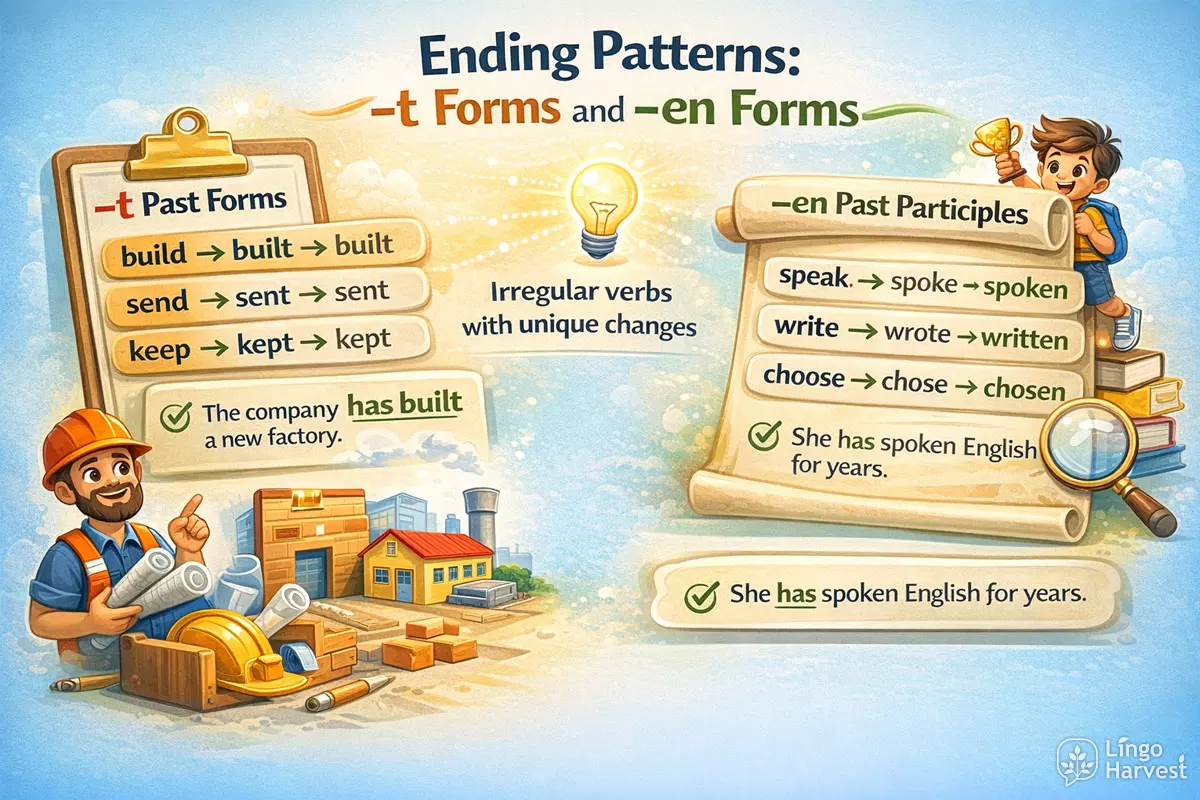
Many irregular verbs in English show unique changes in their past tense and past participle forms, often marked by specific endings. Two of the most noticeable patterns are verbs that end with -t in their past forms, and those that use the -en suffix for the past participle. Recognizing these patterns helps learners predict and remember irregular verb forms more easily.
Verbs with -t past forms: patterns and usage
Many irregular verbs form both the past simple and the past participle with a -t ending. What matters most here is not memorizing a long list, but noticing how these verbs behave in real sentences. In most cases, the same form is used for both past simple and present perfect.
- build → built → built → The company built a new factory last year.
- send → sent → sent → She sent the email yesterday.
- keep → kept → kept → He has kept the promise.
- sleep → slept → slept → They slept poorly during the trip.
- feel → felt → felt → I have never felt so confident.
- leave → left → left → The train left early this morning.
- mean → meant → meant → That comment meant a lot to her.
- deal → dealt → dealt → The manager has dealt with similar issues before.
- weep → wept → wept → He wept quietly after hearing the news.
- sweep → swept → swept → The wind has swept the streets clean.
Some verbs in this group also allow regular alternatives (learned/learnt, burned/burnt), but the -t forms remain especially common in British English and formal writing.
Verbs with -en past participles
Another important pattern involves verbs whose past participle ends in -en. These verbs usually show three distinct forms: base, past simple, and past participle. The -en form appears only after auxiliary verbs such as have, has, or had.
- break → broken → The glass has broken.
- choose → chosen → She has chosen a different approach.
- drive → driven → He has never driven abroad.
- eat → eaten → They have already eaten.
- forget → forgotten → I have forgotten his name.
- give → given → She has given her opinion.
- write → written → The report has been written.
- grow → grown → The city has grown rapidly.
- know → known → This fact has long been known.
- speak → spoken → English is widely spoken here.
How these patterns differ in real grammar
Instead of repeating the same verbs again, the table below focuses on how the two patterns behave in sentences. This highlights the functional difference between -t verbs and -en participles.
| Pattern | Past Simple Example | Present Perfect Example |
|---|---|---|
| -t ending (same form) | They kept the records carefully. | They have kept the records for years. |
| -t ending (same form) | The wind swept through the valley. | The wind has swept away the clouds. |
| -en participle | She wrote the article last night. | She has written several articles. |
| -en participle | He chose the safer option. | He has chosen wisely. |
| -en participle | The price rose suddenly. | The price has risen sharply. |
Seen this way, irregular verbs become less about memorization and more about recognizing behavior. Once learners associate each pattern with real sentence use, accuracy improves naturally and confidence follows.
Usage Tips
When studying irregular verbs, pay attention to both the spelling and the pronunciation changes in these endings. Note which verbs have alternative forms (such as "dreamed/dreamt"), and remember that context or regional variation may affect which form is preferred. Recognizing these patterns makes it easier to use irregular verbs accurately in both speech and writing.
Common confusion pairs and frequent mistakes
Understanding which irregular verbs are most often confused helps learners avoid many typical errors in both writing and speech. Certain irregular verbs look or sound similar, while others have forms that overlap with regular patterns, making them particularly tricky. Recognizing these patterns and their exceptions is essential for accurate communication.
Frequently mixed-up irregular verb forms
Some verbs share similar forms or change in unexpected ways, leading to frequent mix-ups. Here are some of the most commonly confused pairs and groups:
- Lie / Lay: "Lie" (to rest) has the past tense "lay" and past participle "lain." "Lay" (to put something down) has the past tense "laid" and past participle "laid."
- Sit / Set: "Sit" is used for being seated; "set" means to place something. Many confuse "sat" with "set."
- Rise / Raise: "Rise" (to go up) becomes "rose" and "risen;" "raise" (to lift something) is regular: "raised."
- Bear / Bare: "Bear" (to carry) becomes "bore" and "borne;" "bare" is regular: "bared."
- Begin / Began / Begun: "Began" is the simple past, not to be used as a participle. "Begun" is the past participle, used with "has/have/had."
- Drink / Drank / Drunk: "Drank" is the simple past; "drunk" is the past participle.
- Ring / Rang / Rung: "Rang" is the simple past; "rung" is the past participle.
- Swim / Swam / Swum: "Swam" is the simple past; "swum" is the participle.
- Steal / Stole / Stolen: "Stole" for simple past, "stolen" for participle; not interchangeable.
- Write / Wrote / Written: "Wrote" is used for the past; "written" is for the perfect tenses.
- Go / Went / Gone: "Went" is only the simple past; "gone" is never used as a simple past verb.
- See / Saw / Seen: "Saw" is the past tense; "seen" is used with auxiliaries.
- Come / Came / Come: The past participle is "come," not "came."
- Do / Did / Done: "Did" is the simple past; "done" is for perfect tenses.
- Break / Broke / Broken: "Broke" is the simple past, "broken" is the participle.
- Choose / Chose / Chosen: "Chose" is the simple past, "chosen" is the participle.
- Forget / Forgot / Forgotten: "Forgot" for past, "forgotten" for participle.
- Freeze / Froze / Frozen: "Froze" is past, "frozen" is participle.
- Speak / Spoke / Spoken: "Spoke" is past, "spoken" is participle.
- Take / Took / Taken: "Took" is past, "taken" is participle.
Patterns that often cause mistakes
Irregular verbs sometimes seem to follow a regular pattern, which can lead to incorrect forms. For example, learners might mistakenly add “-ed” to an irregular verb, or use the wrong participle after an auxiliary verb. The confusion is greater when verbs have similar forms or when the base and past participle are identical.
| Base Form | Simple Past | Past Participle | Common Error |
|---|---|---|---|
| break | broke | broken | "I have broke" ❌ instead of "I have broken" ✅ |
| go | went | gone | "I have went" ❌ instead of "I have gone" ✅ |
| see | saw | seen | "I have saw" ❌ instead of "I have seen" ✅ |
| choose | chose | chosen | "I have chose" ❌ instead of "I have chosen" ✅ |
| write | wrote | written | "I have wrote" ❌ instead of "I have written" ✅ |
| swim | swam | swum | "I have swam" ❌ instead of "I have swum" ✅ |
| drink | drank | drunk | "I have drank" ❌ instead of "I have drunk" ✅ |
| ring | rang | rung | "I have rang" ❌ instead of "I have rung" ✅ |
Tips for remembering irregular verb patterns
To avoid these common mistakes, it helps to group verbs by their pattern or memorize them in phrases. Reviewing lists and practicing sentences with auxiliary verbs (have/has/had) can reinforce correct usage. Regular exposure to authentic English—reading, listening, and speaking—also builds intuition for which forms are correct in context.
Learning strategies for irregular verbs
Mastering irregular verb patterns in English requires more than simple memorization. Because these verbs do not always follow predictable rules, targeted techniques can help learners recognize and recall their forms more effectively. Noticing similarities between verbs, grouping by patterns, and using regular practice are essential approaches.
Grouping by pattern or sound
Many non-regular verbs fall into recognizable groups based on their endings or changes. Observing these similarities can simplify the learning process. For example, verbs ending in -ow often change to -ew in the past (e.g., "blow" → "blew"), while some verbs have identical present, past, and past participle forms.
- Verbs with unchanged forms: cut, put, let, set, shut
- “-ow” to “-ew” pattern: blow → blew, grow → grew, know → knew
- Vowel change “i” to “a”: begin → began, sing → sang, ring → rang
- Endings with “-t”: build → built, send → sent, spend → spent
- “-ea” to “-ept”: keep → kept, sweep → swept, weep → wept
- “-ing” to “-ung”: sing → sung, ring → rung, spring → sprung
- “-ell” to “-old”: tell → told, sell → sold
- “-ake” to “-ook”: take → took, shake → shook
- Common vowel shifts: swim → swam, give → gave, drive → drove
- Consonant changes: catch → caught, teach → taught
Using visual aids and practice
Organizing verbs into charts or tables helps visualize differences and similarities. Repeated exposure through reading, writing, and speaking reinforces correct usage. Flashcards, sentence-building, and regular quizzes can also aid retention.
| Base Form | Past Simple | Past Participle | Pattern Group |
|---|---|---|---|
| bring | brought | brought | -ing → -ought |
| sing | sang | sung | i → a → u |
| cut | cut | cut | no change |
| grow | grew | grown | -ow → -ew/-own |
| keep | kept | kept | eep → ept |
| drive | drove | driven | i → o → i |
| sell | sold | sold | ell → old |
| take | took | taken | ake → ook/aken |
| build | built | built | ild → ilt |
| teach | taught | taught | ach → aught |
Contextual learning and usage
Applying verbs in real sentences and varied contexts helps solidify their forms. Practice with mini-dialogues, storytelling, and error correction activities can make irregular forms more familiar and automatic. Exposure to authentic language through reading and listening also increases recognition of these patterns in use.
Tips for remembering non-standard verbs
- Group verbs by similar changes or endings for easier recall.
- Practice with sentences, not just isolated words, to understand context.
- Test yourself regularly with quizzes or flashcards.
- Notice patterns in reading and underline irregular verbs.
- Use mnemonic devices or rhymes for tricky verb forms.
- Review and revise frequently to maintain accuracy.
With consistent practice and attention to recurring patterns, learners can build confidence in using these frequently encountered English verbs.
Homework: irregular verb drills and usage tasks
Mastering the unpredictable forms of English verbs requires focused practice. This set of drills and exercises is designed to reinforce recognition of patterns and correct usage of irregular verbs in context. The following activities cover sorting, completion, and transformation tasks to help solidify these essential skills.
Practice: Grouping Irregular Verbs by Pattern
Sort each verb into its appropriate group based on its past tense and past participle forms. Refer to the patterns discussed in the article, such as "all forms the same," "vowel change," or "unique forms."
- begin
- cut
- swim
- find
- come
- run
- sing
- break
- put
- write
- buy
- read
- go
- bring
- choose
Show answers
- All forms the same: cut, put
- Vowel change: begin, swim, sing, break, write, go, choose
- Unique forms: find, come, run, buy, read, bring
Table: Key Irregular Verb Forms
Review the principal parts of several high-frequency irregular verbs. Notice the patterns in their changes.
| Base Form | Past Simple | Past Participle |
|---|---|---|
| go | went | gone |
| take | took | taken |
| see | saw | seen |
| come | came | come |
| eat | ate | eaten |
| give | gave | given |
| run | ran | run |
| bring | brought | brought |
| find | found | found |
| write | wrote | written |
Sentence Completion: Using Irregular Verbs in Context
Fill in the blanks with the correct past simple or past participle form of the verb in parentheses.
- She _______ (go) to the market early this morning.
- We have _______ (see) that movie twice.
- He _______ (take) the wrong bus yesterday.
- They have _______ (eat) all the cookies.
- I _______ (find) your keys under the table.
- Mia has _______ (write) three letters so far.
- The dog _______ (run) across the yard.
- He _______ (give) me a present for my birthday.
- We _______ (come) home late last night.
- She has _______ (bring) her friend to the party.
Show answers
- went
- seen
- took
- eaten
- found
- written
- ran
- gave
- came
- brought
Transformation: Changing Tenses
Rewrite the sentences below, changing the verb from present to past simple.
- They eat breakfast at seven.
- I go to school by bus.
- She writes in her journal every night.
- We take photos when we travel.
- He sees the doctor on Mondays.
- The students begin class at nine.
- My sister chooses a new book each month.
- He drives to work every day.
- They speak quietly in the library.
- I give my keys to my roommate.
Show answers
- They ate breakfast at seven.
- I went to school by bus.
- She wrote in her journal every night.
- We took photos when we traveled.
- He saw the doctor on Mondays.
- The students began class at nine.
- My sister chose a new book each month.
- He drove to work every day.
- They spoke quietly in the library.
- I gave my keys to my roommate.
Consistent practice with these drills will help internalize the principal forms and usage patterns of English irregular verbs, making both recognition and production more automatic in real-world communication.