Modal Verbs vs Auxiliary Verbs: Grammar Comparison

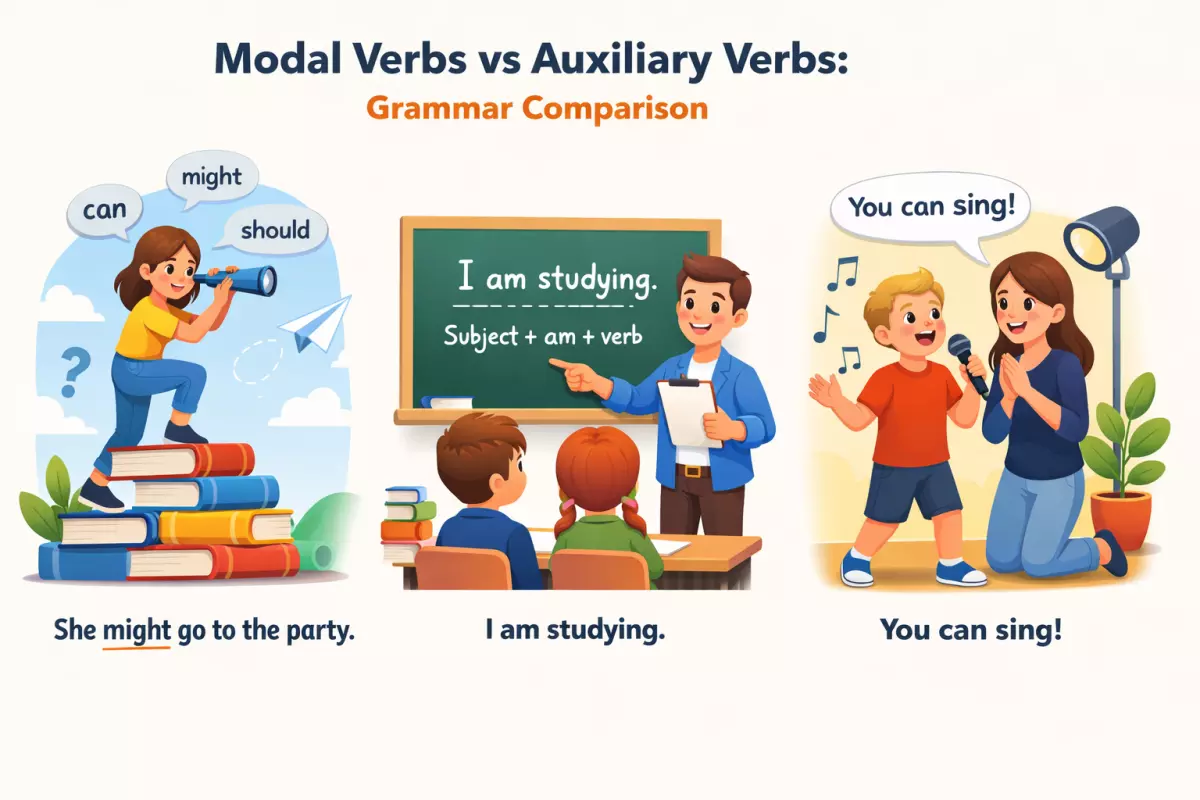 Covers what auxiliary verbs do in English, which verbs are modal auxiliaries, and how modals differ from be, do, and have. Explains tense-building vs meaning/attitude, shows modals with auxiliaries together, flags common mix-ups, and includes practice ID exercises.
- What auxiliary verbs are and the role they play in English grammar
- Which verbs belong to the group of modal auxiliaries
- How modal verbs differ from primary auxiliaries such as be, do, and have
- How auxiliary verbs help build tenses while modals express meaning and attitude
- Examples where modal verbs and auxiliary verbs appear together
- Common learner mistakes when confusing modal verbs with auxiliary verbs
- Practice exercises on identifying modal and auxiliary verbs
Many learners confuse modals with other helping verbs, but the difference matters in daily speech. Modals like can, could, may, and might express ability, permission, advice, or possibility, while auxiliaries such as be, have, and do form tenses, questions, and negatives. When you focus on the meaning each adds, you choose the right form faster and sound more natural in conversation and writing.
What auxiliary verbs are and the role they play in English grammar
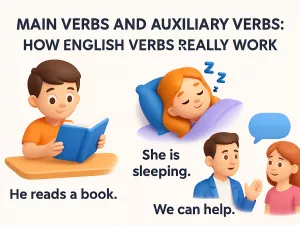
Auxiliary verbs (often called “helping verbs”) are verbs that work with a main verb to build tense, aspect, voice, and sentence type. They don’t usually carry the main meaning by themselves; instead, they supply the grammar framework that lets the main verb show time, completion, passivity, emphasis, or whether something is a question or negative.
Core auxiliaries in English
English relies on three primary auxiliary verbs, each with a distinct job:
- Be (am/is/are/was/were/been/being) → builds progressive aspect and passive voice.
- Have (have/has/had) → builds perfect aspect.
- Do (do/does/did) → supports questions, negatives, and emphasis in simple tenses.
What auxiliaries do: key patterns and uses
- Progressive aspect (be + -ing): “She is studying.” / “They were waiting.”
- Perfect aspect (have + past participle): “I have finished.” / “He had left.”
- Perfect progressive (have + been + -ing): “We have been working all day.”
- Passive voice (be + past participle): “The report was written yesterday.”
- Passive with perfect (have + been + past participle): “The tickets have been checked.”
- Yes/no questions with do-support: “Do you agree?” / “Did she call?”
- Wh- questions with do-support: “What did you say?” / “Where does he live?”
- Negatives with do-support: “I do not know.” / “She doesn’t drive.”
- Emphatic do (affirmative emphasis): “I do understand.” / “He did try.”
- Short answers: “Yes, I do.” / “No, she hasn’t.” / “Yes, they are.”
- Tag questions: “You’re coming, aren’t you?” / “She called, didn’t she?”
- Contractions (common in speech/writing): “She’s” (= she is/has), “they’ve” (= they have), “don’t” (= do not).
- Inversion in questions (auxiliary moves before the subject): “Have you seen it?” / “Are they ready?”
- Auxiliary stacking (more than one helper verb): “It has been repaired.” / “She will have been waiting.”
- Ellipsis after an auxiliary (main verb omitted because it’s understood): “I haven’t finished, but she has.”
Form rules that make auxiliaries easy to spot
- Auxiliaries come before the main verb: “They have arrived,” not “They arrived have.”
- Be is followed by an -ing form (progressive) or a past participle (passive): “is running” / “is chosen.”
- Have is followed by a past participle: “has eaten,” “had gone.”
- Do is followed by the base form of the verb: “does work,” “did go” (not “did went”).
- In negatives and questions, the auxiliary carries tense and agreement: “Does he…?” / “He doesn’t…”
- Only the first auxiliary typically changes for tense: “She has been working” (not “had been worked” unless meaning changes).
Common learner mistakes (with quick fixes)
- ❌ “He did went home.” → ✅ “He did go home.”
- ❌ “They are study now.” → ✅ “They are studying now.”
- ❌ “I have saw it.” → ✅ “I have seen it.”
- ❌ “The letter was write yesterday.” → ✅ “The letter was written yesterday.”
Because auxiliaries control structure, they are the main tools for building accurate verb phrases. This becomes especially important when comparing them with modal verbs, which add meanings like ability, permission, or obligation but follow many of the same placement rules in the verb phrase.
Which verbs belong to the group of modal auxiliaries

In modern English, a small set of helping verbs behave in a distinctive way: they combine directly with the bare infinitive (the base form of the verb), they do not take -s in the third person singular, and they form questions and negatives without do. These are the core members you’ll see in most grammar references.
Core modal auxiliaries (central modals)
- can → ability/possibility: She can swim.
- could → past ability/polite possibility: Could you help?
- may → permission/possibility: You may leave now.
- might → weaker possibility: It might rain.
- must → obligation/strong inference: You must wear a helmet.
- shall → formal future/offer/suggestion (esp. UK, legal): Shall we begin?
- should → advice/expectation: You should see a doctor.
- will → future/intention/prediction: I will call you later.
- would → conditional/polite request/habit in the past: Would you like some tea?
Shared usage patterns that identify modal auxiliaries
- They take a bare infinitive: ✅ She can drive. ❌ She can to drive.
- No third-person -s: ✅ He can swim. ❌ He cans swim.
- Negatives without do: cannot/can’t, should not/shouldn’t, will not/won’t
- Questions by inversion: Can you help? / Should we go?
- No non-finite forms (typically): modals generally do not have to + modal, -ing, or past participle forms (you avoid forms like to must or musting).
- One modal per verb phrase in standard usage: ✅ She may go. ❌ She may can go.
Common “near-modals” often confused with modals
Some verbs express similar meanings (ability, obligation, future), but they do not follow the same grammar. They usually require to, allow tense forms, or use do in questions/negatives. They are better treated as auxiliary-like or semi-auxiliary constructions rather than true modal auxiliaries.
- have to (obligation): Do you have to leave?
- be able to (ability): She is able to drive.
- be going to (planned future): Are you going to call?
- be supposed to (expectation/obligation): You’re supposed to sign here.
- need to (necessity): Do we need to pay now?
- ought to (advice/expectation; behaves partly like a modal but uses to): You ought to rest.
- used to (past habit/state): Did you use to live here?
How modal verbs differ from primary auxiliaries such as be, do, and have
Modal verbs (like can, must, should) and the primary auxiliaries (be, do, have) both help build verb phrases, but they behave differently in form, meaning, and the structures they allow. The differences matter most when you choose tense, make questions/negatives, or combine more than one helper verb.
| Pattern or feature | Modal verbs | Primary auxiliaries (be / do / have) |
|---|---|---|
| Core job in meaning | Add modality: ability, permission, advice, obligation, probability (speaker attitude) | Build grammar: tense/aspect/voice, emphasis, and support for questions/negatives |
| Inflection (verb endings) | No -s in 3rd person singular; no -ing or -ed forms (❌ cans, ❌ musting) | Fully inflect: am/is/are/was/were, do/does/did, have/has/had; participles exist (being, been, having) |
| What form follows | Usually + bare infinitive: can go, should study (no to) | be + -ing / past participle (is going, was taken); have + past participle (has gone); do + base verb (do know) |
| Do they “carry” tense? | Limited tense marking; many have no true past form (e.g., must) and use substitutes (had to) | Clear tense contrasts: is/was, do/did, have/had |
| Questions (inversion) | Invert directly: Can you help? / Should we leave? | Invert the auxiliary: Are you coming? / Have they left?; if no other auxiliary, add do-support: Do you agree? |
| Negatives | Add not after the modal: cannot, should not, must not | Add not after the auxiliary: is not, have not, do not |
| Stacking helpers | Typically only one modal per clause; modals come first: might have gone, should be working | Can stack for aspect/voice after a modal or alone: has been working, is being repaired |
| Use as a main verb | Not used as a normal lexical verb (no infinitive/gerund forms like to can in standard English) | Can be main verbs: be (identity/state), have (possession), do (action): They are happy. She has a car. We did the work. |
| Short answers and tags | Modal repeats: Yes, I can. / No, she shouldn’t. | Auxiliary repeats: Yes, he is. / No, they haven’t. / Yes, I do. |
Practical patterns to remember
- Modal + base verb: ✅ She can drive. ❌ She can drives.
- Modal + have + past participle for past possibility/obligation: He might have missed the train. / You should have called.
- Modal + be + -ing for “in progress” with attitude/uncertainty: They may be waiting outside.
- Modal + be + past participle for passive meaning: The form must be signed.
- Do-support is not used with modals: ❌ Do you can swim? ✅ Can you swim?
- Primary auxiliaries create tense/aspect even without a modal: She has finished. / She is finishing. / It was finished.
- When “to” appears, it usually signals a non-modal construction: have to, be able to, be going to behave more like ordinary verb phrases than true modals.
How auxiliary verbs help build tenses while modals express meaning and attitude
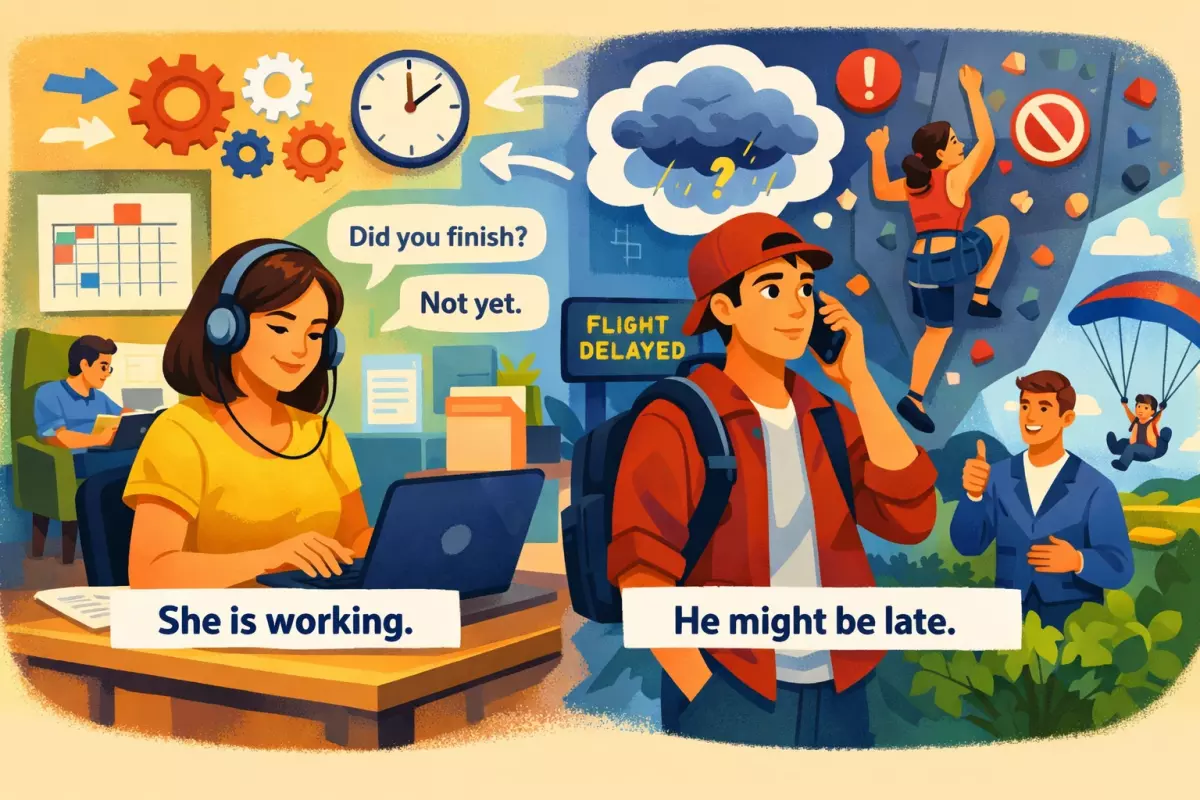
English uses two different “helper” systems. Auxiliary verbs (like be, have, and do) mainly support grammar: they build tense, aspect, voice, and question/negative structure. Modal verbs (like can, must, and might) mainly add meaning: ability, permission, obligation, probability, and attitude. The key is to notice the pattern each type controls.
Auxiliaries: the machinery for tense, aspect, voice, and structure
- Progressive aspect: be + -ing → “She is working.” / “They were waiting.”
- Perfect aspect: have + past participle → “I have finished.” / “He had left.”
- Perfect progressive: have been + -ing → “We have been studying.”
- Passive voice: be + past participle → “The window was broken.” / “The emails are sent daily.”
- Passive with perfect: have been + past participle → “The files have been updated.”
- Questions with be: invert be → “Are you ready?” / “Was she there?”
- Questions with have (perfect): invert have → “Have they arrived?”
- Do-support for simple tenses: do/does/did + base verb → “Do you agree?” / “He did call.”
- Negatives with do: do not + base verb → “She doesn’t know.” / “We didn’t go.”
- Emphasis with do: “I do understand.” (adds stress without changing tense)
- Contractions are common: “She’s working,” “They’ve left,” “I don’t know.”
- Auxiliaries can stack in a fixed order: modal (if present) → perfect (have) → progressive (be) → passive (be) → main verb (participle). Example: “It has been being repaired.” (rare but grammatical)
Modals: meaning first, with a stable verb form
- Core form: modal + base verb → “She can swim.” / “You should leave now.”
- No -s in third person: ❌ “He cans” → ✅ “He can.”
- No infinitive after a modal: ❌ “must to go” → ✅ “must go.”
- Negation attaches to the modal: “You cannot park here.” / “She might not come.”
- Questions invert the modal: “Can you help?” / “Should we start?”
- Typical meanings (context decides the best label):
- Ability: can, could → “I can lift it.”
- Permission: can, may, could → “May I leave early?”
- Obligation/necessity: must, have to, should → “You must wear a helmet.”
- Advice: should, ought to → “You should back up your files.”
- Possibility/probability: might, may, could, must → “It might rain.” / “She must be tired.”
- Willingness/requests: will, would, can, could → “Would you open the window?”
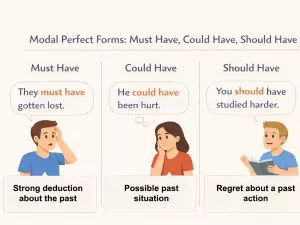
- Past meaning often uses perfect infinitive: modal + have + past participle → “He might have missed the train.” / “You should have called.”
- Reduced tense marking: many modals don’t show a full tense system; past-time reference is frequently expressed through context or the perfect form (“may have…,” “must have…”).
Putting them together: where grammar and meaning meet
- Modal + auxiliary “be” (progressive): “She may be working late.” (possibility + ongoing action)
- Modal + auxiliary “be” (passive): “The form must be signed.” (obligation + passive)
- Modal + auxiliary “have” (perfect): “They could have won.” (past possibility)
- Modal + perfect passive: “The package should have been delivered.” (expectation + passive + past)
- Common pattern check: if the helper is building a tense/aspect/voice frame, it’s functioning as an auxiliary; if it’s adding stance (certainty, permission, duty), it’s functioning as a modal.
Examples where modal verbs and auxiliary verbs appear together
When a modal combines with another helper verb, the modal usually comes first and the next verb is in the base form (for example, be or have). This is how English builds passive voice, progressive aspect, and perfect aspect while still adding meanings like ability, obligation, or possibility.
Common patterns with examples
- Modal + be + -ing (modal meaning + ongoing action): “She may be working late.”
- Modal + be + past participle (modal meaning + passive voice): “The report must be submitted by Friday.”
- Modal + have + past participle (modal meaning + past/perfect inference): “They might have missed the train.”
- Modal + have been + -ing (modal meaning + ongoing action up to a point): “He could have been waiting for hours.”
- Modal + have been + past participle (modal meaning + passive + perfect): “The files should have been backed up already.”
- Modal + be going to + base verb (planned future with modal stance): “We might be going to move soon.”
- Modal + be about to + base verb (imminent action with modal stance): “She may be about to leave.”
- Modal + have to + base verb (modal + semi-modal obligation): “You may have to explain that again.”
- Modal + be able to + base verb (modal + ability phrase, often for tense flexibility): “I might be able to help tomorrow.”
- Modal + need to + base verb (modal + necessity phrasing): “You may need to update your password.”
- Modal + be supposed to + base verb (expectation/arrangement with modal stance): “He should be supposed to start today ❌” → “He is supposed to start today” or “He should start today.”
- Modal + be + adjective/noun phrase (modal meaning + state): “It could be dangerous.”
- Modal + have + noun phrase (modal meaning + possession/experience): “You must have a ticket to enter.”
- Modal + do in short answers (support for emphasis/ellipsis): “Do you agree?” “I might do.”
Usage notes that explain the structure
- After a modal, the next verb is typically the base form: “must be,” “might have,” “should do.”
- Use be to build progressive or passive forms after the modal: “could be waiting” (progressive), “could be delayed” (passive).
- Use have to shift the meaning back in time (perfect): “may have left” often signals uncertainty about a past event.
- Stacking is possible but follows a fixed order: modal → have → been → (-ing or past participle), as in “might have been working” or “should have been repaired.”
Common learner mistakes when confusing modal verbs with auxiliary verbs
Many errors come from treating modals (can, could, may, might, must, shall, should, will, would) as if they behaved like other helping verbs (be, do, have). The patterns look similar on the surface, but the grammar rules for form, negation, questions, and verb endings are different.
Frequent pattern errors (with fixes)
- Adding “to” after a modal
❌ She can to swim. → ✅ She can swim.
Explanation: Most modals take the base verb (bare infinitive), not “to + verb”. - Using -s / -ed / -ing on the main verb after a modal
❌ He must goes. → ✅ He must go.
❌ They might going. → ✅ They might be going.
Explanation: After a modal, the next verb is in base form; continuous/perfect meaning needs an auxiliary pattern (be/have) after the modal. - Doubling auxiliaries with a modal (two “operators”)
❌ Do you can drive? → ✅ Can you drive?
❌ He didn’t can come. → ✅ He couldn’t come.
Explanation: Modals form questions/negatives directly; you usually do not add “do/does/did” with a modal. - Using “don’t/doesn’t” instead of modal negation
❌ She doesn’t must leave. → ✅ She mustn’t leave / She doesn’t have to leave (different meaning).
Explanation: Negation attaches to the modal (cannot, should not, must not). Be careful: “mustn’t” (prohibition) is not the same as “don’t have to” (no necessity). - Using “to” after “must” or “should” in passive/continuous forms
❌ It must to be done. → ✅ It must be done.
❌ You should to be studying. → ✅ You should be studying.
Explanation: Modal + be + past participle (passive) / modal + be + -ing (continuous). - Confusing modal perfect forms with simple past
❌ She must went home. → ✅ She must have gone home.
❌ They could finished earlier. → ✅ They could have finished earlier.
Explanation: Past inference/possibility uses modal + have + past participle. - Mixing up “have to” (semi-modal) with “have” as an auxiliary
❌ I have finished to go. → ✅ I have finished going / I have to go.
Explanation: “Have” as an auxiliary makes perfect tenses (have finished). “Have to” expresses obligation (have to go). They follow different structures. - Incorrect question formation with “have to”
❌ Have you to leave now? → ✅ Do you have to leave now?
Explanation: “Have to” usually uses do-support for questions and negatives in modern English. - Placing “not” in the wrong position
❌ She can go not. → ✅ She cannot go / She can’t go.
❌ He has finished not. → ✅ He has not finished.
Explanation: With modals, “not” follows the modal; with perfect tenses, “not” follows have/has/had. - Using a modal where “be” is required (and vice versa)
❌ I can hungry. → ✅ I am hungry.
❌ She is can swim. → ✅ She can swim.
Explanation: “Be” links to adjectives/nouns (am hungry). Modals express ability/permission/obligation and must be followed by a verb. - Trying to stack two modals
❌ I will can help. → ✅ I will be able to help.
❌ You must should tell him. → ✅ You really should tell him / You must tell him.
Explanation: Standard English does not allow two modals together; use “be able to,” “have to,” or rephrase. - Confusing “used to” with auxiliary “use” or with a modal
❌ I use to can run fast. → ✅ I used to run fast.
Explanation: “Used to” is a fixed form for past habits/states and is followed by the base verb. - Forming tag questions incorrectly
❌ You can swim, don’t you? → ✅ You can swim, can’t you?
❌ She has finished, hasn’t she? (correct) but ❌ She has to leave, hasn’t she? (often wrong) → ✅ She has to leave, doesn’t she?
Explanation: Tags repeat the same auxiliary/operator. “Has” (perfect auxiliary) differs from “has to” (main verb in many tag patterns). - Misreading contractions and choosing the wrong base form
❌ He’d can do it. → ✅ He could do it / He’d be able to do it (context-dependent).
Explanation: Contractions like “he’d” can mean “he had” or “he would,” which changes the grammar that follows. - Overusing “must” where English prefers other forms
❌ You must to see a doctor. → ✅ You must see a doctor / You should see a doctor / You need to see a doctor.
Explanation: Beyond the “to” mistake, learners often pick a modal that is too strong; obligation/advice varies by modal choice.
When checking your own sentences, focus on the “operator” position: a modal itself usually acts as the operator for questions and negation, while be/do/have act as operators in their own tense patterns. If you identify which word is doing that job, the rest of the verb phrase typically falls into place.
Practice exercises on identifying modal and auxiliary verbs
Identify the “helper” in each sentence, then decide what type it is. A quick check: modal verbs (can, could, may, might, must, shall, should, will, would, ought to) typically take a bare infinitive (no to) and don’t change form for he/she/it; auxiliary verbs (be, have, do) build tense, aspect, voice, emphasis, or questions/negatives.
Exercise 1: Underline the helping verb(s) and label them
For each item, write (1) the helping verb(s) and (2) whether each is a modal or an auxiliary. If there is more than one helper, label each one.
- She can swim across the lake.
- They are building a new library.
- I have finished my report.
- Do you know the answer?
- He should call his supervisor.
- The documents were signed yesterday.
- We might be late.
- You must have seen it.
- She doesn’t like coffee.
- They will be waiting outside.
- Has the train arrived?
- The cake was being decorated when we arrived.
Show answers
- can = modal
- are = auxiliary (be + -ing progressive)
- have = auxiliary (have + past participle perfect)
- Do = auxiliary (do-support for a question)
- should = modal
- were = auxiliary (be + past participle passive)
- might = modal; be = main verb (linking verb) in “be late”
- must = modal; have = auxiliary (perfect infinitive “have seen”)
- doesn’t (does + not) = auxiliary (do-support for negative)
- will = modal; be = auxiliary (progressive infinitive “be waiting”)
- Has = auxiliary (perfect question)
- was = auxiliary; being = auxiliary (passive progressive “was being decorated”)
Exercise 2: Choose the correct pattern (modal vs. auxiliary structure)
Select the best option. Focus on the form that should follow the helper (bare infinitive after modals; participles after be/have; base form after do-support).
- He can (go / goes) tomorrow.
- She (is / does) working late this week.
- They have (finish / finished) the task.
- (Do / Are) you understand this rule?
- You should (to call / call) her back.
- The windows were (break / broken) during the storm.
- We didn’t (went / go) to the meeting.
- I might (be / am) wrong.
- He has (been / being) very helpful.
- The report is (write / being written) right now.
Show answers
- go
- is
- finished
- Do
- call
- broken
- go
- be
- been
- being written
Exercise 3: Spot the classification traps
Some words look like helpers but are not acting as auxiliary verbs in context. For each sentence, decide whether the bold word is functioning as (A) a modal, (B) an auxiliary, or (C) a main verb.
- Have you any questions?
- I have a meeting at 3.
- She did her best.
- Did she call you?
- They are happy.
- They are leaving now.
- You must be quiet.
- You will a prize to the winner.
- He can the tomatoes.
- We should have left earlier.
Show answers
- B (auxiliary in some varieties; “have” used for questions without do-support)
- C (main verb meaning “possess”)
- C (main verb meaning “perform”)
- B (auxiliary do-support for a question)
- C (main verb “be” as a linking verb)
- B (auxiliary “be” forming the progressive)
- A (modal)
- C (main verb “will” meaning “leave/assign by will”)
- C (main verb “can” meaning “put in cans”)
- A + B (should = modal; have = auxiliary in “have left”)
Quick self-check patterns (use while correcting)
- Modal + base verb: “may leave,” “should try,” “must stop” (❌ “should to try”).
- Perfect: have + past participle: “has eaten,” “had left,” “might have seen.”
- Progressive: be + -ing: “is running,” “were waiting,” “will be working.”
- Passive: be + past participle: “was made,” “is used,” “has been repaired.”
- Do-support: do/does/did + base verb for questions/negatives/emphasis: “Do you agree?”, “She didn’t go,” “I did check.”
- Two helpers can stack: modal + have + past participle (“could have gone”), modal + be + -ing (“might be sleeping”), or modal + have been + -ing (“should have been studying”).