Why Modal Verbs Never Change Form in English Grammar

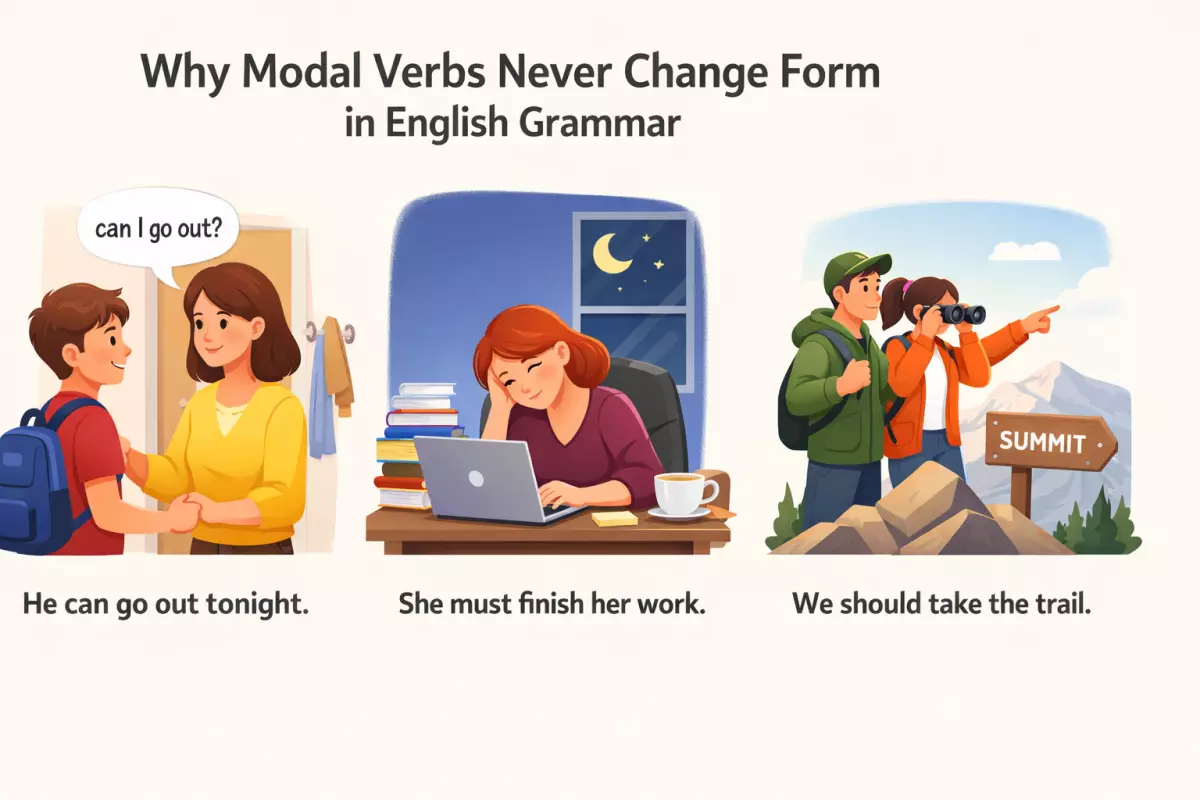 Explains why modal verbs don’t change for any subject, why they take the base verb, and why they never add s, ed, or ing. Includes examples across subjects, how English shows past meaning without changing modals, when another modal replaces a missing tense, plus exercises and homework.
- Why modal verbs stay identical for every subject in English
- The rule that modal verbs are always followed by the base form of the main verb
- Why modal verbs do not use endings such as s, ed, or ing
- Examples showing modal verbs used with different subjects
- How English expresses past meaning when modal verbs themselves do not change
- Situations where a different modal verb replaces a missing tense form
- Exercises and homework to practice correct modal verb forms
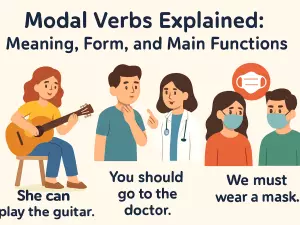
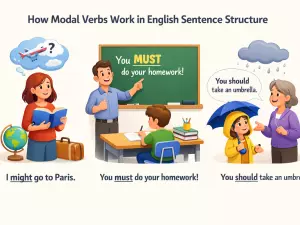
Many learners are surprised that the helping verbs can, must, and should stay the same no matter who is speaking or when the action happens. In everyday English, these modal helpers don’t take -s, -ed, or -ing, so we say she can, not she cans, and we rely on other words to show time and meaning. Noticing this pattern in real conversations makes your sentences quicker, clearer, and more confident.
Why modal verbs stay identical for every subject in English
English modals (such as can, must, and should) don’t take the usual verb endings that change with the subject. Instead of adding -s in the third person singular or using multiple present-tense forms, modals keep one present form and combine with a base verb to express meaning like ability, obligation, permission, or possibility.
Core pattern: modal + base verb
The main usage pattern is stable across subjects: modal + base form (also called the bare infinitive). The verb after the modal does not take to and does not change for person or number.
- I can swim.
- She can swim.
- They can swim.
- We should leave now.
- He must follow the rules.
They don’t behave like normal present-tense verbs
Most present-tense verbs show subject agreement: I work but she works. Modals don’t follow that agreement rule, so there is no third-person -s form.
- ✅ She can drive. ❌ She cans drive.
- ✅ He must go. ❌ He musts go.
- ✅ It may rain. ❌ It mays rain.
Modals are “defective” verbs with limited forms
Modal verbs have a smaller set of forms than typical verbs. Many do not have an infinitive, an -ing form, or a past participle. Because the system is limited, English uses other constructions when those missing forms are needed.
- No infinitive: ❌ to can → use to be able to (to be able to swim)
- No -ing form: ❌ canning (ability) → use being able to
- No past participle: ❌ have canned (ability) → use have been able to
- Limited past forms: could, might, would, should exist, but don’t behave like regular past tense in every meaning
Questions and negatives use the modal directly
Because modals act like auxiliaries, they form questions by inversion and negatives with not—without adding do/does. This auxiliary behavior is another reason their form stays constant across subjects.
- Question: Can you help? / Can she help?
- Negative: I cannot (can’t) agree. / He cannot (can’t) agree.
- Question: Should we wait? / Should he wait?
- Negative: They must not enter. / She must not enter.
Quick subject-by-subject check (same modal every time)
- I can / you can / he can / she can / it can / we can / they can
- I will / you will / he will / she will / it will / we will / they will
- I should / you should / he should / she should / it should / we should / they should
- I may / you may / he may / she may / it may / we may / they may
- I might / you might / he might / she might / it might / we might / they might
- I must / you must / he must / she must / it must / we must / they must
In practice, the rule is simple: choose the modal for the meaning you want, keep it unchanged for every subject, and put the main verb in the base form right after it.
The rule that modal verbs are always followed by the base form of the main verb
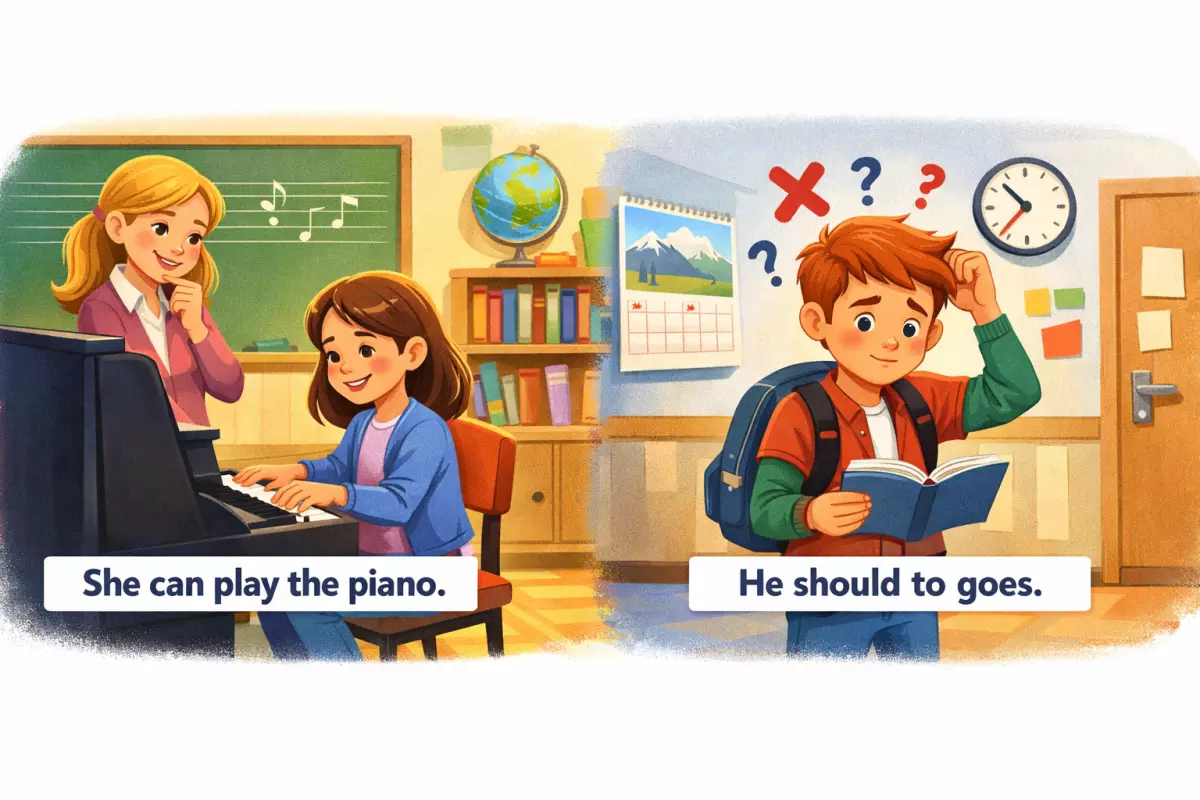
After a modal (such as can, must, or should), English uses the plain infinitive of the next verb: the dictionary form without to, without -s, and without -ing. This pattern stays the same across subjects (I/you/he/we/they) and is one reason modals feel “fixed” in shape.
What “base form” means in this pattern
The base form is the verb form you see in a dictionary entry: go, eat, be, have, do, work. After a modal, you do not add third-person -s (he goes), you do not use to (to go), and you do not switch to -ing unless another structure requires it.
Core pattern
- Modal + base verb: She can drive.
- Modal + not + base verb: They should not wait.
- Modal + subject + base verb (questions): Can you help?
- Modal + base verb + complement: We must finish the report.
Common correct vs. incorrect examples
- ✅ She can swim. ❌ She can swims.
- ✅ He should go now. ❌ He should to go now.
- ✅ You must be quiet. ❌ You must being quiet.
- ✅ They might arrive late. ❌ They might arrives late.
- ✅ We could try again. ❌ We could trying again.
- ✅ I will call you. ❌ I will called you.
- ✅ She may leave early. ❌ She may left early.
- ✅ You shall receive an email. ❌ You shall receives an email.
- ✅ He must not touch that. ❌ He must not touches that.
- ✅ Should we start? ❌ Should we starting?
- ✅ Can she do it? ❌ Can she does it?
- ✅ Might I ask a question? ❌ Might I asking a question?
How to handle “two-verb” meanings (time, aspect, and passive)
When you need a perfect, continuous, or passive meaning, the modal still takes a base verb immediately after it. The extra meaning is carried by the next auxiliary (also in base form), and then by the main verb form that follows.
- Perfect: modal + have + past participle → She may have missed the bus.
- Continuous: modal + be + -ing → He must be working.
- Passive: modal + be + past participle → The form should be signed.
- Perfect passive: modal + have been + past participle → The package could have been delivered.
Quick checklist for accurate modal verb usage
- Put the modal first, then choose the next verb in its plain form: can go, should see, must do.
- Do not add -s after modals, even with he/she/it: She can work (not can works).
- Do not insert to after a true modal: They might leave (not might to leave).
- Use not directly after the modal for negatives: cannot/can’t, should not, must not.
- For perfect/continuous/passive meanings, keep the first verb after the modal as have or be in base form.
Why modal verbs do not use endings such as s, ed, or ing
Core modal verbs stay in a single base form because they function as auxiliary verbs, not as full main verbs. Their job is to add meanings like ability, permission, obligation, or possibility to another verb, and that supporting role comes with a fixed shape: they do not take third-person -s, past -ed, or progressive -ing endings.
Pattern to remember: modal + base verb
A modal is followed by the base form of the main verb (also called the bare infinitive). This structure is stable across subjects and time references, so English does not need extra endings on the modal itself.
- Subject changes do not change the modal: I can / you can / she can / they can.
- Time is often shown by context or by the verb after the modal: She may leave tomorrow; She may be leaving now; She may have left already.
- Negatives and questions use the modal directly: Can you swim? / You cannot swim.
Common “no-ending” contrasts (correct vs. incorrect)
- ✅ She can drive. ❌ She cans drive.
- ✅ He must leave now. ❌ He musts leave now.
- ✅ It may rain. ❌ It mays rain.
- ✅ They should call. ❌ They shoulded call.
- ✅ We will help. ❌ We wills help.
- ✅ I could swim when I was five. ❌ I coulded swim when I was five.
- ✅ You might be right. ❌ You mighting be right.
- ✅ She shall return. ❌ She shalls return.
- ✅ He would agree. ❌ He woulds agree.
- ✅ You ought to rest. ❌ You oughts to rest.
- ✅ Must I go? ❌ Do I must go?
- ✅ You cannot enter. ❌ You don’t can enter.
How English expresses tense and aspect without changing the modal
Because these auxiliaries do not inflect, English typically shifts meaning using other parts of the verb phrase. The modal stays the same while the following verb (or auxiliary) carries the time/aspect information.
- Progressive meaning: may be working, could be waiting, should be studying.
- Perfect meaning: might have forgotten, must have left, should have called.
- Passive meaning: can be done, should be checked, must be followed.
- Future reference: will arrive, may happen, should be fine.
Important note: “semi-modals” can take endings
Some expressions behave like modals in meaning but are grammatically main verbs or verb phrases. These often do take -s, -ed, or -ing, which helps explain why learners sometimes expect the same from true modals.
- have to: She has to leave; She had to leave; She is having to wait.
- be able to: He is able to help; He was able to help; He’s being able to do more lately (less common, but possible in some contexts).
- need to: She needs to go; She needed to go.
- be going to: She is going to call; She was going to call.
Examples showing modal verbs used with different subjects

Modal verbs keep the same form no matter who the subject is. The pattern stays stable: subject + modal + base verb. There is no -s for third person singular, and you do not change the modal for plural subjects.
| Subject | Correct pattern (modal stays the same) | Common mistake to avoid |
|---|---|---|
| I | I can swim. | ❌ I cans swim. |
| You | You should call today. | ❌ You shoulds call today. |
| He | He must leave now. | ❌ He musts leave now. |
| She | She may join us later. | ❌ She mays join us later. |
| It | It might rain tonight. | ❌ It mights rain tonight. |
| We | We could try again. | ❌ We coulds try again. |
| They | They will arrive soon. | ❌ They wills arrive soon. |
| Singular noun (The student) | The student shall submit the form. | ❌ The student shalls submit the form. |
| Plural noun (The students) | The students can submit the form. | ❌ The students cans submit the form. |
| Compound subject (Anna and Leo) | Anna and Leo should review the notes. | ❌ Anna and Leo shoulds review the notes. |
What these patterns show
- The modal verb is fixed: can, could, may, might, must, shall, should, will, would do not add endings for he/she/it.
- The main verb after a modal stays in the base form: can go, should study, will help (not goes, studies, helps).
- Changing the subject does not change the modal: I can → she can → they can.
- If you need a different meaning (ability, advice, possibility, obligation, prediction), you choose a different modal—not a different form of the same modal.
How English expresses past meaning when modal verbs themselves do not change
Because core modals don’t take endings like -ed, English usually signals past time by changing other parts of the verb phrase. The most common tools are (1) choosing a different modal form where one exists, (2) adding the perfect infinitive (have + past participle), and (3) shifting time reference through context, reporting verbs, or surrounding past-tense verbs.
Common patterns for past reference
- Use a past-form modal when English has one (often for remoteness, politeness, or reported speech, and sometimes for past time):
- ✅ Present-ish: can / Past: could → “I can help now.” / “I could help yesterday.”
- ✅ Present-ish: will / Past: would → “She will call later.” / “She said she would call.”
- ✅ Present-ish: shall / Past: should → “I shall return.” / “He said I should return.”
- ✅ Present-ish: may / Past: might → “It may rain.” / “It might rain (uncertain, often less direct).”
- Note: could/would/should/might do not always mean past time; they often mark distance (hypothetical, polite, tentative). Past meaning is clearest when the rest of the sentence anchors the time (e.g., “yesterday,” “last year,” “at that moment”).
- Use the perfect infinitive to look back from a reference point: modal + have + past participle.
- ✅ must have + past participle (strong inference about a past situation): “They must have left early.”
- ✅ may/might have (possibility in the past): “She might have missed the train.”
- ✅ could have (past possibility/ability not realized, or criticism depending on tone): “I could have helped.” / “You could have told me.”
- ✅ would have (unreal past result / conditional): “I would have gone, but I was sick.”
- ✅ should have (past obligation/expectation not met): “You should have called.”
- ✅ needn’t have (unnecessary action that happened): “You needn’t have worried.”
- ✅ ought to have (similar to should have): “They ought to have checked the details.”
- Use a past-time framework in the clause, while the modal stays the same form (time is carried by other verbs, adverbs, or the situation):
- Past reporting verb + modal: “He said I can stay” (informal) / more typical “He said I could stay.”
- Past adverbials: “At the time, I can’t remember the name” (narrative present for vividness), but standard past narrative prefers “I couldn’t remember…”.
- Sequence of tenses in indirect speech often pushes modals to a past form when available: “She says, ‘I will go.’” → “She said she would go.”
- Use a non-modal construction when you need a clear past form (especially for meanings that don’t have a dedicated past modal):
- Ability: “I was able to finish” (often clearer than “I could finish,” which can sound like general ability).
- Permission: “We were allowed to enter” (instead of relying on “could” if permission is the focus).
- Obligation: “I had to leave early” (past of “have to,” since “must” doesn’t take a past form).
- Future-in-the-past: “We were going to meet” (often more concrete than “would”).
- Recognize the difference between “past time” and “remote meaning” (a frequent source of confusion):
- ✅ Past time: “When I was younger, I could run fast.”
- ✅ Remote/hypothetical: “I could run fast if I trained.”
- ✅ Past time: “He didn’t have to pay yesterday.”
- ✅ Present meaning: “You don’t have to pay today.”
In practice, the most reliable “past marker” with modal meanings is the structure around the modal: a perfect infinitive for looking back, a past reporting frame for backshift, or a past-tense substitute like had to and was able to when the language doesn’t offer a dedicated past modal form.
Situations where a different modal verb replaces a missing tense form
English modals don’t supply a full tense system (no infinitives, no -ing forms, and no normal past participles). To express time, distance, politeness, or reported speech, English often switches to a different modal or to a periphrastic form such as be able to or have to. The key is to choose the replacement that matches the meaning (ability, obligation, permission, likelihood) and the time frame (present, past, future, perfect).
Common replacements and the patterns they follow
| Meaning you need | Missing/limited form | Typical replacement | Example |
|---|---|---|---|
| Ability (general) | Infinitive / -ing of can | be able to | I’d like to be able to swim well. |
| Ability (past event achieved) | Past of can doesn’t show “managed to” | was/were able to, managed to | We were able to fix it before midnight. |
| Obligation (general) | Infinitive / -ing of must | have to | She hates having to get up early. |
| Obligation (past) | No true past of must for obligation | had to | I had to leave at 6. |
| No obligation / prohibition (past) | mustn’t has no past form | didn’t have to / wasn’t allowed to | We didn’t have to pay. / We weren’t allowed to enter. |
| Permission (more formal / future) | can can be limited by register | may, be allowed to | May I ask a question? / You’ll be allowed to resit. |
| Polite request / distance | Direct can may sound blunt | could, would | Could you open the window? |
| Future inference / likelihood | will isn’t always “prediction” | should, may, might | It should be ready by Friday. |
| Past possibility | No “past tense” of may/might in meaning | may/might have + past participle | She might have missed the train. |
| Past certainty / deduction | No simple past “deduction” modal | must have + past participle | They must have forgotten. |
| Past ability (general background) | can doesn’t take a normal past form for all uses | could | When I was young, I could run fast. |
| Reported speech backshift | Present modals often shift in reporting | can → could, will → would, may → might | He said he could help. / She said she would call. |
Usage notes that prevent common errors
- Use “be able to” when you need an infinitive or -ing form. ❌ I want to can drive. ✅ I want to be able to drive.
- Choose “was/were able to” for a single successful action in the past. “Could” often describes general past ability, not a one-time achievement.
- Use “had to” for past obligation. ❌ Yesterday I must go. ✅ Yesterday I had to go.
- Separate “no obligation” from “prohibition.” “Didn’t have to” means it wasn’t necessary; “wasn’t allowed to” means it was forbidden.
- Use perfect modal patterns for “past meaning” deductions. Present-time modals don’t simply “turn into” past tense; instead use modal + have + past participle (must have, might have, could have).
- Prefer “could/would” to soften requests. This is not a tense change; it’s a politeness and distance pattern that often looks like a past form.
- In reporting, modals often shift one step back. The shift is optional when the situation is still true, but common when the report is clearly in the past.
Exercises and homework to practice correct modal verb forms
Use these tasks to build the habit that modals keep one form: no -s in the third person, no -ed for past, and no to before the main verb (with a few special cases like ought to and semi-modals such as have to).
1) Quick correction drill (spot the form mistake)
- She cans speak French.
- They musted leave early.
- He will to call you later.
- I shoulds apologize.
- We mayed miss the train.
- Does she can drive?
- He didn’t must pay.
- To be safe, you ought wear a helmet.
- She could to help tomorrow.
- He mightn’t to agree.
Show answers
- She can speak French.
- They had to leave early. / They must leave early. (depending on meaning)
- He will call you later.
- I should apologize.
- We may miss the train.
- Can she drive?
- He didn’t have to pay. (or: He mustn’t pay = prohibition, different meaning)
- To be safe, you ought to wear a helmet.
- She could help tomorrow.
- He mightn’t agree.
2) Choose the correct option (focus on patterns)
- My brother (can / canes) swim very fast.
- She (must / musts) be at work by 9.
- We (should to / should) leave now.
- (May / Mayed) I come in?
- He (doesn’t can / can’t) attend today.
- (Can / Do can) you hear me?
- They (didn’t must / didn’t have to) pay for parking.
- You (ought / ought to) check the address.
- I (might / mighted) be late.
- She (will / wills) call you tonight.
- He (could / coulds) help if he had time.
- We (mustn’t / don’t must) park here.
Show answers
- can
- must
- should
- May
- can’t
- Can
- didn’t have to
- ought to
- might
- will
- could
- mustn’t
3) Rewrite practice (keep the meaning, fix the grammar)
- Rewrite using a modal: “It is possible that he is busy.”
- Rewrite using a modal: “It is necessary for her to leave now.”
- Rewrite using a modal: “It is a bad idea for you to skip breakfast.”
- Rewrite using a past form without changing the modal itself: “I must finish yesterday.”
- Rewrite as a question: “You can speak Spanish.”
- Rewrite as a negative: “He may join us.”
- Rewrite with the same meaning: “She doesn’t need to come early.”
- Rewrite to show prohibition: “It is not allowed to smoke here.”
Show answers
- He may be busy. / He might be busy.
- She must leave now. / She has to leave now.
- You shouldn’t skip breakfast.
- I had to finish yesterday.
- Can you speak Spanish?
- He may not join us.
- She doesn’t have to come early.
- You mustn’t smoke here.
4) Homework: production tasks (write your own sentences)
- Write 10 sentences about your week using these modals exactly once each: can, could, may, might, must, should, will, would, shall, ought to.
- For 5 of your sentences, add a second version that is negative (e.g., can → can’t; should → shouldn’t). Keep the main verb in the base form.
- Turn 5 sentences into questions by moving the modal before the subject (e.g., “You can…” → “Can you…?”). Do not add do/does/did.
- Write 6 “past meaning” sentences without changing the modal form: use patterns like had to, could, might have + past participle, should have + past participle.
- Self-check checklist for every sentence you wrote:
- No third-person -s on a modal (❌ “she cans”).
- No past -ed on a modal (❌ “musted”).
- Base verb after the modal (❌ “can goes” → ✅ “can go”).
- No to after most modals (❌ “should to go”), except fixed ought to.
- No do-support with modals in questions/negatives (❌ “Do you can…?” → ✅ “Can you…?”).