What Are Modal Verbs in English? Complete Guide

 This article explains what modal verbs are and how they shift meaning, covers the main modals and the ideas they express, shows how they pair with the base verb, and why they don’t change form. It includes ability, permission, obligation, and possibility, plus real examples and practice exercises.
- What modal verbs are and how they change the meaning of a sentence
- The main modal verbs in English and the ideas they express
- How modal verbs combine with the base form of the main verb
- Why modal verbs do not change form like regular verbs
- Situations where modal verbs express ability, permission, obligation, or possibility
- Tone, politeness, and certainty: how modal choice changes your message
- Real examples of modal verbs used in everyday English communication
- Common modal verb mistakes and how to fix them
- Exercises and practice tasks to reinforce modal verb usage
- Recommended reading and study plan for modal verbs
- FAQ about modal verbs in English
Modal verbs are small helping verbs with a big effect on meaning. Words like can, could, may, might, must, should, will, and would help you express ability, permission, advice, obligation, possibility, prediction, politeness, and certainty.
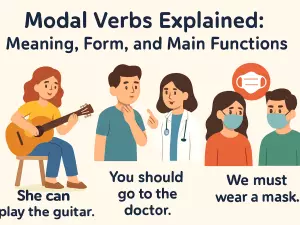
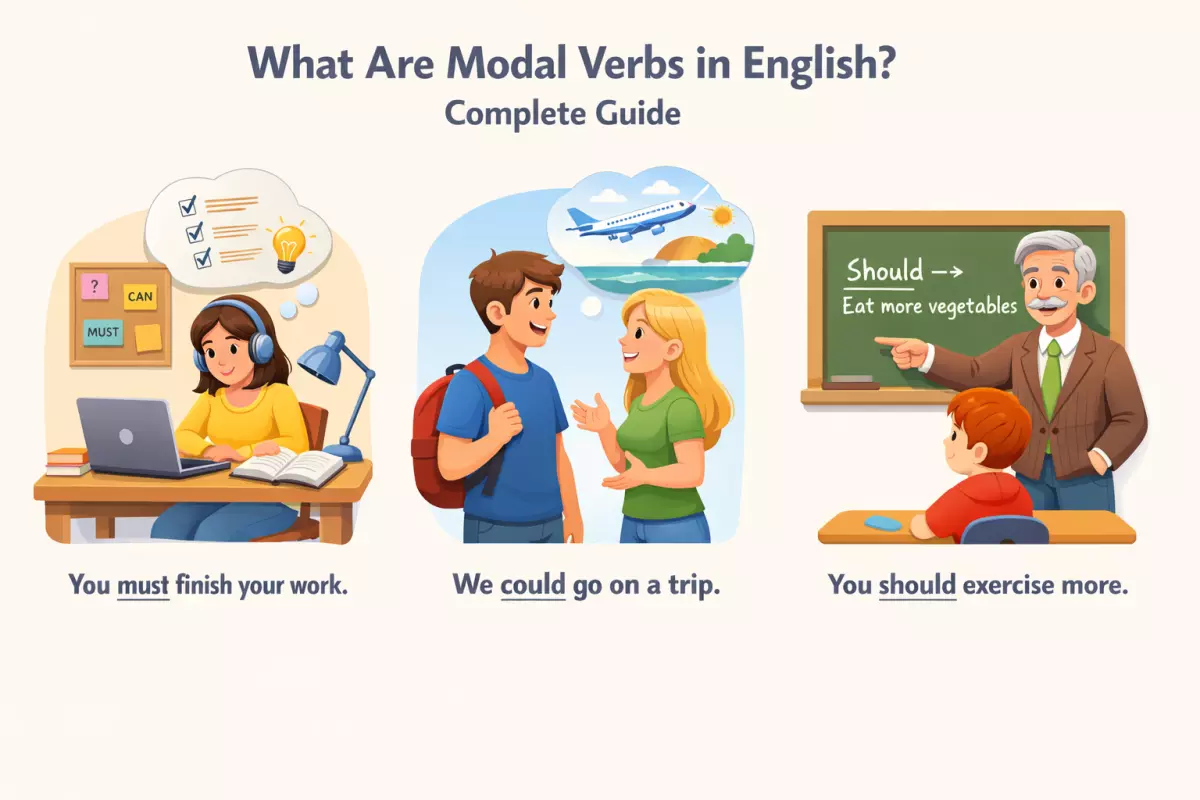
The main verb tells us the action. The modal verb tells us the speaker’s attitude toward that action. Compare: You can leave now, You should leave now, and You must leave now. The action is the same, but the message changes from permission to advice to strong obligation. This is the key to understanding how modal verbs change sentence meaning in real English.
Quick idea: Modal verbs do not just “decorate” a sentence. They help you show whether something is possible, necessary, allowed, recommended, polite, certain, or hypothetical.
What modal verbs are and how they change the meaning of a sentence
A modal verb is a special auxiliary verb that comes before the main verb and changes the meaning of the whole sentence. It does not usually describe the action itself. Instead, it shows how the speaker sees the action: possible, necessary, allowed, polite, likely, impossible, advisable, or hypothetical.
The basic idea behind modal verbs
Look at how one action changes when the modal changes:
| Sentence | Meaning | Function |
|---|---|---|
| You can wait here. | You are allowed to wait here. | Permission |
| You should wait here. | Waiting here is a good idea. | Advice |
| You must wait here. | Waiting here is required. | Strong obligation |
| You might wait here. | Waiting here is possible, but not certain. | Uncertainty |
| You could wait here. | Waiting here is one possible option. | Suggestion or possibility |
This is why modal verbs are so important in real English. They help you avoid sounding too direct, too weak, too strict, or too uncertain.
Fact vs attitude
A sentence without a modal often sounds like a simple fact. A sentence with a modal adds the speaker’s attitude.
- She studies every night. — simple fact or routine.
- She can study in English. — ability.
- She should study tonight. — advice.
- She might study later. — possibility.
- She must study for the test. — obligation.
Practical learning note: When you are not sure which modal to use, do not start with translation. Start with the function. Ask: am I expressing ability, permission, advice, obligation, possibility, politeness, or certainty?
For a deeper explanation of the sentence pattern itself, you can also study modal verb sentence structure.
The main modal verbs in English and the ideas they express

Each modal verb can express more than one idea. The exact meaning depends on context. For example, can can express ability, permission, or general possibility. Must can express obligation or strong deduction.
Core modal verbs and their most common uses
| Modal verb | Main meanings | Example |
|---|---|---|
| can | Ability, informal permission, general possibility | I can help you. |
| could | Past ability, polite request, possibility | Could you repeat that? |
| may | Formal permission, possibility | May I come in? |
| might | Uncertain possibility, cautious suggestion | It might rain later. |
| must | Strong obligation, strong deduction | You must wear a helmet. |
| shall | Offers, suggestions, formal rules | Shall we begin? |
| should | Advice, expectation, mild obligation | You should rest. |
| will | Prediction, willingness, promise, decision | I will call you later. |
| would | Polite request, hypothetical result, past habit | Would you help me? |
Can and could
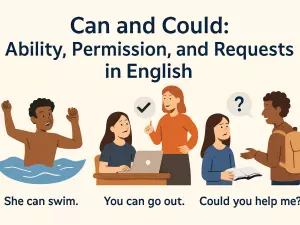
Can usually expresses present ability, informal permission, or general possibility. Could can express past ability, a polite request, a possible option, or a hypothetical situation.
- I can understand simple conversations. — ability now.
- Can I ask a question? — informal permission.
- This road can be dangerous at night. — general possibility.
- I could swim when I was six. — past general ability.
- Could you speak more slowly? — polite request.
If these two forms are confusing, compare them in more detail in this guide to can vs could.
May and might
May and might both express possibility, but may often sounds more formal or neutral, while might often sounds more uncertain or cautious.
- We may need more time. — possible, fairly neutral.
- We might need more time. — possible, more tentative.
- May I leave early? — formal permission.
- She might not agree. — it is possible that she will not agree.
Must, should, and ought to
Must is strong. It can express a rule, duty, urgent necessity, or strong logical conclusion. Should is softer and usually gives advice, expectation, or a recommended action. Ought to is close to should, but often sounds a little more formal or moral.
- You must stop at a red light. — rule.
- You should check your answer. — advice.
- You ought to be more careful. — strong advice or moral expectation.
Will and would
Will often expresses prediction, willingness, promise, or a decision made now. Would often appears in polite requests, hypothetical results, past habits, and preferences.
- I will send the file tonight. — promise or decision.
- It will probably work. — prediction.
- Would you mind waiting? — polite request.
- I would travel more if I had time. — hypothetical result.
- When we were children, we would play outside every day. — past habit.
How modal verbs combine with the base form of the main verb
The most important grammar rule is simple: a true modal verb is followed by the base form of the main verb. This base form is also called the bare infinitive. It means the infinitive without to.
Core pattern: subject + modal verb + base verb. For example: I can help, she should study, they might arrive, we must leave.
Statements
- I can drive.
- She should call her teacher.
- They might arrive late.
- We must leave now.
- He will explain the rule.
Negatives
To make a negative sentence, put not after the modal. In everyday English, contractions are very common.
- I cannot come. / I can’t come.
- You should not worry. / You shouldn’t worry.
- They might not agree.
- You must not touch this. / You mustn’t touch this.
- It will not work. / It won’t work.
Questions
To form a question, place the modal before the subject. You do not need do, does, or did.
- Can you help me?
- Should we wait?
- May I ask a question?
- Would you like some coffee?
- Must I sign this form?
For more examples of this question pattern, review modal verbs in questions.
The rule learners forget most often
After a modal, do not add to, -s, -ed, or -ing to the main verb unless you are using a larger structure such as modal + be + -ing or modal + have + past participle.
- ❌ She can to swim.
- ✅ She can swim.
- ❌ He musts leave.
- ✅ He must leave.
- ❌ They should studied.
- ✅ They should study.
- ❌ Do you can help?
- ✅ Can you help?
For a focused explanation of this pattern, see the guide to modal verbs without to.
Advanced patterns after modal verbs
Modal verbs can also combine with other verb forms to express time, progress, or passive meaning.
| Pattern | Example | Meaning |
|---|---|---|
| Modal + base verb | She might call. | Possible action |
| Modal + be + -ing | She might be calling now. | Possible action in progress |
| Modal + have + past participle | She might have called earlier. | Possible past action |
| Modal + be + past participle | The file must be sent today. | Passive modal structure |
| Modal + have been + -ing | He must have been working all night. | Strong deduction about past progress |
Why modal verbs do not change form like regular verbs
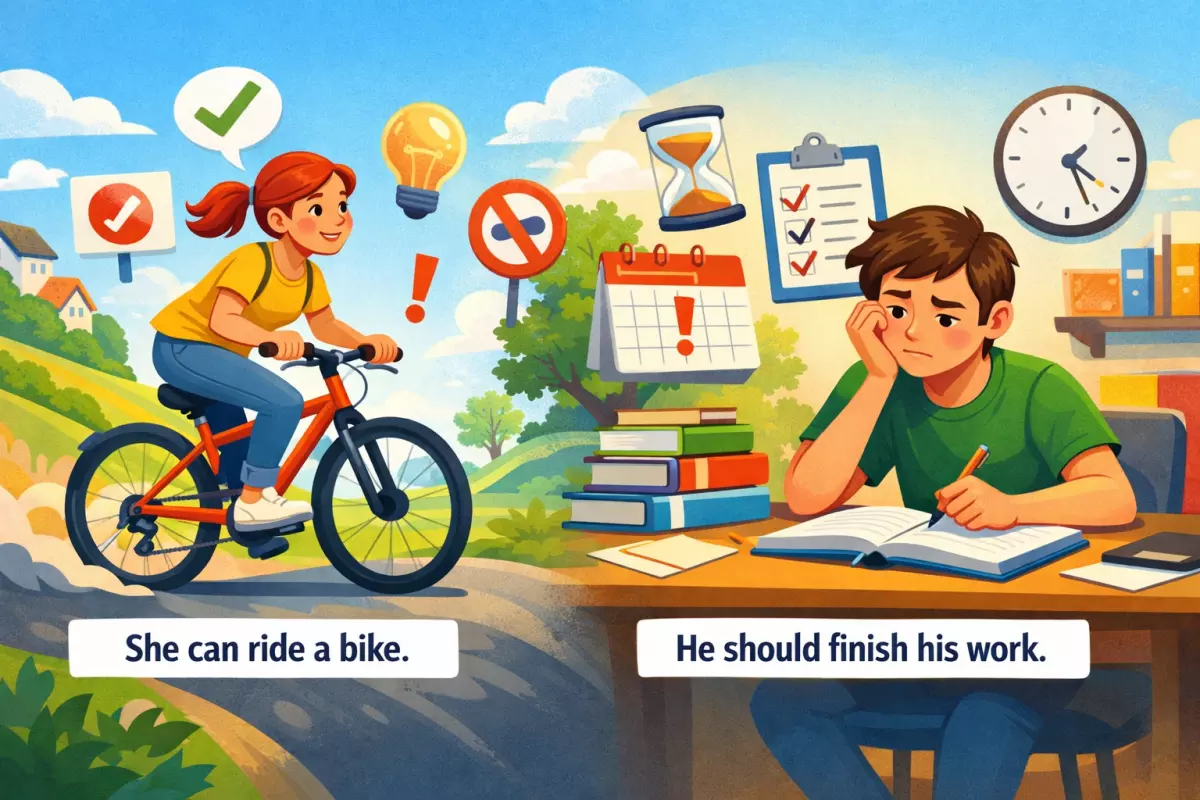
Modal verbs behave differently from regular verbs because they are auxiliary verbs. A regular verb can change form: work, works, worked, working. A modal verb normally does not change like that.
No third-person -s
- ✅ I can swim. / She can swim.
- ❌ She cans swim.
- ✅ They should leave now.
- ❌ They shoulds leave now.
- ✅ You must wear a seatbelt.
- ❌ You musts wear a seatbelt.
No regular past form for most modals
Most modal verbs do not simply take -ed to show the past. English usually uses another modal, a perfect modal structure, or a semi-modal phrase.
| Meaning | Present or general form | Past or alternative form |
|---|---|---|
| Ability | I can swim. | I could swim when I was five. |
| Single successful action | I can fix it. | I was able to fix it yesterday. |
| Obligation | I must leave now. | I had to leave early. |
| Past possibility | She might be late. | She might have been late. |
| Past advice | You should call. | You should have called. |
No do-support in modal questions and negatives
Because modal verbs already behave like auxiliaries, English does not add do, does, or did to form basic questions and negatives.
- ✅ Can you help?
- ❌ Do you can help?
- ✅ She cannot attend.
- ❌ She doesn’t can attend.
- ✅ Should we call him?
- ❌ Do we should call him?
Common modal verb mistakes and how to fix them
Most modal mistakes happen because learners treat modal verbs like regular verbs. The safest rule is: modal + base verb.
Teacher’s field note: translate the function, not the word
Many learners try to translate one modal from their first language into English every time. This often creates errors because English modal verbs are tied to function and context. The same modal may express ability in one sentence, permission in another, and possibility in another.
Micro-drill before choosing a modal
Before choosing a modal, complete this sentence in your mind: “I want to express...”
- I want to express ability → can, could, be able to
- I want to express advice → should, ought to
- I want to express a rule → must, have to
- I want to express uncertainty → may, might, could
- I want to express strong deduction → must, can’t
Mistake 1: adding to after a modal
- ❌ I must to go.
- ✅ I must go.
- ❌ She can to speak English.
- ✅ She can speak English.
Mistake 2: adding -s to the modal or main verb
- ❌ He cans drive.
- ✅ He can drive.
- ❌ She should studies.
- ✅ She should study.
Mistake 3: using do or does in modal questions
- ❌ Do you can help me?
- ✅ Can you help me?
- ❌ Does she should call?
- ✅ Should she call?
Mistake 4: using two true modals together
Standard English usually does not combine two central modals directly.
- ❌ He will can come tomorrow.
- ✅ He will be able to come tomorrow.
- ❌ You must should apologize.
- ✅ You really should apologize.
Mistake 5: using a past form where a perfect modal is needed
For past possibility, regret, criticism, or deduction, English often uses modal + have + past participle.
- ❌ She must missed the bus.
- ✅ She must have missed the bus.
- ❌ You should told me.
- ✅ You should have told me.
For more advanced work with this pattern, use this lesson on perfect modal constructions.
Situations where modal verbs express ability, permission, obligation, or possibility
The best way to master modal verbs is to connect each one with a real situation. Instead of memorizing a long list, learn what you are trying to do: describe a skill, ask permission, give advice, explain a rule, make a guess, or soften your message.
Ability: can, could, be able to
Use can for present or general ability. Use could for general ability in the past. Use be able to when you need forms that can does not have, especially in the future, present perfect, or for a single completed success.
- I can read simple articles in English.
- She can understand native speakers when they speak slowly.
- When I was younger, I could memorize words quickly.
- I will be able to join the class next week.
- We were able to finish the project on time.
Permission: can, could, may
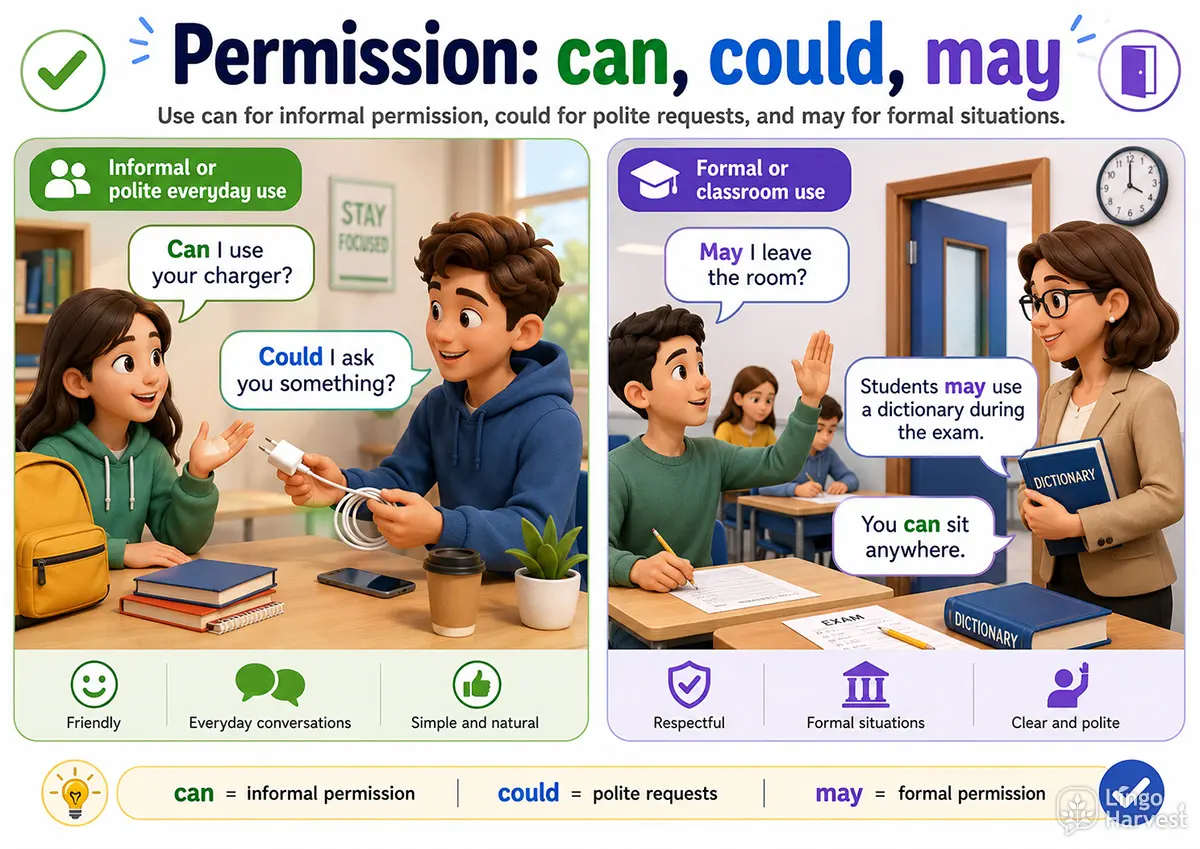
Use can for common informal permission. Use could to make a request more polite. Use may in more formal situations, such as classrooms, offices, written instructions, or official rules.
- Can I use your charger?
- Could I ask you something?
- May I leave the room?
- You can sit anywhere.
- Students may use a dictionary during the exam.
Obligation and rules: must, have to, should
Must often feels strong and direct. It can express an important rule, an urgent personal obligation, or a strong warning. Have to often refers to an external requirement: a law, school rule, job requirement, or practical necessity. Should is usually advice, not a strict rule.
- You must not enter this area. — strong prohibition.
- I have to submit the form by Friday. — external deadline.
- You should review the lesson before the test. — advice.
- You don’t have to print the document. — no obligation.
- You mustn’t share your password. — it is forbidden.
A very common learner mistake is confusing mustn’t and don’t have to. For a focused comparison, study must vs have to.
Possibility and probability: may, might, could, must, can’t
Use may, might, and could for uncertain possibilities. Use must when you are almost certain something is true. Use can’t when you are almost certain something is not true.
- She might be busy. — possible, uncertain.
- He may arrive later. — possible, slightly formal.
- This could be the problem. — one possible explanation.
- The lights are on. They must be home. — strong deduction.
- That can’t be correct. — strong negative deduction.
Politeness and tone
Modal verbs are also social tools. They help you sound polite, confident, careful, direct, diplomatic, strict, or uncertain.
| Sentence | Tone | Best context |
|---|---|---|
| Can you send me the file? | Direct and normal | Everyday situations |
| Could you send me the file? | Polite and softer | Work, teachers, service situations |
| Would you mind sending me the file? | Very polite | Formal emails, professional requests |
| May I ask a question? | Formal permission | Classrooms, interviews, official contexts |
Real examples of modal verbs used in everyday English communication
Modal verbs appear constantly in everyday English. You will hear them in short questions, polite requests, school rules, job interviews, travel situations, emails, instructions, advice, and casual conversation.
At school or in tutoring
- You should review these examples before the quiz.
- Can I use a dictionary?
- You must show your work in math problems.
- This answer might be correct, but check the tense.
- Could you explain that again?
At work
- Could you send the agenda before the meeting?
- We have to finish the report by Friday.
- You should include the client’s feedback.
- The numbers may change after the audit.
- That can’t be the final version.
In daily conversation
- I can pick you up at seven.
- We could watch a movie tonight.
- You shouldn’t worry so much.
- It might be closed already.
- Would you like something to drink?
In travel situations
- You must show your passport.
- May I see your boarding pass?
- The flight might be delayed.
- You can take one carry-on bag.
- We should arrive at the airport early.
Exercises and practice tasks to reinforce modal verb usage
The exercises below focus on both meaning and form. Do not choose a modal only because it sounds familiar. Decide what the sentence needs: ability, permission, advice, obligation, possibility, politeness, or deduction.
Exercise 1: Choose the best modal
Complete each sentence with the best modal or modal phrase.
- You look exhausted. You ______ take a break.
- Students ______ show ID before entering the exam room.
- It is very cloudy. It ______ rain later.
- She is only eight, but she ______ read long books.
- ______ you help me move this table?
- You ______ touch that wire. It is dangerous.
- The lights are on. They ______ be at home.
- We ______ go to the museum tomorrow if it is open.
- You ______ print the form. A digital copy is enough.
- This answer ______ be correct, but I want to check it.
Show answers
- should
- must / have to
- might / may / could
- can
- Could / Can
- mustn’t / can’t
- must
- could / might / may
- don’t have to / needn’t
- might / may / could
Exercise 2: Fix the form
Rewrite each sentence correctly.
- She can to speak English.
- He musts finish today.
- Do you can help me?
- You should to call your teacher.
- She doesn’t can come.
- We might to be late.
- Must I to sign here?
- He can speaks French.
- May you repeat that?
- They will can visit us next year.
Show answers
- She can speak English.
- He must finish today.
- Can you help me?
- You should call your teacher.
- She can’t come. / She cannot come.
- We might be late.
- Must I sign here?
- He can speak French.
- Could you repeat that? / Can you repeat that? / Would you repeat that?
- They will be able to visit us next year.
Exercise 3: Identify the modal meaning
Choose the function: ability, permission, advice, obligation, no obligation, prohibition, possibility, deduction, polite request, or prediction.
- Can you hear me now?
- You should drink more water.
- Visitors must sign in at reception.
- It might snow tonight.
- You don’t have to bring food.
- That can’t be her car. She sold it.
- Could you send me the link?
- You may use a calculator.
- The package will arrive tomorrow.
- You mustn’t take photos inside the museum.
Show answers
- Ability / sensory ability
- Advice
- Obligation
- Possibility
- No obligation
- Strong negative deduction
- Polite request
- Permission
- Prediction
- Prohibition
Exercise 4: Complete with a perfect modal
Use a structure like must have left, might have forgotten, should have called, or can’t have known.
- She is not answering. She ______ her phone at home. Possible explanation.
- You ______ me earlier. I waited for an hour. Criticism.
- They arrived early. They ______ before sunrise. Strong deduction.
- He knew all the answers. He ______ this topic before. Possibility.
- That story is impossible. It ______ that way. Negative deduction.
- We missed the train. We ______ a taxi. Better past choice.
- She looks confused. She ______ the instructions. Negative possibility.
- He looks exhausted. He ______ much last night. Strong deduction.
- I don’t see my keys. I ______ them at the office. Possibility.
- The door is open. Someone ______ here before us. Strong deduction.
Show answers
- might have forgotten / may have forgotten / could have forgotten
- should have called
- must have left
- might have studied / may have studied / could have studied
- can’t have happened
- should have taken
- might not have understood / may not have understood
- can’t have slept / must not have slept
- might have left / may have left / could have left
- must have been
Exercise 5: Rewrite to make the sentence more polite
Rewrite each direct sentence using could, would, may, might, or another softer modal structure.
- Send me the report today.
- Open the window.
- Give me your phone number.
- Explain this again.
- Wait outside.
- Check this paragraph.
- Tell me the answer.
- Move your bag.
- Call me tomorrow.
- Change this sentence.
Show possible answers
- Could you send me the report today?
- Would you mind opening the window?
- Could you give me your phone number?
- Could you explain this again?
- Would you mind waiting outside?
- Could you check this paragraph?
- Could you tell me the answer?
- Would you mind moving your bag?
- Could you call me tomorrow?
- You might want to change this sentence.
Homework: write your own modal sentences
Write your own sentences. Then compare with the model answers. Your answers do not need to be identical, but the modal meaning should be correct.
- Write one sentence about something you can do well.
- Write one polite request with could.
- Write one sentence giving advice with should.
- Write one rule with must.
- Write one sentence with don’t have to.
- Write one uncertain prediction with might.
- Write one formal permission question with may.
- Write one strong deduction with must.
- Write one negative deduction with can’t.
- Write one past regret with should have.
Show model answers
- I can explain grammar in simple words.
- Could you send me the notes after class?
- You should practice for ten minutes every day.
- Passengers must wear seatbelts during takeoff.
- You don’t have to memorize every example.
- It might be easier after more practice.
- May I ask one more question?
- She must be tired after working all day.
- That can’t be the correct answer.
- I should have reviewed the lesson before the test.
Recommended reading and study plan
Modal verbs are easier to learn when you study them in layers. Do not try to memorize every meaning at once. Start with the basic pattern, then move to meaning, tone, and past modal structures.
- Start with form: modal + base verb, negatives, and questions.
- Learn core meanings: ability, permission, advice, obligation, possibility.
- Compare similar modals: can/could, may/might, must/have to, should/ought to.
- Practice tone: direct vs polite, strong vs soft, certain vs uncertain.
- Study past meanings: should have, might have, must have, can’t have.
- Use modal verbs in writing: emails, short answers, advice, rules, and explanations.
Books and references worth using
- English Grammar in Use by Raymond Murphy — clear examples and self-study practice.
- Practical English Usage by Michael Swan — useful for deeper explanations and learner problems.
- Oxford Practice Grammar — helpful for structured exercises by level.
- Longman Student Grammar of Spoken and Written English — useful for advanced learners who want real usage patterns.
- A learner dictionary, such as Oxford, Cambridge, Longman, or Collins — useful for checking real examples with each modal.
FAQ about modal verbs in English
What is the easiest way to understand modal verbs?
The easiest way is to think of modal verbs as meaning-changers. The main verb says the action, and the modal shows the speaker’s attitude toward that action. In You can leave, the modal gives permission. In You must leave, the modal creates obligation. In You might leave, the modal shows uncertainty.
Why do modal verbs not use -s with he, she, or it?
Modal verbs are auxiliary verbs, not regular main verbs. Regular verbs change with third-person subjects: he works, she studies. Modal verbs stay the same: he can, she must, it might. The main verb after the modal also stays in base form.
Is it correct to say can to go or must to study?
No. After true modal verbs, use the base verb without to: can go, must study, should call. The exception is ought to, which keeps to: You ought to apologize.
What is the difference between mustn’t and don’t have to?
Mustn’t means something is forbidden: You mustn’t smoke here. Don’t have to means something is not necessary: You don’t have to come early. The meanings are very different.
Can I use can for permission?
Yes. In modern everyday English, can is very common for permission: Can I sit here? or You can leave now. In formal situations, may can sound more official: May I enter?
Which is more polite: can, could, or would?
Can is direct and normal. Could is usually more polite. Would is often very polite, especially in phrases like Would you mind...?. The best choice depends on the relationship and situation.
What is the difference between may and might?
Both can express possibility. May often sounds more formal or neutral. Might often sounds more uncertain or cautious. Compare: The price may increase and The price might increase. Both are correct, but the second often feels less certain.
How do I use modal verbs for the past?
For past ability, use could or was/were able to. For past obligation, use had to. For past possibility, regret, criticism, or deduction, use modal + have + past participle: might have forgotten, should have called, must have left, can’t have known.
Can two modal verbs stand together?
In standard English, two central modal verbs usually do not stand together. Do not say will can or must should. Use another structure: will be able to, really should, or rewrite the sentence.
Final summary
Modal verbs help you express more than action. They show ability, permission, advice, obligation, possibility, politeness, prediction, certainty, and attitude. The most important form rule is modal + base verb: can go, should study, might rain. Do not add to, -s, or do in basic modal structures.
To choose the right modal, start with meaning. Are you giving permission, making a request, giving advice, describing a rule, making a guess, or drawing a conclusion? Once you know the purpose, the modal becomes much easier to choose.