Modal Verbs Without “To”: Key Grammar Rules Explained

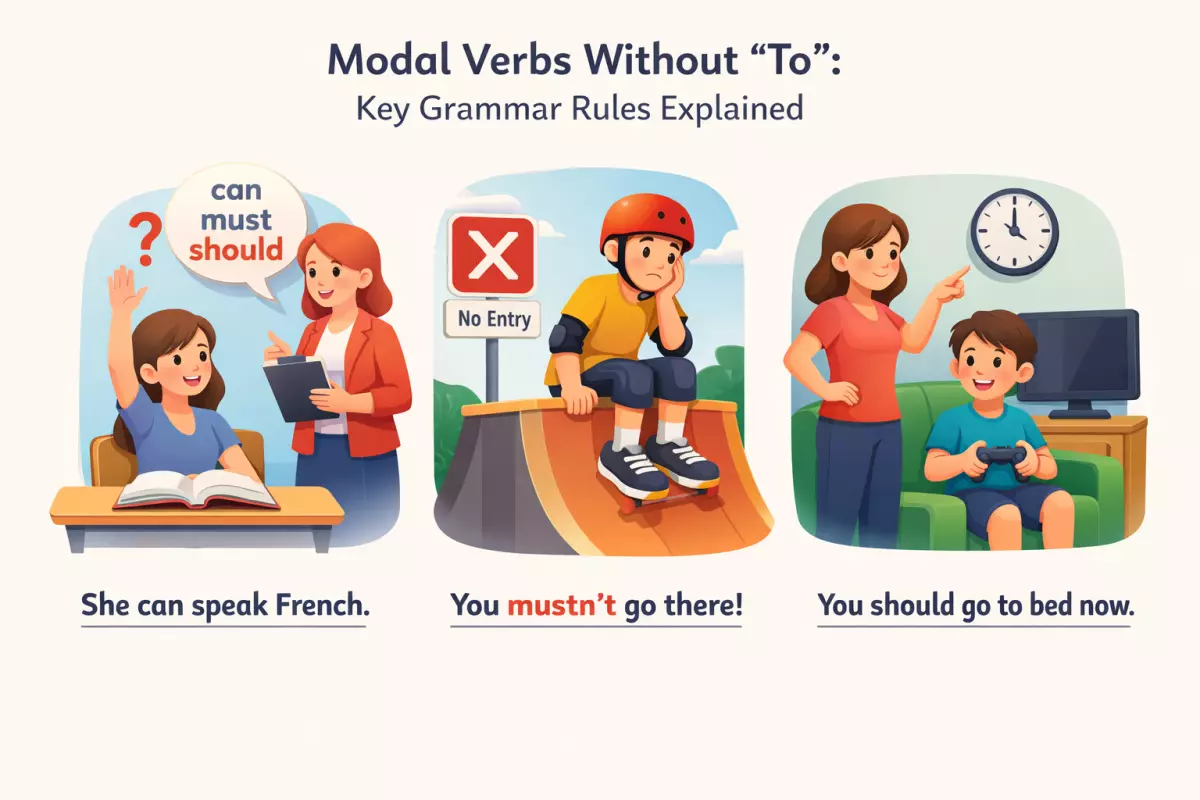 Learn why true modal verbs take the base verb directly, which modals always use the bare form, and how adding to after a modal makes sentences wrong. See correct examples like can go, must finish, should try, plus cases with to from non-modals, common errors, and practice exercises.
- Why modal verbs are followed directly by the base form of the verb
- Which modal verbs always require the bare verb form after them
- How sentences become incorrect when 'to' is placed after a modal
- Examples of correct structures such as can go, must finish, and should try
- Situations where verbs with 'to' appear because they are not true modal verbs
- Typical learner mistakes like writing can to go or must to do
- Exercises and practice tasks on using modal verbs without 'to'
Modal verbs usually take a bare infinitive, meaning the next verb appears without to, and this small detail can make your English sound more natural. When you say I can go or She must leave, you’re using a common pattern for ability, permission, advice, or necessity. This article explains when the bare form is required, when it changes, and how to avoid common learner mistakes.
Why modal verbs are followed directly by the base form of the verb
In modern English, a modal verb (like can, must, or should) works as an auxiliary that sets meaning such as ability, permission, obligation, or probability. Because the modal already carries the “helping” function, the verb that follows stays in the bare infinitive (the base form) without to.
Core pattern: modal + base verb
The standard structure is simple: modal + base form. The second verb does not change for tense or person, and it does not take to.
- ✅ I can swim. ❌ I can to swim.
- ✅ She must leave now. ❌ She must to leave now.
- ✅ We should wait. ❌ We should to wait.
- ✅ They might arrive late. ❌ They might to arrive late.
Why “to” is not used after modals
English typically uses to to mark an infinitive after many verbs (want to go, plan to leave). Modals are different: they form a tight unit with the next verb, so the language keeps the following verb in its simplest form. This is why you get “can go” rather than “can to go.”
- Modals don’t behave like normal verbs: they don’t take -s in the third person (she can, not she cans), and they don’t use “to” before the next verb.
- The modal supplies the grammar: it carries the extra meaning (ability, necessity, possibility), so the main verb stays uninflected (base form).
- It creates a fixed verb phrase: modal + verb is treated as one unit in questions and negatives (Can you help? You can’t help.), which supports the bare infinitive pattern.
What the base form looks like in real sentences
The bare infinitive is the dictionary form: go, see, take, be, have, do. After a modal, you keep that form even when the subject changes.
- Ability: can lift, can run, can solve
- Advice: should rest, should call, should check
- Obligation: must pay, must follow, must wear
- Possibility: may rain, might change, could happen
- Requests/offers: will help, would like, shall begin
Common confusion: “to” appears with some related forms
Some expressions look “modal-like” in meaning but are not true modals in form. These often require to, which is why learners sometimes overuse to after real modals.
- Have to + verb: ✅ I have to leave. (Not a modal; “to” is part of the structure.)
- Ought to + verb: ✅ You ought to apologize. (“To” is fixed with “ought.”)
- Be able to + verb: ✅ She is able to swim. (A semi-modal phrase.)
- Used to + verb: ✅ We used to live there. (Fixed form with “to.”)
As a usage rule, if the first word is a true modal auxiliary (can, could, may, might, must, shall, should, will, would), the next verb stays in the base form with no to. If the expression is a semi-modal (have to, be going to, ought to, be able to), then to may be required as part of that construction.
Which modal verbs always require the bare verb form after them

After a true modal auxiliary, the next verb stays in the base form (the infinitive without to). That means no -s, no -ing, and no past form directly after the modal. This pattern is stable across tenses and subjects.
Core modals that take the bare infinitive
- can + base verb: ✅ She can drive. ❌ She can to drive.
- could + base verb: ✅ We could meet later. ❌ We could met later.
- may + base verb: ✅ You may leave now. ❌ You may leaving now.
- might + base verb: ✅ It might rain. ❌ It might rains.
- must + base verb: ✅ They must follow the rules. ❌ They must to follow the rules.
- shall + base verb: ✅ Shall we start? ❌ Shall we started?
- should + base verb: ✅ You should call her. ❌ You should to call her.
- will + base verb: ✅ I will explain. ❌ I will explained.
- would + base verb: ✅ He would help if he could. ❌ He would helps if he could.
Common “semi-modals” that follow the same bare-verb pattern
Some expressions behave like modals in meaning and word order and are followed by the base verb as well. They are useful to know because learners often try to add to after them.
- had better + base verb: ✅ You had better leave now. ❌ You had better to leave now.
- would rather + base verb: ✅ I would rather stay home. ❌ I would rather to stay home.
- would sooner + base verb: ✅ She would sooner wait outside. ❌ She would sooner to wait outside.
Quick usage checks (what the bare form looks like)
- Use the dictionary form: go, see, take, be, have, do.
- No third-person -s after a modal: ✅ He can swim. ❌ He can swims.
- No past verb form right after a modal: ✅ They might arrive late. ❌ They might arrived late.
- To talk about past time, add have + past participle after the modal: might have missed, should have called, could have gone.
- Negatives keep the same base verb: cannot/can’t go, shouldn’t say, mustn’t touch.
- Questions keep the same base verb: Can you help?, Should we wait?, Will they agree?.
How sentences become incorrect when 'to' is placed after a modal
In standard English, a modal verb (like can, should, or must) is followed by the base form of the main verb, not the infinitive. Adding to after a modal breaks the expected pattern and often makes the sentence sound ungrammatical or non-native.
The core pattern to remember
Most modals use this structure:
- Modal + base verb: “She can swim.” “They should leave.”
- Not modal + to + verb: “She can to swim.” “They should to leave.”
Common incorrect forms and their corrections
- ❌ I can to help. → ✅ I can help.
- ❌ She could to drive at 16. → ✅ She could drive at 16.
- ❌ You may to sit here. → ✅ You may sit here.
- ❌ We might to arrive late. → ✅ We might arrive late.
- ❌ They must to wear helmets. → ✅ They must wear helmets.
- ❌ He should to call his manager. → ✅ He should call his manager.
- ❌ You would to enjoy this book. → ✅ You would enjoy this book.
- ❌ I will to email you later. → ✅ I will email you later.
- ❌ We shall to begin now. → ✅ We shall begin now.
- ❌ She ought to to apologize. → ✅ She ought to apologize.
- ❌ He used to to play here. → ✅ He used to play here.
- ❌ You needn’t to worry. → ✅ You needn’t worry.
- ❌ He daren’t to ask. → ✅ He daren’t ask.
- ❌ She can’t to come tonight. → ✅ She can’t come tonight.
- ❌ Should I to wait outside? → ✅ Should I wait outside?
Why learners add “to” after modals
- Mixing patterns: confusing “want to / need to / plan to” with modal structures (can/should/must).
- Overgeneralizing the infinitive: assuming every verb that follows another verb needs “to.”
- Translation habits: some languages use an infinitive marker after equivalents of modals.
Two easy checks that prevent the mistake
- Check 1: identify the modal. If the first verb is can/could/may/might/must/should/would/will/shall, the next verb should be the base form.
- Check 2: remove “to”. If the sentence becomes natural and grammatical after deleting “to,” the original was likely incorrect.
Keep in mind that “to” is correct after a few semi-modal expressions such as “ought to” and “used to,” but it does not follow the core modals listed above. The key is recognizing which verb is acting as a true modal and then using the base verb that follows.
Examples of correct structures such as can go, must finish, and should try

With core modal verbs, the pattern is simple: modal + base verb (the infinitive without “to”). This structure stays the same across subjects (I/you/he/we/they), and it forms negatives and questions without adding extra helper verbs.
Common affirmative patterns (modal + base verb)
- We can go now.
- She can speak three languages.
- You must finish the report by noon.
- He must follow the safety rules.
- I should try again tomorrow.
- They should check the address before leaving.
- You may leave early today.
- Guests may bring one friend.
- We might miss the last train.
- It might rain later.
- She could help if she has time.
- We could meet after work.
- You will need a password to log in.
- I will call you tonight.
- He would prefer a quiet seat.
- They would agree if the plan is clear.
Negatives: modal + not + base verb
- ✅ She cannot attend today. → ❌ She cannot to attend today.
- ✅ You must not touch that switch. → ❌ You must not to touch that switch.
- ✅ We should not rush the decision. → ❌ We should not to rush the decision.
- ✅ I may not have enough time. → ❌ I may not to have enough time.
- ✅ They might not understand the instructions. → ❌ They might not to understand the instructions.
- ✅ He won’t change his mind. → ❌ He won’t to change his mind.
- ✅ She wouldn’t accept the offer. → ❌ She wouldn’t to accept the offer.
Questions: modal + subject + base verb
- ✅ Can you go with us? → ❌ Do you can go with us?
- ✅ Must we finish today? → ❌ Must we to finish today?
- ✅ Should I try a different approach? → ❌ Should I to try a different approach?
- ✅ May I leave early? → ❌ May I to leave early?
- ✅ Might they arrive late? → ❌ Might they to arrive late?
- ✅ Will she call you back? → ❌ Will she to call you back?
- ✅ Would you help me for a minute? → ❌ Would you to help me for a minute?
Usage notes that keep the structure accurate
- Keep the main verb in its base form: “can go,” not “can goes” or “can going.”
- Do not add “to” after true modals: “must finish,” not “must to finish.”
- Form questions by moving the modal to the front: “Should we try…?” not “Do we should try…?”
- For negatives, place “not” after the modal: “should not try,” “might not work,” “will not help.”
- Use contractions naturally in writing and speech: “can’t,” “won’t,” “shouldn’t,” “wouldn’t,” “mightn’t” (less common).
Situations where verbs with 'to' appear because they are not true modal verbs
Some verbs express ability, obligation, advice, or expectation but behave like regular verbs rather than core modal auxiliaries. Because they are not “true” modals, they can require to before the main verb, especially after tense changes, in negatives/questions with do, or after another auxiliary.
1) Semi-modals that take “to” in their basic pattern
These items often cause confusion because their meaning feels modal, but their grammar is different. The most common pattern is verb + to + base verb.
- have to + base verb (external obligation): I have to leave early.
- need to + base verb (necessity): You need to update the form.
- ought to + base verb (advice/expectation): You ought to check the details.
- be able to + base verb (ability across tenses): She was able to finish on time.
- be going to + base verb (planned future): They’re going to meet later.
- be supposed to + base verb (expected/required): I’m supposed to call today.
- be allowed to + base verb (permission): Are we allowed to park here?
- be required to + base verb (formal obligation): Staff are required to wear badges.
- be meant to + base verb (intended purpose): This button is meant to reset the device.
- be likely to + base verb (probability): Prices are likely to rise.
- be expected to + base verb (expectation): You’re expected to reply within 24 hours.
- be about to + base verb (immediate future): The train is about to depart.
2) When tense and agreement force “to” forms
Core modals don’t change for tense or person (no -s, no infinitive form), but these modal-like verbs do. That is why “to” versions appear naturally in past, perfect, and other structures.
- Past obligation: We had to cancel the trip. (not ❌ We musted cancel.)
- Past ability: I was able to solve it. (not ❌ I could to solve it.)
- Perfect necessity: She has needed to rest more lately.
- Future obligation: You will have to show ID at the desk.
- Conditional obligation: If it rains, we may have to stay inside.
- Third person singular: He needs to sign the form.
3) Negatives and questions use “do” (because they are not auxiliaries)
True modals form negatives and questions without do (e.g., “cannot,” “should you…?”). Many modal-like verbs behave as main verbs, so they typically need do/does/did for questions and negatives.
- ✅ I don’t have to work tomorrow. → (not required)
- ✅ Do you have to wear a uniform?
- ✅ She doesn’t need to explain again.
- ✅ Did they need to book in advance?
- ✅ He didn’t manage to finish. (modal-like meaning: “was able to,” but regular verb grammar)
4) “To” appears after another modal or auxiliary
When a true modal is followed by a modal-like expression, the second part often uses an infinitive with to. This is common in layered meanings such as “possibility + obligation” or “prediction + plan.”
- We might have to leave early.
- You may need to restart the computer.
- They will be able to join later.
- She should be allowed to speak first.
- He could be expected to answer questions.
5) Common learner traps: where “to” is added or removed incorrectly
- ✅ I must go now. ❌ I must to go now.
- ✅ I have to go now. ❌ I have go now.
- ✅ You ought to apologize. ❌ You ought apologize.
- ✅ She can swim. ❌ She can to swim.
- ✅ She is able to swim. ❌ She is able swim.
- ✅ We didn’t need to wait. ❌ We didn’t needed to wait.
Typical learner mistakes like writing can to go or must to do
Many learners add to after a modal because they copy patterns from full verbs (want to, need to, decide to). But core modal verbs (can, could, may, might, must, shall, should, will, would) are followed by the base verb (the bare infinitive) with no to.
Common error patterns and the correct form
- ❌ can to go → ✅ can go
- ❌ could to help → ✅ could help
- ❌ may to leave → ✅ may leave
- ❌ might to rain → ✅ might rain
- ❌ must to do → ✅ must do
- ❌ should to study → ✅ should study
- ❌ would to like → ✅ would like
- ❌ will to call you → ✅ will call you
- ❌ shall to begin → ✅ shall begin
- ❌ can to be → ✅ can be
- ❌ must to have → ✅ must have
- ❌ should to have done → ✅ should have done
- ❌ might to have seen → ✅ might have seen
- ❌ can to not come → ✅ cannot come / can’t come
- ❌ must to not smoke → ✅ must not smoke
Why this mistake happens
- Mixing up two structures: learners confuse “modal + base verb” with “verb + to + infinitive” (want to go, plan to go).
- Overgeneralizing: once “to + verb” feels normal, it gets added everywhere, including after modals.
- Translation influence: some languages use an infinitive marker in places where English uses a bare verb.
Quick rule checks to self-correct
- If the word is a true modal (can, could, may, might, must, shall, should, will, would), the next verb should be in the base form: “can go,” not “can to go.”
- Negatives keep the same pattern: “must not leave,” “shouldn’t worry” (still no to).
- Questions keep the same pattern: “Can you help?” “Should I call?” (modal + subject + base verb).
- Perfect forms still use the bare auxiliary: “must have forgotten,” “might have missed” (modal + have + past participle).
One important exception: “ought to”
Not every word that behaves like a modal follows the no-to rule. Ought normally takes to: “You ought to apologize.” This is why it helps to memorize the core modals as a set, and treat “ought to” as its own pattern.
Exercises and practice tasks on using modal verbs without 'to'
These activities focus on the core pattern: a modal verb is followed by the base form of the main verb (bare infinitive). Practice spotting where learners often add an unnecessary to or use the wrong verb form after a modal.
1) Choose the correct option (no “to” after the modal)
- You must (to finish / finish) the report today.
- She can (to swim / swim) very well.
- We should (to leave / leave) now.
- They might (to come / come) later.
- I will (to call / call) you tonight.
- He could (to be / be) right.
- You may (to take / take) my seat.
- We would (to like / like) some water.
- It may (to rain / rain) this afternoon.
- She must (to not / not) forget her passport.
Show answers
- finish
- swim
- leave
- come
- call
- be
- take
- like
- rain
- not
2) Fix the sentences (remove “to” or correct the verb form)
- I can to speak French, but not fluently.
- You should to check the address again.
- He musts finish his homework before dinner.
- We might to go out after work.
- She can sings beautifully.
- They will to arrive around 6.
- You may to use my phone.
- I could went earlier if you want.
- We would to prefer a quieter table.
- It may rains tonight.
Show answers
- I can speak French, but not fluently.
- You should check the address again.
- He must finish his homework before dinner.
- We might go out after work.
- She can sing beautifully.
- They will arrive around 6.
- You may use my phone.
- I could go earlier if you want.
- We would prefer a quieter table.
- It may rain tonight.
3) Complete the sentences with a modal + base verb
Use the verb in brackets in the correct form after a modal. Do not add to.
- You ________ (send) the file as a PDF.
- She ________ (not / attend) the meeting tomorrow.
- ________ you (help) me with this form?
- We ________ (be) a few minutes late.
- He ________ (not / say) that to her.
- I ________ (pick) you up at 8.
- They ________ (not / know) the answer yet.
- Students ________ (use) calculators in this exam.
- It ________ (get) colder after sunset.
- We ________ (try) a different approach.
Show answers
- should send
- may not attend / might not attend
- Could you help / Can you help
- might be / may be
- should not say / must not say
- will pick
- may not know / might not know
- may use / can use
- may get / might get
- should try / could try
4) Quick pattern checklist (use it while correcting your own writing)
- Modal + base verb: ✅ can go, should study, might happen.
- No to after a modal: ❌ can to go → ✅ can go.
- No -s on modals: ❌ musts → ✅ must.
- Negatives: modal + not + base verb: cannot/can’t drive, should not worry.
- Questions: modal before the subject: Can you help?, Should we leave?
- After a modal, avoid past forms like went/saw: use the base form (go/see).