Modal Verbs and the Bare Infinitive in English Grammar

 This article explains the bare infinitive vs the to infinitive, why modal verbs take the base form, and how subject + modal + bare infinitive works. It gives examples like can see, should study, might happen, shows object/adverb placement, flags common confusions, and includes practice exercises.
- What the bare infinitive is and how it differs from the 'to' infinitive
- Why modal verbs require the base form of the main verb
- How the structure subject plus modal plus bare infinitive works in sentences
- Examples of common combinations such as can see, should study, and might happen
- How objects and adverbs appear in sentences with modal verbs
- Cases where learners confuse the bare infinitive with other verb forms
- Exercises and practice activities with bare infinitives after modal verbs
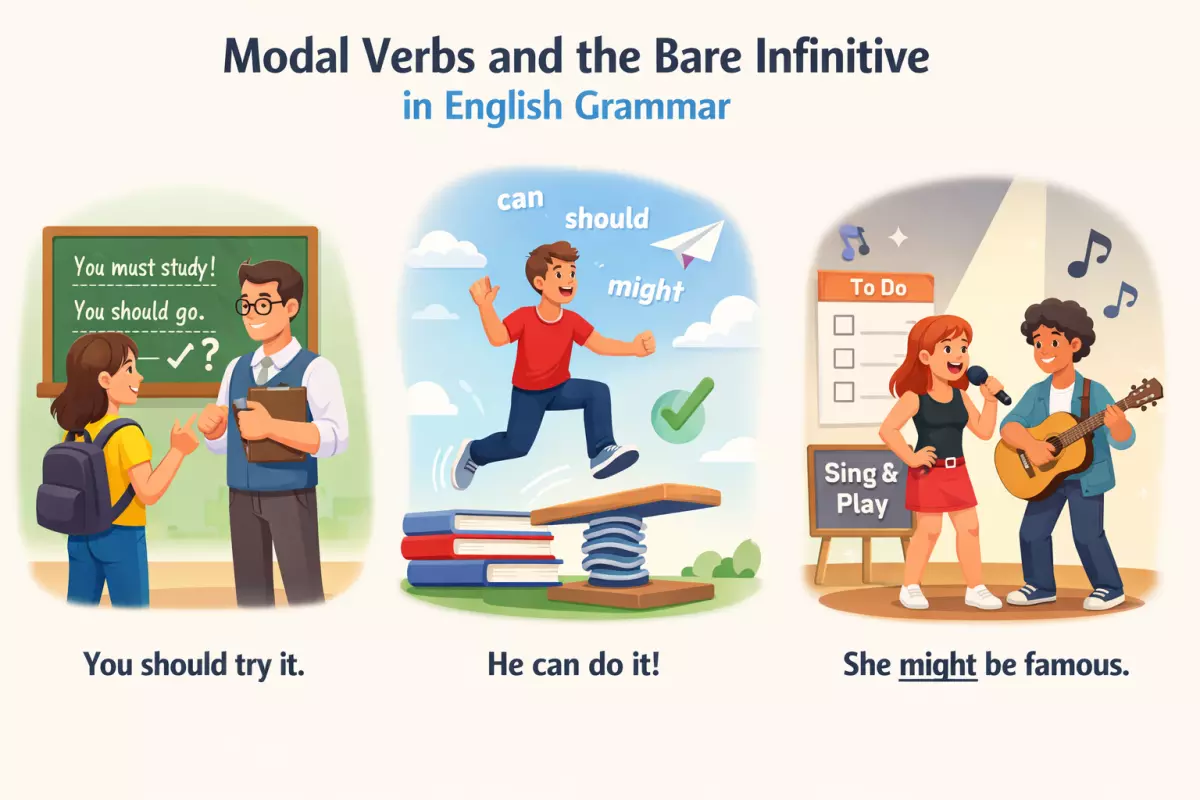
Words like can, must, and should can change a sentence because the verb that follows stays in its simplest form, without to. This is the modal verb plus bare infinitive pattern. You will hear it in everyday advice, rules, and plans, and noticing it helps you choose the right verb form, avoid common mistakes, and sound more natural and confident in conversation.
What the bare infinitive is and how it differs from the 'to' infinitive
The bare infinitive is the base form of a verb used without to (for example, go, see, work). It is especially common after modal verbs and in a few other fixed patterns. The “to” infinitive uses to + base verb (for example, to go, to see, to work) and appears after many other verbs, adjectives, and nouns.
| Pattern | Form | Typical use | Example |
|---|---|---|---|
| After modal verbs | modal + bare infinitive | Ability, permission, advice, obligation, possibility, etc. | She can drive. |
| After most common verbs of intention/decision | verb + to-infinitive | Plans, choices, willingness | They decided to leave. |
| After adjectives | adjective + to-infinitive | Reactions, evaluation, readiness | He is ready to start. |
| After “make/let/help” (common causative patterns) | make/let + bare infinitive (help: bare or to) | Forcing/allowing/assisting an action | They made me wait. |
How to recognize the bare infinitive quickly
- It looks like the dictionary form of the verb: eat, take, write (not eats, took, writing).
- It does not take tense endings: ❌ She can goes → ✅ She can go.
- It commonly follows a modal: can, could, may, might, must, shall, should, will, would.
- It is also used in a few non-modal structures (for example, after let and make).
Core usage patterns (with examples)
- Modal + base verb: You must leave now.
- Modal + not + base verb: You should not worry.
- Modal + base verb + object: She can solve the problem.
- Modal + base verb + be: It might be true.
- Modal + base verb + have + past participle (perfect meaning): They may have missed the bus.
- Modal + be + -ing (continuous meaning): He could be working late.
- Let + object + base verb: Let him speak.
- Make + object + base verb: The noise made me jump.
- Help + object + (to) base verb: She helped me (to) move.
- Why + base verb (questions/suggestions): Why wait?
- Had better + base verb: You had better check the address.
- Would rather + base verb: I would rather stay home.
Common contrasts that cause mistakes
- ❌ He must to go. → ✅ He must go. (modals do not take to)
- ❌ They can to swim. → ✅ They can swim.
- ❌ She decided go. → ✅ She decided to go. (many main verbs require to)
- ❌ He is able do it. → ✅ He is able to do it.
- ❌ We made him to apologize. → ✅ We made him apologize. (after make, use the base form)
In short, use the base form without to after modals and a small set of other structures, and use to + verb after many ordinary verbs and adjective patterns. Learning which “trigger words” select each form helps you produce natural, accurate sentences.
Why modal verbs require the base form of the main verb
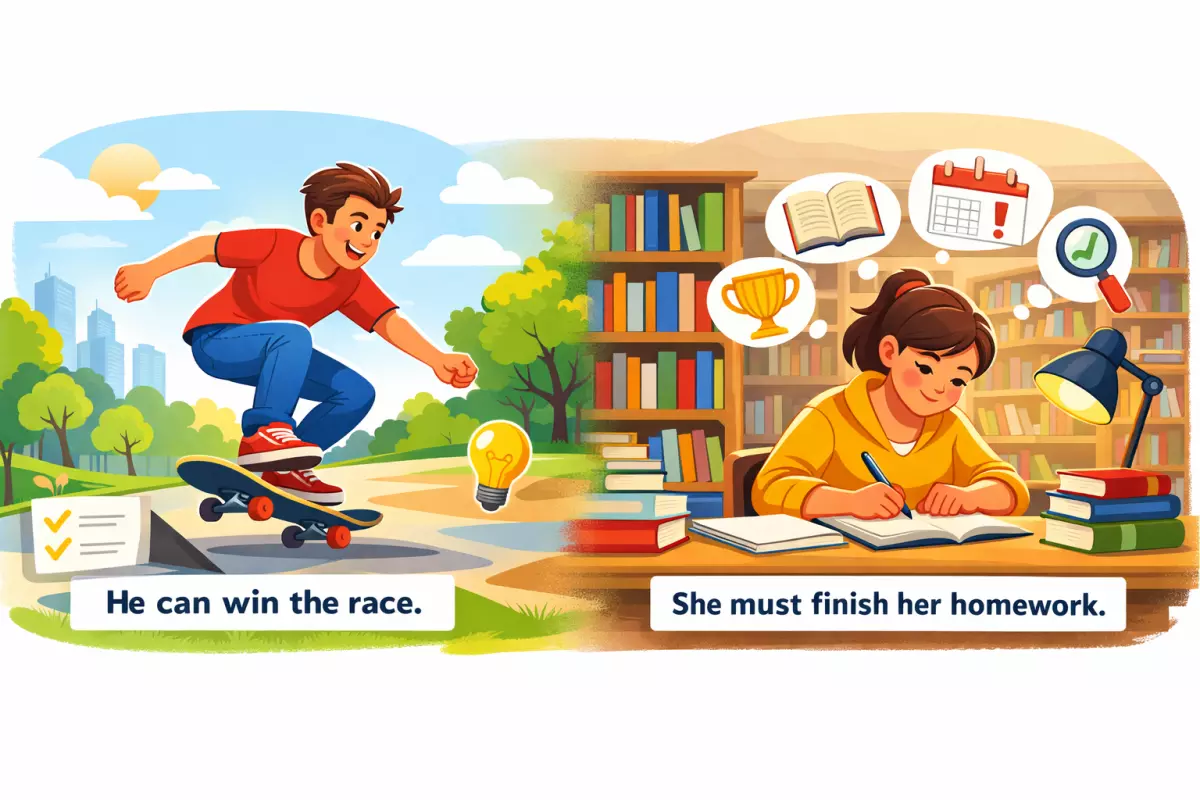
In standard English, a modal verb (like can, must, or should) is followed by the bare infinitive: the verb’s base form without to and without endings like -s, -ed, or -ing. This pattern is fixed because modals act as “helper” verbs that carry meaning such as ability, obligation, permission, or probability, while the main verb stays in its simplest form.
Core pattern: modal + base verb
The main verb does not change for person or number after a modal. The modal itself also does not take -s in the third person singular.
- ✅ She can drive. ❌ She can drives.
- ✅ He must leave now. ❌ He must leaves now.
- ✅ They should wait. ❌ They should waiting.
- ✅ I will call you later. ❌ I will to call you later.
What the modal “does,” and what the main verb “does”
Modals contribute the grammar and meaning of modality (how certain, necessary, allowed, or possible something is). Because that meaning is already expressed by the modal, English keeps the following verb uninflected (in the base form) rather than marking tense or agreement on it.
- Ability: can + base verb → can swim, can speak, can solve
- Permission: may/can + base verb → may enter, can borrow
- Obligation/necessity: must/have to + base verb → must pay, have to leave
- Advice: should/ought to + base verb → should rest, ought to apologize
- Prediction/volition: will + base verb → will arrive, will help
- Possibility: might/could + base verb → might rain, could happen
Common errors and the correct bare-infinitive forms
Most mistakes come from adding to or using a conjugated form after the modal. Keeping the base verb solves both issues.
- ✅ You should go. ❌ You should to go.
- ✅ She may come. ❌ She may comes.
- ✅ We could try again. ❌ We could tried again.
- ✅ He might know the answer. ❌ He might knowing the answer.
- ✅ They will finish soon. ❌ They will finished soon.
- ✅ I can help you. ❌ I can helped you.
- ✅ You must wear a helmet. ❌ You must wearing a helmet.
- ✅ She should see a doctor. ❌ She should sees a doctor.
- ✅ We may need more time. ❌ We may needed more time.
- ✅ He can read fast. ❌ He can reads fast.
- ✅ You might miss the bus. ❌ You might missed the bus.
- ✅ They could be right. ❌ They could are right.
Two important “exceptions” to notice
Some expressions look similar to modals but do not follow exactly the same form. These differences are predictable once you know what counts as a true modal and what behaves like a regular verb.
- Ought to keeps to: ✅ You ought to listen. (Not: ought listen.)
- Have to is not a modal (it’s a main verb + infinitive), so it can change form: ✅ She has to work today; ✅ They had to leave early.
- Be able to also behaves like a regular verb phrase: ✅ She is able to drive; ✅ They were able to finish.
Modal + perfect and passive: the base form still matters
Even when you add more structure, the modal still selects a base-form auxiliary right after it. The extra grammar comes from that auxiliary (not from changing the main verb directly).
- Perfect: modal + have + past participle → ✅ might have forgotten; should have called; must have left
- Passive: modal + be + past participle → ✅ can be seen; must be done; should be repaired
- Continuous: modal + be + -ing → ✅ may be waiting; could be working
How the structure subject plus modal plus bare infinitive works in sentences
This pattern is one of the most common ways to express ability, permission, advice, obligation, possibility, and prediction. The core idea is simple: a modal verb is followed by the base form of the main verb (the bare infinitive), without to.
Core word order and what stays the same
- Basic form: Subject + modal + bare infinitive (+ rest of sentence).
- No -s in the third person: He can swim. (not: He can swims.)
- No “to” after a modal: She must leave now. ✅ / She must to leave now. ❌
- Main verb stays in base form: They might arrive late. (arrive, not arrived/arrives)
- Time is often shown by context or adverbs: We may meet tomorrow; We may be meeting later.
Common modals used with the bare infinitive
- can / could (ability, possibility, polite requests)
- may / might (possibility, permission; might is usually less certain)
- must (strong obligation, logical conclusion)
- shall / should (offers/suggestions; should for advice/expectation)
- will / would (future, willingness, habits; would for politeness or past habit)
Negatives and questions follow a consistent pattern
- Negative: Subject + modal + not + bare infinitive.
- He cannot (can’t) attend.
- You should not (shouldn’t) drive tired.
- Yes/no question: Modal + subject + bare infinitive?
- Can you help?
- Should we wait?
- Wh-question: Wh-word + modal + subject + bare infinitive?
- Where can I park?
- Why might they refuse?
- Short answers: modal (or modal + not).
- “Can she come?” “Yes, she can.” / “No, she can’t.”
Adding meaning with aspect: continuous and perfect bare infinitives
- Modal + be + -ing (activity in progress or around now): They may be waiting outside.
- Modal + have + past participle (earlier time, deduction, regret): She must have missed the train.
- Modal + have been + -ing (duration up to a point): He might have been working late.
Typical usage patterns with examples
- Ability: I can read fast.
- Past ability / polite distance: I could read at four; Could you open the window?
- Permission: You may leave early.
- Possibility: It might rain tonight.
- Strong obligation: You must wear a helmet.
- Advice: You should back up your files.
- Expectation: The package should arrive today.
- Prediction: She will win.
- Willingness: I will help you.
- Polite request: Would you email me the details?
- Suggestion/offer (more formal): Shall we begin?
- Logical conclusion: The lights are off; they must be asleep.
- Rule/prohibition: Visitors must not enter.
- Uncertainty with hedging: He may need more time.
- Conditional-style politeness: I would appreciate your reply.
Common errors to avoid
- Adding to after a modal: We can go. ✅ / We can to go. ❌
- Conjugating the main verb after the modal: She might know. ✅ / She might knows. ❌
- Using a modal where a full verb form is needed: He musts go. ❌ (Use: He must go.)
- Stacking two modals in standard English: He will can help. ❌ (Use: He will be able to help.)
Examples of common combinations such as can see, should study, and might happen

Modal verbs are typically followed by the bare infinitive (the base form of the verb without to). This creates compact verb phrases that show ability, advice, possibility, obligation, and other meanings. The pattern is consistent across subjects: the modal does not change form, and the main verb stays in its base form.
Common modal + bare infinitive pairings
- can see (ability/perception): I can see the difference now.
- can help (ability/offer): She can help after lunch.
- can wait (possibility/option): We can wait a few minutes.
- could try (tentative suggestion): You could try restarting the app.
- could happen (possibility): A delay could happen during storms.
- may need (possibility/politeness): You may need an ID to enter.
- may leave (permission): You may leave early today.
- might happen (weaker possibility): A mistake might happen if you rush.
- might work (tentative possibility): That approach might work.
- should study (advice/expectation): You should study before the test.
- should check (recommendation): You should check the deadline.
- must follow (strong obligation): Visitors must follow the rules.
- must be (logical conclusion): He must be tired after the trip.
- will call (future/decision): I will call you tonight.
- will happen (prediction): The meeting will happen as planned.
- would prefer (polite preference): I would prefer a quieter table.
- would explain (hypothetical/polite offer): I would explain, but we’re out of time.
- shall begin (formal suggestion/offer): Shall we begin?
Usage patterns to notice
- Same form for all subjects: “She can see,” “They can see,” “I can see” (no -s on the modal).
- Bare infinitive after the modal: ✅ She can see. ❌ She can to see.
- Negatives keep the base verb: cannot/can’t see, should not/shouldn’t study, might not happen.
- Questions invert modal and subject: Can you see it? Should we study now? Might it happen again?
- Two verbs, one “to” rule: If a modal is present, the next verb is usually base form; “to” appears only when there is no modal (e.g., “I want to study,” not “I can to study”).
When choosing a combination, focus on the meaning the modal adds (certainty vs. possibility, advice vs. obligation) and keep the main verb in the bare infinitive to maintain correct structure.
How objects and adverbs appear in sentences with modal verbs
With a modal verb, the main verb stays in the bare infinitive, and objects and adverbs usually keep the same positions they have in simple present or past clauses. The key difference is that the modal takes the first verb slot, so word order is built around the pattern modal + bare infinitive.
Core word order patterns
- Basic pattern: Subject + modal + bare infinitive + (object) + (adverbial).
Example: She can finish the report tomorrow. - Direct object after the main verb: Subject + modal + verb + direct object.
Example: They should read the instructions. - Indirect object options:
- Double-object: Subject + modal + verb + indirect object + direct object.
Example: He can give her the keys. - Prepositional: Subject + modal + verb + direct object + to/for + indirect object.
Example: He can give the keys to her.
- Double-object: Subject + modal + verb + indirect object + direct object.
- Object complements: Subject + modal + verb + object + complement.
Example: We must keep the door closed. - Prepositional objects: Subject + modal + verb + preposition + object.
Example: You should listen to your teacher.
Where adverbs typically go
- Mid-position (common with frequency adverbs): Subject + modal + adverb + bare infinitive.
Example: She can usually solve these problems. - End-position (common with time/place/manner): Subject + modal + bare infinitive + (object) + adverbial.
Example: We might meet them at the station. - Front-position (for emphasis or linking): Adverbial + subject + modal + bare infinitive.
Example: After lunch, you should call the client. - Adverb between verb and object (often sounds awkward): Prefer placing the adverb before the main verb or at the end.
✅ She can quickly answer the question. → often better: She can answer the question quickly.
❌ She can answer quickly the question. (unnatural in most contexts)
Common placement choices in real sentences
- Frequency adverb: They may often arrive late.
- Degree adverb: You should really check the figures.
- Manner at the end: He can explain it clearly.
- Time at the end: I must submit the form today.
- Place at the end: We could park behind the building.
- Two adverbials: She might finish the draft at home tonight.
- Object + time: You should email the file before noon.
- Indirect object (double-object): Can you send me the link?
- Indirect object (to-phrase): Can you send the link to me?
- Prepositional object: You must apply for the permit soon.
- Object complement: We should paint the walls white.
- Negative with adverb: She can’t always rely on luck.
- Question with adverb: Should we still book a table?
- Long object at the end: You might want to review the notes from last week’s meeting carefully.
Notes on negatives and questions
- Negatives: Subject + modal + not + bare infinitive + (object/adverbial).
Example: You should not share the password. - Adverbs with negatives: Many adverbs sit after the modal even when not is present.
Example: They can’t really change the schedule. - Questions: Modal + subject + bare infinitive + (object/adverbial).
Example: Can you finish the task tomorrow?
Cases where learners confuse the bare infinitive with other verb forms
Many errors happen when a verb after another verb is expected to stay in its base form, but learners add to, an -ing ending, or a past form instead. The safest approach is to notice the trigger: modals, certain fixed patterns, and perception/causative verbs usually control what form comes next.
Common confusion patterns (with corrections)
- ❌ She can to swim. → ✅ She can swim. (modal + base verb)
- ❌ They might going now. → ✅ They might go now. (modal + base verb, not -ing)
- ❌ He should goes earlier. → ✅ He should go earlier. (no -s after a modal)
- ❌ We must to leave. → ✅ We must leave. (no to after a modal)
- ❌ You could to be right. → ✅ You could be right. (modal + base form of be)
- ❌ I will can help. → ✅ I will be able to help. (don’t stack modals in standard English)
- ❌ She didn’t went. → ✅ She didn’t go. (did + base verb)
- ❌ Did you went there? → ✅ Did you go there? (question with did + base verb)
- ❌ He doesn’t can drive. → ✅ He can’t drive. / He isn’t able to drive. (don’t use do-support with a modal)
- ❌ Do you must leave? → ✅ Must you leave? / Do you have to leave? (modal questions invert; “have to” uses do-support)
- ❌ I to can swim. → ✅ I can swim. (no “to” before a modal)
- ❌ She can swims. → ✅ She can swim. (no agreement ending after can)
- ❌ He made me to apologize. → ✅ He made me apologize. (make + object + base verb)
- ❌ They let us to enter. → ✅ They let us enter. (let + object + base verb)
- ❌ I saw him to leave. → ✅ I saw him leave. (see/hear/feel + object + base verb for a complete action)
- ❌ We heard her sang. → ✅ We heard her sing. (perception verb + base verb, not past)
- ❌ She helped me carry the boxes. → ✅ She helped me (to) carry the boxes. (help allows both; learners often assume only one is possible)
- ❌ You had better to go now. → ✅ You had better go now. (fixed expression + base verb)
- ❌ I would rather to stay home. → ✅ I would rather stay home. (would rather + base verb)
What learners often overgeneralize
- Overusing “to”: after seeing many verbs that take “to + verb” (want to go, plan to go), learners extend it to modals and patterns like had better/would rather.
- Overusing -ing: because -ing is common after prepositions and some verbs (enjoy doing), it sometimes replaces the base form after a modal (might going).
- Mixing tense marking: after a modal or after did, the next verb does not carry tense (should went, didn’t went).
- Adding do-support where it doesn’t belong: modals already function as auxiliaries, so negatives and questions usually don’t need do (doesn’t can, do you must).
Quick check for the correct form
- If the first verb is a modal (can, could, may, might, must, shall, should, will, would) → use the base verb next.
- If you use did/didn’t → use the base verb next.
- If you use make/let or a perception verb (see/hear/feel) with an object → the next verb is often the base form (with some meaning differences vs -ing).
- If you see a fixed pattern like had better / would rather → the following verb stays in the bare form.
Exercises and practice activities with bare infinitives after modal verbs
Practice the pattern modal + base verb (bare infinitive) by correcting common mistakes, choosing the right form, and producing your own sentences. Focus on keeping the main verb in its base form after a modal (can, could, may, might, must, shall, should, will, would), and watch out for exceptions like ought to and semi-modals such as have to.
1) Identify and correct the error (base form vs. -s / -ing / to-infinitive)
- She can speaks three languages.
- You should to call him tonight.
- They might going later.
- He must finishes the report today.
- We could to meet at 6.
- I may am late.
- She will to arrive soon.
- You shouldn’t to worry so much.
- It might rains this afternoon.
- They would preferring a quieter table.
Show answers
- She can speak three languages.
- You should call him tonight.
- They might go later.
- He must finish the report today.
- We could meet at 6.
- I may be late.
- She will arrive soon.
- You shouldn’t worry so much.
- It might rain this afternoon.
- They would prefer a quieter table.
2) Choose the correct option (bare infinitive vs. other forms)
- You must (leave / leaving / to leave) now.
- He can’t (understands / understand / understanding) the instructions.
- We should (take / to take / taking) a break.
- They may (be / are / to be) at home.
- She might (call / calls / calling) later.
- I would (rather / to rather / rather to) wait here.
- It could (work / works / to work) if we try again.
- You shouldn’t (say / to say / saying) that in a meeting.
- He will (help / helps / to help) you with the bags.
- We might (need / needs / needing) more time.
- She must (be / being / to be) exhausted.
- They would (like / to like / liking) a window seat.
Show answers
- leave
- understand
- take
- be
- call
- rather
- work
- say
- help
- need
- be
- like
3) Build sentences from prompts (keep the main verb in base form)
Rewrite each prompt as a complete sentence. Use the modal given and keep the following verb in the bare infinitive.
- (can) / I / join / the call / at 3?
- (should) / you / check / the address / again.
- (might) / she / miss / the train / today.
- (must) / we / follow / the rules.
- (could) / they / solve / the problem / quickly.
- (will) / he / send / the file / tonight.
- (would) / I / prefer / tea / please.
- (may) / we / leave / early?
Show answers
- Can I join the call at 3?
- You should check the address again.
- She might miss the train today.
- We must follow the rules.
- They could solve the problem quickly.
- He will send the file tonight.
- I would prefer tea, please.
- May we leave early?
4) Spot the exception (when it is not a bare infinitive)
Not every “modal-like” expression is followed by a base verb. Choose the best completion.
- You (ought / ought to) apologize.
- She (has to / must) to work late tonight.
- We (have to / can) finish by Friday.
- He (used to / would) to live near the coast.
- They (needn’t / don’t need to) to bring anything.
- I (should / had better) to leave now.
- We (are able to / can) to access the system.
- She (must / is supposed to) to sign here.
Show answers
- ought to
- has to
- have to
- used to
- don’t need to
- had better
- are able to
- is supposed to
5) Production drill (short responses with modals)
Answer each question in one sentence using the modal given. Keep the verb after the modal in base form.
- What is something you must do today?
- What is something you should do more often?
- What is something you can do well?
- What is something you might do this weekend?
- What is something you would change about your routine?
Show answers
- Example: I must finish my assignment today.
- Example: I should drink more water.
- Example: I can explain ideas clearly.
- Example: I might visit a friend this weekend.
- Example: I would reduce my screen time in the evening.
- ✅ Quick check: after a true modal, do not add to, -s, or -ing to the next verb (can go, should study, might rain).
- ❌ Common trap: copying patterns from “want to / plan to” and writing “should to” or “will to.”
- → Editing tip: underline the modal first, then verify the following verb is the base form (be, do, go, take, see, make).