How to Use Could in Natural English Conversations

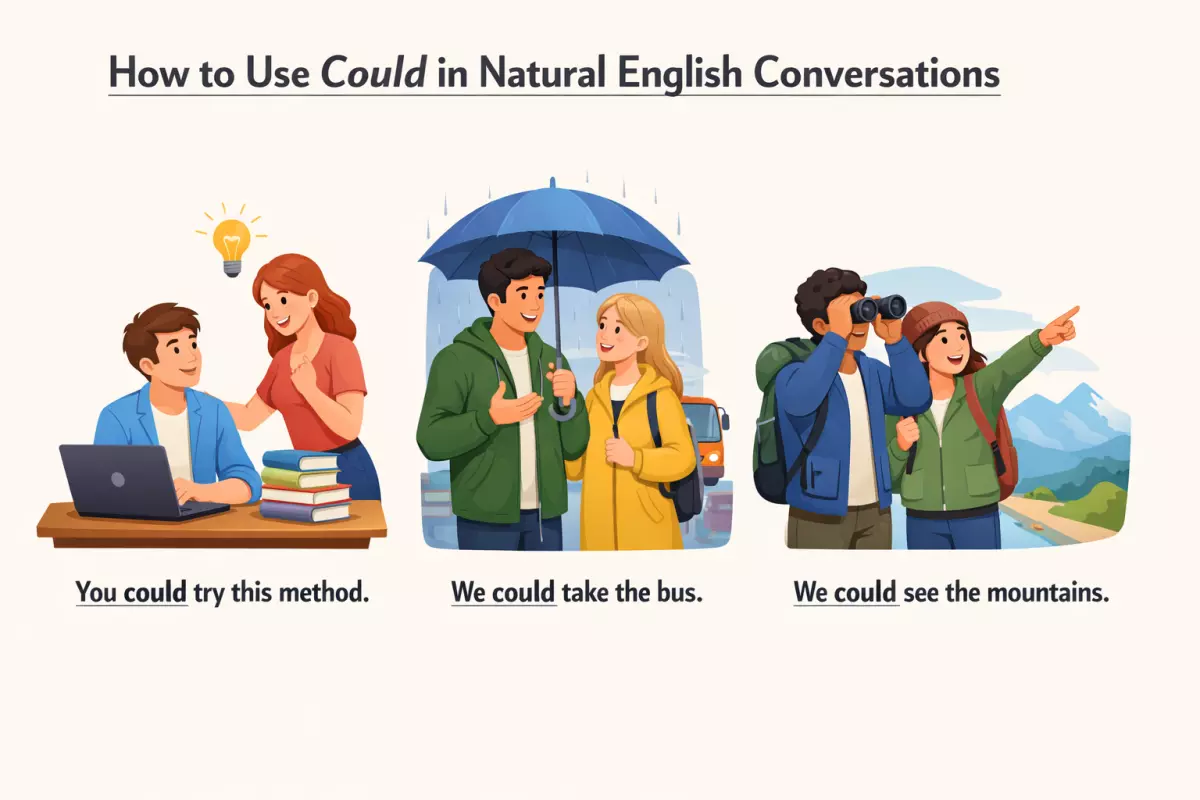 This article explains how could shows past ability and general capability, makes polite requests, and offers softer suggestions. It also covers possible outcomes, key can vs could differences, common sentence patterns, typical mistakes, plus exercises and speaking practice.
- How 'could' describes past ability or general capability
- Using 'could' to make polite requests in everyday conversations
- How 'could' introduces suggestions and softer recommendations
- Using 'could' to talk about possible situations or outcomes
- Key differences between 'can' and 'could' in real communication
- Typical sentence patterns with 'could' in spoken English
- Common learner mistakes when choosing between can and could
- Exercises and speaking practice using 'could' in context
To make your English sound more polite, flexible, and natural, it helps to know when to use could instead of a stronger verb. In everyday conversation, could lets you soften requests, offer options, and talk about possible situations without sounding too certain. This article explains how native speakers use could in common moments, so you can respond smoothly and confidently in real life.
How 'could' describes past ability or general capability
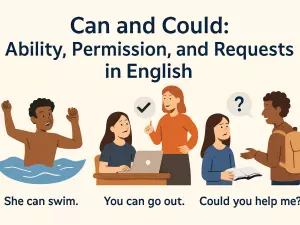
Use could to talk about ability in the past, or to describe what was generally possible in a situation. It often highlights capacity rather than a single completed result, and it can sound more neutral than “was able to” in many everyday contexts.
Core patterns
- Subject + could + base verb: “She could swim at five.”
- Negative: couldn’t + base verb: “I couldn’t hear you.”
- Question: Could + subject + base verb? “Could you read when you were four?”
- With time markers: “Back then, we could walk everywhere.”
- With general conditions: “With enough light, you could see the mountains.”
Past ability vs. one-time success
In affirmative sentences, could usually describes a general skill or repeated possibility, not a single successful event. For a specific achievement on one occasion, English often prefers was/were able to or managed to.
- ✅ General skill: “When I was a kid, I could run fast.”
- ✅ General possibility: “In that town, you could buy fresh bread every morning.”
- ❌ One-time success (often unnatural): “I could fix it yesterday.”
- ✅ One-time success (preferred): “I was able to fix it yesterday.” / “I managed to fix it yesterday.”
- ✅ Exception (negative works well for single events): “I couldn’t find my keys this morning.”
Common uses in natural conversation
- Childhood skills: “I could ride a bike without training wheels.”
- Past languages/knowledge: “He could speak a little French in college.”
- Senses and perception: “We could smell smoke from the kitchen.”
- Availability: “You could get a taxi there at any hour.”
- Rules/permission in the past: “We could stay out late on weekends.”
- Limitations: “She couldn’t lift the box by herself.”
- Old technology or systems: “You could record shows on VHS.”
- Workplace capacity: “I could take calls after 2 p.m.”
- Travel/logistics: “From that station, you could reach the airport in 30 minutes.”
- General conditions: “On clear days, you could see the lake from here.”
- Repeated opportunity: “We could practice every evening.”
- Contrast with now: “I could eat anything then, but not anymore.”
- Past obstacles: “I couldn’t log in because the server was down.”
- Polite-sounding recollection: “I couldn’t really tell what he meant.”
Useful contrasts to avoid confusion
- Could (general past capacity) → “I could play the piano.”
- Was able to / managed to (one successful event) → “I managed to play the song at the recital.”
- Couldn’t (past inability; works for both general and single situations) → “I couldn’t sleep last night.”
- Could for situational possibility → “With a map, we could find it.”
Using 'could' to make polite requests in everyday conversations
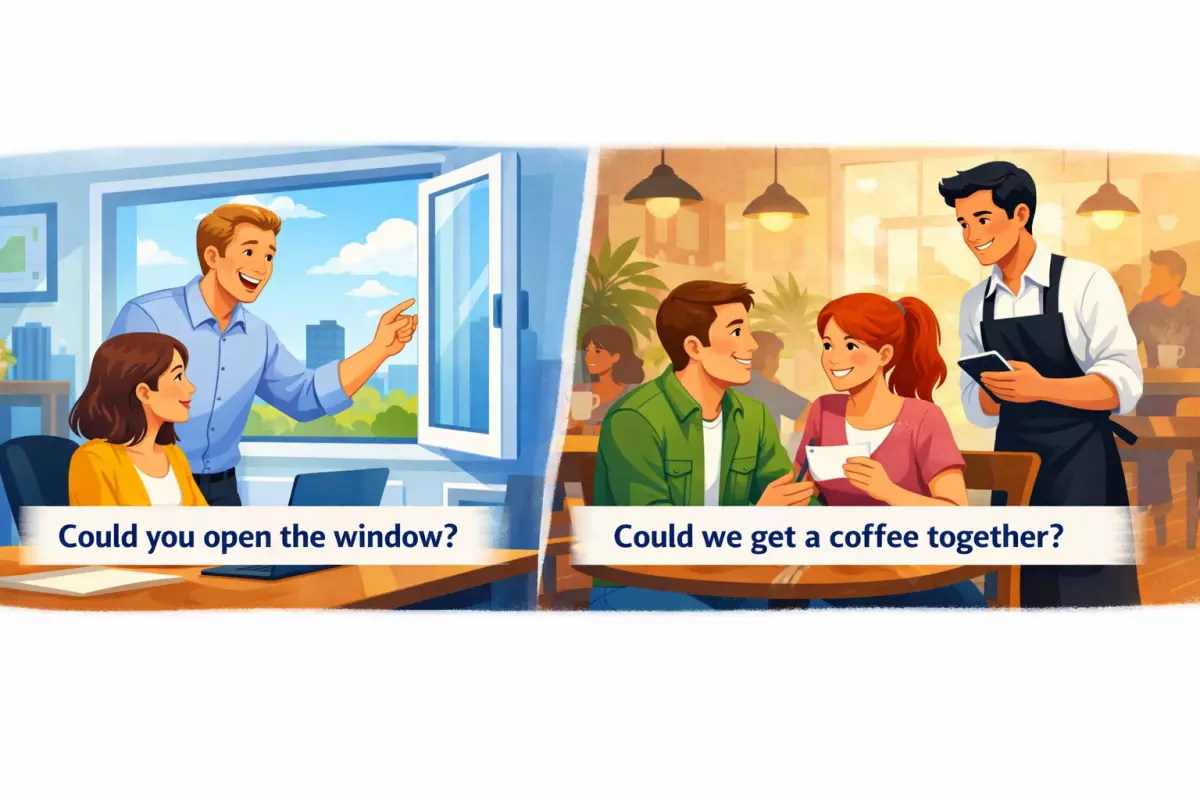
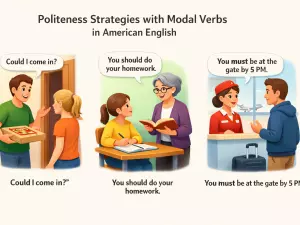
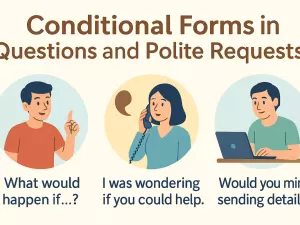
Could is a common choice when you want a request to sound respectful, less direct, and more flexible. It often suggests “if it’s possible” rather than “do it now,” which helps in everyday situations with friends, coworkers, service staff, and strangers.
Core patterns to learn
- Could you + base verb…? (standard request)
Example: Could you open the window? - Could I + base verb…? (asking permission)
Example: Could I use your phone for a minute? - Could we + base verb…? (suggesting a shared action)
Example: Could we meet a little earlier? - Could you please + base verb…? (more formal or extra polite)
Example: Could you please send that email today? - Could you possibly + base verb…? (very soft; use when the request may be inconvenient)
Example: Could you possibly watch my bag for a moment? - Could you + base verb…, please? (polite, natural word order)
Example: Could you hold the door, please?
Everyday request examples (ready-to-use)
- Could you speak a little more slowly?
- Could you repeat that, please?
- Could you help me carry this?
- Could you show me where the restroom is?
- Could you turn the music down a bit?
- Could you give me a hand with this form?
- Could you check if this is correct?
- Could you send me the file when you have a moment?
- Could you call me back later?
- Could you save me a seat?
- Could I borrow your charger for a minute?
- Could I ask you a quick question?
- Could we talk after the meeting?
- Could we move this to tomorrow?
- Could we keep it between us for now?
How to make the request softer (and when to do it)
- Add a short reason to sound cooperative: Could you close the door? It’s a bit noisy out there.
- Use “a bit / a little” for small adjustments: Could you move over a little?
- Use time-softeners to reduce pressure: Could you do it when you have a chance?
- Use “possibly” for bigger favors: Could you possibly cover my shift on Friday?
- Offer an option to show flexibility: Could we meet at 3, or would 4 be better?
Common mistakes to avoid
- ✅ Could you help me? ❌ Could you to help me? (use the base verb, not “to”)
- ✅ Could I leave early today? ❌ Could I to leave early today?
- ✅ Could you tell me where it is? ❌ Could you tell me where is it? (keep normal statement word order after “tell me”)
- Avoid stacking too many softeners in one sentence (it can sound unnatural): “Could you possibly maybe…”
Quick note on tone: “could” vs. “can”
- Could usually sounds more polite and less demanding: Could you email me the details?
- Can is fine in casual situations but can sound more direct: Can you email me the details?
- In many real conversations, both are acceptable; choose could when you want extra courtesy or you’re asking a favor.
How 'could' introduces suggestions and softer recommendations
Could is a common way to offer an idea without sounding pushy. It frames the action as an option rather than a demand, which makes it useful for teamwork, customer service, and everyday planning. The listener still has room to accept, decline, or propose an alternative.
Core patterns for gentle suggestions
- You could + base verb (offer an option): “You could try restarting your phone.”
- We could + base verb (collaborative planning): “We could meet after lunch.”
- I could + base verb (offer help): “I could call them and check.”
- Could + subject + base verb? (polite suggestion as a question): “Could we take a different route?”
- One thing you could do is + base verb (structured advice): “One thing you could do is back up your files.”
- You could always + base verb (backup option): “You could always email it instead.”
- Maybe/Perhaps + you/we could + base verb (extra soft): “Maybe we could reschedule.”
- If you want, you could + base verb (permission-focused): “If you want, you could join us.”
- You could + base verb + if… (conditional suggestion): “You could ask for a refund if it doesn’t work.”
- Could you + base verb? (request phrased gently): “Could you send me the updated file?”
Examples you can reuse in real conversations
- “You could check the spam folder.”
- “We could split the bill.”
- “We could start with the easiest task.”
- “You could take a short break and come back to it.”
- “I could pick it up on my way home.”
- “Could we move this to tomorrow?”
- “Could you clarify what you mean by ‘urgent’?”
- “You could message them first, then call if they don’t reply.”
- “Maybe you could ask your manager for guidance.”
- “Perhaps we could do a quick test before we decide.”
- “You could try a smaller size.”
- “We could keep it simple and use the template.”
- “If you want, you could sit near the window.”
- “You could always come a bit later.”
- “Could we pause here and confirm the details?”
How to choose the right level of softness
- Use “We could…” to sound cooperative and share responsibility: “We could review it together.”
- Use “You could…” for advice, but keep it friendly; add context when needed: “You could update the app; that often fixes it.”
- Use “Could we…?” when you want agreement, not instructions: “Could we keep the meeting to 30 minutes?”
- Add “maybe/perhaps” when the idea is tentative or you’re brainstorming: “Maybe we could try a different approach.”
- Avoid sounding indirect in urgent situations; if it’s a rule or safety issue, a clearer modal may be better than a suggestion.
Common pitfalls to avoid
- ❌ “You could to call them.” → ✅ “You could call them.” (no to after could)
- ❌ “Could you to help me?” → ✅ “Could you help me?”
- ❌ “You could can try…” → ✅ “You could try…” (don’t stack modals)
- Don’t use could when you mean permission in a formal rule: “You can’t park here” is clearer than “You couldn’t park here.”
- In advice, add a reason or next step if the suggestion might feel vague: “You could reset it—hold the button for 10 seconds.”
Using 'could' to talk about possible situations or outcomes
Use could when you want to express possibility rather than certainty. It often signals that something is one option among several, or that the speaker is not fully sure what will happen.
Core patterns for possibility
- Subject + could + base verb (present/future possibility): “It could rain later.”
- Subject + could be + noun/adjective (uncertain identity/state): “That could be the wrong address.”
- Subject + could + be + -ing (possible ongoing situation): “She could be waiting outside.”
- Subject + could have + past participle (possible past explanation): “He could have missed the bus.”
- Could + subject + base verb...? (asking about a possible explanation): “Could this be a scam?”
- It could mean (that)... (interpreting signs/evidence): “It could mean the server is down.”
- There could be + noun (possible existence): “There could be delays.”
Common uses in conversation
- Making a cautious prediction: “Sales could drop in winter.”
- Offering a possible reason: “The noise could be the radiator.”
- Suggesting a possible outcome: “If we leave now, we could catch the earlier train.”
- Softening a warning: “That could cause problems later.”
- Keeping options open: “We could eat out, or we could cook at home.”
- Speculating about what someone is doing: “They could be stuck in traffic.”
- Speculating about what happened: “She could have forgotten to reply.”
Example sentences (useful, reusable models)
- “It could take longer than we think.”
- “This could be a good time to call.”
- “There could be a mistake in the total.”
- “The meeting could run over.”
- “That could work, but we need a backup plan.”
- “It could still be in your spam folder.”
- “He could be joking.”
- “They could be arriving early.”
- “I could be wrong, but the deadline is Friday.”
- “We could end up paying more if we wait.”
- “Could it be that the file didn’t save?”
- “It could have been worse.”
- “The package could have arrived yesterday.”
- “She could have taken the wrong exit.”
- “This could mean we need to restart the system.”
- “If the weather clears, we could go for a walk.”
Quick accuracy notes
- ✅ Use the base verb after could: “It could rain.” ❌ Not: “It could rains.”
- ✅ Use could have + past participle for past possibility: “He could have left early.”
- ✅ Use could be + -ing for a possible action in progress: “She could be driving.”
- In negatives, couldn’t often means “it’s not possible”: “That couldn’t be true.”
Key differences between 'can' and 'could' in real communication
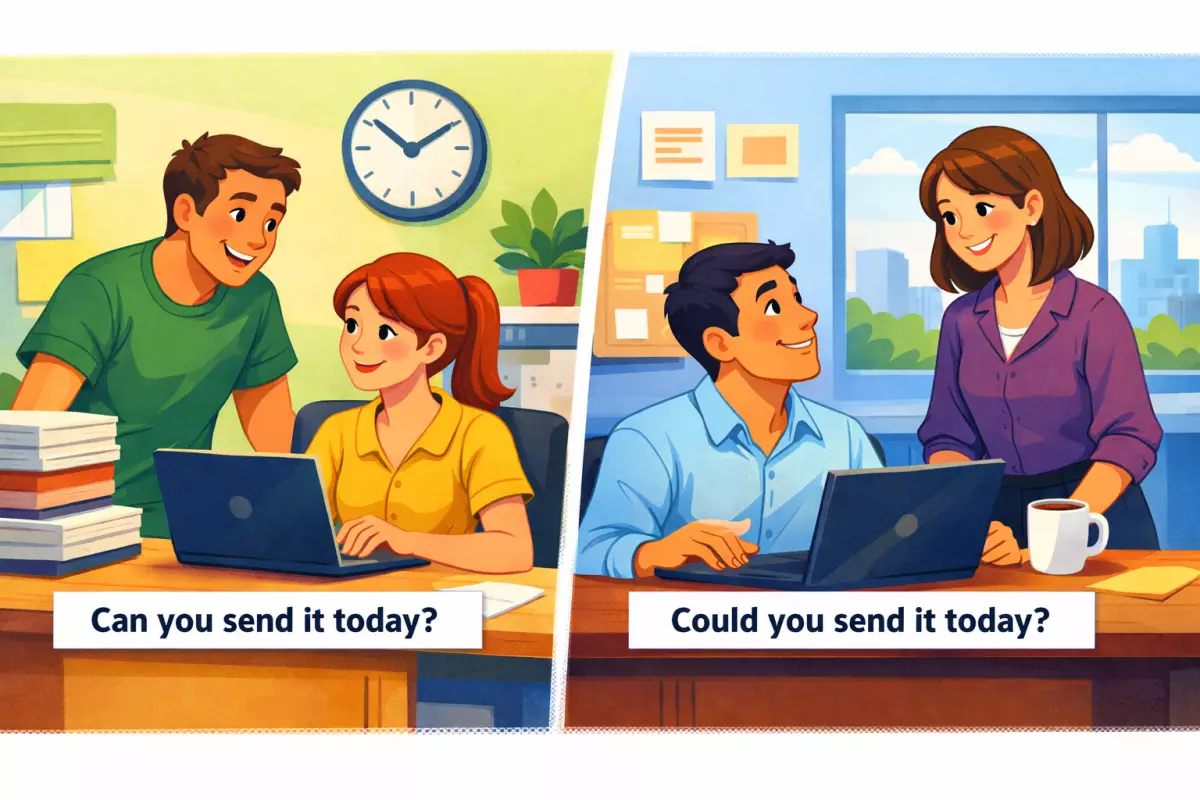
In everyday speech, can and could often overlap, but they signal different levels of directness, certainty, and distance. Choosing one or the other changes how a request sounds, how likely something seems, or whether you’re talking about a real situation or an imagined one.
| Use in conversation | More typical with can | More typical with could |
|---|---|---|
| Requests (asking someone to do something) | More direct and practical: “Can you send it today?” | More polite/soft: “Could you send it today?” |
| Permission (asking if something is allowed) | Common in casual speech: “Can I sit here?” | Slightly more formal/careful: “Could I sit here?” |
| Ability (skills/capacity) | Present/general ability: “I can drive.” | Past ability or conditional ability: “I could drive when I was 16.” / “I could drive if needed.” |
| Possibility (how likely something is) | Often sounds more immediate/real: “It can get busy on Fridays.” | Often sounds less certain or more speculative: “It could get busy later.” |
| Suggestions (offering an option) | Practical option, sometimes firm: “We can take the train.” | Gentler option, brainstorming: “We could take the train.” |
| Hypotheticals (imagined situations) | Less common for unreal situations | Very common for “not real yet” thinking: “If we left now, we could make it.” |
Patterns that change the message
- Can you…? is efficient and neutral; it can sound too blunt in sensitive situations.
- Could you…? reduces pressure and sounds more considerate, especially with strangers or at work.
- Can I…? is common for permission in informal settings; it can feel casual.
- Could I…? adds distance and respect; it’s useful in formal requests or when you want to be careful.
- I can… states a real ability or a real option you’re willing to do.
- I could… often means “it’s possible” or “I’m open to it,” not a firm plan.
- Can’t usually communicates a real limit: “I can’t meet today.”
- Couldn’t often refers to a past limit or an unreal condition: “I couldn’t reach you.” / “I couldn’t do that without help.”
Quick usage notes with common examples
- Direct request: ✅ “Can you email me the file?” → good for teammates and routine tasks.
- Softer request: ✅ “Could you email me the file when you have a minute?” → good when you’re interrupting or asking a favor.
- Permission (casual): ✅ “Can I use your charger?”
- Permission (more formal): ✅ “Could I ask a quick question?”
- Present ability: ✅ “She can speak Korean.”
- Past ability (general): ✅ “He could read at four.”
- One-time past success (use “was able to” instead): ❌ “I could fix it yesterday.” → ✅ “I was able to fix it yesterday.”
- Possibility now vs later: ✅ “It can be noisy here.” (general fact) / ✅ “It could be noisy tonight.” (uncertain prediction)
- Suggestions: ✅ “We can meet at 3.” (available plan) / ✅ “We could meet at 3.” (one option)
- Conditional: ✅ “I could help if you tell me what you need.”
- Polite refusal: ✅ “I can’t today, but I could tomorrow.”
- Softening opinions: ✅ “It could be a good idea to wait.” (less forceful than “It’s a good idea.”)
In real communication, the choice often comes down to relationship and context: use can for straightforward ability, permission, and practical plans; use could to soften requests, present options without committing, and talk about uncertain or hypothetical situations.
Typical sentence patterns with 'could' in spoken English
In everyday conversation, could shows up in a few repeatable frames: polite requests, offers, suggestions, possibility, and “past ability.” Learning these templates helps you produce natural-sounding sentences quickly, then swap in your own verbs and details.
1) Polite requests and asking permission
Use could to sound softer than can. These patterns are common in service situations, work, and casual favors.
- Could you + base verb…? (request) → “Could you send that file?”
- Could you please + base verb…? → “Could you please speak a bit slower?”
- Could I + base verb…? (permission) → “Could I use your charger for a minute?”
- Could we + base verb…? (group permission/plan) → “Could we meet after lunch?”
- Could you possibly + base verb…? (extra soft) → “Could you possibly move your bag?”
- Could you + base verb… + for me? → “Could you check this for me?”
- Could you + base verb… + when you have a second? → “Could you call me when you have a second?”
- Could I just + base verb…? (small, quick request) → “Could I just ask one question?”
2) Offers and willingness
These frames are used to volunteer help or show you’re open to doing something.
- I could + base verb… (offer) → “I could drive you to the station.”
- We could + base verb… → “We could cover the first part, if you want.”
- I could + base verb… + if you’d like → “I could take a look if you’d like.”
- If you want, I could + base verb… → “If you want, I could email them today.”
- I could also + base verb… (adding an option) → “I could also ask my manager.”
3) Suggestions and brainstorming options
Use could to propose ideas without sounding too strong or final.
- You could + base verb… (suggestion) → “You could try restarting it.”
- We could + base verb… (shared plan) → “We could grab dinner nearby.”
- Could we + base verb…? (suggestion as a question) → “Could we push it to Friday?”
- One thing we could do is + base verb… → “One thing we could do is split the tasks.”
- Maybe we could + base verb… → “Maybe we could leave a little earlier.”
- We could always + base verb… (backup plan) → “We could always take a taxi.”
4) Possibility (present or future)
When you mean “it’s possible,” could often pairs with time words and context clues. It’s less certain than will, and often similar to might.
- It could + base verb… → “It could rain later.”
- That could be + noun/adjective… → “That could be a problem.”
- This could mean + clause… → “This could mean we need more time.”
- There could be + noun… → “There could be a delay.”
- It could happen → “It could happen again.”
- It could take + time… → “It could take a few days.”
5) Past ability and past possibility
For ability in the past, could is common with general skills. For a single successful event, speakers often prefer was able to (or managed to), especially in careful speech.
- When I was younger, I could + base verb… (general past ability) → “When I was younger, I could run for hours.”
- I couldn’t + base verb… (past inability) → “I couldn’t hear you on the call.”
- Could you + base verb…? (asking about past ability) → “Could you read music as a kid?”
- ✅ “I could swim at five.” (general ability) → ❌ “I could find my keys yesterday.” (single success sounds off in many contexts)
- More natural for one-time success: “I was able to find my keys yesterday.”
6) “Could have” for missed chances, guesses, and criticism
Could have + past participle is a high-frequency spoken pattern. It can express regret, an unrealized option, or uncertainty about the past.
- I could have + past participle… (missed option) → “I could have told you earlier.”
- We could have + past participle… → “We could have taken the train.”
- It could have + past participle… (past possibility) → “It could have gone wrong.”
- That could have been + noun/adjective… → “That could have been dangerous.”
- You could have + past participle… (often criticism) → “You could have texted me.”
7) Conditional frames (polite, hypothetical)
In “if” sentences, could signals a hypothetical ability or option, often sounding less forceful than would.
- If I could + base verb…, I would… → “If I could, I would help.”
- If we could + base verb…, we could… → “If we could leave now, we could avoid traffic.”
- I could + base verb… if + clause → “I could join if I finish on time.”
- Could you + base verb… if + clause? → “Could you cover for me if I’m late?”
Common learner mistakes when choosing between can and could
Many errors come from treating can and could as interchangeable. In natural conversation, the choice often signals politeness, distance, uncertainty, or whether you mean a present ability versus a past one.
Frequent mistakes and how to fix them
- Using “could” for a general present ability
❌ I could swim. (when you mean now) → ✅ I can swim.
Use can for abilities that are true in general or true right now. - Using “can” when you want a softer request
❌ Can you open the window? (can sound blunt in some contexts) → ✅ Could you open the window?
Could often sounds more polite, especially with strangers, customers, teachers, or formal situations. - Thinking “could” always means past time
❌ Could you help me tomorrow? (learner avoids it because “past”) → ✅ Could you help me tomorrow?
In requests and suggestions, could is about politeness/softening, not past time. - Confusing permission with ability
❌ Could I leave early? (said when you only mean “am I able to?”) → ✅ Can I leave early? / Could I leave early?
Both can ask permission, but could is usually more tentative; can can sound more direct. - Overusing “could” in casual, equal-status situations
❌ Could you pass the salt? (not wrong, but can sound overly formal every time) → ✅ Can you pass the salt?
With friends/family, can is often the natural default unless you want extra politeness. - Using “could” to mean a specific past action happened
❌ I could finish my homework yesterday. (sounds like “it was possible,” not “I did it”) → ✅ I finished my homework yesterday.
For completed past facts, use the past simple. Could usually expresses past ability or possibility, not a confirmed result. - Not using “was/were able to” for a successful one-time past event
❌ I could find my phone after an hour. → ✅ I was able to find my phone after an hour.
When you emphasize success in one specific situation, was/were able to is often clearer than could. - Mixing “could” with “will” incorrectly in requests
❌ Could you will send it? → ✅ Could you send it? / Will you send it?
Keep one modal per verb phrase in standard patterns: Could you + base verb. - Using “could” without a clear meaning (ability vs. possibility vs. request)
❌ I could go to the meeting. (unclear intention) → ✅ I can go. (ability) / I could go, if you want. (suggestion) / I might go. (uncertain plan)
Choose the modal that matches your purpose: ability, suggestion, or uncertainty. - Using “can” for uncertain guesses
❌ It can be John at the door. → ✅ It could be John at the door.
For guesses and uncertainty, could is more natural than can. - Using “could” when you mean strong certainty
❌ She could be at work right now. (but you are sure) → ✅ She’s at work right now.
Could weakens certainty; if you know, state it directly. - Incorrect negative forms for past ability
❌ I didn’t could understand. → ✅ I couldn’t understand.
Use couldn’t (not “didn’t could”) for past inability. - Using “can’t” when you mean “couldn’t” in a past story
❌ Yesterday I can’t sleep. → ✅ Yesterday I couldn’t sleep.
Keep the tense consistent when narrating past events. - Forgetting that “could” can sound like a suggestion
❌ You could call him. (said as a neutral fact, but it sounds like advice) → ✅ You can call him. (ability/option) / You could call him. (suggestion)
In many contexts, You could… is heard as recommending an action. - Using “could” in direct commands
❌ Could you must finish today. → ✅ You must finish today. / Could you finish today?
Don’t combine modals like could and must. Use must for obligation, or could to ask politely. - Choosing “can” in formal writing where a more tentative tone is expected
❌ Can you provide the documents by Friday? → ✅ Could you provide the documents by Friday?
In emails and professional requests, could often matches the expected level of courtesy.
When deciding between these two modals, check what you are expressing: present ability (can), past ability (could), polite requests (could), or uncertain possibility (could). Matching the pattern to the meaning makes your English sound more natural and reduces misunderstandings.
Exercises and speaking practice using 'could' in context
Build accuracy by practicing the main patterns: ability (past), polite requests, permission, possibility, and suggestions. Focus on the structure around the modal: could + base verb, and for past possibilities: could have + past participle. The tasks below move from controlled sentences to short speaking prompts.
1) Quick form drills (choose the best option)
- When I was 10, I (could / can) swim across the pool.
- (Could / Can) you open the window, please?
- It’s cloudy— it (could / could have) rain later.
- She missed the meeting. She (could / could have) forgotten the time.
- (Could / May) I leave a little early today?
- We (could / could have) take a taxi instead of the bus.
- I tried to call you, but I (couldn’t / can’t) get a signal.
- You (could / could have) ask the teacher for feedback.
- He (could / could have) speak three languages when he lived abroad.
- Be careful— that email (could / could have) be a scam.
Show answers
- could
- Could
- could
- could have
- Could
- could
- couldn’t
- could
- could
- could
2) Rewrite for a more natural tone (use “could”)
Rewrite each sentence so it sounds more polite, less direct, or more tentative. Keep the meaning as close as possible.
- Open the door.
- Give me a minute.
- I want to speak to you after class.
- Maybe we meet earlier.
- Is it possible for you to send the file today?
- It’s possible that he is busy.
- Do you have permission to use my charger?
- I’m not able to log in right now.
Show answers
- Could you open the door?
- Could you give me a minute?
- Could I speak to you after class?
- We could meet earlier.
- Could you send the file today?
- He could be busy.
- Could I use your charger?
- I couldn’t log in right now.
3) Spot the mistake (and correct it)
Each sentence has one issue with form or meaning. Rewrite it correctly.
- ❌ Could you to help me with this?
- ❌ I could to drive last year, but now I can.
- ❌ He could have goes to the wrong office.
- ❌ Could you mind closing the window?
- ❌ We could went earlier to avoid traffic.
- ❌ Could I to borrow your pen?
- ❌ It could be rained tomorrow.
- ❌ She could finished already.
Show answers
- ✅ Could you help me with this?
- ✅ I couldn’t drive last year, but now I can.
- ✅ He could have gone to the wrong office.
- ✅ Could you close the window? (Or: Would you mind closing the window?)
- ✅ We could have gone earlier to avoid traffic. (Or: We could go earlier.)
- ✅ Could I borrow your pen?
- ✅ It could rain tomorrow.
- ✅ She could have finished already.
4) Mini-dialogue builder (speaking practice)
Use the prompts to create short, natural exchanges. Aim for 2–3 lines each. Include at least one follow-up question or reason.
- Polite request: You’re in a café and need a different table (noise, sunlight, space).
- Permission: You want to use someone’s phone charger for 10 minutes.
- Suggestion: A friend is stressed about work; offer two options using “could.”
- Possibility: Someone is late; give two possible reasons (traffic, phone, wrong place).
- Past possibility: A package didn’t arrive; explain what might have happened.
- Ability (past): Talk about something you were able to do as a child that you can’t do now (or the reverse).
- Soft disagreement: Someone proposes a plan; respond with a gentle alternative using “could.”
- Problem-solving: Your laptop won’t start; suggest steps: restart, charger, update, repair.
- Customer service: Ask for help finding an item and ask about alternatives.
- Workplace: Ask a colleague to review a document, but keep it low-pressure.
5) Pattern bank (use these frames to sound natural)
- Could you + base verb + (please)?
- Could I + base verb + …?
- Could we + base verb + …?
- I could + base verb + … (if you want).
- We could + base verb + instead.
- It could + base verb + later.
- That could be + noun/adjective.
- There could be + noun.
- He/She could be + -ing (right now).
- You could + base verb + to + purpose (to save time / to avoid traffic).
- Could you possibly + base verb + …? (extra polite)
- I was able to …, but I couldn’t … (contrast)
- Could have + past participle (maybe in the past).
- Couldn’t have + past participle (strong belief it didn’t happen).
- What could + subject + base verb + …? (asking for explanations)