How to Use May Correctly in Modern English

 This article explains the main meanings of may in modern English, how to use it for formal permission and for possibility or uncertainty, and how it differs from might in real communication. It includes professional examples, notes when it sounds too formal, common learner errors, and practice with may, might, and can.
- The main meanings of 'may' in modern English usage
- Using 'may' when asking for formal permission
- How 'may' expresses possibility and uncertainty
- Differences between 'may' and 'might' in real communication
- Examples of 'may' in formal writing and professional situations
- When 'may' sounds overly formal in everyday conversation
- Typical learner errors when using 'may'
- Practice exercises for using may, might, and can correctly
To use may accurately in modern English, listen to how it works in real conversation: showing possibility, granting polite permission, or softening a suggestion. Many learners overuse it or replace it with might or can without noticing the shift in tone. This article will help you choose the form that fits each situation so your meaning stays clear, natural, and confident.
The main meanings of 'may' in modern English usage
In present-day English, may is used for a small set of core functions. The meaning depends on context, the type of sentence (statement, question, request), and the time reference (present/future vs. past).
-
1) Possibility (something is perhaps true)
Use may to say a situation is possible, without claiming certainty. This is common in careful, neutral statements.
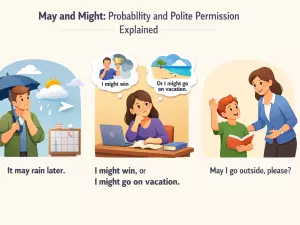
- It may rain later.
- She may be at home already.
- The results may surprise you.
- This explanation may not be complete.
- He may know the answer, but he isn’t saying.
- There may be a simpler way to do it.
- We may have enough time if we leave now.
- They may not agree with the proposal.
- The file may have been deleted by mistake.
- Prices may rise next month.
Pattern notes: may + base verb (may rain, may surprise). For earlier time, use may have + past participle (may have left).
-
2) Permission (giving or asking to do something)
Use may to give formal permission or to ask politely in more formal settings. It often sounds more official than can.
- You may begin now.
- Students may use calculators during the test.
- You may not enter without a badge.
- May I come in?
- May we leave our bags here?
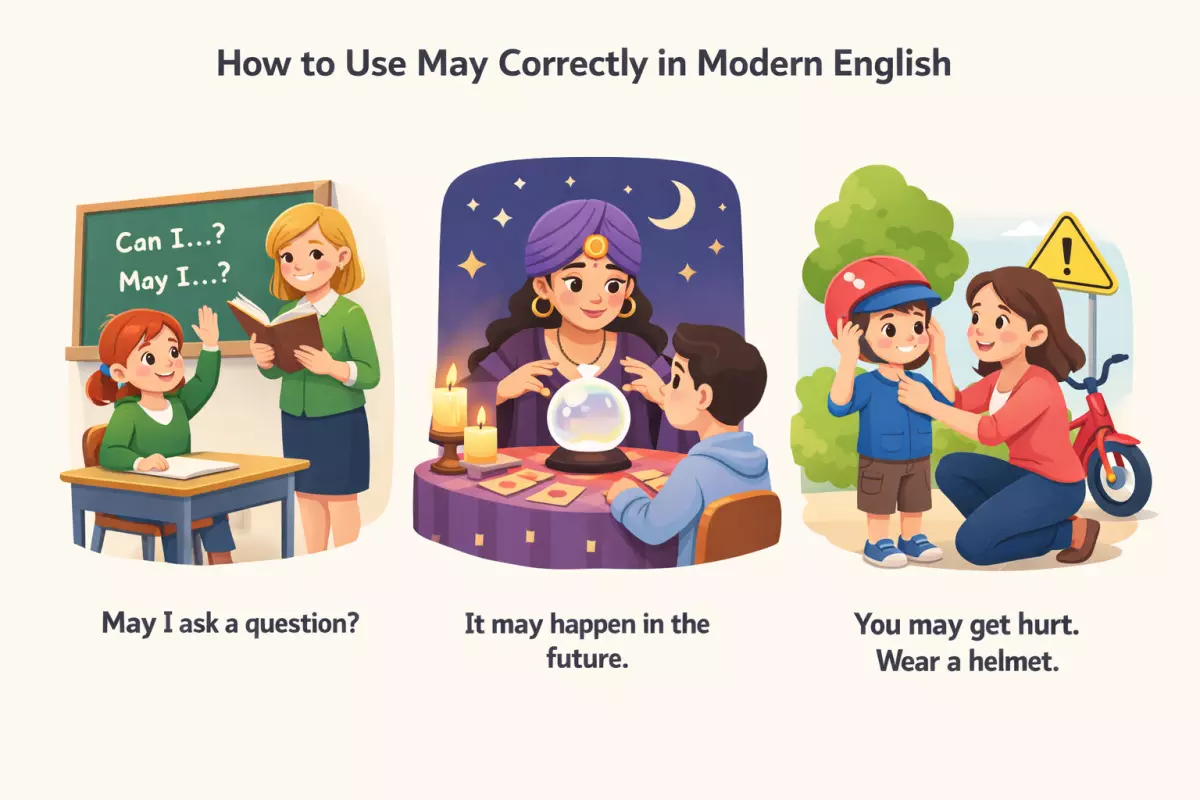
- May I ask a question?
- May I have your name, please?
- Guests may park behind the building.
- Employees may request remote work with approval.
- May I speak to the manager?
Common pattern: May I…? for requests/permission. Negative permission is often written as may not in rules and notices.
-
3) Polite requests (especially in service or formal contexts)
May can introduce a request that is intentionally polite and restrained. This overlaps with permission, but the focus is on the request itself.
- May I see the menu?
- May I have a receipt, please?
- May I take your order?
- May I suggest an alternative?
- May I interrupt for a moment?
- May we schedule a call for Thursday?
- May I confirm your email address?
- May I help you with that?
- May I clarify what you mean by “urgent”?
- May I request a copy of the document?
Usage note: in everyday conversation, many speakers prefer can or could, but may remains standard in formal speech and writing.
-
4) Concessions (acknowledging a point, then contrasting it)
Use may to concede that something is true or possible, while emphasizing a different point. This is common in academic and argumentative writing.
- It may be true, but it doesn’t solve the problem.
- He may be experienced; however, the role requires different skills.
- This plan may look efficient, yet it increases risk.
- She may have intended to help, but the timing was wrong.
- The method may work in theory, but it fails in practice.
- They may disagree, but they still collaborate effectively.
- The changes may be small, but they matter.
- It may seem obvious, but it’s easy to overlook.
Typical structure: may + verb + contrast marker (but/yet/however/nevertheless).
-
5) Wishes and set expressions (formal or literary)
In fixed phrases, may expresses a wish or hope. This use is more formal and appears in speeches, toasts, and traditional formulas.
- May you have a safe journey.
- May all your efforts succeed.
- May he rest in peace.
- May the best team win.
- May this day bring you joy.
- May your work be recognized.
- May we never forget.
- May peace prevail.
- May your family be well.
- May fortune favor you.
Pattern: May + subject + base verb (May you succeed). This is not a question; it is a wish.
-
6) Past-time forms with “might” (how “may” shifts in the past)
May itself usually points to present or future possibility. For reported speech or more remote/uncertain possibility, English often uses might.
- Direct: “It may rain.” → Reported: She said it might rain.
- Present: He may be busy. → Past report: I thought he might be busy.
- Now: They may arrive late. → Then: We knew they might arrive late.
- Past possibility: She may have missed the train. (also possible: She might have missed the train.)
Practical guideline: use may for a current, live possibility; use might when the statement is backshifted, more tentative, or framed as less likely.
Using 'may' when asking for formal permission
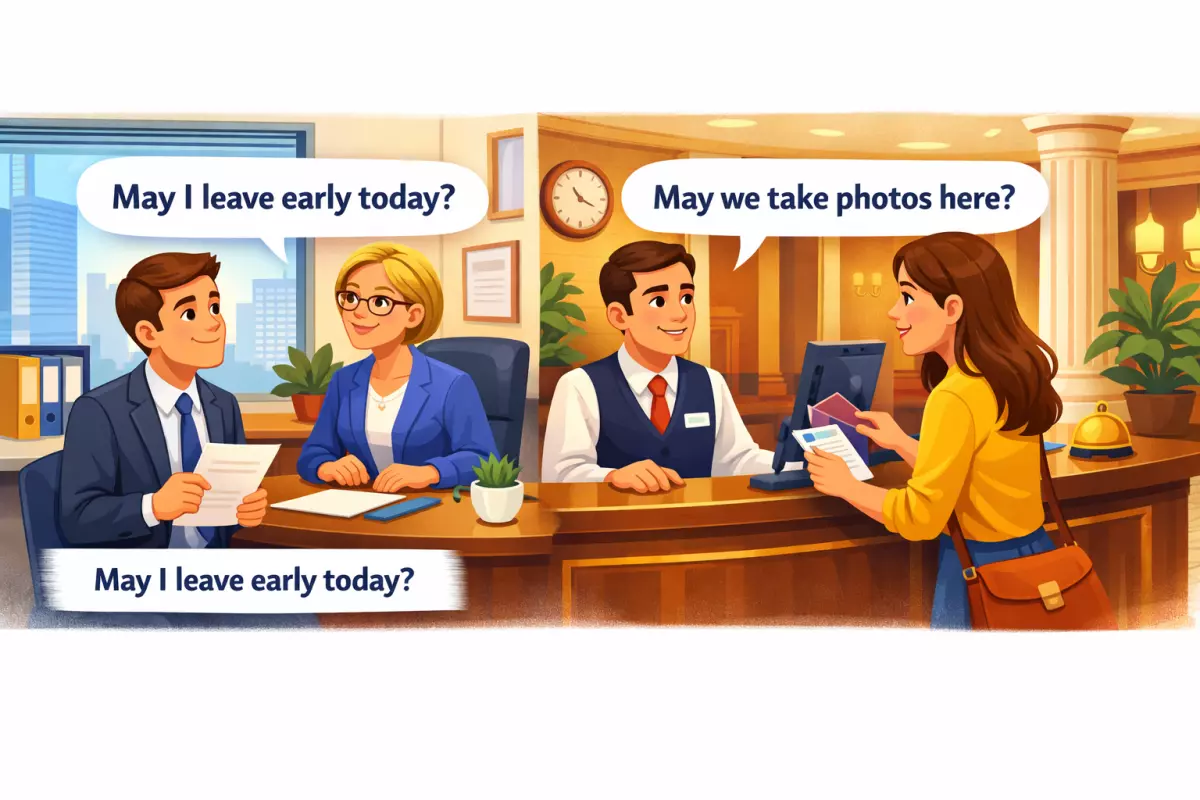
May is the classic choice when you want to request permission in a polite, formal, or rule-based setting. It sounds respectful and slightly distant, which fits situations like speaking to a supervisor, addressing a customer, writing to an institution, or asking about policies.
The core pattern is simple: May + subject + base verb. In questions, it typically appears as May I/we + base verb. In many contexts, could is also polite, but may focuses more directly on permission rather than ability.
Common patterns
- May I + base verb ...? (most common for a single speaker)
- May we + base verb ...? (for a group or on behalf of others)
- May + subject + base verb ...? (more formal, less common in everyday speech)
- May I have + noun ...? (requesting an item or document)
- May I speak to + person/department ...? (formal phone or reception requests)
- May I ask + question ...? (permission to ask something sensitive or time-consuming)
- May I + base verb + for a moment/minute ...? (brief interruption)
- May I + base verb + if ...? (introducing a conditional request)
Example requests (and what they imply)
- May I come in?
- May I sit here?
- May I leave a little early today?
- May I take tomorrow off?
- May I use your phone?
- May I borrow this file for an hour?
- May I speak with the manager, please?
- May I ask a quick question?
- May I ask about the schedule?
- May I request an extension?
- May I have a copy of the report?
- May we begin the meeting?
- May we reschedule our appointment?
- May we have your approval to proceed?
- May I confirm your name and date of birth?
- May I clarify one point before we continue?
Polite add-ons that fit well with “may”
- Add please to soften the request: “May I step out for a moment, please?”
- Use a brief reason when needed (keep it short): “May I leave early today to attend an appointment?”
- Use “May I ask…” before personal topics: “May I ask how you’d like to be addressed?”
- Use “May I confirm…” for administrative checks: “May I confirm the delivery address?”
Common mistakes to avoid
- ✅ May I go now? ❌ May I to go now?
- ✅ May I have a seat? ❌ May I have to a seat?
- ✅ May I speak to Ms. Chen? ❌ May I speak Ms. Chen?
- Don’t use may when you mean possibility rather than permission: “It may rain” is about likelihood, not asking to do something.
- In very casual conversations, may can sound stiff; “Can I…?” is often more natural with friends, while may suits formal contexts.
When you choose may for a permission request, keep the verb in its base form and keep the wording direct. The formality comes from the modal itself, so you usually do not need extra complicated phrasing to sound polite.
How 'may' expresses possibility and uncertainty
May is a modal verb used to show that something is possible, but not certain. It often signals a careful, non-absolute claim: the speaker is leaving room for other outcomes. In writing, it helps you avoid overstatement; in speech, it can sound measured or tentative depending on context.
Core pattern and meaning
The most common structure is:
- may + base verb: “It may rain later.”
- may not + base verb: “The package may not arrive today.”
Use this pattern when you want to communicate “this is possible” rather than “this will happen.”
Common usage patterns (with examples)
- Predictions with uncertainty: “Sales may increase in Q3.”
- Situational possibility: “You may experience delays during maintenance.”
- Explaining a possible reason: “The file may be corrupted.”
- Stating a tentative conclusion: “This may indicate a larger issue.”
- Offering a cautious recommendation: “You may want to back up your data first.”
- Softening a critique: “That approach may be too expensive for a small team.”
- Hedging in academic or formal writing: “These results may suggest a correlation.”
- Possibility in the near future: “We may hear back this afternoon.”
- Possibility over a longer timeline: “The policy may change next year.”
- Conditional possibility (often with if): “If traffic is light, we may arrive early.”
- Uncertain availability: “The manager may be in a meeting.”
- Uncertain identity or cause: “It may be a wiring problem.”
- Uncertain outcome in planning: “The event may be postponed.”
- Careful phrasing in customer support: “Your account may be temporarily locked after repeated attempts.”
- Balanced statement with alternatives: “We may proceed today, or we may wait for approval.”
Time reference: present vs. past possibility
May usually points to a present or future possibility. To talk about uncertainty in the past, English typically uses a perfect form:
- may have + past participle: “They may have missed the train.”
- may not have + past participle: “She may not have seen your message.”
This structure expresses “it’s possible that it happened,” not a confirmed fact.
Choosing between “may” and stronger language
- Use may when you want to avoid certainty: “This change may affect performance.”
- Use a stronger modal when you mean likelihood or confidence: “This will affect performance” (certainty) or “This is likely to affect performance” (high probability).
- Avoid mixing signals of certainty and uncertainty in the same clause: ❌ “It may definitely happen.” → ✅ “It may happen” or “It will definitely happen.”
Differences between 'may' and 'might' in real communication
In everyday English, both may and might express possibility, but speakers use them to signal different levels of certainty, different levels of formality, and different conversational goals. The choice often depends less on “grammar rules” and more on what you want your listener to hear: confidence, politeness, distance, or tentativeness.
Core usage patterns (what listeners usually infer)
- May often sounds a bit more confident or “open” as a possibility: “It may rain later.”
- Might often sounds more tentative or remote: “It might rain later.”
- May is common in careful, formal, or official phrasing (not only in writing): “You may be eligible for a refund.”
- Might is common in casual conversation when speakers soften statements: “I might grab food first.”
- In many contexts, the difference is subtle; intonation and context can matter as much as the modal itself.
Permission vs. possibility
- May is a standard choice for giving permission in formal or rule-based contexts: “You may leave when you finish.”
- Might is unusual for direct permission in modern usage; it can sound indirect, old-fashioned, or humorous: “You might leave now” (often implies “if you want,” or can sound like a suggestion).
- For asking permission, many speakers prefer “Can I…?” in conversation, but may remains common in polite or institutional settings: “May I come in?”
Politeness and softening (how to sound less forceful)
- Use might to make suggestions less direct: “You might try restarting your phone.”
- Use might to soften disagreement: “That might be true, but the data is limited.”
- Use might to reduce pressure in invitations: “We might meet after work if you’re free.”
- Use may when you want polite distance without sounding unsure: “You may want to check the spelling.”
Common structures where the choice matters
- may/might + base verb for present/future possibility: “She may arrive soon.” / “She might arrive soon.”
- may/might + be + -ing for an ongoing situation: “He may be working late.” / “He might be working late.”
- may/might + have + past participle for past possibility: “They may have missed the bus.” / “They might have missed the bus.”
- might is especially common for past “unknowns” in conversation: “I might have left it at the office.”
Typical real-life examples (with the implied tone)
- “It may take a few days to process.” (careful, service/administrative tone)
- “It might take a while.” (casual, slightly apologetic)
- “You may be right.” (polite concession, measured)
- “You might be right.” (more tentative; sometimes implies “I’m not fully convinced”)
- “We may need more time.” (professional, planning tone)
- “We might need more time.” (softer; leaves more room to adjust)
- “May I ask a question?” (formal/polite request)
- “I might ask a question.” (not a request; it describes a possibility)
- “This may cause delays.” (warning, official tone)
- “This might cause delays.” (warning, slightly less categorical)
- “There may be a mistake in the invoice.” (careful, diplomatic)
- “There might be a mistake…” (even more cautious, less accusatory)
Quick accuracy notes (common learner mix-ups)
- ✅ “It may be true.” / ✅ “It might be true.” (both acceptable; different confidence)
- ✅ “He may have forgotten.” / ✅ “He might have forgotten.” (both acceptable for past possibility)
- ❌ “May you please…” (often sounds unnatural for requests; prefer “Could you…?” or “Can you…?”)
- ❌ “I may to go.” → ✅ “I may go.” (no to after modals)
- ❌ “He might can…” → ✅ “He might be able to…” (avoid stacking modals in standard English)
Examples of 'may' in formal writing and professional situations
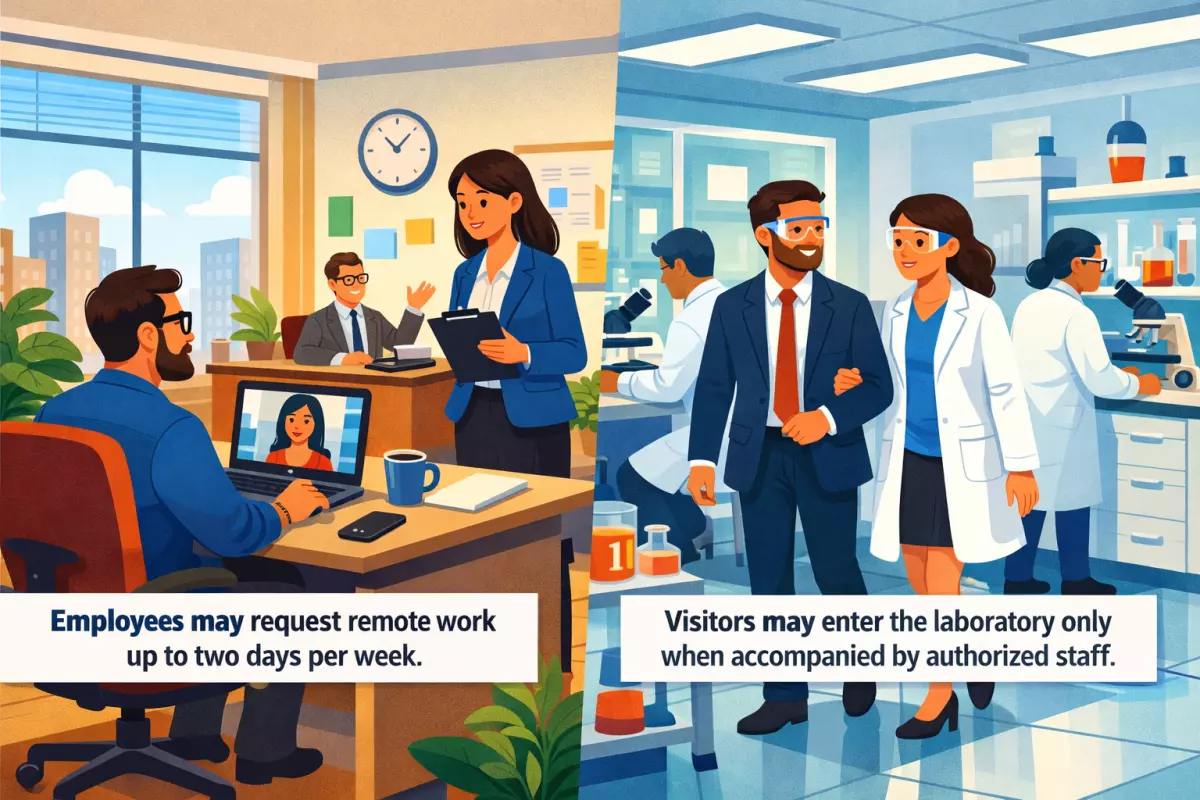
In professional contexts, may is commonly used to express permission, possibility, and careful recommendations. It helps keep the tone neutral and appropriately cautious, especially in policies, reports, and formal correspondence.
Permission and authorization
- Employees may request remote work up to two days per week, subject to manager approval.
- Visitors may enter the laboratory only when accompanied by authorized staff.
- Applicants may submit supporting documents after the initial deadline in exceptional cases.
- Users may reset their password through the account portal.
- Team members may access the shared drive for project-related purposes only.
- Clients may cancel the service within 14 days of activation, in accordance with the agreement.
Possibility and measured uncertainty (reports, analysis, updates)
- The delay may be attributable to supplier constraints.
- This change may affect processing times during peak periods.
- Several factors may have contributed to the variance observed in Q3.
- These findings may indicate a need for additional controls.
- Under certain conditions, the system may generate duplicate notifications.
- The proposed timeline may require revision if approvals are not received by Friday.
Polite requests and formal instructions
- May I confirm the meeting time and location?
- May we ask that all attendees arrive ten minutes early for security screening?
- May I request clarification regarding the scope of deliverables?
- You may wish to review the attached draft before the call.
- To avoid confusion, you may want to label the files using the agreed naming convention.
Legal, compliance, and policy language
- Failure to comply may result in disciplinary action.
- Any breach of confidentiality may be reported to the relevant authority.
- Personal data may be retained for audit purposes for up to seven years.
- Payments may be withheld pending verification of submitted documentation.
- This agreement may be terminated by either party with 30 days’ written notice.
Common pattern choices (what sounds formal)
- May + base verb: “The committee may approve the proposal.”
- May be + past participle (passive): “The request may be declined if incomplete.”
- May have + past participle (past possibility): “The file may have been deleted during migration.”
- May I / May we (polite inquiry): “May we proceed with the next step?”
- ✅ “Employees may work remotely…” → permission in a policy statement.
- ❌ “Employees can work remotely…” → can sound more about ability than authorization in formal policies.
When 'may' sounds overly formal in everyday conversation
May is correct English, but in casual speech it can sound stiff, distant, or “scripted.” In everyday requests and quick questions, speakers often choose can, could, or a softer phrasing because it matches the relaxed tone of modern conversation.
Typical situations where “may” feels too formal
- Quick, low-stakes requests (especially with friends or coworkers): “May I borrow your pen?” can sound overly ceremonious.
- Everyday permission questions in informal settings: “May I sit here?” is grammatical, but “Can I sit here?” is more natural in many contexts.
- Casual offers: “May I help you?” is fine, but it can feel more like customer-service language than friendly conversation.
- Texting and messaging: “May I ask…” often reads formal; “Can I ask…” or “Quick question…” is more typical.
- Peer-to-peer workplace talk: “May I take Friday off?” can sound like a formal petition; “Could I take Friday off?” often fits better.
- Speaking to people you know well: With family or close friends, “may” can create unnecessary distance.
More natural alternatives (with patterns you can reuse)
Use these options to keep the meaning but match a casual register. The choice depends on what you want to signal: ability, permission, or politeness.
- “Can I…?” for everyday permission in relaxed settings: “Can I use your charger?”
- “Could I…?” for a polite request without sounding formal: “Could I leave a little early today?”
- “Is it okay if I…?” for friendly, explicit permission: “Is it okay if I open a window?”
- “Do you mind if I…?” for a softer approach: “Do you mind if I sit here?”
- “Would it be alright if I…?” for careful politeness: “Would it be alright if I rescheduled?”
- “Can we…?” to make it collaborative: “Can we move this meeting to 3?”
- “Could you…?” when the action is theirs, not yours: “Could you send that file?”
- “Any chance I could…?” for a light, non-demanding request: “Any chance I could get a ride?”
- “Would you be able to…?” for polite workplace requests: “Would you be able to review this?”
- “I was wondering if I could…” for extra softness: “I was wondering if I could ask a favor.”
- “Mind if I…?” for very casual speech: “Mind if I join?”
- “Can I just…?” for small, immediate actions: “Can I just check one thing?”
Keep “may” for the contexts where it sounds normal
- Customer service and hospitality: “May I take your order?” / “May I help you?”
- Formal meetings and ceremonies: “May I have your attention, please?”
- Speaking to a judge, official, or panel: “May I approach?” / “May I respond?”
- Written notices and policies: “Visitors may park in the rear lot.”
- Careful, respectful requests where formality is intentional: “May I ask a question?”
Common “may” choices that sound stiff (and smoother rewrites)
- ❌ “May you send me the link?” → ✅ “Could you send me the link?”
- ❌ “May we meet tomorrow?” → ✅ “Can we meet tomorrow?” / “Could we meet tomorrow?”
- ❌ “May I quickly ask you something?” → ✅ “Can I ask you something quick?”
- ❌ “May I get a coffee?” (to a friend) → ✅ “Can I get a coffee?”
- ❌ “May I borrow your notes?” (classmate) → ✅ “Could I borrow your notes?”
In short, may is best treated as a formality marker: use it when you want a more official tone, and switch to can/could or permission phrases when the situation is ordinary and conversational.
Typical learner errors when using 'may'
Many mistakes with this modal come from mixing up meaning (permission vs. possibility), choosing the wrong level of formality, or using an ungrammatical verb form after it. The fixes are usually simple once you notice the pattern.
1) Using the wrong verb form after may
- ❌ She may goes now. → ✅ She may go now. (Use the base verb.)
- ❌ He may to leave early. → ✅ He may leave early.
- ❌ They may are late. → ✅ They may be late.
- ❌ I may can help. → ✅ I may help. or I can help. (Avoid stacking modals in standard English.)
2) Confusing permission with possibility
- For permission, use it to ask or grant: May I leave?, You may sit here.
- For possibility, use it to express uncertainty: It may rain later.
- ❌ May you open the window? (Often sounds like “Is it possible for you…?”) → ✅ Could you open the window? / Can you open the window? (More natural request.)
- ❌ You may be tired, so go home. (Ambiguous: permission vs. guess) → ✅ You might be tired, so you should go home. (Clearer meaning.)
3) Overusing it in everyday conversation
- May I…? is correct but can sound formal in casual settings; learners sometimes use it everywhere.
- In informal speech, Can I…? is often the natural choice for permission, especially with friends and family.
- In writing (emails, customer service, academic tone), May I…? and You may… can be appropriate and polite.
4) Forming negatives and questions incorrectly
- ❌ Do I may leave? → ✅ May I leave? (No do-support with modals.)
- ❌ I don’t may go. → ✅ I may not go.
- Mayn’t exists but is rare in modern usage; learners sometimes copy it from older materials. Prefer may not.
5) Misplacing not and changing the meaning
- He may not come is ambiguous: it can mean “maybe he won’t come” or “he is not allowed to come,” depending on context.
- If you mean lack of permission, make it explicit: He is not allowed to come / He may not enter this area. (Clear rule-setting context.)
- If you mean uncertainty, many writers choose might not to reduce confusion: He might not come.
6) Problems with time: present vs. past possibility
- Learners sometimes use the same structure for all time references.
- For past possibility, use may have + past participle: She may have missed the train.
- ❌ She may missed the train. → ✅ She may have missed the train.
- For ongoing situations, use may be + -ing: They may be waiting outside.
7) Using it for strong predictions or certainty
- This modal signals uncertainty, not confidence. Learners sometimes use it where a stronger verb is needed.
- ❌ It may definitely happen tomorrow. → ✅ It will happen tomorrow. (certainty) or It may happen tomorrow. (uncertainty)
- Avoid mixing it with absolute adverbs like definitely or certainly unless you are deliberately contrasting viewpoints.
8) Missing more natural alternatives in fixed situations
- Rules and signs: You may not park here is correct, but No parking or Parking is not allowed is often more idiomatic.
- Suggestions: instead of You may want to… (which can sound indirect), learners may choose clearer options like You might want to… or You should…, depending on strength.
- Requests in service contexts: May I help you? is standard; in casual contexts, Can I help you? is common.
Practice exercises for using may, might, and can correctly
Use the tasks below to choose the best modal for permission, possibility, and ability. Focus on the meaning you want first (permission vs. ability vs. likelihood), then match it to the typical pattern: may/might for possibility, may/can for permission (depending on formality), and can for ability.
1) Choose the best modal (may / might / can)
- _____ I leave a few minutes early today?
- It _____ rain later, so bring a jacket.
- She _____ speak three languages fluently.
- We _____ be late if traffic gets worse.
- _____ you help me move this table?
- Visitors _____ not enter this area without a badge.
- I’m not sure, but the keys _____ be in the kitchen.
- He _____ run 10 km without stopping.
- _____ I ask a quick question?
- The meeting _____ start early, but it depends on the client.
- You _____ borrow my charger if you return it today.
- This app _____ crash if your phone is low on storage.
Show answers
- may
- might
- can
- might
- can
- may
- might
- can
- may
- might
- can
- may
2) Rewrite to match the meaning (keep the original meaning)
Rewrite each sentence using the modal in parentheses. Keep the meaning as close as possible (permission stays permission; possibility stays possibility; ability stays ability).
- Is it okay if I open the window? (may)
- It’s possible the parcel arrives today. (might)
- She is able to finish this by noon. (can)
- It is not allowed to park here. (may not)
- It is possible he misunderstood the email. (may)
- Are you able to meet at 3 p.m.? (can)
- It’s possible we need more time. (might)
- It is allowed to use calculators in this exam. (may)
Show answers
- May I open the window?
- The parcel might arrive today.
- She can finish this by noon.
- You may not park here.
- He may have misunderstood the email.
- Can you meet at 3 p.m.?
- We might need more time.
- You may use calculators in this exam.
3) Spot the mismatch (permission vs. ability vs. possibility)
Each item has a modal that does not fit the intended meaning. Replace it with a better choice (may / might / can).
- I can be at the office tomorrow, but I’m not sure yet. (uncertain plan)
- May you swim? (ability)
- We might enter now; the sign says “Employees only.” (permission)
- It can snow tonight; the forecast is uncertain. (possibility, not general ability)
- Can I use your phone for a moment? (more formal permission)
- She may lift 50 kg easily. (ability)
- He can not be serious; I heard him say it. (strong certainty)
- You might submit the form by Friday. (rule/permission)
Show answers
- I might be at the office tomorrow, but I’m not sure yet.
- Can you swim?
- We can’t enter now; the sign says “Employees only.”
- It might snow tonight; the forecast is uncertain.
- May I use your phone for a moment?
- She can lift 50 kg easily.
- He can’t be serious; I heard him say it.
- You may submit the form by Friday.
Quick pattern reminders (useful while checking your work)
- Permission (polite/formal): “May I…?” / “You may…” / “May we…?”
- Permission (common/neutral): “Can I…?” / “You can…” (often fine in everyday speech)
- Possibility (uncertain): “It may/might…”; might often sounds a bit less certain than may.
- Ability: “I/She/They can…” (skills, capacity, practical ability)
- Prohibition: “You may not…” (often rules) vs. “You can’t…” (rules or practical impossibility, depending on context)