How to Use Might to Express Possibility in English

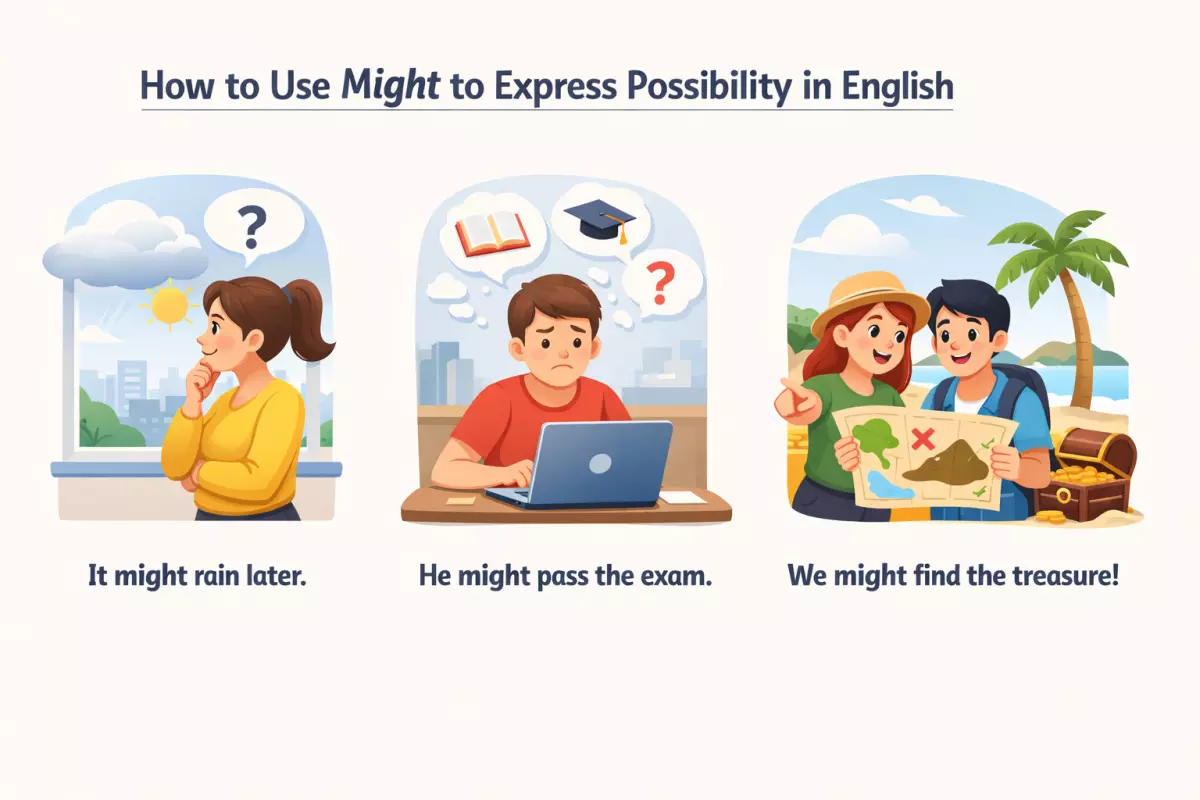 This article explains what might means and how it shows uncertainty, how to use it for possible future events and softer suggestions, and how it differs from may in everyday English. It also gives spoken examples, covers conditionals, flags common learner mistakes, and includes practice exercises.
- The meaning of 'might' and how it signals uncertainty
- How 'might' is used to talk about possible future events
- Using 'might' to suggest ideas or weaker recommendations
- Differences between 'might' and 'may' in everyday English
- Examples of 'might' in natural spoken conversations
- How 'might' appears in conditional or hypothetical situations
- Typical learner mistakes when using 'might'
- Exercises and practice tasks for expressing possibility with 'might'
Might is a useful word when you want to express possibility without certainty. In everyday conversation it helps you sound careful and realistic, leaving room for change, new information, or a different outcome. People use it to guess about the weather, discuss plans, or offer gentle advice, and using it yourself can make your English sound more natural and flexible.
The meaning of 'might' and how it signals uncertainty
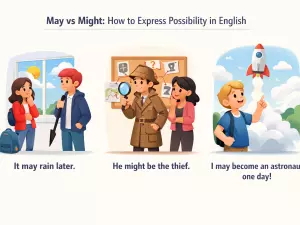
Might is a modal verb used to show that something is possible but not certain. It places an event, situation, or conclusion in the “maybe” zone, often suggesting a weaker probability than may and usually less confidence than will. The speaker is not presenting a fact; they are presenting a reasonable guess, prediction, or option.
Core idea: possibility, not certainty
Use might when you want to keep the statement open because you do not have enough information to be sure, or because the outcome depends on conditions. It commonly appears with:
- Predictions based on limited evidence: “It might rain later.”
- Uncertain plans: “I might go to the meeting.”
- Speculation about reasons: “He might be stuck in traffic.”
- Polite, tentative suggestions: “You might try restarting your laptop.”
- Careful conclusions: “That might explain the error.”
Common patterns and sentence shapes
Might is followed by the base form of the verb (the infinitive without “to”). It does not change for person or number.
- Affirmative: might + base verb → “She might call tonight.”
- Negative: might not + base verb → “They might not agree.”
- Question (less common): Might + subject + base verb? → “Might he be late?”
- With adverbs of uncertainty: “It might possibly work.” / “She might still be asleep.”
- With “be” for states: “I might be wrong.” / “The keys might be in the car.”
- With “have” for past possibility: might have + past participle → “He might have missed the bus.”
How “might” softens what you say
Because it reduces certainty, might is useful when you want to sound cautious, diplomatic, or non-committal. It often signals that the speaker is considering alternatives rather than making a firm claim.
- More cautious than a direct statement: “This might be a problem” (not “This is a problem”).
- Less pressure in suggestions: “You might want to email her” (softer than “Email her”).
- Room for correction: “It might be the wrong file” (invites checking).
Examples that show different degrees of uncertainty
- “I might stay in tonight.” (possible plan, not decided)
- “We might need more time.” (tentative assessment)
- “The delivery might arrive tomorrow.” (uncertain prediction)
- “She might not know the answer.” (uncertain negative)
- “This might look confusing at first.” (gentle warning)
- “You might be right.” (partial agreement, not fully certain)
- “They might be at the office.” (guess about location)
- “It might take a while.” (non-specific, cautious estimate)
- “He might have left early.” (past possibility)
- “I might not have explained it clearly.” (tentative self-correction)
- “Might it be better to wait?” (formal/rare question form)
- “If we leave now, we might catch the train.” (conditional possibility)
Quick accuracy notes (common learner issues)
- ✅ “She might go.” → ❌ “She might goes.” (use base verb)
- ✅ “He might be busy.” → ❌ “He might is busy.”
- ✅ “They might have forgotten.” → ❌ “They might forgot.” (use “might have + past participle” for past)
- “Might” does not need “to”: ✅ “might help” → ❌ “might to help.”
How 'might' is used to talk about possible future events
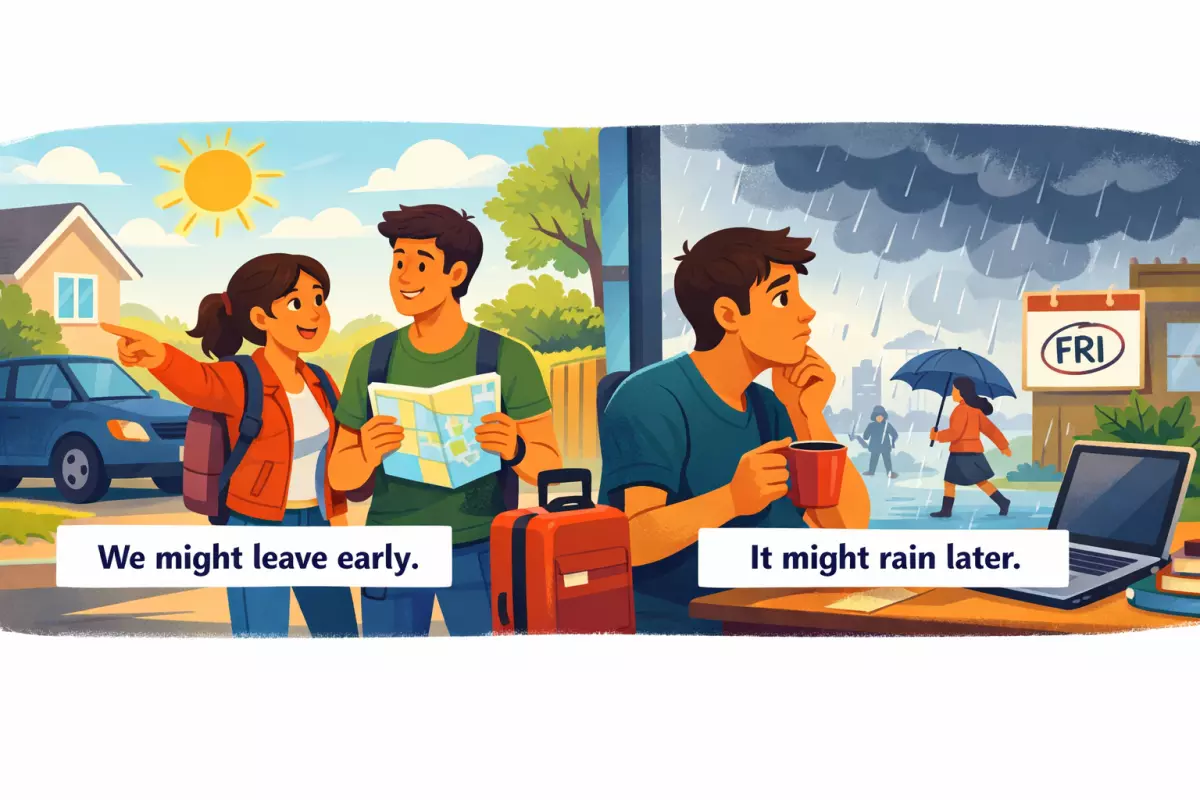
Use might to show that a future outcome is possible but not certain. It keeps the prediction cautious, often implying “this is one realistic option, but I’m not sure.”
Core patterns for future possibility
- might + base verb: “We might leave early.” / “It might rain later.”
- might not + base verb: “I might not have time tomorrow.”
- might + be + noun/adjective: “The meeting might be on Friday.” / “It might be difficult.”
- might + be + -ing (possible ongoing situation): “This time next week, I might be working from home.”
- might + have to (possible obligation): “You might have to reschedule.”
- might + want to (suggesting a possible helpful action): “You might want to bring a jacket.”
Common time markers and where they go
Future time words often appear at the end of the clause, but they can also come first for emphasis.
- Later: “I might call you later.”
- Tonight: “We might watch a movie tonight.”
- Tomorrow: “She might come tomorrow.”
- This afternoon: “It might get warmer this afternoon.”
- Next week/month/year: “They might move next year.”
- In a few minutes/hours: “The bus might arrive in a few minutes.”
- Soon: “He might reply soon.”
- By + time (deadline): “We might finish by Friday.”
- Over the weekend: “Prices might change over the weekend.”
- In the long run: “It might help in the long run.”
Questions and short answers
- Yes/No questions: “Might it snow tomorrow?” (more formal) / “Do you think it might snow tomorrow?” (more natural in conversation)
- Wh- questions: “When might they arrive?” / “What might happen if we wait?”
- Short answers: “Are you coming?” → “I might.” / “I might not.”
Using “might” with conditions and reasons
To explain why something is possible, add a condition or a reason clause.
- If + present, might + base verb: “If traffic is bad, we might be late.”
- Because/Since + present, might + base verb: “Since it’s windy, the flight might be delayed.”
- Depending on + noun/clause: “Depending on the budget, we might hire another person.”
- Unless + present: “We might cancel unless the weather improves.”
Accuracy notes (typical learner issues)
- ✅ “It might rain.” ❌ “It might to rain.” (no “to” after might)
- ✅ “She might be late.” ❌ “She might is late.” (use base form, not “is/are” after might)
- ✅ “They might not come.” ❌ “They don’t might come.” (don’t use “do/does” to negate might)
- ✅ “Might I ask a question?” (formal) → in everyday speech: “Can I ask a question?”
Using 'might' to suggest ideas or weaker recommendations
Use might when you want to offer an option without sounding pushy. It keeps the tone tentative, polite, and open to discussion, which is useful for advice, planning, and problem-solving.
Common patterns
- You might + base verb: a gentle suggestion.
- You might try restarting your computer.
- You might ask your manager for clarification.
- Might + base verb (with an implied subject, often “we”): a collaborative idea.
- Might be worth checking the settings first.
- Might help to write a quick outline.
- You might want to + base verb: slightly more direct, still soft.
- You might want to back up your files before updating.
- You might want to arrive a bit early.
- Might be a good idea to + base verb: frames the suggestion as a sensible option.
- It might be a good idea to confirm the appointment.
- It might be a good idea to set a deadline.
- Might consider + -ing / noun: more formal and cautious.
- You might consider taking a short break.
- You might consider a different supplier.
- Might be worth + -ing: suggests value without insisting.
- It might be worth emailing support.
- It might be worth comparing prices.
Example suggestions in everyday situations
- For problem-solving: You might check the cable connection.
- For studying: You might review the vocabulary in short sessions.
- For health (general): You might talk to a pharmacist about it.
- For work: You might send a brief follow-up message.
- For meetings: We might start with the main decision first.
- For travel: You might book a flexible ticket.
- For relationships: You might tell them how you felt, calmly.
- For time management: You might block an hour with no notifications.
- For writing: You might cut the first paragraph if it repeats ideas.
- For customer service: You might ask for the order number.
- For budgeting: You might set a weekly limit for extras.
- For learning English: You might record yourself and listen back.
- For cooking: You might add a little more salt at the end.
- For planning: We might leave earlier to avoid traffic.
- For conflict at work: You might document the key dates and messages.
How “might” changes the tone
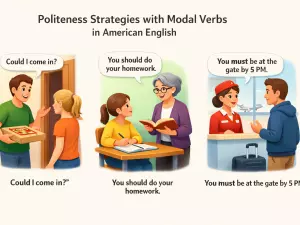
- More tentative than “should”: “You might email them” sounds like an option; “You should email them” sounds like strong advice.
- Often politer than “must” or “need to”: it reduces pressure and leaves room for disagreement.
- Useful when you’re unsure: it signals that the recommendation depends on the situation.
Common learner errors to avoid
- ✅ You might try calling later. ❌ You might to try calling later.
- ✅ It might be worth checking. ❌ It might be worth to check.
- ✅ You might want to leave now. ❌ You might want leave now.
- ✅ Might be a good idea to save a copy. ❌ Might is a good idea to save a copy.
Differences between 'might' and 'may' in everyday English
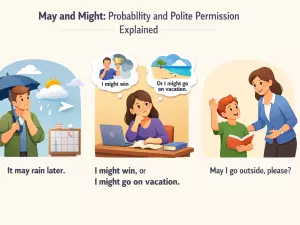
In daily conversation, may and might often overlap, but they tend to signal slightly different levels of certainty and formality. Both are used to talk about possibility, yet speakers choose one or the other based on context: how confident they feel, how polite they want to sound, and whether they are asking for permission.
| Use case | More typical choice | Meaning / effect | Example |
|---|---|---|---|
| Neutral possibility (everyday) | may / might | Both are acceptable; choice often depends on personal style | It may rain later. / It might rain later. |
| Lower confidence / “not sure” feeling | might | Sounds more tentative or cautious | I might be wrong, but I think the meeting is tomorrow. |
| Slightly higher confidence (still not certain) | may | Can sound a bit more likely or more matter-of-fact | Prices may increase next month. |
| Formal writing, notices, rules | may | Common in official or written style | Guests may use the main entrance after 6 p.m. |
| Asking for permission | may | Traditional permission question; polite and formal | May I leave early today? |
| Polite but more casual permission (common spoken English) | might (less common than may) | Sounds very tentative; sometimes used to soften a request | Might I ask a quick question? |
| Giving permission (meaning “is allowed to”) | may | Means permission, not probability | You may take one brochure. |
| Suggesting a possible action | might | Often used for gentle suggestions | You might want to back up your files. |
| Conditional possibility (if… then…) | may / might | Both work; might can feel more hypothetical | If you hurry, you may catch the bus. / …you might catch the bus. |
| Speculating about the past | might have / may have | Both express uncertainty about a past event | She might have missed the train. / She may have missed the train. |
Practical patterns to notice
- Permission vs. possibility: If you mean “allowed to,” may is the clearer choice (You may sit here.). If you mean “maybe,” either can work (It may/might be true.).
- Tentative language: might commonly appears with softening phrases such as “I might be wrong,” “It might just be me,” or “We might want to…”
- Everyday spoken English: Many speakers default to might for uncertainty because it feels less definite and less formal.
- Formal tone: may is frequent in announcements and policies where the writer wants a neutral, official sound.
Common learner pitfalls (quick fixes)
- ✅ Permission question (formal): May I come in? → ❌ Might I come in? (possible, but less typical in everyday speech)
- ✅ Uncertain guess: It might take longer than we think. → It may take longer than we think. (also correct; slightly more formal)
- ✅ Past uncertainty: They might have left already. → They may have left already. (both acceptable; choose the tone you want)
Examples of 'might' in natural spoken conversations
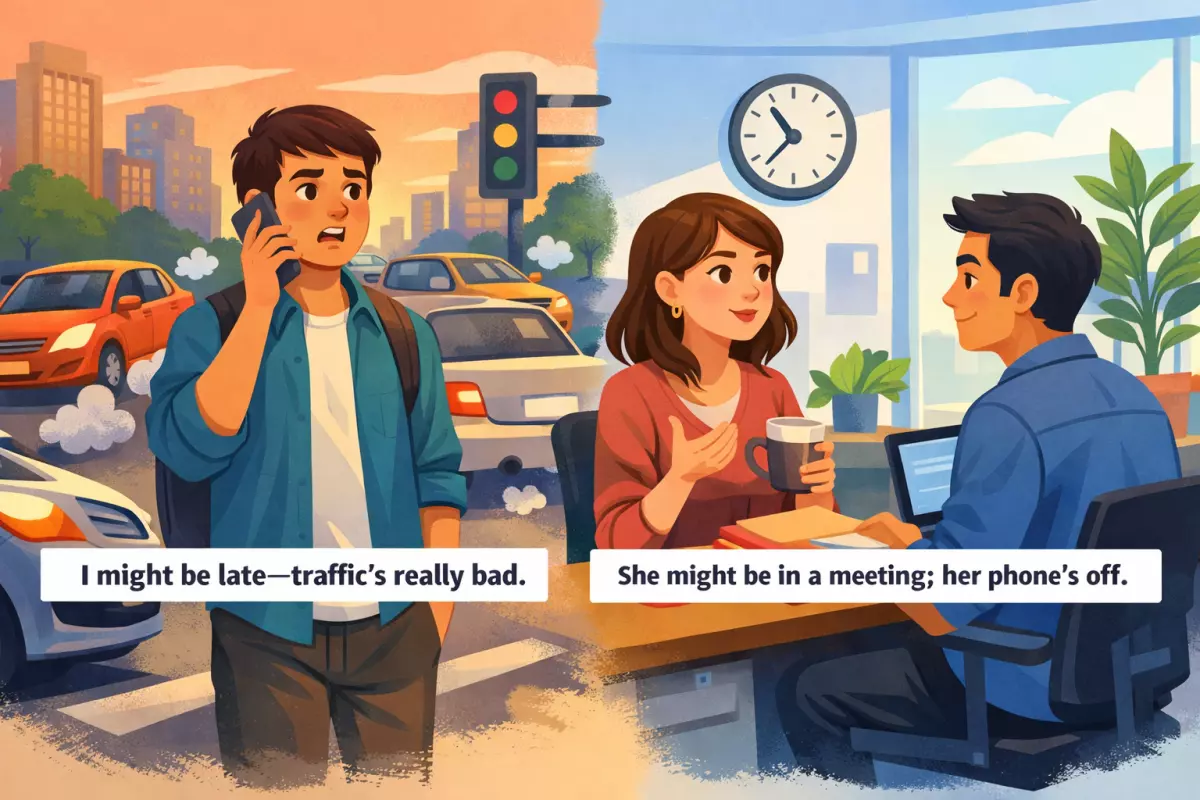
In everyday speech, might often signals a possibility without sounding too certain. It’s common in quick decisions, polite suggestions, and “not sure yet” answers. Notice how speakers frequently soften the message with words like “maybe,” “I think,” “not sure,” or “a bit.”
Common spoken patterns (with context)
- Quick uncertainty: “I might be late—traffic’s really bad.”
- Guessing from limited info: “She might be in a meeting; her phone’s off.”
- Softening a plan: “We might go out after work, but it depends.”
- Polite suggestion: “You might want to back up your files first.”
- Offering a possible reason: “It might be because the app needs an update.”
- Hedging an opinion: “That might be true, but I’m not completely sure.”
- Careful disagreement: “I might be wrong, but I thought the deadline was Friday.”
- Checking a possibility: “Do you think it might rain later?”
- Making a tentative arrangement: “I might be able to meet at six—let me confirm.”
- Responding without commitment: “Yeah, I might come. I’ll see how I feel.”
- Explaining a delay: “The package might arrive tomorrow instead.”
- Talking about health symptoms: “I might be getting a cold.”
- Predicting a reaction: “He might not like that idea.”
- Suggesting a next step: “We might need to restart the router.”
- Polite warning: “You might want to leave a bit earlier—parking’s a nightmare.”
- Speculating about someone’s location: “They might be at the new café near the station.”
How speakers shape meaning
- “might” + base verb is the default for possibility: “I might call you later.”
- might not makes a negative possibility (not a firm refusal): “I might not make it tonight.”
- might be + -ing suggests something in progress: “She might be working right now.”
- might have + past participle is used for past guesses: “He might have missed the bus.”
- Softeners (maybe, I guess, kind of) often appear with it: “It might be kind of expensive.”
- Polite advice uses “might want to” to reduce pressure: “You might want to double-check the address.”
Small accuracy notes
- ✅ “I might go.” → natural for an uncertain plan.
- ❌ “I might to go.” → incorrect (use the base verb without “to”).
- ✅ “It might not work.” → negative possibility, not a definite “won’t.”
How 'might' appears in conditional or hypothetical situations
In conditional and imagined situations, might helps you talk about a possible result rather than a certain one. It commonly appears in “if” clauses (especially second and third conditionals) and in polite, cautious predictions about what could happen under certain conditions.
Common patterns with conditionals
- If + present simple, ... might + base verb (real possibility in the future): If we leave now, we might catch the earlier train.
- If + past simple, ... might + base verb (hypothetical present/future): If I had more time, I might learn another language.
- If + past perfect, ... might have + past participle (hypothetical past result): If you had told me, I might have helped.
- ... might + base verb + if + present simple (same meaning, different order): We might get a discount if we ask.
- ... might have + past participle + if + past perfect (same meaning, different order): I might have missed it if you hadn’t called.
Using “might” to soften predictions and advice
- Use it to avoid sounding too certain: If you keep skipping sleep, you might feel worse tomorrow.
- Use it to make suggestions less direct: If you’re unsure, you might ask for a second opinion.
- Use it when you don’t want to promise a result: If the weather improves, the flight might leave on time.
- Use it to show limited evidence: If the lights are off, they might be out.
Examples you can copy and adapt
- If the meeting runs late, we might miss lunch.
- If you press that button, the computer might restart.
- If I lived closer, I might visit more often.
- If she knew the answer, she might tell you.
- If we took the highway, we might arrive earlier.
- If they offered a refund, I might accept it.
- If you had saved the file, you might not have lost your work.
- If he had checked the address, he might have avoided the delay.
- If we had left ten minutes earlier, we might have caught the bus.
- If I hadn’t forgotten my password, I might have logged in.
- If the price drops, I might buy it.
- If you explain it again, I might understand.
- If she apologizes, we might move on.
- If the noise continues, the neighbors might complain.
- If you’re free later, you might join us.
Accuracy notes (common learner issues)
- ✅ If I had more money, I might buy a car. → hypothetical present/future
- ❌ If I will have more money, I might buy a car. (Use present simple in the if-clause for most future conditionals.)
- ✅ If you had called, I might have come. → hypothetical past
- ❌ If you called, I might have come. (Mixing times usually changes the meaning; choose the conditional that matches the time.)
- ✅ If it’s important, you might want to email them. → polite suggestion
Typical learner mistakes when using 'might'
Errors with this modal usually come from mixing it up with other modals, choosing the wrong verb form after it, or using it in situations where the level of certainty sounds unnatural. The points below focus on common patterns and how to correct them.
1) Using the wrong verb form after the modal
- ❌ He might goes to the office. → ✅ He might go to the office. (Use the base verb after the modal.)
- ❌ She might to call later. → ✅ She might call later. (No to after a modal.)
- ❌ They might going by train. → ✅ They might go by train. (Use base verb, not -ing, unless you add be.)
- ❌ I might am late. → ✅ I might be late. (Use be in the base form.)
2) Confusing present possibility with past possibility
- ❌ He might forgot the meeting. → ✅ He might have forgotten the meeting. (Use might have + past participle for past situations.)
- ❌ They might went home early. → ✅ They might have gone home early.
- ❌ She might not came. → ✅ She might not have come.
- ❌ I might have see him yesterday. → ✅ I might have seen him yesterday.
3) Overusing it when you mean a plan, not a possibility
- ❌ I might go tomorrow (but the ticket is already booked). → ✅ I’m going tomorrow / I’m planning to go tomorrow. (Use it when the decision is not settled.)
- ❌ We might meet at 3 (fixed appointment). → ✅ We’re meeting at 3.
- ❌ He might start on Monday (confirmed). → ✅ He starts on Monday.
4) Using it for strong certainty (it sounds too weak)
- ❌ It might be 100% correct. → ✅ It must be correct / It’s definitely correct. (Choose stronger language when you are sure.)
- ❌ She might be at home (you can see her car and lights are on, and you’re confident). → ✅ She’s probably at home / She must be at home.
5) Double modals and other “stacking” mistakes
- ❌ It might can rain. → ✅ It might rain / It could rain. (Standard English uses one modal at a time.)
- ❌ She might will call. → ✅ She might call.
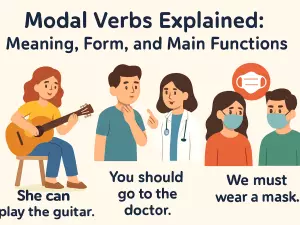
- ❌ They might should leave. → ✅ They should leave / They might need to leave.
6) Negatives and questions formed incorrectly
- ❌ He doesn’t might come. → ✅ He might not come. (Negate the modal, not with do/does.)
- ❌ Do you might be late? → ✅ Might you be late? (formal) / Do you think you might be late? (more natural).
- ❌ Might not he come? → ✅ Might he not come? (formal) / Do you think he might not come?.
7) Mixing up “might” with “maybe” in sentence structure
- ❌ Maybe he might comes. → ✅ Maybe he might come / Maybe he’ll come. (If you use maybe, keep the verb form correct; often one uncertainty marker is enough.)
- ❌ He might maybe come. → ✅ He might come / Maybe he’ll come. (Avoid stacking hedges unless you want an extra-cautious tone.)
8) Forgetting common “continuous” and “perfect continuous” patterns
- ❌ She might work now (you mean “in the middle of working”). → ✅ She might be working now.
- ❌ They might be finished earlier (you mean a past possibility). → ✅ They might have finished earlier.
- ❌ He might have been work all day. → ✅ He might have been working all day.
9) Using it for permission in everyday speech (can sound unnatural)
- ❌ Might I use your phone? (to a friend, casual context). → ✅ Can I use your phone? / Could I use your phone?. (Might I…? is correct but very formal.)
- ❌ You might leave now (intended as permission). → ✅ You can leave now. (You might… usually sounds like possibility, not permission.)
10) Punctuation and contraction issues in writing
- ❌ might’nt → ✅ mightn’t (BrE) / might not (common in AmE).
- ❌ He might, be late. → ✅ He might be late. (Avoid unnecessary commas between the modal and the verb.)
Exercises and practice tasks for expressing possibility with 'might'
Use the tasks below to practice choosing the right form, placing the modal correctly, and matching it to the level of uncertainty. Focus on these core patterns: might + base verb, might be + -ing, might have + past participle, and negative forms like might not.
1) Choose the best option (form and meaning)
- It’s cloudy. It ______ later. (might rain / might to rain / might raining)
- She isn’t answering. She ______ in a meeting. (might be / might is / might being)
- They left early, so they ______ home already. (might have gone / might went / might have go)
- Don’t worry—this ______ a quick fix, but I’m not sure. (might be / might to be / might)
- He ______ come tonight, but he has a lot of work. (might / mights / might to)
- The keys ______ on the kitchen counter. (might be / might are / might being)
- We ______ the wrong address; the building number looks different. (might have / might have used / might used)
- She ______ not know the answer. (might / might does / might to)
- Right now, the kids ______ asleep. It’s unusually quiet. (might be / might are / might been)
- By the time you arrived, he ______ already left. (might have / might / might has)
Show answers
- might rain
- might be
- might have gone
- might be
- might
- might be
- might have used
- might
- might be
- might have
2) Rewrite to express possibility (keep the meaning natural)
- I’m not sure, but John is at home. → Rewrite using might.
- Perhaps they are waiting outside. → Rewrite using might be + -ing.
- It’s possible she forgot my message. → Rewrite using might have + past participle.
- Maybe we chose the wrong day to visit. → Rewrite using might have.
- There’s a chance the train is late. → Rewrite using might be.
- It’s possible he doesn’t understand the instructions. → Rewrite using might not.
Show answers
- John might be at home.
- They might be waiting outside.
- She might have forgotten my message.
- We might have chosen the wrong day to visit.
- The train might be late.
- He might not understand the instructions.
3) Fix the mistakes (word order and verb form)
- She might to come later.
- I might can help you tomorrow.
- They might are lost.
- He might has missed the bus.
- We might not to need a reservation.
- It might raining this afternoon.
- She might have went to the wrong office.
- Might you to call me back?
Show answers
- She might come later.
- I might be able to help you tomorrow.
- They might be lost.
- He might have missed the bus.
- We might not need a reservation.
- It might rain this afternoon. / It might be raining this afternoon.
- She might have gone to the wrong office.
- Might you call me back?
4) Choose the best pattern for the time meaning
Complete each sentence using the pattern in brackets.
- Right now, he ______ (might be + -ing) because his phone is off.
- In the future, we ______ (might + base verb) if the price drops.
- In the past, she ______ (might have + past participle) the email yesterday.
- At the moment, they ______ (might be) at the wrong gate.
- Earlier today, I ______ (might have) the wrong file.
- Later this week, it ______ (might) take longer than expected.
Show answers
- might be driving
- might buy it
- might have seen
- might be
- might have sent
- might take
5) Short production tasks (use your own ideas)
- Write 5 sentences about today using might + base verb (future possibility): plans, weather, schedules.
- Write 5 sentences about what is happening now using might be + -ing (uncertain in-progress actions).
- Write 5 sentences about yesterday using might have + past participle (uncertain past reasons or actions).
- Write 4 negative sentences with might not (e.g., “It might not work”).
- Write 3 polite questions with Might I…? or Might we…? (requests, permission).
6) Self-check checklist (quick accuracy scan)
- After might, use the base verb: ✅ “might go” ❌ “might goes” / “might to go”.
- For “now/in progress,” prefer might be + -ing: “might be working.”
- For “past possibility,” prefer might have + past participle: “might have forgotten.”
- Put not after the modal: “might not be,” “might not have seen.”
- Avoid stacking modals: ❌ “might can” → ✅ “might be able to.”