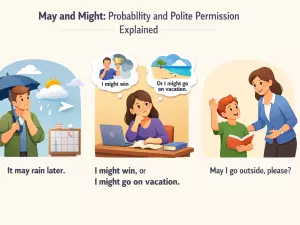
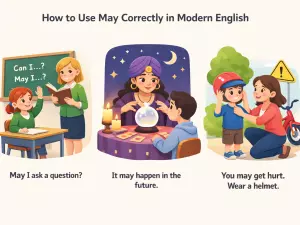
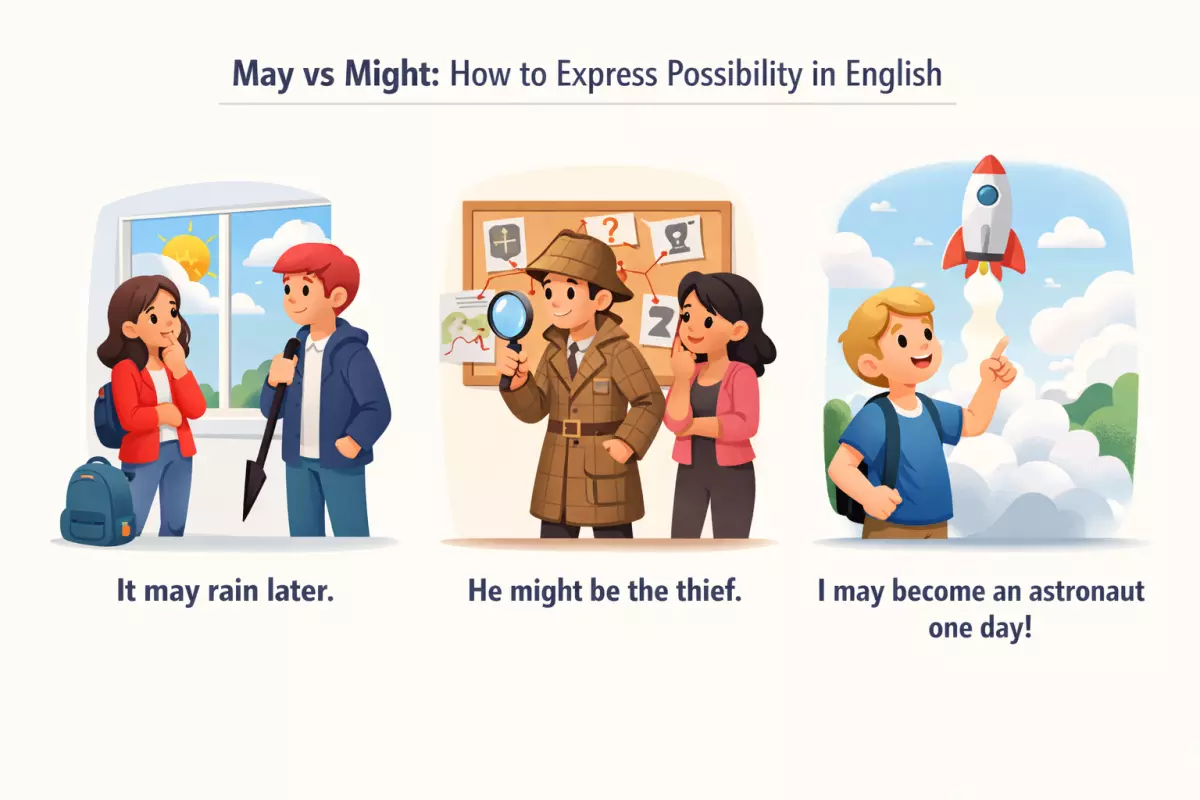
May vs Might: How to Express Possibility in English

 This article explains how may and might both show possibility, how they differ in certainty and formality, and how they work for future outcomes. It shows how context changes strength, when they’re interchangeable, common learner mistakes, and practice exercises.
- How may and might both express possibility in English
- The difference in certainty when speakers choose may or might
- Why may often sounds more formal than might in conversation
- Using may and might to talk about future outcomes
- How context determines the strength of possibility
- Situations where may and might can replace each other
- Typical learner mistakes when using possibility modals
- Exercises and practice tasks with may and might in context
Many learners hesitate between may and might when describing what could happen. Both express possibility, but may often suggests a stronger or more immediate chance, while might can feel more uncertain or distant. This short guide helps you pick the verb that fits your intended meaning in everyday conversation, so you sound natural and clear beyond grammar exercises.
How may and might both express possibility in English
Both may and might are modal verbs used to show that something is possible rather than certain. They commonly appear before the base form of the verb and can refer to the present, future, or past depending on the structure that follows.
Core pattern: modal + base verb
The most common structure is simple and consistent: may/might + base verb. This signals that the speaker is not fully sure, but considers the situation possible.
- She may come later.
- She might come later.
- It may rain this afternoon.
- It might rain this afternoon.
- They may need more time.
- They might need more time.
Talking about “now” vs. “in progress”: may/might + be + -ing
Use may/might + be + verb-ing to show that something is possibly happening at the moment (or around now), not just generally true.
- He may be sleeping.
- He might be sleeping.
- The team may be working on the issue.
- The team might be working on the issue.
- She may be driving, so she can’t answer.
- She might be driving, so she can’t answer.
Referring to the past: may/might + have + past participle
To express a possible past event (something that perhaps happened), use may/might + have + past participle. This is common when you are guessing based on limited evidence.
- They may have missed the train.
- They might have missed the train.
- He may have forgotten the meeting.
- He might have forgotten the meeting.
- The email may have gone to spam.
- The email might have gone to spam.
Negatives: may not / might not
Negative forms show that something is possibly not true or possibly will not happen. In careful writing, may not is often kept as two words.
- She may not know about the change.
- She might not know about the change.
- We may not finish today.
- We might not finish today.
- It may not be safe to swim.
- It might not be safe to swim.
Question forms: possible, but less common
Questions with these modals exist, but they can sound formal or cautious. In everyday conversation, speakers often choose other phrasing (for example, “Do you think…?”), but the patterns below are still correct.
- May this be the right address?
- Might this be the right address?
- May he be at home?
- Might he be at home?
Common signals that “possibility language” fits
May and might are especially natural when the context includes uncertainty, incomplete information, or prediction.
- When you are waiting for confirmation: “The schedule may change.”
- When evidence is indirect: “That noise might be the wind.”
- When predicting outcomes: “Prices may rise next month.”
- When offering a cautious explanation: “He might be stuck in traffic.”
- When listing options: “We may take the bus, or we might walk.”
The difference in certainty when speakers choose may or might
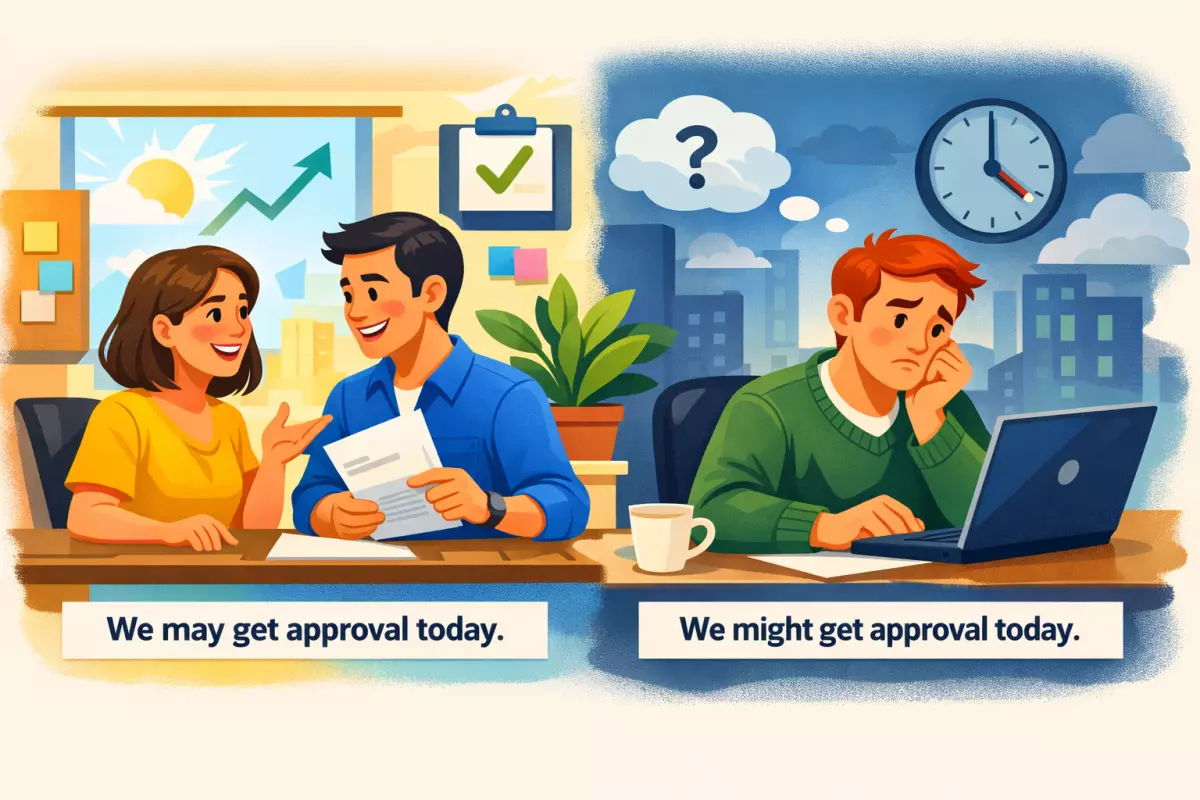
Speakers often pick may or might to signal how strongly they believe something is possible. In many everyday contexts, both are acceptable, but the choice can subtly change the listener’s sense of confidence, distance, or caution.
How the “confidence level” typically sounds
- May often sounds a bit more open or “still realistically possible” in the speaker’s mind:
“We may get approval today.” - Might often sounds a bit more tentative, as if the speaker is less committed to the likelihood:
“We might get approval today.” - In casual conversation, the difference is frequently small; context, intonation, and extra wording (like “probably” or “not sure”) usually carry more weight than the modal alone.
Common usage patterns that affect certainty
- When giving a cautious opinion, might is a common choice to avoid sounding too sure: “That might be the best option.”
- When making a measured prediction, may can sound slightly more confident or formal: “Prices may rise in July.”
- When you have limited evidence, might fits well: “He might be stuck in traffic.”
- When you’re presenting a possibility as a real consideration, may often appears in planning or policy language: “The device may overheat if blocked.”
- When softening advice or suggestions, might can sound gentler: “You might want to back up your files.”
- When listing multiple possible explanations, either works, but might often keeps the tone speculative: “It might be the battery, or it might be the charger.”
Examples that show the nuance in context
- “I may be late.” (speaker sees lateness as a realistic possibility)
- “I might be late.” (speaker sounds more unsure; lateness is only one possibility)
- “It may rain this afternoon.” (neutral forecast style)
- “It might rain this afternoon.” (more tentative, especially without strong forecast data)
- “This may cause delays.” (common in notices and formal warnings)
- “This might cause delays.” (still correct; sounds a little less definitive)
- “She may know the answer.” (speaker thinks it’s plausible she knows)
- “She might know the answer.” (speaker is less certain, or guessing)
- “We may have a problem.” (signals concern; problem seems possible)
- “We might have a problem.” (more cautious; speaker is not ready to confirm)
- “There may be a misunderstanding.” (polite, slightly formal)
- “There might be a misunderstanding.” (even softer; avoids sounding accusatory)
What not to overinterpret
- Do not assume may always means “more likely” and might always means “less likely.” Many speakers use them interchangeably, especially in American English.
- Do not treat either modal as a precise percentage. If you need precision, add an adverb or phrase: “probably,” “possibly,” “there’s a good chance,” “it’s unlikely.”
- In reported speech and past contexts, might can appear for sequence-of-tenses reasons, not just lower certainty: “He said he might come.”
Why may often sounds more formal than might in conversation
May tends to feel more “official” in everyday speech because it’s strongly associated with rules, permission, and careful, measured statements. Might is more common in casual conversation because it sounds less authoritative and often signals a softer, more tentative guess.
Common usage patterns that create the formality difference
- Permission is a major driver. “May I…?” is a classic permission formula, so it carries a polite, institutional tone (classrooms, customer service, formal requests).
- Set phrases preserve older norms. Fixed expressions like “May I help you?” and “May I ask…?” stay common in formal service language, even when everyday speech prefers “Can I…?”
- “May” sounds more deliberate. Speakers often choose it when they want to sound careful, respectful, or neutral rather than casual.
- “Might” signals distance from certainty. It often communicates “this is only a possibility,” which fits informal conversation and hedging.
- “May” appears in official-style writing and announcements. Rules, notices, and policies frequently use “may” (permission/allowance), and that association carries over into speech.
- Politeness strategy differs. “Might” can feel more tactful when offering suggestions or mild warnings because it reduces pressure on the listener.
- Customer-facing English favors “may.” Service roles often use it to sound professional: “You may take a seat,” “You may proceed.”
- “Might” fits storytelling and speculation. In conversation, people often narrate uncertainty: “I thought it might rain,” “It might be him.”
- “May” can sound stiff in relaxed contexts. In a casual chat, “It may be true” can feel more formal than “It might be true,” even if the meaning is similar.
- Regional and register variation matters. Some speakers use “may” more freely, but across many varieties, “might” dominates informal spoken English for possibility.
Where the difference shows up most clearly
- Requests: “May I leave early?” (polite/formal) vs. “Can I leave early?” (neutral) vs. “Could I leave early?” (polite but less formal than “may” for many speakers).
- Permission/allowance: “You may use calculators” often sounds like a rule; “You might use calculators” sounds like a suggestion (and can be confusing if the intent is permission).
- Careful announcements: “The train may be delayed” can sound like an official notice; “The train might be delayed” sounds like a personal guess.
- Hedged opinions: “That might be a problem” commonly softens criticism; “That may be a problem” can sound more formal or more clinical.
Practical guidance for choosing the tone
- Use may when you want a polite, formal request or when you’re expressing permission/authorization: “May I speak with you for a moment?”
- Use might when you want a relaxed, conversational guess or a gentle hedge: “I might be late.”
- If you mean “it’s possible,” both can work, but might usually sounds more natural in everyday talk: “It might rain later.”
- Avoid using might when the goal is to clearly grant permission, because it can sound like a weak suggestion rather than allowance.
Using may and might to talk about future outcomes
To talk about what is possible later, English commonly uses may and might before the base verb. Both express uncertainty rather than a firm plan or prediction, and the choice often depends on how confident the speaker feels and the style of the sentence.
Core pattern for future possibility
The most common structure is simple and flexible:
- Subject + may/might + base verb: “I may call you tomorrow.”
- Subject + may/might not + base verb: “They might not arrive on time.”
- May/Might + subject + base verb? (less common, more formal): “Might we need extra time?”
- When/If + clause + subject + may/might + base verb: “If it rains, the match may be canceled.”
Choosing between may and might
In many contexts, both are acceptable. A practical guideline is that may can sound slightly more likely or more neutral/formal, while might often sounds a bit more tentative. In everyday conversation, might is very common for future uncertainty.
- “She may get the promotion.” (possible; can sound a little more confident or formal)
- “She might get the promotion.” (possible; slightly more cautious)
- “We may see delays this evening.” (typical in announcements)
- “We might see delays this evening.” (natural in conversation)
Useful future-focused patterns and examples
- Plans that are not fixed: “I may work from home next week.”
- Predictions with uncertainty: “Prices might rise later this year.”
- Conditional outcomes: “If you leave now, you may catch the earlier train.”
- Warnings: “Be careful—your phone might fall out of your pocket.”
- Polite, non-committal replies: “I might be able to help on Friday.”
- Softening disagreement: “That may be true, but the data is limited.”
- Possibility with time markers: “They may respond in a few days.”
- Possibility with “soon/later/next”: “We might hear back soon.”
- Possibility with “probably” (use carefully): “It may probably take longer than expected.” (often better: “It will probably…” or “It may take longer…”)
- Negative possibility: “The package may not arrive until Monday.”
- Questions about uncertain outcomes: “Do you think it might snow tomorrow?”
- With “still” for ongoing uncertainty: “We may still need more information.”
- With “end up” for results: “We might end up choosing the cheaper option.”
- With “have to” for possible obligation: “You may have to reschedule.”
- With “need to” for possible necessity: “We might need to leave earlier.”
Common mistakes to avoid
- ❌ “It may to rain tomorrow.” → ✅ “It may rain tomorrow.”
- ❌ “He might goes later.” → ✅ “He might go later.”
- ❌ “We may will arrive at 6.” → ✅ “We may arrive at 6.” / “We will arrive at 6.”
- ❌ “Might to be late.” → ✅ “It might be late.”
When you want to express a future outcome that is uncertain, place may or might before the base verb, add time expressions as needed, and use not directly after the modal to show negative possibility.
How context determines the strength of possibility

The choice between may and might often depends less on the verb itself and more on the situation: how much evidence you have, how direct you want to sound, and whether you’re predicting, requesting, or reporting. In many everyday sentences, both are grammatically fine, but context nudges one to feel more natural.
Common context signals that change the “feel” of the chance
- Evidence right now: When you have a concrete reason (a sign, a message, a visible clue), may often sounds more confident; might sounds more cautious.
- The lights are off; they may be asleep.
- The lights are off; they might be asleep.
- Distance from the facts: If you’re guessing with limited information, might fits the uncertainty better.
- I haven’t heard back; she might be busy.
- Time frame: For near-future plans that are still open, may can sound like a realistic option; might can sound less settled.
- We may go out after work.
- We might go out after work.
- Formality: In formal writing and announcements, may is common for measured, official-sounding possibility.
- Delays may occur due to weather.
- Politeness and softening: Might often sounds more tentative and less pushy, especially when offering suggestions or mild criticism.
- You might want to double-check the address.
- Permission vs. possibility: If the sentence could be read as asking for permission, may can create ambiguity; might avoids that.
- We may leave early. (Could sound like “we’re allowed to” in some contexts)
- We might leave early. (Clearer as “it’s possible”)
- Negative sentences: In negatives, might not often feels like a cautious warning; may not can sound either cautious or rule-like depending on context.
- He might not remember your name.
- Visitors may not enter this area. (Often reads as a rule)
- Conditional thinking: When you’re exploring outcomes (“if… then…”), might is a frequent choice because it keeps the claim hypothetical.
- If we leave now, we might catch the earlier train.
- Reporting someone else’s uncertainty: Might can sound like you’re passing on a guess rather than endorsing it.
- They said the package might arrive today.
- Strategic vagueness: When you don’t want to commit, might helps you stay non-committal.
- I might be able to help later.
Quick patterns that push you toward one choice
- Clue-based inference (sound, smell, visible sign) → often may if you want a firmer tone:
- I hear voices; they may be in the next room.
- Pure guess / limited data → often might:
- He’s not answering; he might be driving.
- Suggestion + “want to” → commonly might:
- You might want to save a copy before editing.
- Formal notices → commonly may:
- This medication may cause drowsiness.
- When clarity matters: If may could be misread as permission, choose might for straightforward possibility.
- ✅ It might be okay to reschedule.
- ❌ It may be okay to reschedule. (Can sound like “allowed” rather than “possible”)
In practice, treat may as a slightly more “supported” or formal-sounding option and might as the more tentative, diplomatic one. When the surrounding context already shows strong evidence, either modal can work; the difference is mainly how cautiously you want to present the possibility.
Situations where may and might can replace each other
In many everyday sentences about possibility, may and might both work without changing the basic meaning. The choice often depends more on tone (slightly more formal vs. slightly more tentative) than on grammar, especially when you are not trying to measure the exact probability.
1) General possibility about the present or future
When you are simply saying something is possible (not certain), either modal is usually acceptable.
- It may rain later. / It might rain later.
- We may get the results tomorrow. / We might get the results tomorrow.
- This plan may work. / This plan might work.
- She may be at home. / She might be at home.
- They may arrive early. / They might arrive early.
2) Possibility based on limited evidence
If you are making a cautious guess from what you know, both forms fit. The sentence stays a “best guess,” not a firm conclusion.
- He may be stuck in traffic. / He might be stuck in traffic.
- The file may be corrupted. / The file might be corrupted.
- Her phone may be on silent. / Her phone might be on silent.
- The store may be closed today. / The store might be closed today.
3) “May/Might + be + -ing” for possible current activity
Use may/might be + -ing to suggest what could be happening right now. Either modal is fine in most contexts.
- She may be working from home. / She might be working from home.
- They may be waiting outside. / They might be waiting outside.
- He may be sleeping. / He might be sleeping.
- The team may be discussing the budget. / The team might be discussing the budget.
4) “May/Might + have + past participle” for possible past events
Use may/might have + past participle to say something possibly happened in the past. Both are common and usually interchangeable.
- I may have left my keys at work. / I might have left my keys at work.
- She may have misunderstood the email. / She might have misunderstood the email.
- They may have missed the train. / They might have missed the train.
- The update may have caused the error. / The update might have caused the error.
5) Conditional sentences where the result is uncertain
In “if” situations, either modal can express an uncertain result. This is especially natural when you are predicting outcomes rather than giving permission.
- If we leave now, we may catch the earlier bus. / If we leave now, we might catch the earlier bus.
- If you call again, she may answer. / If you call again, she might answer.
- If the price drops, I may buy it. / If the price drops, I might buy it.
- If he apologizes, they may forgive him. / If he apologizes, they might forgive him.
6) Question forms when you are checking a possibility
In questions, both choices are used to ask whether something is possible. The meaning is typically the same; the difference is mainly tone.
- May I be mistaken? / Might I be mistaken?
- May this be the correct address? / Might this be the correct address?
- Do you think she may come? / Do you think she might come?
- Is there a chance it may snow? / Is there a chance it might snow?
In these patterns, swapping may and might rarely causes confusion because both signal uncertainty rather than certainty. The main exceptions come from special uses of may (permission, formal requests) and set phrases where one option is strongly preferred.
Typical learner mistakes when using possibility modals
Possibility modals are easy to recognize but tricky to use naturally. Many errors come from mixing up time reference (present vs. past), choosing a modal that sounds too strong or too weak, or building the verb phrase incorrectly after the modal.
Common form and meaning problems
- ❌ Using may when you mean permission vs. possibility: ✅ “You may leave now” (permission) vs. “It may rain later” (possibility). If the context is unclear, listeners can misunderstand.
- ❌ Treating might as the past tense of may: ✅ “It might rain” is usually about uncertainty, not past time. Past time is shown with have + past participle (e.g., “might have missed”).
- ❌ Overstating certainty: using may/might when you actually mean “will” or “must.” ✅ “She will be there at 6” (planned/expected) vs. “She may be there at 6” (not sure).
- ❌ Understating certainty: avoiding stronger language when evidence is strong. ✅ “He must be tired” (strong inference) may fit better than “He might be tired” if the clues are clear.
- ❌ Using can for a single uncertain event: ✅ “It may/might rain tomorrow” (one event) vs. “It can rain a lot here” (general possibility/ability).
- ❌ Using maybe as a verb: ✅ “Maybe it’s true” (adverb) vs. ❌ “It maybe true.” Use “It may be true” or “Maybe it’s true.”
- ❌ Wrong word order with adverbs: ✅ “It may still happen” / “She might already know,” not “It still may happen” in contexts where the adverb normally sits between modal and main verb.
- ❌ Double modals: ❌ “It might may happen.” ✅ Choose one: “It may happen” or “It might happen.”
- ❌ Adding to after a modal: ❌ “It may to rain.” ✅ “It may rain.” (Modal + base verb.)
- ❌ Using an -ing form after a modal without a reason: ❌ “It may raining.” ✅ “It may be raining” (modal + be + -ing) if you mean an action in progress.
- ❌ Forgetting be before adjectives/nouns: ❌ “She might late.” ✅ “She might be late.”
- ❌ Confusing present possibility with past possibility: ✅ “He might be at home” (now) vs. “He might have been at home” (earlier).
- ❌ Using “may/might” for past facts instead of inference: if something is known, state it directly. ✅ “He was at home” (fact) vs. “He might have been at home” (guess based on evidence).
- ❌ Negation mistakes: ✅ “He may not come” usually means “possibly he won’t come.” It does not mean “he is not allowed to come” unless the context is clearly permission-based.
- ❌ Making questions that sound unnatural in everyday speech: ✅ “Do you think it might rain?” is often more natural than “Might it rain?” (though the latter is possible in formal styles).
- ❌ Using might in conditional patterns incorrectly: ✅ “If you leave now, you might catch the train” (possible result) is fine, but avoid using it when you mean a guaranteed result.
Verb phrase patterns learners often mix up
- ✅ Modal + base verb: “may/might + go/come/happen” (simple possibility).
- ✅ Modal + be + adjective/noun: “may/might be late / be a mistake” (state/identity).
- ✅ Modal + be + -ing: “may/might be waiting” (in progress now/around now).
- ✅ Modal + have + past participle: “may/might have forgotten” (past possibility).
- ✅ Modal + have been + -ing: “may/might have been sleeping” (past activity in progress).
When choosing between may and might, focus on the strength of your guess and the situation (formal vs. neutral). When building the sentence, focus on the verb phrase that matches the time you mean: now, in progress, or earlier.
Exercises and practice tasks with may and might in context
Use these tasks to practice choosing the modal that best matches the speaker’s certainty, politeness, and time reference. Focus on common patterns such as may/might + base verb, may/might be + -ing, and may/might have + past participle.
1) Choose may or might (possibility in the present/future)
- Take an umbrella. It ______ rain later.
- I’m not sure where Dana is. She ______ be in a meeting.
- We ______ miss the beginning if the train is delayed.
- This key ______ open the back door, but I haven’t tested it.
- Ask Leo—he ______ know the answer.
- If you leave now, you ______ catch the earlier bus.
- It’s only a rumor, but the company ______ announce layoffs.
- That noise ______ be the dishwasher.
- Try restarting the app. It ______ fix the problem.
- She’s very quiet today. She ______ be tired.
- We ______ go out after dinner, depending on the weather.
- The package ______ arrive tomorrow, but deliveries are slow this week.
Show answers
- might
- might
- might
- may
- may
- might
- may
- might
- may
- might
- might
- may
2) Rewrite to match the meaning (stronger vs. weaker possibility)
Rewrite each sentence twice: (A) with a slightly more confident tone, (B) with a more uncertain tone. Keep the meaning the same otherwise.
- I might be late because of traffic.
- She may join us after work.
- They might not agree with the plan.
- The results may surprise you.
- He might be at home.
- We may need more time.
- The meeting might start early.
- This explanation may help.
Show answers
- A: I may be late because of traffic. B: I might be late because of traffic.
- A: She may join us after work. B: She might join us after work.
- A: They may not agree with the plan. B: They might not agree with the plan.
- A: The results may surprise you. B: The results might surprise you.
- A: He may be at home. B: He might be at home.
- A: We may need more time. B: We might need more time.
- A: The meeting may start early. B: The meeting might start early.
- A: This explanation may help. B: This explanation might help.
3) Pick the correct form (simple, continuous, perfect)
Choose the best option to fit the time reference: may/might + base verb, may/might be + -ing, or may/might have + past participle.
- Don’t call now—he ______ (sleep) after the night shift.
- She isn’t answering. She ______ (leave) her phone at home.
- We ______ (meet) them tomorrow if schedules match.
- Look at the lights—someone ______ (work) in the office.
- They ______ (forget) the deadline; no one replied.
- I ______ (go) to the gym later, but I’m not sure.
- He’s not at his desk. He ______ (talk) to the manager.
- The file is missing. You ______ (delete) it by accident.
- Traffic is heavy, so the bus ______ (arrive) late.
- Her accent is strong; she ______ (grow up) abroad.
Show answers
- may/might be sleeping
- may/might have left
- may/might meet
- may/might be working
- may/might have forgotten
- may/might go
- may/might be talking
- may/might have deleted
- may/might arrive
- may/might have grown up
4) Spot and correct the errors
Each sentence has one problem with form or usage. Rewrite it correctly.
- He might to be busy right now.
- We may can finish today.
- She might has lost her keys.
- It may raining later.
- They might went home early.
- I may to call you after the meeting.
- The email might arrived yesterday.
- May you help me with this report? (neutral office request)
Show answers
- He might be busy right now.
- We may be able to finish today. / We might be able to finish today.
- She might have lost her keys.
- It may be raining later. / It might rain later.
- They might have gone home early.
- I may call you after the meeting.
- The email might have arrived yesterday.
- Could you help me with this report? / Can you help me with this report?
5) Context mini-dialogues (choose the best option)
Select the option that sounds most natural for the situation. In many cases, both are possible, but one fits the context better.
-
Formal announcement: “The committee ______ reach a decision by Friday.” (may / might)
-
Casual guess: “That ______ be Alex’s car, but I’m not sure.” (may / might)
-
Polite permission: “______ I leave a few minutes early today?” (May / Might)
-
Weak prediction: “If the wind gets stronger, the flight ______ be delayed.” (may / might)
-
Careful report: “The missing document ______ have been filed under a different name.” (may / might)
-
Tentative plan: “We ______ order takeout tonight.” (may / might)
-
More confident possibility: “This update ______ solve the security issue.” (may / might)
-
Speculation about now: “They ______ be waiting outside.” (may / might)
Show answers
- may
- might
- May
- might
- may
- might
- may
- might
6) Production practice (write your own)
- Write 5 sentences about today using might for uncertain guesses (e.g., about someone’s location, a possible delay, or a tentative plan).
- Write 5 sentences using may in more formal or careful statements (e.g., work updates, notices, or cautious conclusions).
- Write 5 sentences using the perfect form (may/might have + past participle) to explain past situations (missed calls, lost items, unexpected results).
- Write 3 short requests for permission: one with May I…?, one with Could I…?, and one with Can I…? Note how the tone changes.
- Choose one news-style topic (weather, transport, business, health) and write a 4-sentence update using at least two different structures: base verb, continuous, and perfect.