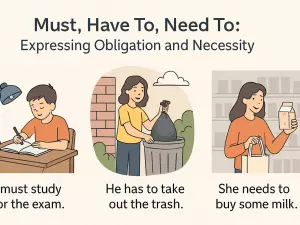
Must vs Have to: Obligation and Necessity Differences

 This article explains how must and have to both show obligation, but with different sources and strength: internal duty vs external rules. It covers past and future obligation with have to, real examples, negative forms, common mistakes, and practice exercises.
- How must and have to both express obligation in English
- The difference between internal obligation and external requirements
- Why must often sounds stronger than have to
- How English expresses past and future obligation with have to
- Examples of rules, duties, and requirements in real situations
- Negative forms and how they change the meaning of obligation
- Common learner mistakes with must and have to
- Exercises and practice activities comparing must and have to
Choosing between must and have to changes how an obligation sounds in everyday English. Must often feels like a firm rule or strong insistence from the speaker, while have to usually points to an outside requirement like a job policy, the law, or a schedule. This guide shows how context, tone, and who sets the rule help you choose the most natural option in real conversations.
How must and have to both express obligation in English
Both must and have to are used to say that something is necessary, required, or not optional. In many everyday situations, they can point to the same basic idea: a duty, rule, or strong need. The difference is often about where the pressure comes from (speaker vs. situation) and how the sentence is built.
Shared meaning: “this is necessary”
When speakers choose either form, they are typically communicating that the action is required. In practice, you can often replace one with the other without changing the core message, especially in simple present-time statements.
- Requirement (general): “You must wear a helmet.” / “You have to wear a helmet.”
- Strong need: “I must leave now.” / “I have to leave now.”
- Non-optional task: “She must finish the report today.” / “She has to finish the report today.”
Common patterns you can reuse
Even when the meaning overlaps, the grammar patterns differ. These templates help you form correct sentences quickly.
- Affirmative (present): Subject + must + base verb → “They must pay in advance.”
- Affirmative (present): Subject + have/has to + base verb → “They have to pay in advance.”
- Past obligation: Subject + had to + base verb → “They had to pay in advance.” (not “musted”)
- Future obligation: Subject + will have to + base verb → “They will have to pay in advance.”
- Question with must: Must + subject + base verb? → “Must I sign here?”
- Question with have to: Do/Does + subject + have to + base verb? → “Do I have to sign here?”
- Negative with must: Subject + must not + base verb → “You must not smoke here.” (prohibition)
- Negative with have to (no necessity): Subject + don’t/doesn’t + have to + base verb → “You don’t have to come early.”
- Short answers (must): “Must I?” → “Yes, you must.” / “No, you mustn’t.”
- Short answers (have to): “Do I have to?” → “Yes, you do.” / “No, you don’t.”
Typical contexts where both appear naturally
These are common real-world situations where either choice can express obligation, with the final nuance depending on tone and context.
- Work instructions: “You must submit the form by Friday.” / “You have to submit the form by Friday.”
- House rules: “Guests must remove their shoes.” / “Guests have to remove their shoes.”
- School requirements: “Students must bring ID.” / “Students have to bring ID.”
- Travel and documents: “You must show your passport.” / “You have to show your passport.”
- Appointments: “I must call the dentist.” / “I have to call the dentist.”
- Safety procedures: “You must wear gloves.” / “You have to wear gloves.”
- Deadlines: “We must finish today.” / “We have to finish today.”
- Payments and fees: “You must pay online.” / “You have to pay online.”
- Legal/official language: “Applicants must provide proof.” / “Applicants have to provide proof.”
- Personal urgency: “I must speak to her.” / “I have to speak to her.”
- Health advice (strong): “You must rest.” / “You have to rest.”
- Problem-solving: “We must find the cause.” / “We have to find the cause.”
Key reminder for learners
When both are possible, choose the form that fits the sentence you need. Use have to when you need clear tense changes (past/future) or common question forms (“Do I have to…?”). Use must when you want a direct, firm statement in the present, especially in rules, instructions, and formal notices.
The difference between internal obligation and external requirements

In everyday English, must often signals a duty the speaker feels personally or is imposing, while have to commonly points to a rule, schedule, or situation that comes from outside the speaker. This is a usage tendency rather than an absolute rule, but it explains why the two forms can sound more or less forceful in the same context.
| Focus | Typical choice | What it suggests | Example |
|---|---|---|---|
| Speaker’s own judgement or insistence | must | Personal obligation; the speaker is driving the requirement | I must finish this tonight. |
| Rules, laws, instructions | have to | External requirement; the rule exists regardless of the speaker | Employees have to wear badges. |
| Unavoidable circumstances | have to | Necessity created by the situation (not preference) | We have to leave early because of traffic. |
| Strong recommendation / urgency (especially in speech) | must | Emphasis: “this is important” | You must see that film. |
| Neutral, routine obligations | have to | Less “commanding” tone; common in conversation | I have to be at work by 9. |
Common patterns that signal “internal” vs “external”
- must + verb is often used when the speaker is taking responsibility for the requirement: “I must call my parents.”
- have to + verb is often used when pointing to a policy, authority, or practical constraint: “I have to submit this form.”
- With you, must can sound like a direct order; have to can sound more like reporting a rule: “You must stop” vs “You have to stop at the checkpoint.”
- When the reason is stated as a fact, have to fits naturally: “I have to go because my train leaves at 6.”
- When the reason is a personal standard, must is common: “I must be more careful.”
Example sets (same situation, different source of obligation)
- I must stay calm. → self-control, personal resolve
- I have to stay calm. → situation demands it (e.g., work role)
- You must wear a helmet. → speaker is enforcing the rule
- You have to wear a helmet. → rule exists externally (law/site policy)
- We must talk. → speaker insists it’s necessary
- We have to talk. → circumstances make it necessary (deadline, problem)
- She must apologize. → moral judgement from the speaker
- She has to apologize. → requirement from a boss/teacher/expectation
- I must remember to lock the door. → personal reminder, self-imposed
- I have to lock the door. → building policy or practical need
- You must be quiet. → direct instruction
- You have to be quiet. → rule of the place (library, exam room)
- They must be on time. → speaker’s standard/pressure
- They have to be on time. → schedule requirement (train, appointment)
In many contexts, both forms are possible, but the choice changes the tone: must often feels more immediate or authoritative, while have to often sounds more neutral and fact-based. When you want to avoid sounding like you’re personally ordering someone, reporting an outside rule with have to is usually the safer option.
Why must often sounds stronger than have to
Must often feels more forceful because it presents an obligation as direct, immediate, and coming from the speaker (or from a rule the speaker is actively enforcing). Have to more often frames the same obligation as external necessity: a schedule, a law, a requirement, or circumstances that leave no real choice.
Common usage patterns that create a “stronger” impression
- Speaker authority vs. outside pressure: must commonly sounds like a command or firm instruction; have to sounds like “this is required by the situation.”
- Directness: must is shorter and more categorical, so it lands like a final decision rather than a description of necessity.
- Less room for negotiation: must often implies “no exceptions,” while have to can imply “I don’t like it, but it’s required.”
- Formal and rule-like tone: signs, policies, and official instructions frequently use must, which reinforces a strict feel (even when the rule is ordinary).
- Emphasis in warnings: must is common in safety and urgency contexts, where strong language is expected.
- Moral or personal obligation: must can express inner conviction (“I must do the right thing”), which can sound intense and non-negotiable.
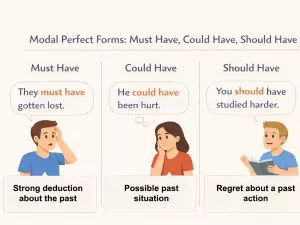
- Inference and certainty: when used for logical conclusions (“He must be tired”), must signals high confidence; that certainty can spill over into how learners perceive its obligation meaning.
- Reduced focus on the reason: must often states the obligation without explaining the cause; have to naturally invites the cause (“I have to… because…”).
- Register expectations: in everyday conversation, many speakers prefer have to for routine duties, so must can stand out as unusually strict.
- Negative forms behave differently: mustn’t expresses prohibition (very strong), while don’t have to expresses lack of necessity (not required). This contrast makes must feel “heavier” overall.
Example pairs showing the difference in force
- Instruction vs. requirement: “You must submit the form today.” / “You have to submit the form today.”
- Authority vs. circumstance: “You must wear a helmet.” / “You have to wear a helmet because it’s the law.”
- Urgency: “We must leave now.” / “We have to leave now or we’ll miss the train.”
- Personal resolve: “I must stop procrastinating.” / “I have to stop procrastinating if I want to pass.”
- Workplace tone: “You must inform your manager.” / “You have to inform your manager for payroll.”
- Rules on paper: “Visitors must sign in.” / “Visitors have to sign in at reception.”
- Strong warning: “You must not touch that wire.” / “You don’t have to touch that wire.”
- Natural spoken rhythm: “I have to go.” is common and neutral; “I must go.” can sound formal or dramatic in casual contexts.
- Explaining the cause: “I have to cancel—we’re over budget.” often sounds more matter-of-fact than “I must cancel.”
- Softening a request: “Do you have to leave so soon?” typically sounds less confrontational than “Must you leave so soon?”
In practice, both forms can express real obligation. The “strength” difference usually comes from context: who is imposing the duty, how urgent it is, and whether the sentence sounds like an order (must) or a statement of necessity (have to).
How English expresses past and future obligation with have to
English uses have to (not must) when you need normal tense forms for obligation. That’s why it’s the natural choice for talking about duties in the past, planned requirements in the future, and obligations that change over time.
| Time / pattern | Form | Meaning | Example |
|---|---|---|---|
| Past obligation (completed time) | had to + base verb | A requirement existed in the past (often external or situational). | I had to leave early yesterday. |
| Past negative obligation | didn’t have to + base verb | No requirement existed (it was optional). | We didn’t have to show ID. |
| Past: requirement not met | was/were supposed to + base verb | An expected duty, but it didn’t happen (common alternative when needed). | I was supposed to call, but I forgot. |
| Future obligation (planned requirement) | will have to + base verb | A duty will exist later. | You’ll have to submit the form tomorrow. |
| Future: schedule/arrangement | am/is/are going to have to + base verb | A requirement is expected based on current plans or evidence. | We’re going to have to reschedule. |
| Future negative obligation | won’t have to + base verb | No requirement will exist (it will be unnecessary). | You won’t have to pay upfront. |
| Ongoing obligation (habit/rule) | have/has to + base verb | A present rule or repeated necessity. | She has to wear a badge at work. |
| Question form (any time via do-support) | do/does/did + subject + have to + base verb | Asks whether a requirement exists/existed. | Did you have to sign anything? |
Key usage notes that prevent common mistakes
- Past requirement: use had to, not “musted.” ✅ I had to work late. ❌ I musted work late.
- “Didn’t have to” means no obligation (optional), not “you were forbidden.” Example: You didn’t have to come (but you could).
- For prohibition, use “mustn’t” or “couldn’t”, not “didn’t have to.” Example: You mustn’t enter (it’s not allowed).
- Future requirement: will have to is neutral and common for decisions, rules, or circumstances. Example: I’ll have to talk to HR.
- Planned or predictable requirement: going to have to often sounds more immediate or based on evidence. Example: It’s broken—we’re going to have to replace it.
- Questions and negatives usually use do-support in simple tenses: Do I have to…? / He doesn’t have to… / Did they have to…?
- Past “must” is usually reported as “had to” when you shift back in time. Example: She said she had to leave.
- Perfect forms are possible when you need them: have had to (up to now), had had to (earlier past), will have had to (rare, but grammatical in formal timelines).
Example patterns to copy
- Past: I had to take a different route.
- Past question: Did you have to wait long?
- Past negative (no need): We didn’t have to book in advance.
- Past + reason: I had to cancel because I was sick.
- Future: You’ll have to update your password next week.
- Future question: Will we have to bring our own equipment?
- Future negative (no need): You won’t have to print anything.
- Going to (evidence): It’s getting late—we’re going to have to hurry.
- Present rule: Visitors have to sign in.
- Present negative: You don’t have to explain everything.
- Reported speech: He told me I had to be there by nine.
- Up to now: I’ve had to learn a lot this month.
Examples of rules, duties, and requirements in real situations

In everyday English, must often sounds more forceful or formal, while have to is common for practical necessity and external rules. The situations below show typical patterns: official signs, workplace policies, school expectations, travel rules, and personal routines.
Public rules and official notices
- You must show your ID at the entrance. (strict requirement; often security/legal)
- You have to wear a seatbelt in the back seat too. (law expressed as an external rule)
- Visitors must sign in at reception. (formal policy language)
- You have to pay the parking fee before you leave. (procedure/necessity)
- ✅ Passengers must not smoke on board. ❌ Passengers don’t must smoke on board. (negative form)
Work duties and company policy
- I have to submit the report by 5 p.m. (deadline set by someone else)
- You must follow the safety instructions at all times. (serious rule; strong obligation)
- Employees have to complete the training before using the equipment. (company requirement)
- You must not share customer passwords. (prohibition; compliance tone)
- Do we have to attend the meeting? (asking about a requirement)
School and academic requirements
- Students must hand in assignments through the online portal. (formal instruction)
- You have to pass this course to graduate. (program requirement)
- You must cite your sources. (academic rule; strong expectation)
- Do I have to take the final exam? (checking necessity)
- You don’t have to memorize every date. (no necessity; optional)
Travel, appointments, and procedures
- You have to check in online before you arrive. (process requirement)
- Passengers must keep liquids under 100 ml. (airport-style formal rule)
- I have to renew my passport next month. (practical necessity)
- You must arrive 15 minutes early for your appointment. (firm instruction; can sound strict)
- We don’t have to print the tickets; the QR code is enough. (no need)
Home, family, and personal necessity
- I have to pick up the kids at 4. (schedule-based necessity)
- You have to water these plants twice a week. (practical requirement)
- I must remember to call my dentist. (self-imposed obligation; internal pressure)
- You don’t have to cook tonight; we can order food. (removing an obligation)
- Must I do it today? (formal; often sounds old-fashioned in conversation)
Quick pattern notes (useful for accuracy)
- Questions: Do/Does/Did + have to is the normal choice in modern speech (e.g., “Do I have to pay now?”). Must I…? is correct but more formal.
- Past: use had to, not “musted” (e.g., “I had to leave early yesterday.”).
- Negative meaning difference: must not = prohibition (“It’s not allowed”). don’t have to = no necessity (“It’s optional”).
Negative forms and how they change the meaning of obligation
In negative sentences, must and have to stop being interchangeable. The negative form can either remove the requirement (don’t have to = “no need”) or create a prohibition (mustn’t = “not allowed”). Choosing the wrong one can flip the meaning.
Core meanings in the negative
- mustn’t = prohibition (an action is forbidden). It expresses a strong “do not.”
- don’t/doesn’t have to = lack of necessity (an action is optional). It means “you can, but it isn’t required.”
- can’t often competes with mustn’t for rules and bans; both can signal “not allowed,” but mustn’t is more explicitly rule-focused.
- didn’t have to (past) usually means something was not necessary (and often implies it was done anyway).
- must not (two words) is the same meaning as mustn’t, just more formal or emphatic in writing.
Common patterns and what they imply
- You mustn’t + verb → “This is forbidden.” (rule, safety, law, strong instruction)
- You don’t have to + verb → “This isn’t required.” (choice, no obligation)
- You don’t have to + verb, but you can if you want → explicitly frames the action as optional.
- You don’t have to + verb; I’ll do it → removes duty from the listener and offers an alternative.
- You mustn’t + verb; it’s dangerous/against the rules → prohibition justified by risk or regulation.
- Do I have to + verb? → asks about necessity; the natural negative answer is No, you don’t have to.
- Must I + verb? (formal) → also asks about obligation; negative reply still tends to be You don’t have to (not You mustn’t).
- not have to can appear in other tenses: won’t have to (future lack of necessity), haven’t had to (no necessity up to now).
Examples that show the meaning flip
- ✅ You mustn’t park here. = Parking is not allowed.
- ✅ You don’t have to park here. = This place isn’t required; you may park somewhere else.
- ❌ You mustn’t submit the form today. (for “it’s optional”) → This actually means “do not submit it today.”
- ✅ You don’t have to submit the form today. = Submitting today isn’t necessary.
- ✅ You mustn’t tell anyone. = You are forbidden to tell.
- ✅ You don’t have to tell anyone. = It’s your choice whether you tell.
- ✅ Employees mustn’t share passwords. = A strict rule prohibits it.
- ✅ Employees don’t have to work weekends. = Weekends are not required.
- ✅ I didn’t have to pay. = Payment wasn’t necessary (often: but I paid anyway).
- ✅ I mustn’t forget. = Strong self-instruction: “I’m not allowed to forget” in the sense of “I really can’t.”
- ✅ You won’t have to wait long. = Waiting won’t be necessary for long (reassurance).
- ✅ You must not touch the exhibits. = Formal prohibition (museum rule).
Quick choice guide
- Use mustn’t when the message is “forbidden / not permitted.”
- Use don’t have to when the message is “not required / optional.”
- If you are answering “Is it necessary?”, prefer No, you don’t have to rather than No, you mustn’t.
Common learner mistakes with must and have to
These two obligation forms overlap in meaning, so errors often come from mixing their grammar or choosing the wrong one for the situation. The points below focus on the patterns that cause the most trouble and how to fix them.
1) Mixing up meaning: rule vs. speaker’s insistence
- Using “must” for external rules in neutral contexts: In everyday speech, regulations, schedules, and workplace rules are usually expressed with “have to.”
❌ I must wear a badge at work. → ✅ I have to wear a badge at work. - Using “have to” when the speaker is strongly insisting: When the obligation is coming from the speaker’s viewpoint (strong advice/insistence), “must” is often more direct.
❌ You have to see this film! → ✅ You must see this film! - Overusing “must” in casual conversation: “Must” can sound formal or forceful; many everyday obligations sound more natural with “have to.”
- Confusing necessity with logical conclusion: “Must” can mean “I’m sure this is true” (deduction), not obligation.
✅ She must be tired (deduction). Not: an obligation for her to be tired.
2) Grammar mistakes with “must” (no tense changes)
- Trying to make a past form of “must”: “Must” does not have a normal past tense for obligation. Use “had to.”
❌ Yesterday I must go early. → ✅ Yesterday I had to go early. - Trying to make a future form of “must”: Use “will have to” (or “going to have to”) for future necessity.
❌ Tomorrow I must work late. → ✅ Tomorrow I’ll have to work late. - Adding “to” after “must”: The correct pattern is “must + base verb.”
❌ You must to call me. → ✅ You must call me. - Using “must” with -ing for obligation: Keep the base verb after “must.”
❌ I must going now. → ✅ I must go now.
3) Grammar mistakes with “have to” (auxiliary “do” and verb forms)
- Forgetting “do/does” in negatives and questions: “Have to” behaves like a normal verb phrase, so it needs “do/does” in the present simple.
❌ You have not to pay. → ✅ You don’t have to pay.
❌ Have you to leave? → ✅ Do you have to leave? - Using the wrong third-person form: Use “has to,” not “have to,” with he/she/it.
❌ She have to study. → ✅ She has to study. - Dropping “to”: The pattern is “have/has/had + to + base verb.”
❌ I have finish this. → ✅ I have to finish this. - Using “had to” incorrectly in questions/negatives: Past questions and negatives still use “did.”
❌ Had you to call them? → ✅ Did you have to call them?
❌ I hadn’t to go. → ✅ I didn’t have to go.
4) Negative forms: “mustn’t” vs. “don’t have to”
- Using “mustn’t” when you mean “not necessary”: “Mustn’t” means prohibition (it is not allowed). “Don’t have to” means no obligation (it is optional).
❌ You mustn’t bring a notebook (meaning: it’s optional). → ✅ You don’t have to bring a notebook. - Using “don’t have to” when you mean “forbidden”: If something is prohibited, use “mustn’t” (or another prohibition form).
❌ You don’t have to park here (meaning: it’s forbidden). → ✅ You mustn’t park here.
5) Pronunciation and contraction habits that cause writing errors
- Writing “hafta” or “hasta” in formal text: In fast speech, “have to / has to” can sound like “hafta / hasta,” but standard writing keeps “have to / has to.”
- Confusing “must” with “have to” in short answers: Keep the auxiliary consistent.
✅ Do you have to go? Yes, I do. / No, I don’t.
✅ Must I go? Yes, you must. / No, you needn’t. (more formal)
6) Pattern choices that improve accuracy
- Use “have to” for routine, external obligations: work rules, laws, schedules, requirements.
- Use “must” for strong personal insistence or formal instructions: warnings, urgent reminders, written notices.
- Use “had to / will have to” for time shifts: past and future necessity are usually expressed through “have to.”
- Check the negative meaning: “mustn’t” = not allowed; “don’t have to” = not required.
Exercises and practice activities comparing must and have to
Build accuracy by practicing three decisions: (1) is the obligation internal (speaker rule) or external (law/requirement)? (2) is it present/future or past? (3) is it a strong rule, a routine necessity, or a logical conclusion? The activities below target those patterns.
1) Choose the best option (must / have to)
- Employees ______ wear an ID badge at all times (company policy).
- I ______ remember to call Maya tonight (personal commitment).
- We ______ submit the form by Friday, or we can’t register (deadline rule).
- You ______ be quiet in the library (speaker sets a rule).
- I ______ leave early yesterday because my train was cancelled (past necessity).
- She ______ work late every Monday (routine).
- Visitors ______ sign in at reception (procedure).
- I ______ finish this chapter before I go out (self-imposed plan).
- He ______ stop driving; the doctor said so (external authority).
- We ______ pay a deposit to book the room (requirement).
Show answers
- have to
- must
- have to
- must
- had to
- has to
- have to
- must
- has to
- have to
2) Rewrite to change the source of obligation
Rewrite each sentence twice: (A) make it sound like a rule coming from the speaker; (B) make it sound like a requirement from outside (policy, schedule, law). Keep the meaning as close as possible.
- I have to finish this report today.
- You must wear a helmet.
- We have to be on time.
- I must stop eating sugar.
- Students have to submit the assignment online.
- You must not park here.
Show answers
- A: I must finish this report today. B: I have to finish this report today (it’s required by my boss/deadline).
- A: You must wear a helmet (I insist). B: You have to wear a helmet (it’s the law/company rule).
- A: We must be on time (I’m setting the standard). B: We have to be on time (the train/meeting schedule requires it).
- A: I must stop eating sugar (my decision). B: I have to stop eating sugar (doctor’s orders/medical necessity).
- A: Students must submit the assignment online (teacher’s rule). B: Students have to submit the assignment online (system requirement/department policy).
- A: You must not park here (I forbid it). B: You can’t park here / You’re not allowed to park here (sign/regulation).
3) Fix the tense: present vs past necessity
Replace incorrect forms with a natural one. Focus on past time: use had to (not “must” for past obligation in most contexts).
- Yesterday I must work late.
- Last week we must take a different route because the road was closed.
- In 2020, she must move back home for a few months.
- Two hours ago, I must leave the meeting early.
- When I was a child, I must wear a uniform.
- They must cancel the trip because of the storm (last weekend).
Show answers
- Yesterday I had to work late.
- Last week we had to take a different route because the road was closed.
- In 2020, she had to move back home for a few months.
- Two hours ago, I had to leave the meeting early.
- When I was a child, I had to wear a uniform.
- They had to cancel the trip because of the storm.
4) Spot the meaning: obligation or logical conclusion?
Decide whether must expresses a rule/necessity or a logical conclusion. Then rewrite any “conclusion” sentences using have to if you want an obligation meaning (and adjust the sentence so it makes sense).
- You must be tired after that flight.
- I must answer all emails within 24 hours.
- She must be at work already; her car isn’t here.
- We must follow the safety checklist.
- They must be joking.
- Visitors must keep to the marked paths.
Show answers
- Logical conclusion. (Obligation rewrite example: You have to rest after that flight.)
- Obligation/rule.
- Logical conclusion. (Obligation rewrite example: She has to be at work by 9:00.)
- Obligation/rule.
- Logical conclusion. (Obligation rewrite example: They have to be serious if they want approval.)
- Obligation/rule.
5) Mini-drill: build your own sentences (pattern practice)
- Write 3 sentences with must where the speaker is setting a rule (e.g., “You must…”).
- Write 3 sentences with have to where the obligation comes from outside (policy, schedule, law).
- Write 3 sentences in the past with had to describing a real situation.
- Write 3 sentences with must meaning “I’m sure” (logical conclusion), based on evidence.
- Check each sentence: if you can add “because it’s the rule” naturally, have to often fits; if it sounds like “my strong instruction,” must often fits; if it’s an inference, use must (not have to).