How to Use Should for Advice and Expectations in English

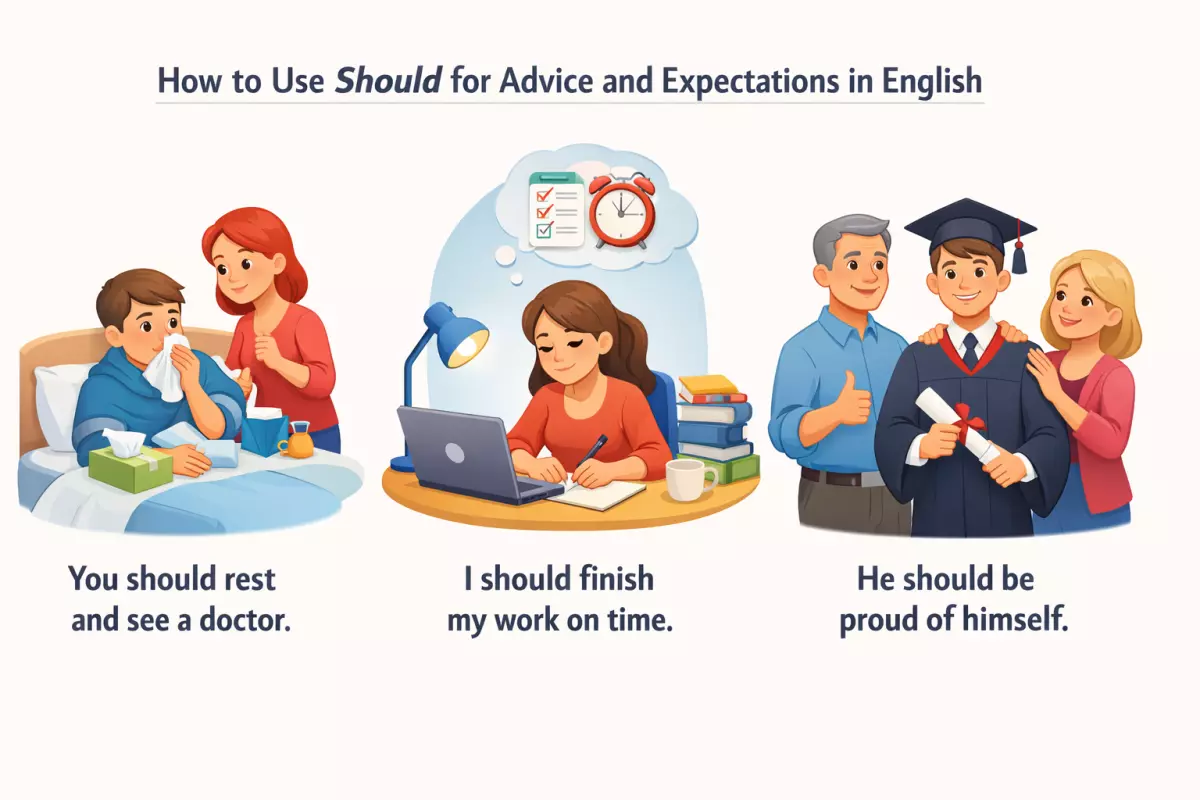 This article explains how should is used for advice, polite suggestions, and expectations about what’s likely or appropriate. It covers negative and question forms, everyday examples, differences from must and ought to, common learner mistakes, and practice exercises.
- The main function of 'should' when giving advice or recommendations
- How 'should' expresses expectations about what is likely or appropriate
- Using 'should' to suggest actions politely in conversation
- How negative and question forms with 'should' work in English
- Examples showing natural use of 'should' in everyday situations
- Differences between 'should', 'must', and 'ought to'
- Typical mistakes learners make when using 'should'
- Exercises and practice tasks for using 'should' in advice and expectations
Using should to give guidance and express expectations can make your English sound more natural and confident. You’ll hear it when friends suggest a better option, when coworkers mention what’s appropriate, or when you remind yourself of a sensible next step. We’ll practice when to use it, how strong it sounds, and how to stay polite without being too direct.
The main function of 'should' when giving advice or recommendations
Use should to suggest the best or most sensible action in a situation. It expresses a recommendation, not a command, so the listener still has a choice. This makes it useful for everyday guidance, professional suggestions, and polite feedback.
Core pattern
- Affirmative: subject + should + base verb (infinitive without to)
- Negative: subject + should not (shouldn’t) + base verb
- Question: Should + subject + base verb?
What “should” communicates in advice
- Recommendation: “This is a good idea.”
- Expectation of benefit: “This will likely help.”
- Mild obligation: “This is the responsible choice,” without sounding forceful.
- Practical judgment: “Based on the situation, this is the sensible option.”
Common uses and example sentences
- Health: You should drink more water during the day.
- Study: You should review your notes before the quiz.
- Work: You should clarify the deadline with your manager.
- Travel: You should arrive at the airport early.
- Money: You should set a monthly budget.
- Tech: You should update your software regularly.
- Communication: You should tell them as soon as possible.
- Customer service: You should keep the receipt in case you need a refund.
- Safety: You should wear a helmet when you ride a bike.
- Time management: You should prioritize the most urgent task first.
- Relationships: You should listen without interrupting.
- Learning English: You should practice speaking every day.
- Negative advice: You shouldn’t skip meals.
- Negative advice: You shouldn’t share your password with anyone.
- Asking for guidance: Should I email them or call them?
- Checking a plan: Should we book the tickets now?
Politeness and strength: choosing the right tone
- Neutral suggestion: You should try restarting your computer.
- Stronger warning (often with “really”): You really should back up your files.
- Softer recommendation (often with “maybe”): Maybe you should talk to them first.
- More formal: You should consider submitting the form by Friday.
Typical mistakes to avoid
- ❌ You should to see a doctor. → ✅ You should see a doctor.
- ❌ You should can call later. → ✅ You should call later.
- ❌ Should to I leave now? → ✅ Should I leave now?
- Don’t use should when you mean a strict rule; in that case, must or have to is usually clearer.
How 'should' expresses expectations about what is likely or appropriate
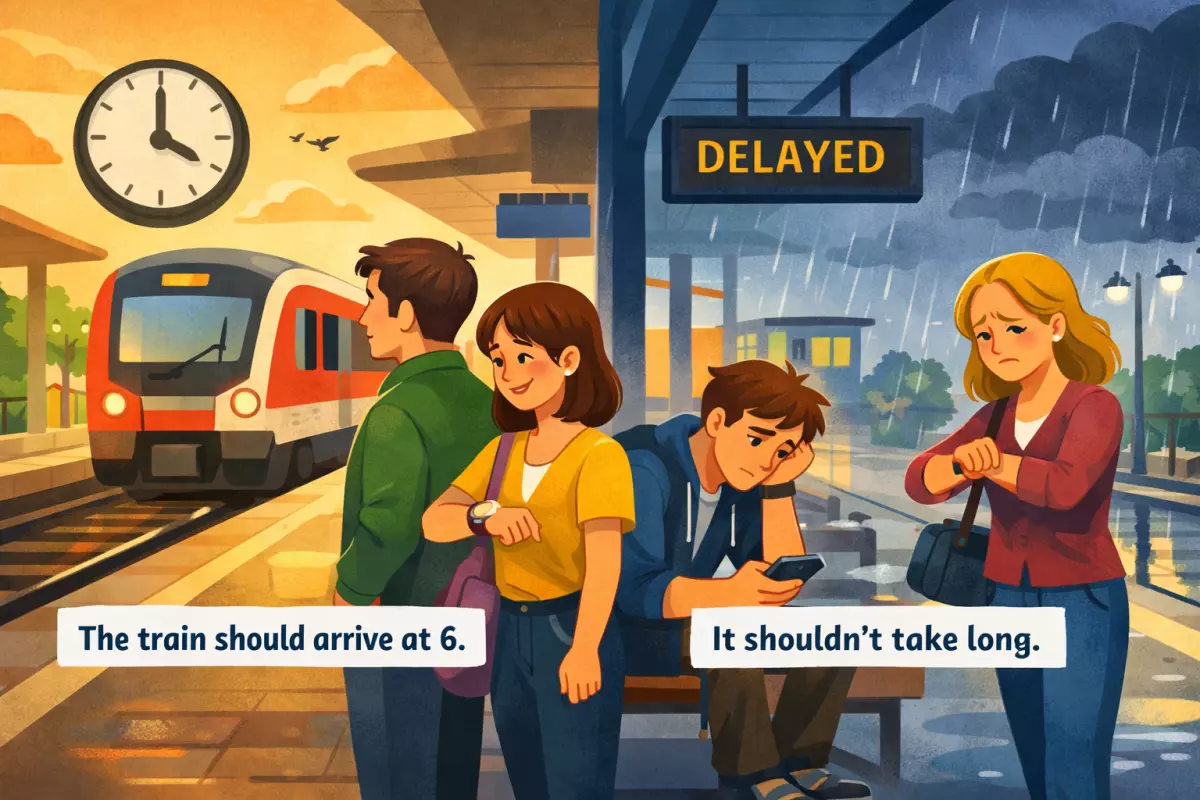
Use should to show what you expect to happen (based on logic, routine, or evidence) or what you think is the proper/normal outcome in a situation. This meaning is less like giving advice to someone and more like predicting or judging what is reasonable.
Core patterns
- Subject + should + base verb (present/future expectation): “The train should arrive at 6.”
- Subject + should not (shouldn’t) + base verb (negative expectation): “It shouldn’t take long.”
- Should + subject + base verb? (checking an expectation): “Should we expect delays?”
- Subject + should be + noun/adjective (expected state): “The room should be quiet now.”
- Subject + should have + past participle (expected past / surprise when it didn’t happen): “They should have arrived by now.”
- It should be + time/amount (approximation): “It should be about ten minutes.”
Expectation based on evidence or normal process
This use often implies “if everything is normal” or “given what we know.” It’s common in planning, travel, work updates, and troubleshooting.
- “If we leave now, we should get there before noon.”
- “The update should fix the bug.”
- “Your order should ship tomorrow.”
- “This key should open the back door.”
- “The medicine should start working in an hour.”
- “The results should appear on your dashboard shortly.”
- “With this discount, the total should be under $50.”
- “The meeting should finish by 3:30.”
- “That explanation should make sense now.”
- “The file shouldn’t be that large.”
- “The battery shouldn’t drain so quickly.”
- “It shouldn’t rain until tonight.”
What is appropriate, fair, or the “right” outcome
Should can also express a judgment about what is proper or acceptable. This is close to obligation, but it often sounds more like a general standard than a direct instruction.
- “Employees should be treated with respect.”
- “People should pay for what they use.”
- “The rules should apply to everyone.”
- “The report shouldn’t include personal data.”
- “Customers shouldn’t have to wait that long.”
- “The final decision should be transparent.”
“Should have” for expected past (often with surprise or criticism)
Use should have + past participle when you expected something to be true by now, or when you believe a different past action was the correct one.
- Expectation by now: “The package should have arrived by now.”
- Expectation based on plan: “They should have finished the test already.”
- Surprise at a result: “The backup should have saved your files.”
- Negative expectation: “It shouldn’t have taken two hours.”
- Appropriate past action (mild criticism): “You should have told me earlier.”
- Appropriate past action (system/process): “The form should have asked for your address.”
Common contrasts that affect meaning
- ✅ “It should work.” (expected/likely) → ✅ “It will work.” (more certain)
- ✅ “It should be ready tomorrow.” (reasonable prediction) → ✅ “It must be ready tomorrow.” (strong necessity/requirement)
- ✅ “You should be there by 8.” (expected arrival time) → ✅ “You have to be there by 8.” (strict obligation)
- ❌ “It should to be fine.” → ✅ “It should be fine.” (no to after should)
Using 'should' to suggest actions politely in conversation
In everyday speech, should is a common way to recommend a next step without sounding forceful. It sits between a direct instruction and a vague hint, so it works well for friendly advice, gentle reminders, and practical suggestions.
Core pattern and meaning
- Form: subject + should + base verb (no to) → You should call her.
- Negative: subject + should not / shouldn’t + base verb → You shouldn’t wait too long.
- Question: Should + subject + base verb? → Should I email them first?
- Use: suggests what is a good idea, sensible choice, or helpful action (not a strict order).
Polite suggestion patterns you can reuse
- You should + verb to give straightforward advice: You should back up your files.
- I think you should + verb to soften the recommendation: I think you should talk to your manager.
- Maybe you should + verb to sound less pushy: Maybe you should take a short break.
- You should probably + verb for cautious advice: You should probably leave a bit earlier.
- You should consider + -ing / noun to suggest options: You should consider applying again.
- It might help if you + past simple as an indirect alternative (often even softer than should): It might help if you wrote down the main points.
- Should we + verb? to propose a joint action: Should we order now?
- Should I + verb? to ask for advice politely: Should I bring anything?
Example sentences for common situations
- You should check the meeting time again.
- I think you should follow up tomorrow morning.
- Maybe you should ask for clarification before you reply.
- You should probably save a copy before editing.
- You shouldn’t send it until you’ve reviewed the attachment.
- Should I introduce you to the team?
- Should we move this discussion to email?
- You should try restarting the app first.
- If you’re tired, you should get some rest.
- You should consider taking notes during the call.
- You shouldn’t worry too much about one mistake.
- I think you should be honest about the timeline.
- Maybe you should set a reminder so you don’t forget.
- You should probably double-check the address.
- Should we schedule a quick follow-up?
How to avoid sounding too strong
- Prefer softeners when needed: maybe, I think, probably, a bit.
- Use a reason to make the advice feel helpful, not controlling: You should leave now, so you don’t get stuck in traffic.
- Offer choices instead of one “correct” action: You could call, but you should email if you need a written record.
- Avoid using should as a criticism in sensitive moments; compare:
- ❌ You should have known that. (sounds blaming)
- ✅ Next time, you should check the requirements first. (forward-looking)
How negative and question forms with 'should' work in English
Negative and interrogative patterns with should are built with the auxiliary itself (no do/does/did). The meaning usually stays in the “advice / expectation” range, but the form changes the strength: negatives warn against an action, and questions ask for guidance, confirmation, or a recommendation.
Core patterns to remember
- Negative: should not + base verb (contracted: shouldn’t)
- Question: Should + subject + base verb?
- Negative question: Shouldn’t + subject + base verb? (often expects agreement)
- Short answers: “Yes, you should.” / “No, you shouldn’t.” (not “Yes, you do.”)
Negative forms: when and how to use them
Use should not to advise against something or to say an action is not a good idea. It can also express that something is not expected or not appropriate in a situation.
- Advice against an action: “You shouldn’t skip breakfast.”
- Warning about risk: “You shouldn’t touch that wire.”
- Polite correction: “You shouldn’t speak to clients like that.”
- Expectation (something is unlikely): “It shouldn’t take long.”
- Expectation (something is wrong if it happens): “The package shouldn’t be open.”
- Common placement with adverbs: “You probably shouldn’t drive tonight.”
- With “ever” for strong advice: “You shouldn’t ever share your password.”
- With “really” to soften: “You really shouldn’t worry so much.”
- Typical contraction in speech: “You shouldn’t do that.”
- ✅ “You shouldn’t go.” ❌ “You shouldn’t to go.”
Question forms: asking for advice or confirming an expectation
Use Should I/we/you…? to ask what the best action is. Use it with you/he/she/they to check what is recommended or what is expected to happen.
- Asking for advice: “Should I email them now or wait?”
- Asking for a recommendation: “Should we book in advance?”
- Checking a rule/policy: “Should we wear ID badges here?”
- Confirming expectation: “Should the results be ready today?”
- Offering help politely: “Should I carry that for you?”
- Asking about priority: “Which task should I do first?”
- Asking about timing: “When should we leave?”
- Asking about method: “How should I format the report?”
- Asking about choice: “Should I take the bus or the train?”
- ✅ “Should she call you?” ❌ “Should she calls you?”
Negative questions: suggesting an answer
Shouldn’t…? often implies the speaker expects “yes” or is gently pushing toward a particular option. It can sound persuasive, surprised, or critical depending on context and intonation.
- Expected agreement: “Shouldn’t we tell them the truth?”
- Surprise about a situation: “Shouldn’t the door be locked?”
- Soft suggestion: “Shouldn’t you take a break?”
- Checking a shared plan: “Shouldn’t we meet at 3:00?”
- Polite reminder: “Shouldn’t you reply to that email?”
Common mistakes to avoid
- Don’t add do: ✅ “Should I go?” ❌ “Do I should go?”
- Don’t use to after it: ✅ “You should study.” ❌ “You should to study.”
- Keep the main verb in base form: ✅ “She shouldn’t worry.” ❌ “She shouldn’t worries.”
- Use the right short answer: ✅ “Yes, you should.” ❌ “Yes, you should do.”
Examples showing natural use of 'should' in everyday situations
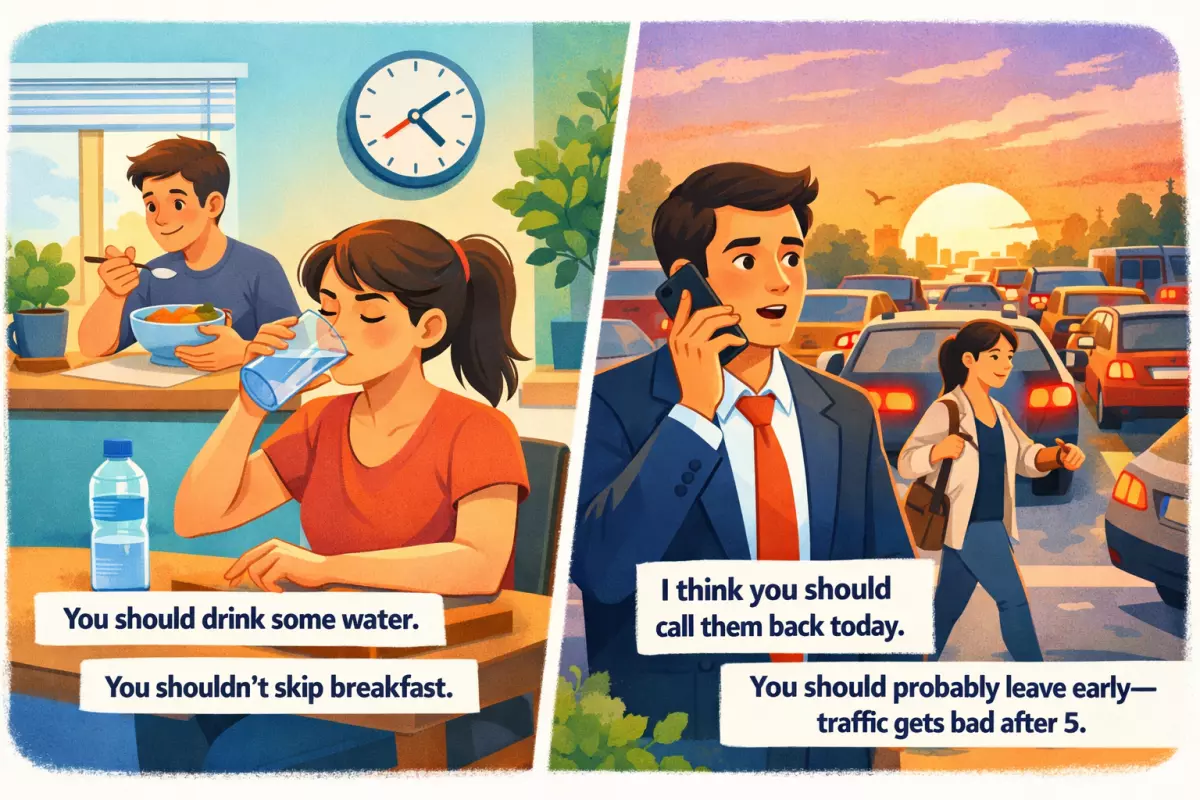
Use should to give advice, make gentle recommendations, or express what you expect is true or likely. The examples below show common patterns you can reuse in daily conversations, emails, and messages.
Advice and recommendations (common in conversation)
- You should drink some water if you have a headache.
- You shouldn’t skip breakfast if you have a long morning.
- I think you should call them back today.
- You should probably leave a bit earlier—traffic gets bad after 5.
- You should try restarting your phone first.
- We should book the tickets soon before prices go up.
- Should I bring anything to the dinner?
- What should I do if the package doesn’t arrive?
- If I were you, I’d talk to your manager (often used instead of “should” for softer advice).
- You should double-check the address before you send it.
- Maybe you should take a short break and come back to it.
- You shouldn’t worry too much—let’s see what happens first.
Expectations and “what’s normal/appropriate”
- The meeting should start at 10, so let’s join a few minutes early.
- Your order should arrive by Friday.
- This key should fit the front door, not the back door.
- It shouldn’t take more than five minutes to reset.
- They should be home by now—do you want to call?
- The instructions should be on the box.
- There should be enough chairs for everyone.
- It should be cheaper online than in the store.
Polite criticism and “this isn’t ideal”
- You shouldn’t talk over people in meetings.
- They should tell customers about delays sooner.
- We should have checked the schedule before we left.
- I shouldn’t have sent that message so quickly.
- The app shouldn’t crash when you open the settings.
Useful patterns to copy (form and word order)
- Should + base verb: You should rest. / She should ask first.
- Shouldn’t + base verb: You shouldn’t drive when you’re that tired.
- Should + subject (question): Should we wait here?
- Wh- word + should (question): Where should I park?
- Should have + past participle (past regret/criticism): I should have saved the receipt.
- Should be + adjective/noun (expectation): It should be fine. / It should be the right one.
Differences between 'should', 'must', and 'ought to'
These three modal verbs can all express guidance, but they differ in strength, formality, and how much obligation the speaker is putting on the listener. Choosing the right one helps your advice sound appropriate rather than too weak or too forceful.
| Modal | Main meaning | Strength | Common use | Typical examples |
|---|---|---|---|---|
| should | Advice, recommendation, expectation | Medium | Helpful guidance; what is likely/normal | You should see a doctor. / It should be fine. |
| must | Strong obligation or necessity | High | Rules, requirements, urgent necessity | You must wear a helmet. / I must leave now. |
| ought to | Moral duty or “the right thing” | Medium (often slightly formal) | Principles, duty, polite/old-fashioned advice | You ought to apologize. / We ought to help. |
| should vs must | Recommendation vs requirement | Medium vs High | Softening vs enforcing | You should submit it today. / You must submit it today. |
How strong is the obligation?
- Use should when you are giving advice or stating what you expect is true, without making it a strict rule.
- Use must when something is required (by rules, safety, or urgency) or when the speaker wants to sound firm.
- Use ought to when you want to highlight duty, ethics, or what is “proper,” often with a slightly more formal tone.
Form and pattern differences (what sounds natural)
- Basic form: should/must/ought to + base verb: should call, must leave, ought to apologize.
- Ought to needs to: ❌ You ought call. ✅ You ought to call.
- Negative forms: should not (shouldn’t), must not (mustn’t), ought not to (less common).
- Questions: Should I…? (very common); Must I…? (can sound strict); Ought I to…? (rare and formal).
- Short answers: Yes, you should. / Yes, you must. (Ought to is usually avoided in short answers in modern speech.)
- Past advice/criticism: should have + past participle: You should have called earlier.
- Past expectation: should have + past participle: The package should have arrived by now.
- Ought to in the past: ought to have + past participle: You ought to have told me.
- Must in the past: use had to for past obligation: I had to work late yesterday. (Not: I musted.)
- Logical conclusion: must can mean “I’m sure”: She must be tired. (This is not obligation.)
- Expectation vs conclusion: It should be easy (expected) vs It must be easy (speaker is certain, based on reasoning).
- Politeness: should often sounds less pushy than must, especially with suggestions.
Choosing the right modal in common situations
- Friendly advice: You should try restarting your phone.
- Company policy / rules: Employees must wear badges.
- Safety instructions: You must not touch that wire.
- Personal duty: I ought to call my parents more often.
- Expectation about timing: The train should arrive at 6:10.
- Strong necessity (speaker’s need): I must finish this tonight.
- Softened requirement (more tactful): You should submit the form by Friday. (Often used when the rule exists but the speaker wants to sound polite.)
- Asking for guidance: Should I email or call?
- Checking obligation: Do I have to bring ID? (Often more natural than Must I bring ID?)
- Criticizing a past action: You shouldn’t have said that.
- Regret/duty in the past: We ought to have helped them.
- Certainty (not advice): He must be at work—his car is gone.
In practice, should is the default for advice and expectations, must signals a non-negotiable requirement or a strong conclusion, and ought to adds a sense of duty or “the right thing to do,” often in a more formal register.
Typical mistakes learners make when using 'should'
Many errors with this modal come from mixing up its form, its strength (advice vs. obligation), and the time reference (now, past, or future). The points below focus on the patterns that cause the most confusion and how to correct them.
-
Using to after should
❌ You should to see a doctor. → ✅ You should see a doctor.
Pattern: should + base verb (should go/should call/should try).
-
Adding -s, -ed, or -ing after should
❌ He should goes / should went / should going. → ✅ He should go.
After modals, the verb stays in the base form: should be, should have, should do.
-
Confusing advice with obligation (should vs. must/have to)
❌ You should wear a seatbelt (meaning “it’s the law”). → ✅ You must/have to wear a seatbelt.
Use should for recommendations; use must/have to for rules and strong necessity.
-
Using should when you mean “probably will”
❌ I should arrive yesterday. → ✅ I was supposed to arrive yesterday.
For expectations about the future, should can mean “likely”: “The train should arrive at 6.” For planned duties, “be supposed to” is often clearer.
-
Mixing up present advice and past regret
❌ You should tell me yesterday. → ✅ You should have told me yesterday.
Use should have + past participle for criticism or regret about the past.
-
Using “should to have” instead of “should have”
❌ I should to have studied. → ✅ I should have studied.
The correct perfect form is: should have done, should have been, should have gone.
-
Incorrect negative forms
❌ You don’t should do that. → ✅ You shouldn’t do that.
Negatives are formed with not: should not / shouldn’t + base verb.
-
Incorrect question forms
❌ Do I should call her? → ✅ Should I call her?
In questions, invert the modal and subject: Should we leave now?
-
Overusing should in formal writing where softer language is expected
❌ You should submit the form immediately. → ✅ Please submit the form by Friday.
In instructions, “please,” “need to,” or clear deadlines can sound more appropriate than constant recommendations.
-
Using should with “to” in passive structures
❌ It should to be done today. → ✅ It should be done today.
Passive pattern: should + be + past participle (should be checked/should be cleaned).
-
Choosing the wrong modal for giving permission
❌ Should I use your phone? (when asking permission) → ✅ Can/Could I use your phone?
“Should I…?” is usually about what is the best idea, not whether it is allowed.
-
Confusing “should” and “would” in conditional advice
❌ If I were you, I should talk to him. → ✅ If I were you, I would talk to him.
Common advice pattern: If I were you, I would + base verb.
-
Using should after “suggest/recommend” incorrectly
❌ I suggest you should see a doctor. → ✅ I suggest you see a doctor.
After suggest/recommend, use a base verb clause (common in American English) or a that-clause: “I recommend that you see a doctor.”
-
Misplacing “not” and other adverbs
❌ You should go not there. → ✅ You should not go there.
Place “not” right after the modal. Other adverbs often go after should: “You should definitely call.”
-
Using should for strong moral judgment when a neutral tone is needed
❌ You should know that already. → ✅ You might already know this, but…
Because it can sound critical, consider softer phrasing when the goal is to inform rather than judge.
When checking your own sentences, focus on three quick tests: (1) Is the verb in base form after the modal? (2) Is the meaning advice, expectation, or past regret? (3) Is the tone appropriate for the situation?
Exercises and practice tasks for using 'should' in advice and expectations
Use the tasks below to practice common patterns: giving recommendations, stating what is expected, and reacting when something is surprising or not as planned. Focus on form (subject + should + base verb) and meaning (advice vs. expectation) as you work.
1) Choose the best option (advice or expectation)
- Your cough is getting worse. You (should / should have) see a doctor.
- It’s 9:55. The train (should / should have) arrive in about five minutes.
- I can’t find my keys. They (should / should have) be on the kitchen table.
- We missed the bus. We (should / should have) left earlier.
- Don’t message him again tonight. You (should / shouldn’t) give him some space.
- She studied a lot, so she (should / shouldn’t) pass the exam.
- It’s a formal event. You (should / should have) wear a jacket.
- He’s not answering, but he (should / should have) be in a meeting right now.
- I feel awful about what I said. I (should / should have) been more careful.
- If you want to improve quickly, you (should / should have) practice every day.
Show answers
- should
- should
- should
- should have
- should
- should
- should
- should
- should have
- should
2) Rewrite using “should” (keep the meaning)
- It’s a good idea to back up your files regularly.
- I expect the package to arrive tomorrow.
- It was a mistake to ignore her message.
- It isn’t a good idea to drink coffee late at night.
- I’m surprised he isn’t here yet; I expected him to be here by now.
- It would be better to check the address before you send it.
- I regret not apologizing earlier.
- I expect the meeting to finish by 4 p.m.
Show answers
- You should back up your files regularly.
- The package should arrive tomorrow.
- I should have not ignored her message. / I shouldn’t have ignored her message.
- You shouldn’t drink coffee late at night.
- He should be here by now.
- You should check the address before you send it.
- I should have apologized earlier.
- The meeting should finish by 4 p.m.
3) Fix the form (common errors)
Correct each sentence. Keep the original meaning.
- You should to call your parents more often.
- He should can finish this today.
- I should went to bed earlier.
- They should arriving soon.
- We shouldn’t to park here.
- She should has the report already.
- I should to have told you.
- It should to be easy.
Show answers
- You should call your parents more often.
- He should finish this today.
- I should have gone to bed earlier.
- They should arrive soon.
- We shouldn’t park here.
- She should have the report already. / She should have had the report already. (depending on meaning)
- I should have told you.
- It should be easy.
4) Mini-scenarios: write advice vs. expectation
Write two sentences for each situation: one giving advice, and one stating an expectation. Use “should” in both sentences.
- A friend has an interview tomorrow and feels nervous.
- You ordered food online; the app says “arriving in 10 minutes.”
- Your classmate keeps missing deadlines.
- You sent an email an hour ago and usually get a quick reply.
- Someone is driving too fast in the rain.
- You’re waiting for a colleague who is normally punctual.
Show answers
- Advice: You should prepare a few answers and get some sleep. Expectation: You should feel more confident once you start.
- Advice: You should keep your phone nearby. Expectation: The food should arrive in about 10 minutes.
- Advice: You should plan your week and start earlier. Expectation: You should submit the next task on time if you begin today.
- Advice: You should check your spam folder. Expectation: They should reply soon.
- Advice: You should slow down. Expectation: The road should be slippery in this weather.
- Advice: You should message them to confirm. Expectation: They should be here any minute.
5) Pattern bank (quick prompts to practice)
- Advice: You should + base verb (You should rest; You should ask; You should take a break.)
- Negative advice: shouldn’t + base verb (You shouldn’t skip meals; You shouldn’t rush.)
- Expectation: subject + should + base verb (The results should be ready tomorrow.)
- Expectation “by now”: should be + noun/adjective/place (She should be home by now.)
- Regret/criticism about the past: should have + past participle (I should have listened.)
- Past negative: shouldn’t have + past participle (We shouldn’t have said that.)
- Polite question for advice: What should I do? / Should I call them now?
- Soft suggestion with reason: You should + verb + because…
- Advice with a time limit: You should + verb + before/after/by…
- Expectation with probability: It should + verb + if… (It should work if you restart it.)
- Checking an assumption: It should be… (It should be on the top shelf.)
- Contrasting correct vs. incorrect form: ✅ should go ❌ should to go