Should vs Ought to: Advice and Recommendation Rules

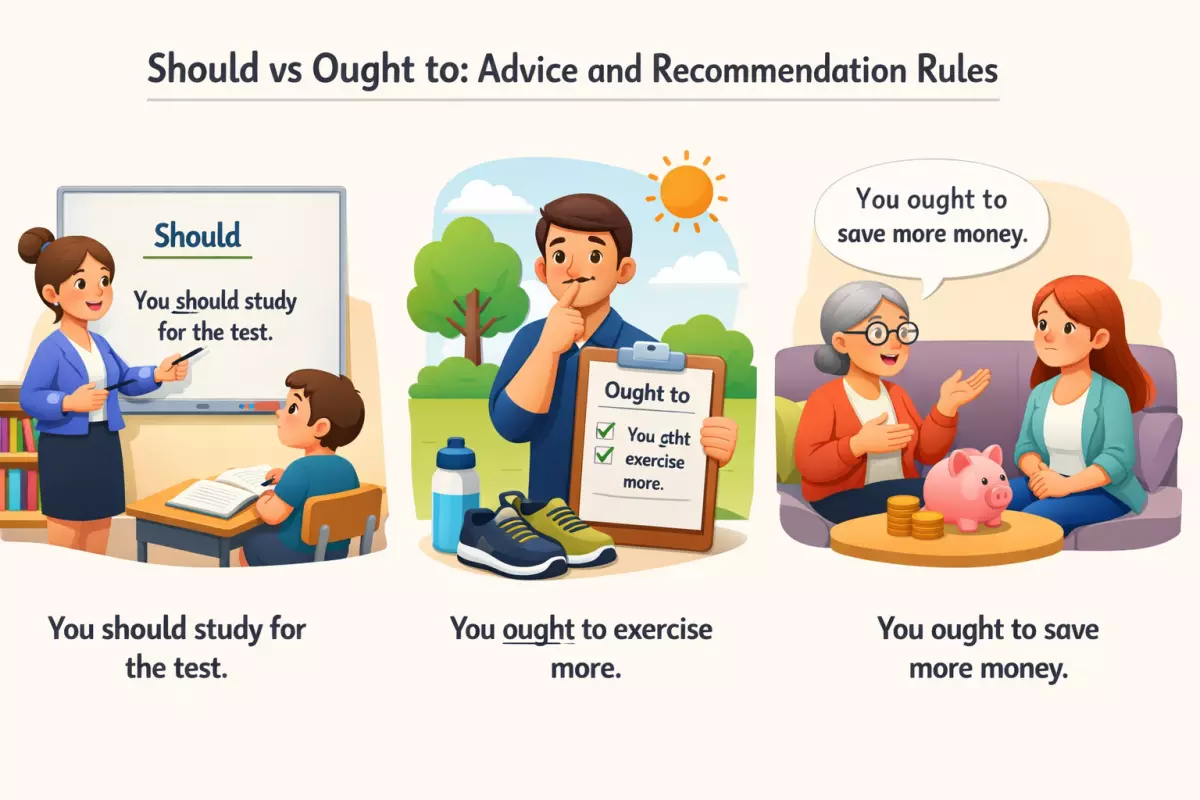 This article explains how should and ought to give advice, how their meanings overlap, and how tone and modern usage differ. It shows everyday examples, why should is more common in speech, negative and question forms, learner mistakes, and practice exercises.
- How should and ought to are used to give advice
- The similarity in meaning between these two recommendation verbs
- Differences in tone and frequency of use in modern English
- Examples of recommendations in everyday contexts
- Why should is more common in modern spoken English
- Negative and question forms with both verbs
- Typical learner mistakes when using advice modals
- Exercises and practice activities using should and ought to
When giving advice in English, choosing between should and ought to can change the tone from casual and friendly to more formal or morally weighted. In everyday talk, should usually sounds like a simple suggestion, while ought to can imply duty or what seems right. This guide helps you decide which one fits your meaning, audience, and situation.
How should and ought to are used to give advice
Should and ought to both express advice, recommendations, and what is considered the right or sensible action. In many everyday situations they are interchangeable, but they differ in tone, formality, and how they behave in questions and negatives.
Core meaning and typical tone
- Should is the most common choice for advice in conversation and writing. It sounds practical and neutral.
- Ought to often sounds a bit more formal or moral, as if the speaker is appealing to duty, expectations, or what is “proper.”
- Both can be gentle (“This is a good idea”) rather than forceful (“You must”).
- Both can be used for personal advice, professional recommendations, and general guidance.
Common patterns for giving advice
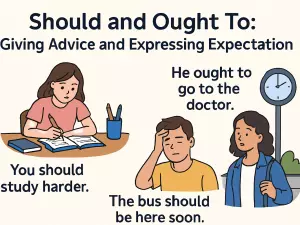
- Affirmative advice: “You should call the doctor.” / “You ought to call the doctor.”
- Advice about a general situation: “People should back up their files.” / “People ought to back up their files.”
- Advice with a reason: “You should leave now because traffic is heavy.” / “You ought to leave now because traffic is heavy.”
- Advice with a condition: “If you’re tired, you should rest.” / “If you’re tired, you ought to rest.”
- Softened advice with “think”: “I think you should apologize.” / “I think you ought to apologize.”
- Advice framed as a question: “Should I email them today?” (more natural) / “Ought I to email them today?” (more formal)
- Advice using “What should…?”: “What should I do next?” (common) / “What ought I to do next?” (formal)
- Advice for another person: “He should talk to his manager.” / “He ought to talk to his manager.”
- Advice for a group: “We should set a deadline.” / “We ought to set a deadline.”
- Advice for the future: “You should save some money for emergencies.” / “You ought to save some money for emergencies.”
Negatives and “don’t” advice
- Should not / shouldn’t is the standard way to advise against something: “You shouldn’t skip breakfast.”
- Ought not to is correct but less common in modern speech: “You ought not to skip breakfast.”
- In informal English, “oughtn’t to” exists but is relatively rare and can sound old-fashioned in many regions.
- When giving strong caution, many speakers prefer “shouldn’t” over “ought not to” because it feels more direct and natural.
Grammar notes that affect usage
- Should is followed by the base verb (no “to”): “should go,” “should see,” “should be.”
- Ought is typically followed by to + base verb: “ought to go,” “ought to see,” “ought to be.”
- Questions are easier with “should” in everyday English: “Should we wait?” is more natural than “Ought we to wait?”
- Short answers are common with “should”: “Yes, you should.” With “ought to,” short answers are less common; speakers often repeat the full idea: “Yes, you ought to.”
- Both can be used for advice about what is generally expected: “You should be on time” / “You ought to be on time.”
Expanded example set (typical advice contexts)
- You should drink more water during the day.
- You ought to read the instructions before you start.
- We should confirm the meeting time.
- They ought to update their password regularly.
- Should I mention the delay in my email?
- Ought I to bring anything to the interview?
- You shouldn’t share that file publicly.
- You ought not to ignore those warning signs.
- If you want clearer results, you should run the test again.
- If the pain continues, you ought to see a specialist.
- I think you should ask for clarification.
- I think you ought to take a short break.
- What should we prioritize first?
- What ought we to do about the budget?
- Students should cite their sources.
- People ought to treat others with respect.
The similarity in meaning between these two recommendation verbs

In many everyday contexts, should and ought to both express a recommendation: the speaker thinks an action is a good idea, sensible, or the right choice. In practice, they often lead to the same decision, especially when the advice is general and not tied to strict rules.
What they share is the core meaning of “this is advisable.” The differences usually come from tone, formality, and how strongly the speaker frames the advice as a duty or expectation.
Shared usage patterns
- Advice about what is best: both can suggest the most sensible option based on information available.
- Recommendations for health and safety: both work when warning about risk or encouraging prevention.
- Suggestions about habits and routines: both can guide behavior without sounding like a command.
- Soft criticism or regret: both can point out a better choice after the fact (often with “have + past participle”).
- Expectations: both can express what is normally expected in a situation, especially with “by now” or similar time phrases.
- Polite guidance: both can be used to advise without using an imperative.
Interchangeable examples (same practical meaning)
- You should back up your files regularly. → You ought to back up your files regularly.
- We should leave early to avoid traffic. → We ought to leave early to avoid traffic.
- She should talk to her manager first. → She ought to talk to her manager first.
- They should check the contract carefully. → They ought to check the contract carefully.
- You should drink more water during flights. → You ought to drink more water during flights.
- He should apologize for the misunderstanding. → He ought to apologize for the misunderstanding.
- I should set a reminder so I don’t forget. → I ought to set a reminder so I don’t forget.
- We should read the instructions before installing it. → We ought to read the instructions before installing it.
- You should keep receipts for warranty claims. → You ought to keep receipts for warranty claims.
- She should get some rest tonight. → She ought to get some rest tonight.
- They should be more careful with personal data. → They ought to be more careful with personal data.
- We should confirm the meeting time. → We ought to confirm the meeting time.
Shared “past advice” pattern (missed opportunity)
- Use should have + past participle and ought to have + past participle to judge a past choice.
- ✅ You should have called earlier. → You ought to have called earlier.
- ✅ They should have booked tickets in advance. → They ought to have booked tickets in advance.
- ✅ I should have saved a copy of the email. → I ought to have saved a copy of the email.
- Meaning in both cases: the earlier action would have been better; it is advice viewed from the present.
Where the overlap is strongest
- General recommendations: “You should/ought to exercise more” (broad, non-technical advice).
- Everyday problem-solving: “You should/ought to restart the device” (simple suggested step).
- Planning and timing: “We should/ought to leave by 6” (practical suggestion).
- Social behavior: “You should/ought to thank them” (recommended courtesy).
Because the meaning overlaps so much, choosing between them often depends less on grammar and more on the tone you want: neutral and common (should) versus slightly more formal or duty-leaning (ought to). In most advice sentences, either verb produces a natural, correct recommendation.
Differences in tone and frequency of use in modern English
In present-day English, should is the default choice for giving advice because it sounds neutral and fits most situations. Ought to is still correct, but it often feels more formal, more “moral,” or more old-fashioned, so it appears less often in everyday conversation.
| Aspect | Should | Ought to |
|---|---|---|
| How common it is | Very common in speech and writing | Less common; more noticeable when used |
| Typical tone | Neutral, practical, low-pressure | More formal or “duty/ethics” flavored |
| Best-fit contexts | Everyday advice, recommendations, expectations | Obligation-as-advice, social expectations, “what’s right” |
| Negative form in use | “shouldn’t” is very common | “ought not to” exists but is relatively rare |
| Questions | Natural: “Should I…?” “Should we…?” | Possible but less natural: “Ought I to…?” |
| Rhythm and brevity | Short and flexible (no “to” needed) | Longer because it usually keeps “to” |
| Common in fixed phrases | Many everyday patterns: “should be,” “should have,” “shouldn’t” | More limited set; can sound emphatic or traditional |
Practical usage patterns you will notice
- Everyday recommendations usually choose should: “You should try calling earlier.”
- Advice with a moral or social expectation often fits ought to: “You ought to apologize.”
- Quick warnings strongly favor shouldn’t: “You shouldn’t drive if you’re exhausted.”
- Formal-sounding criticism can lean toward ought to: “They ought to know better.”
- Questions for guidance are most natural with should: “Should I email or call?”
- Workplace and academic writing typically uses should for recommendations: “The report should include a summary.”
- When the speaker wants to sound less forceful, should is the safer pick than ought to.
- When the speaker wants to add a sense of duty without using “must,” ought to can be effective.
- Negative “ought” is often avoided in casual speech; speakers may switch to shouldn’t instead.
- In short replies, should is easier: “Yes, you should.” (vs. “Yes, you ought to.”)
- With “have” for past advice, both exist, but should have is much more frequent: “You should have told me.”
- In some dialects and older styles, ought to appears more naturally, especially in set expressions.
Choosing quickly: what sounds most natural
- Use should when you want standard, modern-sounding advice in almost any setting.
- Use ought to when you want the advice to carry a stronger sense of responsibility, propriety, or “the right thing to do.”
- If you are unsure, choose should; it is the more frequent and less marked option in modern English.
Examples of recommendations in everyday contexts
In daily situations, should is the most common choice for practical advice, while ought to often sounds a bit more formal or tied to a sense of duty. The patterns below show how speakers give suggestions, express expectations, and soften or strengthen a recommendation depending on context.
Common situations and natural phrasing
- Health (general advice): “You should drink more water during the day.”
- Health (strong expectation): “You ought to see a doctor if the pain continues.”
- Sleep and routine: “You should try going to bed earlier on weekdays.”
- Food choices: “You should eat something before you take that medicine.”
- Work deadlines: “You should start the report today so you’re not rushed tomorrow.”
- Work etiquette (norms): “You ought to reply to that client email by the end of the day.”
- Studying (strategy): “You should review your notes right after class.”
- Studying (expectation): “You ought to cite your sources properly in academic writing.”
- Travel planning: “You should check the weather before you pack.”
- Safety: “You ought to wear a seatbelt, even on short trips.”
- Money (practical tip): “You should set a monthly budget and track your spending.”
- Money (responsibility): “You ought to pay that bill before the due date.”
- Friendship (gentle advice): “You should talk to them directly instead of guessing.”
- Apologies (moral pressure): “You ought to apologize for what you said.”
- Household tasks: “We should clean the kitchen before guests arrive.”
- Team plans: “We ought to agree on a schedule before we start the project.”
Useful patterns for giving recommendations
- Softening a suggestion with “think”: “I think you should wait until you have more information.”
- Making it less direct with a question: “Should we call ahead to confirm?”
- Adding a reason (common in advice): “You should back up your files because the update might fail.”
- Negative advice: “You shouldn’t skip breakfast if you get dizzy easily.”
- Negative expectation (more formal): “You ought not to share someone else’s private messages.”
- Past form for missed advice: “You should have told me earlier.” / “You ought to have checked the address.”
- Conditional recommendation: “If you’re not sure, you should ask for clarification.”
- General rule (impersonal): “People should turn off their phones during the movie.”
Quick correctness notes (common learner issues)
- ✅ “You ought to call your parents.” ❌ “You ought call your parents.” (In modern English, to is normally required.)
- ✅ “You shouldn’t do that.” ❌ “You don’t should do that.” (Use the modal negative, not do-support.)
- ✅ “You should have saved the file.” / “You ought to have saved the file.” → both refer to a past action that didn’t happen.
Why should is more common in modern spoken English

Should tends to dominate everyday conversation because it is shorter, more flexible in tone, and fits smoothly into common speech patterns. In many situations, it delivers the same practical meaning as ought to (advice or recommendation) without sounding formal, old-fashioned, or overly deliberate.
Usage patterns that favor “should” in speech
- It’s quicker to say and easier to reduce in fast speech: “You should go” often becomes “You shoulda go” in casual pronunciation (even if that spelling is nonstandard).
- It works naturally in short replies: “I should.” / “You should.” / “Should I?” are common conversational turns; “Ought to I?” is rare in modern speech.
- It feels neutral: “You should talk to her” can sound supportive or practical, while “You ought to talk to her” can sound more judgmental or moralizing depending on context.
- It fits more question types: “Should we leave?” is standard; “Ought we to leave?” exists but sounds more formal.
- It pairs easily with common hedges: “You should probably…” / “I think you should…” are frequent; “You ought to probably…” is less common.
- It’s the default in advice-giving formulas: Many set phrases use it, so speakers reach for it automatically.
- It avoids “to” placement issues: With ought to, speakers must manage the extra word “to,” which complicates questions and negatives.
- It sounds less marked: “Should” is widely taught and used across registers, so it rarely draws attention to itself.
Common spoken structures where “should” is the natural choice
- Advice + softener: “You should probably get some rest.”
- Recommendation with a reason: “You should take a jacket; it’s cold outside.”
- Checking a plan: “Should we book it now?”
- Asking for guidance: “What should I do?”
- Offering a solution: “You should try restarting your phone.”
- Gentle criticism: “You should be more careful next time.”
- Expectation: “It should be ready by Friday.”
- Reassurance: “You should be fine.”
- Polite suggestion: “You should consider emailing them first.”
- Negative advice: “You shouldn’t skip breakfast.”
- Question form: “Should I call them today?”
- Tag question: “We should leave now, shouldn’t we?”
- Conditional advice: “If you’re tired, you should go home.”
- With “think”: “I think you should talk to your manager.”
- With “maybe”: “Maybe you should wait a day.”
Where “ought to” still appears (and why it can sound different)
- Stronger sense of duty: “You ought to apologize” can imply a clearer moral obligation than “You should apologize.”
- More deliberate emphasis: Speakers may choose it to sound firm or to underline responsibility.
- Fixed or regional habits: Some speakers use it more often because of family, region, or older usage patterns.
- But less smooth in negatives and questions: “You ought not to…” and “Ought we to…?” are grammatical, yet they are less common in everyday talk than “shouldn’t” and “Should we…?”
In short, modern conversation favors the form that is easiest to produce, easiest to shape into questions and short answers, and least likely to sound overly formal. That combination makes should the default choice for advice and recommendations in most spoken contexts.
Negative and question forms with both verbs
Forming negatives and questions is straightforward with should, but it is more variable with ought to. The main difference is that should behaves like a modal auxiliary, while ought to is often treated like a semi-modal, especially in questions and negatives.
Key patterns to use
- Negative with should: should not / shouldn’t + base verb
- ✅ You shouldn’t drive when you’re this tired.
- ✅ We should not ignore the warning signs.
- ❌ You don’t should drive late. → Use shouldn’t.
- Question with should: Should + subject + base verb?
- ✅ Should I call her now or wait?
- ✅ Should we book in advance?
- ✅ What should I do next?
- Negative with ought to (common in modern English): subject + ought not to / oughtn’t to + base verb
- ✅ You ought not to speak to clients like that.
- ✅ We oughtn’t to spend the whole budget in one month.
- Note: oughtn’t is correct but less common in some varieties and in formal writing.
- Alternative negative with ought to (especially in informal speech): subject + don’t/doesn’t + ought to + base verb
- ✅ You don’t ought to skip meals. (informal; some speakers prefer avoiding this)
- ✅ He doesn’t ought to be driving. (informal)
- Many learners are safer sticking to ought not to in writing.
- Question with ought to (more formal/traditional): Ought + subject + to + base verb?
- ✅ Ought we to tell her the truth?
- ✅ Ought I to apologize?
- These are grammatical, but they can sound formal or old-fashioned in everyday conversation.
- More natural question strategy with ought to: use Do you think…?, Should…?, or rephrase
- ✅ Do you think I ought to email them first?
- ✅ Should we talk to HR about it? (often preferred over “Ought we to…?”)
- ✅ Is it a good idea to leave now? (avoids awkward inversion)
- Tag questions: tags usually follow the auxiliary pattern in the main clause
- ✅ You should see a doctor, shouldn’t you?
- ✅ We shouldn’t be late, should we?
- ✅ You ought to call them, shouldn’t you? (common: tag often switches to should)
- ✅ You ought not to worry, ought you? (possible, but less common)
- Short answers: should works cleanly; ought to is less common in short replies
- ✅ “Should I go?” “Yes, you should.” / “No, you shouldn’t.”
- ✅ “Ought I to go?” “Yes, you should.” (often preferred)
- ✅ “You ought to go.” “Yes, I probably should.”
- With perfect forms (past advice): negatives and questions follow the same structure
- ✅ You shouldn’t have said that.
- ✅ Should I have told him earlier?
- ✅ You ought not to have ignored the email.
- ✅ Ought we to have checked the details?
Typical learner mistakes when using advice modals
Advice expressions are easy to recognize but tricky to form correctly. Many errors come from mixing modal patterns, choosing a level of force that doesn’t match the situation, or using the wrong verb form after the modal.
1) Using the wrong verb form after should or ought to
- ❌ You should to call her. → ✅ You should call her.
- ❌ You ought call her. → ✅ You ought to call her.
- ❌ He should calls his mom. → ✅ He should call his mom.
- ❌ We ought to going now. → ✅ We ought to go now.
- ❌ She should can drive. → ✅ She should drive.
2) Confusing advice with obligation
- Using must when you only mean a recommendation can sound too strong: ❌ You must see a dentist (sounds like an order) → ✅ You should see a dentist (suggestion).
- Using should when a rule is required can sound too weak: ❌ You should wear a helmet (if it’s legally required) → ✅ You must wear a helmet.
- Overusing “You should…” in sensitive contexts can feel judgmental; softer options like “You might want to…” or “It may help to…” often fit better.
3) Mixing up negatives and meaning
- ❌ You should don’t eat so late. → ✅ You shouldn’t eat so late.
- ❌ You ought to not be late. → ✅ You ought not to be late. (or: You shouldn’t be late.)
- Be careful with emphasis: “You shouldn’t do that” is advice against an action; it can also sound like criticism depending on tone and context.
4) Problems with past advice (missed recommendations)
- Using present forms for past situations: ❌ You should study yesterday. → ✅ You should have studied yesterday.
- Dropping have: ❌ You should studied more. → ✅ You should have studied more.
- Wrong past participle: ❌ You should have went earlier. → ✅ You should have gone earlier.
- Confusing regret vs. criticism: “You should have called” can sound like blame; “It would have been better to call” is often gentler.
5) Forming questions incorrectly
- ❌ Do I should tell him? → ✅ Should I tell him?
- ❌ Ought I to tell him? (grammatical but formal) → ✅ Should I tell him? (more natural in everyday speech)
- ❌ Should I to go now? → ✅ Should I go now?
6) Choosing an unnatural structure with ought to
- In conversation, ought to can sound formal or old-fashioned in some varieties of English; learners sometimes use it too often where should is the normal default.
- Negative and question forms with ought are less common, so they may sound stiff: “Oughtn’t we…?” is correct but rare; many speakers prefer “Shouldn’t we…?”
7) Overgeneralizing “should” for predictions
- Should can express expectation (“It should be fine”), but learners sometimes use it when they mean certainty: ❌ It should be 100% correct. → ✅ It will be correct / It’s definitely correct.
- When you mean “probably,” should works; when you mean “guaranteed,” it usually doesn’t.
8) Missing the “for advice” patterns that sound more natural
- Not using common frames: “I think you should…,” “You should probably…,” “If I were you, I’d…,” “It might be a good idea to…”
- Using commands instead of recommendations: ❌ Stop doing that. → ✅ You should stop doing that. / You might want to stop doing that.
- For impersonal guidance, learners often forget: “People should…” / “You should…” (generic “you”) / “It’s a good idea to…”
Exercises and practice activities using should and ought to
Use the activities below to practice giving advice, making recommendations, and expressing mild obligation. Focus on the core patterns: should + base verb and ought to + base verb, plus their negatives and questions.
1) Choose the best option (should / ought to)
- You ________ back up your files regularly.
- We ________ leave now if we want to catch the early train.
- He ________ apologize for what he said.
- I think you ________ talk to your manager before you resign.
- People ________ recycle more to reduce waste.
- She ________ see a doctor if the pain continues.
- You ________ read the instructions before using the machine.
- They ________ be more careful with confidential information.
- We ________ check the meeting time again; I’m not sure it’s correct.
- Students ________ submit the form by Friday.
Show answers
- should / ought to
- should / ought to
- should / ought to
- should / ought to
- should / ought to
- should / ought to
- should / ought to
- should / ought to
- should / ought to
- should / ought to
2) Fix the form (common errors)
Rewrite each sentence so the grammar is correct. Pay attention to the base verb after should and the to in ought to.
- ❌ You should to call your parents more often.
- ❌ He ought call the client today.
- ❌ We shouldn’t to park here.
- ❌ Ought we to bringing snacks?
- ❌ She oughts to slow down.
- ❌ Should you to send the email now?
- ❌ They ought to goes home early.
- ❌ I should to not say that.
- ❌ You don’t should ignore the warning.
- ❌ Ought to I tell him the truth?
Show answers
- ✅ You should call your parents more often.
- ✅ He ought to call the client today.
- ✅ We shouldn’t park here.
- ✅ Ought we to bring snacks?
- ✅ She ought to slow down.
- ✅ Should you send the email now?
- ✅ They ought to go home early.
- ✅ I should not say that.
- ✅ You shouldn’t ignore the warning.
- ✅ Ought I to tell him the truth?
3) Make negatives and questions
Transform each sentence in two ways: (a) make it negative, (b) make it a question. Keep the meaning as natural as possible.
- You should check the receipt.
- He ought to tell his team in advance.
- We should update the software tonight.
- They ought to arrive by 8:00.
- I should ask for clarification.
- She ought to rest for a few days.
Show answers
- You shouldn’t check the receipt. / Should you check the receipt?
- He ought not to tell his team in advance. / Ought he to tell his team in advance?
- We shouldn’t update the software tonight. / Should we update the software tonight?
- They ought not to arrive by 8:00. / Ought they to arrive by 8:00?
- I shouldn’t ask for clarification. / Should I ask for clarification?
- She ought not to rest for a few days. / Ought she to rest for a few days?
4) Match the situation to the best advice
Choose the best sentence (A–J) for each situation (1–10). More than one can be reasonable, but pick the most natural.
- Your friend has a bad cough for two weeks.
- A colleague keeps interrupting you in meetings.
- You’re always late because you hit the snooze button.
- Your phone battery dies every afternoon.
- You forgot a deadline and want to rebuild trust.
- You feel overwhelmed by messages and notifications.
- Someone is about to share a password in a group chat.
- You want to improve your speaking skills quickly.
- You’re driving in heavy rain at night.
- You’re unsure whether a website is legitimate.
- A. You should turn on two-factor authentication.
- B. You ought to see a doctor.
- C. You should set a daily charging reminder.
- D. You ought to slow down and increase your following distance.
- E. You should ask them politely to let you finish.
- F. You ought to apologize and propose a clear plan.
- G. You should stop hitting snooze and put your alarm across the room.
- H. You ought not to share passwords in public channels.
- I. You should practice short conversations every day.
- J. You ought to check the URL and look for secure payment signs.
Show answers
- B
- E
- G
- C
- F
- A
- H
- I
- D
- J
5) Guided production (write your own)
Write complete sentences. Use both forms across your answers, and include at least one negative with shouldn’t or ought not to.
- Give advice to someone who can’t sleep well.
- Recommend what a new employee needs to do in their first week.
- Advise a friend who spends too much money online.
- Suggest what to do before an exam tomorrow.
- Warn someone about a risky habit (use a negative form).
- Make one polite question asking for advice using Should I…? or Ought I to…?
- Useful patterns to reuse: “You should consider…”, “You ought to make sure…”, “You shouldn’t rely on…”, “Ought I to… before I…?”
- Quick check: after should use the base verb (go, call, study); after ought keep to + base verb (to go, to call, to study).