How to Use Would for Polite Speech and Hypotheticals

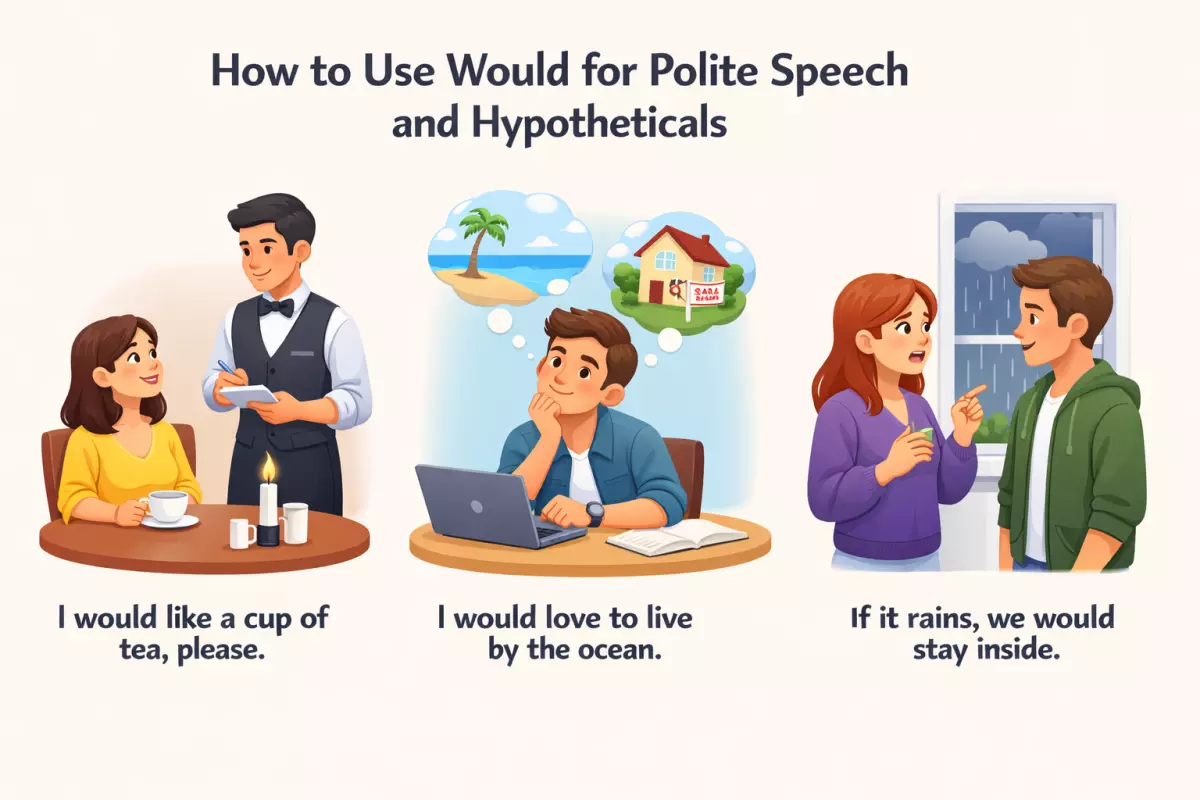 This article shows how would makes requests, offers, invitations, and questions sound more polite in everyday English. It also covers would for hypothetical situations and conditionals, how it differs from will, common mistakes, and practice exercises.
- How 'would' is used to make polite requests and offers
- Using 'would' to talk about imagined or hypothetical situations
- Sentence structures with 'would' in conditional statements
- How 'would' appears in polite invitations and questions
- Examples of 'would' used in everyday spoken English
- Differences between 'would' and 'will' in real communication
- Common learner mistakes when forming sentences with 'would'
- Exercises and practice activities using 'would' in polite and hypothetical contexts
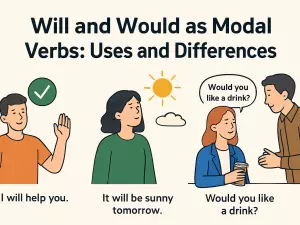
Using would helps you sound polite and talk about unreal or imagined situations, making your English feel more natural. You will hear it in everyday requests, offers, and gentle suggestions, where it softens your tone and shows respect. It also lets you explore different outcomes, such as what you might do if things were different. Here, you will practice using it confidently in real conversations.
How 'would' is used to make polite requests and offers
In everyday English, would helps you sound less direct by framing what you want as a preference, a possibility, or a question about someone’s willingness. This softens the request or offer and makes it feel more considerate, especially with strangers, customers, or colleagues.
Core patterns to learn
- Would you + base verb ...? (polite request)
✅ Would you open the window, please? - Would you mind + -ing ...? (more formal; asks if it bothers them)
✅ Would you mind waiting a moment? - Would it be possible to + base verb ...? (very formal/indirect)
✅ Would it be possible to reschedule? - Would you like + noun / to + verb ...? (offer or invitation)
✅ Would you like some water?
✅ Would you like to join us? - I would like + noun / to + verb ... (polite statement of what you want)
✅ I would like a receipt, please.
✅ I would like to speak to the manager. - Would you be able to + base verb ...? (polite request focusing on ability/availability)
✅ Would you be able to send that today? - Would it help if I + past simple ...? (offer of assistance; “if” clause often uses past for politeness)
✅ Would it help if I called them for you? - Would you prefer + noun / to + verb ...? (offer with choices)
✅ Would you prefer email or a phone call?
Requests: common, natural examples
- Would you pass the salt?
- Would you hold the door for me?
- Would you check this for errors?
- Would you send me the file when you have a moment?
- Would you mind speaking a little more slowly?
- Would you mind if I opened the window? (asking permission for your action)
- Would it be possible to get an extension?
- Would it be okay if we started a bit earlier?
- Would you be able to cover my shift on Friday?
- Would you happen to know where the station is? (extra softening)
- Would you please sign here? (polite but can sound firm in some contexts)
- Would you give me a hand with this box?
Offers and invitations: common, natural examples
- Would you like a seat?
- Would you like some coffee or tea?
- Would you like me to email you the details?
- Would you like to take a look first?
- Would you like help with your bags?
- Would you like to come in and wait?
- Would you like another copy?
- Would you like to schedule a follow-up call?
- Would you like me to explain that again?
- Would you like to leave a message?
Meaning and form notes that prevent mistakes
- Use the base verb after “would you”:
✅ Would you call me later? ❌ Would you to call me later? - “Would you mind” takes -ing:
✅ Would you mind closing the door? ❌ Would you mind close the door? - Answering “Would you mind...?”: “No” means it’s not a problem.
✅ Would you mind waiting? — No, not at all. - Past forms can add distance and politeness:
Would you mind if I sat here? (polite)
Would it be okay if we moved the meeting? - “Would like” is a polite preference, not a past habit:
✅ I would like a refund. (polite request)
Past habit is usually: “used to” or “would” with a time context (different meaning).
Using 'would' to talk about imagined or hypothetical situations
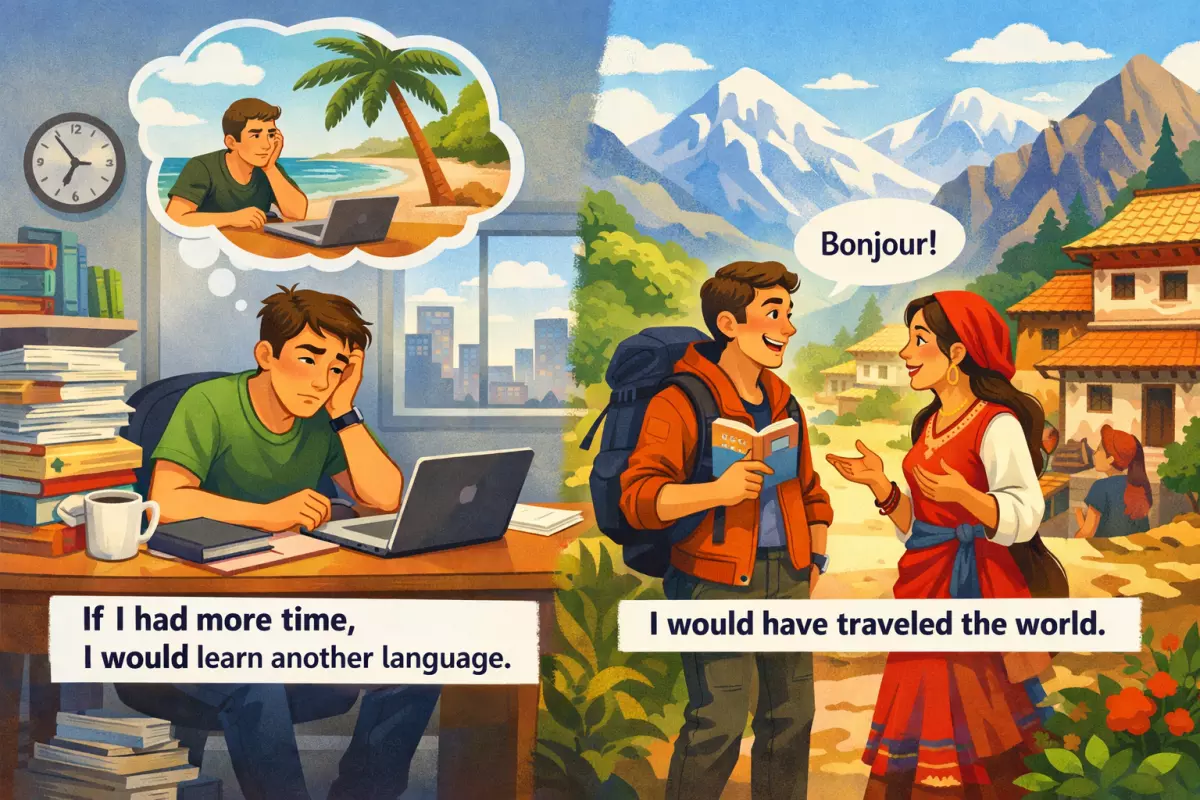
Use would when you describe situations that are not real now, are uncertain, or exist only in the speaker’s mind. It commonly appears in conditional sentences, after verbs that introduce an unreal idea, and in statements about what someone would do in a different world.
Core patterns
- Second conditional (present/future unreal): If + past simple → would + base verb
Example: If I had more time, I would learn another language. - Third conditional (past unreal): If + past perfect → would have + past participle
Example: If we had left earlier, we would have caught the train. - Mixed conditional (past cause, present result): If + past perfect → would + base verb
Example: If I had studied medicine, I would work in a hospital now. - “Would” after verbs that signal an unreal idea: wish / if only / would rather / it’s time (often with past forms)
Example: I’d rather you didn’t tell anyone. - Imagined preference or choice: would + rather/sooner
Example: I would rather stay home than go out. - Hypothetical opinion or evaluation: I would say / I would think / It would be
Example: It would be a mistake to ignore the warning signs. - Conditional offer/plan in an unreal scenario: I would + verb (implied “if…”)
Example: I would help, but I’m not in town this week.
Form choices that matter
- Use the base verb after would: ✅ I would go. ❌ I would to go.
- Use “would have” for unreal past results: ✅ I would have called. ❌ I would called.
- “If” clause usually avoids “would”: ✅ If I knew, I would tell you. ❌ If I would know, I would tell you.
(Exception: “if you would…” can express willingness/politeness, not a standard unreal condition.) - Choose “were” for formal unreal statements: If I were you, I would apologize. (Common in advice.)
- Contracted forms are normal in speech: I’d (= I would) / you’d / we’d / they’d.
- Negative and questions: wouldn’t + base verb; Would + subject + base verb?
Example: Would you take the job if the pay were higher?
Example sentences (varied, ready to copy)
- If I lived closer, I would visit more often.
- If she had the number, she would call you.
- If we had known about the delay, we would have taken a different route.
- I would buy that jacket if it weren’t so expensive.
- Would you still move abroad if your friends stayed here?
- I wouldn’t worry about it if I were in your position.
- If they offered me the role, I would accept.
- If you had told me earlier, I would have prepared.
- I would rather wait than rush a decision.
- He would rather you didn’t mention it at the meeting.
- It would be easier if the instructions were clearer.
- I would consider a smaller apartment if it had more light.
- If the weather had improved, we would have gone hiking.
- I would have agreed, but I didn’t understand the terms.
- If I were to change careers, I would choose something creative.
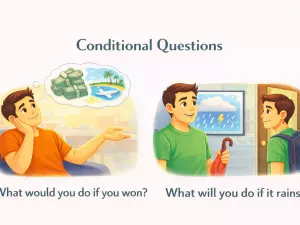
- What would you do if you lost your phone today?
Sentence structures with 'would' in conditional statements
In conditional sentences, would commonly appears in the result clause to express an imagined outcome, a polite offer, or a prediction based on a hypothetical situation. The if-clause usually sets the condition, while the main clause shows what is expected, desired, or possible under that condition.
Core patterns (form and meaning)
- Second conditional (present/future unreal):
if + past simple, ... would + base verb
Example: If I had more time, I would learn another language. - Third conditional (past unreal):
if + past perfect, ... would have + past participle
Example: If she had left earlier, she would have caught the train. - Mixed conditional (past condition, present result):
if + past perfect, ... would + base verb
Example: If I had studied medicine, I would work in a hospital now. - Mixed conditional (present condition, past result):
if + past simple, ... would have + past participle
Example: If he were more careful, he would have avoided that mistake.
Common sentence structures and variations
- Order can change: Would-clause + if-clause (comma usually not needed).
Example: I would call you if I had your number. - Use a comma when the if-clause comes first:
Example: If it stopped raining, we would go for a walk. - Negative result clause: would not / wouldn’t + base verb.
Example: If I knew the answer, I wouldn’t hesitate. - Negative if-clause: if + did not / didn’t + base verb.
Example: If we didn’t have a deadline, I would take more time. - Questions with would: Would + subject + base verb ... if ... ?
Example: Would you accept the offer if they raised the salary? - Polite requests with if: Would you ... if you could ... ?
Example: Would you email me the file if you have a moment? - “If I were you” advice: If I were you, I would ...
Example: If I were you, I would talk to your manager first. - “If it were not for” (imagined exception):
Example: If it weren’t for traffic, I would arrive on time. - “If it hadn’t been for” (past exception):
Example: If it hadn’t been for your help, I would have failed. - Reduced meaning with “even if” (condition doesn’t change the result):
Example: Even if they apologized, I would still be upset. - “Only if” (strong condition):
Example: I would sign the contract only if the terms were clearer. - Using “unless” (except if): ... would ... unless ...
Example: I would go, unless I had to work late. - Modal variation in the if-clause (ability/permission): if + could/might + base verb, ... would ...
Example: If I could take Friday off, I would visit my parents. - Result clause with “would” + adverbs for certainty: probably/definitely/never.
Example: If you asked her directly, she would probably agree.
Accuracy notes: what to avoid
- ❌ If I would have time, I would help. → ✅ If I had time, I would help.
- ❌ If she would study more, she would pass. → ✅ If she studied more, she would pass.
- ✅ Using would in the if-clause is possible when it means willingness or repeated behavior (not a standard condition):
Example: If you would wait here, I’ll check the schedule.
As a practical rule, place would in the main clause to show the imagined result, and choose the if-clause tense (past simple, past perfect, or a modal like could) to match whether the situation is unreal in the present, unreal in the past, or a mix of both.
How 'would' appears in polite invitations and questions
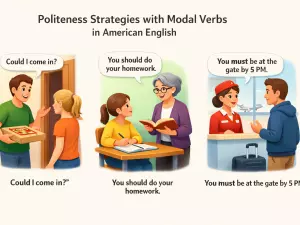
In invitations and requests, would softens the tone by making the question sound less direct. It often signals respect, distance, or tentativeness, especially with strangers, customers, teachers, or in workplace situations. The most common patterns use would with verbs like like, mind, prefer, and with question forms such as Would you...? or Would it be possible...?
Core patterns you’ll see
- Would you like + noun / to + verb? (invitation or offer): “Would you like some tea?” / “Would you like to join us?”
- Would you + base verb...? (polite request): “Would you open the window?”
- Would you mind + -ing...? (very common polite request): “Would you mind waiting a moment?”
- Would it be possible to + verb...? (formal request): “Would it be possible to reschedule?”
- Would there be any chance...? (cautious request): “Would there be any chance of a refund?”
- Would you happen to + verb...? (extra soft, indirect): “Would you happen to know her email?”
- Would you be able to + verb...? (focus on ability/availability): “Would you be able to send it today?”
- Would you prefer + noun / to + verb...? (polite choice): “Would you prefer a morning appointment?”
- Would it be OK if + past simple...? (asking permission politely): “Would it be OK if I left early?”
- Would you like me to + verb...? (offer help): “Would you like me to carry that?”
Useful examples (invitations, offers, and service language)
- “Would you like to come over for dinner on Friday?”
- “Would you like a seat?”
- “Would you like me to explain it again?”
- “Would you like to leave a message?”
- “Would you like to try another size?”
- “Would you like some time to think about it?”
- “Would you like to meet at 3 or 4?”
- “Would you prefer email or a phone call?”
- “Would you like anything else?”
- “Would you like the receipt?”
- “Would you like us to hold the reservation?”
- “Would you like to take a look at the menu?”
Polite question forms and common replies
- ✅ “Would you help me for a minute?” → “Sure.” / “Of course.” / “I’d be happy to.”
- ✅ “Would you mind closing the door?” → “Not at all.” / “No, of course not.” (meaning: I will do it)
- ✅ “Would it be possible to extend the deadline?” → “Yes, that should be fine.” / “I’m afraid not.”
- ✅ “Would you be able to meet tomorrow?” → “Yes, I can.” / “I’m not sure I can.”
- ✅ “Would it be OK if I used your phone?” → “Yes, go ahead.” / “Sorry, I’d rather you didn’t.”
Common learner pitfalls to avoid
- Don’t confuse Would you mind...? answers: “Not at all” means yes, I will do it; “Yes” can sound like refusal or confusion.
- Use the correct verb form after patterns: Would you mind + -ing (not “to + verb”).
- Keep the request realistic: would is polite, but it doesn’t automatically make an unreasonable request acceptable.
- Avoid stacking too many softeners in one sentence in everyday speech; one polite pattern is usually enough.
Examples of 'would' used in everyday spoken English
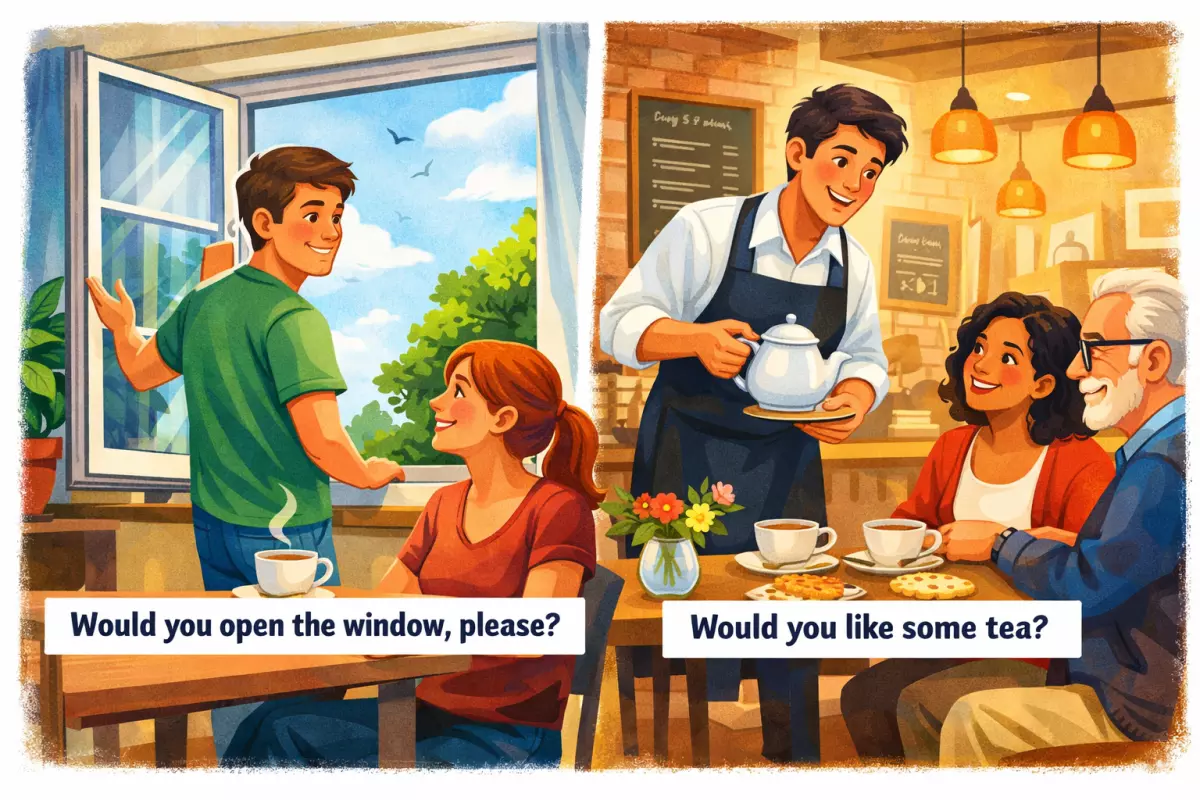
In conversation, would often signals politeness, softens requests, or talks about unreal or uncertain situations. The patterns below show common ways speakers use it in real-life interactions, with short notes to highlight the grammar and meaning.
Polite requests and offers
- Would you open the window, please? (polite request)
- Would you mind waiting a moment? (extra-soft request; verb + -ing)
- Would you like some tea? (offer)
- Would you like to sit here? (offer + to-infinitive)
- Would it be possible to reschedule? (formal, indirect request)
- Would there be any chance you could email me the file? (very indirect; common in workplaces)
Polite preferences and choices
- I'd like a coffee, please. (common ordering; I’d = I would)
- I'd rather walk than take a taxi. (preference; rather + base verb)
- We'd prefer to meet tomorrow. (preference; prefer + to-infinitive)
- Which one would you choose? (asking for preference)
Hypotheticals and imagined results
- If I had more time, I would travel more. (second conditional: unreal present)
- If we left now, we would arrive before noon. (imagined result)
- I would help, but I’m working today. (willingness limited by a reason)
- It would be easier if you wrote it down. (suggesting a better situation)
- That would be great. (accepting an offer politely)
Advice, suggestions, and soft opinions
- I would talk to your manager first. (gentle advice)
- I wouldn’t worry too much about it. (soft reassurance)
- I would say it’s about 20 minutes away. (careful estimate/opinion)
- I wouldn’t call it a mistake, exactly. (softening disagreement)
Past habits (common in storytelling)
- When we were kids, we would play outside until dark. (repeated past action)
- On Sundays, my dad would make pancakes. (habitual routine in the past)
- Every summer, they would visit their grandparents. (regular past pattern)
- ✅ We would go there every weekend. → repeated action
❌ We would live there for five years. → states usually use used to instead
In fast speech, contractions are frequent: I’d, you’d, we’d. In questions and requests, the most common frames are Would you...?, Would you mind...?, and Would you like...?, which keep the tone respectful without sounding overly formal.
Differences between 'would' and 'will' in real communication
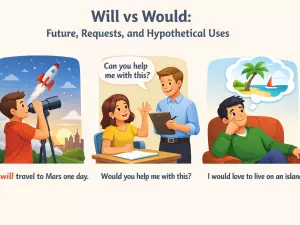
In everyday English, these two modal verbs often point to different levels of certainty, time reference, and social tone. Choosing one over the other changes whether you sound like you are stating a plan, making a prediction, offering something politely, or talking about an imagined situation.
| Use in communication | Typical meaning with will | Typical meaning with would | Example pair (natural contrast) |
|---|---|---|---|
| Decision / intention (now) | Firm decision or promise | More tentative or conditional-sounding intention | “I’ll call you tonight.” / “I’d call you tonight, but I’m on a late shift.” |
| Prediction | Speaker expects it to happen | Prediction viewed from a past point, or less certain | “It will rain later.” / “I thought it would rain.” |
| Polite request | Can sound direct, especially with “you” | Standard choice for softer, more respectful requests | “Will you open the window?” / “Would you open the window?” |
| Offers and invitations | Neutral offer; can feel brisk | More considerate; gives the listener more space to refuse | “Will you have some tea?” / “Would you like some tea?” |
| Hypotheticals (if-situations) | Unusual in the result clause for unreal situations | Main form for imagined results | ✅ “If I had time, I would help.” ❌ “If I had time, I will help.” |
| Conditionals (real possibility) | Common when the condition is realistic and future | Can appear when the speaker is being cautious or indirect | “If it rains, we’ll stay in.” / “If it rained, we’d stay in.” |
| Reported speech (backshift) | Original words about the future | Future seen from the past in reporting | Direct: “I will call.” → Reported: “He said he would call.” |
| Habit in the past | Not used for past habits | Repeated past behavior (often in storytelling) | “When we were kids, we would play outside until dark.” |
Practical patterns that signal the difference
- Would + like/love/prefer is a common politeness formula: “Would you like a receipt?” “I’d prefer an aisle seat.”
- Will + you can be a request, but often feels more insistent: “Will you stop that?” (can sound like a command).
- Would often implies “if…” even when the condition is not spoken: “I’d help, but I’m busy.” (= if I weren’t busy).
- Will is typical for confident commitments: “I’ll send it by 5.”
- Would is typical for careful commitments: “I’d be happy to send it by 5, if that works.”
- Would is common in service language to reduce pressure: “Would you like to pay by card or cash?”
- Will is common for immediate decisions: “Okay, I’ll take it.”
- Would fits imagined outcomes and advice: “I would wait another day.”
- Will fits strong expectations: “That will be expensive.”
- Would fits “future in the past”: “I knew it would be difficult.”
- Would is frequent with hedging words (probably, maybe): “It would probably help to restart.”
- Will is frequent with certainty markers (definitely, for sure): “It will definitely work.”
Common learner traps (and how to fix them)
- Using will in unreal conditionals: ❌ “If I were you, I will…” → ✅ “If I were you, I would…”
- Overusing would for simple future plans: “I would go tomorrow” can sound conditional; for a straightforward plan, prefer “I will go tomorrow” or “I’m going tomorrow.”
- Using would to mean “want” in a direct way: “I would a coffee” ❌ → “I’d like a coffee” ✅
- Confusing past habit would with a one-time past action: “Yesterday I would go to the store” ❌ (use past simple: “Yesterday I went…”).
Common learner mistakes when forming sentences with 'would'
Many errors with would come from mixing up time (past vs. hypothetical), choosing the wrong verb form after it, or using it where English prefers a different structure (like will, used to, or the past simple). The patterns below highlight the most frequent problems and how to fix them.
1) Using the wrong verb form after would
- ❌ “I would to go.” → ✅ “I would go.” (would + base verb)
- ❌ “She would goes later.” → ✅ “She would go later.”
- ❌ “They would went if they had time.” → ✅ “They would go if they had time.”
- ❌ “He would can help.” → ✅ “He would be able to help.” (don’t stack modals)
2) Mixing up would and will (hypothetical vs. real future)
- Use will for a likely/real future: ✅ “I will call you tomorrow.”
- Use would for imagined/conditional situations: ✅ “I would call you if I had your number.”
- ❌ “If I will have time, I will go.” → ✅ “If I have time, I will go.” (first conditional)
- ❌ “If I would have time, I would go.” → ✅ “If I had time, I would go.” (second conditional)
3) Incorrect conditional structures (especially the “if” clause)
- ❌ “If I would know, I would tell you.” → ✅ “If I knew, I would tell you.”
- ❌ “If she would come earlier, we could start.” → ✅ “If she came earlier, we could start.”
- Exception (acceptable): using would in an if-clause to show willingness/insistence: ✅ “If you would listen for a moment, I can explain.”
- ❌ “If they had left earlier, they would arrive on time.” → ✅ “If they had left earlier, they would have arrived on time.” (third conditional)
4) Confusing would with used to for past habits
- Use would for repeated past actions (often with a time marker): ✅ “When we were kids, we would play outside every day.”
- Don’t use would for past states (being, having, liking): ❌ “I would be shy.” → ✅ “I used to be shy.”
- ❌ “She would have long hair.” → ✅ “She used to have long hair.”
5) Overusing would in polite requests (or making them too indirect)
- Natural request patterns: ✅ “Would you open the window?” / “Would you mind opening the window?”
- ❌ “Would you like to open the window?” (this asks about desire, not a request to do it)
- ❌ “I would like that you send me the file.” → ✅ “I’d like you to send me the file.” / “I’d like to ask you to send me the file.”
- ❌ “Would you please to help me?” → ✅ “Would you please help me?”
6) Problems with contraction and word order in questions
- Standard question order: ✅ “Would you help me?” (Would + subject + base verb)
- ❌ “You would help me?” → ✅ “Would you help me?” (unless using surprised echo-question intonation)
- Contractions are common in speech: ✅ “I’d like…” / “I’d rather…” / “I’d better…”
- Avoid confusing I’d (= I would / I had): context must make it clear, e.g., ✅ “I’d go if I could” vs. ✅ “I’d finished by noon.”
7) Using would where English prefers could or might
- Use could for ability/possibility: ✅ “I could help tomorrow.”
- Use might for uncertainty: ✅ “I might be late.”
- ❌ “I would be late (maybe).” → ✅ “I might be late.”
- ❌ “Would you be able to…” is fine, but don’t use it when you mean “maybe”: choose might instead.
8) Confusing would rather / had better patterns
- ✅ “I’d rather stay home.” (rather + base verb)
- ❌ “I’d rather to stay home.” → ✅ “I’d rather stay home.”
- ✅ “You’d better leave now.” (better + base verb)
- ❌ “You’d better to leave now.” → ✅ “You’d better leave now.”
Exercises and practice activities using 'would' in polite and hypothetical contexts
Use the tasks below to build accuracy with common patterns: polite requests and offers, preferences, and unreal or imagined situations. Focus on form (would + base verb) and on choosing the right structure for the meaning you want.
1) Choose the best option (polite requests, offers, and preferences)
- _____ you mind closing the window, please? (Would / Will)
- I _____ like a glass of water, if that’s okay. (would / will)
- _____ you like some help with those bags? (Would / Do)
- What _____ you recommend for a first-time visitor? (would / do)
- I _____ rather sit near the aisle. (would / will)
- _____ it be possible to reschedule the meeting? (Would / Is)
- Would you _____ sending me the file by noon? (mind / like)
- Thanks—_____ you be able to check this quickly? (would / are)
- She said she _____ call me later. (would / will)
- We _____ appreciate your feedback. (would / do)
Show answers
- Would
- would
- Would
- would
- would
- Would
- mind
- would
- would
- would
2) Rewrite to make it more polite (keep the meaning)
- Send me the report today.
- Can you move your bag?
- I want to speak to the manager.
- Tell me your decision by Friday.
- Give me a minute.
- Do you have time to review this?
- I don’t agree with that.
- Can I open the window?
Show answers
- Would you send me the report today, please?
- Would you mind moving your bag?
- I would like to speak to the manager, please.
- Would you let me know your decision by Friday?
- Would you give me a minute, please?
- Would you have time to review this?
- I wouldn’t agree with that.
- Would it be okay if I opened the window?
3) Complete the sentence (hypotheticals and unreal situations)
- If I had more time, I _____ learn another language.
- If we left earlier, we _____ avoid the traffic.
- I _____ help you if I could.
- If she knew the answer, she _____ tell you.
- What _____ you do if you won the lottery?
- If it weren’t raining, we _____ eat outside.
- I _____ be happier if I worked fewer hours.
- If they offered you the job, _____ you take it?
- He _____ travel more if he didn’t have so many meetings.
- If you were in my position, what _____ you say?
Show answers
- would
- would
- would
- would
- would
- would
- would
- would
- would
- would
4) Spot and fix the error (form and pattern accuracy)
- ❌ Would you like that you sit here?
- ❌ If I would have money, I would buy a new phone.
- ❌ Would you mind to open the door?
- ❌ I would like that you can help me.
- ❌ Would you to send me the details?
- ❌ If she would study more, she would pass.
- ❌ I would rather to stay home.
- ❌ Would you like some advice? Yes, I would like.
Show answers
- ✅ Would you like to sit here?
- ✅ If I had money, I would buy a new phone.
- ✅ Would you mind opening the door?
- ✅ I would like you to help me.
- ✅ Would you send me the details?
- ✅ If she studied more, she would pass.
- ✅ I would rather stay home.
- ✅ Would you like some advice? Yes, please. / Yes, I’d like some.
5) Guided speaking or writing prompts (use at least 2 “would” forms each)
- Make three requests in a workplace setting (include one with “Would you mind + -ing”).
- Offer help to a guest in your home using “Would you like…?” and “Would you like me to…?”
- Describe your ideal weekend using “I’d rather…,” “I’d like to…,” and one conditional sentence.
- Explain what you would do if you lost your phone in a foreign city (use 3 steps with “would”).
- Write a short, polite complaint (3–5 sentences) using “I would appreciate…,” “Would it be possible…,” and one softener like “a bit” or “perhaps.”
- Compare two options (two restaurants, two jobs, two courses) and state what you would choose and why.
- Role-play: ask for an extension on a deadline; include a reason and a proposed new date.
- Practice indirect questions: “What would you recommend…?” “Where would you suggest…?” “When would be a good time…?”
- Turn direct negatives into softer ones (e.g., “That’s wrong” → “I wouldn’t say that…”).
- Create five “If I were…, I would…” sentences about your goals for the next year.