How to Use Modal Verbs in Negative English Sentences

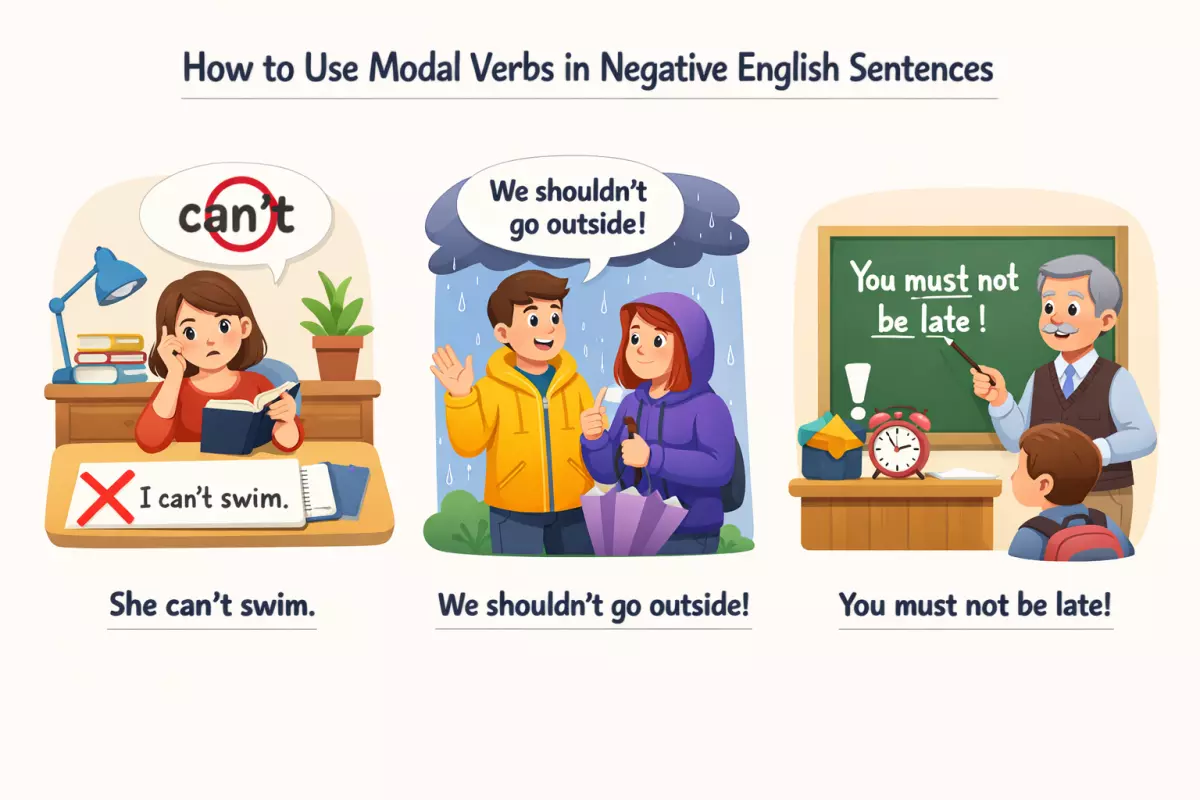 Learn how to make modal verbs negative with not and short forms like can’t, won’t, shouldn’t, and mustn’t, and how these negatives change meaning in real speech. It also explains must not vs do not have to, highlights common learner mistakes, and includes exercises on prohibition and lack of obligation.
- How modal verbs create negative sentences with 'not'
- Short negative forms such as can't, won't, shouldn't, and mustn't
- How negative modal verbs change the meaning of a statement
- The difference between must not and do not have to
- Examples of negative modal verbs used in natural speech
- Common learner mistakes when forming modal negatives
- Situations where negative modals express prohibition or lack of obligation
- Exercises and practice activities with negative modal verb forms
Making a clear negative with can, must, should, or might can feel oddly tricky, but it gets easier with a few rules. These modal verbs shape both meaning and tone, from polite refusal to firm prohibition or simple uncertainty. Learn where to place not, when contractions sound natural, and how to avoid common mix-ups so your sentences stay clear and confident.
How modal verbs create negative sentences with 'not'
To make a negative sentence with a modal verb, place not directly after the modal and before the base form of the main verb. This creates a clear pattern that stays the same across subjects (I/you/he/we/they) and keeps the main verb in its bare infinitive form (no -s, no -ed, no to).
Core word order
- Pattern: Subject + modal + not + base verb (+ rest of sentence)
- Base verb rule: the verb after the modal stays in the base form: go, eat, be, have, do (not goes or to go)
- No extra auxiliary: you do not add do/does/did with modals (❌ He doesn’t can swim.)
- Contractions: in everyday writing and speech, modal + not is often contracted (see examples below)
Common negative forms and examples
- cannot / can’t + base verb: I can’t attend the meeting.
- may not + base verb (often formal/permission): You may not park here.
- might not + base verb (uncertainty): She might not agree.
- must not / mustn’t + base verb (prohibition): You mustn’t touch the wires.
- should not / shouldn’t + base verb (advice): We shouldn’t rush the decision.
- ought not + to + base verb (less common): They ought not to ignore the warning.
- will not / won’t + base verb (future refusal/negative prediction): It won’t take long.
- would not / wouldn’t + base verb (past habit/refusal or conditional): He wouldn’t apologize.
- shall not / shan’t + base verb (rare in many varieties): I shan’t be late.
- could not / couldn’t + base verb (past ability/possibility): We couldn’t find the address.
- need not / needn’t + base verb (no necessity): You needn’t bring anything.
- dare not / daren’t + base verb (rare, formal/literary): I daren’t ask.
Typical mistakes to avoid
- Using to after a modal: ❌ She can’t to drive. → ✅ She can’t drive.
- Adding verb endings after a modal: ❌ He might not goes. → ✅ He might not go.
- Mixing do support with a modal: ❌ They don’t should leave. → ✅ They shouldn’t leave.
- Confusing mustn’t with don’t have to: mustn’t means “not allowed,” while don’t have to means “not necessary.”
Short negative forms such as can't, won't, shouldn't, and mustn't
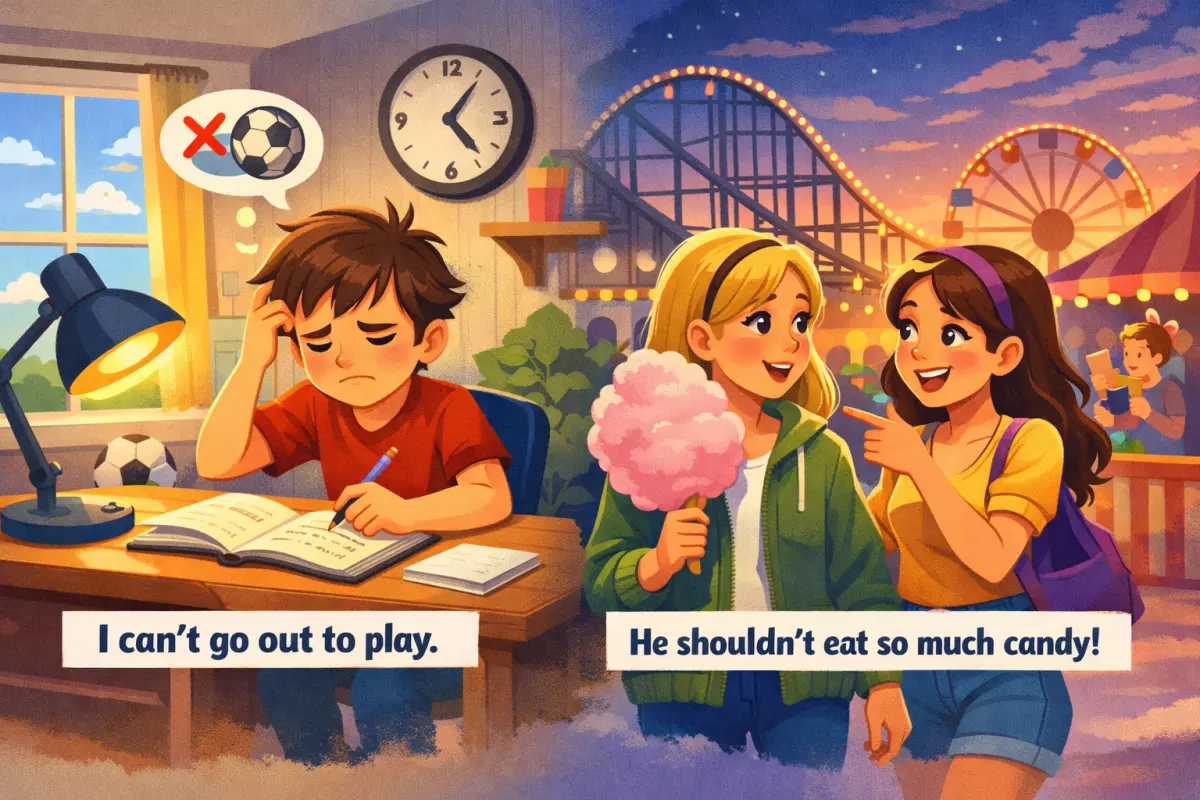
In everyday English, negative modal verbs are usually contracted in speech and informal writing. These contracted forms follow fixed patterns, and some of them have special spelling or pronunciation that learners often mix up.
How contractions are formed
Most negative modal contractions are made by adding n't to the modal. The modal itself does not change for the subject (I/you/he/we/they), and the main verb after the modal stays in the base form.
- Pattern: subject + modal + n’t + base verb
- Example: She can’t come today. (not “comes”)
- Example: They shouldn’t drive in this weather.
Common short negative forms and typical uses
- can’t = “cannot”; used for inability or impossibility: I can’t hear you.
- won’t = “will not”; used for refusal or strong prediction: He won’t apologize.
- shouldn’t = “should not”; used for advice against something: You shouldn’t skip breakfast.
- mustn’t = “must not”; used for prohibition (not lack of necessity): You mustn’t park here.
- couldn’t = “could not”; past inability or impossibility: We couldn’t find the address.
- wouldn’t = “would not”; refusal in the past or hypothetical negative: The car wouldn’t start.
- mightn’t (more common in British English) = “might not”; weak possibility: She mightn’t agree.
- needn’t (BrE) = “need not”; no necessity: You needn’t wait for me.
- shan’t (rare, BrE) = “shall not”; formal/old-fashioned: I shan’t be long.
- oughtn’t (rare) = “ought not”; advice against: You oughtn’t to speak like that.
Spelling and form points that cause mistakes
- ✅ won’t is irregular (not “willn’t”).
- ✅ can’t comes from cannot (one word), though “can not” can appear when stressing the choice: You can not go if you prefer.
- ❌ Avoid double negatives with modals in standard English: ❌ I can’t do nothing. → ✅ I can’t do anything.
- ✅ After a negative modal, use the base verb: He shouldn’t say that. (not “says/said”)
- ✅ With oughtn’t, “to” is common: You oughtn’t to worry.
Meaning contrasts to keep clear
- mustn’t = “it is forbidden”: You mustn’t enter this area.
- don’t have to / needn’t = “it is not necessary”: You don’t have to bring anything.
- can’t often signals logical impossibility: That can’t be true.
- won’t often signals unwillingness: She won’t talk to him.
In formal writing, the full forms (cannot, will not, should not, must not) are often preferred. In neutral or informal contexts, the contracted negatives sound more natural and are the default choice.
How negative modal verbs change the meaning of a statement
Adding not to a modal verb does more than make a sentence negative. It can change the strength of the message (from advice to prohibition), shift the speaker’s certainty, or create a different implication about ability, permission, or obligation. The exact meaning depends on which modal you choose and whether the negative attaches to the modal or to another part of the clause.
Common meaning shifts with negative modals
- must not (mustn’t) → prohibition (not allowed).
Example: You mustn’t park here. - don’t have to → no obligation (optional), not prohibition.
Example: You don’t have to come early. - can’t → impossibility or strong certainty that something is untrue.
Example: That can’t be the right address. - may not → not permitted (formal) or possibly not (rare, context-dependent).
Example: Visitors may not enter this area. - might not → weak possibility that something won’t happen / isn’t true.
Example: She might not answer today. - shouldn’t → advice against; expectation that something is not the case.
Example: You shouldn’t skip meals. - ought not to → formal advice against (less common than shouldn’t).
Example: You ought not to share passwords. - won’t → refusal or predicted non-occurrence (future negative).
Example: The door won’t open. - wouldn’t → refusal in the past / hypothetical negative; also “used to” meaning (past habit) in context.
Example: He wouldn’t apologize. - needn’t → unnecessary (often British English), similar to “don’t need to.”
Example: You needn’t wait for me. - couldn’t → past inability or impossibility; also a polite softener in some contexts.
Example: I couldn’t find the file. - shall not (shan’t) → formal rule or strong determination (varies by dialect; shan’t is rare in many varieties).
Example: Employees shall not disclose client data.
Patterns that often confuse learners
- “mustn’t” vs. “don’t have to”
✅ You mustn’t use your phone in the lab. (forbidden)
✅ You don’t have to wear a tie. (optional)
❌ You mustn’t wear a tie. (means “it’s forbidden,” not “it’s optional”) - “can’t” vs. “may not”
Use can’t for inability/impossibility: I can’t log in.
Use may not for rules/permission (more formal): You may not record this meeting. - “might not” vs. “can’t” (certainty level)
might not = uncertain: He might not know.
can’t = near-certain conclusion: He can’t know (he wasn’t there). - Negative with “have to” uses do-support
Present: I don’t have to go.
Past: I didn’t have to go.
Avoid: ❌ I haven’t to go. (not standard in modern English)
Where the negative goes: modal negation vs. clause negation
- Modal + not usually negates the modal meaning (ability/permission/obligation):
I can’t swim. (no ability) - Not + main verb phrase can change the focus, especially with “not necessarily,” “not always,” or emphasis:
You may not agree. (possible you won’t agree)
You may not agree. (often read the same, but can emphasize the disagreement as the point) - Not both can create a different logic (partial negation):
You don’t have to answer every question. (no obligation for all)
You have to not answer every question. (awkward; suggests an obligation to avoid answering all)
In practice, choosing the right negative modal is about matching the intended force: prohibition (mustn’t), lack of necessity (don’t have to/needn’t), uncertainty (might not), or strong logical conclusion (can’t). Being precise with these forms helps the listener understand whether something is forbidden, optional, unlikely, or impossible.
The difference between must not and do not have to
Must not expresses prohibition: something is not allowed. Do not have to expresses lack of necessity: something is optional, so there is no obligation. Mixing them up can change the meaning from “forbidden” to “not required.”
| Form | Core meaning | Typical context | Example |
|---|---|---|---|
| must not / mustn’t + base verb | Prohibited; not permitted | Rules, safety, strong instructions | You mustn’t park here. |
| don’t/doesn’t have to + base verb | Not necessary; no obligation | Options, relaxed requirements, convenience | You don’t have to come early. |
| don’t/doesn’t need to + base verb | Not necessary (often more informal) | Practical advice, everyday speech | You don’t need to bring anything. |
| needn’t + base verb | Not necessary (more formal BrE) | Notices, formal instructions | You needn’t sign the form. |
Common patterns and quick checks
- Rule test: If breaking it causes trouble (a fine, danger, or a clear rule violation), use must not.
- Choice test: If you can do it, but it’s optional, use do not have to.
- Structure: Both are followed by the base verb (no to after must not; but have to already includes to).
- Strength: mustn’t sounds strong and strict; don’t have to sounds neutral.
- Time: For past time, use didn’t have to (not mustn’t): “We didn’t have to pay.”
- Meaning trap: “You mustn’t go” = you are not allowed to go. “You don’t have to go” = you can go, but you’re not required to.
Examples in realistic situations
- You mustn’t touch the wires. → It’s dangerous/forbidden.
- You don’t have to wait outside. → It isn’t necessary.
- Passengers must not open the door while the train is moving.
- You don’t have to print the ticket; a digital copy is fine.
- Students mustn’t use phones during the exam.
- You don’t have to answer every question; choose five.
- You mustn’t share your password with anyone.
- You don’t have to share your phone number if you don’t want to.
- Visitors mustn’t feed the animals.
- You don’t have to book in advance, but it helps.
- You mustn’t drive without a license.
- You don’t have to drive; we can take the bus.
- You mustn’t interrupt when someone is speaking.
- You don’t have to agree with me; it’s your decision.
- Employees must not enter this area without protective gear.
- You don’t have to wear formal clothes; it’s casual.
Frequent learner mistakes (and fixes)
- ❌ You mustn’t submit the form today. (sounds like “forbidden”)
✅ You don’t have to submit the form today. (not required) - ❌ You don’t have to smoke here. (sounds like “optional”)
✅ You mustn’t smoke here. (not allowed) - ❌ Yesterday we mustn’t pay. (wrong for “not necessary”)
✅ Yesterday we didn’t have to pay. - ❌ You must not to enter. (wrong form)
✅ You must not enter.
Examples of negative modal verbs used in natural speech
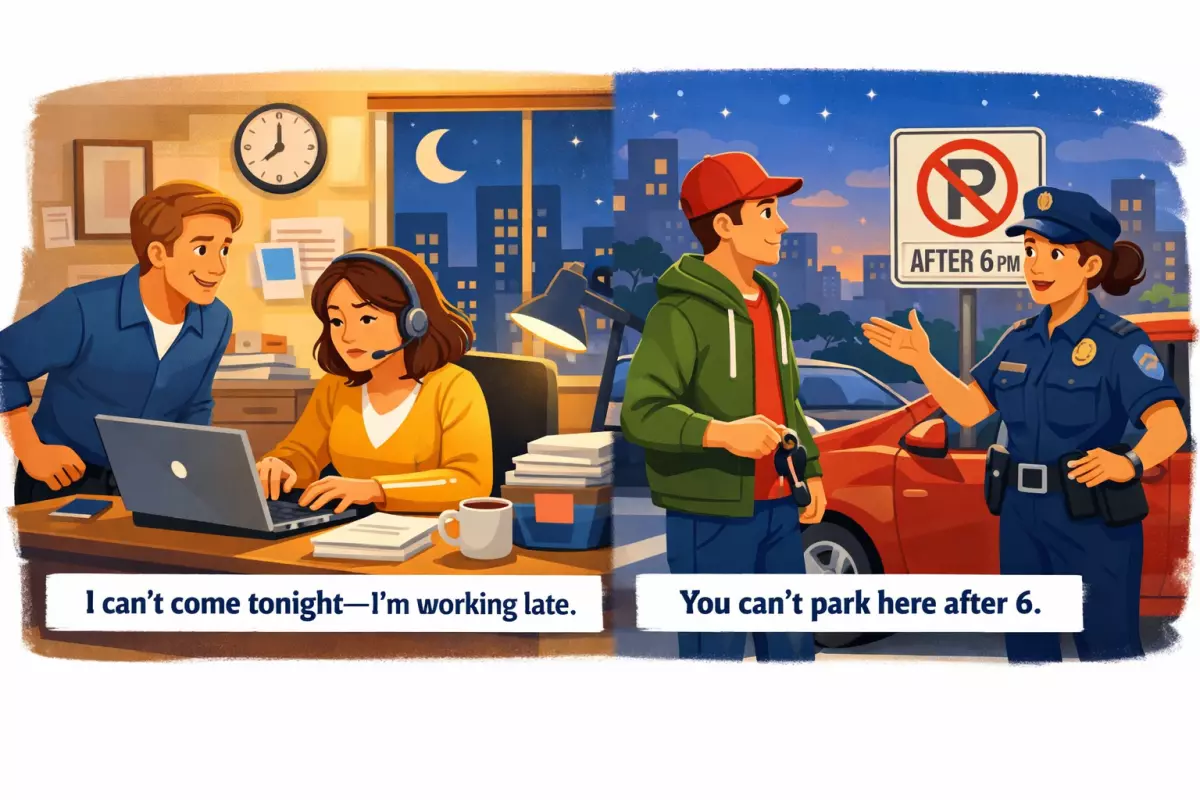
In everyday English, negative modals often soften a refusal, express uncertainty, or set a rule. You’ll hear full forms (cannot, should not) in careful speech, and contractions (can’t, shouldn’t) in relaxed conversation. The patterns below show what native speakers typically do with meaning and tone.
Common patterns with natural-sounding examples
- Can’t for inability or a practical barrier: “I can’t come tonight—I’m working late.”
- Can’t for “not allowed” (informal): “You can’t park here after 6.”
- Can’t for strong disbelief: “That can’t be right—check the numbers again.”
- Couldn’t for past inability: “I couldn’t find the email anywhere.”
- Couldn’t for polite refusal/limitation: “I couldn’t possibly take your seat.”
- May not for permission (more formal): “You may not use phones during the exam.”
- Might not for uncertainty: “I might not make it by eight—traffic’s bad.”
- Mustn’t for strict prohibition: “You mustn’t touch that—it’s hot.”
- Must not for rules in writing/announcements: “Visitors must not enter this area.”
- Shouldn’t for advice (gentle): “You shouldn’t skip breakfast if you’re training.”
- Shouldn’t for expectation not met: “It shouldn’t take this long to load.”
- Ought not to for moral/social advice (less common): “You ought not to talk about people like that.”
- Don’t have to for “no necessity” (not prohibition): “You don’t have to pay now—later is fine.”
- Can’t have + past participle for a strong conclusion about the past: “She can’t have said that—she wasn’t there.”
- Shouldn’t have + past participle for regret/criticism: “I shouldn’t have sent that message so quickly.”
- Wouldn’t for refusal (people/things): “The car wouldn’t start this morning.”
- Wouldn’t for unwillingness: “He wouldn’t apologize, even after the meeting.”
- Won’t for a firm decision: “I won’t sign it until I read everything.”
Quick usage notes learners often miss
- “Mustn’t” vs. “don’t have to”: “You mustn’t leave” = it’s forbidden. “You don’t have to leave” = it’s optional.
- “Can’t” vs. “may not”: “Can’t” is common in speech for both inability and informal rules; “may not” sounds more official and is clearer for permission.
- Contractions are the default in conversation: “I can’t,” “we shouldn’t,” “he won’t” sound natural; full forms can sound emphatic or formal.
- Modal + not stays together: ✅ “She might not come.” ❌ “She not might come.”
Common learner mistakes when forming modal negatives
Most errors with negative modal sentences come from mixing patterns: learners combine auxiliary “do,” change the modal’s form, or place “not” in the wrong position. The key rule to remember is simple: a modal stays the same, and not comes right after it.
Frequent pattern errors (and how to fix them)
- Adding “do/does/did” with a modal
❌ She doesn’t can drive. → ✅ She can’t drive.
❌ They didn’t must leave. → ✅ They didn’t have to leave. (different structure) - Putting “not” after the main verb instead of after the modal
❌ You can go not. → ✅ You can’t go.
❌ He should tell not her. → ✅ He shouldn’t tell her. - Changing the modal to a third-person form
Modals do not take -s.
❌ He cans’t swim. → ✅ He can’t swim.
❌ She musts not be late. → ✅ She must not be late. - Using the wrong negative form for “must”
“Mustn’t” usually means prohibition (not allowed), not “not necessary.”
❌ You mustn’t come early. (if you mean “it’s not necessary”) → ✅ You don’t have to come early.
✅ You mustn’t smoke here. (prohibited) - Confusing “can’t” and “mustn’t”
“Can’t” often expresses impossibility; “mustn’t” expresses prohibition.
✅ It can’t be true. (impossible)
✅ You mustn’t park here. (not allowed) - Using “mayn’t” in modern English
“Mayn’t” exists but is rare in most varieties. Prefer “may not” or “might not.”
✅ She may not agree.
✅ They might not arrive today. - Overusing contractions where they sound too informal
Contractions are common in speech, but in formal writing “cannot / should not / will not” may fit better.
✅ We cannot accept the proposal. (formal)
✅ We can’t accept it. (neutral/informal) - Mixing “won’t” and “don’t”
“Won’t” is “will not” (future refusal/prediction); “don’t” is present simple negative.
❌ I don’t go tomorrow. → ✅ I won’t go tomorrow.
❌ He won’t like coffee. (if you mean a general fact) → ✅ He doesn’t like coffee. - Using “couldn’t” when you mean “can’t” (or the reverse)
“Couldn’t” is often past ability or a more tentative present meaning; context decides.
✅ I couldn’t swim when I was five. (past ability)
✅ I can’t hear you. (present situation) - Forgetting that “need” and “dare” behave differently
As modals (less common), they can take “not” without “do,” especially in formal British English; as main verbs, they usually use “do.”
✅ You needn’t worry. (modal-like, BrE/formal)
✅ You don’t need to worry. (common standard)
✅ He daren’t say anything. / He doesn’t dare to say anything. - Negating the wrong part of the meaning
Sometimes the grammar is correct but the meaning is not what the speaker intends.
✅ You can’t be late. (not possible / not allowed, depending on context)
✅ You may not be late. (often “not allowed” in rules; can sound formal/ambiguous) - Using double negatives unintentionally
Standard English typically uses one negative marker for the clause.
❌ You can’t do nothing. → ✅ You can’t do anything.
❌ She shouldn’t not call. (unless you mean “she should call”) → ✅ She shouldn’t call.
Quick check: the reliable negative modal pattern
- Structure: modal + not + base verb (or contraction) → “cannot/can’t go,” “should not/shouldn’t go,” “might not go.”
- No “to” after most modals: ❌ can’t to go → ✅ can’t go (exception: “ought not to”).
- Keep the modal unchanged for all subjects: I/you/he/she/it/we/they + can’t/shouldn’t/might not.
Situations where negative modals express prohibition or lack of obligation
Negative modal verbs can either block an action (a rule or strong instruction) or remove a duty (saying something is optional). The key is to notice whether the speaker is stopping you from doing something, or simply saying you don’t need to do it.
Prohibition: stopping an action
Use these patterns when the meaning is “this is not allowed” or “do not do this.” The strength ranges from strict rules to strong advice, depending on the modal and context.
- must not + base verb: strongest prohibition (rules, safety, law). Example: “You must not enter this area.”
- can’t + base verb: not permitted (often rules or practical restrictions). Example: “You can’t park here.”
- may not + base verb: formal permission denied (not allowed). Example: “Visitors may not take photos.”
- shouldn’t + base verb: strong advice against an action (not a rule, but discouraged). Example: “You shouldn’t share your password.”
- ought not to + base verb: similar to “shouldn’t,” more formal. Example: “You ought not to speak during the test.”
- cannot + base verb (one word): same meaning as “can’t,” often in formal writing. Example: “Employees cannot disclose client data.”
- mustn’t + base verb: common contraction of “must not” in British English. Example: “You mustn’t touch the equipment.”
- may not be allowed to + base verb: softer, policy-based prohibition (often conditional). Example: “You may not be allowed to bring liquids onboard.”
- can’t ever/anymore + base verb: prohibition linked to a change in rules or status. Example: “You can’t use this entrance anymore.”
- be not to + base verb (formal instructions): official prohibition. Example: “Staff are not to discuss the incident.”
Lack of obligation: removing a duty
Use these patterns when the meaning is “this is not necessary.” This is different from prohibition: the action is allowed, but it isn’t required.
- don’t have to + base verb: not necessary (common, neutral). Example: “You don’t have to attend the meeting.”
- doesn’t have to + base verb: third-person singular. Example: “She doesn’t have to pay today.”
- didn’t have to + base verb: past lack of necessity (often implies it wasn’t needed; it may or may not have happened). Example: “We didn’t have to wait long.”
- don’t need to + base verb: not necessary, often more immediate/practical. Example: “You don’t need to print the form.”
- doesn’t need to + base verb: third-person singular. Example: “It doesn’t need to be perfect.”
- needn’t + base verb: same meaning as “don’t need to,” more common in British English. Example: “You needn’t worry.”
- need not + base verb: more formal version of “needn’t.” Example: “Applicants need not submit references.”
- won’t have to + base verb: future lack of necessity. Example: “You won’t have to redo the work.”
- aren’t required to + base verb: formal “no obligation.” Example: “Students aren’t required to buy the textbook.”
- not obliged to + base verb: formal/legal tone. Example: “You’re not obliged to answer.”
Common confusion to avoid
- mustn’t means prohibition, not “no need.” ✅ “You mustn’t smoke here.” ❌ “You mustn’t come early (meaning ‘you don’t need to’).”
- don’t have to means no obligation, not “not allowed.” ✅ “You don’t have to come.” (optional) ❌ “You don’t have to park here.” (sounds like permission, but the intended meaning is usually “You can’t park here.”)
- can’t can mean “not allowed” or “not possible.” Context decides. Example (rule): “You can’t bring food inside.” Example (ability): “I can’t lift this.”
- may not can mean “not allowed” or “possibly not.” For clarity, use “might not” for possibility. ✅ “You may not enter.” (permission) ✅ “It might not work.” (possibility)
Exercises and practice activities with negative modal verb forms
Build accuracy with negative modals by practicing three things: (1) the word order (modal + not + base verb), (2) the meaning difference between similar forms (for example, mustn’t vs. don’t have to), and (3) the most natural contractions in everyday English.
1) Quick pattern check (spot the correct form)
- Choose the correct sentence: (A) She can’t to drive at night. (B) She can’t drive at night.
- Choose the correct sentence: (A) You mustn’t park here. (B) You don’t must park here.
- Choose the correct sentence: (A) He shouldn’t say that. (B) He shouldn’t to say that.
- Choose the correct sentence: (A) We won’t be late. (B) We don’t will be late.
- Choose the correct sentence: (A) I can not hear you. (B) I cannot hear you.
- Choose the correct sentence: (A) They mightn’t come. (B) They might not to come.
- Choose the correct sentence: (A) You needn’t wait. (B) You needn’t to wait.
- Choose the correct sentence: (A) She must not be at home. (B) She doesn’t must be at home.
Show answers
- B
- A
- A
- A
- B (also acceptable: “can not” is possible, but “cannot” is the standard spelling for inability)
- A
- A
- A
2) Meaning choice: prohibition vs. no obligation vs. deduction
Select the option that matches the meaning in parentheses.
- You _______ smoke here. (It is forbidden.)
(A) mustn’t (B) don’t have to - You _______ bring cash; they accept cards. (It isn’t necessary.)
(A) mustn’t (B) don’t have to - He _______ be the manager; he looks too young. (Negative deduction/assumption.)
(A) can’t (B) mustn’t - We _______ leave yet; the meeting ends at 5. (Not necessary now.)
(A) don’t have to (B) can’t - She _______ be serious. (Strong disbelief.)
(A) can’t (B) may not - They _______ know the answer; they haven’t studied. (Possible that they do not know.)
(A) might not (B) can’t - You _______ tell anyone; it’s confidential. (Prohibition.)
(A) mustn’t (B) needn’t - I _______ remember his name. (Inability right now.)
(A) can’t (B) don’t have to
Show answers
- A
- B
- A
- A
- A
- A
- A
- A
3) Rewrite practice (make each sentence negative with a modal)
Rewrite each sentence using the modal in brackets. Keep the meaning as close as possible.
- It is necessary for you to wear a helmet. (must) → make it negative to show “not allowed to ride without one.”
- It is possible that she will arrive today. (may) → make it negative.
- I am able to finish tonight. (can) → make it negative.
- It is a good idea for him to skip breakfast. (should) → make it negative.
- It is not necessary to print the ticket. (need) → use a negative modal form.
- I am certain they are at home. (can’t) → change it to a negative deduction: “I’m sure they are not at home.”
- It is possible we will miss the train. (might) → make it negative.
- We are willing to help. (will) → make it negative.
- It is required that visitors sign in. (have to) → make it negative to show “not required.”
- It is permitted to take photos. (can) → make it negative.
Show answers
- You mustn’t ride without a helmet. / You must wear a helmet (and you mustn’t ride without one).
- She may not arrive today.
- I can’t finish tonight.
- He shouldn’t skip breakfast.
- You needn’t print the ticket. / You don’t need to print the ticket.
- They can’t be at home.
- We might not miss the train.
- We won’t help. / We will not help.
- Visitors don’t have to sign in.
- You can’t take photos. / You cannot take photos.
4) Contraction drill (choose the most natural negative form)
For each item, write the version you would say in conversation. Focus on common contractions and natural rhythm.
- I (will not) be late.
- She (cannot) come tonight.
- They (should not) talk during the test.
- We (must not) touch the exhibits.
- He (might not) agree.
- You (do not have to) pay today.
- I (would not) do that again.
- It (may not) work on older phones.
Show answers
- I won’t be late.
- She can’t come tonight.
- They shouldn’t talk during the test.
- We mustn’t touch the exhibits.
- He might not agree. (also possible: “mightn’t,” but it is less common in many varieties)
- You don’t have to pay today.
- I wouldn’t do that again.
- It may not work on older phones.
5) Error correction (fix the negative modal pattern)
Correct each sentence. Keep the same modal meaning.
- She doesn’t can swim.
- You mustn’t to enter after 10.
- He can’t to understand the instructions.
- We don’t should argue about it.
- I didn’t can find my keys.
- They won’t to answer my emails.
- You don’t must show your ID.
- She might not to come tomorrow.
Show answers
- She can’t swim.
- You mustn’t enter after 10.
- He can’t understand the instructions.
- We shouldn’t argue about it.
- I couldn’t find my keys.
- They won’t answer my emails.
- You don’t have to show your ID. (If the meaning is “not required.”)
- She might not come tomorrow.
- Usage reminder: after a modal, use the base verb (no to): ✅ “can’t go” ❌ “can’t to go”.
- Meaning reminder: mustn’t = prohibition; don’t have to / needn’t = no obligation; can’t often signals strong negative deduction (“That can’t be true”).
- Form reminder: for past inability, use couldn’t (not “didn’t can”).