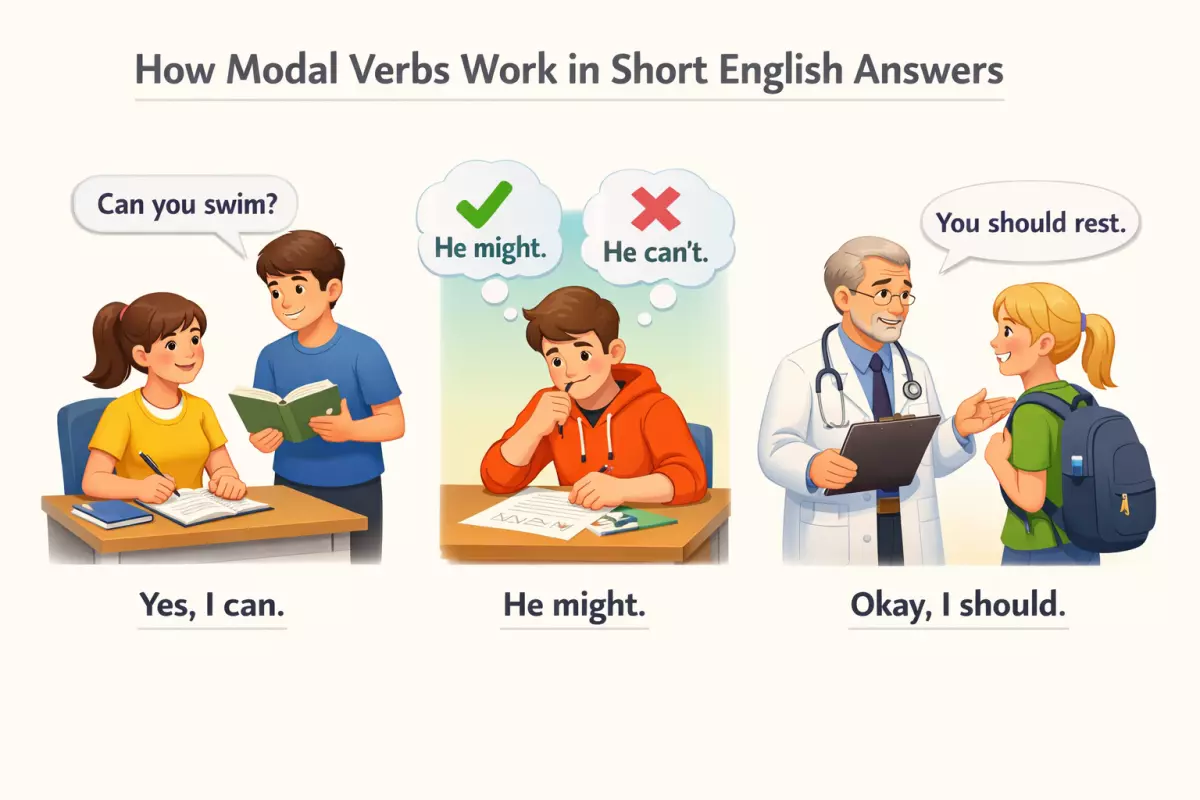
How Modal Verbs Work in Short English Answers

 This article explains what short answers are and why English uses them, how modal verbs shape yes/no replies, and how to form affirmative and negative short answers with common contractions. You’ll see everyday examples, when to use them, common learner errors, plus exercises to practice.
- What short answers are and why English uses them in conversation
- How modal verbs appear in short answers to questions
- Affirmative short answers built with modal verbs
- Negative short answers and their common contractions
- Examples of modal short answers in everyday dialogue
- Situations where speakers prefer short answers instead of full sentences
- Typical learner errors when forming short modal answers
- Exercises and practice tasks using modal verbs in short answers
Modal verbs shape many quick English replies, helping you sound natural and confident. Rather than full sentences, you can respond with a modal plus a subject, and the meaning remains clear, showing permission, ability, advice, or certainty. When you rely on context to fill in what is unsaid, these short answers become easy to understand and use.
What short answers are and why English uses them in conversation
In everyday English, speakers often reply with a compact “auxiliary + subject” (and sometimes a negative) instead of repeating the whole sentence. These replies confirm, deny, or qualify what was just said, while keeping the same tense and modal meaning as the question or statement.
What counts as a short answer
A short answer usually reuses the same helping verb from the question (or the statement you’re responding to). With modal verbs, that means repeating the modal rather than adding do.
- Yes/No + modal + subject: “Yes, I can.” / “No, she won’t.”
- Modal + subject (when “yes/no” is understood): “I can.” / “She won’t.”
- Negative short answers: “No, I can’t.” / “No, they shouldn’t.”
- Tag-like confirmations in response to statements: “You can drive.” → “Yes, I can.”
Why English relies on them
- Efficiency: They avoid repeating information that is already clear from context.
- Clarity about grammar: The auxiliary (including a modal) signals tense, polarity (positive/negative), and meaning.
- Natural conversation rhythm: Quick confirmations and denials keep dialogue moving.
- Focus: They highlight agreement/disagreement rather than the full content.
- Politeness and softening: Short replies can sound less blunt than repeating a full negative sentence.
Core pattern to notice with modals
When a question uses a modal, the short answer repeats that same modal. It does not switch to a different auxiliary.
- ✅ “Can you swim?” → “Yes, I can.” / “No, I can’t.”
- ❌ “Can you swim?” → “Yes, I do.”
- ✅ “Should we leave?” → “Yes, we should.” / “No, we shouldn’t.”
- ❌ “Should we leave?” → “Yes, we do.”
Common short-answer frames you’ll hear
- “Yes, I can.” / “No, I can’t.”
- “Yes, you could.” / “No, you couldn’t.”
- “Yes, he will.” / “No, he won’t.”
- “Yes, she would.” / “No, she wouldn’t.”
- “Yes, we should.” / “No, we shouldn’t.”
- “Yes, they must.” / “No, they mustn’t.”
- “Yes, I may.” / “No, you may not.”
- “Yes, it might.” / “No, it might not.”
- “Yes, I shall.” / “No, I shan’t.” (less common, more British)
- “Yes, I need to.” / “No, I don’t need to.” (semi-modal behavior)
- “Yes, I have to.” / “No, I don’t have to.” (meaning differs from “mustn’t”)
- “Yes, I ought to.” / “No, I ought not to.” (formal/less frequent)
Because these replies echo the auxiliary, they act like a grammatical “pointer” back to the original sentence. That echo is what makes short answers both fast and precise in spoken English.
How modal verbs appear in short answers to questions
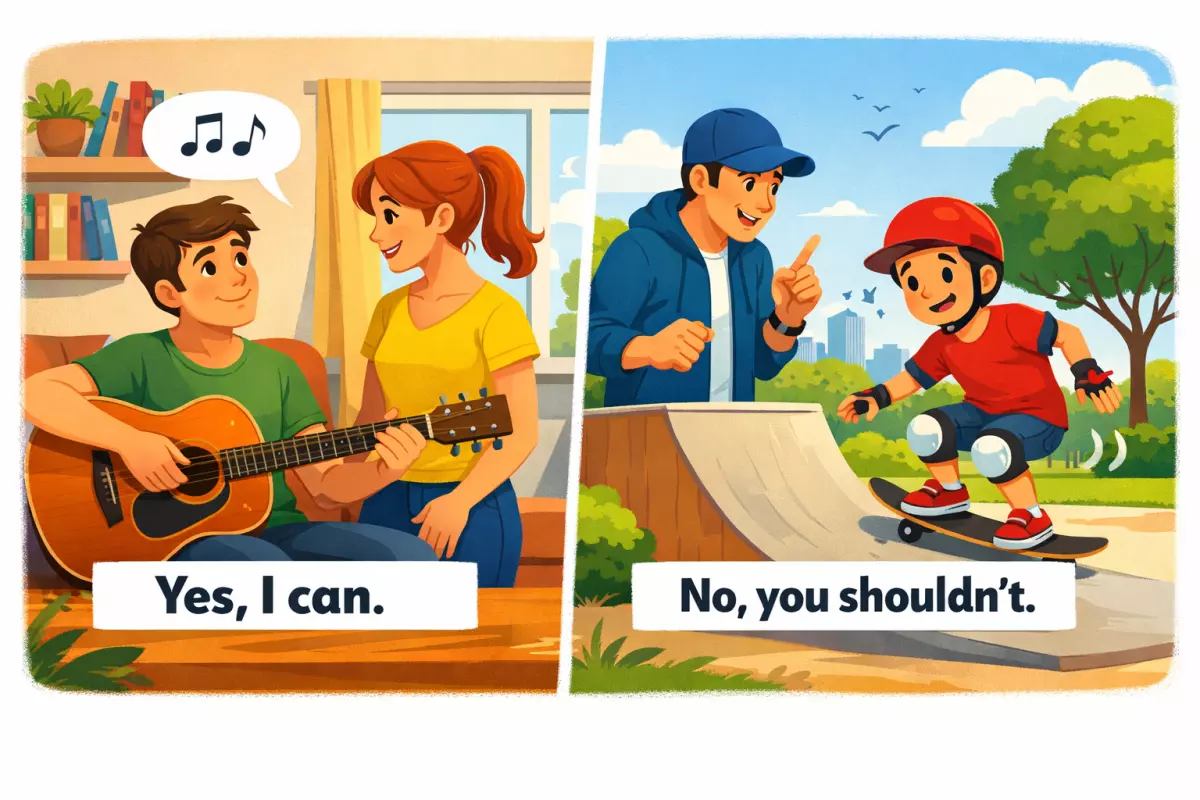
In brief replies to yes/no questions, English usually keeps the same modal verb from the question and adds a short subject + (optional) not. The main verb is normally omitted because the modal already carries the meaning (ability, permission, obligation, possibility, etc.).
Core pattern
- Positive: Yes, + subject + modal. (No main verb)
- Negative: No, + subject + modal + not. (Often contracted)
- Match the modal: If the question uses can, the short answer uses can/can’t; if it uses should, the short answer uses should/shouldn’t, and so on.
- Use the same subject reference: I/you/he/she/we/they (or a name/noun) should match the person being asked about.
Common short-answer models (with examples)
- Can you swim? → Yes, I can. / No, I can’t.
- Could she join us? → Yes, she could. / No, she couldn’t.
- May I open the window? → Yes, you may. / No, you may not.
- Might they be late? → Yes, they might. / No, they might not.
- Should we call him? → Yes, we should. / No, we shouldn’t.
- Must I pay today? → Yes, you must. / No, you mustn’t.
- Will you help me? → Yes, I will. / No, I won’t.
- Would he like some tea? → Yes, he would. / No, he wouldn’t.
- Shall we start now? → Yes, we shall. / No, we shan’t.
- Can Maria drive? → Yes, she can. / No, she can’t.
- Could your parents come? → Yes, they could. / No, they couldn’t.
- Should this be reported? → Yes, it should. / No, it shouldn’t.
- Will the meeting end soon? → Yes, it will. / No, it won’t.
- Would that be a problem? → Yes, it would. / No, it wouldn’t.
Important usage notes
- Contractions are common in negatives: can’t, couldn’t, shouldn’t, won’t, wouldn’t, mightn’t (some are less common in modern use).
- Watch meaning changes with “must”: No, you mustn’t means prohibition (not “not necessary”). For “not necessary,” English often answers with No, you don’t have to or No, you needn’t (where need acts like a modal).
- “May not” vs “might not”: may not can mean “not allowed” or “possibly not,” depending on context; might not is typically only possibility.
- Keep the auxiliary only: ✅ Yes, I can. ❌ Yes, I can swim. (The longer form is possible, but it is not the typical short answer.)
- Use “Yes/No” or skip them: In informal speech, people often answer with just I can / I can’t, especially when the context is clear.
Affirmative short answers built with modal verbs
Positive short replies with modals follow a tight pattern: Yes + subject pronoun + modal. They repeat the same modal from the question and avoid adding extra verbs like do or be unless those were in the question.
Core pattern and word order
- Form: Yes + subject + modal. (Example: “Can you swim?” → “Yes, I can.”)
- Use the same modal: “Should we leave?” → “Yes, we should.” (Not “Yes, we can.”)
- No main verb after the modal: “Yes, I can.” (Not “Yes, I can swim.” in a short answer)
- No auxiliary swap: If the question uses a modal, the answer uses a modal—not do/does/did. ❌ “Can she drive?” → “Yes, she does.”
- Pronoun choice: Use the pronoun that matches the subject in the question: “Will Anna come?” → “Yes, she will.”
- Contracted yes is common in speech: “Yes, I will” is standard; “Yeah, I will” is informal; keep “Yes” for neutral/formal writing.
Common affirmative short-answer models (with examples)
- “Can you help me?” → “Yes, I can.”
- “Could he join us?” → “Yes, he could.”
- “May I open the window?” → “Yes, you may.”
- “Might they be late?” → “Yes, they might.”
- “Should we call her?” → “Yes, we should.”
- “Must I sign this?” → “Yes, you must.”
- “Will you be there?” → “Yes, I will.”
- “Would she like some tea?” → “Yes, she would.”
- “Shall I start now?” → “Yes, you shall.” (More formal/rare; often replaced by “Yes, please.” in real life)
- “Can Tom and I sit here?” → “Yes, you can.” (Answer matches the person addressed: “you”)
- “Could you possibly email it today?” → “Yes, I could.” (Polite possibility; often followed by a fuller sentence if needed)
- “Shouldn’t we check first?” → “Yes, we should.” (Answering the underlying suggestion, not copying the negative form)
Questions with modals + “be” or “have”
- Modal + be: “Will she be ready soon?” → “Yes, she will.” (Not “Yes, she will be.” in a short reply)
- Modal + have: “Should I have called earlier?” → “Yes, you should.”
- Progressive/passive stays unspoken: “Can it be fixed today?” → “Yes, it can.”
Typical learner mistakes to avoid
- ✅ “May I come in?” → “Yes, you may.” → ❌ “Yes, you do.”
- ✅ “Will they arrive on time?” → “Yes, they will.” → ❌ “Yes, they do.”
- ✅ “Should I apologize?” → “Yes, you should.” → ❌ “Yes, you should do.”
- ✅ “Can she speak French?” → “Yes, she can.” → ❌ “Yes, she cans.”
Negative short answers and their common contractions
In short replies, English usually forms the negative by pairing the modal (or auxiliary) with not, often as a contraction. The typical pattern is: modal + not (or modal + n’t) plus an optional short complement when needed for clarity.
Core patterns to follow
- Use the same modal from the question: “Can you…?” → “No, I can’t.” (not “No, I don’t.”)
- Prefer contractions in everyday speech: “No, I can’t.” sounds more natural than “No, I cannot.” in most casual contexts.
- Keep the subject consistent: “Will she…?” → “No, she won’t.”
- Don’t add extra verbs: ❌ “No, I can’t do.” → ✅ “No, I can’t.” / “No, I can’t do it.”
- Use a full form for emphasis or formality: “No, I cannot.” / “No, we will not.” (common in careful writing or strong contrast)
- Match tense and meaning: “Could you…?” often expects “No, I couldn’t.” (past ability or polite distance), not “can’t,” unless you’re switching meaning intentionally.
Common negative short-answer forms (modal/auxiliary + contraction)
| Question uses | Typical negative short answer | Notes on usage |
|---|---|---|
| can | No, I can’t. / No, he can’t. | “Can’t” is the usual spoken form; “cannot” is more formal or emphatic. |
| could | No, I couldn’t. | Common for past ability or polite requests; keep “could” if that’s the frame. |
| will | No, I won’t. | “Won’t” is the standard contraction (not “willn’t”). |
| would | No, I wouldn’t. | Often used for refusals, hypotheticals, or polite offers/requests. |
| shall | No, I shan’t. / No, we shan’t. | More common in British English; “shall not” is also used, especially in formal contexts. |
| should | No, you shouldn’t. | Typical for advice/expectations; can sound firm, so context matters. |
| must | No, you mustn’t. / No, you don’t have to. | “Mustn’t” = prohibition. “Don’t have to” = no necessity (different meaning). |
| may | No, you may not. | Negative permission is usually not contracted; “mayn’t” is rare. |
| might | No, I might not. | Contraction “mightn’t” exists but is less common; full form is often clearer. |
| have to | No, I don’t have to. / No, she doesn’t have to. | Uses do-support (not a modal), but it behaves similarly in short answers. |
| be (am/is/are) | No, I’m not. / No, she isn’t. / No, they aren’t. | Very frequent in short replies; “ain’t” is informal/nonstandard in many settings. |
| do/does | No, I don’t. / No, he doesn’t. | Used when the main verb isn’t a modal: “Do you like…?” → “No, I don’t.” |
| did | No, I didn’t. | Past simple questions without modals: “Did they call?” → “No, they didn’t.” |
| have/has (perfect) | No, I haven’t. / No, she hasn’t. | Present perfect short answers commonly use these contractions. |
| had (perfect) | No, I hadn’t. | Past perfect short answers; common in narratives and reported sequences. |
Quick correctness checks (common learner slips)
- ✅ “Can you swim?” → “No, I can’t.” → ❌ “No, I don’t can.”
- ✅ “Will they come?” → “No, they won’t.” → ❌ “No, they willn’t.”
- ✅ “Must I pay today?” → “No, you don’t have to.” (no necessity) → “No, you mustn’t.” (prohibition; different meaning)
- ✅ “May I leave early?” → “No, you may not.” (often formal) → “No, you mayn’t.” (rare)
- ✅ “Is she ready?” → “No, she isn’t.” / “No, she’s not.” (both fine; choose by rhythm and emphasis)
Examples of modal short answers in everyday dialogue

Short replies with modal verbs usually follow a simple pattern: modal + subject pronoun (or modal + not + pronoun for a negative). The modal repeats the meaning of the question, and the rest of the verb phrase is understood from context.
Common patterns to notice
- Yes/No + modal + pronoun: “Yes, I can.” / “No, she won’t.”
- Negative short answers use contraction or not: “No, I can’t.” / “No, I cannot.”
- Match the tense and modal from the question: “Could you…?” → “Yes, I could.”
- Keep the same subject as the answer’s speaker: “Can you…?” → “Yes, I can.” (not “Yes, you can.” unless you are granting permission)
- Avoid mixing modals: ❌ “Yes, I will” to “Can you…?” (unless you deliberately change meaning)
Everyday mini-dialogues (question → short answer)
- “Can you drive?” → “Yes, I can.” / “No, I can’t.”
- “Could you help me for a minute?” → “Yes, I could.” (ability) / “Sorry, I couldn’t.”
- “May I sit here?” → “Yes, you may.” / “No, you may not.”
- “Can I leave early today?” → “Yes, you can.” / “No, you can’t.”
- “Should we call them now?” → “Yes, we should.” / “No, we shouldn’t.”
- “Must I sign this?” → “Yes, you must.” / “No, you don’t have to.”
- “Do I have to attend the meeting?” → “Yes, you do.” / “No, you don’t have to.”
- “Will you be ready by six?” → “Yes, I will.” / “No, I won’t.”
- “Would you like some tea?” → “Yes, I would.” / “No, I wouldn’t.”
- “Shall we start?” → “Yes, we shall.” / “No, we shan’t.”
- “Might it rain later?” → “Yes, it might.” / “No, it might not.”
- “Could he be at home?” → “Yes, he could be.” / “No, he couldn’t be.”
- “Shouldn’t we tell her?” → “Yes, we should.” (agreeing that we should tell her) / “No, we shouldn’t.”
- “Can’t you stay a bit longer?” → “Yes, I can.” (I am able to stay) / “No, I can’t.”
- “Wouldn’t it be easier to email?” → “Yes, it would.” / “No, it wouldn’t.”
- “Mustn’t we be quiet here?” → “Yes, we must.” (we must be quiet) / “No, we needn’t.”
Meaning shifts to watch for
- Ability vs. permission: “Can you park here?” can mean “Are you able?” or “Is it allowed?” The short answer may clarify: “Yes, I can” (ability) vs. “Yes, you can” (permission granted).
- Must vs. have to: In negatives, English often prefers “don’t have to” for “no obligation.” ✅ “No, you don’t have to.” ❌ “No, you mustn’t” (this changes meaning to “it’s forbidden”).
- Polite requests: “Could you…?” and “Would you…?” often get short answers that confirm willingness: “Yes, I could” / “Yes, I would,” though in real conversation people frequently add action: “Sure, I can.”
Situations where speakers prefer short answers instead of full sentences
In everyday conversation, speakers often choose brief replies with a modal (or an auxiliary) because the question already contains most of the meaning. The short answer confirms, denies, or qualifies the idea without repeating the whole clause, and the modal carries the key information about ability, permission, obligation, possibility, or willingness.
Common contexts where short modal answers sound most natural
- Yes/no questions that repeat the same verb phrase: When the question uses a modal, the reply typically echoes that modal. “Can you drive?” → “Yes, I can.” / “No, I can’t.”
- Permission checks: Short replies keep the focus on allowing or refusing. “May I leave early?” → “Yes, you may.” / “No, you may not.”
- Quick confirmations in fast turn-taking: In meetings, classes, and group chats, brevity helps the conversation move. “Should we start now?” → “Yes, we should.”
- Offers and requests: The modal shows willingness or refusal without extra wording. “Could you help me?” → “I could.” (less common) / more natural: “Yes, I can.” or “Sorry, I can’t.”
- Ability and capacity checks: The modal is the only new information needed. “Can it be fixed today?” → “It can.” / “It can’t.”
- Rules, policies, and instructions: Short answers sound firm and procedural. “Must we sign in?” → “Yes, you must.” / “No, you don’t have to.”
- When the speaker wants to avoid repetition for style: Repeating a full sentence can sound heavy. “Will you be there?” → “I will.” (instead of “I will be there.”)
- When the rest of the sentence is obvious from context: The listener can easily supply the missing words. “Should I call them now?” → “You should.”
- When giving a minimal, neutral response: Short answers can be factual and non-committal in tone. “Could it rain later?” → “It could.”
- When disagreeing politely: A short negative can soften the impact compared with a longer explanation. “Might this be the wrong file?” → “It might be.” / “It might not be.”
- When correcting an assumption: The modal alone can correct the key point. “So you can’t attend?” → “I can.”
- When the subject is already established: If “I/you/we/they” is clear, the modal does the work. “Can you?” → “I can.”
- When the speaker is hedging: Modals like might and could allow careful answers. “Is he at home?” → “He might be.”
- When answering repeated questions: In follow-ups, short replies avoid sounding impatient while staying efficient. “Can you send it today?” → “I can.”
Usage patterns to notice (so the short answer stays grammatical)
- Match the modal from the question when possible: “Should we…?” → “Yes, we should.”
- Keep the same subject as the person/thing being discussed: “Can Maria join?” → “Yes, she can.”
- Use the correct negative form: “can’t,” “won’t,” “shouldn’t,” “mustn’t,” “may not.”
- Don’t add “to” after a modal in the short answer: ✅ “Yes, I can.” ❌ “Yes, I can to.”
- For “have to,” short answers use “do”: “Do we have to pay now?” → “Yes, we do.” / “No, we don’t.”
- For “used to,” short answers often use “did”: “Did you use to live here?” → “Yes, I did.” / “No, I didn’t.”
- Avoid “Yes, I’m” as a modal answer when the question is about ability/permission: “Can you come?” → “Yes, I can,” not “Yes, I’m.”
Typical learner errors when forming short modal answers
Short replies with modal verbs follow a small set of patterns, so most mistakes come from adding extra words, choosing the wrong auxiliary, or mixing tenses. The safest approach is: repeat the auxiliary/modal from the question, keep the subject, and avoid adding a full verb unless the structure requires it.
- Using the main verb instead of the modal: ❌ “Yes, I go.” → ✅ “Yes, I can.” (Question: “Can you go?”)
- Adding an extra “to” after a modal: ❌ “Yes, I can to.” → ✅ “Yes, I can.”
- Adding an extra verb after the modal: ❌ “Yes, I can go.” (when a short answer is expected) → ✅ “Yes, I can.”
- Doubling auxiliaries: ❌ “Yes, I do can.” → ✅ “Yes, I can.”
- Using “do/does/did” with a modal question: ❌ “No, I don’t.” (Question: “Should we leave?”) → ✅ “No, we shouldn’t.”
- Wrong negative form or missing contraction rules: ❌ “No, I can’t not.” → ✅ “No, I can’t.” / “No, I cannot.”
- Mixing the subject from the question: ❌ “Yes, you can.” (when answering about yourself) → ✅ “Yes, I can.”
- Answering with the wrong person/number: ❌ “Yes, he can.” (Question: “Can they come?”) → ✅ “Yes, they can.”
- Using the wrong modal because the meaning changed: ❌ “Yes, I must.” (Question: “May I leave?”) → ✅ “Yes, you may.”
- Confusing permission vs. ability in replies: “Can I…?” is often permission; the short answer still repeats can, but learners sometimes switch to “may” mid-answer. Prefer matching the question: “Yes, you can.”
- Forgetting that many modals don’t take “-s”: ❌ “Yes, she cans.” → ✅ “Yes, she can.”
- Using “to” after “must/should/can”: ❌ “No, you mustn’t to.” → ✅ “No, you mustn’t.”
- Wrong tense in the short answer: ❌ “Yes, I can.” (Question: “Could you swim when you were five?”) → ✅ “Yes, I could.”
- Replying to “will/would” with “want”: ❌ “Yes, I want.” (Question: “Would you like some tea?”) → ✅ “Yes, I would.” / more natural: “Yes, please.”
- Using “yes/no” without the auxiliary when it’s needed: In many contexts “Yes.” is acceptable, but in careful practice short answers should include the modal: “Yes, I can.” / “No, we shouldn’t.”
- Incorrect tag-like additions: ❌ “Yes, can.” → ✅ “Yes, I can.” (A subject is normally required.)
- Confusing “need” as a main verb vs. modal-like “needn’t”: ❌ “No, I don’t needn’t.” → ✅ “No, you needn’t.” / “No, you don’t need to.”
Quick pattern reminders to prevent these mistakes
- Match the auxiliary/modal from the question: “Can…?” → “Yes, I can.” / “No, I can’t.”
- Keep it auxiliary + subject (plus “not” for negatives): “Should we…?” → “Yes, we should.” / “No, we shouldn’t.”
- Use the same time reference: “Could… (past ability)?” → “Yes, I could.” not “can.”
Exercises and practice tasks using modal verbs in short answers
Use these tasks to build fast, natural replies with modals. Focus on the pattern Yes/No + subject pronoun + modal (and the negative version), plus choosing the correct pronoun and modal for the meaning.
1) Complete the short answers (choose the correct form)
- A: Can you swim? B: Yes, ______.
- A: Should we call her now? B: No, ______.
- A: May I sit here? B: Yes, ______.
- A: Will they arrive by 6? B: No, ______.
- A: Could he help us tomorrow? B: Yes, ______.
- A: Must I bring my passport? B: Yes, ______.
- A: Might she be late? B: Yes, ______.
- A: Would you like some tea? B: No, ______.
- A: Shall I open the window? B: Yes, ______.
- A: Can Anna and Leo come too? B: No, ______.
- A: Should I apologize? B: Yes, ______.
- A: Will your brother drive? B: Yes, ______.
Show answers
- Yes, I can.
- No, we shouldn’t.
- Yes, you may.
- No, they won’t.
- Yes, he could.
- Yes, you must.
- Yes, she might.
- No, I wouldn’t.
- Yes, you shall.
- No, they can’t.
- Yes, you should.
- Yes, he will.
2) Fix the short answers (common errors)
Rewrite each reply so it follows standard short-answer structure. Keep the meaning the same.
- A: Can he hear us? B: Yes, he can hear.
- A: Will you be there? B: Yes, I’ll.
- A: Should she leave now? B: No, she not should.
- A: May we start? B: Yes, you may do.
- A: Must I pay today? B: No, you mustn’t. (Meaning: payment is not necessary.)
- A: Could they come earlier? B: Yes, they could do.
- A: Might it rain? B: Yes, it might rains.
- A: Would he agree? B: No, he wouldn’t agree. (Make it a short answer.)
Show answers
- Yes, he can.
- Yes, I will.
- No, she shouldn’t.
- Yes, you may.
- No, you don’t have to.
- Yes, they could.
- Yes, it might.
- No, he wouldn’t.
3) Choose the best negative form (can’t / shouldn’t / mustn’t / don’t have to)
Pick the option that matches the meaning in brackets.
- A: Do I have to print the ticket? (not necessary) B: No, you ______.
- A: Can I park here? (forbidden) B: No, you ______.
- A: Should we tell him tonight? (bad idea) B: No, we ______.
- A: Must I share my password? (forbidden) B: No, you ______.
- A: Can she join the meeting? (not possible) B: No, she ______.
- A: Do I have to stay until the end? (not necessary) B: No, you ______.
- A: Should I skip breakfast? (bad idea) B: No, you ______.
- A: Can they enter without ID? (forbidden) B: No, they ______.
Show answers
- don’t have to
- mustn’t
- shouldn’t
- mustn’t
- can’t
- don’t have to
- shouldn’t
- mustn’t
4) Reply naturally: match the question with a short answer
Write a short answer for each question. Use contractions where they sound natural.
- Can you hear me?
- Should I bring anything?
- Will it take long?
- May I use your phone?
- Could we reschedule?
- Might they cancel?
- Must we sign this today?
- Would you help me for a minute?
- Shall we start?
- Can your parents pick you up?
Show answers
- Yes, I can. / No, I can’t.
- Yes, you should. / No, you shouldn’t.
- Yes, it will. / No, it won’t.
- Yes, you may. / No, you may not.
- Yes, we could. / No, we couldn’t.
- Yes, they might. / No, they might not.
- Yes, we must. / No, we don’t have to.
- Yes, I would. / No, I wouldn’t.
- Yes, we shall. / No, we shan’t.
- Yes, they can. / No, they can’t.
5) Pattern checklist (use while you practice)
- Keep it short: repeat only the modal, not the main verb. ✅ “Yes, she can.” ❌ “Yes, she can swim.” (unless you need emphasis).
- Match the subject: “your sister” → “she”; “Tom and I” → “we”; “the kids” → “they”.
- Use the right negative for meaning: “not necessary” → “don’t have to”; “not allowed” → “mustn’t”.
- Use common contractions in speech: can’t, won’t, shouldn’t, wouldn’t, couldn’t.
- For may, “mayn’t” is rare; prefer “may not” in negatives.
- For shall, short answers exist but are less common in modern everyday English; “should” or “will” often replaces it depending on context.