How to Express Obligation and Rules Using Modal Verbs

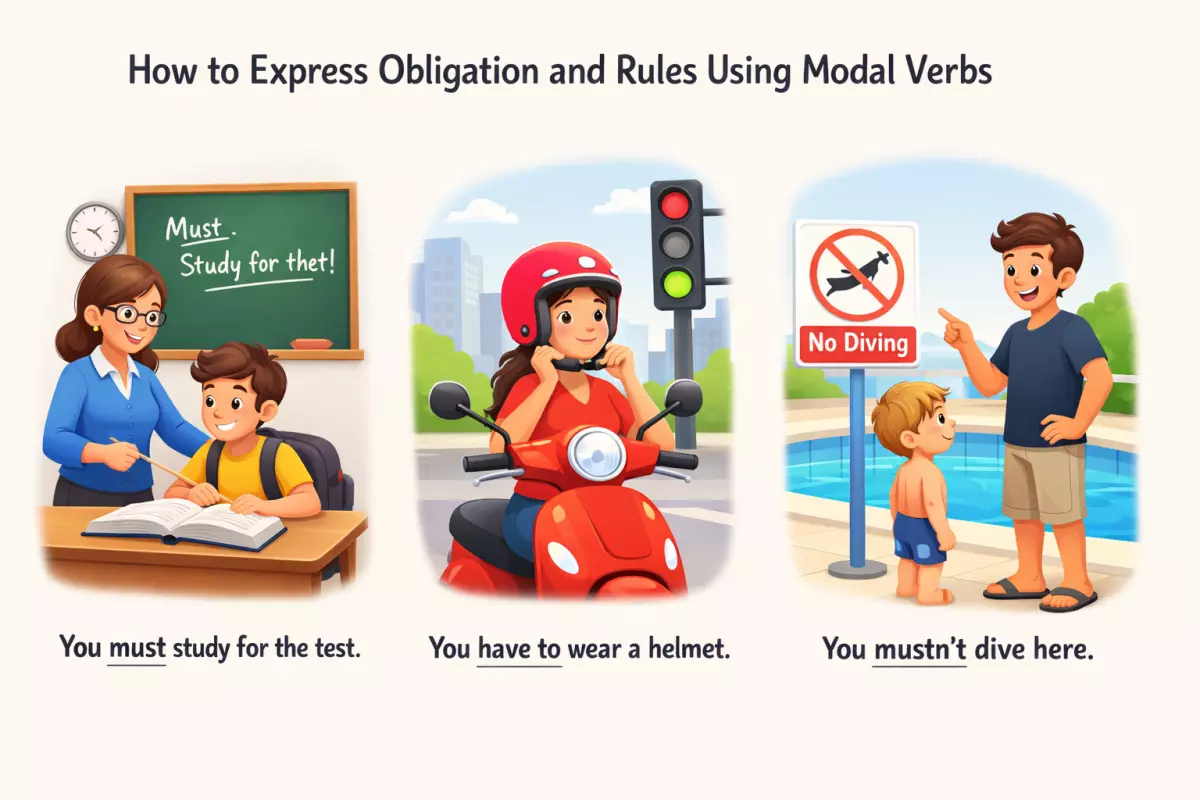 Here we modal verbs for obligation and necessity, comparing must, have to, and should by strength and showing how they work in rules, formal regulations, and negative forms. It uses everyday examples, explains personal vs external obligation, flags common learner mistakes, and includes practice exercises.
- Modal verbs used to express obligation and necessity
- How must, have to, and should differ in strength
- Using modal verbs to describe rules and formal regulations
- How negative forms change the meaning of obligation
- Examples of rules and responsibilities in everyday contexts
- How modal verbs distinguish personal obligation from external rules
- Typical learner mistakes when expressing obligation
- Exercises and practice tasks on modal verbs for rules and duties
Ever wonder how English shows what you are required to do versus what is simply expected? In daily life we use small helper verbs to talk about workplace rules, home duties, and medical advice, and the verb you choose can change the meaning. This article explains how to sound clear and polite while staying firm, so people understand what is mandatory, recommended, or forbidden.
Modal verbs used to express obligation and necessity
English uses several modal verbs (and a few closely related patterns) to show that something is required, expected, or necessary. The choice depends on who creates the rule, how strong it is, and whether you are talking about the present, past, or future.
Core modals and related patterns
-
must + base verb: strong obligation, often from the speaker or an authority the speaker supports.
Examples: “You must wear a helmet.” “I must finish this today.”
-
have to + base verb: external requirement (rules, laws, schedules); very common in everyday speech.
Examples: “We have to show ID.” “She has to work on Saturday.”
-
have got to + base verb: informal, usually present/near-future necessity; often sounds urgent.
Examples: “I’ve got to leave now.” “You’ve got to see this.”
-
need to + base verb: necessity that can feel practical rather than authoritative; can be softer than must.
Examples: “You need to back up your files.” “I need to call my bank.”
-
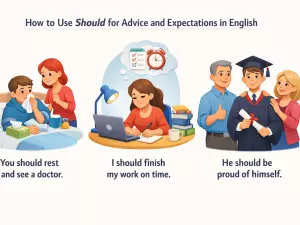
should + base verb: recommendation or expectation; weaker than a rule, but still implies responsibility.
Examples: “You should submit the form by Friday.” “Drivers should slow down here.”
-
ought to + base verb: similar to should, slightly more formal; often used for moral duty.
Examples: “You ought to apologize.” “We ought to follow the guidelines.”
-
be supposed to + base verb: expectation based on rules, arrangements, or what people generally think is correct; can imply “but it may not happen.”
Examples: “You’re supposed to sign in.” “The train is supposed to arrive at 6.”
-
be required to + base verb: formal and explicit (policies, contracts, official instructions).
Examples: “Employees are required to complete training.” “Visitors are required to check in.”
-
be to + base verb: formal instructions or plans, often in notices and official writing.
Examples: “Students are to remain seated.” “The documents are to be submitted by noon.”
Common patterns and form notes
-
Modal + base verb: after true modals, use the base form (no “to”).
✅ “You must leave.” ❌ “You must to leave.”
-
Third-person singular: must does not change; have to becomes has to.
Examples: “He must go.” “He has to go.”
-
Past obligation: had to is the usual past form for required actions.
Examples: “We had to wait.” “She had to pay a fine.”
-
Past expectation: was/were supposed to often suggests the expected action did not happen.
Example: “I was supposed to call you, but I forgot.”
-
Future necessity: use will have to or going to have to for future requirements.
Examples: “You’ll have to renew your license.” “I’m going to have to reschedule.”
Choosing the right strength
-
Very strong / non-negotiable: must, be required to (often used for safety rules, legal duties, strict instructions).
-
Standard requirement: have to (common for workplace rules, school rules, procedures).
-
Practical necessity: need to (focuses on what is necessary to achieve a goal).
-
Advice / expectation: should, ought to, be supposed to (useful when the “rule” is social, informal, or not strictly enforced).
How must, have to, and should differ in strength
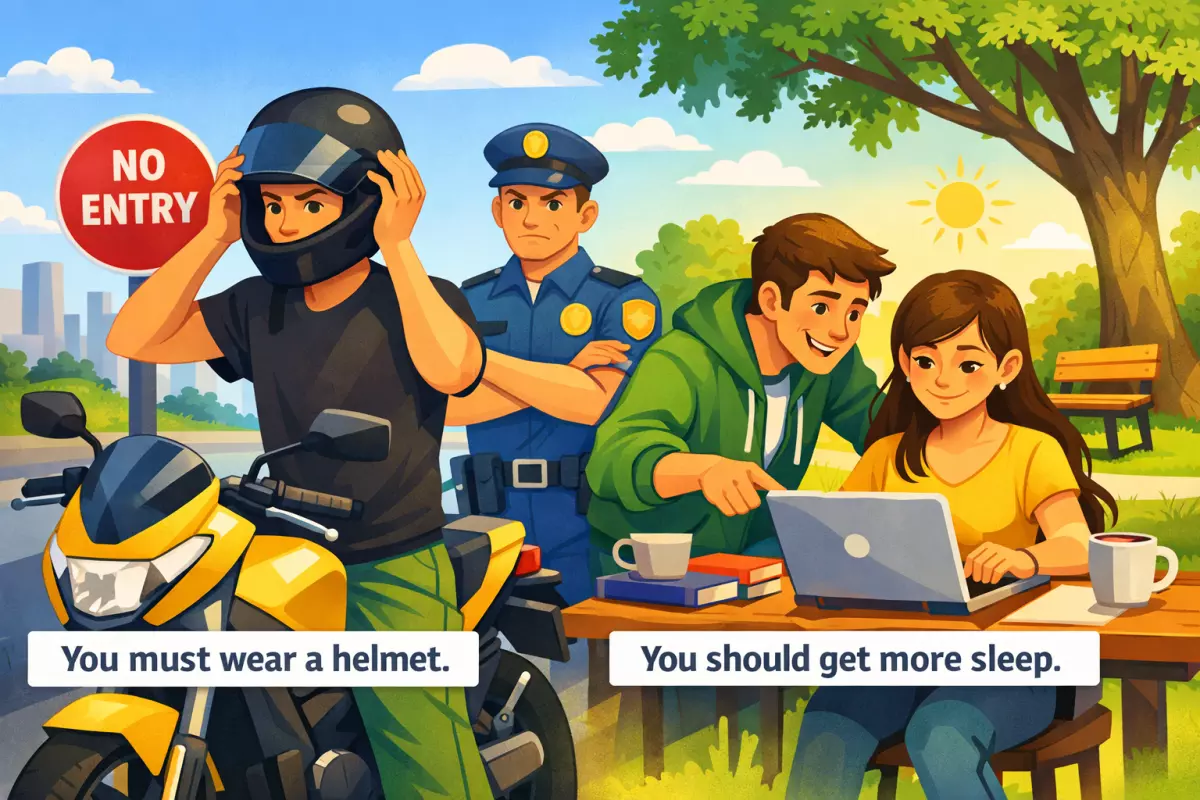
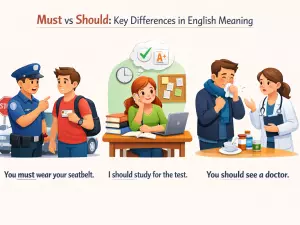
These three modals all express obligation, but they signal different levels of force and different sources of authority. Choosing the right one helps your listener understand whether something is a strict rule, an external requirement, or simply good advice.
| Modal | Strength | Typical meaning | Common source | Example |
|---|---|---|---|---|
| must | Strongest | Non-negotiable obligation; speaker insists | Speaker’s authority, rules, urgent necessity | You must wear a helmet. |
| have to | Strong | Requirement that exists (often practical or official) | External rules, laws, schedules, circumstances | I have to submit the form today. |
| should | Medium | Recommendation; best choice, not strictly required | Advice, expectations, good practice | You should back up your files. |
| don’t have to | Low (no obligation) | Not necessary; optional | Lack of requirement | You don’t have to come early. |
| mustn’t | Strong (prohibition) | Not allowed | Rules, authority, safety | You mustn’t park here. |
Meaning differences that affect tone
- Must often sounds like a firm instruction from the speaker: “I’m telling you this is required.”
- Have to often sounds like the speaker is reporting a requirement: “This is required because of the rules/situation.”
- Should keeps room for choice and disagreement: “This is the sensible thing to do.”
- Don’t have to removes obligation (optional), while mustn’t creates prohibition (not allowed). These are not interchangeable.
Useful patterns (forms learners often mix up)
- Affirmative: I must call them. / I have to call them. / I should call them.
- Negative obligation vs. no obligation: ✅ You mustn’t enter. → prohibited; ❌ You don’t have to enter. → optional.
- Past time: ✅ I had to leave early. ❌ I musted leave early.
- Questions: Do we have to sign in? / Should we sign in? (Questions with must exist but can sound very forceful: Must you play music so loud?)
- Future meaning: I have to work tomorrow. / I must remember to email you tomorrow. / You should arrive by 9.
- Softening a rule: “You have to show ID” (neutral) often sounds less personal than “You must show ID” (more commanding).
Example set: choosing the right strength
- Safety rule: You must wear eye protection in the lab.
- Company policy: Employees have to complete the training module.
- Advice: You should save your work before updating the software.
- Urgent necessity: I must speak to you now.
- Schedule pressure: I have to catch the 7:10 train.
- Expectation (not a rule): You should reply within two days.
- Optional action: You don’t have to print the ticket; a digital copy is fine.
- Strict prohibition: You mustn’t share your password.
- Strong instruction (speaker-driven): You must stop interrupting.
- External requirement (rule-driven): Visitors have to sign in at reception.
- Polite guidance: You should check the address before you send it.
- Regret about advice: I should have called earlier.
- Past necessity: We had to cancel the meeting.
- Emphasis without a formal rule: You must try this soup.
Using modal verbs to describe rules and formal regulations
Formal rules are usually written to be unambiguous, so the modal you choose should match the level of authority: strict requirement, prohibition, permission, or recommendation. In policies, notices, contracts, and workplace procedures, modals often appear with passive structures, fixed phrases, and condition clauses to make responsibilities clear.
Core modals and what they signal in official contexts
- must + base verb: strong obligation from the rule-maker. Common in signs and instructions. Example: “Employees must wear ID badges at all times.”
- must not / mustn’t + base verb: strict prohibition. Example: “Visitors must not enter restricted areas.”
- have to + base verb: external requirement (law, policy, procedure). Often used in spoken explanations of rules. Example: “You have to submit the form by Friday.”
- do not have to + base verb: no obligation (optional). Example: “You do not have to attend the briefing.”
- may + base verb: formal permission. Example: “Staff may request remote access with manager approval.”
- may not + base verb: formal prohibition (can sound legalistic). Example: “Members may not share login details.”
- can + base verb: permission in less formal rules; also used for general allowance. Example: “You can park in the visitor lot after 6 p.m.”
- should + base verb: recommendation or expected best practice, not a strict rule. Example: “Users should change passwords regularly.”
- shall + base verb: very formal, common in contracts to state duties. Example: “The tenant shall pay rent on the first day of each month.”
Common patterns in policies and regulations
- Modal + base verb: “Applicants must provide proof of address.”
- Modal + be + past participle (passive, focuses on the action/result): “All requests must be approved in writing.”
- Modal + be + adjective/noun phrase (requirements stated as conditions): “Payment must be in full before delivery.”
- Modal + be allowed/permitted (explicit permission language): “Children are not allowed to enter the lab.” / “Guests may be permitted to attend with prior notice.”
- Only + modal to restrict permission: “Only authorized staff may access the server room.”
- Unless / except clauses to define exceptions: “Employees must wear safety glasses unless otherwise instructed.”
- If / when clauses to attach conditions: “If a badge is lost, it must be reported immediately.”
- By + time/date to set deadlines: “Reports must be submitted by 5 p.m.”
- At all times / at all times while to show continuous obligation: “Visitors must remain with their host at all times.”
- In order to to explain the purpose (keeps tone formal): “To ensure safety, equipment must be inspected weekly.”
Accuracy checks that prevent common mistakes
- Use must not for prohibition, not “don’t have to.” ✅ “You must not smoke here.” ❌ “You don’t have to smoke here.”
- Use don’t have to for “not necessary,” not “mustn’t.” ✅ “You don’t have to print the receipt.” ❌ “You mustn’t print the receipt.”
- Keep the verb in base form after a modal. ✅ “You must submit the form.” ❌ “You must submitted the form.”
- In formal writing, choose may when you need clear permission language; can may sound more casual or ability-focused depending on context.
- Be consistent within one document: mixing “must,” “shall,” and “have to” randomly can make the level of obligation unclear.
Example rule statements you can model
- “All staff must complete annual safety training.”
- “Personal data must be stored securely.”
- “Visitors must sign in at reception.”
- “Food and drink must not be brought into the computer room.”
- “Employees may take breaks in the designated area only.”
- “You do not have to submit a paper copy.”
- “Requests should be submitted at least 48 hours in advance.”
- “If an incident occurs, it must be reported immediately.”
- “Equipment must be returned by the end of the day.”
- “The contractor shall comply with site security procedures.”
- “Members may not transfer their membership to another person.”
- “Only managers may approve overtime.”
How negative forms change the meaning of obligation
Negatives with modal verbs often flip the message from “this is required” to either “this is forbidden” or “this is not necessary.” The key is to notice whether the negative attaches to the obligation itself (no requirement) or to the action (prohibition).
| Form | Typical meaning | Example | What it implies |
|---|---|---|---|
| must | strong obligation (requirement) | You must wear a helmet. | Wearing a helmet is required. |
| must not / mustn’t | strong prohibition | You mustn’t use your phone here. | Using a phone is forbidden. |
| have to | obligation (often external rules) | We have to show ID. | Showing ID is required by a rule/process. |
| don’t have to | no obligation (not necessary) | You don’t have to show ID. | Showing ID is optional; you may do it, but it’s not required. |
| need to | necessity (practical requirement) | You need to submit the form today. | Submitting today is necessary to meet the goal/deadline. |
| don’t need to | no necessity | You don’t need to submit it today. | Submitting today is not required; later may be fine. |
| should | advice / expectation | You should back up your files. | It’s recommended; not a strict rule. |
| should not / shouldn’t | advice against | You shouldn’t share your password. | It’s recommended not to do it; not necessarily “forbidden.” |
| can | permission / ability | You can leave early. | Leaving early is allowed (or possible). |
| cannot / can’t | no permission / no ability (context decides) | You can’t park here. | Parking here is not allowed. |
| may | formal permission / possibility | You may enter now. | Entering is permitted (often formal). |
| may not | no permission (formal) | Visitors may not enter this area. | Entering is prohibited by a rule. |
Two common meaning shifts to watch
Many learner mistakes come from treating all negatives as “not allowed.” In English, some negative forms remove the obligation instead of banning the action.
- Prohibition (not allowed): the rule blocks the action. Common patterns: mustn’t, can’t (permission), may not.
- No obligation (optional): the rule does not require the action. Common patterns: don’t have to, don’t need to.
High-value usage patterns (with examples)
- ✅ You mustn’t smoke here. → Smoking is forbidden.
- ❌ You don’t have to smoke here. → This sounds like smoking is optional, not banned.
- ✅ You don’t have to bring a laptop. → It’s optional.
- ✅ You don’t need to bring a laptop. → Also optional; often feels more “practical” than “rule-based.”
- ✅ You must not disclose client data. → Strong rule; formal tone.
- ✅ You shouldn’t disclose client data. → Advice; weaker than a strict policy.
- ✅ You can’t enter without a badge. → Not permitted (rule) or not possible (if the door won’t open); context clarifies.
- ✅ You may not enter without a badge. → Formal prohibition (policy language).
- ✅ You don’t have to attend the meeting. → Attendance isn’t required.
- ✅ You must attend the meeting. → Attendance is required.
- ✅ You mustn’t be late. → Being late is not allowed (strong expectation/rule).
- ✅ You don’t need to be early. → Arriving early is not necessary (but still possible).
- ✅ Employees don’t have to pay for uniforms. → No requirement to pay.
- ✅ Employees mustn’t wear open-toe shoes. → Safety rule; prohibited.
- ✅ You can’t use that password again. → Not allowed by policy/system.
- ✅ You shouldn’t use that password again. → Recommendation; not necessarily enforced.
Quick checks for choosing the right negative
- If the message is “It is forbidden,” choose mustn’t, can’t (permission), or may not (formal).
- If the message is “It is optional,” choose don’t have to or don’t need to.
- If you are giving guidance rather than rules, choose shouldn’t (advice against) instead of a prohibition form.
- When clarity matters, add a short rule phrase: “It’s optional,” “It’s against policy,” or “It isn’t required.”
Examples of rules and responsibilities in everyday contexts
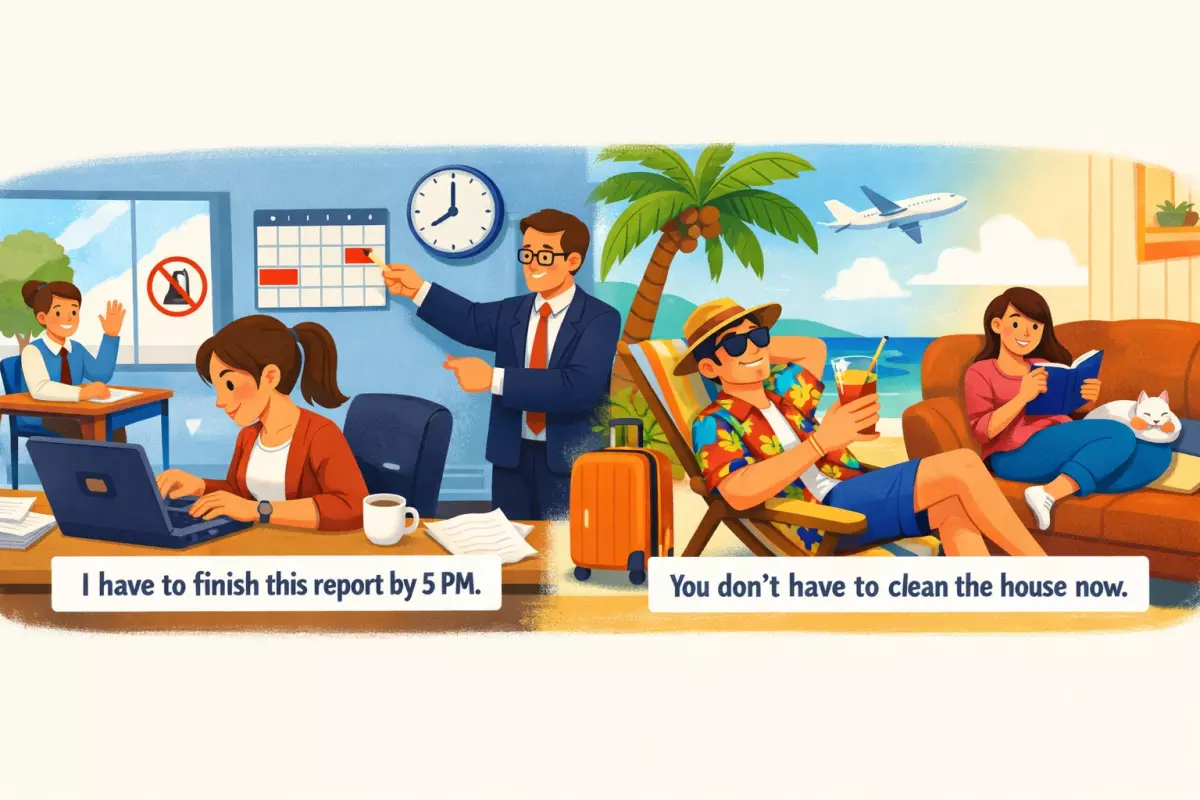
Obligation and rules show up in routine situations like work, school, travel, and home life. The modal verb you choose signals how strong the requirement is, who sets it, and whether it is a strict rule, a personal duty, or a polite instruction.
Common patterns to notice
- must / have to for strong necessity: rules, laws, deadlines, or non-negotiable requirements.
- mustn’t for prohibition (not “don’t have to”): it means something is not allowed.
- don’t have to / don’t need to for no necessity: optional, not required.
- should / ought to for advice or expected responsibility: recommended, but not enforced like a rule.
- be supposed to for expectations and arrangements: what is expected by a plan, rule, or social norm.
- can / may for permission: what is allowed (often in rules or formal instructions).
Everyday examples (with typical contexts)
- Work (policy): “You must wear your ID badge at all times.”
- Work (schedule necessity): “I have to submit the report by 5 p.m.”
- Work (no requirement): “You don’t have to attend the meeting if you’re on leave.”
- Work (recommendation): “You should back up your files regularly.”
- School (rule): “Students mustn’t use phones during exams.”
- School (expectation): “You’re supposed to cite your sources.”
- Home (personal duty): “I have to pick up the kids after school.”
- Home (advice): “You should label leftovers before putting them in the fridge.”
- Apartment building (permission): “Residents may use the gym from 6 a.m. to 10 p.m.”
- Apartment building (prohibition): “You mustn’t leave bicycles in the hallway.”
- Public transport (requirement): “Passengers must validate their tickets.”
- Travel (necessity from circumstances): “We have to leave early because of traffic.”
- Travel (optional action): “You don’t need to print the boarding pass.”
- Health (strong advice): “You should see a doctor if the pain continues.”
- Customer service (polite instruction): “You need to fill out this form to request a refund.”
- Social expectations: “You’re supposed to RSVP by Friday.”
- Rules with permission: “You can bring one guest, but you can’t bring pets.”
- Law/safety (prohibition): “You mustn’t park in front of the fire exit.”
Quick accuracy checks (common confusions)
- ✅ “You mustn’t smoke here.” (It is not allowed.) → ❌ “You don’t have to smoke here.” (This means smoking is optional, which is not the intended meaning.)
- ✅ “You don’t have to come tomorrow.” (No obligation.) → “You mustn’t come tomorrow.” (You are not allowed to come.)
- ✅ “You should apologize.” (Advice/expectation.) → “You must apologize.” (Much stronger; sounds like a strict demand.)
How modal verbs distinguish personal obligation from external rules
English often signals where an obligation comes from by choosing different modal verbs and structures. Some forms sound like the speaker is taking responsibility for the duty, while others point to laws, policies, schedules, or instructions coming from outside the speaker.
1) Personal obligation: duties the speaker accepts
Use these patterns when the pressure is internal (conscience, personal standards, promises) or when the speaker is presenting the duty as their own decision.
- I must + base verb: strong, self-imposed or speaker-driven necessity. (Common in formal speech and writing.)
- I have to + base verb: can be personal, but often sounds practical (what needs doing).
- I need to + base verb: focuses on necessity and goals; less “authority,” more “requirement to succeed.”
- I should / I ought to + base verb: moral duty, advice to oneself, or what is considered the right thing.
- I’m supposed to + base verb: expectation; can be personal, but often implies a role or agreement.
2) External rules: duties imposed by authority or circumstances
Use these when the obligation comes from rules, regulations, authorities, or conditions the speaker cannot easily change.
- You have to + base verb: common for rules and requirements (workplace, school, procedures).
- You must + base verb: formal and strict; typical in written rules, warnings, and official instructions.
- You’re required to + base verb: explicit authority; often used in policies and compliance language.
- You’re not allowed to + base verb: prohibition stated as a rule (permission language).
- You can’t + base verb: everyday prohibition; less formal than “mustn’t.”
- You mustn’t + base verb: strong prohibition; common in formal notices and clear safety rules.
Key usage patterns that show “who is imposing the duty”
- Speaker-centered framing: “I must/should…” suggests the speaker owns the obligation, even if a rule exists in the background.
- Rule-centered framing: “You must/are required to…” points to an external authority (policy, law, instructions).
- Reason clauses clarify source:
- ✅ “I must leave now because I promised.” (internal commitment)
- ✅ “I have to leave now because the building closes at six.” (external condition)
- Passive and impersonal structures sound more institutional:
- ✅ “Visitors are required to sign in.”
- ✅ “It is mandatory to wear a helmet.”
- Permission vs. obligation: “allowed to” and “can” often express rules indirectly by talking about permission rather than duty.
Examples: choosing the modal to match the source
- ✅ “I must apologize.” (personal responsibility)
- ✅ “I should call my parents more often.” (self-judgment)
- ✅ “I need to finish this tonight.” (necessity tied to a goal)
- ✅ “I have to submit it by Friday.” (deadline; often external)
- ✅ “Employees must wear ID badges.” (policy)
- ✅ “You have to show your ticket at the entrance.” (procedure)
- ✅ “You mustn’t park here.” (strict prohibition)
- ✅ “You can’t bring liquids on board.” (rule stated informally)
- ✅ “We’re supposed to keep noise down after 10.” (community expectation)
- ✅ “All guests are required to check out by 11.” (official requirement)
- ✅ “You’re not allowed to use your phone during the exam.” (permission-based rule)
- ✅ “I’m supposed to meet them at noon.” (arrangement/expectation; not necessarily strict)
Typical learner mistakes when expressing obligation
Errors with modal verbs of duty usually come from mixing up strength (rule vs. advice), choosing the wrong time reference, or using a form that does not exist in English. The patterns below highlight what to avoid and what to use instead.
1) Confusing strong obligation with advice
- ❌ “You must see a doctor.” (sounds like a strict requirement) → ✅ “You should see a doctor.” (recommendation)
- ❌ “You have to try this cake.” (can sound pushy) → ✅ “You should try this cake.” (friendly suggestion)
- ❌ “Employees should wear helmets.” (may sound optional) → ✅ “Employees must wear helmets.” (safety rule)
2) Mixing up “mustn’t” and “don’t have to”
- ❌ “You mustn’t pay.” (means payment is forbidden) → ✅ “You don’t have to pay.” (means payment is not necessary)
- ❌ “You don’t have to smoke here.” (means smoking is optional) → ✅ “You mustn’t smoke here.” (means smoking is prohibited)
- ❌ “We mustn’t submit a cover letter.” (forbidden) → ✅ “We don’t have to submit a cover letter.” (not required)
3) Using a non-existent form: “must to”
- ❌ “I must to leave now.” → ✅ “I must leave now.”
- ❌ “She must to wear a uniform.” → ✅ “She must wear a uniform.”
4) Forgetting that “must” has no normal past form
- ❌ “Yesterday I must go to the office.” → ✅ “Yesterday I had to go to the office.”
- ❌ “Last year we must follow new rules.” → ✅ “Last year we had to follow new rules.”
- ❌ “I didn’t must work.” → ✅ “I didn’t have to work.”
5) Negatives and questions with “have to” formed incorrectly
- ❌ “You haven’t to wear a tie.” → ✅ “You don’t have to wear a tie.”
- ❌ “Have you to sign this?” → ✅ “Do you have to sign this?”
- ❌ “He doesn’t has to come.” → ✅ “He doesn’t have to come.”
6) Confusing “must” (obligation) with “must” (logical deduction)
- ❌ “You must be tired, so go home now.” (mixes deduction with a command) → ✅ “You must be tired. You should go home.”
- ❌ “The sign says you must be quiet.” (could be read as deduction) → ✅ “The sign says you must be quiet.” (OK in context, but learners should notice the two meanings)
7) Overusing “must” where “have to” is more natural
- In everyday speech, “have to” often sounds less formal and less like a personal command.
- ❌ “I must get up at 6 for work.” (can sound very formal) → ✅ “I have to get up at 6 for work.”
- ❌ “You must fill in this form.” (speaker-imposed) → ✅ “You have to fill in this form.” (external requirement)
8) Misplacing “need to / needn’t” and “don’t need to”
- ❌ “You needn’t to bring anything.” → ✅ “You needn’t bring anything.” / “You don’t need to bring anything.”
- ❌ “Do you need bring ID?” → ✅ “Do you need to bring ID?”
- Remember: “needn’t” is more common in British English and sounds formal in some contexts.
9) Using “should” for strict rules in formal notices
- ❌ “Passengers should not open the door.” (may sound like advice) → ✅ “Passengers must not open the door.”
- ❌ “Students should submit work by Friday.” (unclear if required) → ✅ “Students must submit work by Friday.” / “Students have to submit work by Friday.”
10) Time-reference mistakes with perfect forms
- To talk about an obligation that existed in the past, use “had to,” not “must” with a past time word.
- To talk about criticism of a past action (not doing what was expected), use “should have + past participle.”
- ❌ “You must have call me yesterday.” → ✅ “You should have called me yesterday.”
- ❌ “I should go yesterday.” → ✅ “I should have gone yesterday.”
Exercises and practice tasks on modal verbs for rules and duties
Use the tasks below to practise choosing the right modal for obligation, prohibition, and permission. Focus on the pattern (modal + base verb) and on meaning: strong duty, weak duty, advice, or “no rule.”
1) Choose the best modal (must / have to / should / mustn’t / don’t have to / can / can’t)
- Employees ______ wear an ID badge at all times. (company rule)
- You ______ park here; it’s reserved for ambulances. (prohibition)
- Visitors ______ sign in at reception. (procedure)
- You ______ bring your laptop tomorrow; we have spare devices. (not necessary)
- Students ______ submit the form by Friday, or they cannot join the trip. (deadline)
- You ______ speak during the exam. (rule)
- You ______ check the timetable before you travel; trains are often delayed. (advice)
- Staff ______ use personal phones on the factory floor. (safety rule)
- You ______ leave early today if you finish your tasks. (permission)
- We ______ wear formal clothes; it’s a casual office. (no requirement)
Show answers
- must / have to
- can’t / mustn’t
- must / have to
- don’t have to
- must / have to
- mustn’t / can’t
- should
- mustn’t / can’t
- can
- don’t have to
2) Rewrite to match the meaning (keep the same meaning)
- It is necessary to wear a helmet. → You ______ wear a helmet.
- It is not necessary to print the ticket. → You ______ print the ticket.
- It is forbidden to feed the animals. → You ______ feed the animals.
- It is a good idea to back up your files weekly. → You ______ back up your files weekly.
- It is allowed to take photos without flash. → You ______ take photos without flash.
- It is required to pay by the 1st of each month. → You ______ pay by the 1st of each month.
- It is not required to attend the meeting. → You ______ attend the meeting.
- It is prohibited to enter this area. → You ______ enter this area.
Show answers
- must / have to
- don’t have to
- mustn’t / can’t
- should
- can
- must / have to
- don’t have to
- mustn’t / can’t
3) Correct the form (modal patterns)
Each sentence has one problem with form or meaning. Rewrite it correctly.
- You must to show your passport at check-in.
- We don’t must wear uniforms here.
- You should to arrive early for the interview.
- He doesn’t have to pays for parking on Sundays.
- You mustn’t to use your phone while driving.
- Do I must sign this document?
- You can’t to enter without a ticket.
- You don’t have to not bring food; snacks are provided.
Show answers
- You must show your passport at check-in.
- We don’t have to wear uniforms here.
- You should arrive early for the interview.
- He doesn’t have to pay for parking on Sundays.
- You mustn’t use your phone while driving.
- Do I have to sign this document?
- You can’t enter without a ticket.
- You don’t have to bring food; snacks are provided.
4) Decide: rule now or general rule? (must vs have to)
Choose the option that sounds more natural in context: must or have to. In some items, both are possible; pick the better fit.
- (Notice on a door) You ______ keep this door closed.
- (Explaining company policy) We ______ complete safety training every year.
- (Speaker giving instructions) You ______ fill in this form before you sit down.
- (External requirement) I ______ renew my visa next month.
- (Personal insistence) I ______ finish this report tonight.
- (School regulation) Students ______ bring a calculator to the test.
Show answers
- must
- have to
- must
- have to
- must
- have to
5) Build your own mini rulebook (production task)
- Write 6 rules for a place you know (gym, library, classroom, workplace). Use at least: one must, one have to, one mustn’t, one don’t have to, one can, and one should.
- Check each sentence for the core pattern: modal + base verb (no “to,” no -s, no -ing).
- Underline the reason in a short clause: “because…”, “for safety,” “to avoid…”. This helps you test whether the strength of obligation matches the situation.
- Optional upgrade: rewrite two of your “must” rules using “have to,” and explain if the meaning changes (speaker’s insistence vs external rule).