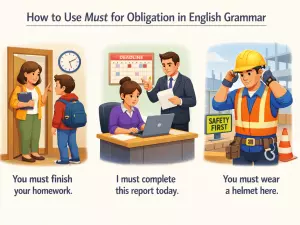
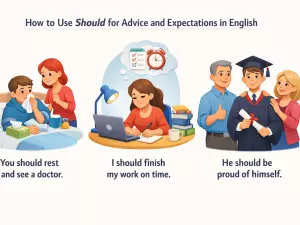
Must vs Should: Key Differences in English Meaning

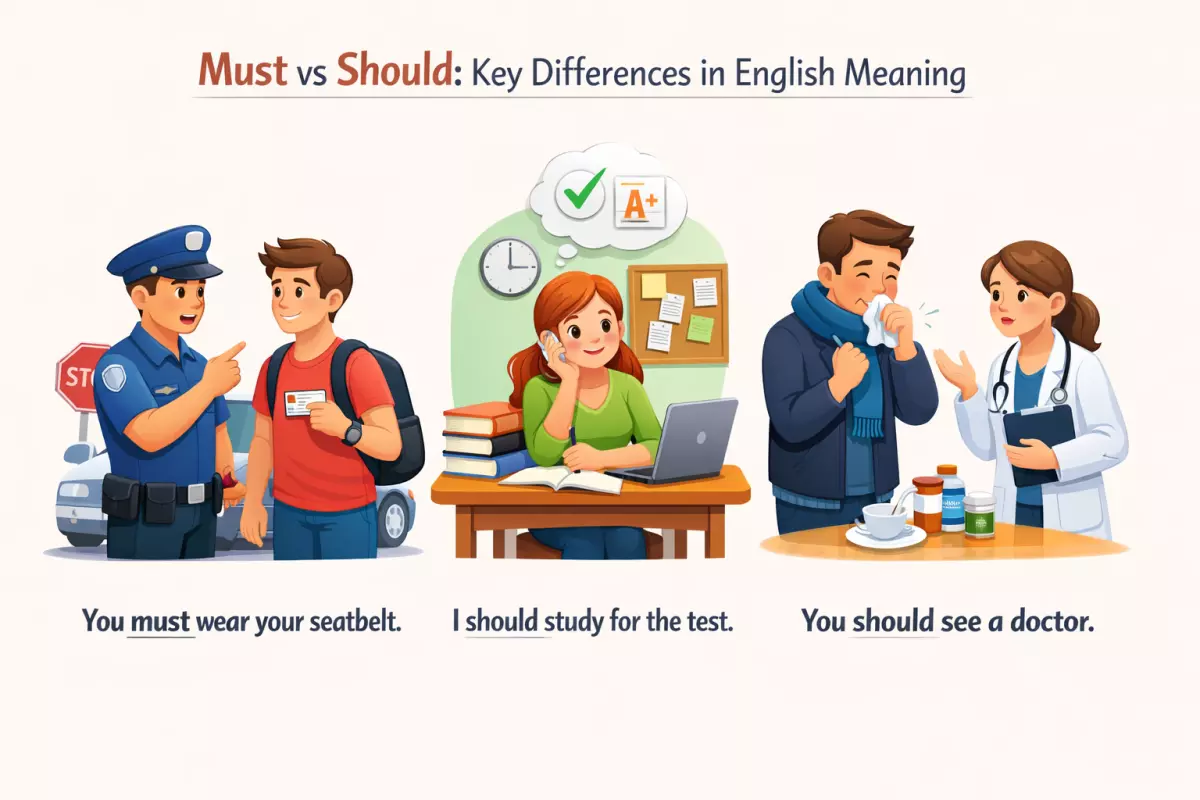 This article explains the difference between strong obligation and recommended action, showing how must signals necessity while should offers advice. It compares strict rules vs softer suggestions, notes when must sounds too strong, covers context, negatives, common mistakes, and practice exercises.
- The difference between strong obligation and recommended action
- How must expresses necessity while should gives advice
- Comparing strict rules with softer recommendations
- Situations where must may sound too strong in conversation
- How context influences whether must or should is appropriate
- Negative forms and how they affect meaning
- Typical learner mistakes when choosing between must and should
- Exercises and practice tasks comparing must and should
In everyday English, understanding the difference between obligation and recommendation can change the tone of what you say and how people respond. Must signals a firm rule or necessity, like a deadline you cannot ignore. Should suggests advice or the best option and leaves room for choice. Knowing this helps your emails, requests, and conversations sound clearer, more respectful, and easier to follow.
The difference between strong obligation and recommended action
Must is used for rules, requirements, and non-negotiable necessity, while should is used for advice, expectations, and the best choice in a situation. The key is how much choice the listener has: “must” leaves little or no option; “should” leaves room to decide.
How “must” works: obligation, necessity, and rules
Use must when the speaker treats the action as required. It often appears with laws, workplace policies, safety instructions, deadlines, and logical necessity.
- Rules and policies: “Employees must wear ID badges.”
- Safety requirements: “You must fasten your seat belt.”
- Deadlines and procedures: “The form must be submitted by Friday.”
- Strong personal obligation: “I must call my parents tonight.”
- Prohibition pattern: “You must not park here.” (stronger than “should not”)
- Logical conclusion: “She must be at work; her car is outside.”
- Fixed condition: “To enter, you must show a ticket.”
- Formal instructions: “All devices must be switched off.”
How “should” works: advice, expectation, and best practice
Use should to recommend an action, express what is generally a good idea, or describe what is expected in a typical situation. It suggests a preferred choice rather than a strict requirement.
- Advice: “You should see a doctor if the pain continues.”
- Best practice: “You should back up your files regularly.”
- Polite suggestion: “You should try the soup.”
- Expectation: “The train should arrive at 6:10.”
- Criticism/regret: “I should have studied more.”
- Soft negative guidance: “You shouldn’t skip meals.”
- Social norms: “Guests should arrive on time.”
- Probability (weaker than certainty): “It should be easy to find.”
Common patterns that signal which one to choose
- Consequences: If there is a penalty for not doing it, “must” is usually the better fit; if the consequence is mainly inconvenience, “should” is often enough.
- Authority: “Must” often reflects an external authority (law, employer, rules). “Should” often reflects guidance (teacher, friend, general standards).
- Degree of choice: “Must” implies no real choice; “should” implies you can choose differently, even if it’s not ideal.
- Negative forms: “Must not” expresses prohibition (❌ not allowed). “Should not” expresses advice against something (not recommended).
- Past forms: “Must” doesn’t normally form a true past for obligation; use “had to.” “Should” forms “should have + past participle” for missed advice or regret.
- Questions: “Must I…?” asks about necessity/requirement; “Should I…?” asks for advice or the best option.
Quick example contrasts (correct vs. incorrect meaning)
- ✅ “You must stop at a red light.” → legal requirement
❌ “You should stop at a red light.” (sounds like optional advice, not a rule) - ✅ “You should drink more water.” → recommendation
❌ “You must drink more water.” (sounds like an order unless there’s a medical or rule-based reason) - ✅ “I had to leave early yesterday.” → past necessity
❌ “I must leave early yesterday.” (incorrect time reference) - ✅ “You shouldn’t tell her yet.” → advice against
❌ “You must not tell her yet.” (prohibition; much stronger)
How must expresses necessity while should gives advice
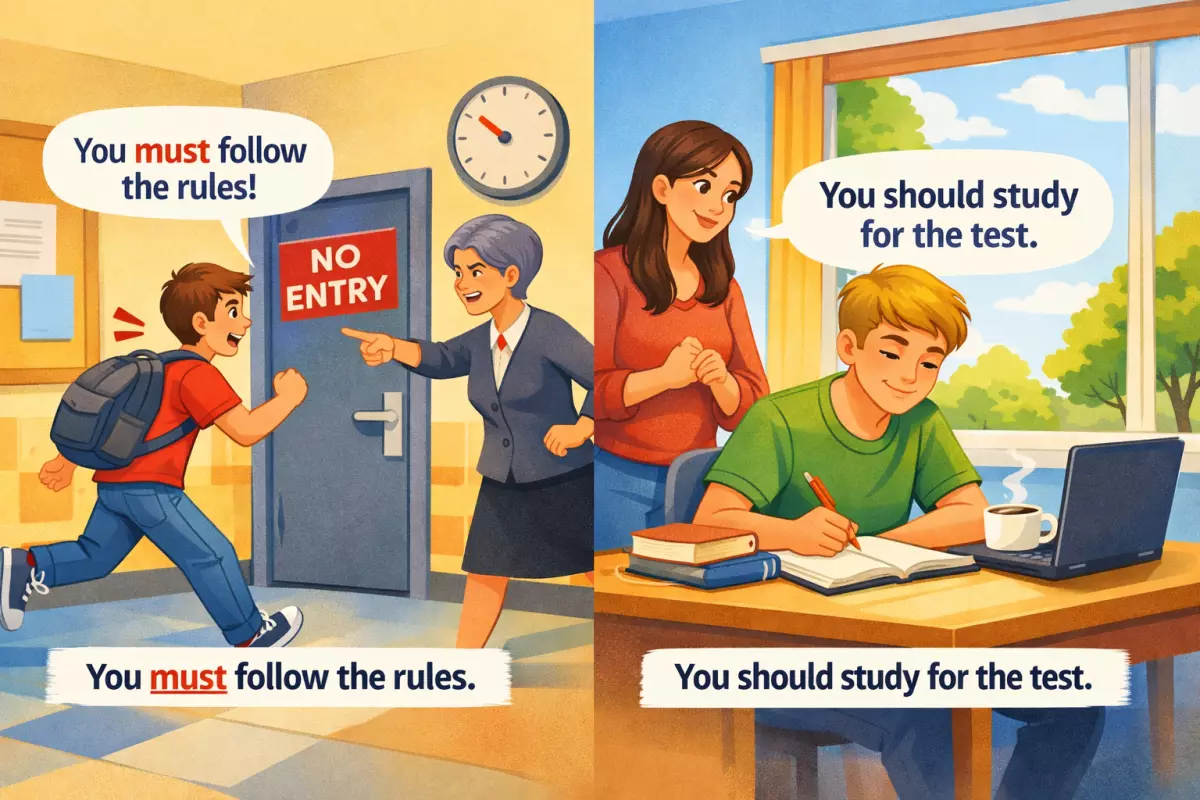
Must is used for strong obligation, rules, or requirements, while should is used for recommendations, expectations, and mild obligations. The difference is about force: one signals “not optional,” the other signals “a good idea” or “the right thing to do,” often leaving room for choice.
Core meaning and when to choose each modal
- Use must when the speaker treats the action as necessary: a rule, a non-negotiable condition, or something required to reach a goal.
- Use should when the speaker is advising, suggesting best practice, or stating what is expected in a typical situation.
- Must often implies consequences for not doing it (penalty, failure, safety risk), even if the consequence is not stated.
- Should can imply mild consequences (inconvenience, lower quality, missed opportunity), but it does not sound like a strict rule.
- Must is common in instructions, regulations, and firm personal requirements.
- Should is common in guidance, polite advice, and “what’s best” discussions.
Common patterns (forms you will see most)
- must + base verb: “You must wear a helmet.”
- should + base verb: “You should wear a helmet.”
- must not + base verb (prohibition): “You must not enter.”
- should not + base verb (negative advice): “You should not skip breakfast.”
- must + be + adjective/noun: “It must be quiet in here.”
- should + be + adjective/noun: “It should be ready by noon.”
- must + have + past participle (past necessity/deduction depending on context): “You must have submitted the form.”
- should + have + past participle (past advice/regret/criticism): “You should have called earlier.”
Example pairs showing the difference in force
- “You must submit the application by Friday.” (deadline requirement) vs. “You should submit it by Friday.” (recommended to avoid problems)
- “Passengers must fasten seat belts.” (rule) vs. “You should fasten your seat belt.” (advice, often in informal speech)
- “You must keep this information confidential.” (strict obligation) vs. “You should keep it confidential.” (strong advice, but less absolute)
- “You must stop at the red light.” (legal requirement) vs. “You should stop at the red light.” (sounds like guidance; weaker than the law)
- “We must leave now.” (no real choice) vs. “We should leave now.” (best timing, but flexible)
- “You must not touch the equipment.” (forbidden) vs. “You should not touch the equipment.” (better not; warning/advice)
- “I must finish this today.” (self-imposed necessity) vs. “I should finish this today.” (responsible plan, but not absolute)
- “Employees must wear ID badges.” (policy) vs. “Employees should wear ID badges.” (recommended practice)
- “You must back up the data before updating.” (required step) vs. “You should back up the data before updating.” (best practice)
- “You must see a doctor immediately.” (urgent necessity) vs. “You should see a doctor.” (advice; less urgent)
- “You must not share your password.” (strict security rule) vs. “You should not share your password.” (advice; still serious, but softer)
- “The form must be signed.” (required condition) vs. “The form should be signed.” (expected, but could be missing in some cases)
Pragmatic notes: politeness, authority, and tone
- Must can sound authoritative or strict; it fits rules, safety, and clear requirements, but may feel too strong in casual advice.
- Should is often the safer choice for giving guidance because it sounds helpful rather than commanding.
- In workplace writing, must signals a non-optional requirement; should signals a guideline or preference.
- When you want to avoid sounding forceful, replace “You must…” with “You should…” or add context that frames it as a recommendation rather than an order.
Comparing strict rules with softer recommendations
Use must when the speaker treats something as non-negotiable (a rule, a requirement, or a logical necessity). Use should when the speaker is advising, recommending, or expressing what is generally a good idea, without making it mandatory. The difference often comes from the source of authority: a rule or obligation versus guidance or expectation.
| Situation | Prefer “must” (strict) | Prefer “should” (softer) |
|---|---|---|
| Legal or official requirement | You must show ID at the entrance. | You should bring ID, just in case. |
| Workplace policy / instructions | Employees must wear safety goggles. | You should wear goggles if you’re near the workshop. |
| Personal rules and boundaries | I must leave by 6. | I should leave by 6 to avoid traffic. |
| Strong necessity (no real choice) | We must act now; the deadline is today. | We should act soon; the deadline is approaching. |
| Advice and best practice | — | You should back up your files regularly. |
| Moral duty (speaker’s judgment) | You must tell them the truth. | You should tell them the truth. |
| Logical conclusion / deduction | She must be home; her car is outside. | She should be home by now. |
| Instructions that allow flexibility | Applicants must submit the form by Friday. | Applicants should submit the form by Friday. |
Common patterns that signal “must”
- Rules and compliance language: “must comply,” “must submit,” “must not,” “must be completed.”
- Fixed conditions: “To enter, you must…,” “To qualify, you must…,” “Before you start, you must….”
- Urgency with no alternative: “We must decide today,” “I must call them now.”
- Prohibitions: “You must not park here” (stronger than “shouldn’t”).
- Deduction from evidence: “That must be the right address,” “This must be the problem.”
Common patterns that signal “should”
- Advice and guidance: “You should try…,” “You should consider…,” “You should avoid….”
- Expected outcomes: “It should work,” “The package should arrive tomorrow.”
- Polite suggestions: “You should email them first,” “We should probably reschedule.”
- General standards: “Drivers should slow down in rain,” “Children should get enough sleep.”
- Gentle criticism: “You should have told me earlier” (less forceful than “You must tell me”).
Quick choice checks
- If breaking it leads to a penalty or clear non-compliance, choose must.
- If it’s mainly about what is wise, helpful, or recommended, choose should.
- If you mean “I’m certain this is true” based on evidence, use must (deduction).
- If you mean “this is likely/expected,” use should.
- If you want to sound less forceful, switch from must to should (or add softeners like “probably”).
Situations where must may sound too strong in conversation
Must often sounds like an order or a non-negotiable rule. In everyday talk, that can feel pushy, judgmental, or overly certain. In many of the situations below, speakers soften the message by choosing should, need to, have to, or polite question forms.
Common contexts where “must” can feel too forceful
- Giving advice to friends: “You must talk to your boss” can sound controlling. A softer pattern is “You should talk to your boss” or “It might help to talk to your boss.”
- Commenting on someone’s lifestyle or choices: “You must exercise more” can feel like criticism. Try “You should try to exercise more” or “Do you want to exercise more?”
- Discussing health, food, or body topics: “You must stop eating that” can sound harsh. Use “You should cut back” or “Maybe it’s better to avoid that.”
- Parenting or relationships (adult-to-adult): “You must forgive them” can sound like moral pressure. “You might want to forgive them” or “It could be worth forgiving them” is less absolute.
- Workplace requests to peers: “You must send me the file today” can sound like you have authority you may not have. Prefer “Could you send me the file today?” or “We need the file today—can you send it?”
- Requests to customers/clients: “You must fill out this form” can feel unfriendly. “Please fill out this form” or “You’ll need to fill out this form” is more service-oriented.
- Speaking to strangers: “You must move your car” may sound confrontational. “Could you move your car, please?” is more likely to be accepted.
- Correcting someone’s behavior in public: “You must be quiet” can escalate tension. “Could you keep it down?” is a common alternative.
- Offering opinions as if they are facts: “This must be the best option” can sound dismissive of other views. “This should be the best option” or “This seems like the best option” leaves room for discussion.
- When you are not responsible for the rule: “You must show ID” can sound like personal enforcement. “You have to show ID” or “We need to see ID” signals an external requirement.
- When the listener has a choice: “You must come to the party” implies obligation. “You should come” or “I’d love you to come” fits better.
- Giving unsolicited career or study guidance: “You must change jobs” can sound intrusive. “You should consider changing jobs” is more respectful.
- Reacting to mistakes: “You must be more careful” can sound like blame. “You should be more careful” or “Next time, be a bit more careful” is gentler.
- Talking about emotions: “You must calm down” often increases conflict. “Take a breath” or “Let’s slow down” is less commanding.
- Making suggestions in group decisions: “We must choose option A” can shut down discussion. “We should choose option A” or “I think we should choose option A” invites input.
Softening patterns that replace “must” in conversation
- Polite questions: “Could you…?” / “Would you mind…?” / “Can we…?”
- Advice framing: “You should…” / “You might want to…” / “It may be better to…”
- External requirement: “You have to…” / “You’ll need to…” / “It’s required that…”
- Collaborative language: “Let’s…” / “How about we…?” / “Maybe we can…”
- Less certainty: “It seems…” / “It looks like…” / “I think…”
In short, must fits best when you truly mean “no choice” (rules, strict necessity, or strong logical conclusions). When the goal is cooperation, politeness, or respectful advice, English speakers usually choose softer modal patterns.
How context influences whether must or should is appropriate
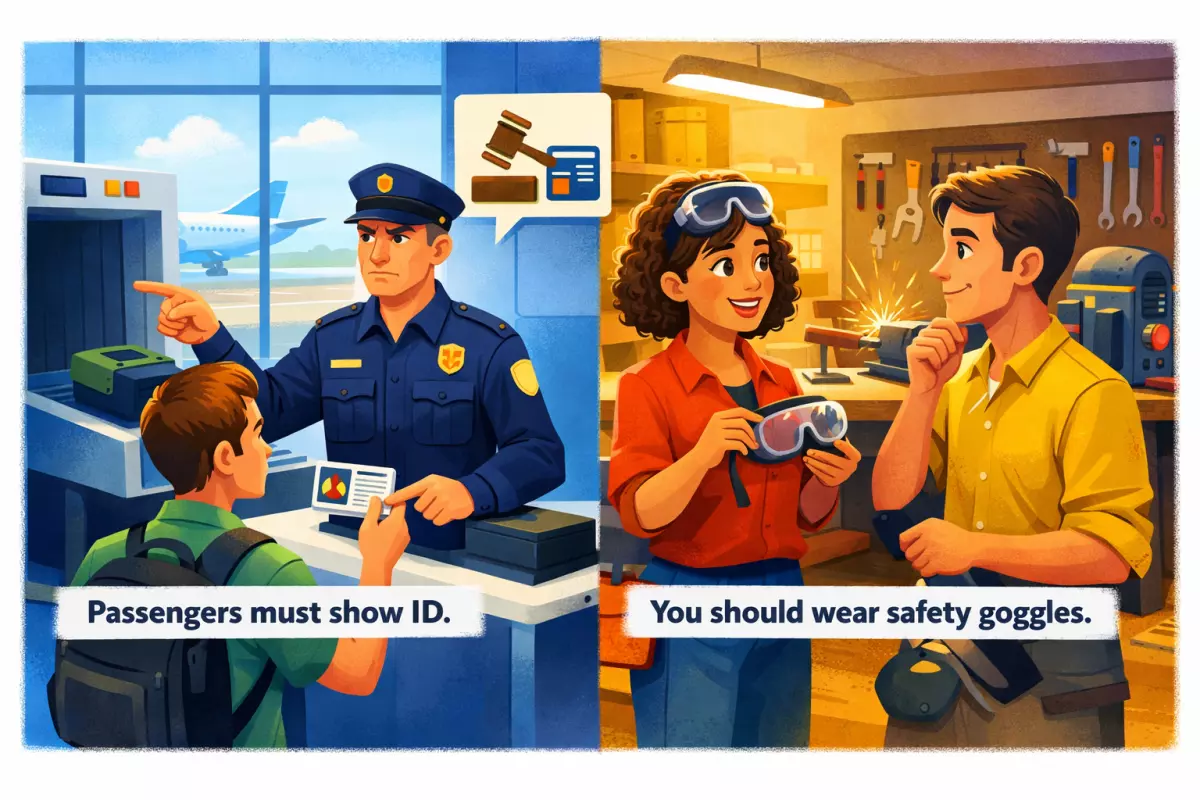
Choose between must and should by checking where the pressure comes from (law, rules, or personal judgment), how strong the consequence is, and whether the speaker is giving an order or advice. In many situations, the “right” modal is the one that matches the relationship and the stakes, not just the grammar.
Context cues that push you toward “must”
- Legal or official requirement: “Passengers must show ID.”
- Workplace policy or safety rule: “Employees must wear protective goggles.”
- Non-negotiable deadline or condition: “You must submit the form by Friday to be considered.”
- Access depends on compliance: “You must have a ticket to enter.”
- Strong internal necessity (speaker’s firm stance): “I must finish this tonight.”
- Clear consequence for not doing it: “You must back up the data, or you could lose everything.”
- Instructions in manuals/procedures: “The device must be unplugged before cleaning.”
- Formal announcements and notices: “All visitors must sign in at reception.”
Context cues that push you toward “should”
- Advice or recommendation: “You should drink more water.”
- Best practice (not mandatory): “You should update your password regularly.”
- Polite guidance to reduce force: “You should email first to confirm.”
- Expectation or typical behavior: “The bus should arrive around 8.”
- Soft criticism after the fact: “You should have told me earlier.”
- Suggestions in customer service: “You should restart the router and try again.”
- Health/fitness guidance (general): “You should warm up before running.”
- Ethical or value-based judgment (not enforceable): “People should be honest.”
Common situations where context changes the best choice
- Rules vs. preferences: “You must be quiet in the exam hall” (rule) vs. “You should be quiet in the library” (expectation/politeness).
- Authority level: A manager may say “You must attend” for mandatory meetings; a colleague often says “You should attend” to avoid sounding controlling.
- Risk level: “You must call 911” fits emergencies; “You should see a doctor” fits non-urgent concerns.
- Negotiability: If alternatives are acceptable, “should” usually fits: “You should take the earlier train” (but you can choose another).
- Written tone: Policies, contracts, and compliance documents favor “must.” Guides, FAQs, and tips favor “should.”
- Blame vs. guidance: “You must do this next time” sets a strict requirement; “You should do this next time” frames it as improvement.
- Certainty vs. probability: “It must be true” (strong logical conclusion) vs. “It should be true” (expected, but not certain).
- Customer instructions: “You must fill in all required fields” (system requirement) vs. “You should add a phone number” (helpful but optional).
- Parenting/teaching tone: “You must hold my hand when we cross” (safety rule) vs. “You should look both ways” (training a habit).
- Social relationships: With friends, “should” often sounds more natural for suggestions; “must” can sound overly intense unless the situation is serious.
Quick pattern checks (with examples)
- If “required” fits, use “must”: “You must register before entering.”
- If “recommended” fits, use “should”: “You should register early to get a better seat.”
- If refusal isn’t really an option, use “must”: “You must stop at a red light.”
- If it’s guidance with room for choice, use “should”: “You should slow down in the rain.”
- If you’re drawing a strong conclusion, use “must”: “She must be at work; her car is gone.”
- If you’re stating an expectation, use “should”: “She should be at work by now.”
- ✅ “You must wear a helmet.” (rule) → ❌ “You should wear a helmet.” (sounds optional if it’s actually required)
- ✅ “You should try the new feature.” (suggestion) → ❌ “You must try the new feature.” (sounds like an order)
Negative forms and how they affect meaning
Negatives change the force of an obligation or recommendation in ways that often surprise learners. With must, the negative usually flips into prohibition (must not), while with should, the negative typically expresses advice against something (should not) rather than a strict ban.
Core negative patterns
- must not + base verb = prohibition (a rule, law, or strict instruction). Example: “You must not park here.”
- should not + base verb = advice against an action (recommended to avoid). Example: “You should not drive when you’re exhausted.”
- mustn’t is common in British English; in many contexts it sounds firm and rule-like. Example: “You mustn’t touch that switch.”
- shouldn’t is widely used in both British and American English; it sounds like guidance, not enforcement. Example: “You shouldn’t skip breakfast if you get headaches.”
“Don’t have to” vs “must not”: not the same meaning
- don’t have to + base verb = no necessity (optional), not a prohibition. Example: “You don’t have to come early.”
- must not + base verb = not allowed. Example: “You must not enter without a badge.”
- Common learner error: ❌ “You must not bring your passport” when the meaning is “it isn’t necessary.” ✅ “You don’t have to bring your passport.”
- In spoken English, don’t need to often replaces don’t have to with the same “no necessity” meaning. Example: “You don’t need to print the ticket.”
Past and perfect negatives: different time, different message
- should not have + past participle = criticism or regret about a past action. Example: “I shouldn’t have said that.”
- must not have + past participle is rare for deduction; English usually uses can’t have for “impossible.” ✅ “He can’t have forgotten the meeting.”
- must have not + past participle (or mustn’t have) can appear when the speaker means “it was necessary not to” (a past prohibition), but it is uncommon and can sound unclear. Often clearer: “We weren’t allowed to…”
- shouldn’t have to + base verb = expectation that something is unreasonable. Example: “You shouldn’t have to pay for that mistake.”
Questions and softening: how negative forms sound
- Shouldn’t we…? often suggests a plan and expects agreement. Example: “Shouldn’t we call a taxi?”
- Mustn’t we…? is much less common and can sound formal or old-fashioned; many speakers prefer Don’t we have to…? or Do we have to…?
- You shouldn’t… can sound like advice or mild criticism depending on tone and context; adding a reason keeps it constructive. Example: “You shouldn’t email them now; it’s midnight there.”
- You mustn’t… is direct and authoritative; it fits safety rules and strict instructions. Example: “You mustn’t mix these chemicals.”
Quick meaning check with common examples
- “You must not share this password.” → It’s forbidden.
- “You don’t have to share your phone number.” → It’s optional.
- “You should not skip the warm-up.” → It’s a recommendation to avoid injury.
- “We shouldn’t have booked the last flight.” → Past regret/criticism.
- “He can’t have seen the message.” → Strong negative deduction (more natural than “must not have”).
Typical learner mistakes when choosing between must and should
Many errors come from treating must and should as interchangeable. In real usage, they signal different levels of force: obligation/necessity versus advice/recommendation. The points below highlight frequent patterns that lead learners to sound too strict, too weak, or simply unnatural.
-
Using must for friendly advice (sounds like an order)
❌ You must try this cake.
✅ You should try this cake. / You have to try this cake. (more enthusiastic, but still strong)Pattern: Use should for suggestions; reserve must for rules, duties, or strong necessity.
-
Using should for rules and non-negotiable requirements (too weak)
❌ Employees should wear ID badges at all times. (if it’s a strict policy)
✅ Employees must wear ID badges at all times.Tip: If there is a penalty or it’s mandatory, must is usually the better choice.
-
Confusing “no obligation” with “not necessary”
Learners sometimes avoid must and say ❌ You don’t must…, which is not grammatical.
✅ You don’t have to come early. (no obligation)
✅ You mustn’t park here. (prohibition)Rule of thumb: Negative of obligation is usually don’t have to, not “don’t must.”
-
Mixing up mustn’t (prohibited) and don’t have to (optional)
❌ You mustn’t bring a laptop if you want. (wrong meaning)
✅ You don’t have to bring a laptop. (it’s optional)
✅ You mustn’t bring a laptop. (it’s forbidden) -
Overusing must for personal opinions (can sound judgmental)
❌ You must be more polite. (can sound like scolding)
✅ You should be more polite. (advice)
✅ You might want to be more polite. (softer)Pattern: When giving feedback, should often fits better unless you truly mean a strict requirement.
-
Forgetting that must also expresses logical certainty
Learners sometimes avoid this meaning and choose should, which weakens the conclusion.
✅ She isn’t answering—she must be busy. (strong conclusion)
✅ She should be busy. (expectation, less certain) -
Using must in the past instead of the correct past forms
❌ Yesterday I must go to the dentist.
✅ Yesterday I had to go to the dentist.Note: Must has no common simple past form for obligation; use had to.
-
Confusing “expected” with “required” in schedules and instructions
❌ The train must arrive at 6:10. (sounds like a rule)
✅ The train should arrive at 6:10. (timetable expectation, not guaranteed) -
Incorrect question forms and unnatural phrasing
Questions with must can sound very formal or forceful, especially in everyday conversation.
- ✅ Do I have to fill out this form? (common, neutral)
- ✅ Must I fill out this form? (formal/strict)
- ✅ Should I fill out this form? (asking for advice)
-
Using should to mean “probably” in all contexts
Should can express expectation, but it does not always mean probability in the same way as “probably.”
✅ It should be easy. (expectation based on experience)
✅ It’s probably easy. (speaker’s guess; different nuance) -
Missing the perfect forms for past advice and past conclusions
These are common in real English and help avoid ambiguity.
- ✅ You should have called me. (past advice/regret)
- ✅ He must have forgotten. (past logical conclusion)
- ❌ You should called me. (missing have)
- ❌ He must forgot. (wrong form after must)
-
Using the wrong verb form after must or should
Both are followed by the base verb (bare infinitive), not “to + verb.”
- ❌ You must to leave now. → ✅ You must leave now.
- ❌ You should to see a doctor. → ✅ You should see a doctor.
-
Stacking modals or doubling obligation markers
❌ You must have to submit it today. (awkward/double obligation)
✅ You must submit it today. / You have to submit it today. -
Not matching strength to context (politeness and relationship)
In requests, must can sound impolite unless you have authority or the situation is urgent.
- ✅ You should email me the file when you can. (polite, flexible)
- ✅ Please email me the file today. (direct but polite)
- ✅ You must email me the file by 5 p.m. (strict deadline)
-
Choosing should when the speaker is expressing a firm boundary
❌ You should not speak to staff like that. (may sound like mild advice)
✅ You must not speak to staff like that. (clear prohibition)
When deciding between these two modals, check what you mean first: a rule/necessity, a recommendation, an expectation, or a logical conclusion. Then choose the form that matches the strength and the situation.
Exercises and practice tasks comparing must and should
Choose between must (strong obligation/necessity) and should (advice/expectation) by focusing on the source of pressure: rules and non-negotiable requirements usually take must, while recommendations and “best idea” guidance usually take should. Use the tasks below to practise common patterns, negatives, and questions.
1) Choose the best modal (must or should)
- You ______ wear a helmet on this site. It’s a safety rule.
- You ______ try restarting the router first; it often fixes the issue.
- Employees ______ submit timesheets by Friday at 5 p.m.
- You ______ apologize if you were rude.
- Visitors ______ sign in at reception before entering.
- We ______ leave now, or we’ll miss the last train.
- You ______ drink more water during hot weather.
- Drivers ______ stop when the light is red.
- I think you ______ talk to your manager about workload.
- All applicants ______ provide a valid ID.
- We ______ follow the instructions exactly, or the test results won’t be valid.
- You ______ check the spelling before you send it.
Show answers
- must
- should
- must
- should
- must
- must
- should
- must
- should
- must
- must
- should
2) Fix the sentence (replace the wrong modal)
Each sentence has one modal that doesn’t fit the meaning. Rewrite it using the better choice.
- You should show your passport at border control. (It’s required.)
- You must see that movie if you like comedies. (It’s just a recommendation.)
- Students should not cheat in exams. (It’s a strict rule.)
- I must call my grandmother more often. (It’s advice to myself, not a rule.)
- Guests should not smoke inside the building. (It’s prohibited.)
- You must take an umbrella; it might rain later. (It’s only a sensible idea.)
- We should submit the application by midnight, or it won’t be accepted. (Hard deadline.)
- You mustn’t forget to back up your files regularly. (General advice, not a ban.)
Show answers
- You must show your passport at border control.
- You should see that movie if you like comedies.
- Students must not cheat in exams.
- I should call my grandmother more often.
- Guests must not smoke inside the building.
- You should take an umbrella; it might rain later.
- We must submit the application by midnight, or it won’t be accepted.
- You shouldn’t forget to back up your files regularly.
3) Practice negatives: mustn’t vs shouldn’t
Decide whether the meaning is prohibition (use mustn’t) or advice against something (use shouldn’t).
- You ______ park here; it’s a fire lane.
- You ______ eat so fast; you’ll get a stomachache.
- Employees ______ share customer data with anyone outside the company.
- You ______ skip breakfast if you have a long morning.
- You ______ touch that switch; it’s dangerous.
- You ______ stay up so late on weeknights.
- Visitors ______ feed the animals.
- You ______ assume the email is real; check the sender.
- You ______ use your phone during the exam.
- You ______ worry so much; you’ve prepared well.
Show answers
- mustn’t
- shouldn’t
- mustn’t
- shouldn’t
- mustn’t
- shouldn’t
- mustn’t
- shouldn’t
- mustn’t
- shouldn’t
4) Rewrite to change strength (must → should, should → must)
Rewrite each sentence so the obligation becomes weaker or stronger, as indicated.
- (Weaker) You must submit the form today.
- (Weaker) You mustn’t enter this area.
- (Stronger) You should arrive ten minutes early.
- (Stronger) You shouldn’t ignore the warning signs.
- (Weaker) We must follow the dress code.
- (Stronger) You should finish the report before the meeting.
Show answers
- You should submit the form today.
- You shouldn’t enter this area.
- You must arrive ten minutes early.
- You mustn’t ignore the warning signs.
- We should follow the dress code.
- You must finish the report before the meeting.
5) Quick pattern reminders to check your choices
- must + base verb: “You must wear…” / “We must leave…”
- should + base verb: “You should call…” / “They should check…”
- mustn’t expresses a ban: “You mustn’t smoke here.”
- shouldn’t gives advice against: “You shouldn’t skip sleep.”
- Questions often signal purpose: “Do I have to…?” (requirement) vs “Should I…?” (seeking advice). If you practise with must, try rewriting with “have to” and see if the meaning stays the same.
- Time pressure can hint at necessity: deadlines and safety rules tend to pull toward must.