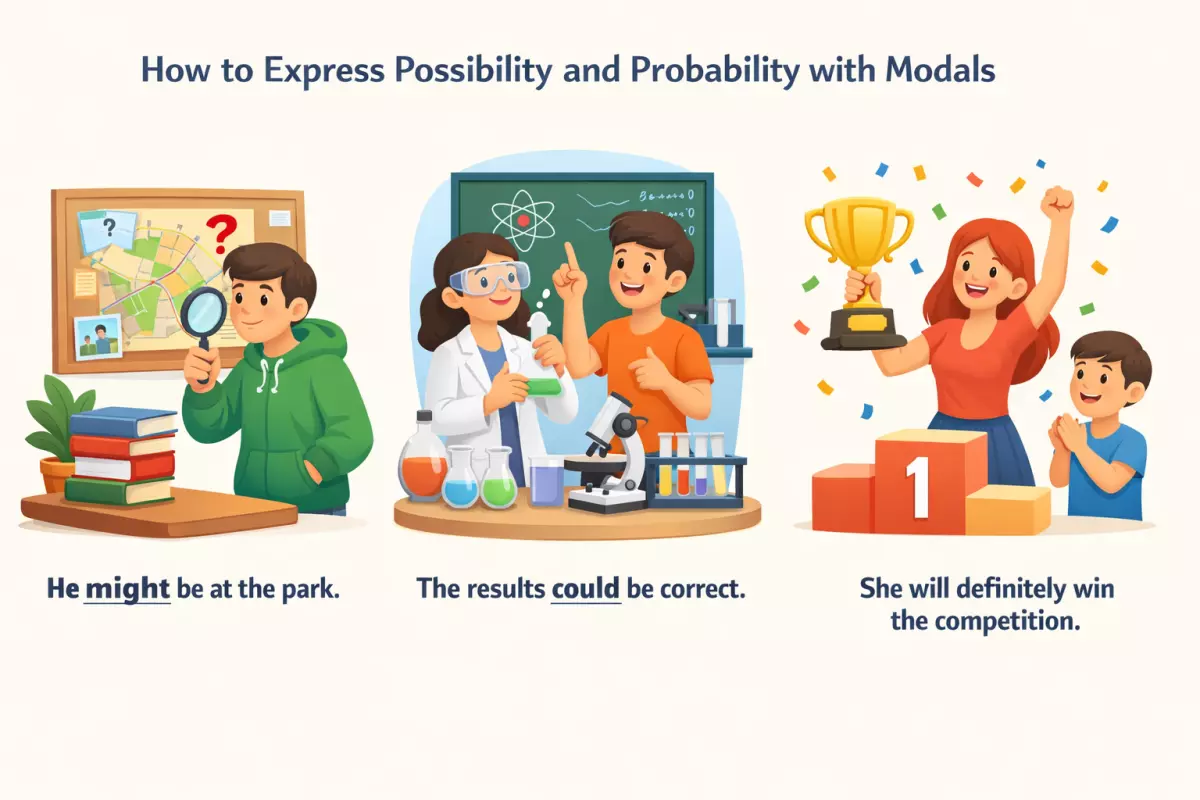
How to Express Possibility and Probability with Modals

 Covers how modal verbs express possibility and probability, how may, might, and could differ in certainty, and how must signals strong logical probability. Includes outcome predictions, context effects, common mix-ups, real-life sentences, plus exercises and practice tasks.
- Modal verbs used to express possibility and probability
- How may, might, and could differ in level of certainty
- Using must to express strong logical probability
- Examples of modal verbs predicting possible outcomes
- How context influences the degree of certainty
- Common learner confusion between different possibility modals
- Real-life sentences showing probability in conversation
- Exercises and practice tasks on modal verbs of probability
English modal verbs help you express possibility and probability naturally. In daily conversation, we rarely speak with complete certainty: you might guess why a friend is late, predict the weather, or weigh options at work. Understanding the subtle differences between may, might, could, and must makes your meaning clearer, your message more precise, and your tone more confident.
Modal verbs used to express possibility and probability
English uses a small set of modal verbs to show how sure (or unsure) a speaker is about something. The main patterns are: modal + base verb (present/future meaning) and modal + have + past participle (past meaning). The choice of modal signals the strength of the guess, from weak possibility to near certainty.
Core modals and what they usually mean
- May: a real possibility; neutral and common in careful speech/writing.
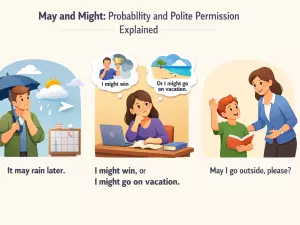
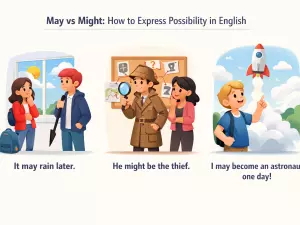
- Present/future: may + base → “It may rain later.”
- Past: may have + past participle → “She may have missed the bus.”
- Might: a weaker or more tentative possibility (often similar to may in modern English).
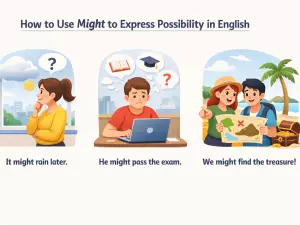
- Present/future: “I might go out tonight.”
- Past: “They might have taken the wrong turn.”
- Could: possible, often based on circumstances; also used for general possibility.
- Present/future: “This could be a problem.”
- Past: “He could have left earlier.” (possible, not certain)
- General possibility: “It can get cold here.” / “It could get cold here.”
- Must: strong logical conclusion (high probability), not a personal rule/obligation in this use.
- Present: “You must be tired after that trip.”
- Past: “They must have forgotten the meeting.”
- Should / Ought to: expectation based on what is normal or planned (probable, but not guaranteed).
- Present/future: “The train should arrive at 6.” / “It ought to be fine.”
- Past: “The parcel should have arrived by now.”
- Can: typically used for general possibility or to say something is sometimes true; less common for a one-time guess.
- General: “Mistakes can happen.”
- One-time guess (often in questions/negatives): “Can that be true?”
- Can’t / Couldn’t: strong negative conclusion (very unlikely or impossible).
- Present: “That can’t be the right answer.”
- Past: “He couldn’t have done it alone.”
Common form rules and patterns
- Use the base verb after a modal: ✅ “She might know.” ❌ “She might knows.”
- Use “have + past participle” for past guesses: “may have seen,” “must have left,” “could have forgotten.”
- Don’t use “to” after most modals: ✅ “It may rain.” ❌ “It may to rain.” (Exception: ought to.)
- Negatives change the meaning:
- “He may not come” = possibly he won’t come (uncertain).
- “He can’t come” = it’s not possible (strong certainty).
- Questions are common with “could/might” for tentative suggestions: “Could it be a wiring issue?” / “Might this be the wrong file?”
- Avoid double modals in standard English: ❌ “He might could be late.” ✅ “He might be late.” / “He could be late.”
Quick example set (present vs. past meaning)
- Weak possibility: “She might be in a meeting.” / “She might have been in a meeting.”
- Neutral possibility: “They may arrive early.” / “They may have arrived early.”
- Situational possibility: “This could cause delays.” / “This could have caused delays.”
- Expectation: “It should work now.” / “It should have worked.”
- Strong conclusion: “He must be joking.” / “He must have been joking.”
- Strong negative conclusion: “That can’t be right.” / “That can’t have been right.”
How may, might, and could differ in level of certainty

These three modals all express possibility, but they often signal different degrees of confidence and different kinds of “maybe.” Context matters most: the same modal can sound more or less certain depending on evidence, tone, and time reference.
| Modal | Typical certainty | What it often implies | Example |
|---|---|---|---|
| may | medium (more “realistic”) | A reasonable possibility; sometimes polite permission in other uses | It may rain this afternoon. |
| might | low to medium (more tentative) | A weaker possibility; speaker sounds less committed | It might rain, but the sky looks clearer now. |
| could | medium (often “one option among many”) | A possible outcome or ability/opportunity; can suggest alternatives | It could rain, or it could stay dry. |
| might vs. could (contrast) | depends on framing | might = uncertainty about what will happen; could = what is possible in principle | She might be late. / She could be late if traffic is bad. |
Common patterns that change the “certainty” feel
- Evidence boosts confidence: “It may be the wrong file—its size doesn’t match.” (sounds more grounded than a bare guess)
- Hedges lower commitment: “It might possibly be a typo.” (extra hedging makes it sound less certain)
- Alternative framing fits could: “We could miss the train, or we could arrive early.” (presents multiple outcomes)
- Conditionals push could toward “if” logic: “It could fail if the battery is old.” (possibility depends on a condition)
- Time reference matters: “It may rain later” (future) vs. “It may have rained” (past inference)
Useful example set (present/future)
- We may need more time to finish the report.
- The meeting might start late because the speaker is stuck in traffic.
- The package could arrive today or tomorrow.
- She may know the answer; she worked on that project.
- He might not recognize you with the new haircut.
- This plan could work, but it needs a clearer budget.
- Prices may rise after the holiday season.
- It might be better to wait until Monday.
- The app could crash if too many users log in at once.
- They may cancel if the weather gets worse.
- I might join you later, depending on how long this call takes.
- We could take the train instead of driving.
Past possibility and inference (may/might/could + have + past participle)
To talk about uncertainty about the past, use may/might/could + have + past participle. This structure is common when you are inferring, not reporting a confirmed fact.
- She may have left already. (possible; speaker has some reason to think so)
- They might have missed the email. (more tentative)
- He could have taken the earlier bus. (was possible; not sure what happened)
- The file may have been deleted by accident.
- The noise might have come from the hallway.
- The results could have been different with more data.
Quick accuracy notes
- ✅ “It may be true.” / “It might be true.” / “It could be true.” (all possible; nuance differs)
- ❌ “It may to be true.” → Use the base form: “may be” (no “to”).
- ❌ “It mights be…” → Modals don’t take -s: “might be.”
- In many everyday situations, may and might are interchangeable; choose might when you want to sound more cautious, and choose could when you want to highlight options or conditions.
Using must to express strong logical probability
Use must when you infer something is almost certainly true based on evidence. This meaning is about logical deduction (what you conclude), not obligation (what someone is required to do). It often appears when you notice clues and make a confident guess.
Core pattern and meaning
- must + base verb (present/near present deduction):
✅ She must be at work (her car is gone). - must + be + -ing (activity in progress):
✅ They must be waiting outside (I can see people by the door). - must + have + past participle (past deduction):
✅ He must have missed the train (he isn’t here yet). - must + have been + -ing (ongoing past activity):
✅ She must have been working late (the lights were on at midnight).
Common usage notes (what it does and doesn’t do)
- It’s evidence-based. The speaker sounds confident because there are clear signs: noise, messages, schedules, results, or visible facts.
- It’s not a promise or a plan. It describes what you think is true, not what will happen: ❌ It must rain tomorrow (prediction) is usually better as “It will probably rain tomorrow.”
- It doesn’t ask for permission. “Must I…?” is obligation, not deduction. For inference, use statements like “You must be…” rather than questions about rules.
- Negative deductions usually use “can’t,” not “mustn’t.”
✅ He can’t be at home (the lights are off and his phone is here).
❌ He mustn’t be at home (this sounds like prohibition). - Time markers help. Use present forms for “now/today,” and perfect forms for “yesterday/last night/already.”
Examples you can copy (present, ongoing, and past)
- That must be the new intern; I haven’t seen her before.
- You must be tired after that long flight.
- It must be cold outside—everyone’s wearing coats.
- They must be siblings; they look very similar.
- She must be working right now; she hasn’t replied all morning.
- He must be driving; his phone goes straight to voicemail.
- The kids must be sleeping; the house is completely quiet.
- The meeting must have started already; the room is full.
- She must have left early; her desk is cleared.
- They must have forgotten the appointment; no one showed up.
- He must have been joking; that story doesn’t make sense.
- We must have taken the wrong turn; this isn’t the main road.
- She must have been waiting for a while; she looks impatient.
- They must have been traveling all day; they’re exhausted.
Quick contrast: deduction vs. obligation
- Deduction: You must be Alex’s brother (you have the same last name).
- Obligation: You must show ID to enter (it’s a rule).
- Deduction: She must have seen my message (it says “read”).
- Obligation: She must answer by Friday (a deadline requirement).
Examples of modal verbs predicting possible outcomes
When you predict what is likely, possible, or uncertain, modal verbs help you show your level of confidence. The most common pattern is modal + base verb (no “to”): “It might rain,” “They should arrive soon.” For past predictions, use modal + have + past participle: “She may have missed the train.”
Common patterns and example sentences
- might + base verb (weak possibility): “The package might arrive tomorrow.”
- may + base verb (possible, slightly more formal): “The results may vary by region.”
- could + base verb (one possible outcome among others): “This decision could cause delays.”
- can + base verb (general possibility, often factual): “Heavy traffic can slow deliveries.”
- should + base verb (expected outcome): “The meeting should finish by 3 p.m.”
- ought to + base verb (expectation, often advice-flavored): “Prices ought to drop after the holiday.”
- will + base verb (strong prediction/certainty): “If you press this button, the screen will restart.”
- won’t + base verb (strong negative prediction): “Without a password, the file won’t open.”
- must + base verb (logical conclusion from evidence): “The lights are off, so they must be asleep.”
- can’t + base verb (strong negative conclusion): “He can’t be at work—his car is still here.”
- might not / may not + base verb (possible negative): “The store might not have that size in stock.”
- couldn’t + base verb (negative logical conclusion, often less absolute than can’t in some contexts): “That couldn’t be the final version; it’s missing pages.”
Past predictions (looking back at what probably happened)
- might have + past participle (possible past): “They might have taken the earlier train.”
- may have + past participle (possible past, neutral/formal): “The email may have gone to your spam folder.”
- could have + past participle (one possible explanation): “The system could have crashed during the update.”
- should have + past participle (expected past result that likely happened, or mild surprise if it didn’t): “The report should have reached you by now.”
- must have + past participle (strong inference about the past): “She must have forgotten the appointment.”
- can’t have + past participle (strong negative inference about the past): “They can’t have seen the message; it was sent after they left.”
Quick accuracy checks (form and meaning)
- ✅ “It might rain later.” → modal + base verb (correct)
- ❌ “It might to rain later.” → no “to” after a modal
- ✅ “She may have missed the bus.” → modal + have + past participle (past possibility)
- ❌ “She may has missed the bus.” → after a modal, use “have,” not “has”
To sound natural, choose the modal that matches your evidence: use might/may/could when several outcomes are still open, should for what you expect based on a plan or routine, and must/can’t when you’re drawing a conclusion from clear clues.
How context influences the degree of certainty

The same modal can sound cautious, confident, or even doubtful depending on the situation around it. Listeners judge probability from the evidence you mention, the time reference, and how specific the statement is. That’s why “must” can feel like a strong conclusion in one setting, but too strong (or sarcastic) in another.
Common context signals that change how modals are understood
- Evidence stated vs. unstated: Adding a reason increases perceived certainty.
- ✅ “She must be home; the lights are on.” (clear evidence)
- “She must be home.” (sounds more like a guess without context)
- Direct observation vs. hearsay: What you personally see tends to strengthen the modal.
- “He might be sick.” (you’re unsure)
- “He might be sick; he’s been coughing all day.” (more grounded)
- “He may be sick; his manager said he left early.” (based on report)
- Specific details: Names, times, and concrete facts make probability claims sound firmer.
- “They could be delayed.”
- “They could be delayed; the 6:10 train was cancelled.”
- Time reference (present vs. past): Past deductions often feel more “closed” because the event already happened.
- “She must be at work.” (present deduction)
- “She must have arrived by now.” (past-to-present deduction)
- “She might have missed the bus.” (past possibility)
- Type of situation: Rules and routines push listeners toward higher certainty; unusual situations lower it.
- “Visitors must sign in.” (obligation, not probability)
- “He must be at the office on Mondays.” (routine-based inference)
- “He might be at the office today.” (non-routine possibility)
- Question vs. statement: Questions often soften commitment and invite confirmation.
- “He might be late.” (your assessment)
- “Might he be late?” (tentative, seeking input)
- “Could he be late?” (often sounds like exploring causes/options)
- Negation placement: Changing where “not” goes changes the meaning and the confidence.
- “He can’t be serious.” (strong negative conclusion)
- “He may not be serious.” (uncertain; maybe yes, maybe no)
- “He must not be home.” (strong conclusion of absence)
- Hedging words: Adverbs and phrases adjust the strength of a modal without changing the grammar.
- “She may possibly be right.” (very cautious)
- “She may well be right.” (leaning toward likely)
- “He could easily be wrong.” (plausible and not surprising)
- Speaker role and setting: Formal contexts often prefer “may” and careful phrasing; casual speech often uses “might” and contractions.
- “The results may indicate a trend.” (formal, measured)
- “It might mean we’re late.” (everyday, tentative)
- Shared knowledge: If everyone knows the background, a modal can sound stronger because less explanation is needed.
- “It must be Alex.” (strong if you’re expecting Alex and only Alex has the key)
- “It could be Alex.” (weaker if several people could arrive)
- Alternative explanations: More competing possibilities reduce certainty, even with the same modal.
- “The internet must be down.” (strong if all devices fail at once)
- “The internet might be down.” (more natural if only one site won’t load)
- Politeness and face-saving: Softer modals can be chosen to avoid sounding accusatory or too direct.
- “You must have forgotten.” (can sound blaming)
- “You might have forgotten.” (gentler, leaves room for other reasons)
Usage pattern to remember
- When you give a clear reason (clues, data, routine), stronger modals like “must” and “can’t” sound natural as deductions.
- When evidence is limited or there are many possible explanations, “might,” “may,” and “could” usually fit better.
- To express uncertainty about a past event, use modal + “have” + past participle: “might have left,” “must have forgotten,” “can’t have seen.”
Common learner confusion between different possibility modals
Learners often mix modals because several forms can all translate as “possible,” but they differ in strength, typical evidence, and the grammar that follows. The easiest way to improve accuracy is to notice (1) how sure the speaker sounds and (2) whether the sentence is about the present, past, or future.
1) Mixing strength: weak vs. strong possibility
- May / might usually express a weaker, more tentative possibility. Use them when you are not confident: “It might rain later.”
- Could often means “one possible option,” not “likely.” It can sound more neutral and can suggest alternatives: “We could take the train.”
- Must (for deduction) is strong logical certainty, not simple possibility: “She must be at work (because her car is gone).”
- Common confusion: using must when you only mean “maybe.” ❌ “He must be late, I’m not sure.” ✅ “He might be late; I’m not sure.”
2) Confusing deduction (evidence-based) with general possibility
- Use must, may/might, could for deductions when you are interpreting clues: “The lights are off; they might be asleep.”
- Use can mainly for general truths/typical behavior, not a single uncertain event: “It can get cold here in October.”
- Common confusion: ❌ “He can be at home now.” (sounds like ability/general possibility) ✅ “He might/could be at home now.”
- Common confusion: ❌ “It may get cold in winter.” (possible, but if you mean a general fact, can is more natural) ✅ “It can get very cold in winter.”
3) Time mistakes: present vs. past possibility
- Present possibility uses: may/might/could + base verb → “She might know the answer.”
- Past possibility uses: may/might/could + have + past participle → “She might have missed the bus.”
- Common confusion: ❌ “She might missed the bus.” ✅ “She might have missed the bus.”
- Common confusion: using present forms for finished past events: ❌ “They may be left early yesterday.” ✅ “They may have left early yesterday.”
4) Negative forms: not possible vs. not certain
- May not / might not means “possibly not”: “He might not come.” (still uncertain)
- Can’t (deduction) means “it’s impossible”: “That can’t be true.”
- Common confusion: ❌ “He might not be at home” when you mean “I’m sure he isn’t.” ✅ “He can’t be at home (his car isn’t here).”
- Common confusion: ❌ “It can’t rain tomorrow” when you only mean “maybe it won’t.” ✅ “It might not rain tomorrow.”
5) Question forms: asking about possibility politely and naturally
- Could is common for polite questions about options: “Could it be a wiring problem?”
- Might can sound more tentative and is often used to “soften” suggestions: “Might it be better to wait?”
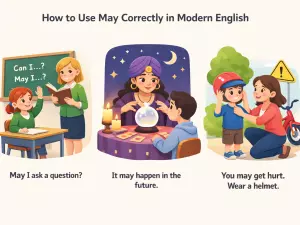
- May in questions can sound formal: “May I ask a question?” (permission) vs. “May it be…?” (rare/formal deduction)
- Common confusion: using may for everyday option questions where could fits better: “Could it be cheaper online?”
6) Pattern errors after modals
- After a modal, use the base verb: ❌ “It might rains.” ✅ “It might rain.”
- Use be for states/identities: “She might be tired.” (not “might tired”)
- Use have + past participle for earlier time: “They could have forgotten.”
- Avoid double modals in standard English: ❌ “It might could happen.” ✅ “It might happen.” / “It could happen.”
7) Quick fixes: choose the modal that matches your meaning
- If you mean “one possible explanation” → use might/could: “It could be a typo.”
- If you mean “I’m almost sure (based on evidence)” → use must: “It must be the wrong file.”
- If you mean “impossible (based on evidence)” → use can’t: “It can’t be the same person.”
- If you mean “general possibility in life/experience” → use can: “Mistakes can happen.”
- If you are talking about the past and you’re unsure → use might/could have: “He might have misunderstood.”
Real-life sentences showing probability in conversation
In everyday talk, speakers often signal how sure they are by choosing a modal (or a modal-like phrase) that matches the evidence they have. Notice how the same situation can sound more or less certain depending on the modal and the context clue (time, tone, or what you can see).
Common patterns you will hear
- must + base verb: strong logical conclusion from evidence (not a rule or obligation).
- might / may / could + base verb: a real possibility, but not certain.
- can’t / couldn’t + base verb: strong belief that something is impossible (based on evidence).
- should / ought to + base verb: expectation (what is likely because it is normal or planned).
- be likely to / probably: probability without using a modal (very common in casual speech).
- must have + past participle: strong conclusion about the past.
- might/may/could have + past participle: possible past situation, but uncertain.
- can’t have + past participle: strong belief something did not happen.
Examples in natural conversation (present and future)
- “It’s already 9:30—he must be stuck in traffic.”
- “She might be in a meeting; try her again in ten minutes.”
- “That can’t be the right address; the building numbers stop at 40.”
- “They could be running late because the train was delayed.”
- “He may not know about the change yet.”
- “It should be quiet after lunch—most people leave early on Fridays.”
- “The delivery ought to arrive before noon if the tracking is accurate.”
- “She’s not answering—she must be driving.”
- “We might need more chairs if everyone shows up.”
- “This could work, but we need a backup plan.”
- “It’ll probably rain later; the sky looks heavy.”
- “He’s likely to say yes if you ask today.”
Examples about the past (using have + past participle)
- “She must have forgotten—she usually replies right away.”
- “They might have missed the last bus.”
- “He could have left his phone at the office.”
- “You can’t have seen her yesterday; she was out of town.”
- “The file may have been deleted by accident.”
- “It must have been expensive—look at the materials.”
Quick accuracy notes (forms that sound natural)
- ✅ “He must be tired.” → strong conclusion now.
- ❌ “He must tired.” → missing be.
- ✅ “They might have left.” → possibility in the past.
- ❌ “They might left.” → missing have.
- ✅ “She can’t be serious.” → strong disbelief based on evidence.
- ✅ “She should be here soon.” → expectation, not certainty.
Exercises and practice tasks on modal verbs of probability
Use these tasks to practise choosing the right modal for how sure you are, and to build accurate patterns for the present, past, and ongoing situations. Focus on two things: (1) the speaker’s certainty level, and (2) the verb form that follows the modal.
Quick pattern reminders (choose the correct structure)
- Present/fact now: modal + base verb (e.g., must be, might live)
- Ongoing now: modal + be + -ing (e.g., may be working)
- Past: modal + have + past participle (e.g., could have missed)
- Negative deduction: can’t / couldn’t + base verb (now) or + have + past participle (past)
- Typical meanings: must (very likely), may/might/could (possible), can’t (almost impossible)
Task 1: Choose the best modal (now)
- The lights are off and the office is locked. They ______ be at work.
- She isn’t answering her phone. She ______ be in a meeting.
- He speaks with a strong Canadian accent. He ______ be from Toronto.
- This key doesn’t fit. It ______ be the right one.
- It’s only 6 a.m. They ______ be awake yet.
- There are fresh footprints in the snow. Someone ______ have come through here recently.
- The soup tastes very salty. You ______ have added too much salt.
- The train is usually late in this weather. It ______ arrive after 9.
- She knows everyone’s name. She ______ work here.
- That explanation doesn’t match the data. It ______ be correct.
Show answers
- can’t
- might / may / could
- might / may / could
- can’t
- can’t
- must
- must
- might / may / could
- must
- can’t
Task 2: Choose the correct form after the modal
- He must ______ (be / to be) tired after the flight.
- They might ______ (wait / waiting) outside.
- She can’t ______ (be / being) serious.
- He may ______ (be / to be) working from home today.
- They must ______ (have left / left) already; the car is gone.
- She could ______ (have forgotten / forgot) the appointment.
- It can’t ______ (have happened / happened) like that.
- He might ______ (be / been) joking when he said it.
- They must ______ (be / being) having lunch right now.
- She may ______ (have taken / took) the earlier train.
Show answers
- be
- be waiting
- be
- be
- have left
- have forgotten
- have happened
- be
- be
- have taken
Task 3: Rewrite to match the meaning (certainty shift)
- Rewrite with must (very likely): “I think she is at home.”
- Rewrite with might (only possible): “He is the manager.”
- Rewrite with can’t (nearly impossible): “They are telling the truth.”
- Rewrite with must have (past deduction): “I’m sure you left your wallet in the taxi.”
- Rewrite with might have (past possibility): “Perhaps she misunderstood the email.”
- Rewrite with can’t have (past impossibility): “It’s impossible that he said that.”
- Rewrite with may be + -ing (possible now, in progress): “Maybe they are sleeping.”
- Rewrite with must be + -ing (very likely now, in progress): “I’m sure he is driving.”
Show answers
- She must be at home.
- He might be the manager.
- They can’t be telling the truth.
- You must have left your wallet in the taxi.
- She might have misunderstood the email.
- He can’t have said that.
- They may be sleeping.
- He must be driving.
Task 4: Spot and fix the error (form or meaning)
- ❌ She must to be at work. → Correct it.
- ❌ He might is late. → Correct it.
- ❌ They can’t have arrive yet. → Correct it.
- ❌ You must have to be joking. → Correct it.
- ❌ She must be at home yesterday. → Correct it.
- ❌ He can’t be the one who called; I saw him an hour ago. → Make the time reference consistent.
- ❌ They might to have missed the bus. → Correct it.
- ❌ It must have raining when you left. → Correct it.
- ❌ She could be forgot my name. → Correct it.
- ❌ This can’t be happened. → Correct it.
Show answers
- She must be at work.
- He might be late.
- They can’t have arrived yet.
- You must be joking.
- She must have been at home yesterday.
- He can’t have been the one who called; I saw him an hour ago.
- They might have missed the bus.
- It must have been raining when you left.
- She could have forgotten my name.
- This can’t have happened.
Task 5: Mini-scenarios (choose the most natural option)
- You hear loud music from your neighbour’s apartment at 2 a.m. Choose: must / might / can’t.
- Your friend’s phone goes straight to voicemail. Choose: must be asleep / might be asleep / can’t be asleep.
- A colleague is not in their office, and their coat is gone. Choose: must have left / might have left / can’t have left.
- You see someone who looks exactly like your teacher, but you’re in another country. Choose: must be / might be / can’t be.
- The package tracking says “Delivered,” but nothing is there. Choose: must be at the door / might be at a neighbour’s / can’t be delivered.
Show answers
- must
- might be asleep
- must have left
- can’t be
- might be at a neighbour’s