Must, Have To, Need To: Expressing Obligation and Necessity

 This article explains types of obligation and necessity, including must vs have to and internal vs external rules. It covers need to and lack of necessity, negatives and questions, past and future forms, common learner confusions with fixes, and homework practice tasks.
- Different types of obligation and necessity
- Must vs have to: meaning differences
- External vs internal obligation
- Need to and lack of necessity
- Negatives and questions with obligation verbs
- Past and future forms of obligation
- Common learner confusion and fixes
- Homework: obligation verb practice tasks
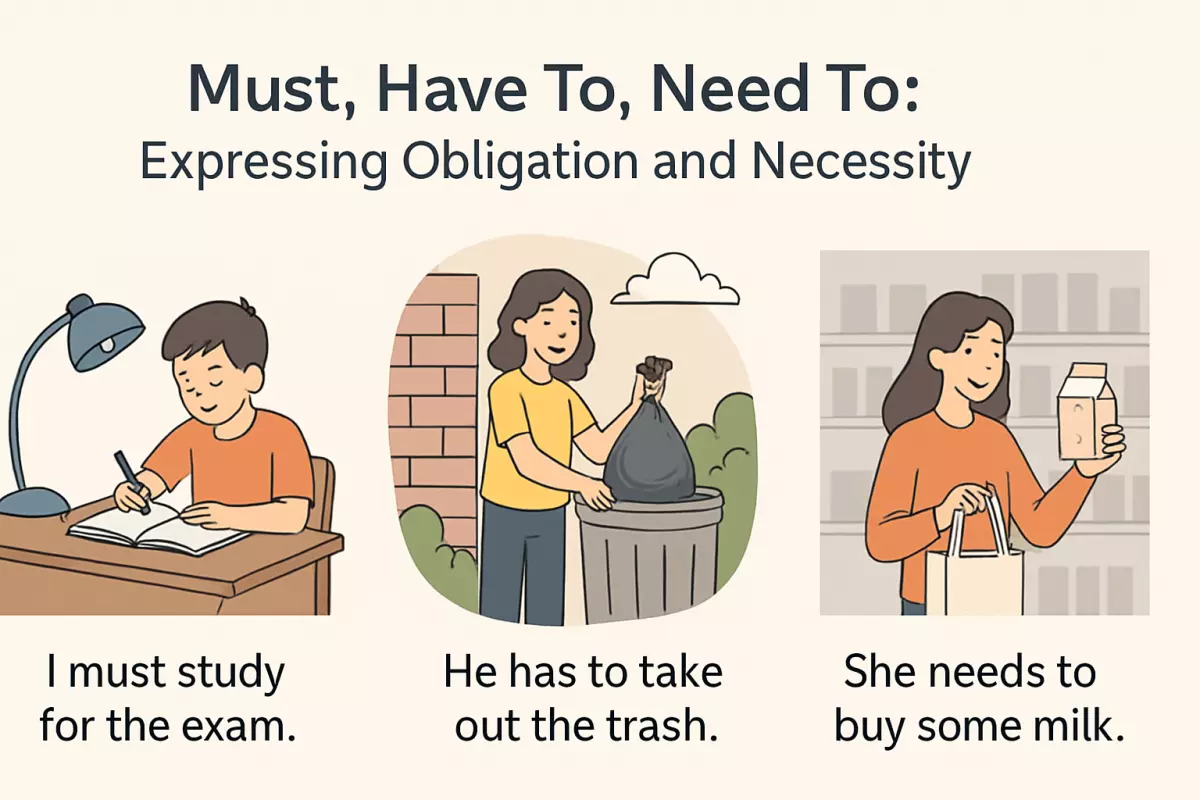
Using obligation and necessity correctly in English often comes down to choosing must, have to, or need to for the context. Must sounds strong and authoritative, often like a firm rule or the speaker’s insistence. Have to usually points to an external requirement, such as a law, schedule, or someone else’s decision. Need to is softer and practical, suggesting something is important or advisable rather than strictly enforced.
Different types of obligation and necessity
English uses several forms to show how strong a requirement is, who imposes it, and whether it feels like a rule, advice, or a practical need. Choosing between must, have to, and need to often depends on the source of the obligation (internal vs. external), the level of force, and the situation (formal rules vs. everyday planning).
How the source of the requirement changes the meaning
A useful way to think about these verbs is to ask: Where does the pressure come from? If it comes from the speaker’s judgment, must is common. If it comes from rules, schedules, or other people, have to is usually more natural. If it comes from practical necessity to achieve a goal, need to often fits best.
| Type | Typical meaning | Common form | Example |
|---|---|---|---|
| Speaker-imposed obligation | The speaker decides it is necessary; often sounds firm or urgent. | must | I must finish this report tonight. |
| External obligation (rules/authority) | A requirement comes from law, policy, instructions, or another person. | have to | You have to wear a helmet on site. |
| Practical necessity (goal-focused) | Necessary in order to do something successfully; often sounds neutral. | need to | We need to leave early to avoid traffic. |
| Strong prohibition | A clear “do not” rule; common in signs and formal instructions. | must not / mustn’t | You mustn’t enter this area. |
| No obligation (absence of requirement) | Something is optional; there is no rule forcing it. | don’t have to / don’t need to | You don’t have to bring anything. |
| Past obligation | A requirement existed in the past; must does not normally take a past form. | had to | We had to cancel the meeting. |
Patterns that signal strength and tone
Small changes in form often change how strict or polite the sentence sounds. These patterns are especially common in instructions, workplace communication, and everyday planning.
- Direct obligation: must / have to + base verb → “This is required.”
- Practical step: need to + base verb → “This is necessary to make it work.”
- Prohibition: must not + base verb → “This is forbidden.”
- No obligation: don’t have to / don’t need to + base verb → “It’s optional.”
- Softening the message: add time/condition phrases (e.g., today, before you leave, if you want to) to make the requirement sound more situational, not personal.
- Making it sound less like an order: use a reason clause (e.g., “because…”, “so that…”) to frame it as necessity rather than control.
High-value example set (quick recognition)
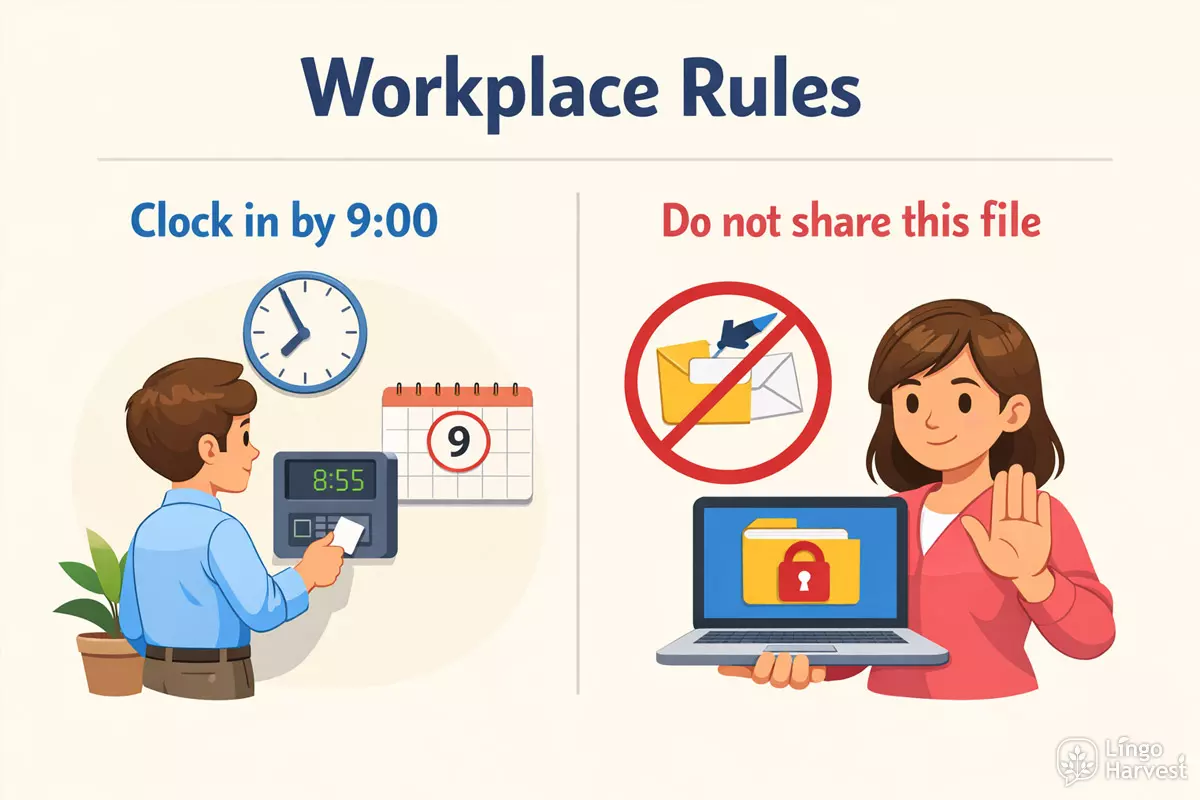
- I must remember to call her. (speaker’s strong intention)
- You have to show ID at reception. (rule)
- We need to update the password. (practical requirement)
- Employees have to clock in by 9:00. (policy)
- You mustn’t share this file externally. (prohibition)
- You don’t have to stay late. (no requirement)
- You don’t need to reply today. (optional; often sounds gentle)
- I had to take a detour because the road was closed. (past external situation)
- We have to renew the license every year. (ongoing obligation)
- I need to charge my phone before we leave. (practical necessity)
- You must be quiet in the library. (rule stated strongly)
- Do we have to print this, or can we email it? (checking requirement)
- I need to stop working so late. (self-directed necessity)
- Visitors must sign in. (formal instruction)
- You don’t have to explain if you’d rather not. (removing pressure)
Must vs have to: meaning differences
Must and have to can both express obligation, but they often differ in where the pressure comes from and how strong or formal the speaker sounds. In many contexts they are interchangeable, yet choosing one over the other can change the tone: must tends to feel more direct and speaker-driven, while have to often points to rules, circumstances, or external requirements.
| Focus | Must | Have to |
|---|---|---|
| Source of obligation | Often the speaker’s authority, judgment, or strong recommendation. | Often an external rule, schedule, law, or situation. |
| Typical tone | More forceful, formal, or urgent; can sound like an order. | More neutral and common in everyday speech. |
| Common use cases | Rules stated by the speaker; instructions; emphatic advice; notices. | Work/school requirements; legal rules; practical necessity; routines. |
| Negative meaning | must not = prohibition (not allowed). | don’t have to = no necessity (optional). |
| Past reference | Not used as a true past obligation; use had to instead. | had to is the normal past form for obligation/necessity. |
| Questions | Possible but can sound formal: “Must I…?” | More natural: “Do I have to…?” |
| Strength and emphasis | Often stronger; highlights importance from the speaker’s perspective. | Can be strong too, but usually feels factual: “This is required.” |
| Examples | “You must wear a helmet.” “I must apologize.” | “I have to submit the form by Friday.” “She has to work late.” |
Key contrast: prohibition vs lack of necessity
The biggest meaning difference appears in negative forms. Learners often confuse these because the grammar looks similar, but the meanings are not.
Must not (mustn’t) → it is forbidden: the action is not allowed.
Don’t have to (doesn’t have to) → it is not necessary: the action is optional.
Choosing the more natural option
In conversation, have to is often preferred because it sounds less like a command. Must is common in written rules, formal instructions, and strong personal statements. When you want to soften the message, switching from must to have to (or using a different modal like should) can reduce the force without changing the basic idea of obligation.
External vs internal obligation
When you talk about necessity, it helps to show where the pressure comes from: a rule, authority, schedule, or situation (outside), versus your own judgment, conscience, or preference (inside). English often signals this difference through the choice between must, have to, and need to, plus context.
How speakers typically frame the source
- Have to commonly points to an outside requirement (laws, workplace rules, instructions, circumstances).
- Must often sounds like the speaker is imposing the requirement (a strong personal stance, a firm instruction, or a formal written rule).
- Need to frequently expresses a practical necessity (what is required to achieve a goal), and can feel less forceful than must.
- In many everyday situations, must and have to can both be correct; the difference is usually about tone and perceived authority, not grammar.
Typical usage patterns (with examples)
- Outside rule/authority → have to: “Employees have to wear ID badges.”
- Outside schedule/circumstance → have to: “I have to leave early because the last train is at 10.”
- Speaker’s firm instruction → must: “You must submit the form by Friday.”
- Speaker’s strong personal conclusion → must: “I must remember to call her today.”
- Goal-based necessity → need to: “We need to back up the files before updating.”
- Polite workplace requests → need to: “You need to sign in at reception.”
- Formal notices → must: “Visitors must report to security.”
- Everyday obligation → have to: “I have to pay the rent on the first.”
- Self-imposed discipline → must: “I must stop checking my phone during meetings.”
- Practical requirement (not moral pressure) → need to: “You need to enter a password to continue.”
- Company policy explained neutrally → have to: “We have to verify your identity.”
- Strong warning → must: “You must not touch that wire.”
Negatives: different meanings to watch
- Must not / mustn’t = prohibition (it is not allowed): “You mustn’t park here.” ❌
- Don’t have to = no obligation (it is optional): “You don’t have to come early.” ✅
- Don’t need to = unnecessary (often similar to don’t have to, sometimes more about practicality): “You don’t need to print it; a screenshot is fine.”
- Avoid using mustn’t when you mean “not necessary.” For “not necessary,” use don’t have to or don’t need to.
Quick choice guide
- Choose have to when the obligation feels imposed by rules, authorities, or circumstances.
- Choose must when you want a stronger, more direct tone, or when the speaker is the source of the requirement.
- Choose need to when you want to emphasize necessity for a purpose, often with a slightly softer tone.
Need to and lack of necessity
Need to expresses that something is necessary to do. It often sounds practical and neutral, focusing on requirements, priorities, or what is required to achieve a result. In many contexts it is close in meaning to have to, but it can feel slightly less forceful and more “situation-based” than a command.
Core patterns with need to
Use these forms to talk about necessity in the present, past, and future:
- Affirmative: Subject + need to + base verb: I need to leave early.
- Negative: Subject + don’t/doesn’t need to + base verb: You don’t need to explain.
- Question: Do/Does + subject + need to + base verb?: Do we need to book a table?
- Past: Subject + needed to + base verb: They needed to reschedule.
- Future: Subject + will need to + base verb: You’ll need to show ID.
- Continuous (less common): be + needing to + base verb (often avoided; use need to instead): I need to talk to you is usually better than I’m needing to talk to you.
Talking about “no necessity”
To say something is not required, English typically uses don’t/doesn’t need to. This means the action is unnecessary, but it may still be possible or optional. Contrast this with mustn’t, which means prohibition (not allowed), not lack of requirement.
- ✅ No requirement: You don’t need to bring anything. (It’s optional.)
- ❌ Prohibition: You mustn’t bring food inside. (It’s not allowed.)
- ✅ Optional action: You don’t need to wait for me. (You can, but you don’t have to.)
- ❌ Wrong meaning: You mustn’t wait for me. (This sounds like you are forbidding waiting.)
Useful example sentences (common situations)
- I need to update my password.
- She needs to rest for a few days.
- We need to be there by nine.
- Do I need to fill out this form?
- He doesn’t need to come if he’s busy.
- You don’t need to apologize.
- They needed to raise prices last year.
- Did you need to call the bank?
- You’ll need to sign at the bottom.
- We won’t need to print the tickets.
- I need to stop working so late.
- Do we need to tell everyone now?
- You don’t need to answer right away.
- He didn’t need to buy a new laptop. (It wasn’t necessary; he bought one anyway.)
- She didn’t need to go to the office today.
- We may need to change the plan.
Past forms: “didn’t need to” vs “needn’t have”
English can distinguish between (1) something that was unnecessary in the past, and (2) something that was done but turned out to be unnecessary. The second meaning is often expressed with needn’t have + past participle (more common in British English).
- Unnecessary (and probably not done): We didn’t need to take a taxi. (A taxi was not required; the sentence does not say whether you took one.)
- Done but unnecessary: We needn’t have taken a taxi. → We took one, but it wasn’t necessary.
- Unnecessary action: He didn’t need to worry. (Worrying wasn’t required.)
- Worried but unnecessary: He needn’t have worried. (He worried, but there was no reason.)
Negatives and questions with obligation verbs
Forming negatives and questions with obligation language depends on the verb you choose. The biggest trap is meaning: mustn’t usually means “prohibited,” while don’t have to and don’t need to mean “not necessary.” Getting the auxiliary right (do/does/did) also matters because must behaves differently from have to and need to.
Negatives: prohibition vs. lack of necessity
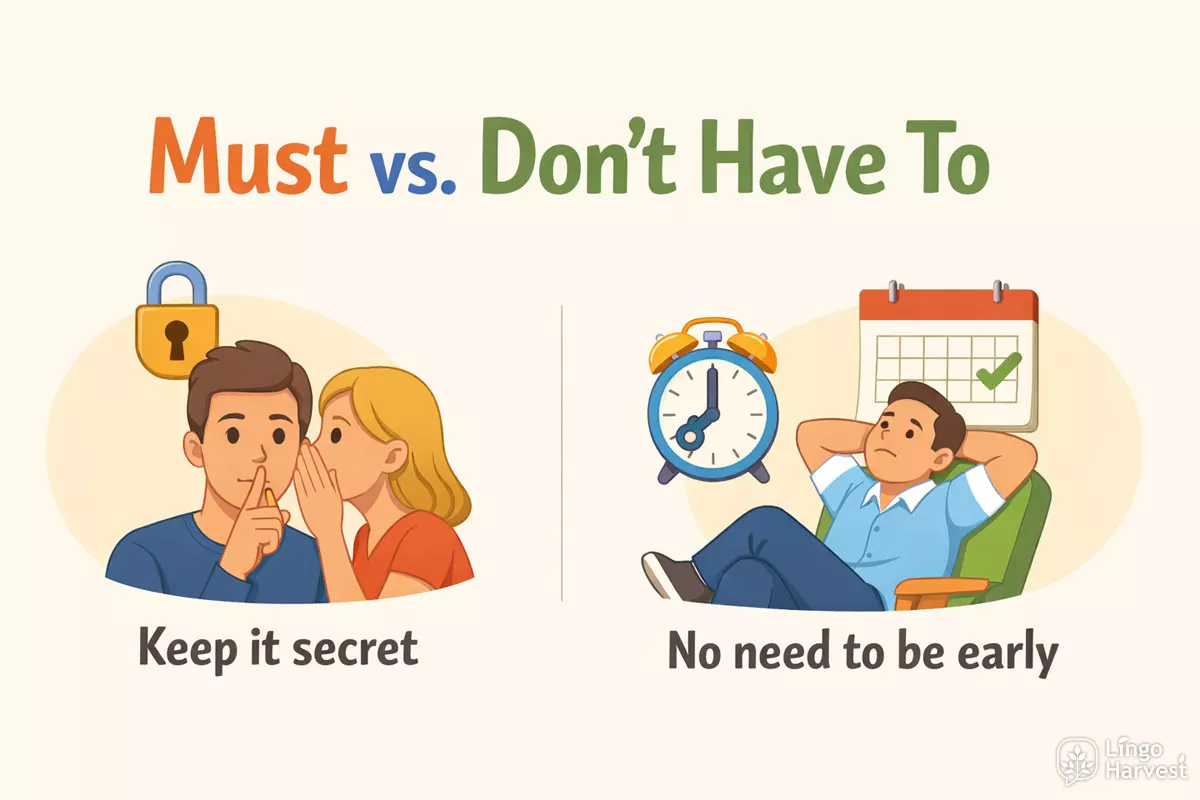
Use must not / mustn’t for rules and bans. Use don’t/doesn’t have to or don’t/doesn’t need to when something is optional.
- ❌ You mustn’t park here. → It is not allowed.
- ❌ Students mustn’t use phones during the exam. → Prohibited.
- ❌ You mustn’t tell anyone. → You are required to keep it secret.
- ✅ You don’t have to come early. → It isn’t necessary.
- ✅ She doesn’t have to wear a uniform. → No requirement.
- ✅ We didn’t have to pay for parking. → It wasn’t necessary (past).
- ✅ You don’t need to print it. → A digital copy is enough.
- ✅ He doesn’t need to explain. → No need.
- ✅ I didn’t need to call them. → It turned out unnecessary (past).
- ✅ You needn’t worry. → (More formal) It isn’t necessary to worry.
- ❌ We can’t have to redo everything. → (Common) It’s impossible that this is required.
- You don’t have to, but you can if you want. → Optional action.
Questions: asking about rules, requirements, and necessity
For have to and need to, questions use do/does/did. For must, questions invert directly (Must I…?). Choose the verb based on what you want to ask: official rules often sound natural with have to, while direct obligation can use must.
- Do I have to register in advance? → Asking about a requirement.
- Does she have to bring ID? → Present requirement for someone else.
- Did you have to work late yesterday? → Past requirement.
- Do we need to book a table? → Asking if it’s necessary.
- Does he need to sign this form? → Checking necessity.
- Did they need to change the plan? → Past necessity (whether it was necessary).
- Must I fill out every section? → Formal/direct obligation.
- Must we finish today? → Strong requirement (often from a rule or authority).
- Do I have to pay now, or can I pay later? → Requirement plus options.
- Do you need to leave so early? → Asking if it’s really necessary (can sound like mild surprise).
- Why do we have to do it this way? → Asking for the reason behind a rule.
- What do I need to bring? → Practical question about necessities.
Common meaning mistakes to avoid
These pairs look similar but communicate different obligations. Use the form that matches your intent.
- mustn’t (forbidden) → You mustn’t enter.
- don’t have to (not required) → You don’t have to enter.
- don’t need to (not necessary) → You don’t need to enter.
- didn’t have to (no requirement in the past) → We didn’t have to show tickets.
- didn’t need to (unnecessary action) → I didn’t need to buy one; I already had it.
Past and future forms of obligation
To talk about necessity in different time frames, English usually shifts away from must and relies on have to, need to, and set phrases like had to or will have to. The key is choosing a form that matches the time (past, present, future) and the source of the requirement (external rule vs. personal decision).
Past obligation: what was necessary
Must has no true past form for obligation, so past meaning is normally expressed with had to or needed to. Use had to for a required action in the past (often due to rules, circumstances, or someone else’s decision). Use needed to when you want to highlight necessity, often practical or goal-focused.
- had to + base verb → past requirement: “I had to leave early.”
- didn’t have to + base verb → no requirement (but it may still have happened): “We didn’t have to pay.”
- needed to + base verb → past necessity (often for a purpose): “She needed to rest after the trip.”
- didn’t need to + base verb → no necessity (and often implies it didn’t happen, depending on context): “You didn’t need to call.”
- needn’t have + past participle → it happened, but it was unnecessary: “You needn’t have waited.”
- was/were supposed to + base verb → expected duty (may or may not have happened): “I was supposed to submit it on Friday.”
- was/were meant to + base verb → intended requirement or plan: “The form was meant to include your address.”
- should have + past participle → past criticism/advice (not a strict requirement): “You should have told me earlier.”
- had to often sounds more factual than needed to: “We had to evacuate” (rule/circumstance) vs. “We needed to evacuate” (necessity for safety).
- For reported rules, had to is common: “They said we had to show ID.”
- For repeated past requirements, use had to: “When I was a student, I had to wear a uniform.”
- For one-time past necessity, both can work: “I had to/needed to replace my passport.”
Future obligation: what will be necessary
For future meaning, must can sound like a strong instruction, but it’s more common to use will have to for a neutral future requirement. Use need to for planned necessity or practical steps, especially in instructions and workplace contexts.
- will have to + base verb → future requirement: “You’ll have to sign in at reception.”
- won’t have to + base verb → no future requirement: “You won’t have to attend the meeting.”
- will need to + base verb → future necessity (often practical): “You’ll need to update your password.”
- going to have to + base verb → near-future requirement, often because of evidence now: “It’s broken—we’re going to have to replace it.”
- may have to / might have to + base verb → possible requirement: “We may have to postpone.”
- be to + base verb (formal) → scheduled duty/instruction: “All visitors are to wear badges.”
- must for future can sound like an order or strong insistence: “You must submit the form by Monday.”
- For polite planning, prefer will need to over must: “You’ll need to bring ID.”
- For external rules in the future, will have to is usually the safest choice: “We’ll have to follow the new policy.”
- For personal intention framed as necessity, need to fits well: “I need to cut down on sugar next month.”
Common pitfalls to avoid
- ❌ “I musted go.” → ✅ “I had to go.”
- ❌ Using didn’t have to to mean “it was unnecessary and I didn’t do it” (not always true). If you want to clearly say you did it unnecessarily, use needn’t have + past participle.
- ❌ Overusing must for future plans when you mean a neutral requirement. → Prefer will have to or will need to for most everyday situations.
Common learner confusion and fixes
Many mistakes with obligation language come from mixing up strength (rule vs. advice), source (speaker vs. law/company), and time (present vs. past). The fixes below focus on the patterns learners most often confuse.
1) Mixing “must” and “have to” in negative forms
The negative meanings are not the same, so swapping them can change the message completely.
| Form | Core meaning | Typical use | Example |
|---|---|---|---|
| mustn’t | Prohibition (it is not allowed) | Rules, safety, strong restrictions | You mustn’t park here. |
| don’t have to | No necessity (it is optional) | Permission to skip something | You don’t have to come early. |
| don’t need to | No necessity (often “not required”) | Informal, practical decisions | You don’t need to print it. |
| needn’t | No necessity (more formal/BrE) | Not required; sometimes polite | You needn’t worry. |
2) Using “must” for past obligation
Must has no simple past form for obligation. Use had to instead.
- ❌ Yesterday I must work late. → ✅ Yesterday I had to work late.
- ❌ Last year we must move. → ✅ Last year we had to move.
- ✅ I had to call the bank because my card stopped working.
- ✅ She didn’t have to attend the meeting, so she skipped it.
3) Confusing obligation with logical deduction (“must” = conclusion)
Must can mean “I’m sure this is true” (deduction), not “it’s required.” Context usually makes the difference.
- Obligation: You must wear a helmet on site. (a rule)
- Deduction: He must be on the train already. (a conclusion)
- Fix: If you can replace it with “I’m sure,” it is deduction, not necessity.
4) Overusing “must” in everyday conversation
In many situations, have to sounds more natural for routine requirements, while must can sound very strong or formal.
- More neutral: I have to pick up my sister at 6.
- Stronger/official: Passengers must show ID.
- Polite alternative: Do I have to fill this out now?
5) “Need to” vs. “have to”: requirement vs. practical necessity
Both can express necessity, but need to often focuses on what is necessary to achieve a goal, while have to often points to an external requirement.
- Goal-focused: We need to leave early to avoid traffic.
- Rule/requirement: We have to sign in at reception.
- Fix: Ask “Is this a rule, or just the best/necessary step?”
6) Form errors: auxiliaries, questions, and third person
Each verb follows different grammar patterns. These small form mistakes are common in speaking and writing.
- Must: no “to” and no “-s” → ✅ She must go now. ❌ She musts go.
- Have to: uses do/does in questions and negatives → ✅ Do you have to work tomorrow?
- Need to (main verb): uses do/does in questions and negatives → ✅ Do we need to book?
- ❌ Must to pay. → ✅ Must pay / have to pay.
- ❌ He don’t have to. → ✅ He doesn’t have to.
- ❌ Need you to go? → ✅ Do you need to go?
7) Choosing the wrong level of force in instructions
When giving directions, match the strength to the situation to avoid sounding too strict or too weak.
- Must: safety/strict rules → You must turn off the power first.
- Have to: standard procedure → You have to submit the form online.
- Need to: practical step → You need to restart the app.
- Don’t have to / don’t need to: optional → You don’t need to bring anything.
Homework: obligation verb practice tasks
Practice choosing between must, have to, and need to by focusing on meaning (rule vs. requirement vs. necessity), time (present/past/future), and form (negatives and questions). Complete the tasks in order; each one targets a common usage pattern.
Task 1: Choose the best verb (meaning first)
Complete each sentence with must, have to, or need to. Use the form that best matches the situation.
- Employees ______ wear an ID badge in the building. (company rule)
- I ______ call my bank today; my card was declined. (practical necessity)
- You ______ smoke here. (prohibition)
- We ______ leave early tomorrow because the train schedule changed. (external reason)
- To apply, you ______ submit two references. (requirement)
- I ______ finish this tonight; I promised my team. (speaker pressure)
- You don’t ______ bring food; we already ordered. (no necessity)
- Visitors ______ sign in at reception. (formal instruction)
- I ______ go now, or I’ll miss the last bus. (necessity)
- Students ______ complete the safety quiz before the lab. (rule)
- We ______ be quiet; the baby is sleeping. (speaker judgment)
- She ______ take a break; she’s been working for six hours. (advice-like necessity)
Show answers
- have to
- need to
- mustn’t
- have to
- have to
- must
- need to
- have to
- need to
- have to
- must
- needs to
Task 2: Rewrite to change the source of obligation
Rewrite each sentence twice:
- Version A: make it sound like a rule/authority requirement (use have to).
- Version B: make it sound like strong personal insistence (use must).
- I need to submit the form by 5 p.m.
- She needs to wear a helmet on site.
- We need to pay the fee before Friday.
- You need to turn off your phone during the exam.
- They need to show a ticket at the entrance.
- He needs to apologize to the client today.
Show answers
- A: I have to submit the form by 5 p.m. B: I must submit the form by 5 p.m.
- A: She has to wear a helmet on site. B: She must wear a helmet on site.
- A: We have to pay the fee before Friday. B: We must pay the fee before Friday.
- A: You have to turn off your phone during the exam. B: You must turn off your phone during the exam.
- A: They have to show a ticket at the entrance. B: They must show a ticket at the entrance.
- A: He has to apologize to the client today. B: He must apologize to the client today.
Task 3: Fix the form (questions, negatives, and tense)
Each sentence has a problem with grammar or natural usage. Rewrite it correctly.
- Do I must finish this today?
- I don’t must go to the meeting.
- Yesterday, we must work late.
- He musts wear glasses for driving.
- You have to not park here.
- She didn’t need to to call you.
- Must you to show your passport?
- I needed finish the report before noon.
- We don’t have to to pay in cash.
- You mustn’t to touch the equipment.
Show answers
- Do I have to finish this today?
- I don’t have to go to the meeting.
- Yesterday, we had to work late.
- He must wear glasses for driving.
- You mustn’t park here. / You can’t park here.
- She didn’t need to call you.
- Must you show your passport?
- I needed to finish the report before noon.
- We don’t have to pay in cash.
- You mustn’t touch the equipment.
Task 4: Mini-dialogues (choose the most natural option)
Select the best completion for each reply. Write A or B.
- A: “Is it compulsory to attend?” B: “Yes, you ______ attend.” (A: must / B: have to)
- A: “Is it necessary to attend?” B: “No, you don’t ______ attend.” (A: must / B: need to)
- A: “Why are you leaving?” B: “I ______ pick up my sister.” (A: have to / B: must)
- A: “Can I park here?” B: “No, you ______.” (A: don’t have to / B: mustn’t)
- A: “Do we ______ bring our own laptops?” (A: must / B: have to)
- A: “I’m exhausted.” B: “You ______ rest.” (A: must / B: have to)
- A: “The form is optional.” B: “So I don’t ______ fill it in?” (A: need to / B: must)
- A: “The rules changed.” B: “Then we ______ update the policy.” (A: have to / B: must)
Show answers
- B
- B
- A
- B
- B
- A
- A
- A
Task 5: Production (short writing)
Write one short paragraph (70–120 words) about rules and necessities in one context (workplace, school, travel, or health). Include:
- 2 sentences with have to for rules or official requirements.
- 2 sentences with need to for practical necessities.
- 1 sentence with must to show strong personal insistence.
- 1 negative sentence using don’t have to or don’t need to (no necessity).
- 1 negative sentence using mustn’t (prohibition).
Check your paragraph for these patterns: have to uses do/does in questions and negatives, must has no to, and past obligation is usually had to.