Might vs Could: Possibility and Probability Differences

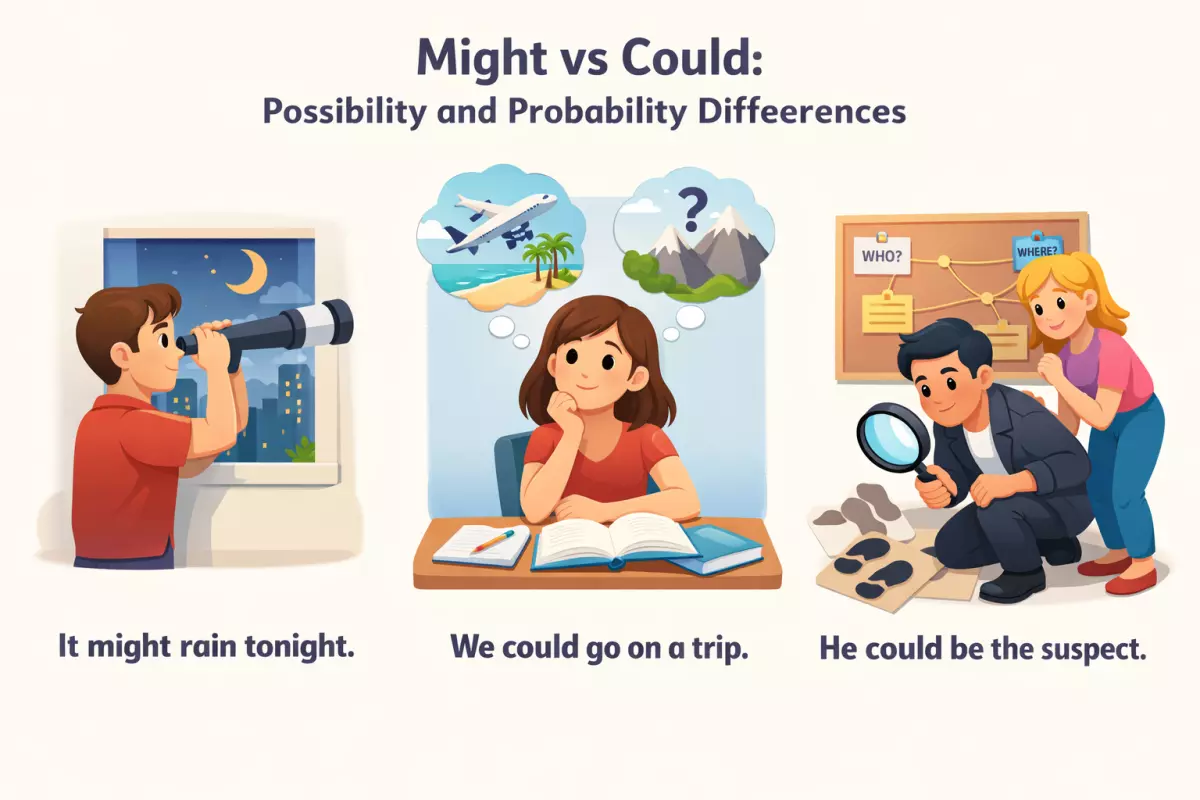 This article explains how English uses might and could for uncertainty, how might can sound less likely than could, and shows sentence comparisons that shift certainty. It covers cautious vs typical contexts, nuance when both fit, interchangeability in speech, and practice exercises.
- How English uses might and could to describe uncertain situations
- The subtle difference in probability when speakers choose might instead of could
- Sentence comparisons showing how each modal changes the level of certainty
- Typical contexts where might sounds more cautious than could
- Cases where both verbs appear possible but create different nuance
- How spoken English sometimes treats might and could as interchangeable
- Exercises and practice activities comparing might and could in context
In everyday English, choosing between might and could helps you express how likely something seems, not only whether it is possible. Might rain sounds more uncertain and leaves more room for doubt, while could rain suggests a real chance because conditions make it possible. Knowing the difference can make your advice, plans, and predictions clearer and more precise in daily conversation.
How English uses might and could to describe uncertain situations
In everyday English, might and could both help you talk about situations that are not certain. The difference is often about the speaker’s focus: might commonly signals a weak possibility, while could often highlights that something is possible because conditions allow it (and sometimes it suggests an alternative option).
Common patterns with might
Use might when you want to keep the claim cautious and avoid sounding too confident. It fits well with guesses, predictions, and tentative explanations.
- might + base verb: “I might go later.” (a tentative plan)
- might not + base verb: “She might not agree.” (uncertain negative)
- might be + -ing: “They might be waiting outside.” (uncertain ongoing situation)
- might have + past participle: “He might have missed the train.” (uncertain past)
- might have been + -ing: “I might have been overreacting.” (uncertain past-in-progress)
- might + adverbs of uncertainty: “It might possibly snow.” (extra caution)
- might for polite, low-pressure suggestions: “You might try restarting it.”
- might to soften disagreement: “That might not be the best approach.”
Common patterns with could
Use could when you want to emphasize that something is within the range of possibility, often because circumstances make it feasible. It also works well when presenting options.
- could + base verb: “We could take a taxi.” (an available option)
- could not / couldn’t + base verb: “It couldn’t work without power.” (impossibility under the conditions)
- could be + -ing: “She could be driving right now.” (one plausible explanation)
- could have + past participle: “They could have left early.” (plausible past scenario)
- could have been + -ing: “He could have been sleeping.” (plausible past-in-progress)
- could for general possibility: “Prices could rise this year.”
- could to introduce alternatives: “We could email them, or we could call.”
- could to show a possible cause: “That could explain the delay.”
Choosing between them in typical uncertain scenarios
In many contexts, both are acceptable, but the nuance changes. Might tends to sound more tentative, while could often sounds like “this is a real possibility given what we know.”
- Weak guess vs. plausible explanation: “It might be a mistake” (very cautious) vs. “It could be a mistake” (a realistic possibility).
- Prediction: “The meeting might run late” (uncertain) vs. “The meeting could run late” (conditions suggest it’s possible).
- Plans: “I might go” (not decided) vs. “I could go” (I’m able to go; it’s an option).
- Offering choices: “You might take the bus” (a gentle suggestion) vs. “You could take the bus” (a clear option).
- Past uncertainty: “She might have forgotten” (speculation) vs. “She could have forgotten” (one plausible reason among others).
Accuracy notes and common learner errors
- ✅ “It might rain.” / “It could rain.” → both are natural for uncertain weather.
- ❌ “It might can rain.” → avoid stacking modals; use one: “It might rain” or “It could rain.”
- ✅ “He might not come.” → place not after the modal.
- ✅ “They could have arrived already.” → use could have + past participle for uncertain past.
- ❌ “They could arrived already.” → missing have; correct: “could have arrived.”
- ✅ “You might want to check the settings.” → common soft-advice pattern.
The subtle difference in probability when speakers choose might instead of could

When speakers pick might rather than could, they often signal a smaller, less committed chance. Might tends to keep the speaker at a distance from the outcome (“this is possible, but I’m not leaning strongly either way”), while could often frames the situation as a realistic option among others (“this is one plausible outcome or ability/condition”). The difference is subtle, but it shows up in predictable patterns.
How the probability “feels” in common contexts
- Neutral possibility vs. plausible option: might sounds more tentative; could often sounds a bit more “on the table” as a real scenario.
- Speaker commitment: might reduces commitment (“I’m not sure”); could can sound like the speaker sees a credible pathway.
- One outcome vs. multiple outcomes: could frequently implies “one of several possible results,” especially when listing alternatives.
- Evidence level: might fits when evidence is thin or mixed; could fits when there’s a clear mechanism or known precedent.
- Planning talk: could is common when discussing options or proposals; might is common when discussing uncertain developments.
- Warnings and risk: could often appears in cautions about realistic risks (“It could break”); might can sound more speculative (“It might break”).
Usage patterns that push speakers toward one choice
- Option framing: “We could take the train” (a workable plan) vs. “We might take the train” (a tentative idea, not decided).
- Cause-and-effect reasoning: “If we leave now, we could catch the 6:10” (a reachable outcome) vs. “If we leave now, we might catch the 6:10” (less confidence about timing).
- Predictions: “Sales could rise next quarter” often suggests identifiable factors; “Sales might rise next quarter” stays more cautious.
- Permission/ability readings: could easily shifts to ability/permission (“I could help tomorrow”); might generally does not carry that meaning in modern usage.
- Polite suggestions: “You could try restarting it” is a gentle recommendation; “You might try restarting it” is also polite but can sound more tentative or indirect.
- Counterfactual or remote scenarios: “That could happen” usually treats it as a real possibility; “That might happen” can sound more remote.
- Hedging in formal writing: might is a common hedge when the writer wants to avoid overstating a conclusion.
Example pairs (same situation, different probability signal)
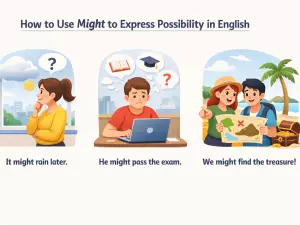
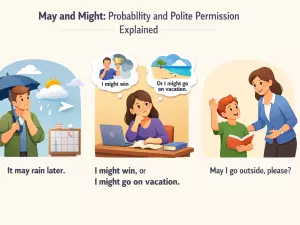
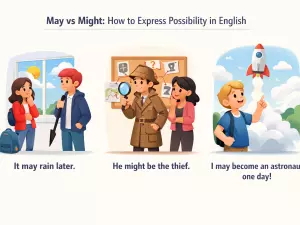
- “It might rain later” (uncertain forecast) vs. “It could rain later” (a plausible outcome among others).
- “She might be at the office” (guessing) vs. “She could be at the office” (one reasonable location).
- “This might be the wrong file” (low confidence) vs. “This could be the wrong file” (a credible concern).
- “They might cancel” (no strong evidence) vs. “They could cancel” (conditions make cancellation realistic).
- “We might need more time” (tentative) vs. “We could need more time” (possible given constraints; often used when explaining risks).
- “He might not agree” (soft prediction) vs. “He could not agree” (less common in this meaning; can sound like ability/permission or a formal structure).
- “It might work” (uncertain result) vs. “It could work” (workable approach, worth trying).
- “That might be true” (careful hedge) vs. “That could be true” (acknowledging it as a plausible explanation).
- “The delay might be due to traffic” (one tentative cause) vs. “The delay could be due to traffic” (one plausible cause among several).
- “You might want to double-check the address” (polite nudge) vs. “You could double-check the address” (option offered, slightly more direct).
- “I might go” (undecided) vs. “I could go” (available/able; sometimes implies “if needed”).
- “The results might change” (uncertain) vs. “The results could change” (realistic possibility given known factors).
In many everyday sentences, both words are grammatically fine, and context does most of the work. Still, choosing might typically lowers the speaker’s implied confidence, while choosing could often presents the outcome as a more concrete possibility or a practical option.
Sentence comparisons showing how each modal changes the level of certainty
Choosing between might and could changes the listener’s expectation. In many contexts, might signals a weaker, more tentative guess, while could often highlights that something is realistically possible (sometimes because conditions or ability make it feasible). The pairs below show how meaning shifts with the same situation.
| Using might (more tentative) | Using could (more “realistic possibility” / ability) | What changes in certainty or focus |
|---|---|---|
| It might rain this afternoon. | It could rain this afternoon. | Might sounds like a cautious guess; could sounds like a plausible outcome among others. |
| She might be at home. | She could be at home. | Might = uncertain location; could = one reasonable option (not ruled out). |
| They might miss the train. | They could miss the train. | Could often implies conditions make it possible (traffic, delays); might is a softer prediction. |
| I might go to the meeting. | I could go to the meeting. | Might suggests indecision; could suggests availability/ability (it’s an option). |
| He might know the answer. | He could know the answer. | Might is a guess about knowledge; could can sound like “it’s possible he knows” based on what you know about him. |
| The package might arrive tomorrow. | The package could arrive tomorrow. | Could fits when delivery windows allow it; might is more tentative about timing. |
| This might be the right file. | This could be the right file. | Might = weak confidence; could = one candidate among several. |
| We might need more time. | We could need more time. | Might is a cautious warning; could implies a foreseeable scenario if things go a certain way. |
| There might be a mistake in the report. | There could be a mistake in the report. | Could often sounds slightly more “worth checking”; might keeps the claim softer. |
| He might have forgotten. | He could have forgotten. | Both are past possibility; could can imply a reasonable explanation, not just a vague guess. |
| She might have taken the earlier bus. | She could have taken the earlier bus. | Might have = uncertain reconstruction; could have = one feasible past option. |
| The noise might be coming from the pipes. | The noise could be coming from the pipes. | Could often introduces a plausible cause to investigate; might sounds less committed. |
| I might be late. | I could be late. | Might = tentative warning; could often implies circumstances make lateness possible (traffic, delays). |
| The results might change. | The results could change. | Could suggests change is a real possibility given the process; might is more hedged. |
| That might work. | That could work. | Could often sounds more encouraging (“it’s viable”); might sounds less confident. |
| He might not agree. | He could not agree. | Might not = possible refusal; could not is often read as inability (“cannot”) unless context clearly signals possibility. |
Patterns to notice in these pairs
- Might commonly softens a claim when you have limited evidence: it keeps the probability low or unspecified.
- Could often points to a concrete option or a condition-based possibility: it can sound slightly more “actionable” or “feasible.”
- In warnings and forecasts, could frequently implies “this can happen given the situation,” while might implies “this is one guess.”
- With negatives, be careful: might not clearly means “possibly not,” but could not can easily be understood as “was not able to / cannot.”
Typical contexts where might sounds more cautious than could
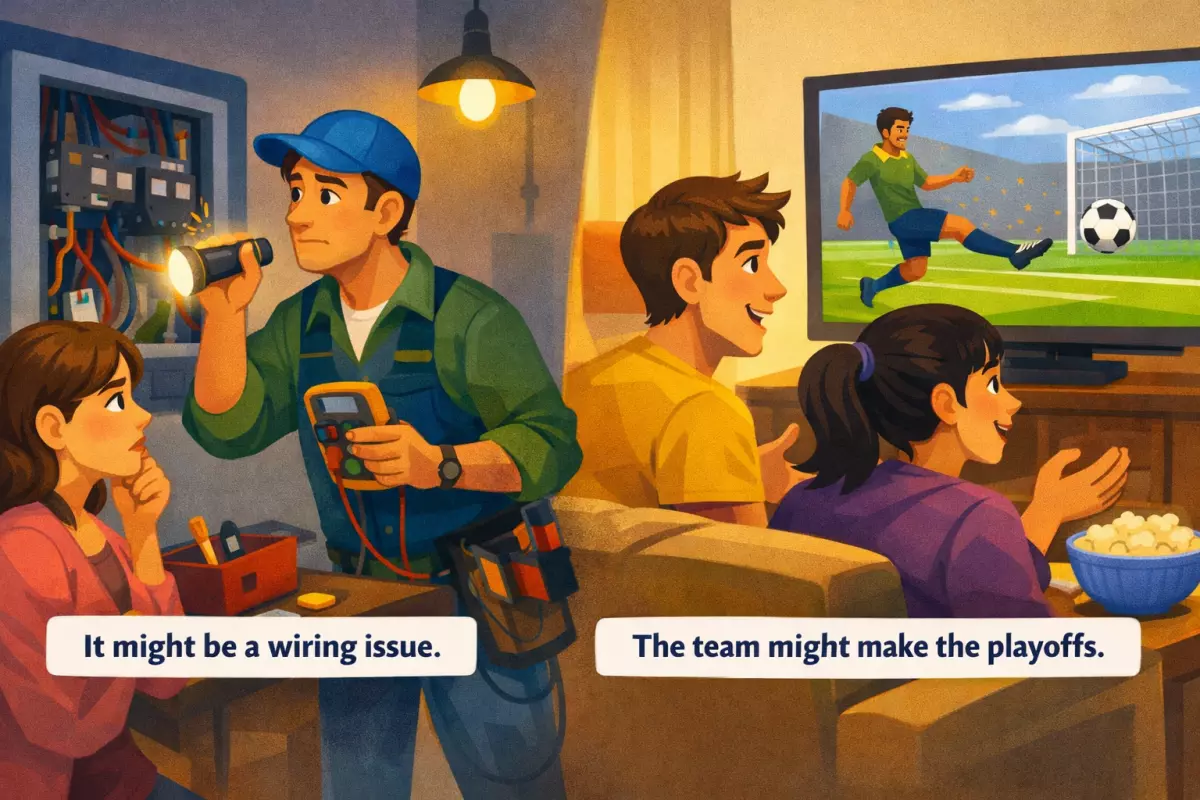
Use might when you want to keep the claim small and avoid sounding too sure. In many everyday situations, could suggests a more open or practical possibility, while might signals “this is only one possible outcome” and leaves more room for doubt.
Common situations where speakers choose might to soften certainty
- Speculating with limited evidence: “It might be a wiring issue.” (careful diagnosis) vs. “It could be a wiring issue.” (more neutral, often slightly broader)
- Early-stage predictions: “Sales might dip in Q3.” (tentative forecast) vs. “Sales could dip in Q3.” (a plausible scenario, sometimes read as more actionable)
- Hedging in professional writing: “This might indicate a correlation.” (academic caution) vs. “This could indicate a correlation.” (still cautious, but often a touch firmer)
- Giving advice without sounding pushy: “You might want to back up your files.” (gentle suggestion) vs. “You could back up your files.” (one option among others)
- Delivering bad news carefully: “There might be a delay.” (softens impact) vs. “There could be a delay.” (more matter-of-fact)
- Uncertain availability or plans: “I might be late.” (not sure yet) vs. “I could be late.” (possible due to conditions, sometimes implies a reason like traffic)
- Polite refusals and non-commitment: “I might not be able to make it.” (less direct) vs. “I couldn’t make it.” (stronger, often final)
- When you want to avoid implying ability: “It might rain.” (pure possibility) vs. “It could rain.” (also possibility, but can feel more “it’s within the range of outcomes”)
- Discussing sensitive causes: “This might be related to stress.” (careful) vs. “This could be related to stress.” (slightly more diagnostic)
- Legal/HR wording and risk statements: “This might result in disciplinary action.” (hedged) vs. “This could result in disciplinary action.” (often used in formal warnings; can sound more direct)
- Talking about rumors or secondhand info: “He might have resigned.” (speaker distances themselves) vs. “He could have resigned.” (possible, sometimes invites alternative explanations)
- Uncertain interpretations of behavior: “She might be upset.” (tentative reading) vs. “She could be upset.” (possible; can sound a bit more analytical)
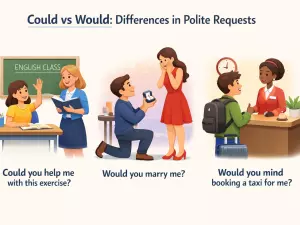
- Softening requests: “Might I ask a question?” (very formal/polite) vs. “Could I ask a question?” (polite, more common)
- Leaving room for multiple outcomes: “The fix might work, but we should test it.” (explicit caution) vs. “The fix could work…” (often reads as more optimistic)
- When you want to avoid sounding like you’re proposing a plan: “We might need to postpone.” (cautious signal) vs. “We could postpone.” (sounds like a concrete option)
Useful patterns that naturally sound cautious with might
- might + be + adjective/noun: “It might be unnecessary.” / “That might be a mistake.”
- might + verb: “I might call later.” / “They might disagree.”
- might not for gentle uncertainty: “It might not be enough.”
- might have + past participle for uncertain past: “She might have missed the email.”
- might need / might want to soften recommendations: “You might need more time.” / “You might want to restart it.”
In practice, both modals can be polite and non-absolute, but might is a reliable choice when the goal is to sound careful, avoid overcommitting, or present a possibility as tentative rather than actionable.
Cases where both verbs appear possible but create different nuance
In many sentences, might and could are both grammatically acceptable, but they guide the listener toward different interpretations. A useful shortcut is: might often frames a situation as uncertain or speculative, while could often highlights ability, a workable option, or a condition that makes something possible.
Common patterns where the meaning shifts
- Prediction vs. potential option
“It might rain later.” (speaker is unsure; forecasting)
“It could rain later.” (rain is one possible outcome among others; “it’s possible”) - Weak commitment vs. feasible plan
“I might go to the meeting.” (undecided; low commitment)
“I could go to the meeting.” (it’s feasible; schedule/ability allows it) - Speculation about causes vs. identifying a candidate cause
“The noise might be the heater.” (guessing)
“The noise could be the heater.” (one plausible explanation; invites checking) - Uncertain outcome vs. capability under conditions
“This might work.” (uncertain result)
“This could work.” (it has the potential to work, especially if conditions are met) - Permission/soft suggestion vs. offering an option
“You might try restarting your phone.” (gentle suggestion; less direct)
“You could try restarting your phone.” (clear option in a set of possible actions) - Hedged advice vs. practical recommendation
“You might want to back up your files.” (polite warning; indirect)
“You could back up your files.” (one action you can take; less “warning” tone) - Possibility (uncertain) vs. possibility (conditional)
“We might finish today.” (depends; speaker not confident)
“We could finish today.” (possible if time/resources align; implies a route to success) - Speculative interpretation vs. alternative interpretation
“He might mean the earlier version.” (guess about intention)
“He could mean the earlier version.” (one interpretation among several) - Low-probability feel vs. “not impossible” feel
“They might win.” (sounds more doubtful in many contexts)
“They could win.” (emphasizes that winning is within reach) - Uncertain memory vs. acknowledging a possible memory
“I might have met her before.” (not sure; hazy recollection)
“I could have met her before.” (it’s plausible; circumstances allow it) - Polite refusal/hesitation vs. constraints
“I might not be able to help.” (softens refusal; leaves room)
“I couldn’t help.” / “I could not help.” (stronger; focuses on inability or impossibility) - Speculation about reactions vs. potential reactions
“She might be upset.” (speaker’s guess about her state)
“She could be upset.” (one plausible state; suggests multiple explanations) - Uncertain timing vs. available timing
“I might call you tonight.” (unsure whether it will happen)
“I could call you tonight.” (tonight is an available slot; an option) - Soft warning vs. risk framing
“That might cause problems.” (cautious; less forceful)
“That could cause problems.” (highlights risk/possible consequence more directly) - Hedged claim vs. logical possibility
“This might be true.” (speaker uncertain)
“This could be true.” (logically possible; not ruled out)
Quick usage cues
- Choose might when you want to sound tentative, noncommittal, or when you’re simply guessing.
- Choose could when you want to emphasize a workable option, a plausible explanation, or a condition-based possibility.
- In suggestions, might tends to be softer; could tends to be more practical and option-focused.
How spoken English sometimes treats might and could as interchangeable
In everyday conversation, speakers often choose might or could without a sharp difference in meaning, especially when they simply want to signal uncertainty. The result is that both verbs can function as a general “maybe,” and listeners usually understand the intended message from context, tone, and follow-up details.
Where the overlap is most common
Interchangeability shows up most when the speaker is not emphasizing ability or a specific condition, but is just leaving the outcome open. These are typical situations where either choice sounds natural:
- Casual predictions: “It might rain later” / “It could rain later.”
- Speculating about someone’s location: “She might be at work” / “She could be at work.”
- Guessing reasons: “He might be tired” / “He could be tired.”
- Uncertain plans: “I might go out tonight” / “I could go out tonight.”
- Softening opinions: “That might be a problem” / “That could be a problem.”
- General possibility in the future: “We might see delays” / “We could see delays.”
- Low-commitment suggestions: “We might try a different approach” / “We could try a different approach.”
- Explaining a result without details: “It might cause errors” / “It could cause errors.”
- Talking about unknown outcomes: “This might work” / “This could work.”
- Speculating about what happened: “They might have missed the bus” / “They could have missed the bus.”
- Hedged advice: “You might want to back up your files” / “You could back up your files.”
- Uncertain timing: “I might be late” / “I could be late.”
Patterns that make them feel interchangeable
Some sentence shapes encourage the “either one works” effect because they focus on uncertainty rather than on ability or permission.
- “It might/could + verb”: “It might take longer” / “It could take longer.”
- “That might/could be + noun/adjective”: “That might be true” / “That could be true.”
- “Subject might/could + verb”: “They might cancel” / “They could cancel.”
- Perfect forms for past guesses: “might have + past participle” / “could have + past participle” (e.g., “might have left,” “could have left”).
- Question forms used for gentle probing: “Could that be the issue?” and (less common but possible) “Might that be the issue?”
- With “maybe” already present: “Maybe it might…” / “Maybe it could…” (often redundant, but common in speech).
When spoken English still tends to separate them
Even in conversation, there are recurring moments where many speakers prefer one over the other. These preferences help explain why the verbs are not fully identical.
- Ability or practical capacity often pulls toward could: “I could lift it” (ability) is more natural than “I might lift it” (uncertain intention).
- Permission is typically expressed with could: “Could I leave early?” is standard; “Might I leave early?” sounds formal.
- Polite, formal requests can use might, but it’s less common in casual speech: “Might I ask a question?”
- Regret or criticism about the past often uses could have to imply a missed option: “You could have told me” (you had the chance). Using “might have told me” changes the meaning to uncertainty about whether it happened.
- Conditional planning often favors could when the speaker is presenting an option: “If we leave now, we could catch the train.”
- Very cautious probability often favors might when the speaker wants to sound especially non-committal: “It might be worth waiting.”
In short, casual speech frequently treats both as a flexible marker of uncertainty, but context still nudges the choice: could commonly signals an available option or capability, while might often signals a more tentative stance.
Exercises and practice activities comparing might and could in context
Choose between might and could by checking what the speaker is doing: estimating likelihood (might) or pointing to a possible option/ability/opportunity (could). In many sentences both are grammatically possible, but the meaning shifts: might sounds more like a prediction; could sounds more like “one possible path.”
1) Quick choice: pick the best modal
- It’s getting dark. We ______ miss the last bus if we don’t leave now.
- If you want, you ______ take a taxi instead of waiting.
- She ______ be at the office already, but I’m not sure.
- With a little help, he ______ finish the report today.
- Don’t open that email. It ______ be a phishing attempt.
- We ______ meet on Thursday, or we can move it to Friday.
- That noise ______ be the radiator; it does that in winter.
- You ______ try restarting the router first.
- They ______ not agree to the new terms, so have a backup plan.
- After the storm, the roads ______ be blocked.
- If the train is delayed, we ______ share a ride.
- He’s not answering. His phone ______ have died.
Show answers
- might
- could
- might
- could
- might
- could
- might
- could
- might
- might
- could
- might
2) Meaning shift: both work, but the focus changes
Rewrite each sentence twice: once with might (uncertain prediction) and once with could (possible option/cause). Keep the rest of the sentence the same unless you need a small adjustment for naturalness.
- We ______ get there early if traffic is light.
- This ______ be the wrong address.
- I ______ help you after lunch.
- She ______ be late because of the snow.
- They ______ cancel the event.
- You ______ ask for a refund.
- He ______ be joking.
- The meeting ______ run over.
Show answers
- might get there early (prediction); could get there early (possible outcome/ability depending on context)
- might be the wrong address (speaker suspects); could be the wrong address (one possible explanation)
- might help you after lunch (uncertain plan); could help you after lunch (availability/offer)
- might be late because of the snow (likely enough to mention); could be late because of the snow (one possible reason)
- might cancel the event (uncertain decision/outcome); could cancel the event (it’s an option they may choose)
- might ask for a refund (possible action); could ask for a refund (suggested option)
- might be joking (speaker’s guess); could be joking (one possible interpretation)
- might run over (prediction); could run over (possible outcome)
3) Error check: correct the sentences
Each item has a problem with meaning or form. Rewrite it so it sounds natural in standard English.
- ❌ If you’re tired, you might take a break now. (intended meaning: suggestion)
- ❌ He could be at home yesterday. (intended meaning: past possibility)
- ❌ I might to call you later. (intended meaning: uncertain plan)
- ❌ Could you be sick, so you should see a doctor. (intended meaning: uncertain cause + advice)
- ❌ We might not can park here. (intended meaning: uncertain permission/possibility)
- ❌ She could comes tomorrow. (intended meaning: possible plan)
- ❌ It might be rain later. (intended meaning: possible weather)
- ❌ They could have arrive already. (intended meaning: past possibility)
Show answers
- ✅ If you’re tired, you could take a break now.
- ✅ He might have been at home yesterday. / He could have been at home yesterday.
- ✅ I might call you later.
- ✅ You might be sick, so you should see a doctor. / If you might be sick, you should see a doctor.
- ✅ We might not be able to park here.
- ✅ She could come tomorrow.
- ✅ It might rain later.
- ✅ They could have arrived already.
4) Mini-dialogues: choose the modal that matches the situation
Pick might when the speaker is unsure about what is true or what will happen; pick could when the speaker is offering, suggesting, or naming an available option.
- A: Where’s Dana? B: She ______ be in a meeting; her calendar is blocked.
- A: We’re out of milk. B: I ______ stop by the store on my way home.
- A: Should we email or call? B: We ______ call first, then email if there’s no answer.
- A: Why is the app crashing? B: It ______ be the latest update; a few people reported bugs.
- A: Are you joining us tonight? B: I ______, but I’m waiting to hear back from work.
- A: How do we fix this? B: We ______ roll back to the previous version.
Show answers
- might
- could
- could
- might
- might
- could
5) Production task: write your own pairs
- Write 5 sentences with might about uncertain facts (where someone is, what caused something, what will happen).
- Write 5 sentences with could that present options (suggestions, offers, alternative plans).
- For each pair, underline the clue words that pushed your choice (for example: “not sure,” “maybe,” “if you want,” “we can,” “one option is”).
- Optional challenge: convert two might sentences into could sentences and explain the meaning change in one short line.