Using May for Formal Permission in English

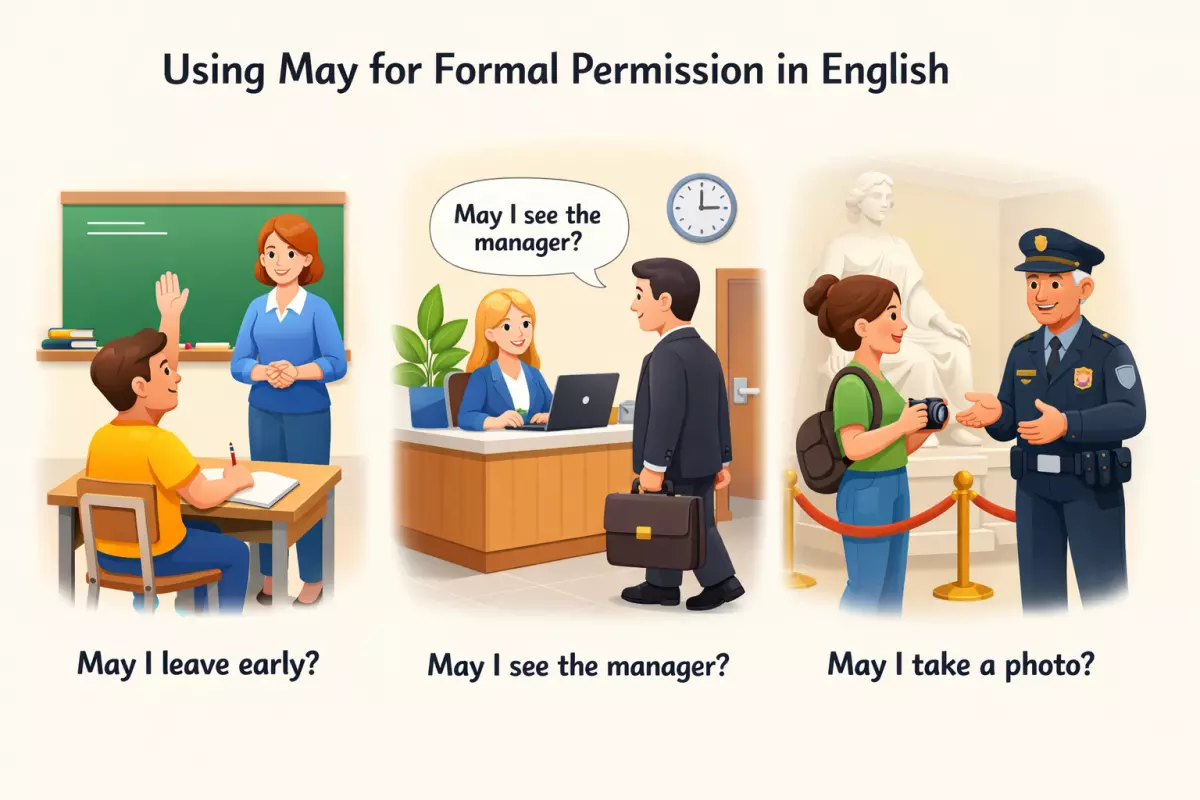 This article explains why may became the traditional verb for permission, where it still fits best in formal English, and how may questions differ from everyday can requests. It gives classroom, office, and announcement examples, notes modern spoken alternatives, covers negatives, and includes practice exercises.
- Why may became the traditional modal verb for permission
- Contexts where may is preferred in formal English
- How permission questions with may differ from everyday requests with can
- Typical examples from classrooms, offices, and formal announcements
- How modern spoken English sometimes replaces may with other modals
- How negative forms affect the meaning of permission
- Exercises and practice activities using may in formal permission contexts
May is a reliable choice for polite, formal requests in English. You will hear it in offices, interviews, and customer service because it sounds respectful without being stiff. This guide explains how to use may to ask permission, how it differs from can and could, and how to reply naturally in everyday situations while keeping your tone clear and professional.
Why may became the traditional modal verb for permission
May settled into the “polite permission” role because it fits a specific social pattern: the speaker asks for approval while keeping the request indirect and respectful. Over time, that indirectness became associated with formal situations (schools, workplaces, official interactions), so may started to sound like the default choice when you want to be careful, deferential, or rule-aware.
How usage patterns pushed may toward formal permission
- It frames permission as the listener’s authority. “May I…?” treats the other person as the decision-maker, which matches formal settings where roles matter.
- It avoids sounding demanding. Compared with more direct forms, may keeps the request at arm’s length and reduces pressure.
- It became a classroom and etiquette standard. Many learners were explicitly taught “May I…?” for asking to do something, reinforcing it as the “correct” polite pattern.
- It aligns with rule-based contexts. In signs, instructions, and policies, may expresses what is allowed, so it naturally connects to permission language.
- It stays neutral about willingness. “May I leave?” focuses on authorization, not on whether the speaker wants to leave or is able to leave.
- It works well with formal vocabulary. Words like “request,” “permission,” “authorized,” and “permitted” sit comfortably alongside may in official tone.
- It supports hedging and softening. “May I ask…?” and “May we discuss…?” let speakers introduce sensitive topics politely.
- It fits institutional English. Legal, administrative, and academic writing often uses may to state permitted actions, which feeds back into spoken formality.
Common permission frames that kept may in place
- May I + base verb: “May I enter?” “May I speak?”
- May we + base verb: “May we begin?” “May we proceed?”
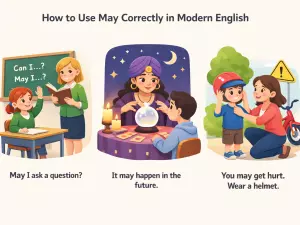
- May I ask + question: “May I ask your name?” “May I ask a quick question?”
- May I have + noun: “May I have your attention?” “May I have a copy?”
- May I speak to + person: “May I speak to the manager?”
- You may + base verb (granting permission): “You may leave now.” “You may use a calculator.”
- May + be allowed/permitted: “Visitors may be permitted with approval.”
- May not (prohibition in formal rules): “Students may not bring food into the lab.”
- May I + adverb (extra politeness): “May I briefly respond?” “May I respectfully disagree?”
- May I + please + base verb (very polite, sometimes old-fashioned): “May I please see your ID?”
- ✅ “May I sit here?” → permission-focused
- ❌ “May I can sit here?” → avoid stacking modals; use one modal only
Because these frames are short, repeatable, and clearly tied to authorization, they became easy to teach and easy to recognize. That consistency is a major reason may still signals formal permission even when other options (like can or could) are common in everyday speech.
Contexts where may is preferred in formal English
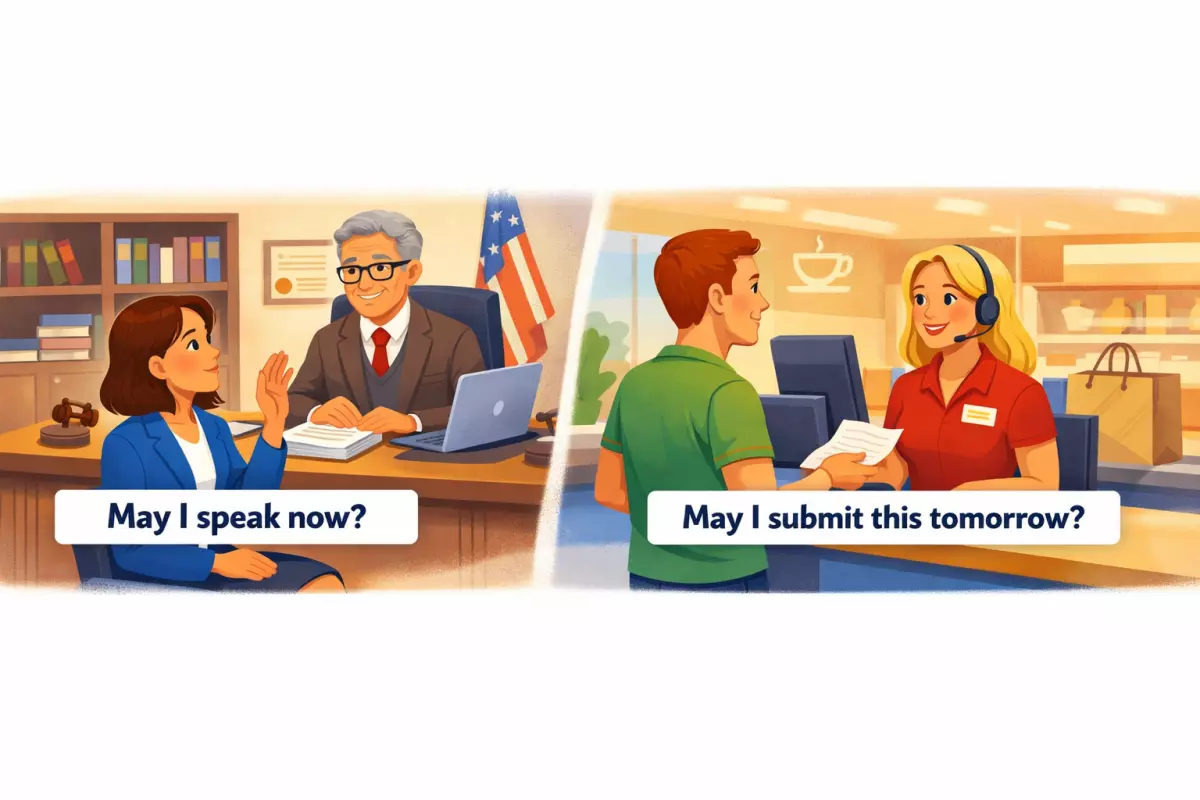
In more formal settings, may is often chosen because it signals polite permission without sounding overly casual or assuming closeness. It is especially common when the speaker is requesting approval, granting authorization, or writing in an official tone where careful wording matters.
Situations where may is the natural choice
- Official requests to a person with authority (manager, examiner, chair, judge): “May I speak now?” “May I submit this tomorrow?”
- Customer-facing service language that aims for courtesy: “May I take your name?” “May I help you with anything else?”
- Formal meetings and hearings where turn-taking is controlled: “May I respond to that point?” “May I ask a clarifying question?”
- Academic and professional emails when asking for approval or access: “May I request an extension?” “May I have permission to use your data?”
- Policies, notices, and compliance language that grants permission under conditions: “Visitors may enter only with identification.”
- Legal or contractual wording to indicate what is permitted: “The tenant may terminate the agreement with notice.”
- Institutional instructions (schools, labs, libraries) where rules are explicit: “Students may use calculators approved by the department.”
- Formal interviews (job, research, media) when requesting to proceed: “May I ask about your previous role?”
- Requests involving personal boundaries where extra politeness is expected: “May I sit here?” “May I look at the document?”
- Permission to begin or continue an action in structured settings: “May we begin?” “May I continue?”
- Written invitations and RSVP-style messages that keep a respectful tone: “You may bring a guest.”
- Medical or care contexts when asking consent in a professional manner: “May I examine your arm?”
Common patterns that sound appropriately formal
- May I + base verb: “May I leave early?” “May I reschedule?”
- May we + base verb (group permission): “May we proceed to the next item?”
- May I have + noun (requests for items/information): “May I have a copy?” “May I have your signature?”
- May I ask + question: “May I ask why the deadline changed?”
- You may + base verb (granting permission): “You may begin.” “You may enter.”
- May + subject + base verb in rules: “Employees may request flexible hours.”
Usage notes: keeping the tone formal and clear
- Use “may” for permission, not ability. ✅ “May I leave now?” ❌ “May I swim?” (if you mean “Can I swim?” = ability)
- In writing, “may” often sounds more neutral than “can” when you are asking for authorization rather than simply checking if something is possible.
- For very deferential requests, “may” pairs well with softeners such as “please” or “if I may”: “May I ask a quick question, please?” “If I may, I’d like to add one point.”
- When granting permission with conditions, add the condition directly. “You may submit the form, provided it is signed.”
How permission questions with may differ from everyday requests with can
May typically signals formal, rule-based permission, while can is the everyday choice for asking to do something. In many situations both are understood, but they create different expectations about tone, authority, and how the listener should respond.
| Feature | Questions with may | Requests with can |
|---|---|---|
| Overall tone | More formal, polite, and careful | Neutral, friendly, everyday |
| What it emphasizes | Permission from an authority or rule | Practical ability or a casual request |
| Typical settings | Schools, offices, official conversations, customer service | Friends, family, coworkers in informal moments |
| Expected type of answer | Approval/denial (Yes, you may / No, you may not) | Agreement/refusal (Sure / Sorry, I can’t) |
| How it can sound if overused | Overly stiff or distant in casual conversation | Too casual when rules or hierarchy matter |
Common patterns and what they imply
- May I + verb? → a respectful permission check: “May I leave early?”
- May we + verb? → group permission: “May we begin?”
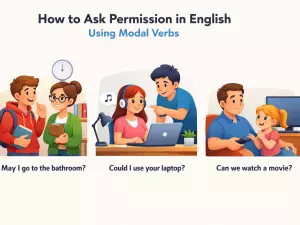
- Can I + verb? → everyday request; often treated as permission in practice: “Can I borrow your pen?”
- Can we + verb? → casual group request: “Can we start now?”
- May I please + verb? → extra politeness, often used with strangers or in service contexts.
- Can you + verb? → a request for action from the listener (not permission): “Can you open the window?”
- May you + verb? ❌ not used for asking permission in modern English; it usually sounds like a wish (“May you succeed”).
Examples where the choice matters
- In a meeting with a senior manager: “May I add something?” (signals deference and turn-taking)
- In a classroom: “May I go to the restroom?” (fits a rule-governed setting)
- At a friend’s place: “Can I use your charger?” (natural and relaxed)
- At a reception desk: “May I see your ID?” (professional, procedural)
- With a coworker you know well: “Can I take the afternoon off?” (common in day-to-day talk)
- In a formal email: “May I request approval to proceed?” (matches an official process)
Answering: keeping the same level of formality
- ✅ “Yes, you may.” / “No, you may not.” (direct permission language; often used in policies or formal contexts)
- ✅ “Yes, of course.” / “Sure.” (friendly, conversational acceptance)
- ✅ “I’m afraid you can’t.” (common refusal to a can request; focuses on practicality)
- When rules are involved, a reason often follows: “No, you may not, because it’s against policy.”
In short, may frames the question as a matter of authorization, while can frames it as a normal request in everyday interaction. Choosing between them helps you match the social distance and the level of formality in the situation.
Typical examples from classrooms, offices, and formal announcements
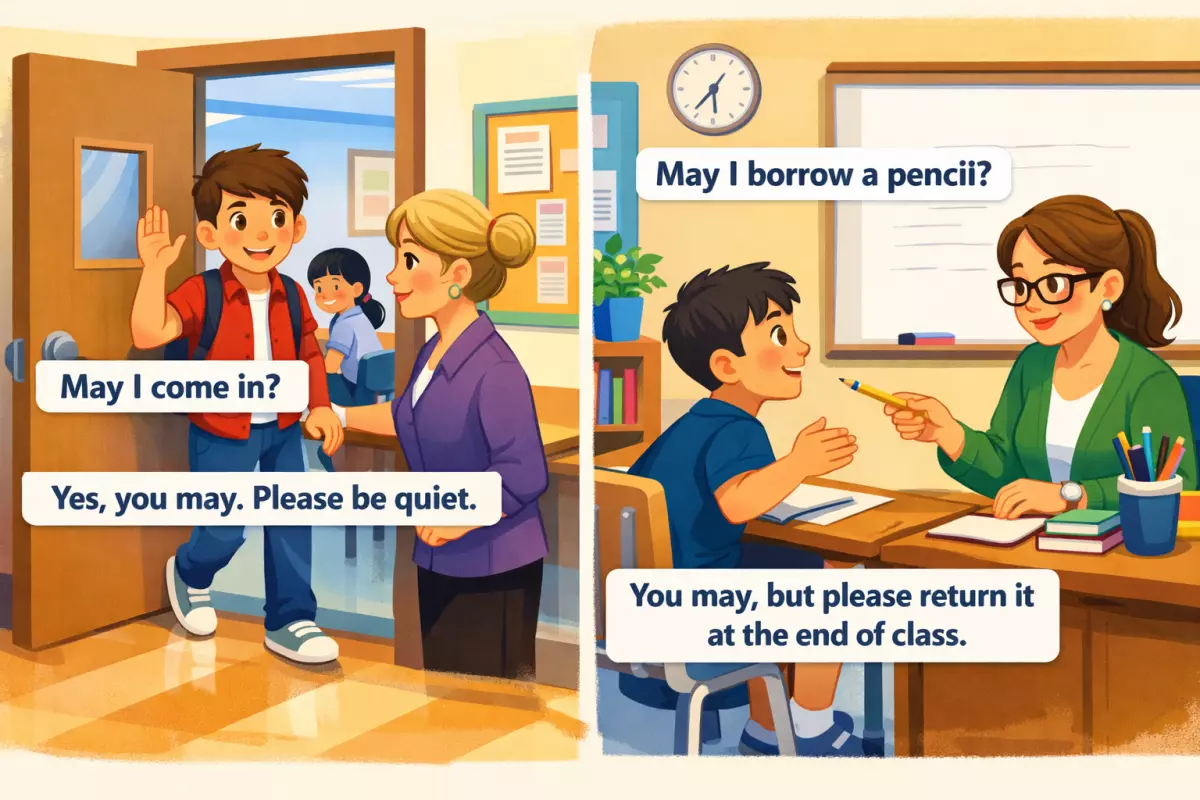
In institutional settings, may is used to ask for and grant permission in a controlled, polite way. The pattern is usually a question for requesting access or approval, followed by a short, clear response that accepts, limits, or refuses the request.
Classroom requests and teacher permissions
- Student: May I come in? Teacher: Yes, you may. Please be quiet.
- May I go to the restroom? / Yes, you may. / No, you may not right now.
- May I borrow a pencil? / You may, but please return it at the end of class.
- May I ask a question? / Yes, you may. Go ahead.
- May we work in pairs? / You may, as long as you keep your voices low.
- May I submit the assignment tomorrow? / You may, but there will be a late penalty.
- May I use my dictionary during the test? / You may not. This is a closed-book exam.
- May I redo this exercise? / You may redo it for partial credit.
- ✅ May I leave early? → Formal request to a teacher or supervisor
- ❌ Can I leave early? → Often acceptable, but less formal in strict classroom rules
Office and workplace permission language
- May I take tomorrow morning off for an appointment? / Yes, you may, provided coverage is arranged.
- May I work remotely on Friday? / You may, subject to manager approval.
- May we reschedule the meeting? / You may, but please confirm with all attendees.
- May I access the client file? / You may if you are assigned to the project.
- May I share these notes with the team? / You may, as long as confidential details are removed.
- May I leave my desk for a few minutes? / Yes, you may. Please keep your phone with you.
- May I expense this purchase? / You may, if it follows the policy limits.
- May I bring a guest to the event? / You may bring one guest with prior registration.
Formal announcements and written notices
- Visitors may sign in at reception upon arrival.
- Employees may park in the designated lot after 6:00 p.m.
- Students may use calculators approved by the department.
- Guests may be asked to present identification.
- Applications may be submitted online or in person.
- Participants may request accommodations by contacting the organizer.
- Food and drink may not be brought into the auditorium.
- Mobile phones may not be used during the performance.
- Only authorized personnel may enter this area.
- Late arrivals may not be admitted until the next break.
Common patterns to notice
- Request form: May I/we + base verb…? (May I sit here? May we begin?)
- Granting permission: Yes, you may. / You may + verb… (You may proceed.)
- Refusing permission: No, you may not. / You may not + verb… (You may not enter.)
- Conditional permission: You may…, but… / You may…, provided that… / You may…, as long as…
- Passive, policy style: X may be + past participle (Requests may be approved; forms may be returned.)
How modern spoken English sometimes replaces may with other modals
In everyday conversation, speakers often choose other modal verbs instead of may because they sound more natural, less formal, or more direct. The substitute you hear depends on the relationship between speakers, the level of politeness needed, and whether the speaker is asking for permission, offering permission, or talking about rules.
Common replacements and what they usually signal
| Modal often used in speech | Typical meaning and tone | Example in context |
|---|---|---|
| can | Neutral, everyday permission; common with friends, colleagues, and quick requests | Can I borrow your pen for a second? |
| could | More polite/softer than can; adds distance and reduces pressure | Could I leave a little early today? |
| might | Very tentative; sounds cautious or indirect (often used when unsure) | Might I ask a quick question? |
| should | Asking for advice about what is allowed or appropriate (not permission itself) | Should I email them first, or is it okay to call? |
| must | Rules/obligation; used to state requirements rather than ask permission | You must sign in at reception. |
| have to | Practical obligation; often sounds less strict than must | You have to wear a badge in this area. |
| be allowed to | Explicit permission based on rules or authority; useful for policies | Are we allowed to park here? |
| be supposed to | Expectation or guideline (may include rules, but often softer than “must”) | Are we supposed to submit it by Friday? |
Patterns you will hear (and when they fit)
- Quick permission requests: “Can I…?” is the default in casual speech; it is usually understood as permission, not ability.
- Polite requests to someone you don’t know well: “Could I…?” and “Could we…?” are common in service situations and workplaces.
- Permission with a rule in the background: “Am I allowed to…?” is preferred when the speaker expects a policy (school, office, venue, website).
- Softening the request further: “Would it be okay if I…?” often replaces “May I…?” when the speaker wants to sound friendly and non-demanding.
- Giving permission informally: “You can…” is more common than “You may…” in conversation.
- Giving permission formally or in writing: “You may…” still appears in instructions, notices, contracts, and official emails.
- Checking what is appropriate: “Should I…?” asks for guidance, not authorization; it often appears when social norms matter.
- Stating requirements: “You must…” / “You have to…” express obligation; they do not grant permission.
- Very formal or old-fashioned politeness: “Might I…?” can sound elegant, but it is less frequent and may feel overly formal in everyday settings.
- Group permission: “Can we…?” is common for shared plans; “May we…?” is reserved for formal settings (meetings, ceremonies).
Example swaps: formal to conversational
- ✅ May I ask a question? → Can I ask a question?
- ✅ May we begin? → Can we get started?
- ✅ You may enter now. → You can go in now.
- ✅ May I use your phone? → Could I use your phone?
- ✅ May I leave early? → Would it be okay if I left early?
- ✅ May I park here? → Am I allowed to park here?
- ✅ Employees may work remotely. → Employees can work remotely.
- ✅ Visitors may not enter. → Visitors aren’t allowed to enter.
- ✅ You may take one brochure. → You can take one.
- ✅ May I speak to the manager? → Could I speak to the manager?
- ✅ May I suggest an alternative? → Can I suggest an alternative?
- ✅ Students may use calculators. → Students are allowed to use calculators.
In short, may still signals formal permission clearly, but modern spoken English often prefers modals that match the situation: can for everyday requests, could for extra politeness, and rule-focused forms like be allowed to when policies matter.
How negative forms affect the meaning of permission
Negative wording changes whether you are talking about a restriction, a refusal, or simply the absence of permission. With may, the placement of not and the choice of structure (active vs. passive, “may not” vs. “may not be allowed to”) strongly affect how formal and how clear the message is.
Key patterns and what they usually mean
- may not + verb often signals a rule or prohibition in formal notices: “Visitors may not enter the laboratory.”
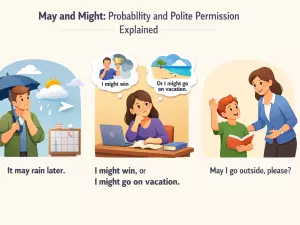
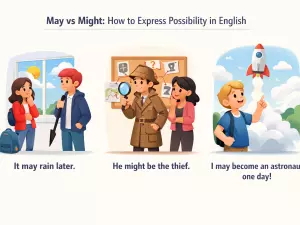
- may not can also mean “it is possible that… not,” especially in speech: “The manager may not approve it.” (possibility, not a rule)
- may not be allowed to + verb is clearer when you want “no permission” without the ambiguity of possibility: “You may not be allowed to park here overnight.”
- may not + be + past participle works well for formal restrictions in passive voice: “Food may not be brought into the auditorium.”
- may not + have + past participle usually expresses uncertainty about a past action, not permission: “He may not have received the email.”
- may not + need to expresses lack of necessity (not permission): “You may not need to submit a paper copy.”
- may not + want to expresses preference (not permission): “You may not want to mention that in the meeting.”
- may not + be able to expresses ability/feasibility (not permission): “You may not be able to access the file off-site.”
- may + never can sound like a strong prohibition in rules: “Staff may never share passwords.”
- may + no longer indicates permission has been removed: “Members may no longer use the side entrance.”
Common sources of confusion (and how to avoid them)
- Ambiguity of “may not”: In writing, “may not” can be read as either prohibition or possibility. If you mean prohibition, add context (policy language) or use a clearer structure:
- ✅ “Employees may not disclose client data.” (policy context makes it a prohibition)
- ✅ “Employees are not permitted to disclose client data.” (unambiguous)
- ❌ “Employees may not disclose client data” (in a casual email without context, it can be misread as “maybe they won’t”)
- “May not” vs. “cannot”: Cannot is often more direct and less formal; may not is common in regulations, signs, and official instructions.
- Don’t use “mayn’t”: It exists historically but is not standard in modern formal English. Use “may not.”
- Negative questions change the social meaning: “May I not…?” is rare and can sound old-fashioned or argumentative. Prefer clearer alternatives:
- ✅ “May I leave now?”
- ✅ “Am I allowed to leave now?”
- ✅ “Is it okay if I don’t attend?” (when the negative idea is the action itself)
Example sentences you can reuse in formal contexts
- “Applicants may not submit more than one form.”
- “Guests may not bring outside food or drinks.”
- “Personal items may not be stored in the hallway.”
- “This badge may not be transferred to another person.”
- “Children may not be admitted without an adult.”
- “Vehicles may not park in front of the emergency exit.”
- “Phones may not be used during the examination.”
- “Late entries may not be accepted.”
- “You may not be allowed to re-enter after leaving the venue.”
- “If you arrive after 6 p.m., you may not be able to collect your pass.”
- “The supervisor may not approve requests submitted after the deadline.” (possibility, not permission)
- “We may not have received your payment yet.” (uncertainty, not permission)
Exercises and practice activities using may in formal permission contexts
Use these activities to practice choosing may for polite, official-sounding requests and for granting permission in controlled settings (workplaces, schools, public notices). Focus on the pattern, the level of formality, and whether the speaker is asking, allowing, or stating a rule.
1) Pattern drill: build correct request sentences
Complete each sentence with May I + a suitable verb phrase. Keep the tone formal and concise.
- __________ your office to discuss the report?
- __________ a copy of the signed agreement?
- __________ this form in ink, or is pencil acceptable?
- __________ my phone during the examination to check the time?
- __________ the meeting a few minutes early due to another appointment?
- __________ your name badge for identification purposes?
- __________ a brief question regarding the policy?
- __________ the documents to the reception desk?
- __________ my application in person rather than online?
- __________ the conference room after 6 p.m.?
Show answers
- May I enter your office to discuss the report?
- May I request a copy of the signed agreement?
- May I complete this form in ink, or is pencil acceptable?
- May I use my phone during the examination to check the time?
- May I leave the meeting a few minutes early due to another appointment?
- May I present your name badge for identification purposes?
- May I ask a brief question regarding the policy?
- May I deliver the documents to the reception desk?
- May I submit my application in person rather than online?
- May I reserve the conference room after 6 p.m.?
2) Choose the best option: may vs. can vs. could
Select the option that best fits a formal permission context. (More than one may sound possible in casual speech, but choose the most appropriate for an official tone.)
- __________ I speak with the chair of the committee? (May / Can / Could)
- Employees __________ leave early on Fridays with manager approval. (may / can / could)
- __________ we postpone the appointment to next week? (May / Can / Could)
- Visitors __________ not enter the laboratory without authorization. (may / can / could)
- __________ I have your permission to record this interview? (May / Can / Could)
- Students __________ use calculators only in Section B. (may / can / could)
- __________ I take a moment of your time regarding a complaint? (May / Can / Could)
- Participants __________ submit questions in writing after the session. (may / can / could)
Show answers
- May
- may
- May
- may
- May
- may
- May
- may
3) Rewrite for formality: upgrade to “may”
Rewrite each sentence to sound more formal by using may. Keep the meaning the same (permission, not ability). Avoid adding extra information.
- Can I come in?
- Can we start now?
- Can I see your ID?
- You can park here after 5 p.m.
- Can visitors take photos?
- Can I have a day off next Monday?
- Students can use the library computers.
- Can I ask a quick question?
- You can’t bring food into the auditorium.
- Can we extend the deadline?
Show answers
- May I come in?
- May we start now?
- May I see your ID?
- You may park here after 5 p.m.
- May visitors take photos?
- May I have a day off next Monday?
- Students may use the library computers.
- May I ask a quick question?
- You may not bring food into the auditorium.
- May we extend the deadline?
4) Spot the issue: permission vs. possibility
Decide whether may expresses permission or possibility in each sentence. Write Permission or Possibility.
- You may begin the assessment now.
- The results may be delayed due to system maintenance.
- May I address the panel briefly?
- Applicants may submit supporting documents by email.
- The visitor may arrive after 3 p.m.
- Employees may not disclose confidential information.
- May we proceed to the next item on the agenda?
- The printer may require servicing.
Show answers
- Permission
- Possibility
- Permission
- Permission
- Possibility
- Permission
- Permission
- Possibility
5) Controlled practice: formal permission phrases bank
Use the following patterns to create your own sentences for workplace or academic situations. Aim for short, neutral wording and a clear action verb.
- May I + verb…? (May I reschedule the meeting?)
- May we + verb…? (May we review the final draft?)
- May I have + noun…? (May I have written confirmation?)
- May I ask + noun/clause…? (May I ask for clarification on item 4?)
- May I confirm + clause…? (May I confirm the delivery address?)
- You may + verb… (You may proceed to the next step.)
- Users may + verb… (Users may access the portal after registration.)
- May I speak with + person/role…? (May I speak with the supervisor?)
- May I request + noun…? (May I request an extension?)
- May I submit + noun + by + time…? (May I submit the form by Friday?)
- May I be excused…? (May I be excused from the session?)
- May we proceed…? (May we proceed with the vote?)
- May I inquire about + noun…? (May I inquire about the refund policy?)
- May I direct your attention to + noun…? (May I direct your attention to page 2?)
- May I have your permission to + verb…? (May I have your permission to record?)
- You may not + verb… (You may not enter without a badge.)
6) Mini role-cards: short formal exchanges
Practice two-turn dialogues. Speaker A asks for permission using may; Speaker B grants or refuses politely. Keep answers brief and policy-focused.
- Entering a restricted area to deliver documents
- Requesting to record a meeting for minutes
- Asking to submit a form after the deadline
- Requesting to leave a training session early
- Asking to bring a guest to an appointment
- Requesting access to a shared folder
- Asking to use a device during an exam
- Requesting clarification during a public hearing
- Asking to take photographs in a museum
- Requesting a change to a reservation time