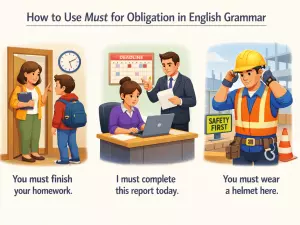
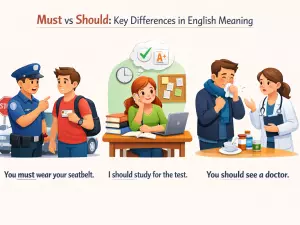
Using Must to Express Strong Obligation in English

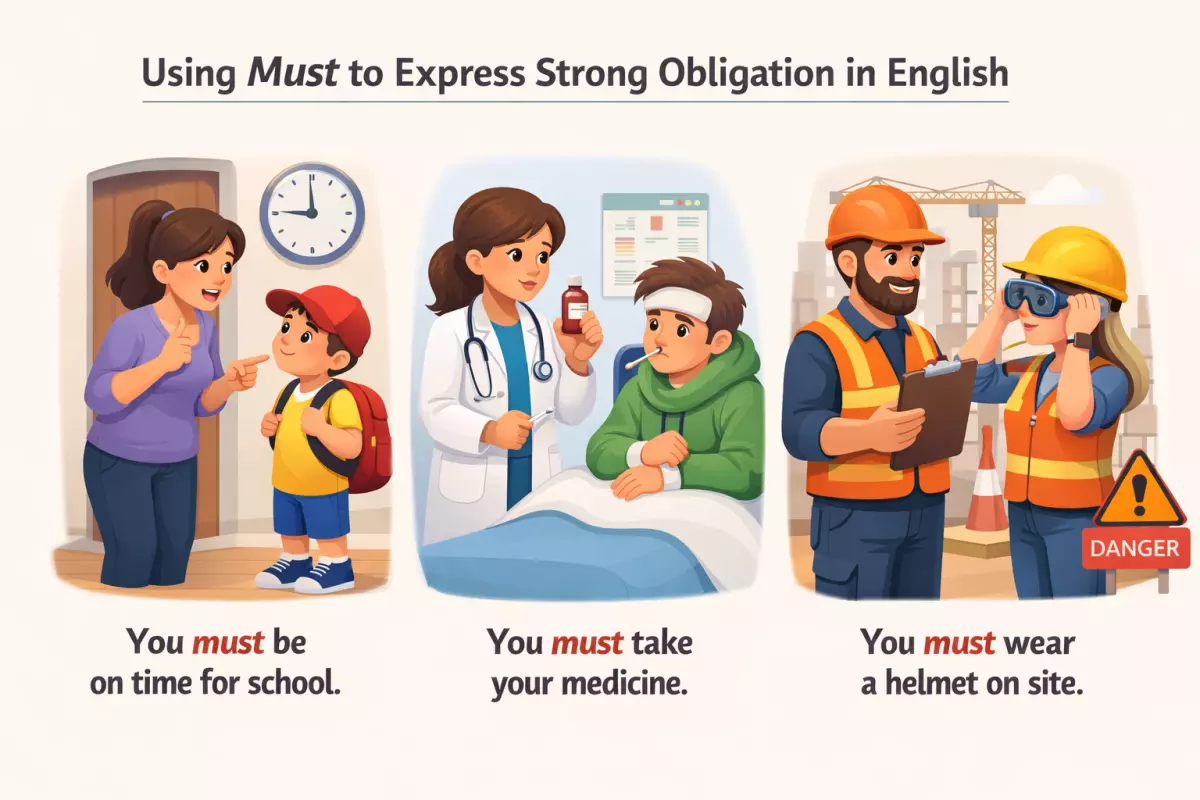 This article explains how must expresses strong necessity, strict rules, and urgency, and how it differs from have to when talking about personal vs external obligations. It also shows how negatives change meaning and includes exercises to practice must in obligation contexts.
- How must communicates strong necessity or obligation
- Situations where must introduces strict rules or instructions
- How speakers use must to emphasize urgency or importance
- The difference between personal obligation and external requirements
- How must compares with have to in everyday communication
- How negative forms change the meaning of necessity
- Exercises and practice activities using must in obligation contexts
In everyday English, must expresses a strong duty or necessity, used when something is urgent or cannot be ignored. You often hear it in safety rules, firm advice, and personal decisions where action is expected now, not later. This article explains how to use must naturally, how it differs from softer choices, and how to avoid sounding too harsh.
How must communicates strong necessity or obligation
Must signals that something is required, not optional. It is used when the speaker presents a rule, a firm expectation, or a conclusion that leaves little choice. The force can come from the speaker (personal authority), from an institution (rules and laws), or from logic (what is necessarily true given the evidence).
Core pattern and meaning
- Form: must + base verb (no to) → must leave, must pay, must be
- Meaning: “It is necessary/required that…”
- Time reference: usually present or future necessity; for past necessity, English typically uses had to rather than must.
Common uses that create a strong obligation
- Rules and regulations: “Visitors must sign in at reception.”
- Instructions and procedures: “You must press the reset button before restarting the device.”
- Firm personal requirement: “I must finish this report tonight.”
- Authority in the moment: “You must stop talking during the test.”
- Non-negotiable conditions: “To apply, you must be over 18.”
- Warnings: “You must not touch the wires.”
- Strong recommendations framed as necessity: “You must try the new schedule for a week before deciding.”
- Logical necessity (deduction): “She must be at work; her car is gone.”
Useful sentence patterns
- Must + base verb: “You must submit the form by Friday.”
- Must be + noun/adjective: “This must be the right address.”
- Must have + past participle (deduction about the past): “They must have missed the train.”
- Must not + base verb (prohibition): “You must not park here.”
- Must + adverb (emphasis): “You must always wear a helmet.”
- Must + verb + object + time phrase: “You must return the keys by 6 p.m.”
Accuracy notes: what learners often get wrong
- ✅ “You must go now.” ❌ “You must to go now.”
- ✅ “He must be tired.” ❌ “He must is tired.”
- ✅ “We must not enter.” (prohibited) ❌ “We don’t must enter.”
- ✅ “I had to leave early yesterday.” (past obligation) ❌ “I must leave early yesterday.”
Example set (strong obligation vs. logical necessity)
- “Employees must wear ID badges at all times.” (rule)
- “You must call me when you arrive.” (firm instruction)
- “We must act quickly to avoid delays.” (urgent necessity)
- “This must be the entrance; the sign matches the map.” (deduction)
- “You must not share your password.” (prohibition)
- “Applicants must provide two references.” (requirement)
- “I must remember to lock the door.” (self-imposed duty)
- “He must have forgotten our meeting.” (past deduction)
- “All bags must be screened.” (procedure)
- “You must be joking.” (strong inference; often expressive)
Situations where must introduces strict rules or instructions
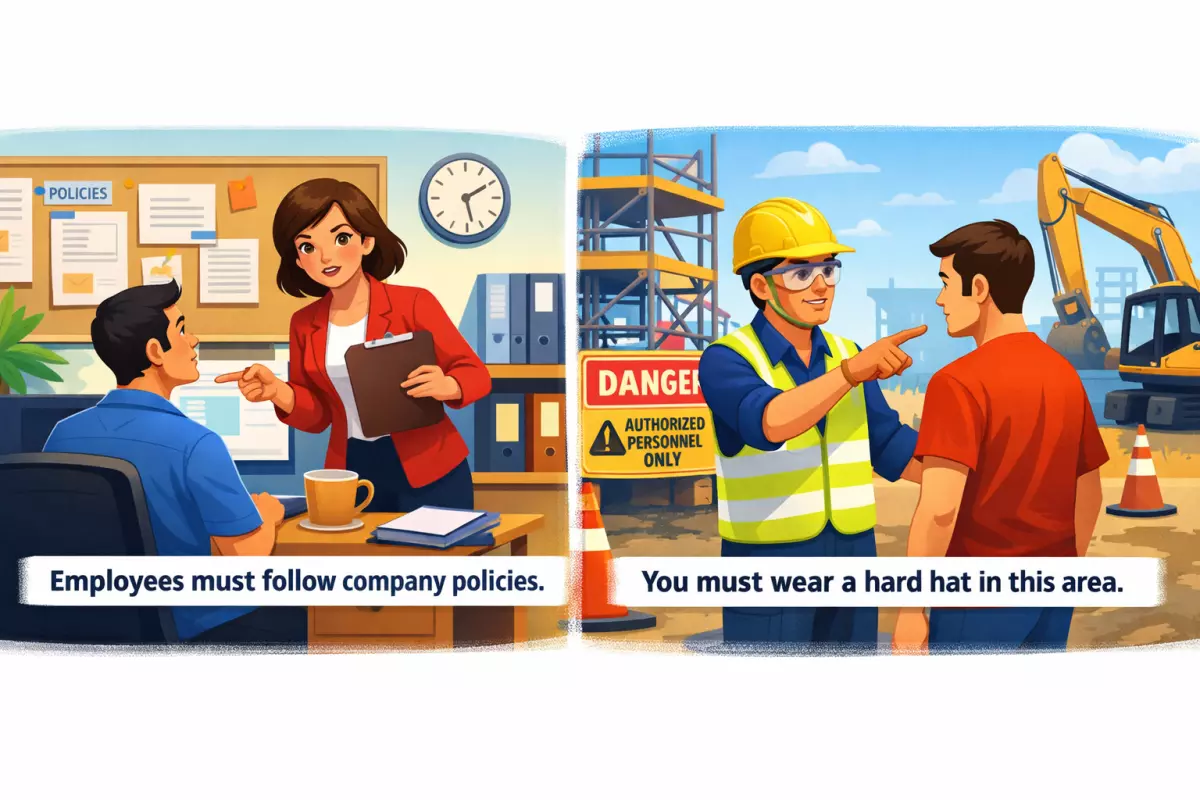
Use must when the speaker (or the text) presents a rule as non-negotiable. It commonly appears in formal notices, policies, safety guidance, and step-by-step procedures where compliance is expected, not optional. The meaning is stronger than advice: it signals a requirement.
Common contexts where must is natural
- Workplace policies: rules in employee handbooks, internal emails, or HR notices.
- Safety instructions: lab rules, construction sites, factory procedures, emergency guidance.
- Public signs and notices: buildings, transport, events, museums, libraries.
- Legal or official requirements: forms, government instructions, compliance statements.
- School and exam rules: test instructions, classroom rules, academic integrity policies.
- Medical and care settings: patient instructions, hygiene rules, medication guidance (especially written).
- Technical procedures: manuals, setup steps, troubleshooting sequences where order matters.
- Security requirements: passwords, ID checks, access control, data handling rules.
- Event participation rules: entry conditions, age checks, wristbands, prohibited items.
- Contracts and service terms: conditions for refunds, returns, or account use.
Typical patterns used in rules
- Must + base verb: “You must wear a helmet.” / “Visitors must sign in.”
- Must not / mustn’t + base verb (prohibition): “You must not smoke here.”
- Must be + past participle (passive, formal rules): “All forms must be completed.”
- Must be + adjective/noun (requirements about status): “ID must be valid.” / “Tickets must be original.”
- Must have + past participle (requirement by a deadline): “You must have submitted the form by Friday.”
- Must + time/condition phrase: “Applications must be received by 5 p.m.” / “Guests must check in before entry.”
- All/each/every + noun + must: “Each participant must register.”
- Before/after + clause + must: “Before you start, you must read the safety notes.”
Examples you often see in strict instructions
- Employees must wear ID badges at all times.
- Visitors must report to reception on arrival.
- All bags must be screened before entry.
- Passengers must keep their seat belts fastened.
- Students must write their answers in black ink.
- Candidates must not use mobile phones during the exam.
- Food must be stored below 5°C.
- Protective eyewear must be worn in this area.
- Payments must be made in advance.
- Returns must be accompanied by a receipt.
- Data must be backed up weekly.
- Passwords must be changed every 90 days.
- Children must be accompanied by an adult.
- All fields must be completed before you submit the form.
- Vehicles must not block the emergency exit.
Usage notes to keep rules clear
- Choose the subject that matches the rule: “You must…” (direct instruction) vs. “All visitors must…” (general policy).
- Use the passive for impersonal policies: “Forms must be signed” sounds more official than “You must sign the forms.”
- Avoid mixing strength levels in the same rule: keep “must” for requirements; use “should” only for recommendations.
- Be careful with negatives: ✅ “You must not enter.” (forbidden) ❌ “You don’t have to enter.” (not necessary).
How speakers use must to emphasize urgency or importance
Must often signals that a situation is time-sensitive or that the speaker considers the action non-negotiable. It pushes the listener to treat the message as a priority rather than a casual suggestion.
Common patterns that add urgency
- must + base verb for immediate priority: “You must leave now.”
- must with time markers to tighten the deadline: “We must finish by noon.”
- must with “right away / immediately / at once” to remove delay: “Call her immediately; you must confirm the details.”
- must with “before” clauses to show a critical sequence: “You must back up your files before you update.”
- must with “first” to set an order of actions: “You must sign this first, then we can proceed.”
- must in short, direct sentences for impact: “You must listen.”
- must not / mustn’t to stress a serious prohibition: “You mustn’t touch that wire.”
- must paired with consequence language: “You must wear a helmet, or you could be injured.”
- must used with “only” to narrow acceptable options: “You must use only this entrance.”
- must with “still / yet” to show pressure remains: “We still must submit the form today.”
- must with passive voice when the focus is on the requirement, not the person: “The form must be submitted by 5 p.m.”
- must with “all” or “everyone” for group urgency: “Everyone must evacuate.”
Typical contexts where speakers choose must
- Safety and risk: “You must keep the door locked.” / “You mustn’t inhale the fumes.”
- Rules and compliance: “Visitors must show ID.”
- Critical deadlines: “We must send the report today.”
- Strong instructions (work or training): “You must follow the checklist in order.”
- Urgent problem-solving: “We must find the source of the leak.”
- Emotional emphasis (seriousness, insistence): “You must believe me.”
How to keep the emphasis strong but appropriate
- Use must when you want to sound firm; switch to softer options (like “should” or “need to”) when the listener has more choice.
- Avoid stacking multiple intense markers unless the situation truly warrants it. “You must leave now” is usually stronger and clearer than adding extra intensifiers.
- When giving instructions, add a brief reason if it improves cooperation: “You must turn off the machine before cleaning it, because the blades can start automatically.”
- Keep negatives clear: ✅ “You mustn’t enter” (prohibited) ❌ “You don’t must enter” (incorrect form).
The difference between personal obligation and external requirements
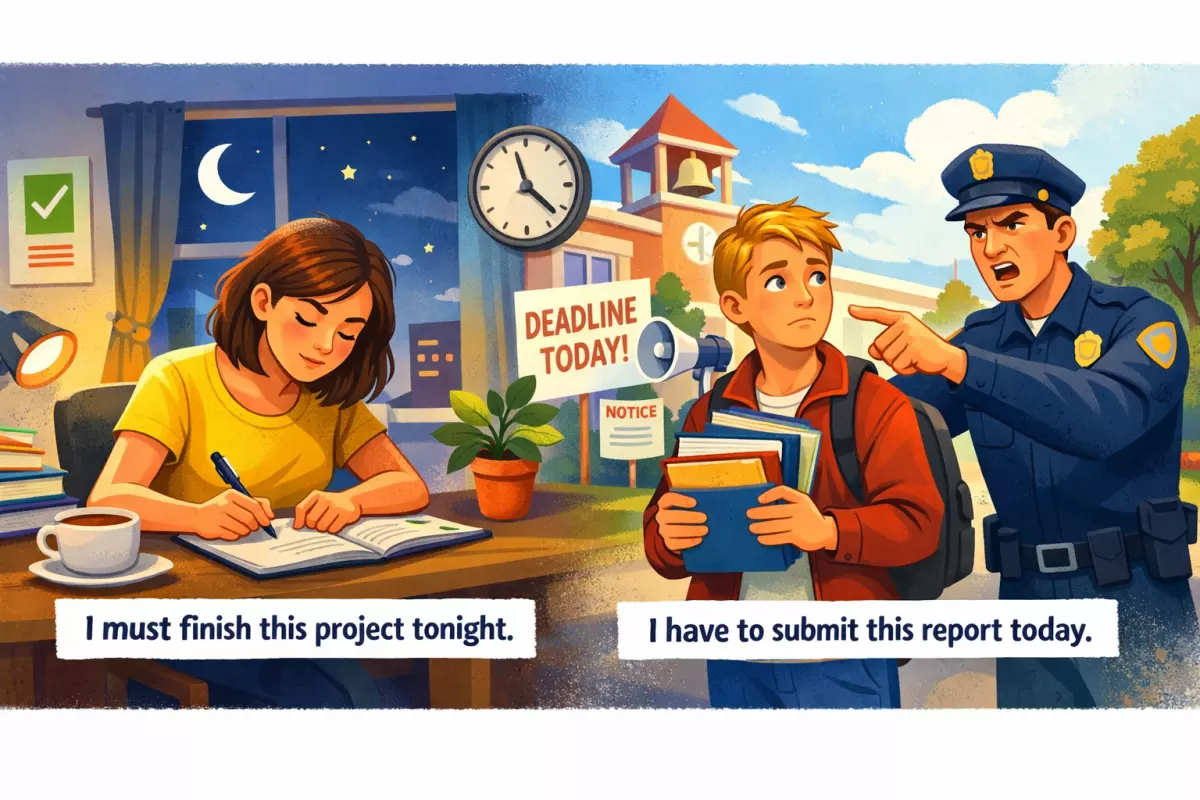
English often separates duties you place on yourself from duties imposed by rules, authorities, or circumstances. This affects which modal you choose (especially must vs have to) and how your sentence sounds: internal commitment versus outside pressure.
How meaning changes with the source of obligation
- Personal obligation (internal): the speaker decides the duty is necessary. This is a common use of must when you are expressing a strong personal judgment or commitment.
- External requirement (external): the duty comes from regulations, schedules, instructions, or other people. This is often expressed with have to (and sometimes need to), because the pressure is outside the speaker.
Side-by-side patterns and typical contexts
| Meaning focus | More typical form | Common contexts | Example |
|---|---|---|---|
| Speaker’s own decision / strong personal rule | must | self-imposed standards, determination, moral duty, urgent personal priority | I must finish this tonight. |
| Rule or instruction from an authority | have to | workplace policy, school rules, legal requirements, official procedures | You have to wear a badge. |
| Obligation created by circumstances (not a person) | have to | deadlines, transport schedules, practical necessity, lack of alternatives | We have to leave early because the last train is at 9. |
| Strong advice framed as necessity (speaker’s judgment) | must | warnings, recommendations with urgency, persuasive emphasis | You must try the new system; it saves time. |
| Requirement presented neutrally (less “speaker pressure”) | need to / have to | instructions, checklists, routine obligations | You need to submit the form by Friday. |
Practical tests you can use while writing
- Ask “Who says so?” If the answer is “I do,” must often fits. If the answer is “the rules / my boss / the law / the schedule,” have to is usually more natural.
- Check the tone. Must can sound firm, insistent, or formal. Have to often sounds more neutral and matter-of-fact.
- Notice what you are emphasizing. Must emphasizes the necessity itself; have to emphasizes the existence of a requirement.
Example pairs (same situation, different source)
- I must stop procrastinating. → self-discipline
- I have to stop here; parking is not allowed ahead. → rule/sign
- She must speak to him today. → personal urgency/judgment
- She has to speak to him today; the manager requested it. → instruction
- We must be careful with this data. → speaker’s strong stance
- We have to be careful with this data; it’s confidential under policy. → external policy
- You mustn’t tell anyone. → strong prohibition (speaker-imposed or authoritative tone)
- You don’t have to tell anyone. → no requirement (permission/option)
- I must remember to call. → personal reminder
- I have to call; they’re waiting for confirmation. → situation-driven necessity
In many real conversations, both forms can be grammatically correct, but they signal different motivations. Choosing must highlights your own firm view of what is necessary, while have to points to an outside demand or practical constraint.
How must compares with have to in everyday communication
Must and have to can both express obligation, but everyday English tends to prefer have to for most real-life duties. Must often sounds more formal, more forceful, or more like the speaker is laying down a rule. Choosing between them is mainly about where the pressure comes from (speaker vs. situation) and how strong you want to sound.
| Point of comparison | Must | Have to |
|---|---|---|
| Where the obligation comes from | Often the speaker’s authority, rules, or strong personal insistence | Often external circumstances, schedules, laws, or other people’s requirements |
| Typical tone in conversation | Stronger, more direct; can sound formal or strict | Neutral and common; fits casual speech well |
| Negative meaning | Must not = prohibition (not allowed) | Don’t have to = no necessity (optional) |
| Past and future forms | No true past form; uses had to for past obligation | Full tense range: had to, will have to, have had to |
| Questions | Possible but can sound official: “Must I…?” | Most natural: “Do I have to…?” |
Common patterns that sound natural
- Speaker-driven rule/insistence: “You must be on time.” / “We must talk.”
- External requirement: “I have to work late.” / “You have to show ID.”
- Polite question about necessity: “Do I have to fill this out?”
- More official-sounding question: “Must I sign here?” (often heard in formal settings)
- Strong warning: “You mustn’t touch that.” ✅ (prohibition)
- Optional / no need: “You don’t have to come early.” ✅
- ❌ “You mustn’t come early.” (this means “you are not allowed to come early,” not “it’s unnecessary”)
- Past obligation: “I had to leave early yesterday.” (not “I musted…”)
- Future obligation: “I’ll have to call you tomorrow.”
- Softening the force of must: “We must try to be careful.” (still strong, but less like an order)
Choosing the right one in everyday situations
- Use have to for routines and practical necessities: work hours, appointments, paperwork, travel schedules.
- Use must when you want to sound firm or when stating a clear rule: safety instructions, strict policies, urgent priorities.
- Prefer don’t have to to say something is not required; reserve must not for “not allowed.”
- In casual conversation, must can sound intense; speakers often replace it with have to to keep the tone neutral.
- When reporting obligations in the past, both meanings normally switch to had to, regardless of whether the original pressure was internal or external.
Example set: same situation, different feel
- “I have to go now.” (practical necessity; neutral)
- “I must go now.” (more formal or dramatic; stronger)
- “You have to wear a helmet.” (rule/requirement, stated neutrally)
- “You must wear a helmet.” (stronger enforcement; sounds stricter)
- “Do we have to pay today?” (natural everyday question)
- “Must we pay today?” (more formal; can sound like a complaint)
How negative forms change the meaning of necessity
With must, adding not does more than make the sentence negative. It often changes the type of obligation: from “it is necessary to do X” to “it is necessary not to do X” (a prohibition). This is different from “it isn’t necessary to do X,” which is usually expressed with don’t have to or don’t need to.
| Form | Meaning | Typical use | Example |
|---|---|---|---|
| must | Strong necessity / strong obligation | Rules, urgent advice, speaker authority | You must wear a helmet. |
| must not / mustn’t | Strong prohibition (it is necessary not to do it) | Rules, safety warnings, strict instructions | You mustn’t touch that wire. |
| don’t have to | No necessity (it is optional) | Removing an obligation | You don’t have to come early. |
| don’t need to | No necessity (often situation-based) | Practical advice; not required right now | You don’t need to print it. |
Key pattern: “mustn’t” is not the negative of “must” in meaning
Many learners expect mustn’t to mean “not necessary,” but it usually means “not allowed.” If you want to say something is optional, choose don’t have to or don’t need to instead.
- ✅ You mustn’t park here. → Parking is forbidden.
- ❌ You mustn’t bring your laptop. (If you mean “it’s optional.”)
- ✅ You don’t have to bring your laptop. → It’s not required.
- ✅ You don’t need to bring your laptop. → It isn’t necessary (often because of the situation).
Usage notes and common contexts
- must not / mustn’t is common in signs and formal instructions: “Visitors must not feed the animals.”
- mustn’t often sounds strict or urgent in speech, especially for safety: “You mustn’t lean over the railing.”
- don’t have to is neutral and common in everyday conversation: “You don’t have to explain.”
- don’t need to often suggests “because it won’t help” or “because it’s already done”: “You don’t need to call her; she knows.”
- In many situations, don’t have to and don’t need to are both correct, but the second can feel more immediate or practical.
Expanded examples (choose the form that matches the intention)
- Prohibition: You mustn’t share your password.
- Prohibition: Students must not use phones during the exam.
- Prohibition: You mustn’t open the door while the train is moving.
- Prohibition: You must not mix these chemicals.
- Prohibition: We mustn’t interrupt the speaker.
- No necessity: You don’t have to wait for me.
- No necessity: You don’t have to pay today; you can pay tomorrow.
- No necessity: You don’t need to bring water; there’s some here.
- No necessity: You don’t need to reply right away.
- Strong obligation: You must submit the form by Friday.
- Strong obligation: You must keep this receipt.
- Contrast in one situation: You must show ID, but you don’t have to print the email.
- Contrast in one situation: You mustn’t enter this area, but you don’t have to leave the building.
- Softening advice (not prohibition): You don’t need to worry; it’s a minor issue.
- Rule vs. option: You must wear a seatbelt; you don’t have to sit in the front.
When choosing a negative form, decide whether you mean “forbidden” (mustn’t) or “not required” (don’t have to/don’t need to). That choice determines the listener’s understanding of the obligation.
Exercises and practice activities using must in obligation contexts
Build accuracy with must by focusing on three things: the meaning (strong obligation), the form (must + base verb), and the context (rules, safety, urgent requirements). The activities below move from controlled practice to realistic situations where you choose the best obligation language.
1) Form focus: must + base verb (no “to”)
- Complete each sentence with the correct form of the verb in brackets.
- You must ______ (wear) a helmet on this site.
- Visitors must ______ (sign) in at reception.
- We must ______ (finish) the report by 5 p.m.
- He must ______ (not / enter) this area without permission.
- I must ______ (call) the client today.
- Employees must ______ (not / share) passwords.
- You must ______ (be) quiet during the exam.
- We must ______ (check) the fire exits every month.
Show answers
-
- wear
- sign
- finish
- not enter
- call
- not share
- be
- check
2) Meaning check: strong obligation vs. advice
- Choose the best option (A or B) for each context.
- This is a safety rule in a lab: A) You must wear goggles. B) You should wear goggles.
- A friend is tired: A) You must go to bed earlier. B) You should go to bed earlier.
- A strict deadline from your manager: A) We must submit it today. B) We should submit it today.
- A polite suggestion at a restaurant: A) You must try the soup. B) You should try the soup.
- An exam instruction: A) You must not use your phone. B) You should not use your phone.
- A personal recommendation: A) You must see that movie. B) You should see that movie.
- A legal requirement: A) Drivers must stop at red lights. B) Drivers should stop at red lights.
- A mild tip for learning: A) You must review vocabulary daily. B) You should review vocabulary daily.
Show answers
-
- A
- B
- A
- B
- A
- B
- A
- B
3) Correction practice: spot and fix common errors
Rewrite each sentence so it correctly expresses obligation with must. Keep the meaning the same.
- You must to show your ID at the entrance.
- She musts finish the training this week.
- We mustn’t to be late for the interview.
- Do you must wear a uniform?
- He doesn’t must tell anyone the code.
- I musted call you yesterday.
- Must you to submit the form online?
- They must not to park here.
Show answers
- You must show your ID at the entrance.
- She must finish the training this week.
- We mustn’t be late for the interview.
- Must you wear a uniform?
- He mustn’t tell anyone the code.
- I had to call you yesterday.
- Must you submit the form online?
- They must not park here.
4) Mini-drills: negatives and questions
Transform each sentence using the instruction in brackets.
- You must keep this door closed. (Make it negative.)
- She must attend the meeting. (Make it a question.)
- We must follow the checklist. (Make it negative.)
- They must wear badges. (Make it a question.)
- I must submit the form today. (Make it negative.)
- He must answer all questions. (Make it a question.)
Show answers
- You mustn’t keep this door closed.
- Must she attend the meeting?
- We mustn’t follow the checklist.
- Must they wear badges?
- I mustn’t submit the form today.
- Must he answer all questions?
5) Controlled production: choose must / mustn’t / don’t have to
Fill the gaps with must, mustn’t, or don’t have to based on the meaning: required, prohibited, or not necessary.
- You ________ enter the server room without authorization. (prohibited)
- Staff ________ wash their hands before returning to work. (required)
- You ________ bring your own laptop; computers are provided. (not necessary)
- Passengers ________ fasten seat belts during takeoff. (required)
- We ________ talk during the presentation. (prohibited)
- Students ________ print the reading; a digital copy is fine. (not necessary)
- You ________ report the incident immediately. (required)
- Visitors ________ feed the animals. (prohibited)
- Employees ________ work overtime this week; it’s optional. (not necessary)
- You ________ follow the evacuation route shown on the map. (required)
Show answers
- mustn’t
- must
- don’t have to
- must
- mustn’t
- don’t have to
- must
- mustn’t
- don’t have to
- must
6) Real-world writing tasks (short, practical)
- Safety notice: Write 6 rules for a workshop or lab. Include at least 2 negatives with mustn’t (e.g., “You mustn’t…”).
- Workplace policy: Write 5 requirements for remote work (security, meetings, deadlines). Use must for non-negotiable items.
- Event instructions: Write 6 instructions for an exam, conference, or tour. Mix must (required) and don’t have to (not necessary) to show contrast.
- Role-play prompt: One person is a supervisor explaining rules; the other asks 5 questions using “Must I…?” / “Must we…?” and receives clear answers.
7) Pattern bank: common obligation frames to reuse
- You must + base verb (You must arrive by 9.)
- You mustn’t + base verb (You mustn’t smoke here.)
- Must I/we/they + base verb? (Must we sign in?)
- Everyone must + base verb (Everyone must follow the procedure.)
- All visitors must + base verb (All visitors must wear badges.)
- Employees must + base verb (Employees must complete training.)
- For safety, you must + base verb (For safety, you must wear gloves.)
- To avoid delays, you must + base verb (To avoid delays, you must submit the form early.)
- Under no circumstances must you + base verb (Under no circumstances must you share your password.)
- If X happens, you must + base verb (If the alarm sounds, you must evacuate.)
- You must + base verb + by + time/date (You must pay by Friday.)
- You must + base verb + before + action (You must log out before leaving.)
- You must + base verb + at least once + frequency (You must update it weekly.)
- You must + base verb + immediately (You must report it immediately.)
- You must + base verb + in order to + goal (You must verify your ID in order to enter.)