Using Should to Express Expectations in English

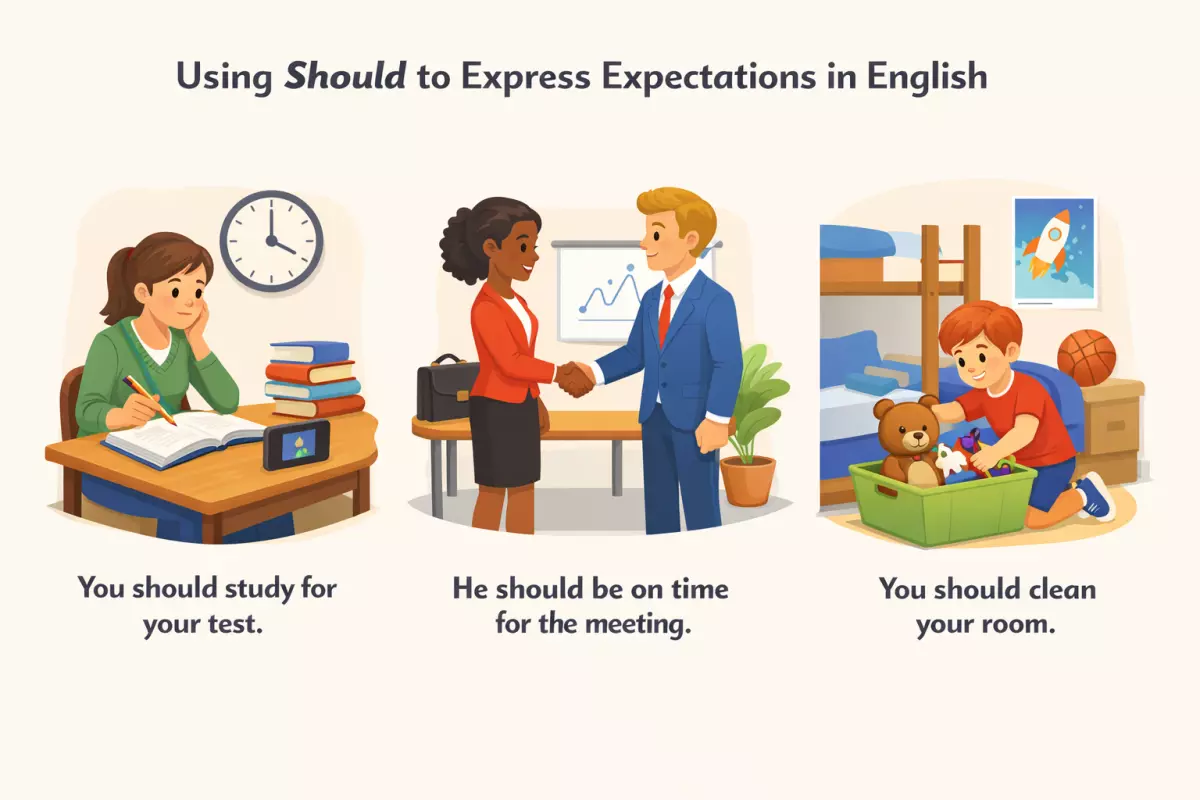 This article explains how should can mean advice or an expected outcome, and when it describes what normally happens or predicts likely results. It shows common sentence patterns, how context shifts tone, typical learner mistakes, and practice exercises.
- How should can describe both advice and expected outcomes
- Situations where should expresses what is normally supposed to happen
- How speakers use should when predicting likely results
- Sentence patterns commonly used with should in expectations
- How context determines whether should sounds like advice or prediction
- Typical misunderstandings when learners interpret should too strongly
- Exercises and practice activities using should to express expectations
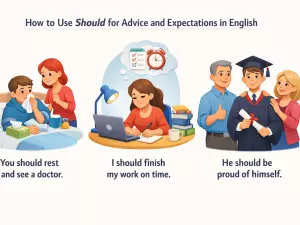
In everyday English, we use should to express what we expect or think is the right outcome. It helps you sound polite and realistic when giving advice, discussing plans, or predicting what seems likely, without sounding too forceful. You might say the train should arrive soon or your friend should call back, and people understand it is a reasonable assumption, not a guarantee.
How should can describe both advice and expected outcomes
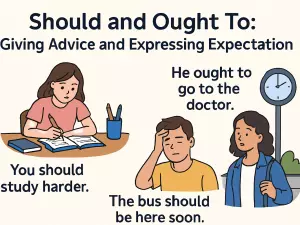
Should often does two jobs at once: it can recommend an action (advice) and also signal what the speaker thinks is likely or reasonable (an expected result). The meaning comes from context, especially whether the sentence focuses on a choice (what to do) or on a prediction (what will probably happen).
Core patterns that blend recommendation and expectation
- Should + base verb to suggest a good action: “You should call earlier.”
- Should + base verb to express a reasonable expectation: “The package should arrive today.”
- Should in instructions where the “advice” is also the expected standard: “The report should include sources.”
- Should after a condition to show a likely outcome if the advice is followed: “If you leave now, you should catch the train.”
- Should with a reason clause to connect action and outcome: “Take a break, so you should feel better afterward.”
How to tell which meaning is stronger
- Advice is stronger when the subject can control the action (you/we/they + deliberate verb): “You should apologize.”
- Expectation is stronger when the subject cannot control the result (things/systems + event verb): “The system should update overnight.”
- Mixed meaning appears when the action is controllable but the outcome is not guaranteed: “You should back up your files (so you don’t lose them).”
- Time expressions often push the sentence toward prediction: “should be here by 6,” “should finish soon.”
- Evaluation words often push it toward guidance: “should really,” “should probably,” “shouldn’t.”
Useful sentence templates (with examples)
- You should + verb (recommendation): “You should review the contract.”
- You shouldn’t + verb (warning): “You shouldn’t skip breakfast.”
- It should + verb (expected outcome): “It should work after a restart.”
- There should be + noun (expected situation): “There should be enough seats.”
- That should + verb (expected result from an action): “Restart it. That should fix the issue.”
- If + present, ... should + verb (likely result): “If you follow the steps, you should get the same output.”
- Should be + adjective (expected state): “The room should be quiet now.”
- Should have + past participle (past expectation or criticism): “They should have arrived by now.”
- Shouldn’t have + past participle (regret/criticism): “You shouldn’t have shared that password.”
- Should + be able to (expected ability): “You should be able to log in with that code.”
- Should + need to (soft requirement): “You should need only two documents.”
- Should + not need to (expected lack of necessity): “You shouldn’t need to reinstall anything.”
- Why don’t you + verb (alternative advice; often similar force): “Why don’t you email support? That should speed things up.”
- Do X, and it should... (action → expected result): “Save the file, and it should sync automatically.”
Common learner issues to avoid
- ✅ “It should arrive tomorrow.” → expectation (not a promise).
- ❌ “It should to arrive tomorrow.” → should takes the base verb (no “to”).
- ✅ “You should see a doctor.” → advice.
- ✅ “You should be fine after some rest.” → expectation about the result.
- ❌ Using should when you mean certainty: if it is guaranteed, use “will” or a stronger statement instead.
In many real conversations, should intentionally stays in the middle: it encourages a sensible action while leaving room for uncertainty about the outcome. This makes it useful for polite guidance, troubleshooting, planning, and setting reasonable standards.
Situations where should expresses what is normally supposed to happen
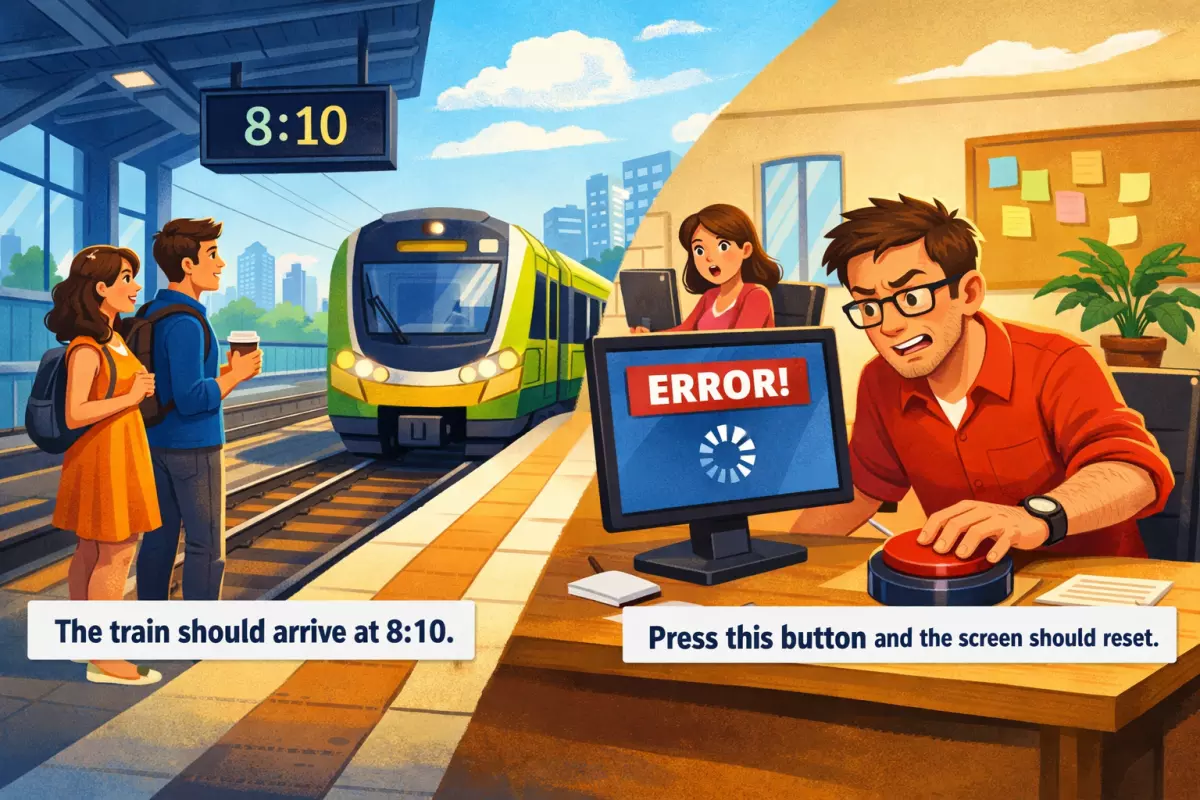
Use should to talk about what is expected in a typical situation: the normal result, the usual schedule, or the standard outcome if nothing unusual happens. This meaning is common when you are predicting based on routines, rules, or past experience rather than giving advice.
Common contexts and patterns
- Timetables and routines:
should + base verb
“The train should arrive at 8:10.” - Normal results from a process: “Press this button and the screen should reset.”
- What typically happens in a place: “There should be plenty of taxis outside the station.”
- Expected availability: “The report should be on the shared drive.”
- Standard procedures: “After you submit the form, you should receive a confirmation email.”
- Predictions based on evidence: “With this traffic, we should get there in about 20 minutes.”
- Assumptions about people’s actions: “Sam should be home by now.”
- Expected performance: “This battery should last all day.”
- Typical weather/seasonal expectations: “It should be warm this weekend.”
- Customer/service expectations: “Your order should ship within two business days.”
- Rules and standards (describing the norm): “Employees should wear ID badges in the building.”
- “By” deadlines: “They should finish by Friday.”
- Ongoing situations (expected to be happening now):
should be + -ing
“The meeting should be starting now.” - Expected completed actions (by now / already):
should have + past participle
“The email should have arrived by now.” - Negative expectations:
shouldn’t + base verb
“It shouldn’t take long.” - Existence/quantity expectations:
There should be
“There should be enough chairs for everyone.”
Example set (short, practical sentences)
- “The package should arrive tomorrow.”
- “The instructions should be clear on page 2.”
- “If you restart the app, the problem should disappear.”
- “We should hear back from them this afternoon.”
- “The restaurant should be open until 11.”
- “This key should fit the front door.”
- “There shouldn’t be any extra fees.”
- “She should have finished the exam by now.”
- “They should be waiting near the entrance.”
- “The new update should improve performance.”
How this differs from advice
- Expectation: “The bus should come every 10 minutes.” (describing the normal schedule)
- Advice: “You should take the bus.” (recommending an action)
- Expectation with uncertainty: “It should work.” (likely, but not guaranteed)
In this usage, should is close to “probably” or “is expected to,” and it often implies that a different outcome is possible if something unusual happens.
How speakers use should when predicting likely results
Use should to express an expectation based on what is normal, planned, or logically likely. It suggests a high probability, but not certainty. This makes it useful for predictions that rely on schedules, typical outcomes, evidence, or reasonable assumptions.
Core pattern and meaning
- Form: subject + should + base verb
- Meaning: “I expect this to happen” / “This is likely” (not a promise or guarantee)
- Time reference: often future or near-future, but it can also describe what is expected in the present
Common contexts where should predicts outcomes
- Schedules and timetables: “The train should arrive at 6:10.”
- Plans and arrangements: “They should be here in a few minutes.”
- Typical cause-and-effect: “If you restart it, the error should disappear.”
- Evidence-based guesses: “She left at five, so she should be home by now.”
- Process expectations: “After you click ‘Save,’ the file should upload automatically.”
- Service or delivery estimates: “Your order should ship tomorrow.”
- Workflows and systems: “The new settings should reduce loading time.”
- Predicted reactions: “The audience should respond well to the simpler explanation.”
Useful structures with should for likely results
- With time expressions: “It should be ready by Friday.” / “We should hear back within two days.”
- With “soon/shortly/any minute now”: “The update should finish shortly.”
- With “by now” for present expectations: “He should know the result by now.”
- With “in case” reasoning (implied): “Take the charger; your phone should last, but just in case.”
- In conditional sentences: “If the weather holds, the flight should land on time.”
- With “so” to show a conclusion: “It’s a direct flight, so it should be faster.”
- With “there” + be: “There should be enough seats for everyone.”
- With “should be” to predict a state: “The room should be quieter after 9.”
Choosing should vs. will vs. might
- Should = expected, likely: “It should rain later.”
- Will = more definite (speaker sounds sure): “It will rain later.”
- Might/could = possible but less certain: “It might rain later.”
Accuracy and common corrections
- ✅ “The package should arrive tomorrow.” → expected delivery, not guaranteed
- ❌ “The package should arrives tomorrow.” → use base verb: “should arrive”
- ✅ “She should be in a meeting now.” → expectation about the present
- ✅ “They should have arrived by now.” → expectation about a completed action (past expectation)
In short, should is a practical choice when you want to predict a result while leaving room for delays, exceptions, or new information.
Sentence patterns commonly used with should in expectations
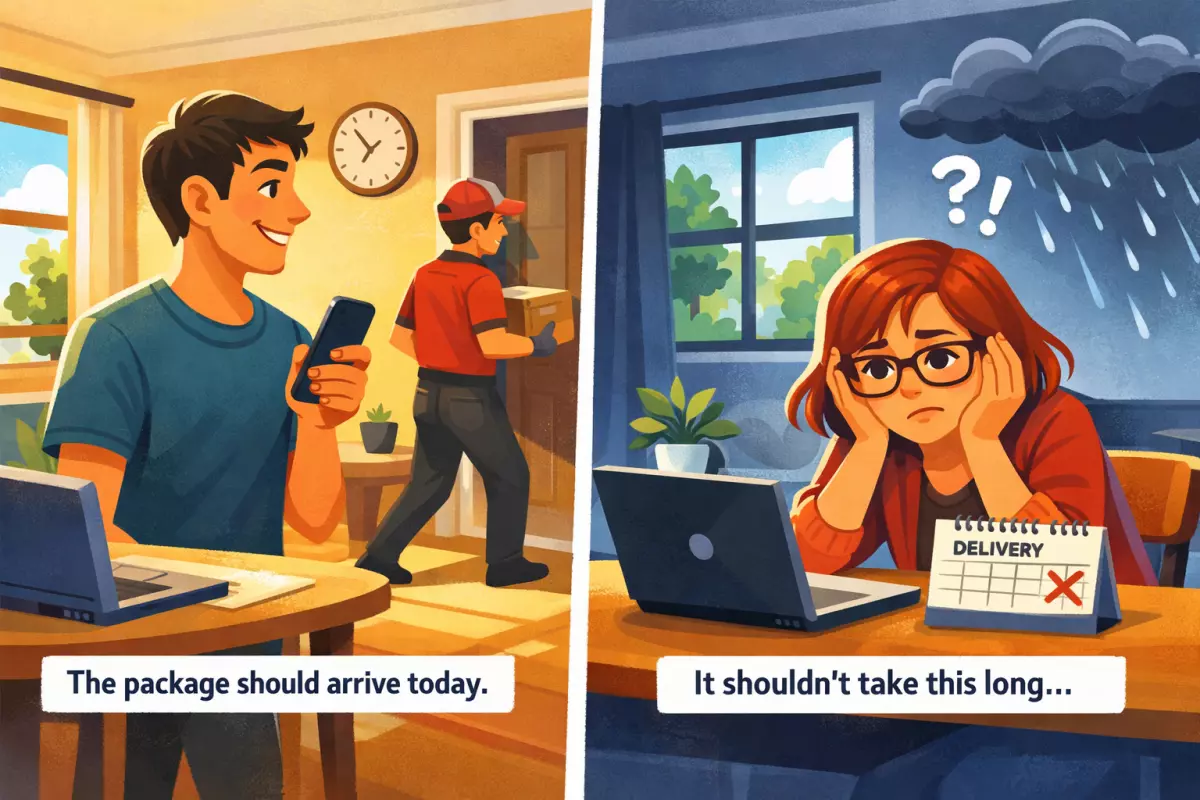
When you use should to talk about what you expect, the grammar usually stays simple: should + base verb. The meaning changes depending on whether you’re predicting a likely result, checking an assumption, or reacting when reality doesn’t match what you thought.
Core forms (affirmative, negative, questions)
- Subject + should + base verb: “The package should arrive today.”
- Subject + should not (shouldn’t) + base verb: “It shouldn’t take long.”
- Should + subject + base verb? (expectation check): “Should the results be ready by Friday?”
- Wh- word + should + subject + base verb?: “When should the train get in?”
- Tag question (confirming an expectation): “They should be here soon, shouldn’t they?”
Common expectation frames (useful sentence starters)
- I/We should + base verb (self-expectation): “I should hear back this afternoon.”
- It should + base verb (general situation): “It should be fine.”
- There should be + noun (expected existence/quantity): “There should be enough seats.”
- This/That should + base verb (referring to a plan or step): “That should solve the issue.”
- Subject should + base verb + by + time (deadline expectation): “She should finish by 6.”
- Subject should + base verb + in + time period (time estimate): “It should start in a few minutes.”
- Subject should + base verb + soon/shortly/any minute now: “The taxi should arrive shortly.”
- Subject should + base verb + without + -ing (expected ease): “It should work without restarting.”
- Subject should + base verb + if + condition (conditional expectation): “It should load faster if you clear the cache.”
- Subject should + base verb + unless + condition (exception): “It should be quiet unless there’s construction.”
Using should with “be” for expected states
- Subject should be + adjective: “The room should be warm now.”
- Subject should be + noun: “This should be the right address.”
- Subject should be + prepositional phrase: “He should be on the second floor.”
- Subject should be + -ing (expected activity in progress): “They should be waiting outside.”
Perfect forms for expectations about the past
To express what you expected to have happened already (or what you assume happened), use should have + past participle.
- Subject should have + past participle: “The email should have arrived by now.”
- Subject shouldn’t have + past participle (unexpected past result): “It shouldn’t have taken that long.”
- Should + subject + have + past participle? (checking an assumption): “Should the payment have gone through?”
- By now / already / yet with perfect expectation: “She should have finished already.”
Modal combinations that often appear with expected results
- should be able to + base verb (expected ability): “You should be able to log in now.”
- should need to + base verb (expected necessity): “You shouldn’t need to reinstall anything.”
- should only + base verb (expected limitation): “It should only take a minute.”
- should still + base verb (expectation continues): “The offer should still be valid.”
- should just + base verb (expected simplicity): “It should just work after the update.”
Clarifying the source of the expectation
- According to + source, subject should + base verb: “According to the schedule, the meeting should start at 10.”
- Based on + evidence, subject should + base verb: “Based on the forecast, it should clear up later.”
- If everything goes to plan, subject should + base verb: “If everything goes to plan, we should land on time.”
Common learner pitfalls (form-focused)
- ✅ “It should be ready.” → ❌ “It should is ready.”
- ✅ “She should arrive soon.” → ❌ “She should arrives soon.”
- ✅ “They should have left by now.” → ❌ “They should have leave by now.”
- ✅ “Should I call again?” → ❌ “Do I should call again?”
How context determines whether should sounds like advice or prediction
Whether should feels like guidance (“do this”) or an expectation (“this will probably happen”) depends less on the word itself and more on the surrounding signals: who is speaking, what evidence is available, and which time frame is being discussed. The same sentence can shift meaning when you change the situation, the tone, or the extra words around it.
Key context signals that push should toward advice
- Speaker authority or responsibility: A teacher, manager, parent, or doctor often uses should to recommend an action.
Example: “You should submit the form today.” - Second-person subjects (you/we) + action verbs: Advice commonly targets a decision or behavior.
Example: “You should call them and clarify.” - Goal-oriented framing: If the sentence implies a desired outcome, it reads as guidance.
Example: “To avoid delays, you should arrive early.” - Imperative-like rhythm: Short, direct clauses often sound like recommendations.
Example: “You should back up your files.” - Softening phrases that mark recommendations: “I think,” “probably,” “if I were you,” “it might be best to.”
Example: “I think you should talk to HR first.” - Problem–solution context: If a problem is stated and should follows, it usually introduces a solution.
Example: “The battery drains fast. You should replace it.” - Warnings and prevention: Advice often appears with risk language.
Example: “You should wear a helmet.” - Negative advice with shouldn’t: This typically signals “avoid this action.”
Example: “You shouldn’t share that password.”
Key context signals that push should toward prediction/expectation
- Evidence-based setup: When the speaker refers to facts, schedules, or typical patterns, should leans predictive.
Example: “The train left on time, so it should arrive by 6.” - Inanimate subjects and systems: Machines, plans, weather, and processes often take predictive should.
Example: “The update should fix the bug.” - Time markers for near future: “soon,” “in a minute,” “by Friday,” “later today.”
Example: “They should be here in ten minutes.” - Reference to schedules or rules: Timetables and procedures make it sound like an expected result.
Example: “The refund should appear within 3–5 days.” - Logical conclusion language: “so,” “therefore,” “given that,” “based on.”
Example: “Given the traffic, it should take about an hour.” - Third-person subjects (he/she/they/it) + state verbs: “be,” “have,” “work,” “finish” often read as expectation.
Example: “She should have the information already.” - Past expectation with should have + past participle: Can mean “was expected to happen,” sometimes with surprise or criticism.
Example: “The email should have arrived by now.” - Uncertainty without instruction: If no one is being told what to do, the sentence usually describes likelihood.
Example: “This should be enough for everyone.”
Patterns that commonly create ambiguity (and how to clarify)
- “You should be …” can be advice (a recommended state) or expectation (a likely state).
✅ Advice: “You should be more careful with the data.”
✅ Expectation: “You should be able to log in now (the reset is complete).” - “Should” in questions often sounds like asking for advice, but can also check an expectation.
✅ Advice: “Should I email them or call?”
✅ Expectation-check: “Should the light be blinking like that?” - Adding “I think” or “probably” usually shifts toward prediction; adding “if I were you” shifts toward advice.
→ “It should probably work now.” (expectation)
→ “If I were you, I should…” ❌ (wrong subject) / “If I were you, you should…” ✅ (advice) - Use alternatives when you need a clear signal:
→ For advice: “ought to,” “need to,” “it’s best to,” “I recommend…”
→ For prediction: “will likely,” “is expected to,” “is supposed to,” “probably will…”
Typical misunderstandings when learners interpret should too strongly
Many learners treat should as if it always means a strict rule or a strong command. In reality, it often expresses an expectation, a reasonable assumption, or advice that can be ignored. The result is that sentences sound too forceful, too certain, or even rude when the speaker only meant “this is likely” or “this is a good idea.”
Common over-strong readings and what they usually mean
- Turning expectation into obligation: “You should be here at 9” can sound like an order. If you mean a schedule or requirement, use “You have to be here at 9” or “You’re required to be here at 9.” If you mean a plan, use “You’re supposed to be here at 9.”
- Assuming certainty instead of probability: “She should arrive soon” usually means “I expect she will,” not “She will definitely arrive soon.” For stronger certainty, use “She will arrive soon” (if you are sure) or add evidence: “She should arrive soon; her train just left.”
- Hearing blame when the speaker means prediction: “The package should be delivered today” is often a neutral forecast based on tracking, not criticism of the delivery company.
- Confusing advice with permission: “You should take a break” is advice, not permission. If permission is intended, use “You can take a break” or “Feel free to take a break.”
- Reading “should” questions as accusations: “Should you be driving?” can be a genuine safety check, but it can also sound judgmental. A softer alternative is “Are you okay to drive?”
- Misinterpreting “should” in polite offers as pressure: “Should we sit here?” is often a suggestion, not a demand. If you want to avoid pressure, use “Do you want to sit here?”
- Overstating moral judgment: “People should recycle” can sound like moral criticism. If you want a softer tone, use “It’s a good idea to recycle” or “Recycling helps.”
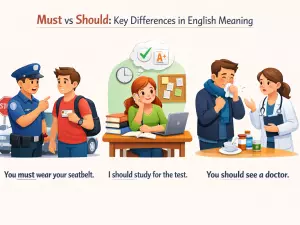
- Confusing “should” with “must” in rules: In many contexts, “must” signals a firm requirement, while “should” signals recommended behavior. Learners sometimes swap them and change the strength of the message.
- Missing the “expectation vs. instruction” difference in workplace English: “You should send the report by Friday” may be interpreted as optional advice, but in some teams it functions as a strong expectation. When clarity matters, speakers often choose “Please send it by Friday” or “It needs to be sent by Friday.”
- Taking “should” as a promise: “It should be ready tomorrow” is not a guarantee; it leaves room for delays. If you need a commitment, use “It will be ready tomorrow” (only if you can commit) or “We plan to have it ready tomorrow.”
- Misreading “should” with negatives as harsh criticism: “You shouldn’t do that” can be advice (safety, etiquette) but can sound scolding. Softer options include “It might be better not to…” or “I wouldn’t do that.”
- Confusing “should have + past participle” with simple past: “You should have called” expresses regret/criticism about a past action, not a past expectation. Learners sometimes use it when they mean “I expected you to call” (use “You were supposed to call”).
Patterns that often cause the problem
- should + base verb for advice/expectation: “You should check the email.” (recommendation, not a rule)
- should be + adjective for expected state: “It should be easy.” (likely/evaluative expectation)
- should be + -ing for expected current activity: “He should be working now.” (assumption, not certainty)
- should have + past participle for past regret/criticism: “They should have left earlier.” (judgment after the fact)
- Should…? for suggestions: “Should we start?” (proposal, not pressure unless the context is tense)
Quick contrast: expectation vs. stronger meanings
- ✅ “The meeting should finish by 3.” → expected/likely end time ❌ “The meeting must finish by 3.” → strict deadline
- ✅ “You should see a doctor.” → advice ❌ “You must see a doctor.” → urgent requirement (stronger)
- ✅ “It should be fine.” → reassurance/assumption ❌ “It will be fine.” → stronger certainty
- ✅ “You should have told me.” → criticism/regret about the past ❌ “You were supposed to tell me.” → missed duty/arrangement
Exercises and practice activities using should to express expectations
Use the activities below to practice how should expresses what is expected, likely, or normal in a situation. Focus on the common patterns: should + base verb, should be + adjective/noun, and should have + past participle (for expected outcomes in the past).
1) Quick pattern drill (choose the best completion)
- The train ______ arrive in about ten minutes (it’s usually on time).
- By now, the email ______ in your inbox.
- Don’t worry—this software update ______ take long.
- It’s 9 a.m.; the office ______ open.
- With this map, we ______ find the museum easily.
- She left at 6, so she ______ here already.
- The keys are on the table, so they ______ be easy to spot.
- If the weather stays clear, the flight ______ land on schedule.
- He studied a lot, so he ______ pass the exam.
- They shipped it yesterday; it ______ have arrived by now.
Show answers
- should
- should be
- shouldn’t
- should be
- should
- should be
- should
- should
- should
- should
2) Correct the sentence (expectation vs. advice)
Each item contains a common mistake. Rewrite it so it clearly communicates expectation (not advice), and fix any grammar issues.
- The package should arrives tomorrow.
- He should to be at work by now.
- It should raining later.
- They should have arrive already.
- My phone should be ring soon (it’s on silent).
- We should can see the mountains from here.
- She should has the report in her folder.
- The meeting should finished at 3 p.m.
Show answers
- The package should arrive tomorrow.
- He should be at work by now.
- It should rain later.
- They should have arrived already.
- My phone should ring soon (but it’s on silent). / My phone should be ringing soon (but it’s on silent).
- We should be able to see the mountains from here.
- She should have the report in her folder.
- The meeting should finish at 3 p.m. / The meeting should be finished by 3 p.m.
3) Choose the meaning (expectation, advice, or obligation)
Identify what should means in each sentence: expectation (likely/normal), advice (recommendation), or obligation (rule/requirement in a specific context).
- It should be quiet in the library.
- You should back up your files regularly.
- Employees should wear badges at all times.
- Don’t call yet—he should be in a meeting.
- We should leave early to avoid traffic.
- The results should be ready by Friday.
- Visitors should sign in at reception.
- Her train should have arrived by now.
Show answers
- Expectation (normal/appropriate state)
- Advice
- Obligation (workplace rule)
- Expectation
- Advice
- Expectation
- Obligation (procedure)
- Expectation (past expectation)
4) Build sentences from prompts (use the target form)
Write one complete sentence for each prompt using the form shown.
- (should + base verb) The bus / arrive / soon (it’s usually punctual).
- (should be + adjective) The room / quiet / now (class has started).
- (should be + -ing) He / drive / right now (he left five minutes ago).
- (should have + past participle) They / receive / the documents / by now (sent yesterday).
- (negative expectation) The repair / not take / long (simple fix).
- (question form) Where / the charger / be (it’s normally in the drawer)?
- (should + base verb) This key / open / the front door (it’s labeled).
- (should have + past participle) She / finish / already (deadline was noon).
Show answers
- The bus should arrive soon.
- The room should be quiet now.
- He should be driving right now.
- They should have received the documents by now.
- The repair shouldn’t take long.
- Where should the charger be?
- This key should open the front door.
- She should have finished already.
5) Mini-situations (pick the best response)
Choose the sentence that best matches an expectation based on evidence or routine.
- You’re outside a store during business hours.
A) The store should be open. B) You should open the store. - Your friend left home 30 minutes ago for a 10-minute walk.
A) She should be here by now. B) She should come here by now. - You mailed a letter last week; delivery is usually 2–3 days.
A) It should have arrived already. B) It should arrive already. - You see dark clouds; the forecast says rain.
A) It should rain later. B) It should to rain later. - You used the correct password many times before.
A) This password should work. B) This password should works.
Show answers
- A
- A
- A
- A
- A
6) Production practice: expectation phrases you can reuse
- It should be + adjective: “It should be fine/ready/quiet/available.”
- It should + base verb: “It should arrive/start/end/work.”
- Subject should be + time/place: “She should be here by 6.”
- Subject should be + -ing: “They should be waiting outside.”
- Subject should have + past participle: “He should have received it.”
- Negative expectation: “It shouldn’t take long / It shouldn’t be difficult.”
- Question form: “Where should it be?” / “What time should it start?”
- Soft certainty with evidence: “Based on the schedule, it should…”
- Routine-based expectation: “Normally, it should…”
- Contrast with reality: “It should be working, but it isn’t.”