Using Might to Show Uncertainty in English

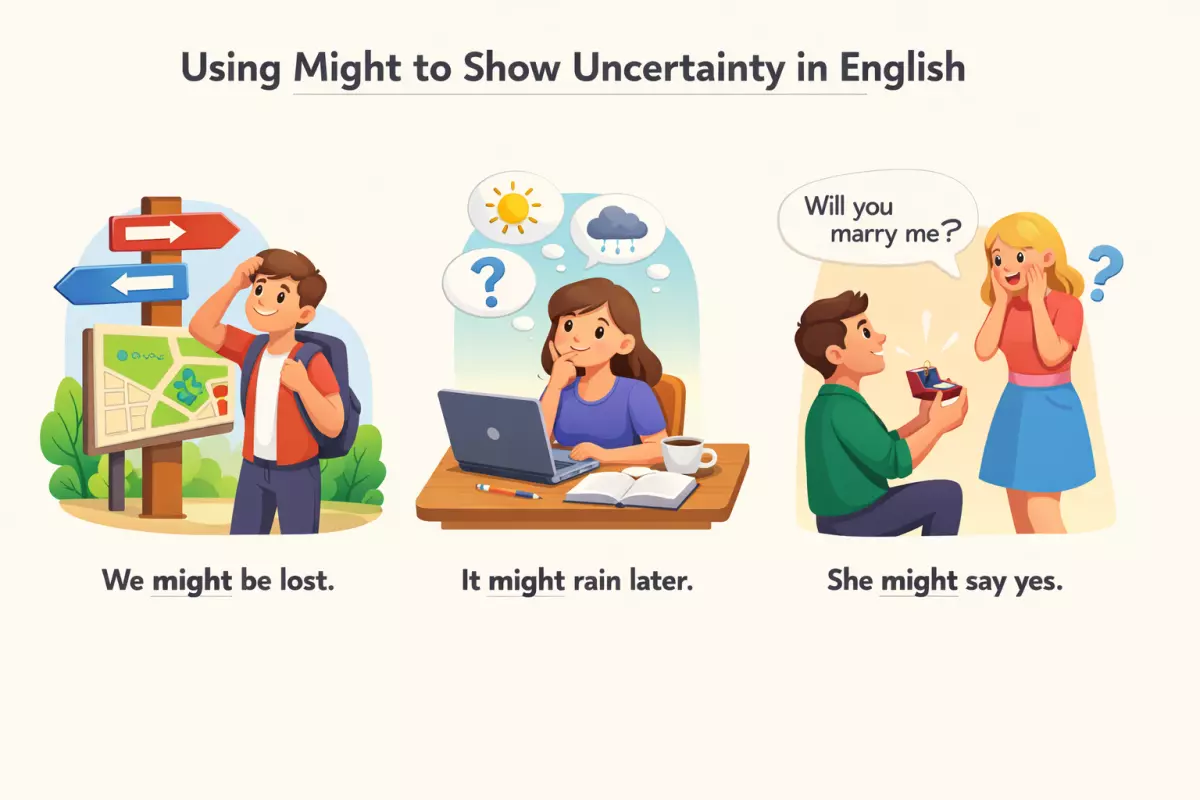 This article explains how might signals uncertainty or weak probability, why speakers use it to avoid strong predictions, and how it fits when talking about possible future outcomes. It also covers cautious opinions, differences from other modals, and practice exercises.
- How might signals uncertainty or weak probability
- Situations where speakers avoid strong predictions by using might
- How might appears when discussing possible future outcomes
- How speakers use might to present cautious ideas or opinions
- Differences between might and other possibility modals
- How might softens statements in uncertain situations
- Exercises and practice activities using might in uncertain contexts
When you are not fully sure, English often uses might to soften what you say and leave room for other possibilities. You will hear it in everyday situations like guessing the weather, giving advice, or explaining why someone is late. It helps you sound polite and realistic instead of too certain. This guide shows how to use it naturally and avoid mistakes that make you sound hesitant or overly confident.
How might signals uncertainty or weak probability
Might is used when a speaker does not want to commit to something being true. It presents an outcome as possible, but not certain, and it often sounds more cautious than may and much less confident than will. The idea is “this is one reasonable option,” not “this is what will happen.”
Core meaning and common patterns
The most frequent structure is might + base verb. It can refer to the present, the future, or a general situation, depending on context.
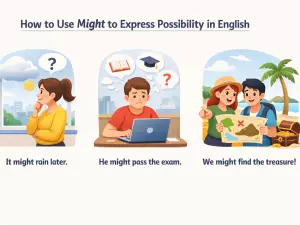
- might + base verb for a tentative present/future: “It might rain later.”
- might be + noun/adjective for cautious identification: “That might be the right file.”
- might not to reduce certainty further: “I might not have time today.”
- might + adverb to fine-tune probability: “It might still work.”
- might + base verb with time markers for future possibility: “We might meet on Friday.”
- might + base verb for general possibility: “Small errors might cause big delays.”
Examples that show “possible, but not guaranteed”
- “I might go to the gym after work.” (a plan, but not fixed)
- “She might know the answer.” (uncertain knowledge)
- “This might take longer than expected.” (cautious prediction)
- “They might be stuck in traffic.” (one explanation)
- “The price might drop next month.” (speculation)
- “He might not agree with that approach.” (uncertain reaction)
- “We might need more data.” (tentative requirement)
- “It might be better to wait.” (soft recommendation)
- “The email might have gone to spam.” (possible cause)
- “There might be a mistake in the report.” (possible problem)
- “I might have left my keys at the office.” (uncertain memory)
- “The meeting might start late.” (uncertain schedule)
How to avoid common form mistakes
- Use the base verb after might: ✅ “She might come.” ❌ “She might comes.”
- Use might be (not “might is”): ✅ “It might be true.” ❌ “It might is true.”
- Negation goes after might: ✅ “I might not finish today.” ❌ “I don’t might finish today.”
- Don’t use to after might: ✅ “We might leave early.” ❌ “We might to leave early.”
When speakers choose might instead of stronger modals
- To make a prediction sound less certain: “It might snow tonight.”
- To offer an idea without pushing it: “You might try restarting the app.”
- To acknowledge limited information: “That might be what happened.”
- To keep options open in planning: “We might reschedule if needed.”
- To be polite when disagreeing or correcting: “That might not be the best example.”
Situations where speakers avoid strong predictions by using might
Use might when you want to signal that a future outcome is possible but not something you’re ready to state confidently. It helps you sound cautious, avoid overpromising, and leave room for new information.
Common contexts where might is preferred
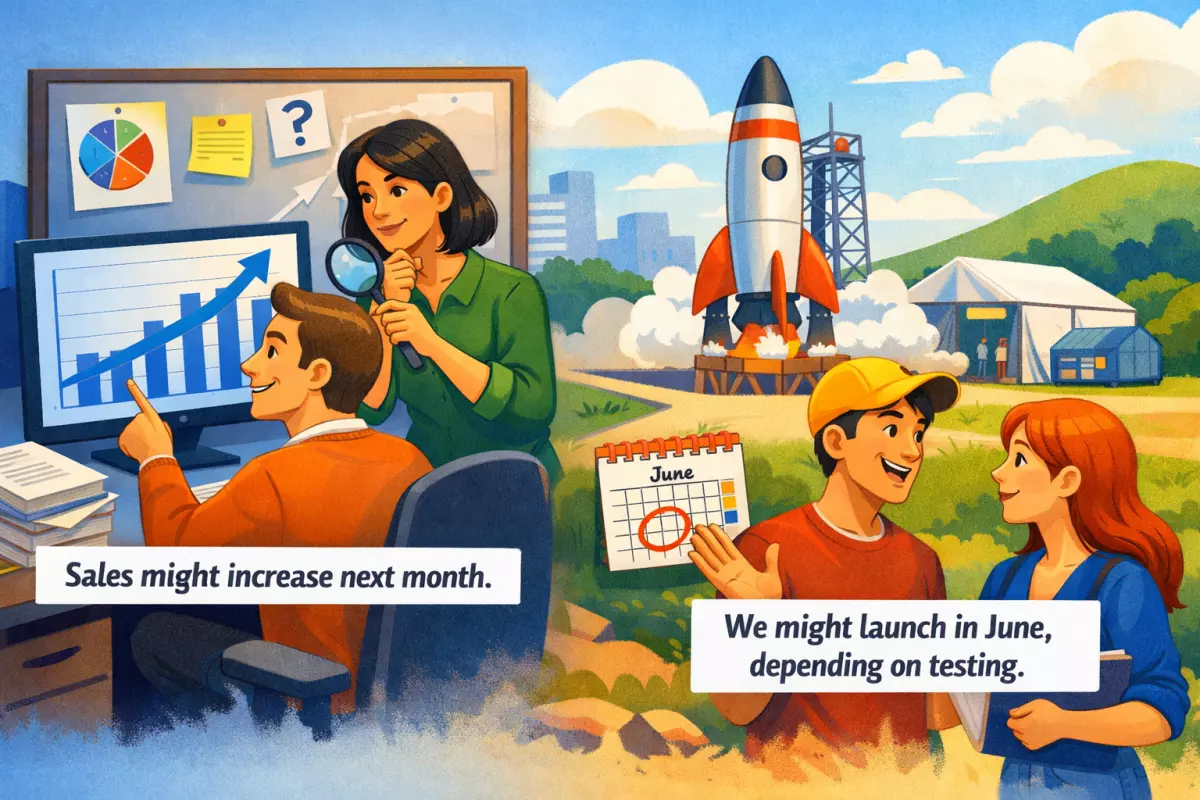
- Limited evidence: You have some clues, but not enough to commit. “The numbers look better, so sales might increase next month.”
- Early-stage plans: The plan exists, but it is not confirmed. “We might launch in June, depending on testing.”
- Conditions still unknown: The result depends on factors outside your control. “If shipping is delayed, the order might arrive late.”
- Rapidly changing situations: Things can shift quickly, so certainty would be risky. “With the weather changing, the flight might be canceled.”
- Polite hedging in professional settings: You soften a prediction to sound measured. “This approach might reduce costs over time.”
- Avoiding responsibility for a definite outcome: You want to be accurate rather than bold. “The fix might solve the issue, but we need to monitor it.”
- Forecasting with incomplete dаta: Typical in analytics, finance, and planning. “If demand stays flat, revenue might level off.”
- When you expect questions or pushback: Might leaves space for discussion. “That change might affect performance.”
- When multiple outcomes are plausible: You acknowledge uncertainty. “They might accept, or they might ask for changes.”
- When you want to avoid sounding dramatic: You keep the tone neutral. “There might be some delays this week.”
- Speculating about other people’s decisions: You cannot know their choice. “She might decide to stay with her current job.”
- Making careful predictions in customer communication: You reduce the risk of misleading someone. “Your refund might take 3–5 business days to appear.”
- Talking about risks: You highlight possibility without certainty. “A power outage might interrupt the update.”
- Responding when you have not checked yet: You avoid stating a fact. “It might be in the shared folder—I’ll confirm.”
Useful patterns for cautious predictions
- might + base verb: “It might rain later.” / “Prices might drop.”
- might not + base verb: “They might not agree to the timeline.”
- might be + noun/adjective: “It might be a server issue.” / “It might be too late.”
- might have to + base verb (possible necessity): “We might have to reschedule.”
- might + happen/occur (neutral event language): “A delay might occur during deployment.”
- might + depend on (explicit condition): “It might depend on budget approval.”
- might + if-clause (conditional prediction): “If traffic is heavy, we might miss the start.”
Quick accuracy notes
- ✅ “It might happen.” ❌ “It might to happen.” (No to after might.)
- ✅ “They might be late.” ❌ “They might are late.” (Use the base form, not a conjugated verb.)
- ✅ “We might not finish today.” (Place not after might.)
How might appears when discussing possible future outcomes
Use might to talk about a future result that is possible but not certain. It helps you avoid sounding too definite, especially when you do not have enough information or when conditions could change. This is common in planning, predictions, and risk-focused conversations.
Core patterns for future possibility
- might + base verb: “We might leave early.”
- might not + base verb: “They might not agree to the new schedule.”
- might be + noun/adjective: “It might be a long meeting.”
- might have to + base verb (possible obligation): “I might have to work late tomorrow.”
- might need to + base verb (possible necessity): “You might need to reset your password.”
- might want to + base verb (soft suggestion): “You might want to bring a jacket.”
- might + adverb (adjusting certainty): “It might still rain later.”
- might + verb with time markers: “She might call this evening.”
Using might with conditions and triggers
Might often appears with an “if” clause or a stated condition. This makes the uncertainty clear: the outcome depends on something.
- “If traffic is bad, we might miss the start.”
- “If the server is down, the page might not load.”
- “If sales improve, the team might hire another designer.”
- “If you don’t back up your files, you might lose your work.”
- “If the weather clears, we might go hiking.”
- “If the client changes the scope, the deadline might move.”
Common contexts and example sentences
- Planning: “We might meet on Friday instead.”
- Scheduling: “The train might arrive late due to maintenance.”
- Work decisions: “I might take a different approach on the next draft.”
- Predictions: “Prices might rise next month.”
- Health and safety: “You might feel tired after the vaccine.”
- Travel: “Our flight might be delayed because of fog.”
- Technology: “The app might crash on older devices.”
- Relationships: “He might be upset about the change.”
- Finance: “We might not have enough budget for that option.”
- Learning: “It might take a few weeks to get comfortable with the format.”
- Events: “The venue might close early on holidays.”
- Customer service: “Your refund might take 3–5 business days.”
- Logistics: “The package might arrive tomorrow, but it isn’t guaranteed.”
- Performance: “The system might run slower during peak hours.”
Practical usage notes (accuracy and tone)
- No “to” after might: ✅ “It might rain.” ❌ “It might to rain.”
- Use the base verb (not -s/-ed): ✅ “She might come.” ❌ “She might comes.”
- Negatives are simple: “might not” is standard; avoid double negatives.
- Might is weaker than will: “will” sounds like a decision or strong prediction; “might” keeps it open.
- Might can soften suggestions: “You might want to…” sounds less forceful than “You should…”
How speakers use might to present cautious ideas or opinions
Might is a practical choice when a speaker wants to sound tentative, avoid overcommitting, or leave room for other interpretations. It often signals “this is possible” rather than “this is true,” which makes it useful for opinions, suggestions, and informal predictions.
Common patterns that soften a statement
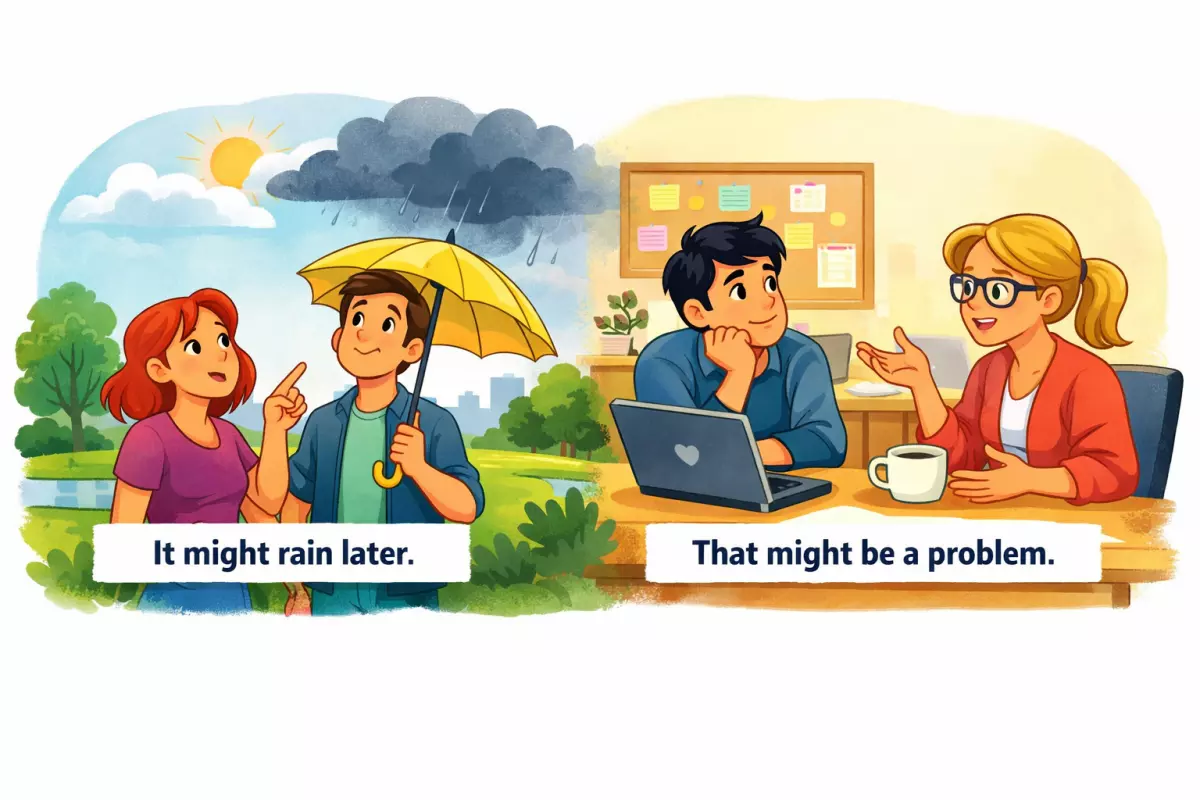
- Might + base verb to present a possibility: “It might rain later.”
- Might be + noun/adjective to avoid a firm judgment: “That might be a problem.” / “He might be right.”
- Might not to express cautious doubt: “They might not agree with that plan.”
- Might have + past participle to suggest an uncertain past explanation: “She might have missed the email.”
- Might be + -ing to describe a possible current situation: “They might be waiting outside.”
- Might want to for gentle advice: “You might want to double-check the address.”
- Might as well to show a low-stakes decision: “We might as well start now.”
- Might even to add a careful emphasis: “It might even save time.”
Using “might” to make opinions sound less absolute
In discussions, might helps speakers share a view without sounding certain or confrontational. It can reduce pressure on the listener and keep the conversation open.
- “I think this approach might work better for beginners.”
- “That might be true, but we should check the numbers.”
- “It might be worth considering a simpler design.”
- “Your point might apply in some cases, not all.”
- “This might sound strict, but the deadline matters.”
- “It might be more effective to start with the main issue.”
Polite suggestions and indirect advice
When giving advice, speakers often choose might to avoid sounding like they are ordering someone. The suggestion feels optional, which is useful in workplaces, classrooms, and customer situations.
- “You might want to back up those files before updating.”
- “We might try a shorter meeting next time.”
- “You might consider emailing them instead of calling.”
- “It might help to add an example in the introduction.”
- “You might be able to solve it by restarting the app.”
- “We might need to ask for clarification.”
Careful disagreement and hedging
Speakers also use might to disagree without sounding blunt. This is a common hedging strategy: it signals uncertainty or partial agreement while still expressing a different view.
- “That might be one interpretation, but there’s another angle.”
- “It might not be the best option if cost is the priority.”
- “That might work in theory, but the timing is tight.”
- “It might be safer to wait for confirmation.”
- “I might be wrong, but the data looks incomplete.”
Quick accuracy notes (form and meaning)
- ✅ “It might be true.” → cautious possibility (not a firm claim).
- ✅ “He might have left already.” → uncertain past guess.
- ❌ “He might to leave.” → after might, use the base verb (no “to”).
- ✅ “Might I ask a question?” → very polite and formal; less common in everyday speech.
Differences between might and other possibility modals
English has several ways to talk about possibility, and each modal carries a slightly different meaning about likelihood, evidence, politeness, or formality. Choosing the right one helps listeners understand whether you are guessing, predicting, giving a cautious suggestion, or reporting a logical conclusion.
| Modal / form | Typical meaning (strength) | Common uses and patterns | Example |
|---|---|---|---|
| might | Possibility; often fairly uncertain | Guessing, cautious statements, polite suggestions; might + base verb, might be + -ing, might have + past participle | We might leave early if the meeting ends soon. |
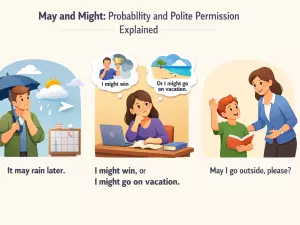
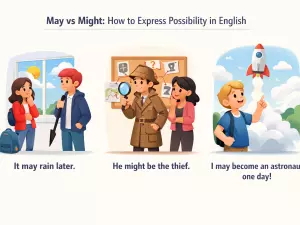
| may | Possibility; sometimes a bit more neutral/formal | More common in formal writing; also used for permission in some contexts; may + base verb | The results may vary depending on the sample size. |
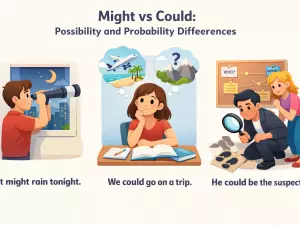
| could | Possible (sometimes suggests a realistic option/ability) | Options and potential outcomes; can imply “one possible solution”; could + base verb, could have + past participle | We could take the train instead of driving. |
| can | General possibility (often “sometimes/it is possible”) | General truths and typical behavior; less common for a single uncertain future event; can + base verb | It can get windy here in the afternoon. |
| must | Strong logical conclusion (high certainty) | Inference from evidence; not used for “maybe”; must be, must have + past participle | She must be at work; her car isn’t here. |
| should / ought to | Expectation (probable, based on norms/plans) | What is likely because it is planned or typical; should be, should have + past participle | The package should arrive by Friday. |
| might as well | Practical choice when alternatives aren’t better | Resigned or pragmatic decision; might as well + base verb | It’s raining—we might as well stay in. |
| maybe / perhaps (adverbs) | Possibility (flexible, tone depends on context) | Often at the start of a sentence; works without a modal; common in speech and writing | Maybe we’ll hear back today. |
How to choose in real situations
- Use “might” when you want to keep the claim light and non-committal: “I might be wrong, but…”
- Use “may” when the tone is more formal or neutral in writing: “This may indicate a trend.”
- Use “could” when you are presenting an option or a possible explanation among others: “It could be a software issue.”
- Use “must” when you are drawing a strong inference from evidence: “They must have missed the bus.”
- Use “should” when something is expected (not just possible): “He should be home by now.”
- Use “can” for general possibility rather than one uncertain event: “Mistakes can happen.”
Pattern contrasts that often cause mistakes
- Single-event uncertainty: ✅ “It might rain later.” → more natural than ❌ “It can rain later.” (unless you mean “it is possible in this climate”).
- Inference vs. guess: ✅ “She must be tired” (strong evidence) vs. ✅ “She might be tired” (weaker evidence).
- Past uncertainty: ✅ “They might have taken a wrong turn.” (uncertain) vs. ✅ “They must have taken a wrong turn.” (near-certain conclusion).
- Suggestion tone: ✅ “You might want to restart your phone.” (soft, polite) vs. ✅ “You should restart your phone.” (stronger advice).
- Options: ✅ “We could meet on Tuesday.” (one possible plan) vs. ✅ “We might meet on Tuesday.” (uncertain whether it will happen).
Useful example set (quick reference)
- It might take longer than expected.
- He may be unavailable this afternoon.
- We could try a different approach.
- Prices can change without notice.
- She must be the new manager.
- The train should arrive in ten minutes.
- I might be misunderstanding the instructions.
- The noise may come from the вентиляtion system.
- That could explain the error message.
- It can be hard to focus in a noisy room.
- They must have forgotten the appointment.
- He should have received the email by now.
- You might want to save your work before updating.
- We might as well order now; the line is getting longer.
- Maybe the file didn’t upload correctly.
- Perhaps we’ll need a backup plan.
How might softens statements in uncertain situations
Might is useful when you want to sound less definite and leave room for other possibilities. It helps you avoid overcommitting to a claim, especially when you do not have full information or when the outcome depends on conditions.
Core patterns that reduce certainty
- might + base verb: “I might call you later.” (possible, not promised)
- might not + base verb: “They might not agree.” (uncertain negative)
- might be + noun/adjective: “It might be a scam.” / “He might be tired.”
- might have + past participle: “She might have missed the train.” (uncertain past)
- might not have + past participle: “We might not have understood the instructions.”
- might be + -ing: “She might be working right now.” (uncertain in-progress situation)
- might have been + -ing: “He might have been joking.” (uncertain past in-progress)
- might be able to + base verb: “I might be able to help tomorrow.” (possibility + ability)
- might need to + base verb: “You might need to restart the app.” (soft suggestion)
- might want to + base verb: “You might want to save a copy.” (polite, indirect advice)
Common situations where it sounds natural
- Speculating: “That noise might be the heater.”
- Predicting cautiously: “Sales might improve next quarter.”
- Offering a tentative plan: “We might meet after lunch.”
- Giving advice without pressure: “You might try a different password.”
- Disagreeing gently: “That might not be the best approach.”
- Explaining limits: “I might be wrong, but the file looks corrupted.”
- Softening requests: “Might I ask a quick question?” (more formal)
- Hedging in professional writing: “This result might indicate a measurement error.”
Short example set (with typical meaning)
- “It might rain.” → a real possibility, not a firm forecast
- “I might be late.” → warning without certainty
- “They might not have seen your email.” → avoids blaming
- “The meeting might start early.” → suggests flexibility in plans
- “This might take a while.” → prepares someone for delay
- “You might have left it in the car.” → a guess, not an accusation
- “She might be feeling sick.” → cautious interpretation
- “We might need more data.” → tentative conclusion
- “He might not be available today.” → uncertainty + polite tone
- “I might have misunderstood.” → softens disagreement and invites clarification
Accuracy tips and frequent issues
- ✅ Use the base verb after might: “might go,” “might happen,” “might be.” ❌ Not “might goes” or “might to go.”
- Use might have + past participle for uncertain past events: “might have forgotten,” not “might forgot.”
- For polite suggestions, might want to and might need to sound less forceful than “must” or “have to.”
- When you want stronger probability, speakers often choose “will” or “probably”; when you want to keep it open, “might” fits better.
Exercises and practice activities using might in uncertain contexts
Use these activities to build control over how might expresses possibility (not certainty). Focus on the core patterns: might + base verb, might be + -ing, and might have + past participle. Pay attention to time (now/future vs. past) and to how strong or weak the guess sounds in context.
1) Choose the best form of might (present/future vs. past)
Complete each sentence with the correct form: might + verb, might be + -ing, or might have + past participle.
- Don’t call her yet—she __________ (drive) right now.
- He isn’t answering. He __________ (be) in a meeting.
- I can’t find my keys. I __________ (leave) them at the office.
- They __________ (arrive) later, depending on traffic.
- The lights are off. They __________ (go) to bed already.
- She looks tired. She __________ (work) late this week.
- We __________ (need) more time to finish the report.
- That noise was loud. Something __________ (fall) in the kitchen.
- He’s not here yet. He __________ (miss) the bus.
- Take an umbrella. It __________ (rain) this afternoon.
Show answers
- might be driving
- might be
- might have left
- might arrive
- might have gone
- might have been working
- might need
- might have fallen
- might have missed
- might rain
2) Spot the mistake and rewrite (form and meaning)
Each sentence has a problem with structure or time reference. Rewrite so the uncertainty is expressed naturally.
- He might to be late because of traffic.
- She might goes to the gym after work.
- They might have arrive already.
- I might can help you tomorrow.
- It might raining later.
- He might be forgot my message.
- We might to finish early if the client agrees.
- She might has left her phone at home.
Show answers
- He might be late because of traffic.
- She might go to the gym after work.
- They might have arrived already.
- I might be able to help you tomorrow.
- It might rain later. / It might be raining later (less common; use for an ongoing situation).
- He might have forgotten my message.
- We might finish early if the client agrees.
- She might have left her phone at home.
3) Match the situation to the best might sentence
Choose the sentence (A–L) that fits each situation (1–10). Two sentences are extra.
- A. She might be on the train.
- B. She might have been on the train.
- C. They might cancel the meeting.
- D. They might have cancelled the meeting.
- E. He might be joking.
- F. He might have been joking.
- G. I might need your help later.
- H. I might have needed your help earlier.
- I. The package might arrive tomorrow.
- J. The package might have arrived yesterday.
- K. She might know the answer.
- L. She might have known the answer.
- You’re waiting for a delivery that is expected tomorrow.
- You think the delivery already came yesterday, but you didn’t check.
- Right now, you’re not sure if someone is being serious.
- Yesterday, you realized later that someone was not serious.
- You may ask for assistance later today.
- You needed assistance earlier, but the moment has passed.
- You’re unsure whether she has the information in general.
- You’re talking about a past moment when she possibly had the information.
- She isn’t answering; you guess she is currently travelling by train.
- You’re explaining why she didn’t answer earlier; you guess she was travelling then.
Show answers
- I
- J
- E
- F
- G
- H
- K
- L
- A
- B
4) Strength and tone: soften statements with might
Rewrite each sentence to make it less direct. Keep the original meaning, but reduce certainty or pressure.
- You are wrong.
- This plan will fail.
- He doesn’t understand the problem.
- We can’t finish by Friday.
- That’s not the best option.
- You need to check the numbers again.
- She is ignoring your email.
- There is a mistake in the report.
Show answers
- You might be wrong.
- This plan might fail.
- He might not understand the problem.
- We might not finish by Friday.
- That might not be the best option.
- You might want to check the numbers again.
- She might be ignoring your email.
- There might be a mistake in the report.
5) Quick pattern drill (build 12 correct sentences)
Combine one item from each group to make natural sentences. Aim for a mix of time references.
- Starters: I / We / They / He / She / The train / The email / The results / My phone / The kids / Our manager / This software
- Possibility frames: might be / might not be / might + base verb / might not + base verb / might be + -ing / might have + past participle / might not have + past participle
- Endings (choose what fits): ready yet; at home; in the spam folder; on the way; working late; having lunch; updated overnight; delayed by traffic; sent to the wrong address; finished already; need a restart; misunderstood the question
Self-check rules while you practice:
- After might, use the base form: ✅ might go ❌ might goes.
- Use might be + -ing for “in progress now/around now”: might be working.
- Use might have + past participle for past guesses: might have missed.
- For ability, prefer might be able to rather than might can.