Using Modal Verbs to Make Predictions in English

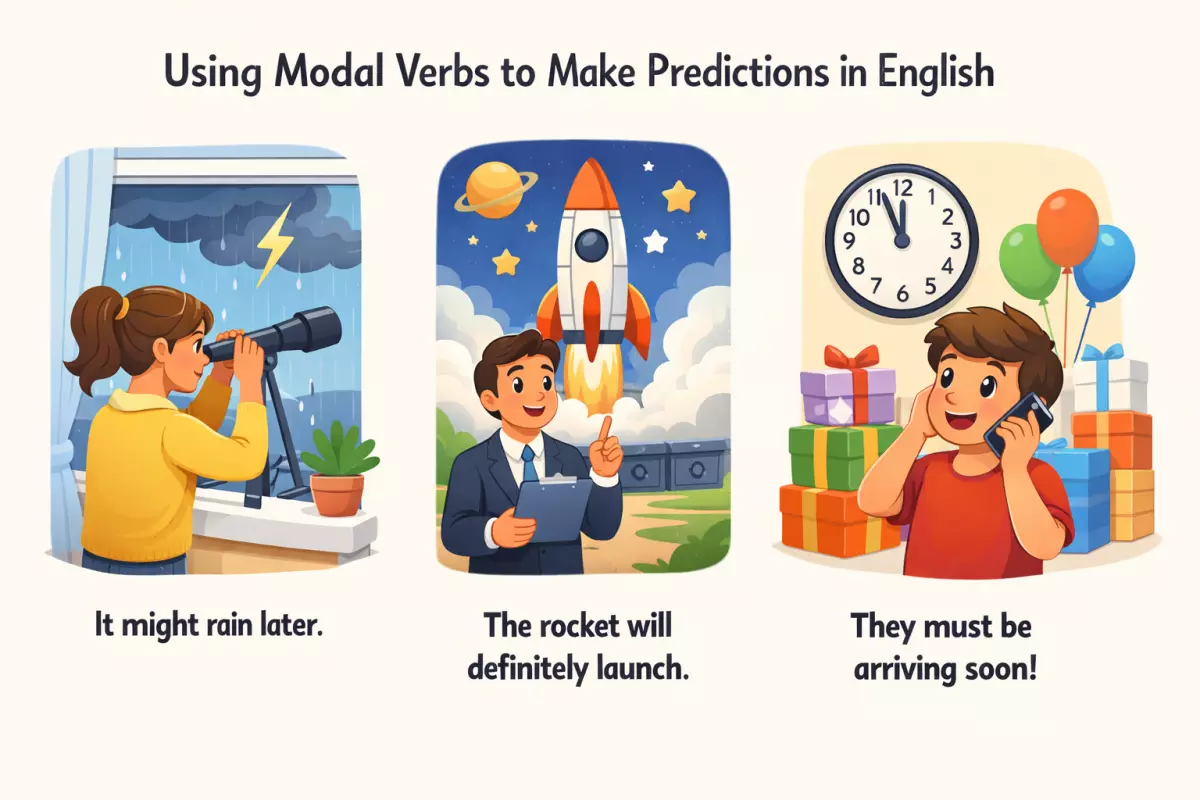 Learn how English speakers predict outcomes with modal verbs, which ones show strong certainty vs uncertainty, and how evidence or logic affects the choice. See examples about plans, results, and future events, plus formal vs conversational use, common learner mistakes, and practice exercises.
- How English speakers predict outcomes using modal verbs
- Which modals express strong predictions and which signal uncertainty
- How evidence or logic influences the choice of modal verb
- Examples of predictions about plans, results, and future events
- How conversational predictions differ from formal predictions
- Typical mistakes learners make when predicting with modal verbs
- Exercises and practice activities using modal verbs for predictions
To talk about what you think will happen in English, modal verbs help you sound natural and precise. Since you usually cannot know the future for sure, you choose wording that matches your confidence level, from a strong expectation to a reasonable guess or a simple possibility. This guide shows how to pick the right form so your predictions fit the situation and the evidence you have.
How English speakers predict outcomes using modal verbs
English uses modal verbs to show how sure a speaker is about a future or present result. The key is choosing a modal that matches the strength of your evidence (facts, patterns, what you see now) and the time reference (now, later, or in the past).
Common prediction patterns and what they signal
- will + base verb: a neutral, confident prediction based on expectation or general knowledge. “It will rain this afternoon.”
- be going to + base verb: a prediction based on present evidence or a clear trend. “Look at those clouds—it’s going to rain.”
- should + base verb: a reasonable expectation (often with schedules, norms, or probability). “The train should arrive at 6:10.”
- may/might + base verb: a possible outcome; the speaker is not sure. “We might miss the start if traffic is bad.”
- could + base verb: one possible result among several (often suggests alternatives). “That decision could cause delays.”
- must + base verb: a strong logical conclusion from evidence (more “deduction” than “future plan”). “The lights are off; they must be asleep.”
- can’t + base verb: a strong negative conclusion (the speaker thinks something is impossible). “He can’t be at work—his car is here.”
- will probably / will likely: increases certainty while keeping it realistic. “They’ll probably choose the cheaper option.”
- might still / may still: keeps the possibility open despite new information. “It may still work if we restart it.”
- shouldn’t + base verb: expectation that something is unlikely or not supposed to happen. “It shouldn’t take more than an hour.”
Time focus: present, future, and past predictions
- Present deduction: modal + base verb. “She must know the answer.” / “They might be at home.”
- Future prediction: modal + base verb (often with time words). “It will get colder tonight.” / “We might finish by Friday.”
- Past deduction: modal + have + past participle. “They must have left early.” / “He might have forgotten.”
- Past negative deduction: can’t have + past participle. “She can’t have said that.”
Accuracy tips: choosing the right strength
- Use will when you’re fairly sure, not when you’re guessing with weak evidence.
- Use going to when something in the situation points to the outcome (what you see, hear, or know right now).
- Use may/might/could to show uncertainty; these are safer for predictions you can’t support strongly.
- Use must for conclusions from evidence, not for personal plans. ✅ “He must be stuck in traffic.” ❌ “I must go to the store tomorrow.”
- Remember that must (deduction) and have to (obligation) are different meanings even though both can sound “strong.”
Quick model sentences you can adapt
- “If the price drops again, people will buy more.”
- “With those dark clouds, it’s going to storm.”
- “Given the schedule, the meeting should end by 3.”
- “There may be a delay because of maintenance.”
- “We might not have enough time to cover everything.”
- “A small change could improve performance.”
- “They must be in a different time zone.”
- “He can’t be serious—that doesn’t make sense.”
- “They must have missed the email.”
- “She might have taken the earlier train.”
- “It can’t have been easy to fix.”
- “It’ll probably take longer than we think.”
Which modals express strong predictions and which signal uncertainty
English modals let you grade a prediction from “almost certain” to “just a guess.” The key is choosing a modal that matches your evidence (facts, patterns, what you can see now) and your purpose (confident forecast vs. cautious possibility).
Modals that make strong predictions (high confidence)
- will + base verb: the default for confident forecasts and expectations.
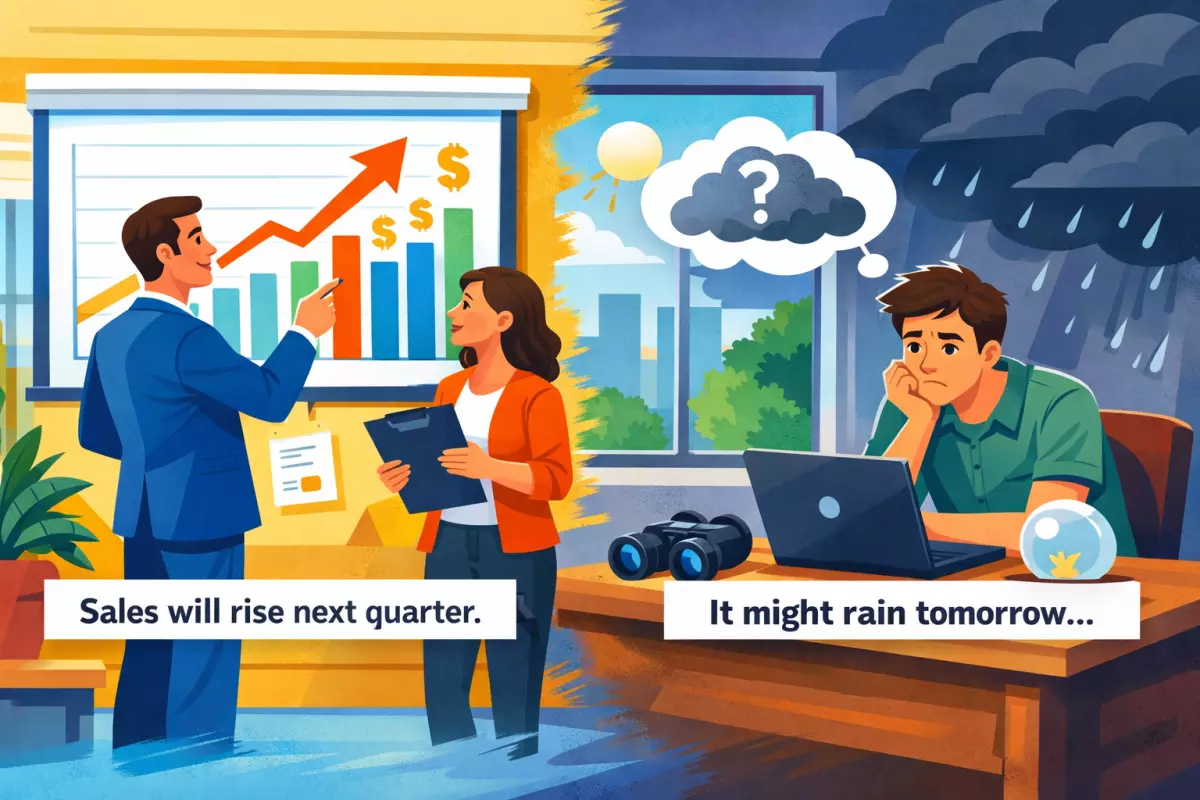
“Sales will rise next quarter.” - be going to + base verb: strong prediction based on present evidence (what you see now).
“Look at those clouds—it’s going to rain.” - must + base verb: logical conclusion from strong evidence (speaker inference).
“They left the lights on; they must be home.” - should + base verb: expectation based on norms, plans, or typical outcomes (still fairly strong).
“The train should arrive on time.” - ought to + base verb: similar to should, often slightly more formal.
“The repair ought to fix the problem.” - will definitely / will certainly + base verb: adds emphasis to certainty (use when you truly mean it).
“She will definitely pass.” - can’t + base verb (negative certainty): strong prediction that something is impossible.
“That can’t be the right address.” - won’t + base verb: strong negative prediction (refusal or confident “not going to happen,” depending on context).
“It won’t take long.”
Modals that signal uncertainty (medium to low confidence)
- may + base verb: a real possibility, but not guaranteed.
“We may need more time.” - might + base verb: often a weaker possibility than may (or simply more tentative).
“It might snow tonight.” - could + base verb: one possible outcome among others; often suggests alternatives.
“Prices could drop if demand slows.” - may not / might not + base verb: uncertainty in the negative direction.
“They might not agree to the terms.” - couldn’t + base verb: sometimes used for “it’s unlikely,” but more often means “it’s not possible” in context—be careful with ambiguity.
“That couldn’t happen without funding.” - should (cautious use): in some contexts it’s more of a hopeful expectation than a firm forecast.
“It should work, but we’ll test it.” - would (conditional prediction): not about certainty, but about a forecast that depends on a condition.
“With more staff, we would finish sooner.”
Pattern cues that strengthen or soften predictions
- Evidence now → “be going to”: “He’s limping—he’s going to fall if he keeps running.”
- Logic from clues → “must”: “The shop is dark; it must be closed.”
- General expectation → “should/ought to”: “The update should improve performance.”
- Multiple possible futures → “could/might”: “We could see delays if the system overloads.”
- Stronger certainty with adverbs: “will probably” (softer) vs. “will definitely” (stronger).
- Time reference stays the same: modals don’t change form for future; use context or time phrases. “It may rain tomorrow.”
- Progressive for “in progress” predictions: “She must be working late” (inference about now).
- Perfect forms for past predictions/inferences: “They must have missed the bus” (conclusion about the past).
As a practical guide: use will for straightforward confident forecasting, be going to when you can point to current signs, must for strong logical conclusions, and may/might/could when you want to keep the prediction open and avoid sounding certain without enough evidence.
How evidence or logic influences the choice of modal verb
When you make a prediction in English, the modal verb you choose signals how strong your support is: direct evidence, logical deduction, or a weaker expectation. Listeners use that modal to judge whether you are certain, fairly sure, or simply guessing.
Match the modal to the strength and type of support
- Use must for a confident conclusion based on clear evidence or strong reasoning (you feel it is the only realistic explanation).
- “The lights are off and no one’s answering. They must be out.”
- “He knows every detail—he must have read the report.”
- Use will for a firm prediction you consider very likely, often based on patterns, experience, or a settled expectation (not necessarily proof in front of you).
- “Don’t worry—she will call back this afternoon.”
- “If you keep heating it, it will boil.”
- Use should / ought to when the prediction is reasonable and expected, but not guaranteed (conditions suggest it).
- “The train left on time, so it should arrive by 6.”
- “With this weather, the roads ought to be quiet.”
- Use may / might / could for possibility when you lack strong support or several outcomes are plausible.
- “It might rain later—those clouds are building.”
- “They could be stuck in traffic.”
- “We may need more time if the server is slow.”
- Use can’t / couldn’t to reject a conclusion because it conflicts with evidence or logic (negative deduction).
- “He can’t be at home—I just saw him downtown.”
- “That couldn’t be the right file; it’s dated last year.”
Common evidence-to-modal patterns (with example cues)
- Immediate physical evidence (what you see/hear/smell) → often must: “You’re shivering—you must be cold.”
- Strong logical chain (A implies B) → must: “No signal + empty battery icon = it must be dead.”
- Established routine → will: “He always takes the early bus; he will be on the 7:10.”
- General rule / scientific certainty → will: “If you drop it, it will fall.”
- Plan + normal conditions → should: “The parts shipped yesterday, so they should arrive tomorrow.”
- Expectation with a possible obstacle → should + condition: “It should work if the password is correct.”
- Uncertain signs → might/could: “The sky’s dark; it might storm.”
- Multiple explanations → could: “She could be busy, or she could have missed the message.”
- Permission/neutral possibility in formal style → may: “The results may change after review.”
- Evidence contradicts the idea → can’t: “It can’t be broken; it turns on and runs.”
- Past clues leading to a present conclusion → must: “Her car is outside; she must be here.”
- Prediction softened for politeness → might: “That might take longer than expected.”
- Weather/traffic/sports talk (typical uncertainty) → might/could: “It could go either way.”
- Confident refusal of a rumor → can’t: “That can’t be true; the numbers don’t match.”
Quick accuracy checks
- Don’t use must for a simple guess. ✅ “He might be late.” ❌ “He must be late.” (unless you have strong reasons)
- Use can’t (not mustn’t) for negative deduction. ✅ “It can’t be hers.” ❌ “It mustn’t be hers.”
- Keep should for “expected,” not “certain.” If you mean “almost guaranteed,” choose will or a stronger phrasing.
- Add a reason clause to show your logic. “He must be asleep because his phone is off.” / “It might be delayed if there’s an accident.”
Examples of predictions about plans, results, and future events

When you predict what is likely to happen, English often uses modal verbs to show how certain the speaker is. The most common patterns are will for confident forecasts, be going to for plans or strong evidence, and may/might/could for possibilities. The examples below model typical sentence frames you can reuse.
Common patterns you can copy
- will + base verb for a strong prediction: “It will improve.”
- be going to + base verb for plans or clear signs: “They’re going to launch it next month.”
- may/might/could + base verb for uncertain outcomes: “It might take longer.”
- should + base verb for an expected result: “It should work now.”
- will probably / will likely + base verb to soften certainty: “Prices will probably rise.”
- may well / might well + base verb for a reasonable guess: “She might well win.”
- be likely to + base verb for probability: “They’re likely to agree.”
- be bound to + base verb for near certainty (often informal): “Mistakes are bound to happen.”
Example sentences (plans, results, and future events)
- The team will finish the report by Friday.
- I think the meeting will run over time.
- They are going to announce the new schedule tomorrow.
- We are going to move the deadline to next week.
- Look at those clouds— it is going to rain soon.
- If you keep driving like that, you might get a ticket.
- With this traffic, we may not arrive on time.
- Sales could increase after the holiday campaign.
- Don’t worry; the update should fix the problem.
- Based on the reviews, the film should be popular.
- The train will probably be delayed because of the storm.
- She will likely accept the offer if the salary is higher.
- He might well change his mind after he sees the data.
- The new policy may well reduce complaints.
- They are likely to miss the connection unless they hurry.
- With those costs, the project is bound to go over budget.
Quick usage notes (to avoid common mistakes)
- Use the base verb after a modal: ✅ “It might rain.” ❌ “It might rains.”
- Use be going to (not “will”) when you mean a planned action: “We’re going to start at 9.”
- Use will for a confident forecast or a quick prediction: “You’ll feel better tomorrow.”
- Use may/might/could when you want to keep the prediction open: “It could take a few days.”
- Use should when the result is expected, not guaranteed: “It should be ready by noon.”
How conversational predictions differ from formal predictions
In everyday speech, predictions often sound softer, more flexible, and more interactive because speakers leave room for new information. In more formal settings, predictions are usually framed as measured judgments, supported by evidence, and expressed with more controlled certainty.
| Conversational prediction (typical patterns) | Formal prediction (typical patterns) | Example pair (same idea, different register) |
|---|---|---|
| Uses hedges and “I think/guess” to reduce certainty. | Uses cautious, impersonal framing (e.g., “It is likely…”). | “I think it’ll rain later.” / “Rain is likely later today.” |
| Prefers contractions and shorter clauses. | Prefers full forms and longer, explicit wording. | “They’ll probably win.” / “They will probably win the match.” |
| Leans on will for quick, on-the-spot guesses. | Leans on probability language and evidence-based verbs. | “That’ll be Sam calling.” / “That is likely Sam calling.” |
| Uses might/could to keep options open and invite response. | Uses structured uncertainty (ranges, conditions, assumptions). | “We might be late.” / “Delays could occur under peak traffic conditions.” |
| Uses questions to check predictions collaboratively. | Uses statements that stand alone without negotiation. | “Should be fine, right?” / “It should be acceptable based on the criteria.” |
| Allows vague time markers (“soon,” “later,” “in a bit”). | Uses specific time frames when possible. | “It’ll be ready soon.” / “It will be ready by 3 p.m.” |
Common conversational choices (and what they signal)
- will for immediate inference: “That’ll be the delivery.”
- probably to show a strong but not absolute guess: “She’ll probably say yes.”
- might for low-to-medium confidence: “It might take longer than expected.”
- could for multiple possible outcomes: “Prices could drop next month.”
- should for expectation based on routine: “The train should arrive on time.”
- Hedges: “I think,” “I guess,” “maybe,” “kind of” to soften certainty.
- Tag questions to invite agreement: “It’ll be okay, won’t it?”
- Ellipsis and fragments: “Probably tomorrow.” / “Might not.”
- Contractions: “It’ll,” “we’ll,” “she’ll,” “won’t” for natural flow.
- Casual intensifiers: “pretty sure,” “not sure,” “I’m betting” to show stance.
- Personal viewpoint as the source: “I’d say he’ll be late.”
- Quick revisions mid-sentence: “It’ll be—actually, it might be closer to ten.”
Common formal choices (and what they signal)
- Impersonal subjects: “It is likely that…” / “There is a possibility that…”
- Condition-based predictions: “If X occurs, Y may follow.”
- More cautious modals: may and might for uncertainty in reports.
- Measured probability wording: “likely,” “unlikely,” “expected,” “projected.”
- Reduced reliance on personal stance: ❌ “I guess” → ✅ “The data suggest…”
- Explicit scope and limits: “in the short term,” “under current assumptions.”
- Clear time frames and quantities when available: “within 48 hours,” “by Q3.”
- More complete sentence structures (fewer fragments and tags).
- Careful separation of fact vs. forecast: “Current results show…; this suggests…”
- Preference for consistency: avoiding frequent shifts between will, might, and should without explanation.
When choosing a modal verb for a prediction, match the level of confidence and the setting. In casual talk, speakers often prioritize speed and rapport, so softer language and interactive checks are common. In formal writing and presentations, the same forecast is usually presented with clearer assumptions and more controlled certainty, often using probability terms alongside modals like may, might, and should.
Typical mistakes learners make when predicting with modal verbs
Errors with predictive modals usually come from mixing up levels of certainty, choosing the wrong time reference, or applying the wrong verb form after the modal. Fixing these patterns makes predictions sound more natural and more precise.
- Using “will” for everything (overconfidence). Learners often use will even when the evidence is weak. Prefer might / may / could for less certain guesses. ❌ “It will rain later.” (no evidence) → ✅ “It might rain later.”
- Using “must” as a simple future prediction. Must is typically a logical conclusion based on evidence now, not a neutral future forecast. ❌ “He must arrive tomorrow.” → ✅ “He will probably arrive tomorrow.” / “He’s sure to arrive tomorrow.”
- Confusing “may” and “maybe” in sentence structure. May is a modal before the base verb; maybe is an adverb that can start a clause. ❌ “Maybe it rain.” → ✅ “Maybe it will rain.” / “It may rain.”
- Wrong verb form after a modal. After modals, use the base form (no -s, no to). ❌ “She might goes.” / “They will to arrive.” → ✅ “She might go.” / “They will arrive.”
- Mixing up present evidence vs. future prediction. Use must be for a conclusion about now; use will (often with “probably”) for what you expect later. ❌ “He will be at home now.” (meaning “I’m sure now”) → ✅ “He must be at home now.”
- Using the wrong perfect form for past predictions. For conclusions about the past, use modal + have + past participle. ❌ “They must left early.” → ✅ “They must have left early.”
- Confusing “could” (possibility) with “could” (ability). In predictions, could often means “it’s possible,” not “was able to.” Clarify with context. ✅ “It could get worse.” (possible) vs. ✅ “When I was younger, I could run fast.” (ability)
- Overusing “can” for probability. Can often describes general possibility, not a specific prediction about a situation. ❌ “He can be late today.” (intended: likely) → ✅ “He might be late today.”
- Skipping “be” with adjectives/nouns. Predictions about states need be. ❌ “It might cold tonight.” → ✅ “It might be cold tonight.”
- Using “mustn’t” to mean “probably not.” Mustn’t expresses prohibition, not negative deduction. Use can’t for strong negative conclusions. ❌ “He mustn’t be at work.” (sounds like “he is not allowed”) → ✅ “He can’t be at work.”
- Confusing “can’t” (deduction) with “won’t” (refusal/strong expectation). Can’t = logically impossible; won’t often implies refusal or a firm expectation. ✅ “That can’t be true.” vs. ✅ “He won’t help.” (refusal/strong expectation)
- Using “would” as a direct substitute for “will.” Would is common in hypothetical or reported predictions, not simple forecasts. ❌ “I think it would rain tomorrow.” (neutral forecast) → ✅ “I think it will rain tomorrow.” / “They said it would rain tomorrow.”
- Incorrect question forms with modals. In questions, invert the modal and subject. ❌ “Will it rains?” → ✅ “Will it rain?” ❌ “Might it will rain?” → ✅ “Might it rain?”
- Double modals in standard English. Standard English avoids stacking modals. ❌ “It might will happen.” → ✅ “It might happen.” / “It will probably happen.”
- Negation placed in the wrong spot. Put not after the modal, not after the main verb. ❌ “It will happen not.” → ✅ “It will not happen.” / “It won’t happen.”
- Choosing a modal that doesn’t match the evidence. When you have clear signs, use stronger language (must / will); when you’re guessing, use softer language (might / could). A quick self-check: “How sure am I, and what evidence do I have?”
Quick correction patterns to remember
- ✅ Modal + base verb: “may rain,” “might go,” “could happen.”
- ✅ Modal + be + adjective/noun: “might be late,” “must be the answer.”
- ✅ Modal + have + past participle (past conclusion): “must have forgotten,” “might have missed the bus.”
- ✅ Strong negative deduction: “can’t be,” “can’t have + past participle.”
Exercises and practice activities using modal verbs for predictions
Build accuracy by matching each modal to the strength of the evidence. In prediction language, the most common pattern is modal + base verb (e.g., “It might rain”), and for past guesses, modal + have + past participle (e.g., “It must have rained”). The activities below focus on choosing the right modal, keeping the verb form correct, and avoiding overconfidence when the evidence is weak.
1) Choose the best modal (present/future predictions)
- The sky is very dark and the wind is picking up. It ______ rain soon.
- I’m not sure, but I think they ______ arrive late because of traffic.
- Look at the timetable: the train ______ leave at 6:05.
- He’s not answering any messages. He ______ be in a meeting.
- She studied every day and did lots of practice tests. She ______ pass the exam.
- There are no lights on and the curtains are closed. They ______ be at home.
- Prices are rising fast this year. They ______ go up again next month, but it’s hard to say.
- That’s the doorbell. It ______ be the delivery driver; I ordered something this morning.
- With this much noise outside, the baby ______ wake up.
- Based on the forecast, it ______ be sunny tomorrow (but forecasts can change).
Show answers
- must / is going to
- might / may / could
- will
- might / may / could
- should / will
- can’t
- might / may / could
- might / could / may
- might / may / could
- should
2) Fix the form (common errors with prediction modals)
Rewrite each sentence so it uses a correct modal pattern. Keep the meaning as close as possible.
- ❌ It may to rain later.
- ❌ She must goes now.
- ❌ They will can finish by Friday.
- ❌ He might arrives tomorrow.
- ❌ This can’t be happen.
- ❌ We should to see results soon.
- ❌ The meeting might to be cancelled.
- ❌ It must raining; the streets are wet.
- ❌ She may be knows the answer.
- ❌ He will probably can help you.
Show answers
- ✅ It may rain later.
- ✅ She must go now.
- ✅ They will finish by Friday. / They can finish by Friday.
- ✅ He might arrive tomorrow.
- ✅ This can’t happen.
- ✅ We should see results soon.
- ✅ The meeting might be cancelled.
- ✅ It must have rained; the streets are wet. / It must be raining (if it’s raining now).
- ✅ She may know the answer.
- ✅ He can probably help you. / He’ll probably be able to help you.
3) Evidence ladder: choose a weaker or stronger modal
For each situation, write two predictions: one cautious (low certainty) and one confident (high certainty). Use different modals each time.
- You see heavy clouds, but no rain yet.
- You hear your neighbor’s car and see the lights turn on.
- Your friend has a history of being late, and the event starts in 10 minutes.
- The website says “Out of stock,” but you haven’t checked other stores.
- The teacher says the test will be “very similar” to the practice test.
- You smell smoke in the kitchen, and the oven is on.
Show answers
- Low: It might rain. High: It must be going to rain.
- Low: They could be home. High: They must be home.
- Low: He might be late. High: He’ll probably be late.
- Low: It might be unavailable everywhere. High: It can’t be available on this site.
- Low: It might be similar. High: It should be similar.
- Low: Something might be burning. High: Something must be burning.
4) Past predictions (deductions about what happened)
Use must have, might have, or can’t have to complete each sentence.
- The ground is wet this morning. It ______ rained overnight.
- He looks exhausted. He ______ slept well.
- She isn’t answering, but her phone is on. She ______ seen your message yet.
- The lights are off and the office is locked. They ______ left early.
- My keys aren’t on the table. I ______ put them in my bag.
- He’s smiling and holding a gift bag. He ______ forgotten your birthday.
- The file is missing from the folder. You ______ saved it in the wrong place.
- They arrived an hour early. They ______ taken the earlier train.
Show answers
- must have
- can’t have
- might have
- must have
- might have
- can’t have
- might have
- must have / might have
5) Production practice: mini-scenarios (10 quick prompts)
- Write a prediction about the weather using might (uncertain).
- Write a confident guess about where someone is using must.
- Write a negative deduction using can’t.
- Write a prediction based on a schedule using will.
- Write a “reasonable expectation” prediction using should.
- Write a cautious prediction using could (one possibility).
- Write a past deduction using must have.
- Write a past possibility using might have.
- Write a past negative deduction using can’t have.
- Write two versions of the same prediction: one with low certainty and one with high certainty.
When checking your work, focus on two things: (1) the verb form after the modal (base verb, or “have + past participle” for past deductions), and (2) whether the modal matches the evidence level (possibility vs. strong conclusion vs. impossibility).