Using Modal Verbs to Soften Statements in English

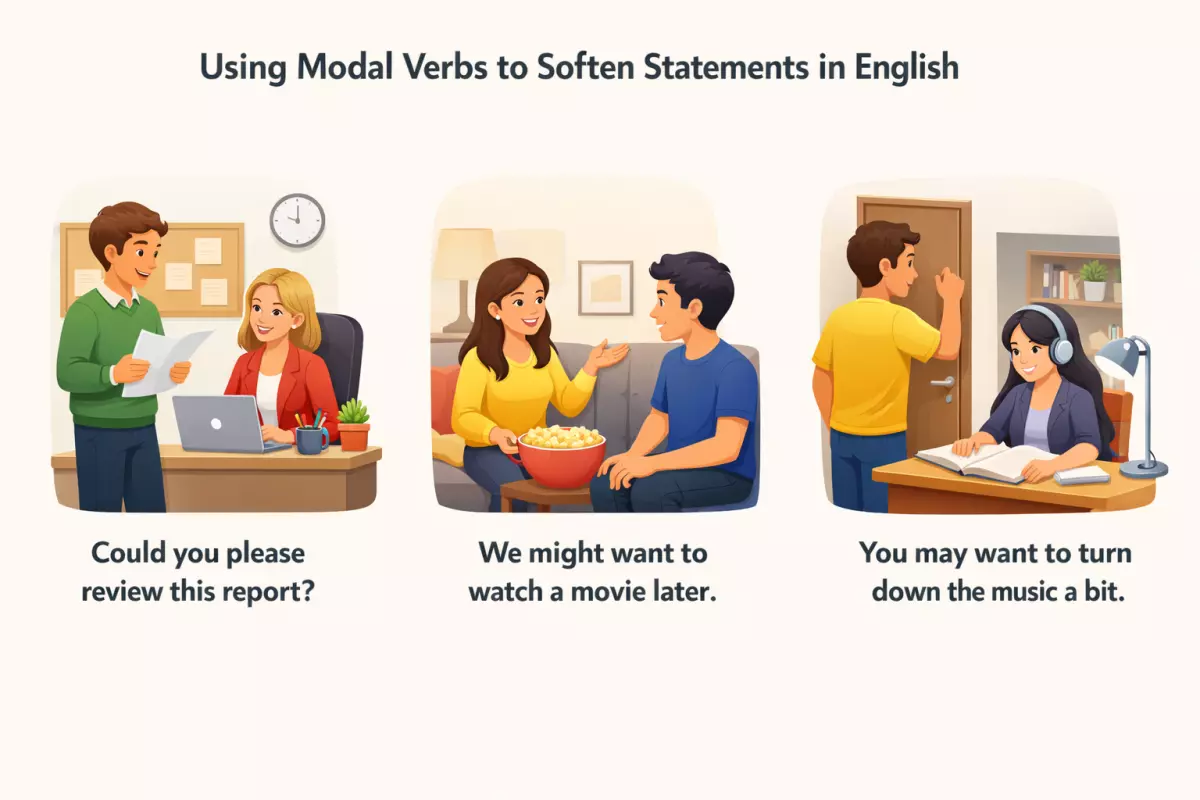 This article explains why speakers soften statements, which modal verbs they use to weaken opinions, and how that changes the tone of suggestions or criticism. It compares direct vs modal versions, covers when softer wording avoids rudeness, and ends with rewrite practice.
- Why speakers soften statements instead of making direct claims
- Modal verbs commonly used to reduce the strength of opinions
- How softened language changes the tone of suggestions or criticism
- Examples comparing direct statements with modal-softened versions
- Situations where softer language helps avoid sounding rude
- How speakers use modal verbs to express cautious opinions
- Exercises and practice activities rewriting statements with modal verbs
In everyday English, you can sound less direct by choosing the right modal verbs, making your message polite and flexible rather than harsh. This helps at work, with friends, and in customer situations, where tone affects how people respond. Small changes like could, might, or would let you give advice, disagree, or make requests without sounding too strong.
Why speakers soften statements instead of making direct claims
English speakers often reduce the force of a statement to sound more cooperative, realistic, or tactful. Modal verbs (and related softening patterns) help a speaker present information as a possibility, suggestion, or personal view rather than an absolute fact. This is especially common when the topic is sensitive, uncertain, or likely to affect the listener’s choices.
Common communication goals
- To be polite and respectful: Softening avoids sounding commanding or rude, especially with requests and instructions.
- To show uncertainty honestly: Modals allow speakers to signal that evidence is incomplete or the situation may change.
- To reduce conflict: A less direct claim can prevent the listener from feeling blamed or challenged.
- To invite collaboration: Tentative language makes space for the other person’s ideas and corrections.
- To protect relationships: Indirect phrasing can maintain goodwill when giving criticism or bad news.
- To sound professional: Workplace and academic English often prefers measured claims over absolute certainty.
- To avoid overpromising: Modals help speakers make careful commitments and manage expectations.
- To keep options open: Suggestions with modals feel less final and easier to adjust later.
- To be diplomatic: Softened statements can communicate disagreement without direct confrontation.
- To match social distance and power: When speaking to clients, teachers, or strangers, indirectness can be the safer default.
Where softening is especially common
- Requests: “Could you send the file?” instead of “Send the file.”
- Suggestions: “We might try a different approach.”
- Advice: “You may want to back up your data.”
- Predictions: “It could rain later.”
- Opinions: “I would say the main issue is timing.”
- Criticism and feedback: “This might be clearer with an example.”
- Disagreement: “That may be true, but…”
- Rules and expectations: “Employees must wear badges” (strong obligation) vs. “Employees should wear badges” (recommended).
- Apologies and explanations: “There may have been a misunderstanding.”
- Negotiation: “We could consider a later deadline.”
Patterns speakers use to soften meaning
- Possibility modals (may, might, could) to avoid sounding certain: “It might take longer than expected.”
- Ability/permission forms (can, could, may) to make requests less forceful: “Could I ask a quick question?”
- Recommendation modals (should, ought to) to advise without commanding: “You should check the figures again.”
- Conditional framing with would/could to reduce pressure: “I would recommend updating the title.”
- Hedging phrases that pair naturally with modals: “It seems,” “It looks like,” “I think,” “I’m not sure, but…”
- Softened negatives to avoid blunt refusal: ✅ “I might not be able to” → ❌ “I can’t.”
- Question forms instead of statements: “Could we move this meeting?” rather than “We’re moving this meeting.”
- Partial agreement plus a modal: “That could work, but we may need more time.”
Choosing a softer form is not only about politeness; it also signals how confident the speaker is and how much room there is for discussion. In many contexts, a modal verb is the simplest way to communicate that balance between clarity and tact.
Modal verbs commonly used to reduce the strength of opinions

To make an opinion sound less absolute, English often uses modals to add uncertainty, politeness, or room for disagreement. These verbs help you signal that you are suggesting, estimating, or interpreting rather than stating a fixed fact.
Key modals and how they soften meaning
- might: shows a tentative opinion or a possible explanation (often the softest option).
- Pattern: might + base verb → “It might be a better idea to wait.”
- Pattern: might not → “That might not be the best approach.”
- Pattern: might be + -ing (tentative interpretation) → “You might be overlooking the cost.”
- may: similar to might, slightly more formal; common in careful, professional phrasing.
- Pattern: may + base verb → “This may cause confusion for some readers.”
- Pattern: may not → “That may not reflect the full situation.”
- could: frames an opinion as one possible option or outcome, not the only one.
- Pattern: could + base verb → “We could be focusing on the wrong metric.”
- Pattern: could also (adds an alternative) → “It could also be a timing issue.”
- Pattern: could be + adjective/noun → “That could be a valid concern.”
- would: makes opinions sound more measured, especially with preferences, predictions, and hypotheticals.
- Pattern: I would say/argue/think → “I would say the second option is clearer.”
- Pattern: would probably (adds cautious probability) → “That would probably work better in practice.”
- Pattern: would be + adjective (polite evaluation) → “It would be helpful to add an example.”
- can: softens by describing general possibility or capacity rather than a definite judgment.
- Pattern: can + base verb → “This can feel a bit abrupt to some people.”
- Pattern: can be + adjective → “That can be tricky to explain.”
- should: expresses a recommendation, but it can still be softened with common hedging patterns.
- Pattern: should probably → “We should probably clarify the terms.”
- Pattern: should be able to (gentler expectation) → “Users should be able to find it quickly.”
- Note: on its own, should can sound firm; add softeners when needed.
Common softening frames (ready-to-use patterns)
- Modal + seem/appear → “It might seem too detailed for the introduction.”
- Modal + depend → “It could depend on the audience’s background.”
- Modal + help → “It would help to define the key term earlier.”
- Modal + be worth + -ing → “It might be worth adding a short summary.”
- Modal + be better/best (gentle comparison) → “It might be better to move this section up.”
- Modal + be a bit/kind of (mild critique) → “That could be a bit unclear without context.”
- Modal + not necessarily (reduces certainty) → “That may not necessarily solve the main issue.”
- Modal + perhaps/possibly/probably (adds hedging) → “We could possibly shorten the first paragraph.”
- Modal + be + -ing (tentative inference) → “You might be assuming everyone knows the acronym.”
- Modal + want to (polite suggestion) → “You may want to check the tone in the final sentence.”
Choosing the right level of softness
- Use might/may when you want to leave maximum room for disagreement or when you are not fully certain.
- Use could to present alternatives and keep the discussion open (“one possible explanation/solution”).
- Use would for tactful evaluations and recommendations, especially in feedback and proposals.
- Use can for general observations that avoid sounding like a direct personal judgment.
- Use should when you do intend to recommend, and soften it with words like “probably” if you want it to sound less forceful.
How softened language changes the tone of suggestions or criticism
Softening devices (especially modal verbs) reduce the force of a suggestion or negative feedback. Instead of sounding like an order or a judgment, the message comes across as a proposal, a possibility, or a shared problem to solve. This is useful when you want cooperation, when you are correcting someone, or when the relationship is formal.
What changes when you add modal verbs
- Directness decreases: the listener has more room to respond without losing face.
- Choice increases: modals frame actions as options rather than requirements.
- Certainty shifts: you can signal “I’m not 100% sure” or “this is my view,” which can sound more respectful.
- Responsibility is shared: phrases like “we could” distribute ownership of the solution.
- Emotional temperature drops: criticism can sound calmer and less confrontational.
Common patterns for softened suggestions
These structures often sound more collaborative than imperatives. They are especially common in meetings, emails, and peer feedback.
- Could + base verb: “We could move the deadline to Friday.”
- Might + base verb: “You might want to add a short summary at the top.”
- May + base verb (more formal): “You may want to review the final paragraph.”
- Should + base verb (advice, still fairly strong): “You should back up your claim with data.”
- Would + base verb (polite preference): “I would include one more example.”
- Could we…? (invites agreement): “Could we check the numbers again?”
- Would you be able to…? (polite request): “Would you be able to resend the attachment?”
- It might be better to…: “It might be better to keep the introduction shorter.”
- You may want to consider…: “You may want to consider a different title.”
- One option could be to…: “One option could be to split this into two sections.”
- Perhaps we could…: “Perhaps we could test it with a smaller group first.”
- Would it make sense to…?: “Would it make sense to reorder these steps?”
- Could you clarify…? (softens a challenge): “Could you clarify what you mean by ‘efficient’ here?”
- We might need to… (gentle urgency): “We might need to revisit the budget.”
Common patterns for softened criticism
When the content is negative, modals help you focus on improvement rather than blame. They also help you avoid sounding absolute.
- May not / might not (reduces certainty): “This might not be the best example for that point.”
- Could be + adjective (gentle evaluation): “The wording could be clearer.”
- Could use + noun (improvement focus): “This section could use a stronger conclusion.”
- Could have + past participle (soft past critique): “We could have explained the assumptions more clearly.”
- Would be better if…: “It would be better if the chart had labels.”
- May need to… (formal, neutral): “You may need to update the references.”
- Might need to… (less forceful): “We might need to rethink the timeline.”
- Should probably… (adds caution): “You should probably double-check the totals.”
- Could you…? (turns critique into a request): “Could you add a source for this claim?”
- ✅ “This could be improved by adding a definition.” → ❌ “This is unclear.”
Choosing the right level of softness
- Use “could” for flexible suggestions and brainstorming; it sounds open and non-pushy.
- Use “might/may” when you want to avoid sounding certain or when you are offering a cautious opinion.
- Use “should” for stronger advice, policies, or clear best practices; it can still feel critical if overused.
- Use question forms (“Could we…?”, “Would it help if…?”) to invite agreement and reduce defensiveness.
- Prefer “we” when the issue is shared; it often sounds more supportive than “you.”
Examples comparing direct statements with modal-softened versions
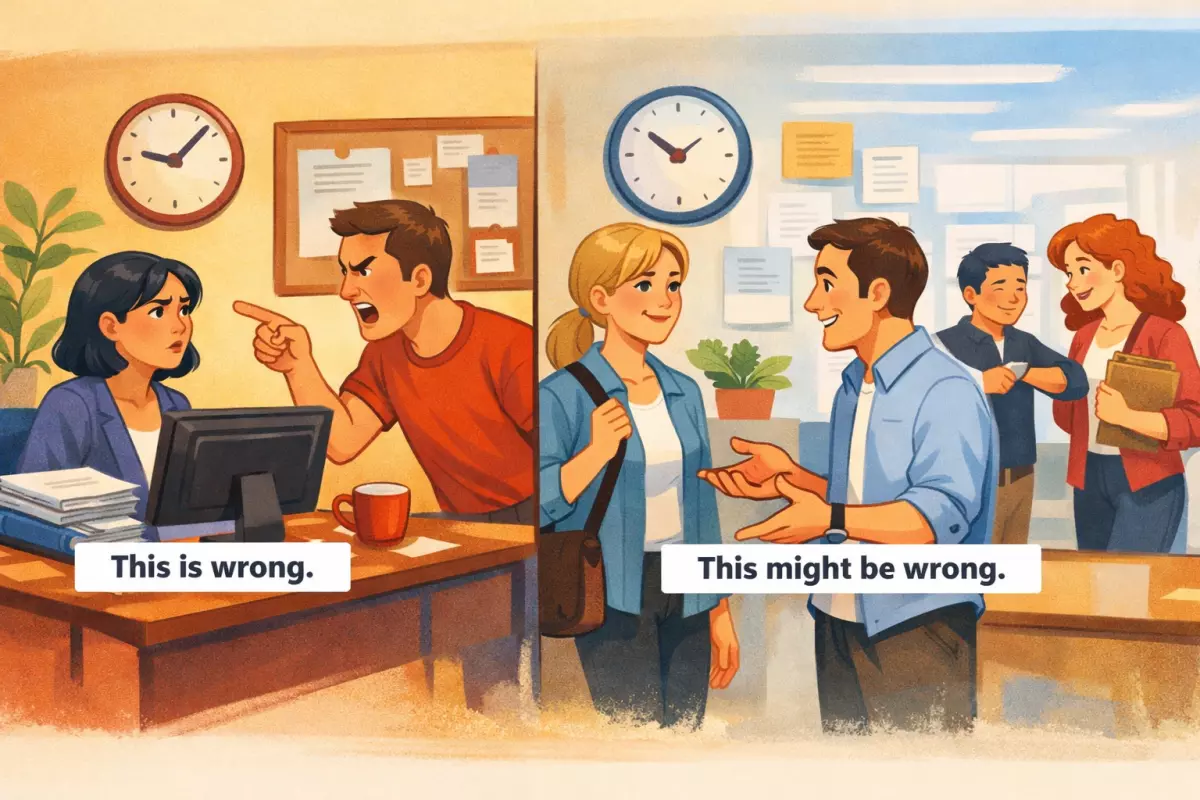
Modal verbs help you reduce the force of a statement so it sounds more tentative, polite, or open to discussion. The softened version often adds room for the listener to respond, disagree, or negotiate without losing face.
| Direct statement | Modal-softened version | Typical effect / when used |
|---|---|---|
| This is wrong. | This might be wrong. | Signals uncertainty; invites checking rather than blaming. |
| You’re late. | You might be running a bit late. | Less accusatory; focuses on the situation, not the person. |
| We need to change the plan. | We may need to change the plan. | Suggests a possibility; keeps options open. |
| Send me the file today. | Could you send me the file today? | Turns an order into a polite request. |
| Call the client now. | Can you call the client now? | Checks ability/availability; softer than an imperative. |
| Explain this again. | Could you explain that again? | More courteous; common in customer service and meetings. |
| Take a seat. | You can take a seat. | Makes it sound like permission/option, not a command. |
| We will finish by Friday. | We should finish by Friday. | Sets an expectation without guaranteeing; useful for timelines. |
| This will take two hours. | This could take about two hours. | Softens a prediction; acknowledges variables. |
| That solution doesn’t work. | That solution may not work. | Reduces bluntness; encourages problem-solving. |
| You need to be more careful. | You might want to be a bit more careful. | Gives advice indirectly; less confrontational. |
| We must leave now. | We should leave now. | Less strict than “must”; still communicates urgency. |
| I don’t agree. | I might see it differently. | Disagrees without shutting the other person down. |
| This is the best option. | This could be the best option. | Shows openness to alternatives; helpful in brainstorming. |
| Stop doing that. | You might want to avoid doing that. | Softens criticism; sounds like guidance rather than scolding. |
| We can’t approve this. | We may not be able to approve this. | Less final; leaves room for conditions or exceptions. |
Patterns to notice
- might / may + base verb often signals possibility: “This may cause delays.”
- could + base verb often softens suggestions and requests: “We could try a different approach.”
- should often expresses expectation rather than certainty: “It should be ready soon.”
- Turning an imperative into a question with can/could is a common politeness move: “Could you…?”
- Adding about, a bit, or perhaps alongside a modal can further reduce bluntness: “It might be a bit risky.”
Situations where softer language helps avoid sounding rude
In many everyday exchanges, direct grammar can sound like an order or a criticism, even when you do not intend it. Modal verbs (and a few related patterns) help you make requests, give feedback, and set boundaries in a way that leaves the other person room to respond.
Common contexts where modals make a difference
- Requests in shared spaces: Use could, would, or can to reduce the “command” feeling.
- ✅ Could you close the window?
- ✅ Would you mind turning the music down?
- ❌ Close the window.
- Asking for help at work or school: Modals signal respect for the other person’s time.
- Could you take a quick look at this?
- Would you be able to send it by 3 p.m.?
- Can I ask you a quick question?
- Interrupting or changing topics: Softer phrasing prevents you from sounding abrupt.
- Could I jump in for a second?
- May I add something here?
- Could we come back to that later?
- Giving instructions without sounding bossy: Modals turn instructions into cooperative suggestions.
- You might want to restart your computer.
- Could you try saving it as a PDF?
- We may need to update the settings.
- Disagreeing or correcting: Modal language helps you challenge ideas without attacking the person.
- I might be wrong, but I think the date is Tuesday.
- Could it be that we missed a step?
- We may want to double-check the numbers.
- Making complaints or pointing out problems: Indirect forms sound less accusatory.
- Could you check the noise level, please?
- Would it be possible to move us to a quieter table?
- There seems to be an issue with my order.
- Setting boundaries and saying “no”: Modals let you refuse while staying polite and clear.
- I can’t meet today, but I could do tomorrow.
- I’m afraid I won’t be able to join.
- Could we schedule it for next week instead?
- Asking for permission: may and could often sound more formal than can.
- May I leave a little early?
- Could I use your phone for a moment?
- Can I step out for a minute?
- Making offers: Modals help you offer assistance without pressuring the other person.
- Shall I open the window?
- Would you like me to carry that?
- I can help if you’d like.
- Negotiating and proposing plans: Softer proposals invite collaboration instead of demanding agreement.
- We could meet at 2 instead.
- Could we try a different approach?
- Would it work for you if we moved the deadline?
- Reminding someone: Modals reduce the “you forgot” tone.
- Could you remember to attach the file?
- Would you mind sending the address again?
- You might want to check the calendar invite.
- Handling sensitive topics: Modals help you sound careful and considerate.
- It might be better to talk about this privately.
- Could we discuss this after the meeting?
- I may not have the full picture, but…
Useful softening patterns to reuse
- Could you…? / Would you…? for requests: “Could you send me the link?”
- Would you mind + -ing…? for very polite requests: “Would you mind waiting a moment?”
- Could I…? / May I…? for permission: “May I ask a question?”
- Would it be possible to…? for formal requests: “Would it be possible to reschedule?”
- We could… for suggestions: “We could start with the easiest task.”
- You might want to… for advice: “You might want to back up your files.”
- It may/might be… for cautious opinions: “It might be a formatting issue.”
- I can’t…, but I could… to refuse and offer an alternative: “I can’t today, but I could tomorrow.”
How speakers use modal verbs to express cautious opinions
Modal verbs let speakers share a view while leaving room for uncertainty, alternative explanations, or new information. This is useful in meetings, feedback, academic discussion, and everyday conversation when you want to sound measured rather than absolute.
Core patterns for hedging an opinion
- Modal + base verb to signal possibility: “It might help to restart the app.”
- Modal + be for cautious evaluation: “That could be the main issue.”
- Modal + have + past participle to guess about the past: “They may have missed the email.”
- Modal + be + -ing for tentative interpretation of a current situation: “He might be working from home today.”
- Modal + depend / vary to avoid overgeneralizing: “It can depend on the dataset.”
- Modal + suggest / indicate to soften claims: “The results may suggest a trend.”
Choosing the right modal for the level of caution
- Might = very tentative: “It might be better to wait.”
- May = possible, slightly more formal: “This may cause delays.”
- Could = one plausible option among others: “We could try a different approach.”
- Can = general possibility (often about what is sometimes true): “This can happen when the server is busy.”
- Should = expectation with some uncertainty: “That should work, but we’ll need to test it.”
- Would = tentative prediction or preference: “I would expect prices to rise.”
Common sentence frames that sound natural
- “It might be worth + -ing …” → “It might be worth checking the logs.”
- “That could be + noun/adjective …” → “That could be a timing issue.”
- “There may be + noun …” → “There may be a simpler fix.”
- “It may not be + adjective …” → “It may not be necessary.”
- “This could mean (that) …” → “This could mean the file is corrupted.”
- “We might want to + verb …” → “We might want to revise the wording.”
- “You may want to + verb …” (polite suggestion) → “You may want to back up your data.”
- “It could be that …” → “It could be that the settings changed.”
- “I would say (that) …” → “I would say the main risk is timing.”
- “That should be fine, but …” → “That should be fine, but let’s confirm.”
- “It might not + verb …” → “It might not load on older devices.”
- “It may take + time …” → “It may take a few minutes to update.”
- “This can lead to …” → “This can lead to duplicate entries.”
- “That could explain …” → “That could explain the sudden drop.”
- “We could consider + -ing …” → “We could consider postponing the launch.”
Accuracy and tone: small choices that matter
- Use might/may/could when you lack full evidence; avoid strong certainty words in the same clause (e.g., “definitely”).
- For past guesses, prefer may/might/could have: ✅ “She might have misunderstood.” ❌ “She might misunderstood.”
- For polite disagreement, pair a modal with a reason: “That may be true, but the sample is small.”
- To avoid sounding evasive, add a next step: “It could be a permissions issue—let’s check the access logs.”
- Be careful with must in cautious contexts; it often sounds like strong certainty rather than a tentative view.
Exercises and practice activities rewriting statements with modal verbs
Rewrite each sentence so it sounds less direct while keeping the core meaning. Focus on common softening patterns such as could for suggestions, might for possibility, would for polite preference, and may for formal permission. When you rewrite, pay attention to tone: the goal is usually to reduce pressure, leave room for choice, or show uncertainty appropriately.
1) Rewrite: direct → softer
- Send me the report by 3 p.m.
- You are wrong about the schedule.
- Close the window.
- I need your answer today.
- That explanation makes no sense.
- Move this meeting to Friday.
- Stop talking during the presentation.
- Give me more details.
- We can’t approve this request.
- You didn’t follow the instructions.
- Call the client now.
- This is the best solution.
Show answers
- Could you send me the report by 3 p.m.?
- I think you might be mistaken about the schedule.
- Could you close the window, please?
- Would it be possible to get your answer today?
- I’m not sure that explanation really makes sense.
- Could we move this meeting to Friday?
- Could we keep the side conversations to a minimum during the presentation?
- Could you share a few more details?
- We may not be able to approve this request.
- It looks like the instructions may not have been followed.
- Could you call the client now?
- This might be the best solution.
2) Choose the best modal to match the intention
Rewrite each sentence using the modal in parentheses. Keep the rest of the sentence as similar as possible, but adjust word order if needed (for example, turning a command into a question).
- (could) You need to email HR the updated form.
- (might) This plan will cause delays.
- (would) I prefer a shorter meeting.
- (may) Can I leave early today?
- (could) Fix this formatting problem.
- (might) He is not available this afternoon.
- (would) Send the invoice again.
- (may) We can need more time to review this.
- (could) Explain your decision.
- (might) That number is incorrect.
Show answers
- Could you email HR the updated form?
- This plan might cause delays.
- I would prefer a shorter meeting.
- May I leave early today?
- Could you fix this formatting problem?
- He might not be available this afternoon.
- Would you send the invoice again?
- We may need more time to review this.
- Could you explain your decision?
- That number might be incorrect.
3) Pattern practice: use these softening frames
Use one frame per item and rewrite the sentence. These frames are useful because they add politeness without changing the main message.
- Could you + base verb → turns a command into a polite request.
- Could we + base verb → makes a suggestion collaborative.
- Would you mind + -ing → especially common for small requests.
- Would it be possible to + base verb → indirect and professional.
- We might want to + base verb → gentle recommendation.
- It might be better to + base verb → soft evaluation.
- I may be wrong, but... → disagreement with reduced force.
- It may be that + clause → formal uncertainty.
- That might not be + adjective → soft criticism (e.g., correct, ideal, clear).
- We may not be able to + base verb → gentle refusal.
- Would you be able to + base verb → checks availability, reduces pressure.
- Could you possibly + base verb → extra soft, but use sparingly.
4) Mini-scenarios (rewrite for tone)
Rewrite each line to fit the situation. Use at least one modal verb in each answer.
- To a coworker: “You forgot to attach the file.”
- To a customer: “You must fill out this form.”
- In a meeting: “This idea won’t work.”
- To a teammate: “I want an update now.”
- To a vendor: “Lower the price.”
- To a friend: “Don’t be late.”
- To a manager: “I can’t finish today.”
- To IT support: “Fix my laptop.”
Show answers
- You might have forgotten to attach the file.
- You may need to fill out this form.
- I’m not sure this idea will work; we might need a different approach.
- Could you share an update when you have a moment?
- Would you be able to offer a lower price?
- Try not to be late, okay? (Or: Could you try not to be late?)
- I may not be able to finish today, but I could have it ready tomorrow.
- Could you take a look at my laptop when you get a chance?
5) Self-check: common issues to watch for
- Use the base verb after modals: ✅ “could help” ❌ “could helps”.
- For polite requests, questions often sound softer than statements: “Could you…?” vs. “You could…”.
- May is more formal for permission; can is more casual. Choose based on context.
- Might usually sounds less certain than may, which can make feedback feel less absolute.
- Would is useful for preferences and invitations to cooperate: “I’d prefer…”, “Would you…?”.
- When refusing, combine a modal with a reason or alternative: “We may not be able to…, but we could…”.