Modal Verbs in Informal Spoken English Conversations

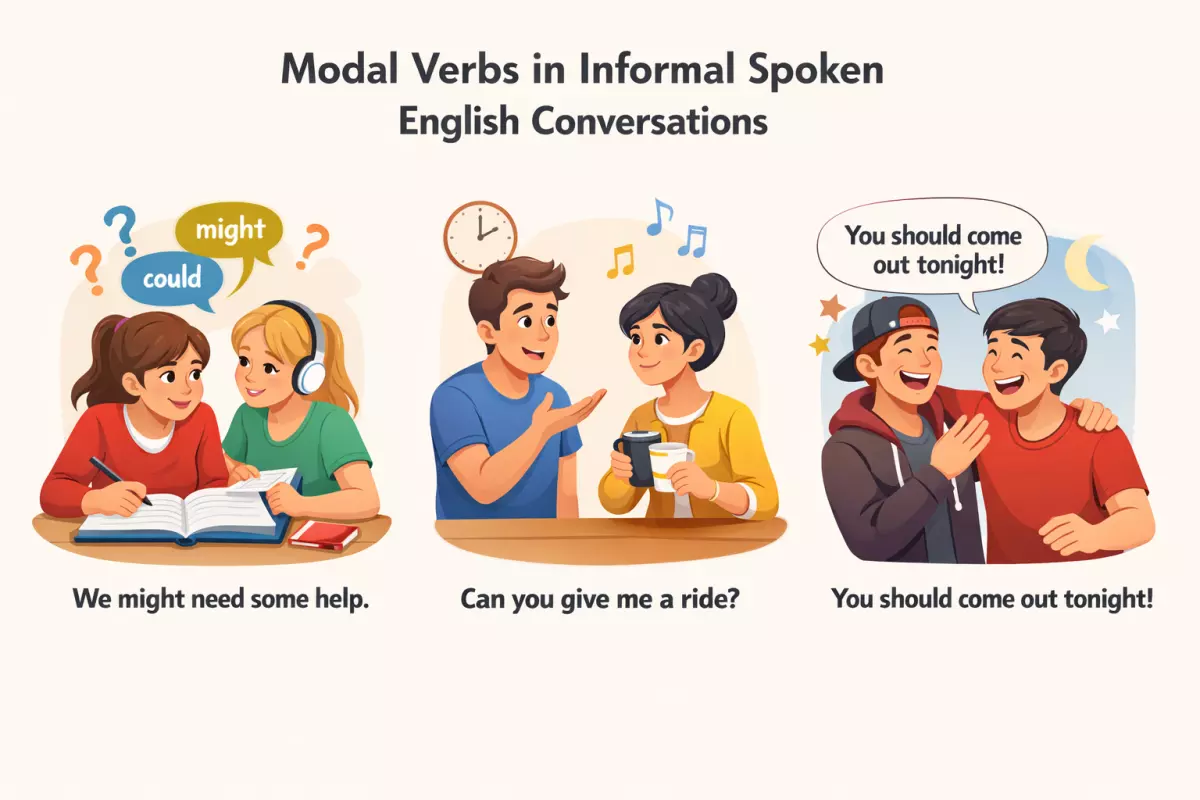 This article shows how modal verbs show up in relaxed everyday talk, including common contractions and shortened forms. It gives casual dialogue examples, explains how tone affects modal choice, compares textbook rules to real speech, and includes practice exercises.
- How modal verbs naturally appear in relaxed everyday conversations
- Common contractions and shortened forms used in speech
- Examples of modal expressions in casual dialogue
- How conversational tone influences the choice of modal verb
- Differences between textbook grammar and real spoken usage
- How speakers simplify modal sentences during conversation
- Exercises and practice activities recognizing modal verbs in informal speech
In everyday conversation, small helping verbs that express ability, permission, advice, or possibility carry more meaning than we notice. In casual spoken English, they are often shortened or softened to sound polite, relaxed, or uncertain, depending on tone and context. This guide will help you understand what speakers intend, pick natural choices yourself, and avoid sounding too direct when you do not mean to.
How modal verbs naturally appear in relaxed everyday conversations
In casual speech, modal verbs tend to show up as quick tools for managing tone: making requests softer, giving advice without sounding strict, and showing uncertainty without overexplaining. You will also hear them in short, incomplete sentences because the context does a lot of the work.
Common conversational jobs modals do
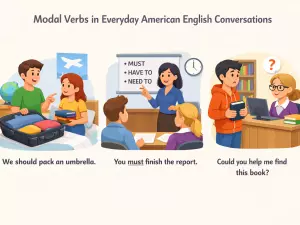
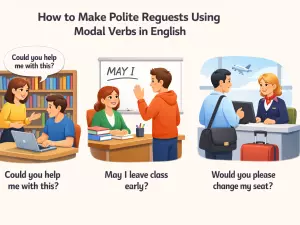
- Softening requests so they sound friendly rather than demanding (often with could or would).
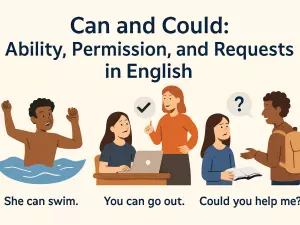
- Offering help in a low-pressure way (often with can / could).
- Asking permission quickly and politely (often can, could, sometimes may in more formal moments).
- Giving advice without sounding like an order (often should, might want to).
- Making suggestions and keeping options open (often could, might).
- Expressing possibility when the speaker is not fully sure (often might, may, could).
- Stating ability in a simple, everyday way (often can, can’t).
- Setting rules or boundaries (often can/can’t, have to, don’t have to).
- Talking about obligation with different levels of pressure (from must to have to to should).
- Making quick predictions or expectations (often will, should).
- Negotiating plans and timing (often can, could, should).
- Reducing certainty to sound tactful (often might, could, may).
Patterns you hear a lot (with realistic examples)
- Can you + verb…? for simple requests: “Can you text me when you’re there?”
- Could you + verb…? for extra politeness: “Could you hold this for a second?”
- Would you mind + -ing…? for very soft requests: “Would you mind closing the window?”
- Can I + verb…? to ask permission: “Can I borrow your charger?”
- Could I + verb…? to sound more careful: “Could I leave a little early?”
- I can + verb to offer: “I can drop you off if you want.”
- I could + verb to suggest an option: “I could pick it up on my way.”
- We could + verb to propose a plan: “We could grab food after.”
- You should + verb for advice: “You should back up your files.”
- You might want to + verb for gentler advice: “You might want to call first.”
- It might + verb for possibility: “It might rain later.”
- That could + verb for a cautious guess: “That could be the issue.”
- I’ll + verb for quick decisions: “I’ll send it tonight.”
- That’ll + verb for expectations: “That’ll be fine.”
- Do I have to + verb…? to check obligation: “Do I have to bring anything?”
- You don’t have to + verb to remove pressure: “You don’t have to explain.”
Small choices that change the vibe
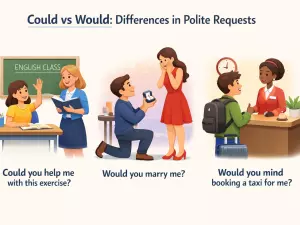
- Can vs could: could usually sounds more polite or less direct. ✅ “Could you send it?” → softer than “Can you send it?”
- Will vs would: would often feels more tentative. ✅ “Would you help me for a minute?” → less pushy than “Will you help me?”
- Must vs have to: must can sound strong in everyday talk; have to is more common for real-life obligations.
- Should vs need to: should suggests; need to adds urgency or importance.
- Negative forms are frequent and often shortened: “I can’t,” “you shouldn’t,” “we don’t have to.”
Ellipsis and short answers (very typical in speech)
- Short permission checks: “Can I?” / “Yeah, you can.”
- Quick refusals: “I can’t, sorry.” / “We can’t today.”
- Minimal agreement: “That should work.” / “It might.”
- Follow-up questions that reuse the modal: “Should I?” “Could you?” “Will it?”
- Context-based omissions: “Could you?” (meaning “Could you help me?”) when the situation is obvious.
Common contractions and shortened forms used in speech
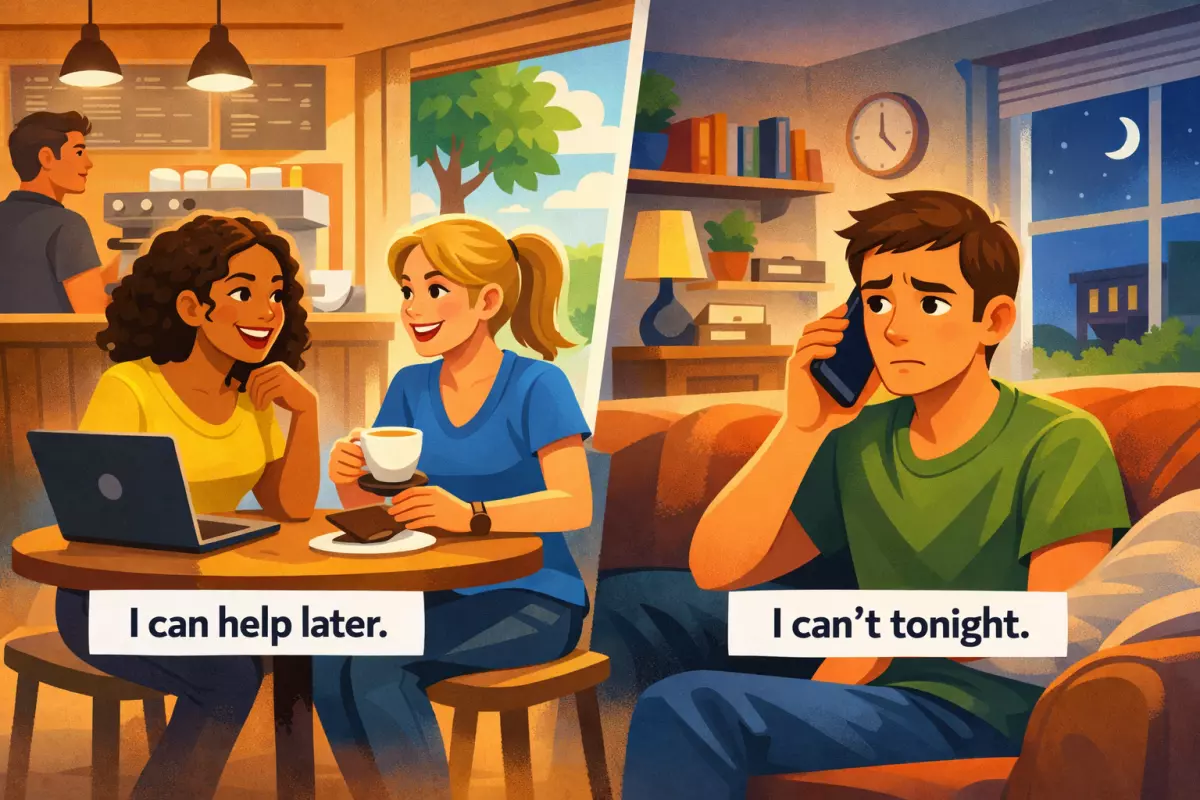
In casual conversation, modal verbs are often reduced, blended, or dropped into fixed chunks. These forms are normal in fast speech, but they can be tricky in listening because several sounds disappear or merge.
Everyday reduced forms with modals
| Full form | Typical spoken form | Example in conversation |
|---|---|---|
| can / cannot | can (weak /kən/), can’t (often /kænt/ or /kɑːnt/) | “I can help later.” / “I can’t tonight.” |
| could | could (weak /kəd/) | “We could just leave early.” |
| should / would | shoulda / woulda | “I shoulda called you.” / “I woulda gone.” |
| could have | could’ve (often sounds like “coulda”) | “I could’ve missed the train.” |
| might have | might’ve (often sounds like “mighta”) | “I might’ve left it at work.” |
| must have | must’ve (often sounds like “musta”) | “You must’ve been exhausted.” |
| have to / has to | hafta / hasta | “Do we hafta go?” / “She hasta leave.” |
| got to | gotta | “I gotta run.” |
| want to | wanna | “You wanna grab coffee?” |
| going to | gonna | “I’m gonna text him.” |
Patterns to notice (so you can recognize them quickly)
- Weak forms are common: modals like can and could
- Have + modal blends: could’ve, should’ve, would’ve, might’ve, must’ve are frequently pronounced as a single unit. In rapid speech they may sound like “coulda/shoulda/woulda/mighta/musta,” even though that spelling is informal.
- To reductions: to often reduces to a quick “tuh,” which is why have to becomes “hafta,” got to becomes “gotta,” and want to becomes “wanna.”
- Sound merging across words: when one word ends and the next begins with similar sounds, speakers compress them. This is why “must have” can sound like “must’ve” with the /h/ disappearing.
- Negative forms stay clearer: negatives like can’t, won’t, and shouldn’t
Usage notes: where these forms fit (and where they don’t)
- ✅ Use reduced forms freely in relaxed speech: “I gotta go,” “We shoulda left earlier,” “You might’ve seen it.”
- ❌ Avoid writing spellings like shoulda or musta in formal contexts; write should have, must have, etc.
- In careful speaking (presentations, interviews), many speakers keep the contractions (could’ve) but avoid the most casual reductions (coulda).
- Listening tip: if you hear a quick “-a” after a modal (coulda/mighta), it often signals modal + have and a past meaning (possibility, regret, deduction).
Examples of modal expressions in casual dialogue
In everyday conversation, modal verbs and modal-like phrases help speakers sound polite, tentative, or practical. They often appear in short turns, with reduced pronunciation (e.g., “couldja,” “might’ve”), and they frequently pair with softeners like “just,” “maybe,” or “I think.” The patterns below show how people use them to ask, offer, suggest, and respond without sounding too direct.
Common patterns and sample lines
- Polite requests with “could”: “Could you pass me the charger?” / “Could you give me a sec?”
- Casual permission with “can”: “Can I grab a seat here?” / “Can we leave a little early?”
- Softer requests with “would you mind…?”: “Would you mind closing the window?” (often followed by “for a second?”)
- Offers with “can” and “could”: “I can drop you off.” / “I could pick something up on the way.”
- Suggestions with “should”: “We should try that new place.” / “You should text them now.”
- Gentler advice with “might want to”: “You might want to save that file.” / “You might wanna call ahead.”
- Possibility with “might/may”: “It might rain later.” / “She may be running late.”
- Uncertainty with “could”: “It could be the Wi‑Fi.” / “That could work, actually.”
- Plans and willingness with “will”: “I’ll send it tonight.” / “We’ll figure it out.”
- Reluctant willingness with “I guess I can…”: “I guess I can do it.” (signals mild hesitation)
- Preference with “would rather”: “I’d rather stay in.” / “We’d rather not drive.”
- Conditional help with “could”: “I could help if you want.” / “We could do it tomorrow.”
- Invitations with “wanna” + modal meaning: “Do you wanna come over?” (informal, invitation/offer)
- Checking feasibility with “can you…?”: “Can you hear me?” / “Can you make it by six?”
- Softening a “no” with “can’t” + reason: “I can’t tonight—I’ve got work.” / “I can’t, I’m already booked.”
- Hedged disagreement with “might”: “That might be a bit much.” / “It might not be the best idea.”
- Expectation with “should”: “It should be fine.” / “He should be there by now.”
- Light obligation with “have to / gotta”: “I have to head out.” / “I gotta run.” (informal necessity)
Quick usage notes (what these choices signal)
- “Can” vs. “could”: “Can” is direct and common; “could” usually sounds more polite or less pushy.
- “Should” vs. “might want to”: “Should” can feel like advice; “might want to” reduces pressure and leaves more choice.
- “Would” for tone: “Would you…?” and “I’d…” often make statements and requests sound less blunt.
- Hedging words: Adding “just,” “maybe,” “kind of,” or “a bit” often makes a modal expression feel friendlier: “Could you just…?” / “It might be a bit late.”
- Short answers with modals: Natural replies often repeat the modal: “Can you?” → “Yeah, I can.” / “Could you?” → “Sure, I could.”
- Common mistake to avoid: ✅ “Could you help me?” ❌ “Could you to help me?” (no “to” after a modal verb)
How conversational tone influences the choice of modal verb

In everyday speech, modal verbs often signal attitude as much as meaning. Speakers choose forms that match the mood of the moment: relaxed and friendly, cautious and indirect, firm and no-nonsense, or supportive and collaborative. Small shifts (like can vs could) can change how a request, suggestion, or opinion lands.
Common tone settings and the modals that fit them
- Casual, friendly: can, will for straightforward requests and offers.
- “Can you text me when you’re there?”
- “I’ll grab us coffee.”
- Polite, softened: could, would to reduce pressure and sound considerate.
- “Could you send that again?”
- “Would you mind closing the window?”
- Hedged or cautious: might, may to avoid sounding too certain.
- “It might rain later.”
- “That may be the best option.”
- Warm suggestions: could, might to present ideas as options, not commands.
- “We could try that new place.”
- “You might want to back up your files.”
- Firm boundaries: can’t, won’t to be clear and final.
- “I can’t make it tonight.”
- “I won’t share that.”
- Rules and obligations (heavier): have to, must when something is non-negotiable.
- “I have to leave by six.”
- “You must show ID at the desk.”
- Advice (gentler): should, ought to when you want to guide without ordering.
- “You should get some rest.”
- “We ought to call them back.”
- Permission and social comfort: can for informal permission; may for more formal or careful permission.
- “Can I sit here?”
- “May I ask a quick question?”
- Reassurance and willingness: can, will to sound helpful and ready.
- “I can help you with that.”
- “I’ll take care of it.”
Patterns that make modals sound more (or less) direct
- Past-form modals soften: could/would often feel less pushy than can/will.
- ✅ “Could you take a look?” → softer
- ❌ “Can you take a look?” → more direct (not wrong, just stronger)
- Question form reduces force: turning a statement into a question usually sounds less commanding.
- “You could email them?” (tentative prompt)
- “Could you email them?” (clear but polite request)
- “Maybe” pairs naturally with possibility modals: might/could + “maybe” creates a low-pressure suggestion.
- “Maybe we could leave a bit earlier.”
- “I might just head out soon.”
- Negative modals can sound abrupt: can’t/won’t are clear; adding a brief reason often keeps the tone cooperative.
- “I can’t tonight—I’ve got a deadline.”
- “I won’t be able to—I’m out of town.”
- “Have to” is common in speech for obligations: it often feels more everyday than must.
- “I have to run.” (neutral, conversational)
- “I must run.” (less common, can sound formal or dramatic)
Quick tone-to-modal choices you can reuse
- For a simple favor between friends: “Can you…?”
- For a favor when you want to be extra considerate: “Could you…?”
- For a request that respects the other person’s choice: “Would you be able to…?”
- For a suggestion without pressure: “We could…” / “You might want to…”
- For uncertain predictions: “It might…” / “It could…”
- For clear refusal: “I can’t…” / “I won’t…”
- For strong necessity: “I have to…” (everyday) / “You must…” (rule-based)
- For advice with care: “You should…”
- For offering help: “I can…” / “I’ll…”
- For permission in relaxed settings: “Can I…?”
- For permission in more careful settings: “May I…?”
- For negotiating plans: “Should we…?” / “Could we…?”
Differences between textbook grammar and real spoken usage
In everyday conversation, modal verbs often look less “complete” than the forms shown in grammar books. Speakers prioritize speed, politeness, and shared context, so you’ll hear shorter structures, softer meanings, and blended patterns that still follow consistent rules.
- Short answers and ellipsis are normal: Instead of full sentences, people drop repeated words when the meaning is clear. Examples: “I might.” “We should.” “Could be.”
- Contractions and reduced pronunciation are common: Forms like “I’ll,” “we’d,” “should’ve,” “could’ve,” “might’ve” appear constantly in speech (and often in informal writing).
- “Have” is frequently reduced or lost in fast speech: “should’ve” may sound like “shoulda,” and “must have” can sound like “musta.” The underlying structure is still modal + have + past participle.
- Modals soften statements more than textbooks suggest: “Could you…?” and “Would you…?” often function as polite requests, not literal questions about ability or willingness.
- “Can” often replaces “may” for permission: Textbooks may prefer “May I…?” but casual speech commonly uses “Can I…?” without sounding incorrect in most settings.
- “Would” is used for gentle opinions and habits: “I’d say…” and “That would be…” reduce directness; “When we were kids, we’d…” describes repeated past behavior.
- “Should” and “ought to” are not equally frequent: “Ought to” exists but is much less common in spontaneous talk; “should” covers most advice and expectation meanings.
- “Must” is often avoided to reduce pressure: In informal conversation, speakers may choose “have to,” “need to,” or “should” because “must” can sound strict. “You must…” can feel like an order.
- “Have to” behaves like a modal in meaning, but not in form: It takes “do” in questions/negatives (“Do you have to…?” “I don’t have to…”), which differs from true modals (“Should you…?” “I shouldn’t…”).
- “Need” and “need to” split by style: “You need to…” is common; modal-like “needn’t” exists but is rarer in casual American speech and more common in some British varieties.
- Negative patterns shift meaning in conversation: “You don’t have to” usually means no obligation (not prohibition). Compare: “You mustn’t” = prohibition; “You don’t have to” = optional.
- Double-modals are usually nonstandard, but some dialects use them: In some regional varieties you may hear “might could” or “used to could.” In mainstream contexts, these are typically avoided.
- Tag questions and modal tags are frequent: Speakers add “right?” “yeah?” or classic tags like “could you?” “wouldn’t you?” to check agreement or soften requests.
- “Maybe” often competes with “might/may”: Instead of “It might rain,” people often say “Maybe it’ll rain,” especially when thinking aloud.
- Informal “guessing” language pairs with modals: Phrases like “I think,” “I guess,” “probably,” “kind of” commonly sit next to modals to reduce certainty: “It might kind of help.”
- Questions are shaped by politeness more than logic: “Could you pass the salt?” is a request, not a real inquiry about ability. The modal signals social tone.
- Spoken grammar favors chunks: Fixed frames like “Would you mind…?” “Can I just…?” “I might just…” appear as ready-made patterns rather than freshly built sentences.
Practical takeaway for learners
When listening to informal conversations, focus on the function (request, suggestion, probability, obligation) and expect reduced forms. If you can recognize the core pattern—modal + base verb, or modal + have + past participle—you can understand most casual modal usage even when words are shortened or dropped.
How speakers simplify modal sentences during conversation
In everyday speech, people often reduce modal structures to keep pace with the conversation. The meaning usually stays the same, but the grammar becomes shorter, less explicit, or more dependent on context, intonation, and shared knowledge.
Common simplification patterns
- Contractions of modal + not: speakers default to shorter negatives.
Examples: can’t, won’t, shouldn’t, couldn’t, mightn’t (less common in some varieties). - Reduced pronunciation in fast speech: the written form stays the same, but the sound is compressed.
Examples: coulda (could have), shoulda (should have), woulda (would have), mighta (might have). - Dropping “have” in perfect modals (informal): in very casual talk, have may disappear even though the meaning is “past possibility/obligation.”
Example: “I should told you.” (informal) → more standard: “I should have told you.” - Leaving out repeated verbs: once the main verb is clear, it’s often not repeated.
Example: “I can drive, but she can’t.” (drive is understood after can’t) - Short answers with modals: quick replies avoid full clauses.
Examples: “Can you come?” “I might.” / “You should.” / “We could.” - Ellipsis after modal in coordinated speech: the second part is shortened because the listener can fill it in.
Example: “You can call now, or you can later.” (call is understood) - Using “can” as a general-purpose ability/possibility modal: speakers choose one modal instead of a more specific one when precision isn’t needed.
Example: “It can be tricky” instead of “It may be tricky.” - Simplifying “may/might” to “might”: many speakers prefer one form in casual conversation.
Example: “I might go later.” (covers uncertainty without choosing between may/might) - Replacing “must” with “have to”: obligation is often expressed with the more common spoken option.
Example: “I have to leave” instead of “I must leave.” - Tag questions reduced to a modal tag: the tag carries the checking/confirming function with minimal wording.
Examples: “We can meet at six, can’t we?” / “You’ll text me, won’t you?” - Question forms shortened in context: speakers drop extra words when the topic is already established.
Example: “Should I?” (meaning “Should I do it / go / tell them?”) - “Better” as a shortcut for advice: had better is commonly reduced to better in fast, informal talk.
Example: “You better hurry.” (informal) → more standard: “You’d better hurry.” - Using “gonna / gotta / wanna” instead of full forms: semi-modal meanings are expressed with reduced forms.
Examples: gonna (going to), gotta (have got to / have to), wanna (want to). - Softening requests by trimming the structure: politeness can come from tone and context rather than longer grammar.
Example: “You could pass the salt?” (informal) vs. “Could you pass the salt?” - Omitting “please” but keeping a modal: the modal carries the request while politeness is signaled by voice and timing.
Example: “Could you send that?” (often polite without “please”) - Preference for “would” in casual offers and invitations: speakers use one modal to cover many social functions.
Examples: “Would you like some?” / “Would you want to come?” - Repair and re-starts that leave a modal hanging: conversation includes self-correction, so the modal starts a thought that gets reshaped.
Example: “I could—actually, I’ll just email them.”
What to listen for
These shortened forms rely heavily on shared context. When you hear a modal without a full verb phrase, check what was said just before, and notice whether the speaker is expressing ability (can), advice (should), obligation (have to/gotta), or uncertainty (might). Intonation often supplies what the grammar leaves out.
Exercises and practice activities recognizing modal verbs in informal speech
Focus on spotting how modals get shortened, softened, or replaced by casual alternatives in real conversation. The activities below train you to notice meaning (permission, advice, obligation, probability) even when the grammar looks “messy” in fast speech.
1) Quick recognition: underline the modal meaning
Read each line and identify the modal idea (ability, permission, request, suggestion, obligation, prohibition, possibility, certainty). Some lines use classic modal verbs; others use common informal substitutes.
- “Can you grab my charger real quick?”
- “I can’t make it tonight, sorry.”
- “Could you text me when you’re outside?”
- “You should probably back up those files.”
- “We gotta leave in like five.”
- “You don’t have to come if you’re tired.”
- “Might be easier if we take the train.”
- “That’ll be Jake—he said he was close.”
- “You’re not allowed to park there.”
- “I’m supposed to call my mom.”
Show answers
- Request/permission (can)
- Inability/negative ability (can’t)
- Polite request (could)
- Advice (should)
- Strong necessity/obligation (gotta = have got to)
- No obligation (don’t have to)
- Possibility/suggestion (might)
- Expectation/near certainty (’ll = will)
- Prohibition/permission rule (not allowed to)
- Expectation/obligation from someone else (supposed to)
2) Informal forms: match the casual phrase to the standard modal
Choose the best standard equivalent. Pay attention to meaning, not just the word.
- “I gotta go.”
- “You wanna sit here?”
- “We shoulda left earlier.”
- “I coulda sworn I sent it.”
- “He mighta missed the bus.”
- “You don’t gotta explain.”
- “I’m gonna call her.”
- “You better not be late.”
Show answers
- have to / must (strong need)
- do you want to (offer/suggestion)
- should have (past advice/regret)
- could have (strong belief about the past)
- might have (past possibility)
- don’t have to (no obligation)
- going to / will (planned future)
- had better (strong warning/advice)
3) Listen-in-your-head drill: predict the reduced pronunciation
In informal speech, modals often reduce, especially before have or in negatives. Rewrite each item the way it often sounds in quick conversation (keep it readable, not phonetic).
- could have
- should have
- might have
- must have
- going to
- got to
- have to
- cannot
Show answers
- coulda
- shoulda
- mighta
- musta
- gonna
- gotta
- hafta
- can’t
4) Meaning check: choose the closest interpretation
Pick the best paraphrase for each line. This builds the habit of hearing the function (certainty, advice, permission) even when the wording is casual.
- “You might wanna save that.”
- “Can I just say something?”
- “He should be here by now.”
- “You don’t have to do that.”
- “That can’t be right.”
- “We’re supposed to meet at 6.”
Show answers
- Suggestion/advice (softened)
- Request for permission to speak
- Expectation (and possibly mild complaint)
- No obligation; it’s optional
- Strong disbelief/negative certainty
- Planned/expected arrangement (often from an agreement or instruction)
5) Spot the modal pattern in common conversation moves
- Soft suggestions: “You might wanna…”, “You could just…”, “Maybe we should…”
- Polite requests: “Could you…?”, “Can you…?”, “Would you mind…?”
- Rules and permission: “You’re allowed to…”, “You’re not allowed to…”, “You can’t…”
- Obligation and urgency: “I gotta…”, “We have to…”, “You’re supposed to…”
- Quick predictions: “That’ll be…”, “He should be…”, “It might…”
- Refusing gently: “I can’t, sorry”, “I might not be able to”, “I don’t think I can”
6) Mini self-test: correct the modal choice (natural informal style)
Each sentence has a modal that sounds off for casual conversation. Rewrite it to sound more natural while keeping the meaning.
- “May you send me the address?”
- “You must not worry about it.” (meaning: it’s not necessary)
- “I will to call you later.”
- “He can to help tomorrow.”
- “Should you pass me the salt?”
Show answers
- “Can you send me the address?” / “Could you send me the address?”
- “You don’t have to worry about it.”
- “I’ll call you later.” / “I’m gonna call you later.”
- “He can help tomorrow.” / “He might be able to help tomorrow.”
- “Can you pass me the salt?” / “Could you pass me the salt?”