How Native Speakers Use Modal Verbs in Conversation

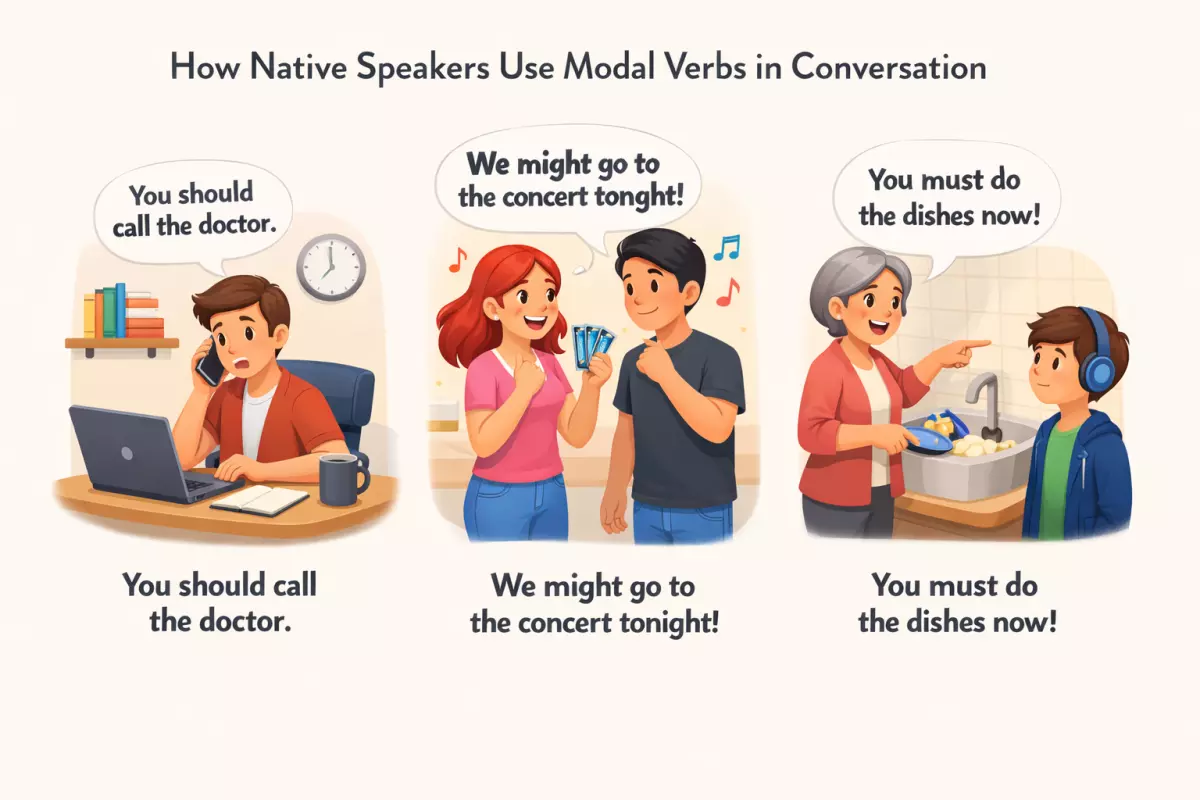 Here we how fluent speakers naturally use modal verbs in conversation, common everyday patterns, and how tone and context change meaning. It gives short dialogue examples, explains why one modal is chosen over another, contrasts textbooks with real speech, and includes practice exercises.
- How fluent speakers naturally use modal verbs in conversation
- Common modal patterns heard in everyday speech
- How tone and context influence the meaning of modal verbs
- Examples of modal verbs in short conversational exchanges
- Situations where speakers choose one modal instead of another
- Differences between textbook explanations and real spoken usage
- Exercises and practice activities based on natural conversation patterns
Fluent speakers use verbs like can, might, and should to express ability, possibility, advice, or gentle pressure without sounding blunt. Instead of memorizing rules, focus on what the speaker is trying to do: soften a request, hedge an opinion, or show confidence. This article helps you notice these small choices so your English sounds more natural and socially smooth.
How fluent speakers naturally use modal verbs in conversation
In everyday speech, modal verbs show attitude as much as meaning: certainty, politeness, hesitation, pressure, or willingness. Fluent speakers choose modals to fit the relationship, the setting, and how direct they want to sound, often softening statements or turning them into collaborative suggestions.
Common conversational patterns native speakers rely on
- Softening requests with “could” and “would”: “Could you send that over?” / “Would you mind closing the window?”
- Using “can” for simple, friendly requests (often with people you know): “Can you grab my phone?”
- Choosing “might” to avoid sounding too certain: “It might be easier to do it tomorrow.”
- Using “may” less in casual talk (more formal or careful): “May I ask a quick question?”
- Making suggestions with “could”: “We could try a different approach.”
- Offering help with “can” / “could”: “I can take a look.” / “I could help you with that.”
- Expressing willingness with “will”: “I’ll call them and check.”
- Using “would” for polite preferences: “I’d rather meet earlier.”
- Adding “just” to reduce pressure: “Could you just sign here?”
- Using “maybe” with a modal to sound less pushy: “Maybe we could leave a bit earlier?”
- Framing advice gently with “might want to”: “You might want to back up your files.”
- Using “should” for expectations and recommendations: “You should be able to log in now.”
- Using “have to” for real obligation (often stronger than “should”): “I have to submit this by five.”
- Using “need to” for practical necessity: “We need to talk about the schedule.”
- Reducing force with “don’t have to”: “You don’t have to explain if you don’t want to.”
- Showing rules with “must” (common in signs/instructions; less common in casual speech): “You must wear a badge.”
- Using “must be” for strong logical guesses: “It’s locked—she must be out.”
- Using “can’t” for confident negative conclusions: “That can’t be right.”
- Hedging plans with “should”: “I should be done by three.”
- Asking for permission indirectly: “Could I borrow this for a minute?”
How modals get shortened and blended in real speech
Conversation often uses contractions and reduced forms, especially with “will” and “would.” This makes speech sound natural and keeps the rhythm smooth. Typical reductions include “I’ll,” “we’ll,” “you’ll,” “I’d,” “we’d,” and “that’ll.” With “could,” “should,” and “would,” the reduced pronunciation is common even when the spelling stays the same.
Quick accuracy notes that matter in natural usage
- ✅ “I could help later.” ❌ “I could to help later.” (No “to” after a modal.)
- ✅ “She might be late.” ❌ “She might be late to.” (Use the base verb form after a modal.)
- ✅ “You don’t have to come.” → means no obligation, not prohibition.
- ✅ “You mustn’t park here.” → means prohibition (stronger than “don’t have to”).
Common modal patterns heard in everyday speech

In real conversation, modal verbs show up in short, repeatable chunks rather than in “full” textbook sentences. Speakers use them to soften requests, show uncertainty, offer help, and negotiate plans quickly. The patterns below are the ones you’ll hear most often, along with what they usually do in context.
High-frequency chunks and what they do
- Could you + base verb…? Polite request: “Could you send that over?”
- Can you + base verb…? Direct request (still normal in friendly settings): “Can you help me for a second?”
- Would you mind + -ing…? Very polite request: “Would you mind closing the window?”
- Do you think you could + base verb…? Extra-soft request, gives the listener an easy “no”: “Do you think you could pick me up?”
- Can I + base verb…? Asking permission: “Can I borrow your charger?”
- Could I + base verb…? More formal/softer permission: “Could I leave a little early?”
- May I + base verb…? Formal permission (less common in casual talk): “May I ask a question?”
- I can + base verb Offering ability/availability: “I can drive if you want.”
- I could + base verb Tentative offer or option: “I could stop by after work.”
- Do you want me to + base verb…? Offer of help: “Do you want me to call them?”
- Should I + base verb…? Asking for advice: “Should I email again?”
- You should + base verb Advice (can sound strong depending on tone): “You should get some rest.”
- Maybe we should + base verb Gentle suggestion for a group: “Maybe we should leave now.”
- I might + base verb Uncertain plan: “I might go later.”
- I may + base verb More formal uncertainty: “I may be late.”
- It might + base verb Possibility about a situation: “It might rain.”
- That could + base verb Possible explanation/option: “That could work.”
- Must be + noun/adjective Strong guess: “You must be tired.”
- Can’t be + noun/adjective Strong disbelief: “That can’t be right.”
Softening and “making room” for the other person
- Would it be okay if + past simple…? Polite permission framing: “Would it be okay if I left early?”
- Could we + base verb…? Collaborative request: “Could we talk for a minute?”
- Would you be able to + base verb…? Focuses on ability/availability, not obligation: “Would you be able to review this?”
- Can you just + base verb…? Small, quick favor (can sound impatient if stressed): “Can you just sign here?”
- Could you possibly + base verb…? Extra polite; often used for bigger favors: “Could you possibly cover my shift?”
Everyday negatives and quick corrections
- I can’t + base verb Inability or refusal: “I can’t make it tonight.”
- You don’t have to + base verb No obligation (often reassuring): “You don’t have to explain.”
- You can’t + base verb Prohibition/rule: “You can’t park here.”
- We shouldn’t + base verb Advising against something: “We shouldn’t wait too long.”
- I wouldn’t + base verb Gentle warning/advice: “I wouldn’t do that.”
- That shouldn’t + base verb Expectation that something is wrong/unlikely: “That shouldn’t take long.”
Quick grammar notes native speakers rely on
- Modal + base verb: “can go,” “should call,” “might help” (not “can goes” ❌).
- Modal questions usually invert: “Can you…?” “Should we…?” “Would they…?”
- Past forms often signal politeness, not past time: “Could you…?” and “Would you…?” are frequently about the present.
- “Have to” behaves like a normal verb: “Do I have to…?” “I don’t have to…” (useful for obligation without “must”).
How tone and context influence the meaning of modal verbs
In everyday conversation, native speakers rely on voice, situation, and shared assumptions to “set” what a modal verb means. The same words can sound like a polite offer, a firm order, a cautious guess, or a complaint depending on intonation, speed, emphasis, and what’s happening in the moment.
Common context shifts that change the message
- Rising vs. falling intonation: Rising often signals a real question or softens a request; falling can sound more certain or more final.
- Stress placement: Emphasizing the modal (“You must go”) increases force; emphasizing another word (“You must go”) can sound like urgency or correction.
- Relationship and power: The same modal is interpreted differently between friends, coworkers, and authority figures (teacher/student, manager/employee).
- Setting and stakes: Safety, deadlines, and rules make modals sound more like obligations; casual settings make them sound like suggestions.
- Shared knowledge: If both speakers know the background, a modal can function as a hint or reminder rather than new information.
- Prior turns in the conversation: After disagreement, modals often become more careful (“might”) or more forceful (“have to”) to manage conflict.
- Nonverbal cues: Pauses, facial expression, and gestures can turn “could you” into either friendly politeness or visible impatience.
- Regional and community norms: Some groups use “can” for requests more freely; others prefer “could” or “would” for the same situations.
- Medium: In text, missing tone can make modals sound harsher; people add softeners (“maybe,” “just,” “a bit”) to avoid that.
- Time pressure: When things are urgent, speakers switch to shorter, stronger forms (“Need you to…”, “You’ve got to…”).
Patterns native speakers use to soften or strengthen modals
- Softening with hedges: “You might want to…” / “We could maybe…” reduces pressure and leaves room to disagree.
- Softening with questions: “Could you…?” and “Would you mind…?” frame the request as optional, even when it isn’t.
- Softening with reasons: “Could you send it today, since the client’s waiting?” makes the request feel more justified than demanding.
- Softening with partial commitment: “I can try” signals willingness without promising a result.
- Strengthening with obligation language: “We have to…” and “You need to…” sound more like requirements than “should.”
- Strengthening with time markers: “You need to do it now” removes flexibility that “need to” might otherwise have.
- Strengthening with certainty adverbs: “It must definitely be…” increases confidence; “must” alone can still be an inference rather than a rule.
- De-escalation with “might/could”: “That might not work” is less confrontational than “That won’t work.”
- De-escalation with inclusive “we”: “We should…” often feels collaborative compared with “You should…”
- Face-saving with indirectness: “Could we…” can function as a polite directive in meetings, especially when the speaker has authority.
Same modal, different meaning in real situations
- “Can you…?” can be a genuine ability question (“Can you lift this?”) or a request (“Can you email me the file?”). Context decides which one listeners hear.
- “Could you…?” often signals politeness, not past time. It can still be urgent if said with firm tone: “Could you come here, please.”
- “You should…” can be friendly advice (“You should try that café”) or criticism (“You should have told me”) depending on timing and emphasis.
- “You must…” can express a rule (“You must wear a helmet”) or a logical conclusion (“You must be tired”). The surrounding topic (rules vs. guessing) clarifies it.
- “You might…” can be a gentle suggestion (“You might ask Alex”) or a cautious warning (“You might want to back up your files”).
- “We could…” can be brainstorming (“We could try Friday”) or a subtle push (“We could start now”) when said after delay.
- “I have to…” can be a real external obligation (“I have to pick up my kid”) or a polite exit strategy (“I have to run”).
- “I can’t…” can mean inability (“I can’t reach it”) or refusal (“I can’t do that”) with tone doing most of the work.
- “May I…?” often sounds formal; in casual talk it can be playful, overly polite, or used to signal seriousness.
- “Would you…?” can be a simple request, but with extra stress it can sound like frustration: “Would you just listen for a second?”
Quick usage cues to avoid misunderstandings
- When you want a request to sound friendly, pair the modal with a brief softener: “Could you send that over when you get a chance?”
- When you need clarity, add the goal or constraint: “Can you do it today, or should I ask someone else?”
- When giving advice, reduce judgment by focusing on outcomes: “You might want to save a copy, so you don’t lose it.”
- When stating obligations, name the source if possible: “We have to submit it by noon” (deadline) vs. “We should submit it by noon” (recommendation).
- In text messages, consider adding context words (“I’m not sure,” “I think,” “for the meeting”) because tone is easy to misread.
Examples of modal verbs in short conversational exchanges

In everyday talk, modal verbs often appear in short turns to soften requests, show uncertainty, offer help, or set expectations. The same modal can sound polite, firm, or tentative depending on word choice, stress, and context, so it helps to notice the recurring patterns native speakers rely on.
Quick exchanges by function
-
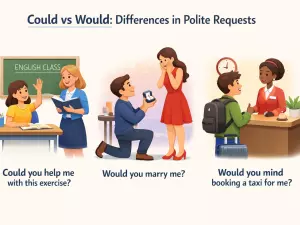
Polite requests with “could/would”
A: “Could you send that over?”
B: “Sure—give me two minutes.”Pattern: Could/Would + you + base verb to sound less direct than “Can you…?”
-
Casual requests with “can”
A: “Can you grab a chair?”
B: “Yeah, got it.”Pattern: Can + you + base verb is common with friends or when the favor is small.
-
Offers with “can/could”
A: “I’m running late.”
B: “I can pick it up for you.”Pattern: I can/could + base verb to volunteer help; “could” can sound more tentative.
-
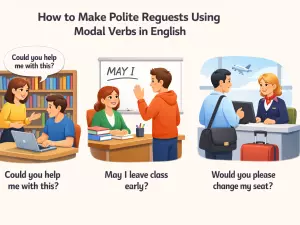
Permission with “can/may”
A: “Can I leave a bit early?”
B: “Yeah, that’s fine.”Pattern: Can I…? is normal in conversation; “May I…?” is more formal.
-
Suggestions with “should/ought to”
A: “My laptop keeps freezing.”
B: “You should restart it first.”Pattern: You should + base verb gives advice without commanding.
-
Strong advice or criticism with “should have”
A: “I missed the deadline.”
B: “You should’ve told me earlier.”Pattern: should have + past participle looks back and implies a better choice existed.
-
Obligation with “have to” (common in speech)
A: “Do you want to hang out?”
B: “I have to work tonight.”Pattern: have to often replaces “must” in casual conversation.
-
Rules and firm necessity with “must”
A: “Do I need an ID?”
B: “Yes, you must bring one.”Pattern: must sounds official or strict; it’s frequent in instructions and policies.
-
Prohibition with “can’t / mustn’t”
A: “Can I park here?”
B: “No, you can’t—tow zone.”Pattern: can’t is the everyday choice; “mustn’t” is less common and can sound formal.
-
Possibility with “might/may”
A: “Is Sam coming?”
B: “He might be late.”Pattern: might + base verb signals uncertainty without committing.
-
Predictions with “will”
A: “Do you think it’ll rain?”
B: “It’ll clear up later.”Pattern: will is used for confident guesses and quick assurances.
-
Spontaneous decisions with “I’ll”
A: “The phone’s ringing.”
B: “I’ll get it.”Pattern: I’ll + base verb often appears when deciding in the moment.
-
Plans and willingness with “would”
A: “Do you want to join us?”
B: “I’d love to, but I can’t tonight.”Pattern: I’d + verb (would) softens the response and sounds friendly.
-
Hypotheticals with “would”
A: “What would you do in my place?”
B: “I’d talk to her directly.”Pattern: would frames advice as a hypothetical, which can feel less pushy.
-
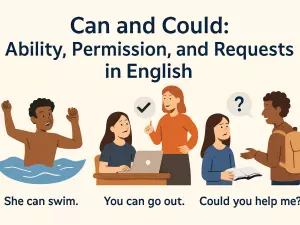
Ability with “can/could”
A: “Can you swim?”
B: “I can, but I’m not great.”Pattern: can for present ability; could often for past or more tentative ability.
-
“Could” for softening (not just past)
A: “Could we meet tomorrow instead?”
B: “Yeah, that works.”Pattern: Could we…? is a common way to negotiate without sounding demanding.
-
Expectation with “should”
A: “When will it arrive?”
B: “It should be here by noon.”Pattern: should can mean “probably” based on what’s normal or expected.
-
Requests for guidance with “should”
A: “Should I reply now?”
B: “Yeah—keep it short.”Pattern: Should I…? asks for advice, often when the speaker is unsure.
Small form choices native speakers use a lot
-
Short answers often drop repetition: “Could you email it?” → “Sure.” (not “Sure, I could email it.”)
-
“Can” vs. “could” changes tone more than meaning: “Can you…?” is direct; “Could you…?” is softer.
-
“Have to” is more natural than “must” in casual speech: “I have to go” is common; “I must go” can sound dramatic or formal.
-
Past modals compress in speech: “should have” → “should’ve,” “could have” → “could’ve,” “would have” → “would’ve.”
-
Polite follow-ups reduce pressure: “Could you review this when you have a second?” keeps the request flexible.
Situations where speakers choose one modal instead of another
Native speakers often pick a modal based on how direct they want to sound, how sure they are, and whether they’re talking about rules, advice, ability, or likelihood. Small changes in context (power relationship, urgency, evidence, and politeness) can make one modal feel more natural than another.
1) Making requests: choosing the right level of politeness
- Can for everyday, neutral requests: “Can you pass the salt?”
- Could to soften and sound more considerate: “Could you email me the file?”
- Would for polite, slightly formal requests (often with “you”): “Would you mind closing the window?”
- Will when the speaker expects agreement or is being brisk: “Will you call me when you get there?”
- May for more formal permission-asking (less common in casual talk): “May I ask a quick question?”
2) Asking permission vs. giving permission
- Asking permission in conversation often uses can or could: “Can I leave a bit early?” / “Could I use your charger?”
- Giving permission commonly uses can: “Yeah, you can.”
- May can sound official or rule-based: “You may enter now.”
- Refusing permission often uses can’t or may not depending on tone: “Sorry, you can’t park here.” / “You may not record this.”
3) Advice and recommendations: strength matters
- Should for general advice: “You should back up your files.”
- Ought to for similar advice, sometimes more moral/“duty” flavored: “You ought to apologize.”
- Could for gentle suggestions and options: “You could try restarting it.”
- Must for strong advice that feels urgent (can sound intense): “You must see a doctor.”
- Have to can also be strong, but often feels more practical than emotional: “You have to submit it by Friday.”
4) Obligation and rules: internal vs. external pressure
- Must often signals the speaker’s stance or a firm rule: “You must wear a helmet.”
- Have to commonly points to external requirements (schedule, policy, reality): “I have to be there at 8.”
- Need to is frequent in speech for practical necessity: “We need to talk.”
- Should is weaker than obligation modals and can sound like guidance rather than a rule: “You should be on time.”
5) Ability vs. possibility: avoiding ambiguity
- Can can mean ability or general possibility, so context decides: “I can swim” (ability) vs. “It can get cold here” (general possibility).
- When speakers want to avoid confusion, they add wording: “It’s possible it’ll get cold” instead of “It can get cold” in some contexts.
- Could often signals potential rather than ability: “That could work.”
- Be able to is chosen when talking about specific situations or tense clarity: “I wasn’t able to log in yesterday.”
6) Probability and inference: matching the evidence
- Must (deduction) for strong conclusions from evidence: “You must be tired—you worked all night.”
- May / might for uncertainty; might often feels slightly less confident: “It might rain later.”
- Could for one plausible explanation among several: “It could be a wiring issue.”
- Should for expected outcomes: “The package should arrive tomorrow.”
- Will for confident predictions (sometimes based on experience): “Don’t worry, it’ll be fine.”
7) Offers and willingness: who is in control
- Can for practical offers: “I can help you carry that.”
- Will for willingness and quick commitment: “I’ll do it.”
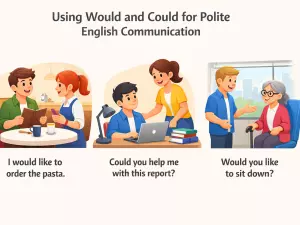
- Would for polite offers, especially to guests/customers: “Would you like some tea?”
- Shall (more common in UK) for suggestions and offers: “Shall I open the window?”
8) Suggestions and planning: proposing actions
- Let’s is the default for inclusive suggestions: “Let’s take a break.”
- Shall we is used to propose and check agreement: “Shall we start?”
- Could suggests an option without pushing: “We could go after lunch.”
- Should can sound more directive in planning: “We should leave now.”
9) Polite disagreement and hedging: sounding less absolute
- Could and might help soften claims: “It could be a bit risky.”
- Would is common in careful opinions: “I would say that’s unlikely.”
- May appears in more formal hedging: “That may be true, but…”
- Must is usually avoided when the speaker wants to sound open-minded: “It must be wrong” can feel too final.
10) Negative forms: different meanings, not just “not”
- Mustn’t = prohibition: “You mustn’t touch that.” (not “you don’t have to”)
- Don’t have to / don’t need to = no obligation: “You don’t have to come.”
- Can’t = impossible or not allowed (context decides): “That can’t be right” vs. “You can’t park here.”
- May not can mean “not allowed” (often formal) or “possibly not”: “You may not enter” vs. “They may not know yet.”
Differences between textbook explanations and real spoken usage
In real conversation, modal verbs are less about neat “rules” and more about managing tone, uncertainty, politeness, and social distance. Speakers also rely on fixed chunks, hedges, and intonation, so the same modal can sound like a suggestion, a soft command, or a guess depending on context.
- Textbooks: one modal = one meaning. Speech: one modal covers a range of meanings that listeners infer from context (relationship, situation, shared knowledge).
- Textbooks: “must” for obligation. Speech: “must” often signals a logical conclusion (“You must be tired”), while obligation is frequently softened or replaced (“You need to…”, “You have to…”, “You might want to…”).
- Textbooks: “can” for ability. Speech: “can” is commonly used for permission and offers (“Can I…?”, “Can I get you…?”), and ability is often shown with other wording (“I’m able to…”, “I can manage”).
- Textbooks: “may” for permission. Speech: “may” is comparatively formal; everyday permission is more often “can” or “could” (“Can I sit here?”).
- Textbooks: “should” = advice. Speech: “should” can sound judging or firm; speakers hedge it (“You should probably…”, “I think you should…”) or switch to softer options (“You could…”).
- Textbooks: “could” = past ability. Speech: “could” is heavily used for polite requests and suggestions (“Could you…?”, “We could…”), sometimes more than for past ability.
- Textbooks: “would” = conditional. Speech: “would” is a politeness tool and a routine marker (“Would you mind…?”, “I’d say…”, “That would be great”).
- Textbooks: clear separation between “will” (future) and “going to” (plans). Speech: “gonna” is frequent for intention, and “will” often expresses willingness/decision-now (“I’ll do it”) rather than neutral future.
- Textbooks: questions use full forms. Speech: contractions and reduced forms are normal (“I’ll”, “we’ll”, “you’d”), and “gonna/wanna/hafta” appear in casual registers.
- Textbooks: modals stand alone. Speech: modals cluster with hedges and stance markers (“maybe”, “probably”, “I think”, “sort of”, “a bit”) to calibrate certainty.
- Textbooks: direct requests are fine. Speech: speakers often choose indirectness to be smooth (“Could you…?” instead of “Do this.”; “You might want to…” instead of “You should…”).
- Textbooks: “mustn’t” is a common prohibition. Speech: “mustn’t” can sound formal or strong; “can’t” and “don’t” are often used for everyday prohibitions (“You can’t park here,” “Don’t touch that”).
- Textbooks: “might” is just “less certain than may.” Speech: “might” is a go-to for softening suggestions and opinions (“You might try…”, “It might be better if…”).
- Textbooks: “shall” is a future marker. Speech: “shall” is limited (certain dialects, formal settings, or set phrases like “Shall we…?” for suggestions).
- Textbooks: strict correctness about “can” vs. “may.” Speech: social meaning matters more than the rule; “Can I…?” is widely accepted, while “May I…?” signals extra formality.
- Textbooks: modal meaning is carried by the verb alone. Speech: intonation and stress can flip the force (a rising tone can make “You could…” sound like a gentle proposal; heavy stress can make it sound like criticism).
- Textbooks: “have to” equals “must.” Speech: “have to” is common for practical obligation, while “must” can sound official, emphatic, or like a deduction.
- Textbooks: negative forms are straightforward. Speech: negatives often carry extra stance (“You don’t have to” = no obligation; “You must not” = strong prohibition; “You can’t” can be rule-based or logical impossibility).
- Textbooks: complete sentences are the norm. Speech: modals appear in fragments and short turns (“Could you?”, “I might.”, “We should, yeah.”) because context fills the gaps.
Common “textbook vs. conversation” adjustments to notice
When listening to native speakers, focus on the patterns around the modal rather than the modal alone. The surrounding words often show whether the speaker is requesting, advising, guessing, or negotiating.
- Hedged advice: “You should probably…” / “You might want to…” / “You could always…”
- Soft requests: “Could you…?” / “Would you mind…?” / “Can you just…?”
- Low-certainty guesses: “It might be…” / “That could be…” / “He may have…” (more formal)
- Willingness and quick decisions: “I’ll…” / “We’ll just…” / “I can do that.”
- No-obligation reassurance: “You don’t have to…” / “You don’t need to…”
- Polite refusals: “I can’t, I’ve got…” / “I might not be able to…”
Exercises and practice activities based on natural conversation patterns
Focus on how modals behave in real talk: short turns, hedging, quick negotiations, and polite refusals. The goal is to choose a modal that matches the speaker’s stance (certainty, obligation, willingness) and the relationship (casual, professional, sensitive).
1) Micro-dialogue completion (choose the most natural modal)
Complete each line with one modal (or modal phrase) that sounds natural in everyday conversation. Use: can, could, may, might, should, would, must, have to, don’t have to, be supposed to, need to.
- A: “_____ you give me a hand with this box?” B: “Yeah, sure.”
- A: “Do we _____ bring anything to the dinner?” B: “Just a drink is fine.”
- A: “It’s getting late. We _____ head out.” B: “Good call.”
- A: “Where’s Sam?” B: “He _____ be in a meeting—his calendar’s blocked.”
- A: “I’m not sure this is the right file.” B: “It _____ be. Let me check the name.”
- A: “_____ I sit here?” B: “Of course.”
- A: “You _____ park there. It’s permit-only.” B: “Oh—thanks for the heads-up.”
- A: “I _____ finish this tonight, but I’ll try.” B: “No worries—tomorrow’s okay.”
- A: “We _____ to meet at 3, right?” B: “Yeah, but it might run a little late.”
- A: “You _____ worry about it. I already handled it.” B: “Seriously? Thanks.”
Show answers
- could
- have to / need to
- should
- must
- might
- may / could
- can’t
- can’t
- are supposed to
- don’t have to
2) Upgrade the tone (casual → polite/softer)
Rewrite each sentence so it sounds less direct while keeping the meaning. Use modals to soften requests, advice, or disagreement.
- “Open the window.”
- “Send me the file today.”
- “That’s wrong.”
- “I can’t meet at 2.”
- “Give me a minute.”
- “You’re late again.”
- “Explain that.”
- “I need your help now.”
Show answers
- “Could you open the window?” / “Would you mind opening the window?”
- “Could you send me the file today?” / “Would you be able to send it today?”
- “I could be wrong, but I think that might not be right.”
- “I might not be able to meet at 2.” / “Could we do a different time?”
- “Could you give me a minute?” / “Can I have a minute?”
- “You might be running a bit late again.” / “Could we try to start on time?”
- “Could you explain that?” / “Would you mind explaining that?”
- “Could you help me with this when you have a second?” / “Would you be able to help me now?”
3) Pattern drills that match native-speaker phrasing
- Quick permission: “Can I…?” / “Could I…?” / “Is it okay if I…?”
- Soft request: “Could you…?” / “Would you…?” / “Would you mind -ing…?”
- Offering help: “Do you want me to…?” / “I can…” / “I could…”
- Advice with room to disagree: “You might want to…” / “You could…” / “I’d probably…”
- Rules and obligation: “You have to…” (external rule) / “You’re supposed to…” (expectation)
- No obligation: “You don’t have to…” / “You don’t need to…”
- Logical conclusion: “That must be…” (strong) / “That might be…” (uncertain)
- Polite refusal: “I can’t, I’m afraid.” / “I might not be able to.”
- Negotiating plans: “Could we…?” / “We could always…” / “Do we have to…?”
- Checking expectations: “Are we supposed to…?” / “Do we need to…?”
4) Listening-style noticing (read and label the function)
For each modal, label what it does in context: request, permission, suggestion, obligation, prohibition, certainty, possibility, willingness.
- “Could you text me when you’re outside?”
- “You don’t have to explain— I get it.”
- “He must’ve missed the train.”
- “We might just stay in tonight.”
- “You’re supposed to submit it through the portal.”
- “Can I borrow your charger for a second?”
- “You can’t leave your bag here.”
- “I can pick you up if you want.”
Show answers
- request
- no obligation / reassurance
- certainty (strong inference)
- possibility / tentative plan
- expectation / obligation
- permission (requesting)
- prohibition
- willingness / offer
5) Real-time role-play prompts (aim for short turns)
- At work: Ask a colleague to review something today without sounding demanding (use could/would).
- Roommates: Negotiate chores using “don’t have to” and “need to” to separate preferences from necessities.
- Travel: Ask for permission and directions using “Could I…?” and “Would you happen to know…?”
- Customer service: Make a complaint politely using “might” and “could” to reduce confrontation.
- Planning: Suggest alternatives using “We could…” and “Do we have to…?” to reopen decisions.
- Rules: Explain a policy using “have to” (rule) vs. “should” (recommendation).
- Guessing: Discuss where someone is using “must be” vs. “might be” based on evidence.
- Refusing: Decline an invitation using “I might not be able to” plus an alternative time.
6) Common conversation fixes (choose the more natural option)
Select the option that better matches typical spoken English in the situation.
- Request to a stranger: “Can you tell me where the station is?” vs. “Could you tell me where the station is?”
- Rule at work: “You should wear a badge.” vs. “You have to wear a badge.”
- Reassurance: “You must not pay.” vs. “You don’t have to pay.”
- Uncertain guess: “It must be John calling.” vs. “It might be John calling.”
- Soft suggestion: “You must try restarting it.” vs. “You could try restarting it.”
Show answers
- “Could you tell me where the station is?”
- “You have to wear a badge.”
- “You don’t have to pay.”
- “It might be John calling.”
- “You could try restarting it.”