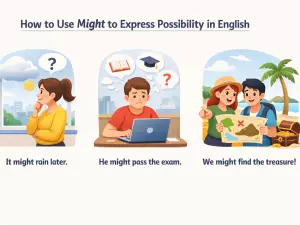
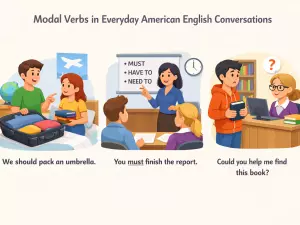
Double Modals in American English Dialects Explained

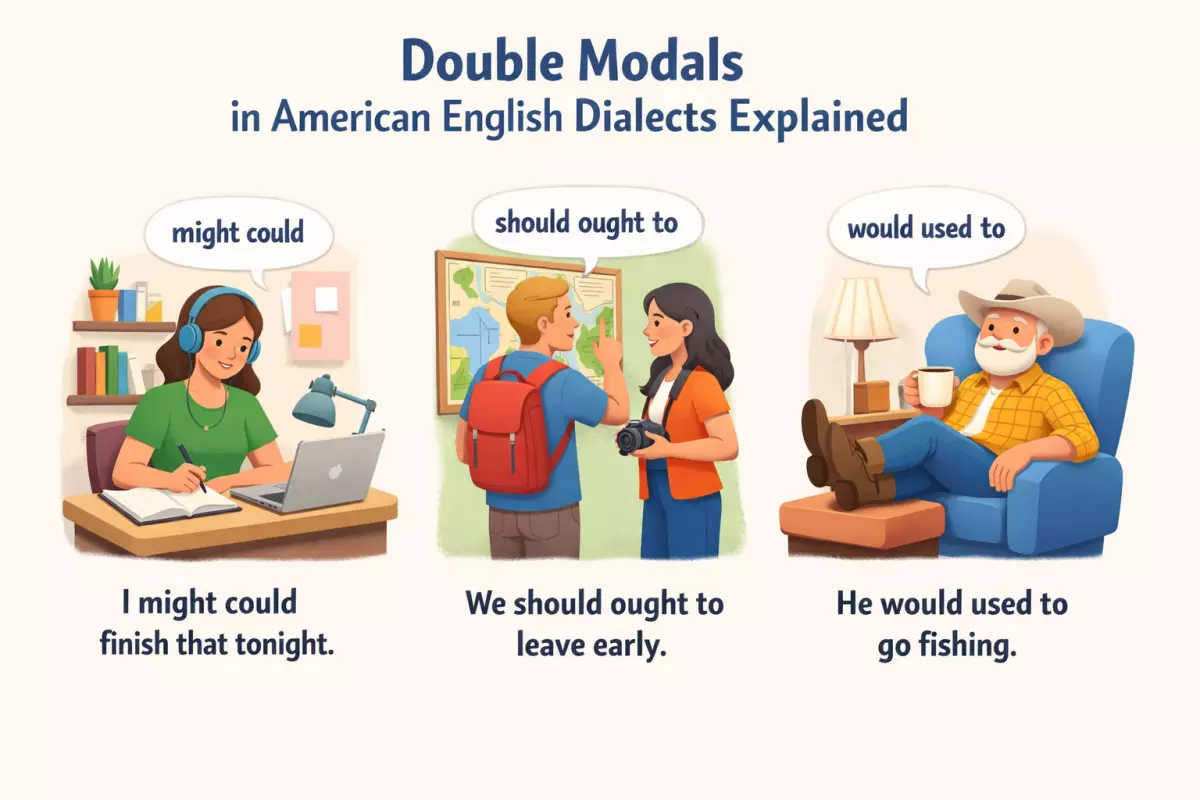 Explains double modal constructions in some English dialects, including forms like might could and may can, and where they’re commonly heard in the United States.
- What double modal constructions are in certain English dialects
- How expressions like might could or may can appear in regional speech
- Where double modals are commonly heard in the United States
- How these structures convey hesitation, uncertainty, or polite suggestions
- Why double modals are rarely used in standard written English
- How learners can recognize these patterns when listening to informal speech
- Exercises and practice activities interpreting sentences with double modals
In some U.S. regional dialects, speakers sometimes stack two helper verbs to express nuance, attitude, or uncertainty, as in might could or used to would. If you have heard this and wondered whether it is incorrect, you are not alone. This article explains what these pairings typically mean in everyday speech, where you are most likely to encounter them, and how to interpret them without getting stuck on strict grammar rules.
What double modal constructions are in certain English dialects
In several regional varieties of English, speakers sometimes place two modal-like elements in the same verb phrase to fine-tune meaning. These pairings typically combine (1) a modal that signals possibility, obligation, or prediction with (2) a second modal that adds politeness, tentativeness, or a different layer of certainty. The result is a compact way to express stance, especially in conversation.
Common patterns and how they’re used
Double-modal sequences are not random. They tend to follow recurring templates, and the first element often sets the overall “type” of meaning (permission/ability/necessity), while the second element shades it (likelihood, willingness, or softening).
- might could → suggests a cautious possibility plus ability: “I might could meet you after lunch.”
- may can → permission/possibility plus ability (often more formal-sounding in the first modal): “If I finish early, I may can stop by.”
- might can → tentative possibility plus ability: “She might can help if you ask.”
- might would → hedged willingness/conditional intention: “I might would go, but I’ve got work.”
- may would → polite, tentative conditional: “I may would prefer the earlier time.”
- might should → softened advice/obligation: “You might should call them first.”
- may should → cautious recommendation: “We may should double-check the address.”
- used to could → past ability with emphasis on “back then”: “I used to could run five miles.”
- would could → conditional ability (less common, but attested in some speech): “I would could do it if I had the tools.”
- should oughta → stacked obligation (often for emphasis): “You should oughta tell her the truth.”
- might oughta → gentler obligation: “He might oughta slow down.”
- may oughta → tentative obligation: “We may oughta leave earlier.”
- might will → uncertain prediction/plan: “It might will rain later.”
- might coulda → tentative ability in a past/conditional frame: “I might coulda fixed it, but I didn’t try.”
- mighta could → reduced form in fast speech, same general meaning as “might could”: “I mighta could help tomorrow.”
Placement and verb form expectations
These combinations usually appear directly before the main verb, and the main verb typically stays in the bare form (no to): “might could go,” not ❌ “might could to go.” Negation generally attaches to one of the modals depending on the intended meaning, and contractions may occur in rapid speech (for example, “mightn’t could” in some varieties).
Why speakers choose a double modal
The main function is precision in stance. A single modal can be too blunt (“You should call”) or too vague (“You might call”). Pairing them lets speakers balance advice, permission, ability, and uncertainty in one short phrase, which is especially useful in informal, face-to-face interaction.
How expressions like might could or may can appear in regional speech

In several U.S. regional varieties, speakers sometimes stack two modal verbs to fine-tune meaning. Instead of choosing one helper (like might or can), they combine them to express both uncertainty and ability, or politeness and permission, in a single clause. These forms are systematic in the dialects where they occur, even if they look unusual in standardized writing.
What double modals typically communicate
Two modals usually split the work: the first one sets the speaker’s stance (uncertainty, politeness, obligation), and the second one carries the core modal idea (ability, permission, willingness). The result is often more nuanced than either modal alone.
- Hedged ability: ✅ “I might could help later.” → ability is possible, but not promised.
- Hedged permission: ✅ “You may can park behind the store.” → permission is likely, depending on conditions.
- Softened suggestion: “We might should leave soon.” → advice presented gently, not as a firm directive.
- Polite willingness: “I might will stop by.” → intention is tentative, offered without commitment.
- Conditional obligation: “You might oughta call first.” → obligation framed as considerate guidance.
Common structural patterns
These combinations follow recurring templates. The first modal is often epistemic (about likelihood), while the second is more “action-oriented” (about ability, permission, or obligation). Negative forms and questions are possible, but many speakers prefer certain placements that keep the sequence easy to process.
- Epistemic + ability: “might could,” “may can,” “might can.”
- Epistemic + obligation: “might should,” “might oughta,” “may should” (less common).
- Epistemic + willingness/future: “might will,” “may will” (regionally variable).
- Negation tends to attach to the second modal or the main verb: “might couldn’t,” “may can’t,” or “might could not go.”
- Questions often keep the stack intact: “Might could you give me a hand?”
- Contractions vary by community: some speakers avoid contracting the first modal in writing even if it’s reduced in speech.
Example sentences and what they imply
In context, the stacked modals typically signal “possible but not certain” rather than confusion. The same speaker may switch to a single modal in more formal settings, but the meaning difference can be noticeable.
- “I might could come by after work.” → the visit is possible; schedule is uncertain.
- “She may can get you a discount.” → permission/ability depends on her role or the store’s rules.
- “We might should take the back road.” → recommendation with room for disagreement.
- “You might oughta save that receipt.” → advice framed as practical caution.
- “I might could do it, but not today.” → ability exists, timing does not.
- “They may can meet us halfway.” → feasibility is tentative, not guaranteed.
- “Might could you check on that for me?” → request softened to sound less imposing.
- ❌ “I can might go.” → uncommon ordering; most varieties keep the likelihood modal first.
- ❌ “I might could to go.” → double modals take a bare verb (“go”), not an infinitive (“to go”).
- ❌ “I might could went.” → the following verb is typically base form, not past tense.
Where they show up in conversation
These forms are most natural in informal speech where speakers manage politeness and uncertainty in real time. They often appear when someone is negotiating plans, offering help, or giving advice without sounding forceful.
- Planning and scheduling: “We might could do Friday.”
- Offering assistance carefully: “I might could carry that for you.”
- Giving advice tactfully: “You might should ask first.”
- Discussing rules and access: “You may can use the side entrance.”
- Responding with partial commitment: “I might could, but I’m not sure yet.”
Where double modals are commonly heard in the United States
In the U.S., stacked modal patterns like might could or may can show up most reliably in regional speech, especially in the South and parts of the South Midland. They’re typically used in casual conversation to soften a statement, add politeness, or express a careful level of possibility rather than firm commitment.
Core regions and the speech communities where they’re most typical
- Appalachia (eastern Kentucky, eastern Tennessee, western North Carolina, southwestern Virginia, West Virginia): double modals are widely recognized and often sound natural in everyday talk.
- The Deep South (Alabama, Mississippi, Georgia, South Carolina, Louisiana): many speakers accept forms like “might could” as a normal way to sound tentative or considerate.
- The South Midland / Upland South (Arkansas, southern Missouri, parts of Oklahoma, parts of Texas, western North Carolina and adjacent areas): usage overlaps with Appalachian patterns and often travels along migration and family networks.
- North Florida and nearby Gulf Coast communities: speech often aligns with neighboring Southern varieties more than with Central/South Florida.
- Rural and small-town networks across the South: stronger presence in close-knit communities where local norms are maintained through frequent face-to-face interaction.
- Some African American communities in the South: certain combinations occur in local varieties; acceptance and frequency vary by place, age, and style.
- Urban Southern areas (e.g., Atlanta, Nashville, Birmingham, Charlotte): heard most in informal settings; some speakers shift away from it in formal contexts.
- Border areas with Southern influence (southern Indiana, southern Illinois, parts of Kansas): less consistent, but some speakers use Southern-like modal stacking due to settlement history and ongoing contact.
Where you’re less likely to hear them (and what that means)
- Most of the Northeast, Upper Midwest, and West Coast: double modals are uncommon and may sound marked or “Southern” to many listeners.
- General American in formal settings: even speakers who use them at home often avoid them in school, workplace writing, or public speaking.
- Transplant-heavy communities: mixed dialect contact can reduce frequency because speakers accommodate to wider norms.
Common combinations that cluster in these regions
- might could + verb (e.g., “I might could help later.”)
- may can + verb (e.g., “She may can come tomorrow.”)
- might should + verb (often advice with uncertainty)
- might would + verb (tentative intention)
- used to could + verb (past ability/habit in some varieties)
- might oughta + verb (softened obligation in some speakers’ usage)
- may could + verb (less common than “might could,” but attested)
- might can + verb (varies by community)
- could might + verb (rare; often judged less natural than “might could”)
- might better + verb (regional, often advice)
- might coulda + verb (reduced forms in fast speech)
- mighta could + verb (spoken reduction; spelling varies in representations)
Across these areas, the pattern is not random: the first modal often sets the level of uncertainty (like might or may), and the second contributes ability, permission, or willingness (like could or can). That division of labor helps explain why certain pairings sound “right” locally while other combinations are rejected or treated as jokes.
How these structures convey hesitation, uncertainty, or polite suggestions
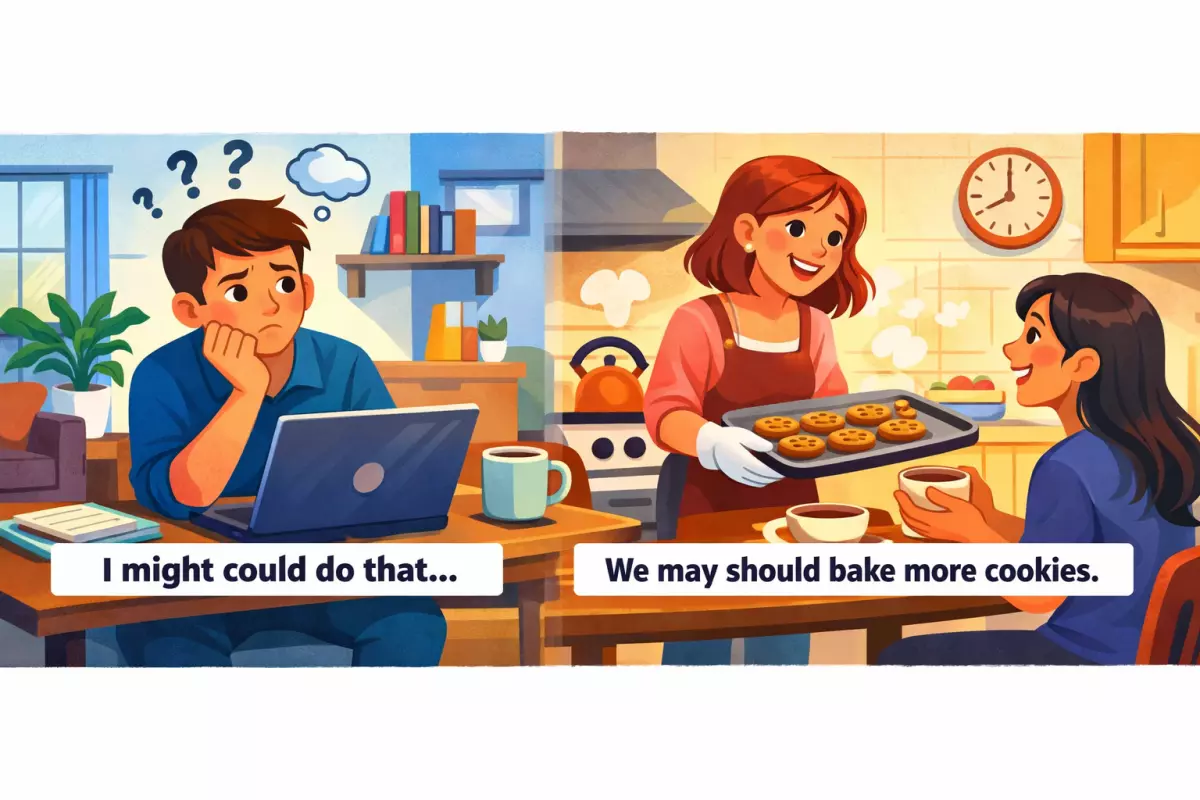
Double modals in some American English dialects often work as a built-in “softener.” Instead of stating ability, permission, or intention directly, speakers stack two modal meanings so the message sounds less forceful, more tentative, or more socially careful.
What the two modals usually “split” between
- Modal 1 (the first) commonly signals stance: tentativeness, politeness, or a conditional frame (often might or may).
- Modal 2 (the second) carries the main action meaning: ability, permission, willingness, obligation, or prediction (often could, can, would, should, will).
- The combined effect is frequently “I’m not pushing; I’m leaving room for your choice or for uncertainty.”
Common pragmatic effects and the patterns that create them
- Hesitation before a request → might could / might would makes the request feel exploratory rather than demanding.
- Example: “I might could borrow that for a minute?”
- Reduced certainty about a plan → might could frames the plan as possible, not promised.
- Example: “We might could come by after lunch.”
- Polite permission-seeking → may can or might can
- Example: “May can I use your phone?”
- Gentle advice → might should
- Example: “You might should call and let them know.”
- Non-imposing offers → might could
- Example: “I might could give you a ride if you need.”
- Face-saving disagreement → a double modal can cushion a correction or alternative.
- Example: “It might could be the other switch.”
- Conditional politeness → pairing with “if” clauses makes the suggestion sound optional and considerate.
- Example: “If you want, we might could meet earlier.”
Usage cues: when double modals sound most natural
- They often appear with hedging words like “maybe,” “I reckon,” “a little,” or “if you don’t mind,” which reinforce the tentative stance.
- They fit best in spoken, informal contexts where relationship management matters (requests, offers, advice, negotiations).
- They commonly target the listener’s autonomy by implying “only if it works for you,” even when that phrase is not said.
- They can downshift commitment: “might could” typically sounds less committed than “could,” and “might should” sounds less directive than “should.”
Example patterns to notice (form and function)
- might could → tentative ability/possibility: “I might could help later.”
- might can → cautious permission/ability: “She might can come in for a bit.”
- may can → polite permission-seeking: “May can we step outside?”
- might would → softened willingness/offer: “I might would try that.”
- might should → gentle recommendation: “You might should double-check the date.”
- used to could → past ability with a reflective tone (often nostalgic or explanatory): “I used to could run five miles.”
- might oughta (where used) → softened obligation: “We might oughta head out.”
- Negative forms typically attach to the second modal in many speakers’ usage: “I might could not make it,” keeping the first modal as the hedge.
Why double modals are rarely used in standard written English
In edited prose, stacked modal verbs (like might could or may should) are usually avoided because they conflict with the conventions that guide formal grammar, punctuation, and clarity. Even when these combinations are natural in some spoken American dialects, standard writing tends to prefer one modal plus other wording that makes the meaning explicit.
What standard written norms expect
Most style guides and classroom grammars treat the English “modal slot” as allowing a single core modal before the base verb. When a second modal appears, editors often read it as an error rather than a meaningful pattern. That expectation shapes what gets published, taught, and tested.
- One-modal rule in teaching materials: learners are typically taught patterns like “modal + base verb” (e.g., might go, should go), not “modal + modal + base verb.”
- Editing for uniformity: copyediting aims for consistency across audiences; dialect features are often removed unless they are part of dialogue or voice.
- Perceived redundancy: two modals can look like “double marking” of possibility/obligation, even when the combination actually adds nuance.
- Ambiguity for broad readers: a reader unfamiliar with the dialect may not know which modal has priority, so the sentence feels uncertain or ungrammatical.
- Limited representation in formal registers: because these forms are less common in academic and professional writing, many writers never see them modeled in print.
How meaning and “stacking” can confuse readers
In dialect use, double modals often encode layered meanings (for example, combining tentativeness with ability, or permission with advisability). In standard written English, that layering is usually rewritten so each meaning is signaled in a more widely recognized way.
- Unclear scope: readers may not know whether the first modal modifies the second, or both modify the main verb.
- Competing strengths: a weak modal (like might) plus a stronger one (like should) can be hard to interpret without dialect knowledge.
- Multiple social readings: the same string can be read as informal speech, character voice, or a mistake, depending on context.
- Harder to proofread: editors may “correct” it automatically, replacing it with a single modal and unintentionally changing the nuance.
Common edits that replace double modals in formal prose
When writers want the same shades of meaning but need a standard form, they typically keep one modal and express the second meaning with adverbs, phrases, or a different clause structure.
- ✅ We might be able to meet tomorrow. → replaces might could meet
- ✅ You should probably call first. → replaces should might call
- ✅ I may have to leave early. → replaces may must leave
- ✅ She might need to go. → replaces might should go
- ✅ He could possibly help. → replaces might could help
- ✅ It would be best to wait. → replaces might ought to wait
- ✅ If you want, you can come by later. → replaces might can come by
- ✅ There’s a chance we’ll have to reschedule. → replaces might have to can reschedule
- ✅ He’s allowed to leave early, but he shouldn’t. → splits meanings that might be stacked in speech
- ✅ I’m not sure I can make it. → replaces a tentative ability meaning often conveyed by stacked modals
- ✅ It’s possible we’ll need more time. → replaces “possibility + necessity” stacking
- ✅ She’s likely to be able to finish today. → replaces “likelihood + ability” layering
Where they still appear in writing
Although uncommon in formal expository writing, these constructions can show up when the goal is to represent speech patterns accurately. In those contexts, the form is often treated as a feature of voice rather than a general-purpose standard.
- Dialogue in fiction and scripts: to reflect regional speech and interpersonal nuance.
- Quoted interviews and oral histories: especially when transcription preserves the speaker’s grammar.
- Informal personal writing: texts, emails, and social posts where spoken rhythm carries over.
- Sociolinguistic writing: examples cited to discuss dialect grammar explicitly.
How learners can recognize these patterns when listening to informal speech
In fast, casual conversation, double modals can be easy to miss because the first modal is often reduced (or blended with the subject) and the second modal carries the clearest meaning. Listening for the overall “two-step” modal rhythm—one short modal-like piece followed by another modal—helps you catch them even when individual words are unclear.
1) Listen for the typical two-modal frame
Most dialect double-modal sequences follow a stable order: a first modal that signals stance (politeness, tentativeness, expectation) plus a second modal that expresses ability, permission, obligation, or prediction. If you hear two modal meanings packed into one clause, consider whether you’re hearing a double modal rather than a single modal plus another verb.
- First modal (stance/softening): often sounds like might, may, or used to in some varieties; it sets the tone (hedged, polite, cautious).
- Second modal (core meaning): often sounds like could, can, should, would, or will; it carries the main modal force.
- Common overall “shape”: [modal 1] + [modal 2] + base verb (no -s, no -ed on the main verb).
2) Train your ear for reductions and “hidden” words
In informal speech, modals compress. The first modal may be quick and unstressed, so learners often only perceive the second modal. Pay attention to small consonant clusters and weak vowels right before the clearer modal.
- might could may sound like migh(t)could with a very light t or none at all.
- might should can sound like migh’ should (the first word reduced to a brief onset).
- may can can compress so the may is little more than a glide before can.
- After pronouns, the boundary can blur: I might could may be heard as one chunk rather than three separate words.
- Negation can mask the first modal: might not could may sound like mightn’t could or a quick might not plus a clear could.
3) Use meaning cues: what kind of “double message” is being sent?
Double modals often combine two layers of meaning: a hedge plus a judgment about possibility/ability/obligation. If the speaker seems to be both softening and stating a modal idea, that’s a strong clue you’re hearing a double-modal pattern.
- might could often signals “possible ability” (a cautious, not fully committed could).
- might would often signals a tentative prediction or conditional willingness.
- might should often signals a softened recommendation (less direct than plain should).
- may should can sound like “perhaps it’s advisable,” again reducing directness.
- used to could (in some varieties) points to past ability with a habitual/past-time framing.
4) Watch for grammar signals that confirm what you heard
Even if the audio is unclear, the surrounding grammar can confirm a double modal. These constructions usually keep the main verb in the base form and place adverbs and negatives in predictable spots.
- Base verb after the modal pair: might could go (not might could goes).
- Adverbs often come after the modal pair or between them depending on the speaker: might could maybe help.
- Negation typically attaches to one modal (often the first or the second, depending on dialect and intent): might not could, might could not.
- Questions may keep the pair together rather than splitting them widely: Might could you…? (in dialect speech).
5) High-yield sequences to recognize (practice set)
When you practice listening, focus on a small set of recurring combinations. The goal is not to use them in formal writing, but to recognize them quickly when they appear in regional or casual speech.
- might could + verb (e.g., might could help)
- might would + verb (e.g., might would work)
- might should + verb (e.g., might should call)
- may can + verb (e.g., may can come)
- may could + verb
- may should + verb
- used to could + verb (past ability in some dialects)
- might oughta + verb (where oughta functions like a modal)
- might better + verb (in some speech, better behaves like a semi-modal)
- Negative variants: might not could, might could not
- Tag/response patterns: I might could. / We might could later.
- Conditional contexts: If it quits raining, we might could go.
6) Distinguish double modals from similar-sounding structures
Some sequences can trick learners because English also allows a modal plus a lexical verb like like, want, or have to. A quick check is whether the second word is truly a modal (can/could/would/should) or a main verb/semi-modal phrase.
- ✅ might could go → two modals + base verb
- ❌ might try to go → modal + main verb (try)
- ✅ might should tell him → softened advice
- ❌ might have to tell him → modal + semi-modal phrase (have to)
- ❌ may be able to go → modal + adjective phrase (able), not a double modal
7) Practical listening routine
- First pass: listen for the clearer second modal (could/should/would) and mark the spot mentally.
- Second pass: replay and focus on the syllable(s) immediately before it; that’s where the reduced first modal often sits.
- Check the verb after the pair: if it stays in the base form, that supports a modal reading.
- Confirm with meaning: ask whether the speaker is both hedging and expressing ability/obligation/prediction at the same time.
Exercises and practice activities interpreting sentences with double modals
Interpretation practice works best when you focus on two things: (1) which modal carries the main meaning (ability, permission, obligation, likelihood), and (2) how the first modal shades that meaning (often adding tentativeness, politeness, or “conditional” distance). In many dialect examples, the first modal sets the stance and the second modal supplies the core function.
1) Pattern-spotting warm-up (identify the “stance” + “core”)
- might could → stance: uncertainty; core: ability (“possibly able to”)
- may can → stance: permission/possibility; core: ability (“it may be that I’m able to”)
- might should → stance: hedging; core: advice/obligation (“it would probably be wise to”)
- might oughta → stance: hedging; core: moral duty (“it’s probably the right thing to”)
- used to could → stance: past/habitual; core: ability (“was able to in the past”)
- might would → stance: uncertainty; core: conditional (“would, under some conditions, perhaps”)
- might will → stance: uncertainty; core: future (“may end up”)
- might can’t → stance: uncertainty; core: inability (“possibly not able to”)
- might shouldn’t → stance: hedging; core: negative advice (“probably not a good idea to”)
- might not could → stance: uncertainty + negation; core: ability (“maybe unable to”)
- might could’ve → stance: uncertainty; core: past ability (“may have been able to”)
- might should’ve → stance: hedging; core: past advice/regret (“probably should have”)
2) Meaning-matching drills (choose the closest paraphrase)
For each item, pick the best paraphrase (A, B, or C). Focus on what the speaker is committing to: a firm claim, a tentative suggestion, or a conditional plan.
- “I might could help you tomorrow.”
- A) I will definitely help you tomorrow.
- B) It’s possible I’ll be able to help you tomorrow.
- C) I helped you tomorrow.
- “You might should call before you come.”
- A) It would probably be wise to call first.
- B) You are forbidden to call first.
- C) You already called first.
- “We used to could park over there.”
- A) We are able to park there now.
- B) We were able to park there in the past (but maybe not now).
- C) We might park there in the future.
- “If it clears up, I might would go fishing.”
- A) I am going fishing no matter what.
- B) Under that condition, I would possibly go.
- C) I went fishing yesterday.
- “She might can’t make it tonight.”
- A) She definitely can’t make it tonight.
- B) It’s possible she won’t be able to make it tonight.
- C) She is able to make it tonight.
- “You might oughta apologize.”
- A) You must apologize immediately or else.
- B) It’s probably the right thing to do (said gently).
- C) You apologized already.
Show answers
- B
- A
- B
- B
- B
- B
3) Negation and placement practice (what is being negated?)
In many dialect sentences, negation can attach to the second modal or appear between the two. Your job is to decide whether the speaker is denying ability/permission/obligation, or expressing uncertainty about that denial.
- Paraphrase “I might not could come.” in plain English.
- Paraphrase “I might couldn’t come.” (treat it as “might + couldn’t”) in plain English.
- Paraphrase “You might shouldn’t say that.” in plain English.
- Which is stronger (more definite), and why?
- A) “I can’t come.”
- B) “I might can’t come.”
- Explain the difference in commitment:
- A) “He shouldn’t drive.”
- B) “He might shouldn’t drive.”
Show answers
- Maybe I won’t be able to come / It’s possible I can’t come.
- It’s possible that I was unable to come / might be unable to come (uncertainty about inability).
- It’s probably not a good idea for you to say that.
- A is stronger; “can’t” is definite, while “might can’t” leaves room for uncertainty.
- A states firm advice; B softens it, presenting the advice as tentative or situation-dependent.
4) Context cues: decide the intended force (request, suggestion, prediction)
- Requests often use a hedge + ability: “You might could…” to sound less demanding.
- Suggestions often use a hedge + obligation/advice: “You might should…” to soften criticism.
- Conditional plans often use hedge + would: “I might would…” to keep options open.
- Past contrast often uses “used to could” to highlight change over time.
- Face-saving refusals often use uncertainty + inability: “I might can’t…” to avoid sounding blunt.
5) Production practice (rewrite without double modals)
Rewrite each sentence in a single-modal or no-modal form while keeping the same level of certainty and politeness.
- “I might could bring dessert.”
- “You might should leave early.”
- “We used to could see the mountains from here.”
- “If she calls, I might would answer.”
- “He might can’t get off work.”
- “You might oughta check the oil.”
Show answers
- “I might be able to bring dessert.” / “I may be able to bring dessert.”
- “It might be a good idea to leave early.” / “You should probably leave early.”
- “We used to be able to see the mountains from here.”
- “If she calls, I might answer.” / “If she calls, I would probably answer.”
- “He might not be able to get off work.”
- “You probably ought to check the oil.” / “It’d be best to check the oil.”